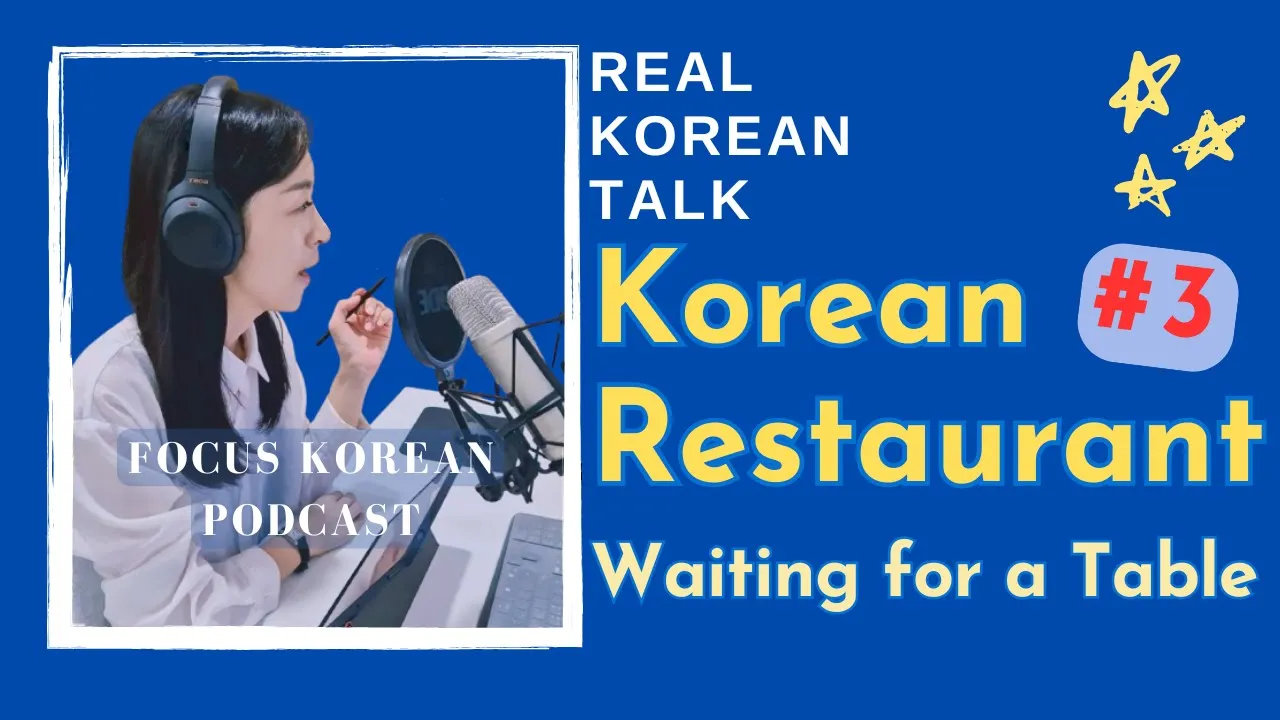
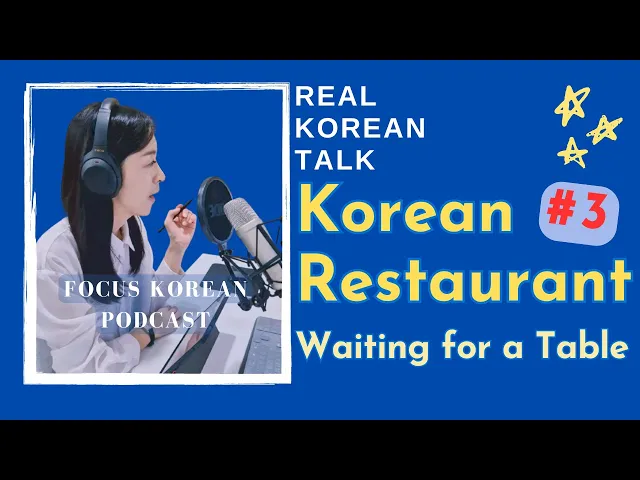
Hello, everyone. This is Professor Jeong from Focus Korean. In this episode, we’ll learn expressions to use when you go to a restaurant but have to wait for a table.
You know how at famous restaurants, you often can’t go in right away and have to wait? Especially during weekend lunch or dinner time, there are so many customers, waiting is pretty much a must. Let’s look at a typical conversation between a staff member and a customer.
Listen carefully to the dialogue. Staff: Welcome. Staff: How many in your party?
Customer: Four. Do you have a table? Staff: All the tables are full right now, so you’ll need to wait.
Staff: If you enter your contact info in the waiting kiosk here, you’ll get a KakaoTalk message when it’s your turn. Customer: How long is the wait? Staff: Hmm… we can’t say exactly, but you’ll probably need to wait at least 30 minutes.
Staff: You can check how many teams are ahead of you via KakaoTalk. Staff: We also have a waiting area inside the restaurant. Do you know the word “차다”?
It’s a verb used when something is full and there’s no room left. For example, the trash can is already full of garbage. So when there’s no more room to throw anything away, you can say, ““쓰레기통에 쓰레기가 가득 찼어요(The trash can is full).
” At a restaurant, if you hear: “테이블이 다 찼어요(The tables are full)” or “자리가 다 찼어요(All the seats are taken),” it means there’s no seating available. When that happens, we have to wait, right? You can also say “기다리다,” but sometimes people say “대기하다.
” And these days, many just say “웨이팅하다,” We often use the English word just as it is. So you’ll hear different ways to say the same thing! In the past, you’d write your name and phone number on a sheet near the restaurant entrance.
But these days, many restaurants use a waiting kiosk. This is especially common at popular spots where you might wait over an hour. Once you register on the kiosk, you get a KakaoTalk message.
Through the message, you can see how many teams are ahead and check your estimated wait time—which helps you use your time more efficiently. While waiting, you can even go run an errand somewhere else. When it’s my turn, I get a KakaoTalk message, so I don’t have to just wait around.
I like that. Recently, I went to a new buffet restaurant and there were 73 teams ahead of me. The estimated wait time was over two hours.
So I spent the time shopping at a nearby mall until it was my turn. If you register through the kiosk, you can also check your status in real time via KakaoTalk and even cancel your spot—which is really convenient. Some places still use the old system where they hand out number tickets and call out the numbers when your turn comes.
And if you're not there when your number is called, they might move on to the next person. So in that case, you have to wait nearby and can’t go far—which is a bit inconvenient. And some restaurants don’t take any waiting lists at all.
They just have you line up in the order you arrive. If the weather is really hot or cold, you’ll want to be prepared for that kind of wait. Thankfully, many popular restaurants have designated waiting areas, so you can at least sit and wait inside.
In the dialogue, the staff said: “You’ll probably have to wait at least 30 minutes. ” This isn’t really a guess—it’s basically a fact. But you learned that “-(으)ㄹ 것 같다” is used to express uncertainty or speculation, right?
That’s true—it is mostly used for guessing. But in real life, Koreans often use “-(으)ㄹ 것 같다” even when they’re pretty sure about something— especially if the message isn’t very positive. Koreans tend to soften bad news rather than saying it too directly.
So when we have to say no or share bad or negative news, we use “-(으)ㄹ 것 같다” to say it more softly. For example, if a friend invites me to a party, but I already have other plans and can’t go— I’m 100% sure I really can’t go. But instead of saying, “나는 못 가(I can’t go),” I say, “나는 못 갈 것 같아(I don’t think I can go).
” Using “-(으)ㄹ 것 같다” softens the message. The last sentence was: “카톡으로 확인하실 수 있으세요(You can check on KakaoTalk). ” Does it sound a bit awkward to you?
That sentence actually uses honorifics twice, which is more than necessary. In that sentence, “-시-” appears once in “확인하시다” and once in “있으시다,” so it’s used twice in total. That’s a bit too much honorific, right?
But you’ll hear this kind of expression a lot in real life— Especially at restaurants, department stores, or shops, staff often use these expressions to speak politely to customers. They’re trying to be kind, but end up using too many honorifics. For example, when your coffee is ready at a café, the staff could just say, “커피 나왔습니다(Your coffee is ready).
” But to sound more polite, they say, “커피 나오셨습니다. ” But that version technically honors the coffee—which sounds a bit strange. You might hear: “화장실은 이쪽에 있으세요(The restroom is over here).
” But again, that’s adding unnecessary politeness. These expressions might not be grammatically perfect, but they’re used all the time in daily life. Kind of fun to notice, right?
In this episode, we looked at expressions used when you have to wait at a restaurant. I hope they’ll be useful next time you go to a Korean restaurant. If there are any other expressions you’d like to learn, leave a comment below.
![[SUB/PDF] Real Korean Talk | At a Restaurant #1 - Ordering Food | Korean Podcast](https://img.youtube.com/vi/4qJalkA6bms/maxresdefault.jpg)
![[SUB/PDF] S1 E48 | Intermediate | Korean Podcast | At a Convenience Store 편의점 |](https://img.youtube.com/vi/kdzBYfAZgPw/maxresdefault.jpg)

![[SUB/PDF] Real Korean Talk | 편의점 At a Convenience Store #1 – Buying & Paying | Korean Podcast](https://img.youtube.com/vi/1UCSAdL-wLs/maxresdefault.jpg)
![🌏 외국어 공부[🇰🇷Korean Podcast for Beginners🌿] (SUB/PDF)](https://img.youtube.com/vi/wokW1du6AT4/maxresdefault.jpg)
![[SUB/PDF] S2 E10 | Beginner | Korean Podcast | Doing Laundry 빨래](https://img.youtube.com/vi/nDdpS1xs2Pg/maxresdefault.jpg)



![[SUB/PDF] S1 E47 | Intermediate | Korean Podcast | My Favorite Cafes 카페 |](https://img.youtube.com/vi/itaA9my-2ZU/maxresdefault.jpg)
![[SUB/PDF] S1 E41 | Intermediate | Korean Podcast | At the Hair Salon 미용실](https://img.youtube.com/vi/lcr9nbUPAz4/maxresdefault.jpg)
![[SUB/PDF] Real Korean Talk | At a Restaurant #2 - Asking for Things | Korean Podcast](https://img.youtube.com/vi/GxdGlTPPgTU/maxresdefault.jpg)

![[SUB/PDF] S1 E44 | Intermediate | Korean Podcast | My Language Learning Journey 내가 배운 외국어 |](https://img.youtube.com/vi/CawGUJvCgu0/maxresdefault.jpg)