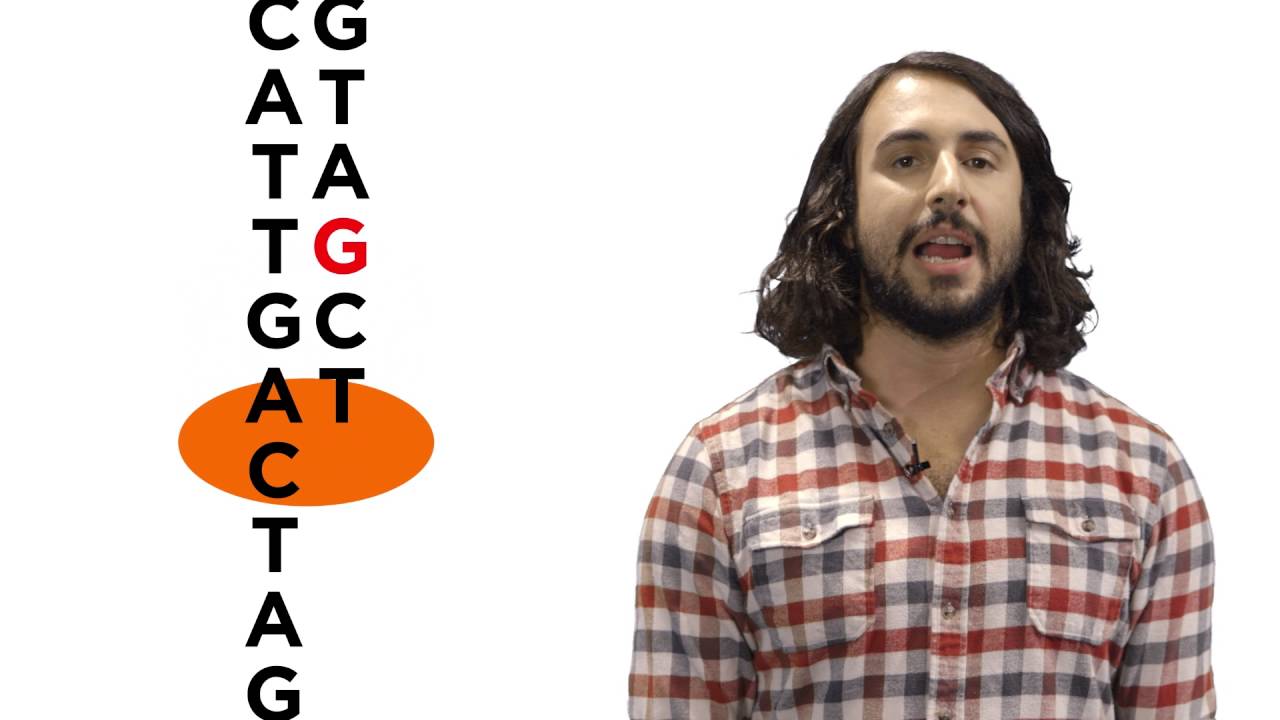
this video is for d1.3 on mutations in gene editing and the standard level content will focus specifically on mutations now DNA is an incredibly stable molecule and mutations are very rare that's because we have several ways of noticing and correcting any errors that happen in replication and those complimentary base pairing rules ensure that correct nucleotides are added when we're synthesizing new DNA strands however mutations still do occur and it's important to note that they are both rare and random they can fall under several categories so if this is my original DNA strand and I experience
a substitution mutation then I can have a new strand that looks something like this where I have one base that has been substituted for another a different type type of mutation is called an insertion an insertion mutation is when we insert an extra nucleotide somewhere in that sequence so actually sorry this is my extra nucleotide everything else Remains the Same but we have an extra nucleotide here and insertion and then deletion is exactly what it sounds like in deletion we have the removal of a nucleotide and that's going to result in a shorter DNA sequence
the consequence of these mutations can largely depend on where they are whether they're in a coding region that makes a protein or a non-coding region we'll focus specifically on base substitution mutations right that are occurring in coding regions so we want to be on the lookout for how they might change that amino acid sequence of the polypeptide we have three different effects here we can have a same sense mutation so a mutation still occurs but there's not a change in the amino acid sequence so that means that my codons of mRNA will be different but
that those codons still code for the same amino acid that refers back to that degenerate genetic code some texts or some teachers May refer to this as a silent mutation and that's because it does not change the amino acid sequence these mutations can also cause a nonsense mutation this means that instead of a normal amino acid we're going to have a stop codon instead and when a stop codon is read by that ribosome it literally stops the translation process so this will result in a polypeptide that is shorter than what it should be and finally
we can have a Mis sense mutation this causes a different amino acid to be inserted into the chain like with CLE cell anemia glutamic acid is substituted for by veiling in our genetic code we have you and I have different base sequences and those different base sequences are the results of mutations areas in our genetic code that have different possibilities for nucleo tiddes are called Snips single nucleotide polymorphisms so again these are areas in which our genetics codes differ due to the accumulation of mutations over time it should be noted that you and I have
on almost identical genome most of our genetic based sequences are identical we only differ in these Snips these single nucleotide polymorphisms and again that is the result of mutations so let's look at this in an example here I have some um base sequences of mRNA a and they are read three at a time in those groups called codons so each codon creates what's called a reading frame that means I'm reading them in groups of three now if I just substitute one uh base for another then that does not change my reading frame the reading frame
remains the same it could still change the amino acid sequence but it doesn't change the number of amino acids in the reading frame or I shouldn't say number of amino acids um in our polypeptide now an insertion or a deletion can change those reading frames so if I insert an amino or if I insert some kind of Base here like that and then I try to group my codons together I'm getting an entirely different group and they will be read in very different ways so this last codon for example in my original sequence I would
have looked up gu in my codon chart and now I'm looking up a that is going to be wildly different in terms of the amino acid that it creates okay so if I add one or if I delete one that is going to cause a problem here's an example of a deletion if I delete this one from the middle here then I'm reading my frame like this a codon here a codon here and then I don't even have a third um base to read over here so you can see that this causes a massive change
in the codons that would then be translated into amino acids so again these are usually harm ful and um it's definitely something that is going to cause big changes to our polypeptide at the end there are two major causes of mutations one of which is an error in replication so it's possible that the wrong nucleotide is laid down in that sequence it does happen but it's relatively rare again due to the proof reading and the compliment base pairing mutagens can also o cause changes in the DNA based sequence mutagens are things like radiation or things
like chemical substances that chemically cause different bases to be present in that DNA if you have not already studied natural selection yet great I want you to really kind of file this away in your brain mutations occur in individuals and mutations are random whether or not they are beneficial doesn't change the likelihood of them happening so for example if I am finding that my environment is changing I can't just wish to have a mutation that gives me a better chance of surviving in that environment it doesn't happen there is no natural mechanism for creating a
mutation and certainly not for creating a specific mutation that might be helpful at that time mutations can occur anywhere in the genome but some are more likely to occur than others so if we think about coding versus non-coding regions okay they're going to have very different effects there and then most mutations that occur during an organism's lifetime are not P to offspring so that's got some big ramifications for our understanding of natural selection even if I do have a beneficial mutation unless it's in some of my cell cells that produce gametes that mutation will not
be passed along to my Offspring so when we talk about natural selection and we talk about mutations creating variation again it's not a mutation because you want them mutations are random they occur in individuals not populations they become more prominent in populations via natural selection but that's another topic for another time there are lots of ways to categorize the cells in your body one of which is is to group them into either somatic cells like your body cells a skin cell a muscle cell a liver cell something like that or a germ cell germ cells
are cells that produce gametes they're capable of undergoing meosis let's talk about mutations that occur in somatic cells first these mutations are not passed to offspring because those cells are not used to create gametes for reproduction so for example um gen mutations that cause cancer if I am exposed to UV radiation and I get a mutation in one of the my skin cells okay um that may cause changes to my body in during my lifetime but it would not be passed to my Offspring that's very different than mutations that occur in germ cells so these
would be like in the testes of males or the ovaries of females okay these can be passed to offspring even if they're not beneficial there is no really like natural selection process happening for gamet production that's just meosis most of these are harmful so it's very important to minimize exposure that's why if you go to get an xray or something that exposes your body to harmful radiation you're going to find that they put like a lead jacket over the parts of your body um where your gametes are produced again to prevent those germ cells from
from experiencing mutations that might then be passed along to offspring just in case you haven't already studied inheritance a quick review here um our chromosomes come in pairs one from your mom and one from your dad and we have 23 pairs of chromosomes um and those chromosomes are called homologous chromosomes homologous chromosomes have the same genes in the same location but may have different Al alals are various versions of a gene so here's a case where the Al from each parent is different they are sending like different messages so for example one might say have
type B blood and the other one might say no have type O blood something like that okay new alals arise from mutations okay so if we think about what makes an Al different well they have different base sequences remember our chromosomes are made up of DNA so these genes um are made up of DNA and the base sequences for this Gene are going to be slightly different from the base sequence of that Gene and those base sequences the differences in those sequences are the result of mutations and this is one of the things that leads
to an increase in genetic variation it's important to note that mutations um can be good they can be bad or they can be silent most of them are either silent like they don't make a difference in the amino acid sequence or they just occur in a non-coding region or are harmful rare beneficial mutations however can give an organism an advantage in its environment and that's when we want to start thinking about natural selection okay so if we think about this process as a whole themed D continuity and change environments change organisms that have survived changes
in that environment or shouldn't even say organisms right like maybe we should say species okay must change and that process of a changing environment yet still being able to survive those changes that is driven by mutations without this genetic variation then that species might not have those beneficial mutations to survive that change
![D1.3. HL Genetic Modification [IB Biology HL]](https://img.youtube.com/vi/-z8k5fapbh4/maxresdefault.jpg)
![D2.1 Cell Division and Mitosis [IB Biology SL/HL]](https://img.youtube.com/vi/i9XPl4ePyxU/maxresdefault.jpg)
![D1.2 HL Protein Synthesis [IB Biology HL]](https://img.youtube.com/vi/dFYBBFEKg6E/maxresdefault.jpg)
![D1.2 Protein Synthesis [IB Biology SL/HL]](https://img.youtube.com/vi/ybso-VivjF8/maxresdefault.jpg)
![D3.1 Human and Animal Reproduction [IB Biology SL/HL]](https://img.youtube.com/vi/nnPd6FVpPvE/maxresdefault.jpg)

![D2.1 Meiosis [IB Biology SL/HL]](https://img.youtube.com/vi/dpEaR6AUcdQ/maxresdefault.jpg)
![D2.2 HL Genetic Expression [IB Biology HL]](https://img.youtube.com/vi/0mHb3Y5Z4A4/maxresdefault.jpg)
![D3.3 Homeostasis [IB Biology SL/HL]](https://img.youtube.com/vi/nKmXluCB6Js/maxresdefault.jpg)
![D1.1 HL DNA Replication [IB Biology HL]](https://img.youtube.com/vi/OzXIsbkybbk/maxresdefault.jpg)
![D2.1 HL Control of Cell Division [IB Biology HL]](https://img.youtube.com/vi/SGzvl-r5aT8/maxresdefault.jpg)
![D4.1 Natural Selection [IB Biology SL/HL]](https://img.youtube.com/vi/Rg8TwlaJZFI/maxresdefault.jpg)