It is 2:00 a. m. The house is completely silent.
The only sound you can hear is the ticking of the clock or the hum of the refrigerator. You are exhausted. Your body is heavy.
Your eyes are burning. And you are begging for sleep. But your brain, your brain is wide awake.
It is running a marathon, replaying conversations from 10 years ago, worrying about tomorrow, or just refusing to shut down. Does this sound familiar? If you are nodding your head, I want you to know something important.
You are not broken and you are not alone. Insomnia, especially as we get older, is one of the most common complaints I hear. Many people think that as we age, we just need less sleep.
That is a myth. You need just as much rest now as you did in your 40s. The problem isn't that you need less sleep.
The problem is that your sleep switch has become a little rusty. The chemicals that tell your brain to turn off, like melatonin, aren't as strong as they used to be. And the chemicals that keep you alert, like cortisol, are staying active too long.
But here is the good news. You can retrain that switch. You don't need heavy sleeping pills that leave you feeling groggy and unsteady the next morning.
You don't need expensive gadgets. You just need to speak the language of your nervous system. Today I am going to teach you five powerful sciencebacked techniques to trick your body into falling asleep.
These are not just tips. These are physiological triggers. We are going to lower your heart rate.
We are going to bore your busy brain and we are going to physically melt the tension out of your muscles. Technique number one is a breathing trick used by doctors. Technique number three is a mental game that stops racing thoughts instantly.
And technique number five, it's a method used by the military to help soldiers sleep in trenches. So, I guarantee it can help you sleep in your comfortable bed. So, turn off the lights, get comfortable, and let's reclaim your night.
Technique one, the 478 breath, the natural tranquilizer. Let's start with the most powerful tool you own. It's free, it's always with you, and it works in less than 60 seconds.
It is your breath. Now, I know what you're thinking. I know how to breathe.
I've been doing it for 70 years. But this is different. This is a specific rhythm called the 478 method.
Here's why it works. When you can't sleep, your nervous system is usually stuck in fight or flight mode. Your heart is beating a little too fast and your mind is alert.
You cannot force yourself to sleep with willpower. But you can force your nervous system to switch gears by changing how you breathe. By making your exhale longer than your inhale, you physically flip a switch in your brain that says, "We are safe.
We can relax. " Here is exactly how to do it. You can do this sitting up or lying down in bed.
First, take the tip of your tongue and place it against the ridge of tissue just behind your upper front teeth. Keep it there the whole time. Now, follow this pattern.
Exhale completely through your mouth, making a whoosh sound. Close your mouth and inhale quietly through your nose to a count of four. Hold your breath for a count of seven.
Exhale completely through your mouth, making a whoosh sound to a count of eight. Let's try a round together right now. Get comfortable.
Ready? Close your mouth. Inhale through your nose.
2 3 4. Now hold it. Keep holding.
2 3 4 5 6 7 Now exhale out your mouth forcefully. 2 3 4 5 6 7 8. Let's do it again.
Inhale nose for four. Feel your chest expand. Hold for seven.
Let the oxygen fill your blood. Exhale mouth for eight. Push all that stale air out.
One more time. In for four, hold for seven. Relax your shoulders while you hold.
Out for eight. Let your body sink into the mattress. When you do this in bed, I want you to do four cycles of this breath.
By the time you reach the fourth exhale, you will notice your heart rate has slowed down. It acts like a natural tranquilizer for your nervous system. If you wake up in the middle of the night, don't look at the clock.
Just go right into the breathing. We have four more techniques to go, including the military method, which is absolutely fascinating. But before we get there, I have a quick request.
If you are enjoying this video, and if you are ready to finally get the rest you deserve, please click that subscribe button and give this video a thumbs up. By subscribing, you are joining a community of people just like you taking control of their health. It helps me create more guides like this one.
Thank you so much and welcome to the family. Now let's move to the second technique. Technique two, progressive muscle relaxation, the body melt.
Technique number two is for anyone who feels physically restless. You know that feeling? You can't get comfortable.
The pillow is too hot. The blanket is too heavy. Your legs feel twitchy.
This happens because even when we lie down, we are often subconsciously holding tension in our muscles. You might be clenching your jaw or shrugging your shoulders without realizing it. Progressive muscle relaxation or PMR forces that tension to leave.
The concept is simple. You cannot relax a muscle that you don't realize is tense. So, we are going to deliberately create tension and then release it.
We are going to squeeze and then let go. Let's simulate this. Imagine you're lying in bed on your back.
Start with your feet. I want you to curl your toes downward hard. Squeeze them.
Tighten your calves. Hold it. Hold it.
Really feel that tension. And now release. Let your feet flop open.
Feel the blood rushing back into your toes. Feel how heavy they are now. Now move to your thighs.
Squeeze your thigh muscles. Press your knees together. Tighten your buttocks.
Hold it. 3 2 1 and release. Let your legs sink into the mattress.
They should feel like dead weight sinking into the foam. Move to your hands. Make fists.
Tighten your forearms. Squeeze hard like you are grabbing something. Hold and release.
Open your fingers. Wiggle them gently. Feel the warmth in your palms.
Now your shoulders. This is where we hold the most stress. Pull your shoulders up toward your ears.
Shrug them high. Tighten your neck. Hold it and drop them.
Let them fall away from your ears. Feel the space between your neck and the pillow. Finally, your face.
We hold so much tension here. Squeeze your eyes shut. Wrinkle your nose.
Clench your jaw. Make a funny face. Hold it and let go.
Let your jaw hang loose. Let your tongue rest on the floor of your mouth. Smooth out your forehead.
Do this scan from toe to head. By the time you reach your face, your body will feel heavy, warm, and loose. It is physically impossible to remain stressed when your muscles are this relaxed.
Technique three, cognitive shuffling, the brain scramble. Now, let's address the biggest enemy of sleep, the racing mind. You lie down and suddenly your brain starts a greatest hits album of your worries.
Did I pay the electric bill? What if my hip pain gets worse? Why did my daughter sound short on the phone?
You cannot just tell your brain to stop thinking. That never works. It's like telling someone, "Don't think of a pink elephant.
" You immediately think of a pink elephant. Instead, you need to distract your brain with something boring and nonsensical. This technique is called cognitive shuffling.
It was invented by a university professor to scramble your thoughts. Here is how you do it. You are going to pick a simple word.
Let's say the word is bedtime. Now, for each letter in that word, you have to think of new words that start with that letter and visualize them for a few seconds. Let's start with B.
Picture a bear. See the bear eating honey. Picture a ball, a red rubber ball bouncing.
Picture a baby sleeping in a crib. Picture a boat floating on a lake. When you run out of bees, move to E.
Elephant. Big gray ears. Egg.
A fried egg in a pan. Envelope. A white letter.
Then D. Dog. Door.
Drm. Why does this work? It works because the logic center of your brain, the part that worries and plans, cannot focus on these random images.
You are confusing your brain. You are simulating the random fragmented thoughts we have right before we dream. You are essentially tricking your brain into thinking, "Oh, we are thinking nonsense now.
We must be falling asleep. " If you wake up at 3:00 a. m.
with a worry, start spelling a word. Try garden. G A R.
I guarantee you won't get to the end of the word before you drift off. Technique four, the worry dump. Clearing the ram.
Technique number four is a preventative measure. This is something you do about 30 minutes before you get into bed. Computer experts talk about RAM, random access memory.
When a computer has too many windows open, it slows down and overheats. Your brain is the same. [snorts] If you go to bed with all your tabs open, your brain tries to keep them active all night so you don't forget them.
You need to close the tabs. You need a worry dump. Here is what you do.
Keep a simple notebook and a pen on your nightstand or by your favorite chair. In the evening, sit down and write down everything that is on your mind. But, and this is key, you must write it in two columns.
Column one, what I am worried about. Column two, the very next step. For example, worry.
I need to make an appointment with the dentist. Next step, call Dr Smith at 9:00 a. m.
tomorrow. worry. I'm worried about the leak in the roof.
Next step, ask neighbor Bob for a roofer recommendation on Tuesday. Once you write down the next step, you give your brain permission to let go of the worry. You are telling your subconscious, it is written down.
We have a plan. We don't need to hold on to this information while we sleep. It sounds simple, but the physical act of writing transfers the burden from your mind to the paper.
Close the notebook, put the pen down, and tell yourself the office is closed for the night. Technique five, the military method. Finally, we have the military method.
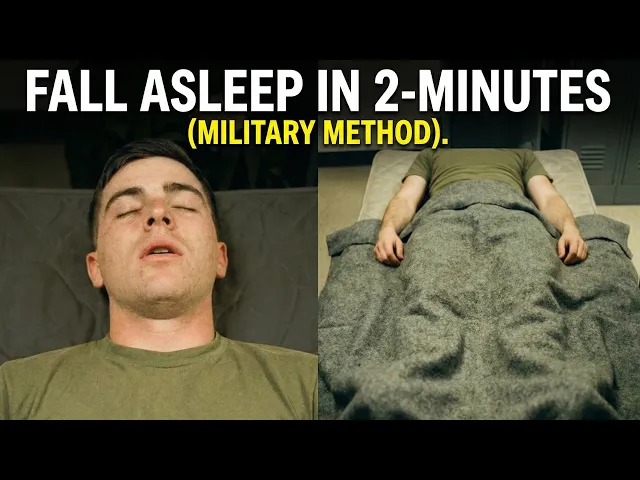
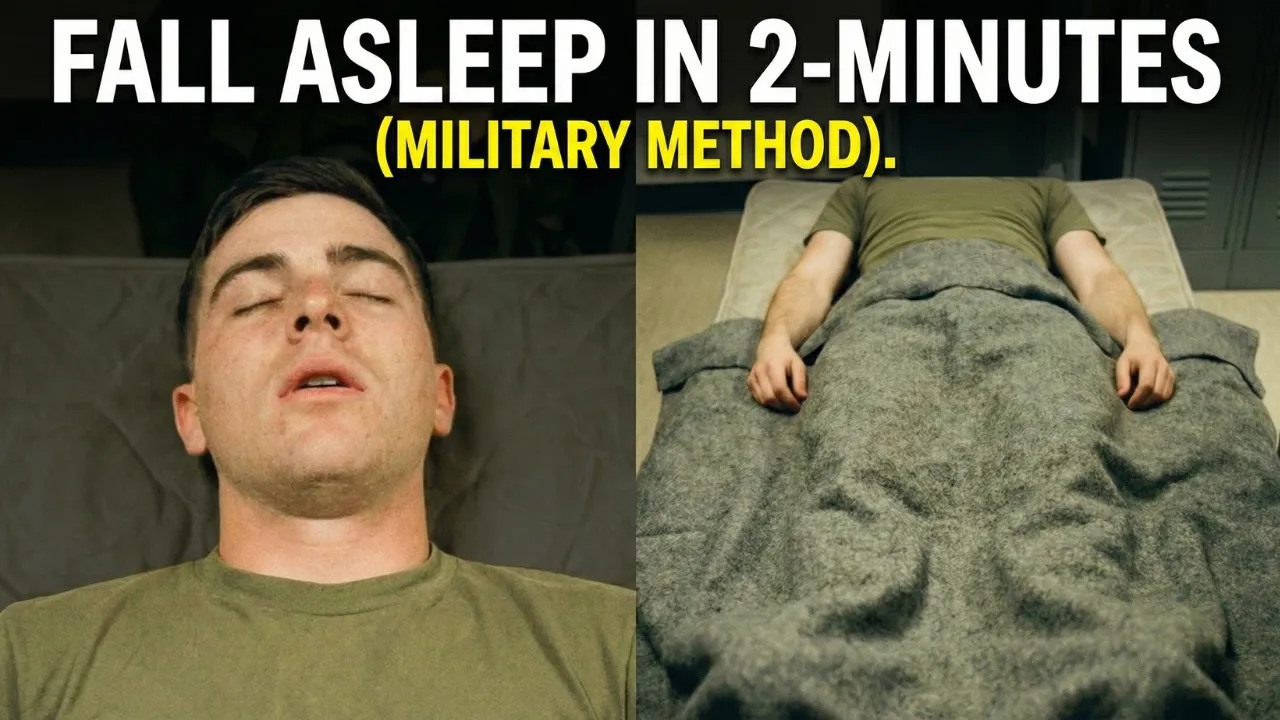
This technique was popularized by the US Navy pre-flight school to help pilots fall asleep in 2 minutes or less, even with loud noises and high stress. If it works for a pilot sitting in a cockpit, it will work for you. This combines muscle relaxation with a specific mental visualization.
It takes practice. It might take a few weeks to master, but once you get it, it is like a superpower. Here are the steps.
Step one, relax the face. We talked about this earlier, but the military method focuses intensely on the face. Close your eyes.
Breathe slowly. Relax your entire face, including the muscles inside your mouth. Relax your tongue.
Unclench your jaw. Release the tension around your eyes. When your face is slack, it sends a signal to the rest of the body to stand down.
Step two, drop the shoulders. Drp your shoulders as low as they can go. Imagine they are melting into the mattress.
Let your hands drop to the side of your body, palms open. Step three, the exhale. Exhale, relaxing your chest.
Then relax your legs, starting from the thighs and working down to your feet. Step four, the mental clearing. This is the most important part.
You need to clear your mind for 10 seconds. You cannot think about your grandkids, your health, or your bills. The method suggests holding one of these two static images in your mind.
Image A. You are lying in a canoe on a calm lake with nothing but a blue sky above you. Focus on the blue sky.
Image B. You are lying in a black velvet hammock in a pitch black room. Focus on the blackness.
If your mind wanders to a worry, the military method has a solution. You simply repeat the words don't think, don't think, don't think over and over again for 10 seconds. It sounds silly, but repeating don't think blocks other thoughts from entering.
It creates a wall. Once you have blocked the thoughts and relaxed the body, sleep usually follows within minutes. Bonus, the golden rule of temperature.
Before we wrap up, I have one bonus tip that acts as a force multiplier for all these techniques. It is about temperature. Many seniors keep their bedrooms too warm because circulation decreases as we age and we feel colder.
I understand that. But to fall asleep, your core body temperature needs to drop by about 2°. If your room is a sauna, your body cannot cool down to initiate sleep.
The ideal sleeping temperature is actually between 65 and 67° F or about 20° C. I know that sounds freezing, but here is the trick. Keep the room cool, but use warm blankets and wear socks.
Yes, socks. Warm feet and a cool room is the magic combination. When your feet are warm, your blood vessels dilate, which actually helps your internal body heat escape, cooling your core down.
It tells your brain it is time to sleep. So turn the thermostat down and pull the duvet up. We have covered a vast amount of information today and I know it might feel like a lot to remember.
That is why I have one important request before you go. If you found this video helpful, please take a moment right now to click the subscribe button. By doing that, you are joining a community of people just like you who are taking charge of their health naturally.
Also, and this is crucial, I want you to find the save or bookmark button under this video. Why? Because you might not master these techniques tonight.
You might wake up at 3:00 a. m. tomorrow and need a refresher.
By saving this video, you are keeping this sleep tool kit right on your nightstand, ready whenever you need it. You won't have to search for it in the middle of the night. Be patient with yourself.
Your body wants to sleep. We are just helping it remember how. Thank you for trusting me with your time today.
I truly hope this video brings you the peace and rest you deserve. Good night, sleep tight, and I will see you in the next video. Thousands of seniors have found this video helpful, so I highly recommend you watch it.
Click to keep going.