Scribe
Scribe

¿Te gusta? Haz que Scribe sea aún mejor dejando una reseña

Obtener Extensión para Chrome

Explorar

  • Videos Populares
  • Videos Recientes
  • Todos los Canales

Herramientas Gratuitas

  • Descargador de Subtítulos de Video
  • Generador de Marcas de Tiempo de Video
  • Resumidor de Videos
  • Contador de Palabras de Video
  • Analizador de Títulos de Video
  • Búsqueda de Transcripciones de Video
  • Analíticas de Video
  • Creador de Capítulos de Video
  • Generador de Cuestionarios de Video
  • Chat con Video

Producto

  • Precios
  • Blog
  • Obtener Extensión para Chrome

Developers

  • Transcript API
  • API Documentation

Legal

  • Términos
  • Privacidad
  • Soporte
  • Mapa del sitio

Derechos de autor © 2026. Hecho con ♥ por Scribe

— Si esto hizo tu vida más fácil (o al menos un poco menos caótica), ¡déjanos una reseña! Prometemos que nos alegrará el día. 😊

Related Videos

Primary vs. Secondary Sources: The Differences Explained | Scribbr 🎓

Video thumbnail
255.34k558 Palabras2m readGrade 12
Compartir
Channel
Scribbr
When writing an academic essay or research paper, you have to gather information and evidence from a variety of sources. Primary sources provide raw information and first-hand evidence. Whereas secondary sources provide second-hand information and commentary from other researchers.
Wanna learn more about the differences and understand when to use which? Then keep watching! Hi, I'm Jessica from Scribbr, here to help you achieve your academic goals.
A primary source is anything that gives you direct evidence about the people, events, or phenomena that you are researching. They will usually be the main objects of your analysis. The form of primary sources depends on the subject you’re studying.
In history, primary sources are essential for learning about the events of the past. They can be anything produced at the time, such as letters, photographs, newspapers, and official records. In art and literature, your primary sources are the artistic works you’re analyzing – for example, poems, paintings or films.
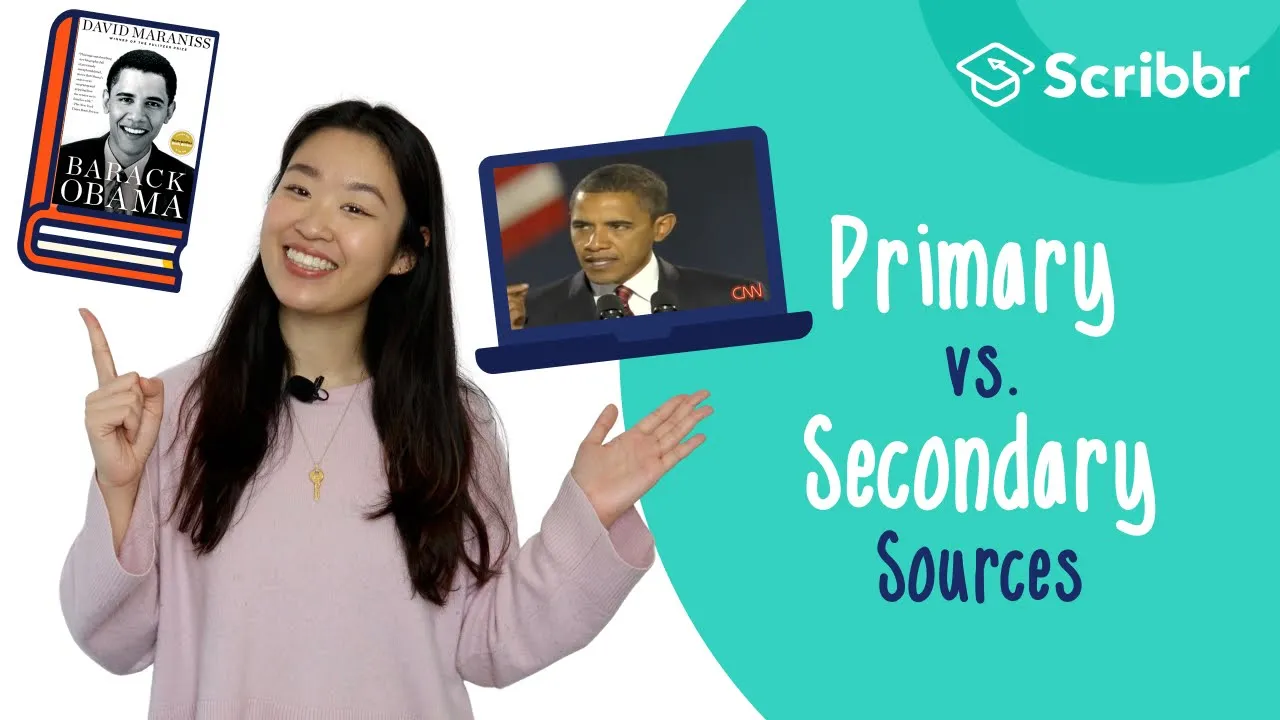
And in the social sciences, primary sources are usually empirical studies or data that you collected yourself – anything from interview transcripts to social media posts. For example, say I’m writing a paper about political communication, and I want to analyze Barack Obama’s election victory speech. If I quote Obama directly in my paper, the video or transcript of the speech is the primary source.
Check out our article here for more examples! But then what is a secondary source? A secondary source is anything that describes, interprets, evaluates, or analyzes information from primary sources.
In a paper or essay, most of your secondary sources will be academic books or journal articles. But they might also include: Encyclopedias and textbooks that summarize information Reviews and essays that evaluate or interpret primary sources Or news stories or documentaries that report on your topic When you cite a secondary source, it’s usually not to analyze it directly. Instead, you’ll probably test its arguments against new evidence or use its ideas to help formulate your own.
For example, in my political communication paper, if I cite an academic article that also analyzed Obama's speeches, then I’m using a secondary source. I can also use secondary sources that focus on other famous political speeches, to gain a better understanding of the topic and how other researchers have approached it. Most papers should use both primary and secondary sources.
They complement each other to help you build a convincing argument. Primary sources make your work more original and credible, while secondary sources show how your work relates to existing research. Secondary sources often bring together a large number of primary sources that would be difficult and time-consuming to gather by yourself, so they’re important to help you gain a full understanding of your topic.
Use primary sources when you want to: Make new discoveries Provide your own original analysis Or give direct evidence for your arguments Use secondary sources when you want to: Provide background information on the topic Support or contrast your arguments with other researchers’ ideas Or use information from primary sources that you can’t access directly, for example, private letters or physical documents located elsewhere. Now no matter which kind of source you've used, make sure to cite it correctly - it's super easy with Scribbr's citation generator! If you’re not sure how to do in-text citations, check out this video here!
Videos Relacionados
What's the difference between Primary and Secondary Sources in History?
3:43
What's the difference between Primary and ...
The Medieval Historian
100,947 views
Quantitative vs. Qualitative Research: The Differences Explained | Scribbr 🎓
3:37
Quantitative vs. Qualitative Research: The...
Scribbr
920,597 views
How to use ChatGPT to easily learn any skill you want
8:08
How to use ChatGPT to easily learn any ski...
Bri Does AI
1,927,303 views
SOURCES OF INFORMATION: PRIMARY SOURCES AND SECONDARY SOURCES by ANA PH
7:44
SOURCES OF INFORMATION: PRIMARY SOURCES AN...
ANA PH
6,904 views
The Liar Paradox - an explanation of the paradox from 400 BCE
14:17
The Liar Paradox - an explanation of the p...
Jeffrey Kaplan
1,046,528 views
how to study less and get higher grades
11:16
how to study less and get higher grades
Gohar Khan
1,466,044 views
Understanding History: Primary and Secondary Sources
12:54
Understanding History: Primary and Seconda...
Prof Next Door
8,551 views
3 tips on how to study effectively
5:09
3 tips on how to study effectively
TED-Ed
5,113,901 views
Circle of 5ths: Easiest Way to Memorize and Understand It
16:05
Circle of 5ths: Easiest Way to Memorize an...
Gracie Terzian
1,627,596 views
ANNOTATED BIBLIOGRAPHY | APA FORMAT |
14:49
ANNOTATED BIBLIOGRAPHY | APA FORMAT |
Smart Student
685,700 views
Primary Sources, Secondary Sources & Tertiary Sources: Explained Simply (With Examples)
10:30
Primary Sources, Secondary Sources & Terti...
Grad Coach
21,704 views
Qualitative vs Quantitative vs Mixed Methods Research: How To Choose Research Methodology
17:38
Qualitative vs Quantitative vs Mixed Metho...
Grad Coach
550,789 views
Historian's Toolbox: Analyzing Primary and Secondary Sources - World History for Teens!
11:29
Historian's Toolbox: Analyzing Primary and...
Miacademy Learning Channel
14,601 views
The Difference Between Primary and Secondary Historical Sources Explained
3:41
The Difference Between Primary and Seconda...
LEARN OR DIE
7,025 views
Primary and Secondary Sources in History Explained
8:43
Primary and Secondary Sources in History E...
History Skills
322,676 views
How to Write a Successful Research Proposal  | Scribbr 🎓
4:26
How to Write a Successful Research Proposa...
Scribbr
1,015,011 views
Psychology Professor's Viral Study Techniques: A+ Students Love It! (Part 1)
9:27
Psychology Professor's Viral Study Techniq...
Motivation2Study
2,776,088 views
Primary and Secondary Sources
5:41
Primary and Secondary Sources
Lincoln Learning Solutions
248,615 views
Market Research: the Difference Between Primary and Secondary Sources
1:57
Market Research: the Difference Between Pr...
Emily Craig
40,452 views