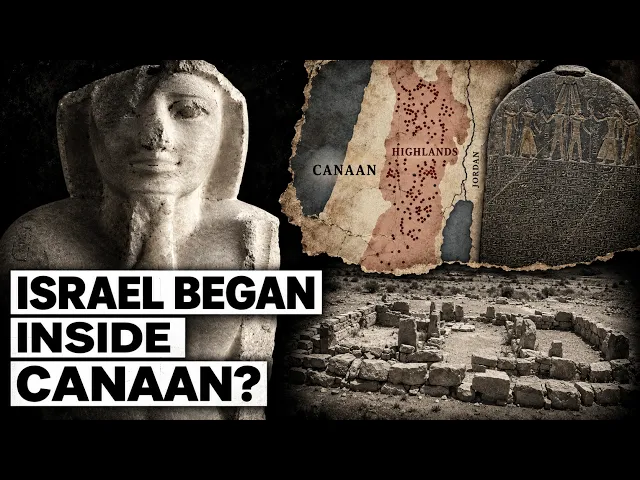
You know, there is a story that has been told for thousands of years. A story about an enslaved people, a miraculous escape, a wandering through the desert, and a violent conquest of a promised land. It is one of the most powerful origin stories ever written.
It has shaped religions, empires, and entire civilizations. But here's the thing that most people never hear. The closer historians and archaeologists look at the evidence, the more that familiar narrative begins to unravel.
Not because it is meaningless, but because the real story, the one buried in the soil and encoded in ancient DNA, is far more complex, far more fascinating, and and far more unsettling than the version most of us were taught. This is the true origin of the ancient Israelites. And what historians have been getting wrong about it for centuries now.
Before we go any further, I want to be very clear about something. This is not an attack on anyone's faith. What we are doing here is looking at the physical evidence, the archaeological record, the ancient inscriptions and the genetic data and asking what it actually tells us because there is a difference between what the texts say happened and what the ground has happened and that difference is where our story begins.
So let us start where any serious investigation should. Let us start with the land itself. The region we are talking about is the southern Levant, a narrow corridor of land squeezed between the Mediterranean Sea to the west, the Arabian desert to the east, the great civilizations of Egypt to the south, and the powerhouses of Mesopotamia to the north.
For most of recorded history, this strip of land was not independent. It was a buffer zone, a contested borderland, a highway for armies and merchants passing between far more powerful kingdoms and the people who lived there. The ones we eventually come to call the Canaanites, were not one unified nation.
They were a patchwork of citystates, each ruled by its own petty king, each paying tribute to whoever happened to be the dominant imperial power at the time. During the late Bronze Age, roughly from 1550 to,200 B. CE, that dominant power was Egypt.
The pharaohs of the new kingdom, names like Thutmos III, Aman Hototeep III, and later Romeses II, they held Canaan as a network of vassal states. We know this because of one of the most remarkable discoveries in the history of archaeology, the Amarna letters. These are a collection of nearly 400 clay tablets found in 1887 at the site of Amarna in Egypt, the shortlived capital of the so-called heretic Pharaoh Akenatan.
The tablets are diplomatic correspondents between the Egyptian court and the rulers of Canaan. And they paint a vivid picture of a land in constant turmoil. Local kings writing desperately to the Pharaoh, begging for military reinforcements, accusing each other of treachery, complaining about roving bands of people called the Habiru.
Now, this is where things get interesting. For a long time, some scholars tried to equate the Habiru with the Hebrews. The words sound similar, and the idea of a marginalized semi-nomatic group causing trouble in Canaan seemed to fit the biblical narrative.
But the deeper scholars dug, the more that connection fell apart. The Habiru were not an ethnic group. They were a social class.
Outcasts, refugees, mercenaries, people who had fallen outside the structure of settled Canaanite society. They appear in texts from all over the ancient near east from Mesopotamia to Anatolia to Egypt across many centuries. They were not one people.
They were a category, a label for anyone living on the margins. So the Habaru may have included ancestors of the Israelites, but they were certainly not identical to them. This is an important distinction and one that many popular histories still get wrong.
Now, if the Habiru connection is shaky, what about the big story, the Exodus? This is the foundational narrative of Israelite identity. Enslavement in Egypt, the 10 plagues, the parting of the sea, the wandering in the Sinai for 40 years, the conquest of Canaan under Joshua, it is dramatic, cinematic, and deeply powerful.
But when we look for evidence of it in the archaeological record, we run into a serious problem. There is none. Let me say that again because it is important.
After more than a century of intensive archaeological exploration in Egypt, the Sinai Peninsula, and the land of Israel itself, no direct evidence has been found for the Exodus. As described in the Bible, no Egyptian texts mention Israelite slaves. No records describe a mass departure of a foreign population.
The Sinai Peninsula, which supposedly hosted hundreds of thousands of wandering Israelites for four decades, has yielded no archaeological trace of such an encampment. Not a single campsite, not a single burial, not a single pottery shard that can be definitively linked to a large migrating Israelite population. Now, absence of evidence is not always evidence of absence.
There are explanations for why the record might be silent. Egypt's pharaohs were notorious for erasing embarrassing events from their official histories. Slaves do not typically leave behind grand monuments, and the Sinai is a harsh environment where organic materials decompose quickly.
These are all fair points. But the problem goes deeper than just missing evidence. When archaeologists examined the cities that the book of Joshua says were conquered by the Israelites, they found that many of them were either uninhabited or already destroyed long before the supposed conquest would have taken place.
Jericho, the famous city whose walls came tumbling down, was according to extensive excavations by Kathleen Kenyon and others, not even occupied during the late 13th century B. C. E.
, which is when the conquest is typically dated. The site of Iay, another key target in the Joshua narrative, was similarly abandoned for over a thousand years by that point. These are not minor discrepancies.
These are fundamental contradictions between the text and the physical evidence. So, if the Israelites did not arrive in Canaan through a dramatic military conquest, where do they come from? This is where the story gets really fascinating and where several competing theories have been battling it out for decades.
The first major theory was the conquest model championed in the early 20th century by the great American archaeologist William Foxwell Albreight. Albbright believed that the Bible was essentially accurate and that archaeological evidence would confirm it. He pointed to destruction layers at various Canaanite sites as proof of Joshua's military campaign.
For decades, his view dominated. But as more sites were excavated and more precise dating methods were developed, the evidence crumbled. The destruction layers he pointed to dated to different centuries, were caused by different events, and in many cases had nothing to do with any Israelite invasion.
The second theory was the peaceful infiltration model proposed by the German scholar Alrech Alt in the 1920s and developed by his student Martin Kn. Alt argued that the Israelites were originally semiynomatic pastoralists from the desert fringes who gradually migrated into the sparsely populated hill country of Canaan, settling down over time and eventually forming the tribal confederation described in the book of Judges. This theory was more nuanced and it avoided the problem of the missing conquest evidence, but it had its own weaknesses.
It assumed a clear distinction between nomadic and settled populations that the archaeological record does not support and it still relied on the idea that the Israelites were outsiders who entered Canaan from elsewhere. The third theory and the one that shook the field to its core was the peasant revolt model proposed by George Mendenhal in 1962 and later expanded by Norman Gotwald. This theory turned the traditional narrative on its head.
It argued that the early Israelites were not outsiders at all. They were Canaanites, specifically lowerass Canaanites who rebelled against the oppressive city-state system of the late Bronze Age. In this view, the Exodus story was not a literal account of migration from Egypt, but a powerful metaphor for liberation from local tyranny.
The formation of Israel was essentially a social revolution, a rejection of the hierarchical Canaanite order in favor of a more egalitarian tribal society. This theory was provocative and influential, but it also had problems. There is very little archaeological evidence for a widespread peasant revolt in late Bronze Age Canaan.
And the material culture of the early Highland settlements does not look like the product of a revolutionary movement. It looks like well more Canaanite culture. That brings us to the theory that has become the dominant view among most archaeologists and historians working in this field today of what we might call the emergence model or the indigenous origins theory.
Its most prominent advocates are the Israeli archaeologist Israel Finkelstein and the American archaeologist William Dver. Though they disagree on many details, the core argument is this. Starting around 1200 B.
CE, at the very end of the late Bronze Age, something extraordinary happened across the entire Eastern Mediterranean. The great civilizations that had dominated the region for centuries, the Hittite Empire, Mcinian Greece, the Egyptian New Kingdom, they all collapsed or severely contracted in a remarkably short period. This event known as the late Bronze Age collapse was one of the most catastrophic civilizational breakdowns in human history and the causes are still debated.
Climate change, drought, famine, earthquakes, disruptions in international trade networks, and the mysterious raids of the so-called sea peoples all played a role. The sea peoples were a confederation of naval raiders recorded in Egyptian inscriptions from the reigns of Rameses II and Rameses III who attacked coastal cities across the Mediterranean. They included groups with names like the Sheran, the Shecklish, the Luca, and most significantly for our story, the Peliset, who are widely identified with the Philistines of the Bible.
When this great system collapsed, the Canaanite city states that had existed under Egyptian protection collapsed with it. Trade routes were severed, cities were destroyed or abandoned. The entire political and economic order of the region disintegrated.
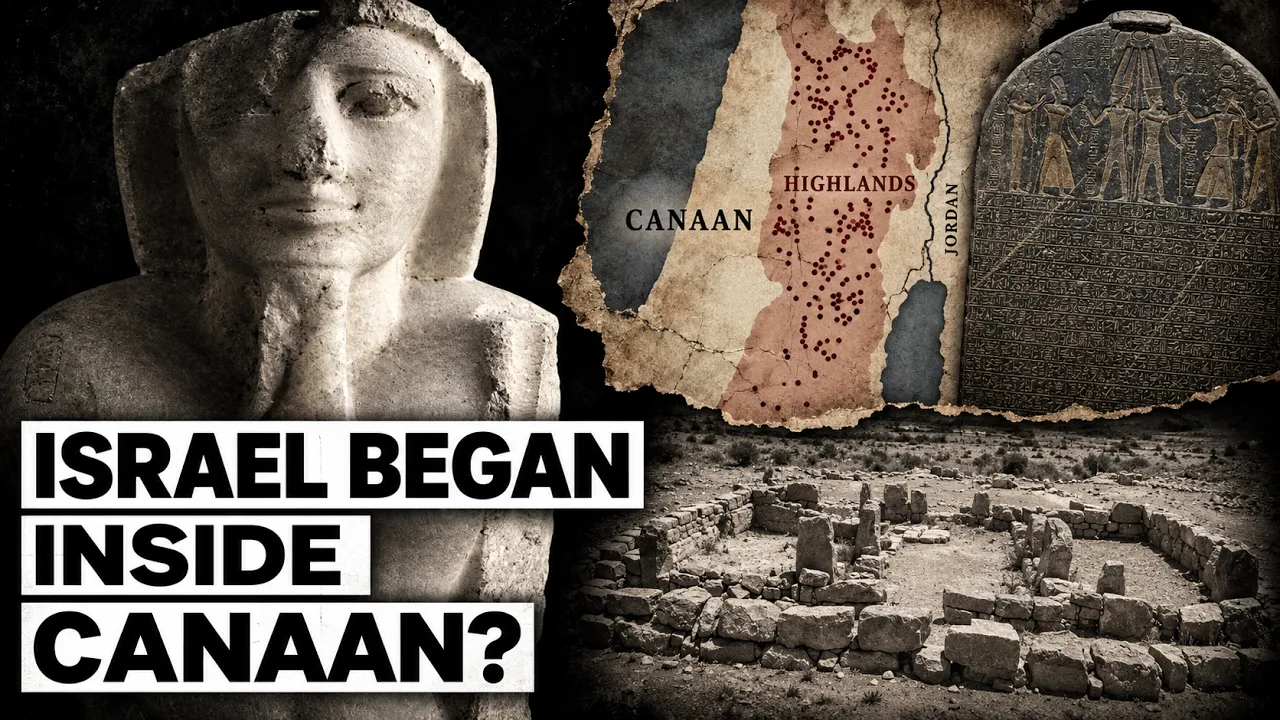
And it was precisely in this power vacuum, in this period of chaos and upheaval, that the first identifiable Israelite settlements appear in the archaeological record. Starting around 1,200 B. CE and accelerating dramatically over the next two centuries, a wave of new settlements sprouted in the central highlands of Canaan, the rugged hilly terrain between the coastal plane and the Jordan Valley.
Archaeological surveys have documented a stunning transformation. In the late Bronze Age, this region was sparssely populated with only about 30 small villages. By the early Iron Age, around 1100 B.
CE, there were over 300 settlements home to an estimated 45,000 people. By the 10th century B. C.
E. , that number had swelled to hundreds of villages with a combined population perhaps reaching several hundred thousand. This was not an invasion.
This was an emergence. And here is the key detail that changed everything. When archaeologists examined the material culture of these New Highland settlements, they found something that many did not expect.
The pottery, the architecture, the agricultural techniques, the language, they were all fundamentally Canaanite. There was no dramatic cultural break, no introduction of a foreign material culture that you would expect if a large population had migrated in from Egypt or the desert. The early Israelites used the same kind of pottery as their Canaanite neighbors.
They spoke the same language, or rather a dialect of the same Canaanite language family. Their houses followed similar architectural patterns. Their farming practices were adapted versions of existing Canaanite techniques.
In the words of Finkelstein and Silberman writing in their landmark 2001 book, The Bible Unearthed, the early Israelites were irony of ironies themselves, originally Canaanites. Now, that does not mean there were no differences. There were.
And those differences are important because they tell us something about how this new identity formed. One of the most striking archaeological markers of the early Israelite settlements is the near total absence of pig bones. In Canaanite lowland cities, pig bones were common.
Pigs were a regular part of the diet. But in the highland settlements that we associate with early Israel, pigs essentially disappear from the fondal record. This is significant because the avoidance of pork becomes one of the defining markers of Israelite identity in the biblical texts.
What the archaeology suggests is that this dietary taboo was not some ancient law handed down on Mount Si. It was a social boundary marker, a way for a new community to distinguish itself from its neighbors. It was identity through practice.
Similarly, these early highland settlements show a distinct pattern of architecture. They are typically small unfortified villages arranged in an elliptical or circular plan with houses facing inward and the backs of the buildings forming a kind of defensive perimeter. This layout suggests a community organized around the extended family or clan without the hierarchical structures you see in the Canaanite citystates down in the lands.
There are no palaces, no temples, no monumental buildings. This was a deliberately egalitarian society, or at least one that defined itself in opposition to the stratified urban culture it had emerged from. Another diagnostic artifact is the collared rim storage jar, a large ceramic vessel that appears in huge quantities at these highland sites.
These jars were used to store grain and olive oil, reflecting an agricultural economy adapted to the challenging terrain of the Hill Country. While collared rim jars are not exclusively Israelite, they are found in such concentrations at these sites that they have become a hallmark of early Israelite material culture. So what we see in the archaeological record is not a people arriving from elsewhere.
We see a people becoming a new identity crystallizing out of the existing Canaanite population in response to the collapse of the old order. people who had been peasant farmers, pastoralists on the margins, refugees from destroyed cities, perhaps even some who had connections to Egypt or the Trans Jordan, all coming together in the highlands and forging something new, something that would eventually call itself Israel. And that brings us to the single most important piece of external evidence we have for the existence of early Israel, the MPTA stlele.
This is a slab of black granite standing over 3 m tall. Carved during the reign of Pharaoh Marpta, the son and successor of Rameses II. It dates to approximately 1205 B.
CE and was discovered in 1896 by the legendary archaeologist Flender's Petri at the ancient Egyptian city of thieves, modernday Luxor. The steel is essentially a victory monument, a boastful record of MPA's military campaigns. Most of it deals with a war against the Libyans.
But the final lines turn to Canaan. And it is here that something extraordinary appears among the conquered entities listed alongside the cities of Ashcolon, Gazer, and Yenoam. The stale mentions a people called Israel.
The inscription reads in translation, "Israel is laid waste, bear of seed. " This is the oldest undisputed extra biblical reference to Israel in existence. And what makes it even more fascinating is the way the word Israel is written in the hieroglyphic text.
Unlike Ashcolon, Gazer, and Yanowam, which are marked with the Egyptian determinative for a city, state, or place, Israel is marked with a determinative for a people, a seated man and woman above three plural strokes. This tells us something crucial. In 1205 BCE, the Egyptians did not consider Israel to be a country or a city.
They considered it to be a people, an ethnic group, a tribal entity. This aligns perfectly with what the archaeology tells us. At the time of the MPTA, Israel was not yet a state.
It was not a kingdom with borders and a capital. It was a loose confederation of highland communities, distinct enough to be recognized as a group by the Egyptians, but not yet organized into anything resembling a nation. It was a people in the process of becoming.
And there may be an even earlier reference. In 2012, scholars Manfred Gorg, Peter Vandervine, and Christopher Tea published an analysis of a broken statue pedestal found in the Egyptian Museum in Berlin. On it, they identified a hieroglyphic name ring that they argue should be read as Israel.
If their reading is correct, and not all scholars agree, this inscription dates to around 1400 B. CE, roughly 200 years before the MPI. If confirmed, it would push back the earliest known reference to Israel by two centuries, suggesting that the group identity we call Israel may have roots even deeper than most scholars currently assume.
Now, this is where the genetic evidence enters the picture, and it adds yet another layer of complexity to the story. In recent years, advances in ancient DNA technology have allowed scientists to extract and analyze genetic material from human remains buried thousands of years ago. Several major studies have focused on the population of the Bronze Age Levant, including a landmark 2020 study published in the journal cell.
This study analyzed genomewide ancient DNA from 93 individuals buried at Canaanite sites across Israel, Lebanon, and Jordan spanning the Bronze Age. The results were striking. The Canaanites as a population were a mix of two main ancestral components.
One derived from earlier local Neolithic populations who had been farming in the Levant for thousands of years. The other came from migrants originating in the Caucasus and Zagros mountain regions, a population that began arriving in the Levant during the Calcolithic and early Bronze Age roughly 5,000 to 4,000 years ago. This genetic mixture was remarkably uniform across different Canaanite sites, suggesting that despite being politically fragmented into competing citystates, the Canaanites were genetically speaking a coherent population.
And here is the crucial finding. Modern-day populations in the Levant, including Jewish and Arabic speaking groups in Lebanon, Israel, and Jordan, share a significant portion of their ancestry, in most cases, more than half, with these Bronze Age Canaanites. The genetic continuity is substantial.
It means that the people living in the region today are to a large degree descended from the people who were living there over 3,000 years ago. In 2023, for the first time, archaeologists and geneticists managed to extract ancient DNA from individuals identified as ancient Israelites from the first temple period. Found in a family burial near Jerusalem, dating to approximately the 8th century BCE.
While the results are still being studied and expanded, the preliminary findings support what many experts had suspected. The ancient Israelites shared substantial genetic ancestry with the earlier Bronze Age Canaanite population. They were not a genetically distinct group that arrived from somewhere else.
They were at the deepest biological level part of the same population that had been living in the southern Levant for millennia. This does not mean that there was zero outside input. The DNA evidence shows that there were continuous low-level population movements into the Levant throughout the Bronze and Iron Ages.
Small groups from Anatolia, Mesopotamia, the Aian, and possibly even Egypt contributed genetic material to the Levventine population over time. But the overwhelming signal is one of local continuity, not foreign migration. So if the early Israelites were fundamentally Canaanites, if they did not come from Egypt in a mass exodus, if they did not conquer Canaan through military force, then where did the Exodus story come from?
Why is it such a central part of Israelite identity? This is one of the most debated questions in biblical scholarship, and the answers are speculative by nature. But several intriguing possibilities emerge from the evidence.
First, it is entirely plausible that a small group of people with genuine Egyptian connections was part of the mix that formed early Israel. The presence of Egyptian names within the Levite priestly tribe, names like Moses, Hoffnne, Phinehas, and Aaron, all of which have plausible Egyptian etmologies, suggests a real connection to Egypt for at least one segment of the Israelite population. Perhaps a small group of Semitic people who had been in Egypt, possibly even enslaved there, escaped or were expelled and eventually made their way to the central highlands of Canaan, where they joined the larger population, forming the new Israelite identity.
Over time, the story of this small group's experience in Egypt could have been adopted as the foundational narrative for the entire people. A particular memory became a national myth. Second, we know that there was a significant presence of Semitic-speaking people in Egypt during the late Bronze Age.
The Hixos, a dynasty of rulers with Canaanite origins, had controlled lower Egypt for over a century during the second intermediate period, roughly from 1700 to 1550 B. CE. Their expulsion by the native Egyptian pharaohs of the New Kingdom is well documented in Egyptian sources.
Some scholars have suggested that the memory of this expulsion passed down and transformed over centuries of oral tradition may have been one of the raw materials from which the Exodus narrative was eventually constructed. Third, the biblical place names associated with the Exodus. Places like Pyrams, Pitham, and Yamsuf correspond to Egyptian locations that are only attested together in texts from the Remisite period, the 13th to 11th centuries B.
CE. This suggests that whoever wrote the Exodus narrative had access to authentic Egyptian geographical knowledge from that era. Knowledge that an Israelite scribe living centuries later in Jerusalem would have been unlikely to invent from scratch.
So the picture that emerges is not one of simple fabrication. The Exodus narrative contains genuine historical memories, real place names, real cultural details, possibly even real events. But those memories were woven together, amplified, and transformed into something much grander than the original events probably were.
A small group's experience became a nation's founding story. A local memory became a cosmic drama of liberation. And there is a reason why that story was so powerful, why it was selected and elevated above all others.
The Exodus narrative served a profoundly important political and ideological function. It united a diverse, fragmented population under a single identity. It said, "We are not just a collection of hill farmers and herders.
We are a chosen people. We were forged in the fire of oppression and delivered by divine power. We have a covenant with the creator of the universe.
" That is a powerful story. That is the kind of story that can hold a people together through centuries of hardship, exile, and foreign domination. But understanding its power does not require us to take it literally.
In fact, understanding its power requires us to see it for what it really was. A masterpiece of collective memory making. Now, let us talk about the biblical kingdoms because this is another area where the traditional narrative and the evidence diverge in important ways.
According to the Bible, after the period of the judges, the Israelite tribes united under a monarchy, first under Saul, then under David, and then under Solomon. David conquered Jerusalem and made it his capital. Solomon built the first temple, amassed enormous wealth, and ruled over a vast and powerful kingdom stretching from the Euphrates to the border of Egypt.
It is a magnificent story. But the archaeological evidence for this united monarchy is, to put it charitably, thin. For decades, archaeologists searched for evidence of Solomon's grand kingdom.
They expected to find monumental architecture, fortifications, administrative centers, the kind of infrastructure that a wealthy and powerful state would produce. And for a while they thought they had found it. In the mid- 20th century the archaeologist Yigel Yadin excavated impressive gates and fortifications at Hazer, Megiddo and Geyser, three cities that the Bible credits Solomon with building.
He dated these structures to the 10th century B. C. E.
and proclaimed them evidence of Solomon's building program. But in the 1990s, Israel Finkelestein proposed a controversial redating of these structures using refined pottery chronologies and carbon 14 dating. He argued that the monumental structures at these sites dated not to the 10th century B.
CE. the supposed time of Solomon, but to the 9th century B. CE during the reign of the kings of the northern kingdom of Israel, particularly the Omr dynasty.
If Finkelstein is right, and this remains hotly debated, then the 10th century Jerusalem of David and Solomon was not a grand capital of a vast empire. It was a small, relatively insignificant hilltown, perhaps home to only a few hundred or at most a couple of thousand people. This does not mean that David and Solomon did not exist.
In 1993, the discovery of the Teldan Staley, an Aramaic inscription from the 9th century B. C. E.
that appears to reference the house of David, provided strong evidence that David was a real historical figure, or at least that a dynasty claiming descent from someone named David ruled in Judah. But there is a vast gap between the existence of a historical David and the biblical portrayal of David as the ruler of a mighty empire. The evidence suggests that the biblical account was written centuries later during the 7th century BCE by scribes in the court of King Josiah of Judah who had strong political motivations to portray their dynasty's founder as a great and powerful king.
And this brings us to what may be the most important insight of all, the one that ties everything together. The Bible as we have it is not a straightforward historical account written at the time the events occurred. The core narratives of the Pentetuk from Genesis through Deuteronomy including the creation stories, the patriarchs, the Exodus and the conquest of Canaan were written down in something close to their current form during the 7th and 6th centuries BCE in the Kingdom of Judah.
This was a period of immense political and religious upheaval. The northern kingdom of Israel had been destroyed by the Assyrians in 7:22 B. CE.
BCE and its population scattered. Judah, once the smaller and less significant of the two Israelite kingdoms, found itself as the sole surviving heir to the Israelite tradition. Under King Josiah, who reigned from around 640 to 609 B.
C. E. , Judah underwent a dramatic religious reform.
The worship of Yahweh was centralized in the temple in Jerusalem. Other gods and cult sites were suppressed. And a comprehensive national history was compiled, one that traced the origins of the people all the way back to a single ancestor, Abraham, through the formative experience of the Exodus to the glorious United Monarchy under David and Solomon.
This was not simply an exercise in historical recordkeeping. It was an act of nation building, identity construction on a grand scale. The scribes of Josiah's court were not lying, at least not in the way we might think of lying today.
They were working with real traditions, real memories, real fragments of earlier texts and oral histories, but they were shaping those materials into a coherent narrative that served their present-day political and religious agenda. They were creating a usable past. And that is what makes this story so endlessly fascinating.
The origin of the ancient Israelites is not a simple tale of migration or conquest. It is a story of identity formation of how a diverse collection of Canaanite highlanders, pastoral nomads, urban refugees, and perhaps a few people with genuine Egyptian connections coalesed over centuries into a people with a shared identity, a shared religion, and a shared story about where they came from. The real history is messier than the myth.
It is full of ambiguity, gradual transitions, and unanswered questions. But it is also in many ways more remarkable because what the evidence shows is not a people who were chosen from the outside and placed into a land. It shows a people who chose themselves who looked at the chaos of a collapsing world and decided to build something new.
Who forged an identity not from military conquest but from shared practice, shared belief, and shared stories. The Israelites were not strangers in Canaan. They were Canaan's own children, reinventing themselves in a time of crisis.
And the story they told about their origins, the Exodus, the covenant, the promised land, that story was itself one of the most powerful acts of creation in human history. Not because it recorded what literally happened, but because it defined who they would become. And that ultimately is what historians have been getting wrong for so long.
They kept looking for where the Israelites came from, as if the answer was a place on a map, a point of departure, a migration route. But the real answer is not geographical. It is cultural.
It is psychological. It is the story of how a people living in one of the most turbulent corners of the ancient world created an identity so powerful that it has endured for over 3,000 years. We are still talking about it today.
We are still arguing about it. We are still excavating the soil and decoding the DNA trying to understand what happened in those rugged highlands three millennia ago when a group of Canaanite villagers looked at the world they inherited and decided they were something else, something new. And in a way, maybe that is the most human story there is.
Not a story of divine intervention or military glory, but a story of ordinary people in an extraordinary time deciding who they were going to be. Now, there is one more dimension to this that deserves attention, and that is how this question of Israelite origins continues to shape the present day. The archaeological and historical debates we've been discussing are not confined to academic journals and university lecture halls.
They are deeply political. In the modern Middle East, claims to ancient ancestry are used to justify territorial rights, national narratives, and geopolitical positions. Both Israeli and Palestinian national movements have at various points invoked archaeology to support their claims to the land.
The question of who the ancient Israelites were and where they came from is not merely an academic curiosity. It is a live political issue with real world consequences. And this is precisely why getting the history right matters so much.
When we understand that Israelite identity emerged from within the Canaanite world, that the people of the ancient Levant, regardless of what they called themselves, shared deep genetic and cultural roots, we gain a perspective that complicates simplistic narratives on all sides. The history is not a weapon to be wielded. It is a mirror to be studied.
And what it reflects back is a picture of shared origins, interconnected lives, and the profound human capacity for reinvention. The ancient Israelites did not drop out of the sky. They grew out of the soil of the land they lived in.
Shaped by the same forces that shaped their neighbors, the Moabites, the Ammonites, the the Phoenetians. They were all part of the same Canaanite family tree. What made Israel different was not its DNA or its pottery or its farming techniques.
What made Israel different was its story, its commitment to a particular vision of the world. A vision that centered on one God, one covenant, and one people with a unique destiny. That vision, whatever its historical origins, changed the world.
It gave rise to Judaism, which in turn gave rise to Christianity and Islam, three traditions that between them encompass more than half of the human race. The monotheistic revolution that began in those humble highland villages eventually reshaped the spiritual landscape of the entire planet. So when we talk about the true origin of the ancient Israelites, we are not diminishing their legacy by pointing out the complexities.
We are deepening it. We are showing that one of the most consequential cultural innovations in human history did not require a miraculous origin. It emerged from the struggles, the creativity, and the resilience of ordinary people navigating an uncertain world.
And that to me is far more inspiring than any myth. If you made it this far, you're clearly someone who values depth and nuance over easy answers. And I deeply appreciate that.
If you enjoyed this deep dive, please do like this video and subscribe to the channel. It makes a genuine difference. And if you are curious about more stories like this, about the hidden currents of power, wealth, and identity that have shaped our world, check out the video on screen right now.
I think you will find it just as fascinating.