It is a really warm welcome to event four and the start of your fourth cycle on mpq where we're going to look at organizational Effectiveness and to start today we have a quote from Peter draer um so just have a a quick read of this quote from draa that's on the screen only three things happen naturally in organizations friction confusion and underperformance everything else require Leadership now I know that in this group we've got some some big fans of um some of dra's other big quotes I think um cultur strategy for breakfast came through really
strongly in one of our former cycles and what are people's views on what we can see from draa here in terms of getting us thinking about organizational Effectiveness anyone want to sort of unmute join in in the conversation does that resonate with you is that something that you really Recognize in your own school or previous schools no rights or wrongs here folks it's just a good opportunity to get us talking no hands up so far come on people ah thank you Charlotte yeah I've seen um quite a few different head teachers at the school that
I'm at I've been assistant head um acting head of it twice and has and yeah I I can see that this does happen because these things I've seen happen in very varying amounts depending on the leadership Style and how that's done um but yeah see the friction Fusion under performance yeah I think that's then sums it up quite accurately really from what I've seen thank you Charlotte and I think what you've pulled out there is really really key that actually with every change of head teacher a school is going to go through change even if
someone walks in and says I'm not going to do anything for my first 100 days the kind of really you know kind of strap Line that lots of people kind of live by when they go into headship I'm not doing anything I'm just watching actually things will change because it's a new head teacher and Charlotte you're completely accurate there to go back right to cycle one I think really where we're thinking about e ethical principles and behaviors of leaders in terms of how that leader then influences things like underperformance how does that leader manage that
what's their Tolerance level for underperformance all of these things don't happen by accident we have to deliberately create systems Pro processes ways of working um we have to lead to make sure that we do manage underperformance but actually if there is friction or confusion that that is addressed that we're picking up on that as well um so it's a really useful quote from dra I think and it really leads us nicely into today and the kind of Content areas that we're going to be covering and thinking about so this is our first session of today
folks where it's a warm welcome back to those of you that we've seen before and a welcome to those colleagues that we've got joining from other GR groups um we're going to quickly walk you through what the day is going to look like and there'll be some changes in terms of some of the slides which you might have noticed ahead of today and then I'm going to hand over to Hardal to do our reg regular check-in process which you're going to be very used to just as a um kind of heads up for today you
are going to need your resource pack in front of you um we will pop that into the chat box now but it's worth just mentioning that if you haven't got those resources to hand already you're going to need them in front of you today and hopefully you did have an opportunity to go through the pre-event learning at that start of the Res resource pack which we know this group are usually so fantastic at as well so what are we going to be looking at today then folks well we are leading to the center of this
diagram that you can see here we're thinking about organizational Effectiveness now what we mean by organizational Effectiveness is how effective your school can be through really deliberate leadership in a number of different areas so we're going to really back to and think about culture Ethos teaching again which we've already covered in previous Cycles we're going to be recapping on that and actually that is going to be the Bedrock really that reflection in terms of building them through to the activities that we do today that lead towards organizational Effectiveness because they will be The Guiding Light
if you like in terms of how we organize our resources our people our Governors all of those things that then fall into Organizational effect iess we are going to be doing an activity today to do with Finance so this is where I look carefully at people's faces to try and read their reactions because the reality is we know that in life some of us are numbers people we really like the numbers that's me I'll put my hands up and I've always been very interested in numbers I think they're very very useful um and as a
result Finance doesn't really worry me or frighten me in the Same way um but for some of you when you see the word Finance financial management we know that that might be a prickle down your back because it's something that perhaps you haven't looked at before we're going to really think about uh financial management and accountability today in terms of a case study school so we're going to look at some different resources that can be really useful in terms of financial benchmarking but then we're going to be Really thinking about looking at a budget sheet
and we'll take you through some of the nuances on that budget sheet in terms of um local Authority schools versus math schools Etc and then we're going to reply what we see on that budget sheet to thinking about in a case study school what recommendations would we be making in terms of what needs to happen What needs to change so again building on all of those SK study activities that we've Done previously in terms of thinking about change management as part of that we're also going to touch on governance in terms of accountability so we're
going to walk through again some really useful resources um that actually I think lots of previous participants on mpq have said have been key in taking back to school with them to share with with their own governing bodies to really develop their understanding of what is The expectation of a governing body and how does that work and again we'll have the opportunity to pick up on some of those big nuances now in terms of governance structures in different types of schools and what you're going to do today is then you're going to be the governors
while another group presents their recommendations and we're going to get you to really think as Governors what are the challenging questions that Governors could ask and how we e that's Really useful for you is again you can take that experience back to school do some work with your Governors so that they are asking the right sorts of questions of of you as leaders in terms of money spend finances Etc we're then going to move into a um another activity where we start to think about um staff the team what makes an effective team we're going
to think about what happens if we have someone who's not performing within our team You'll remember that big quote that we've spoken about loads before and actually many of you have given us examples in this group of how you've applied this in your school as well in terms of the standard you walk past is the standard you accept and we're going to pick up on that in terms of performance today if someone's performance or someone's doing something that is not what we would expect if we walk past that to permit is to promote Okay so
how are we going to address that and hardal is going to walk you through um a brilliant strategy from Susan Scott today a really simple process on how you can nip under performance in the bud um I was doing this event with a group in Southampton recently um well actually it was the the event that follows and we were checking in on this process and this person had said that they had enjoyed that part of their act activity and day so much that they' taken that Back and used it with all their middle leaders so
that they're building this culture of you know we nip things in the bud here we address things we do it in a polite professional way um and that had really seen the school transform in quite a short SP period of time since we'd seen him then between event four and event five so that's something to look forward to today as well and then we're going to be rounding off our day on thinking about Partnerships and Collaborations um really key at the moment we know that there is a a big agenda if you like in our
sector a good one a positive agenda that we want schools to work more together we've got organizations that have come through such as challenge Partners to create peerreview processes Etc um lots of nodding on the screen there something that probably you're very familiar with and actually we know that schoolto school support is one of the most Beneficial ways of getting um lasting Improvement in schools so we're really going to be thinking about Partnerships collaboration today and how that can feed into organizational Effectiveness so that if we have an issue over here with Finance if we
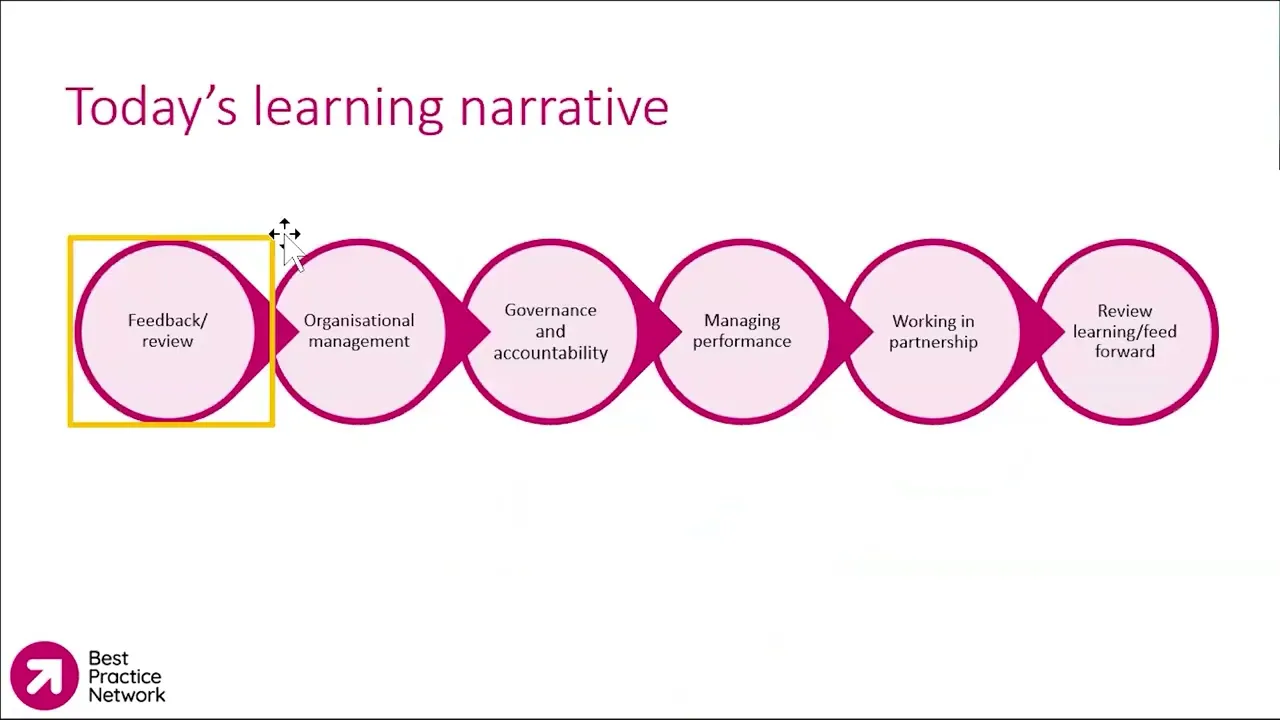
have an issue over here with performance how can we use them Partnerships to build on that and improve what's happening in our school so that's quite a detailed overview of the day for you and lots to look forward To oh just as my screen goes funny there for me and we're now going to just look at that in different ways folks so the first diagram our narrative for today we're right here at the start we're going to be doing that review now of um the session that's been but here's some rough timings for you I'm
not going to walk you through these because um we've we've just kind of spoken about these activities and these different sessions In quite a lot of detail you'll notice today that we have taken off um the the kind of the timings in terms of 1105 or or 3:22 because we find that um as as all groups that can be quite restrictive for you you know that hard you and I are going to flow with you today so these timings you see are approximate they are rough they are loose timings we will work with you to
make sure that the sections that you as a group need the most time on we have them and if we need To nip and Tuck somewhere else we'll do that responsively to your needs so that's a slight change on the slide there that you'll have seen before that's not just happened in this group it's happened in all groups just so we can really tailor the learning what we have in front of us event aims and outcomes again I think we've sort of rushed through these already today or raced through them um But really we're going
to be thinking about the best allocation of resources in a school and we're not just going to be thinking here about um educational resources uh the glue sticks and we could probably spend a whole day talking about things like that couldn't we the photo cop but we're going to be thinking about human resourcing as well uh we will look at you know what's the biggest part of a budget goes on is going to be your Staffing they are your most Valuable and your most expensive resource so there's going to be a real focus on that
today we want you to leave here with a real understanding of core functions of a governing body of governance whether that's at a trustee level whether that's at a local board level whatever that might be but particularly in their role in holding leaders to account for financial performance so not just saying every governing body meeting that sounds Wonderful how can we really grow our Governors to be diligent in terms of financial performance and management and there'll be some takeaways for you today as I've said already hopefully today you're going to be re leaving re feeling
really boyed up about tackling underperformance as well um which is something that probably most people don't look forward to I think in my journey and time on mpq across the last four or five years I've only ever met One person that says they like having difficult conversations um most of us don't but hopefully you'll be leaving here today thinking right after Easter this is is the conversation I need to go and have this is what I'm going to do call it swallowing the Frog if you haven't heard that book before it's very good it's getting
the most difficult job out of the way first and finally hopefully you're going to leave thinking about Where are my effective Partnerships and what more can I do so that's our kind of final thoughts for the day for you so over to you hardio I think for our first activity okay thank thanks for that Emma that's set up the day really nicely but before we get into all of that on uh uh cycle four we're going to get you to reflect on your learning from cycle 3 which was on leading teaching for that you will
need resource 3 from your resource pack and I've just put that in The in the chat for you if you haven't got it to hand so you can download it from there and we want you to use that uh resource 3 just to reflect on your learning using uh uh your formative Tas assessment task using the reflective task that you'll have done and all you're learning from that basically just to think about what were your key learning points from that and uh thinking about the learn that and learn how to statements in your last ldr
how Have your has your understanding developed as a result of uh doing cycle three but more important than that how have you actually applied that because it's no point just uh learning these things if that is not impacting on your leadership in school so how's that impacted on your leadership in school and your school practice so think about examples where that has happened and what leadership behaviors have you demonstrated as a result of your Learning during that cycle on leading teaching and then what areas do you need to continue to work on and develop and
how will you address these These are the key things we want you to reflect on individually now use resource 3 for the next uh 5 minutes or so so make some bullet point notes against those and then we're going to put you into uh uh small groups to be able to H have a discussion with an another colleague actually not in groups we're going to Put you in pairs uh to have a discussion with another colleague and then we'll take a bit of feedback so five minutes individually then we're going to put you in pairs
for 10 minutes and then we'll take a bit of feedback from you before moving on to cycle four the key really thing is how have you applied that learning from the last cycle into your leadership and into your school practice and let's think about some examples okay five minutes individual Reflection then hopefully everyone should start flying back in now yeah they coming back in welcome back everyone hopefully you had a good opportunity to discuss uh your learning uh from uh cycle 3 and how you've applied that learning and uh let's just get a bit of
flavor of what you were discussing anybody like to share what's been your key learning how you've applied that in in terms of it if if we Can have you raise your virtual hand otherwise I'll need to come around and seek some people out but it' be nice if you can just volunteer to begin might be volunteering Hardy or Kathy volunteering yourself there right go on Kath I so do you want me to yeah what was your key learning from there and how you applied that from the leading teaching sound Curriculum we're getting interruptions uh there
so I'm I'm going to go to someone else let's go to um lurine who's in room one if you pop it in the chat for us as well that would be great actually because I liked what you started to say they just sound a bit like a robot to us RN so if you pop it in the chat for us sorry hard hi hi lorine clearly yeah lorine can you hear me clearly yeah oh great so I was just talking about my my key learning um with Chris in in the room he was a fellow
Secondary School um um come from fellow secondary school so I was talking about the key learning for me was curriculum planning and um looking at space retrie retrieval and space and space practice I kind of like did a deep dive with a couple of the curriculum leaders and found that um a lot of the heads of departments were really focused on the spec the spec and teaching a lot Of the content but from student um student voice um the students found that actually they didn't have enough time to actually practice what they were learning and
that was really clear when I then looked at the curriculum and assessment and looked at the the data in terms of the types of um outcomes that there was um for the students which is then actually a reflection in what we're getting at year 11 outcomes and year 13 outcomes um so I kind of like went back To retraining um heads of departments um um giving them we went we we then looked at the CPD program and started including in the CPD program um um the kind of like some of the resources from the npq
what the expectation was um and the only kind of like difficulty we had um was time there's always not enough time to put these things in um but we were willing to sacrifice that as such just to go back to the basics and listen to the students um in terms of them not Being able to apply their learning not all of them are of I should say um you know haps where they're able to grasp it but um they needed to also look at their curriculum sequencing but also look at the planning and how they
can incorporate homeworks and getting the kids to practice within homeworks and making homework more valuable that actually it's not a tick box you are coming back to it you are looking over it within the classroom and so the kids Then start to Value it and then apply it as well so it comes into like a full circle but this the staff were buying in um definitely but do feel that they are taking a couple of steps back in order to make big steps forward brilliant you you've given a really powerful example there of how you've
applied the learning from that and you know at the whole school level as well with all your your heads of departments there Lorraine you said that time was an issue for you in Terms of that have you thought about kind of mapping that out in terms of what you what you can do when and maybe even take it into next year yes definitely that's one of the things that we're looking at in the school development well School development plan but as SLT we are going to start looking at the timetable for example next year one
of the other things was that teaching assistance I mean if you're having issues where you're not giving a Lot of SP um practice and retrieval etc for students who are nonn you need to think about how is that affecting students who are scnd so um we we are looking at what we can do in terms of timetabling for teaching assistants and how we can then maybe bring out um small group smaller groups onetoone tuition as well um not only with scnd but also with other students as well and um we're looking at um recruitment in
terms of that as well not necessarily teachers But maybe more teaching assistance right brilliant in that way because if you look at it holistically like that not only are you applying the learning from cycle three on leading teaching but you're applying the learning from your implementation cycle as as well uh from the induction cycle in terms of how you're going to go and Implement that and really map that out uh in the way that the EF suggests so that that that's well done for that thanks for sharing That line let's try and see in uh
let us go to room two uh Laura anything you discussed in terms of how you applied your learning yeah it was quite interesting and as I was saying that um to John my key learning area really was around send my role is very much um based on curriculum learning assessment um and we have someone in our trust who over see send so I guess the importance for me was around the collaboration between the Curriculum team and send team and making sure that um those Rel relationships are really tight and that we're you know attending their
send meetings they're attending our Qui meetings so that those key messages are are are shared and and made sure that they've been implemented um for the areas of need um and then interesting interestingly John is a trained Senai so then he was seeing it from the other point of view um so I think it was it was quite lucky that we Both ended up in the same room I don't know if JN wanted to add anything but I think that sort of summarizes really it was both of us realizing the importance of of of that
communication between a ccan lead and and a Seno making sure that you're yeah working together has there been any impact so far Laura in terms of how how you've applied that the only things far is that I've attended the Seno cluster groups which happen every half term and then the the trust And Lead has attended the curriculum learning assessment lead meetings which also happen every half term brilliant I mean again you you you've really looked at applying your learning uh trust wide as well which is which is fabulous to see anything you wanted to add
John or no I think Laura pretty much kind of kind of summs all all that kind of kind of interesting how actually we both did want to sort of focus on sort of similar things um I kind of I probably don't Want to last that start I finish um I spent a lot of time looking at marketing feedback and how um what's written in our policy isn't necessarily reflected in kind of what we see in the books um and then the impact um or or lack of impact really of of what the teachers is doing
on the on the progress of the children but so the learning from it enabled you to focus in on that and really pick that up didn't it whereas had you not done The uh course you you that might not have been possible is that fair to say yeah definitely so um so we've got planed and opportunities um so I've Rewritten the policy um I mean it's kind of more kind of minor tweaks and things to kind of make it more uh sort of user friendly um then we've got planned opportunity for the summer term to
to introduce that to staff so we can sort of get it pretty much nailed over the summer term ready for a September start And hopefully obious have the impact with the children right brilliant thank thanks for sharing that let's go to our final pair that was uh Vicky and Karen let let's listen to one of you let's start with Vicki first uh any way you've applied that learning I think I'm the um opposite of Laura in terms of I my role at school is senko and assistant head so I've I've got more involved in the
curriculum and assessment side of things and as a Result of the learning we've kind of set up a working party to look at our marketing and feedback just to consider the impact it's having we've got some teachers who are spending so long doing marking of books but what impact is that having on children so I think from the course and my stat was around the flexible grouping and we've been looking at that as well we've put systems in place as a school but they're not embedded people are Going back to their default organizing children by
groups and not doing the assessment for learning so thinking about how we can make sure that they understand why we're doing that so I found I found this cycle particularly useful if I'm honest brilliant you you've actually uh really applied the learning not only from the cycle as a whole but also from informative assessment task in terms of people grouping to make it come alive in Terms of what is happening with within your school so that that that's great to hear any anyone else want to share before we move on cath did pop hers in
the chat hardal um because of her sound issue so Kath said that uh her key learning was around the curriculum as a federation they've done a complete overhaul of the curriculum it's allowed them to build on good practice resources Etc uh and it had helped Kath in her practice to Develop her faculty which was sen and life skills um and particularly with an emphasis on adapting the curriculum to make make it and here's the kind of key word I think completely accessible and she said it was a really good opportunity to be reflective I think
that's come through from others as well hasn't it yeah I mean I think the key points that are coming across is that that opportunity for reflection so not just learning but reflecting on your Learning and looking at what's happening within your organizations or on a trust-wide basis and then really sitting back and trying to say how can we move that better to have an even more of an impact on our children if you're doing that with every cycle then uh you know you you you're doing a great job in terms of the applying your learning
so thank you everyone who shared uh your experiences with the uh previous cycle what we want to do is give every one of You an opportunity during the course of today to participate so I know not everybody has had a chance to speak here but we we we'll make sure that you do get an opportunity later on in the day thanks Emma thanks hardal and and what really struck me there um as well for you all was how over the course of the time that we've kind of seen you and and Revisited and those of
you that joined us I'm sure it'll be a similar picture for your usual groups Is that real kind Of um tenacity I think is probably the right word now around the checking this is what we expect to be happening is it actually happening Vicki you kind of alluded to this brilliantly there you know this is what I've done the training on this is the expectation but as human beings people people default back you're completely right Vicki people do default back it's really good to hear that you've got so much out of that cycle because it's
the bread and butter is Probably the bit that we felt most comfortable with um and and but actually there's always that ongoing reflective practice that can improve what's going on in school so brilliant it leads us really nicely on to then our first session to think about organization Effectiveness now as part of today's uh this is where we are on the narrative moving through very quickly as part of today's pre-reading you were asked to watch um a short video by an Davey can I Just sort of have a show of hands on who managed to
or nods on the screens of who managed to watch um an's presentation oh what a great brilliant Fab thank you um we are going to go into slightly larger group so if you were someone that didn't find the time to do that please don't worry too much um because obviously you'll have others that have taken the time to listen to that but I would recommend if you haven't go back and review Anne's presentation now Anne is a Facilitator on mpq and on mpq as well um and obviously she's got a lot of experience in the
sector and she manages um many many budgets across her schools but she's also got some really interesting and unique ways in which she manages performance of her staff for example as well and the way that she um draws in her governance team and some of the strategies she uses to get the best bums on seats for her Governors also she talks you through that so without kind Of giving too much away about the presentation what we want you to have the opportunity to do is to go into breakout rooms and I'm going to pop you
in for 10 minutes everybody so we can have a good conversation when we come out and think about what you heard from an now she spoke you through like I just said financial management she spoke to you about how she manages her governance structures how she and there was a particular Focus like I've said already On how she gets the right people into her schools she talks you through um her performance management and and you might have a view on how that sits against what you do in terms of managing performance of Staff whether you
like what you heard from an or whether you think that there's any issues or challenges around that she speaks to you a little bit about team Effectiveness and how she tries to grow that cohesive Team so that everybody's working to the same objectives and also there's a an emphasis on that value of kind of partnership and collaboration obviously an is working for a map she's a trust leader um so she's already got that advantage that she's got group of schools that she can pull on and we've already heard interestingly from lots of you today that
you're in federations you're in multi-academy trusts a large number of you and so you might have your Views on what she said versus what your experience is as well so what we're looking for here is your key takeaways was there anything that hit you in the heart about what an said and you said that is exactly what I'm about as well or this stands out for me because my school isn't there yet and I want to build it in this way it might be something that you completely disagree with as well that's okay too this
is an open discussion a debate in small groups Around what you heard what resonated and perhaps what didn't also it's an opportunity for us to practice those um mpq behaviors around articulation clear articulation um also around professionalism and around having these debates in a way uh where we can disagree with things and we can agree with things um in in a in a way that you know is is respectful to our our peers and colleagues also so you've got 10 minutes in this group And then we'll be taking some feedback so as hardal said what
would be brilliant is if you're somebody that hasn't yet had an opportunity to share just make a few bullet points um from your group as you go um and then if you're happy to volunteer when we come back that means that we'll start to hear from the whole group which would be super so I'll open those rooms now and we will see you back shortly everybody Welcome back everybody welcome back I get a sense that that conversation was going on because everybody was in there right till the last minute there and it put before it
pulled you back so um it'd be lovely to hear just some kind of brief summaries of what your group was talking about as part of that discussion around what you heard from an Davey so is anyone happy to kind of raise the virtual hand on mute and jump in for us with some Feedback that would be super oh thank you Karen thought get in there early thank you so we sorry one of our colleagues has got problems with our microphone I think so she she couldn't um contribute but we had two on one so two
of us was saying one of the bits that really stuck out for us was an's conversations around governance and and the importance of the but actually the importance of Supporting and challenging them um I love the fact that she runs around the playground looking for people she thinks are effective and grabbing people into her building um but two of us saying that we felt although we had a governing body they were very led by the head teacher so excuse me I'm going to sneeze um so things that you may say would be effective or detrimental
to the school it's just a nod and okay let's not or let's do that um rather than what she Was portraying was a really um committed working body that may not have the skills and knowledge but she gave them those so that they could be more effective in and grow um but one of our other colleagues said that that's what her governing body previous look like but now they've they've had a new leadership team recently this year I'm assuming what she was saying which is and also the governs who were parents have left because their
children left The school and they' governs coming in who may not be from the that sector of of parents or an education and the things she were really really effective that they were doing and how she could see it was moving the school forward um so yeah for our group that was what we talk really was um how that's really that's really um really concise thanks so much Karen I think really interesting because governance I think can be quite divisive in schools which I think is What you were kind of describing there Karen in terms
of you know who's leading who who's leading who and is it just something that's tokenistic I think but often how I would describe some governing bodies as being you know they're there because they have to be there because it's a requirement rather than actually adding value in the way that the the school needs and I think pulling together kind of those two sides I love the fact there's a debate there As well but I think there's argument that both of those things can work well what I'm hearing and you know feel for anyone to jump
in on this is that what your group has kind of identified is that actually the most important thing is having the right sort of people on that governance board for that school at any given moment so for it might be that actually that needs to be weighted towards parent co-opted local community whatever that might look like um but There are other points where you just really need someone in who's got a really good HR background or a really good Finance background or any of those moments um and what I'm hearing is that there's an opportunity
for us as Leaders to make sure that governing bodies don't go stagnant that actually you just don't roll people's terms over and over and over because they've been there for a thousand years if it's not what that school needs at a moment so again going Back to that drer quate right at the start of today that's very deliberate leadership I think um in terms of what governance structures can look like and great that there was some debate in that group so thank you Karen any other groups prepared that was group four any other groups thanks
David um yeah we we similar to what Karen's already said when we were talking about choosing the governor's making sure that you are doing it Carefully um and making sure that the governing the governing body can be critical friends um holding people to account making sure that they are also providing that strategic view um and then when we were talking about budget as we know it's obviously getting harder and harder for schools to make sure that we are working within our constraints um the the head teachers and Senior leaders have a working knowledge of the
budget and even if it isn't your area of Expertise making sure that you are surrounding yourself with competent people um that you can rely on versus and and other people um and then kind of that that led into to how we were talking about money and how sometimes you have to plan for the unpredictable making sure that you've always got money in the bank to support children that are coming through with more and more complex needs um but making sure that even when you're applying for IA funding But making sure that you have the money
to support them immediately and then searching that funding and make sure that we can try and get it backdated to provide the support for those children really really valuable thank you David again really concise summary there if your kind of group's discussion we could probably spend a whole week on budgets and finances um and you're completely right I love I love what you've done there is you've You've addressed the elephant in the room in terms of we know that schools are in difficult positions with money right now and you've actually identified I think one of
the biggest reasons and issues that you're facing which is that rise in need um and services perhaps not being available and so the the the requirement on schools to provide what we've never had to provide before is also increased it's almost being like in that kind of Perpetual cycle isn't it of When's it going to end but what you've pulled out from what an said there which which is so valuable is the it is what it is what can we do to make our lives better or easier so how can we protect ourselves you spoke
about that kind of protected pot of money which is really difficult in schools when it's really tight but actually really keeping your finger on the pulse when it comes to the money is important we're going to come on to this in the next task but I love How you pulled out there from your group the point which I makes about you don't need to be the expert that is not the job of the head teacher in my going back to getting the right people in the right place it's absolutely about having the right School business
manager if you have a school business manager the right Finance director in a trust if it's a trust whatever that might look like having the right person there and probably taking it back to the Connections that we've spoken about before in terms of relationships that is somebody you want to get on with that you have a good relationship with somebody that you know comes to you and you go to them that you can have kind of a professional debate and dialogue and um disagreement I think it's fair to say certainly i' I've found that with
people I've worked with but that relationship that's going to mean that actually you can keep your finger on the pulse and That you can have a say as well um because what you don't want to end up in a position of and S an alludes to this of a point where your Finance drives your vision rather than your vision driving your Finance they're two separate issues and that's why it's important for us to stay involved because it's very easy to let your money Define the school rather than the vision defining the school and the money
fitting around I could see hard or Nodding there as well I think that's really really key brilliant thank you so we picked up on governance so far we've picked up on the budgets from an so far um any of the other rooms anything else that's cropped up in your discussions we haven't let have a look see if I get any little shows of hands here room one or room two anything to add that we haven't discussed so far did anyone have a discussion around the Performance Management at all oh John are you gonna Jump in
for us thank you I was gonna say we only got As far as the Finance Management I didn't want to just just to ignore it and I think we had an interesting conversation you've just alluded to about the importance of having that ver a business manager um and I think it was um I'm not as good with names I think it was Emma and our group um has got a a really strong business manager and that's having sort of a real impact um whereas at my school We've got a h so I should just is
more of an old school uh kind of person who doesn't have uh as such good lit uh computer literacy skills um and everything is very paper based um even though obviously the functionality there on sap um yeah we had s discussion around kind of the difficulties um that kind of brings with kind of the slowness and things yeah nothing to add about the other things we didn't get on to that no I think that's really valuable a valuable add-on to um Charlotte I've noticed you this I'll come to you next it's a really valuable add-on
in terms of what we're talking around around the right people in in the right seats isn't it and you've actually raised on a really interesting kind of challenge around our role as head teachers in terms of what do we do if we have somebody who's like that you know nice person good at what they do but Perhaps isn't working in the most efficient way um what does that level of efficiency mean for the organization um and it might just be wor if anyone's come across that or got any strategies pop them in the chat I'm
going to come to Charlotte next but pop them in the chat if you've come across that if you found anything that works um because it'd be interesting to pick up on that as a group so thank you John Charlotte and we did talk about Performance Management we um we picked out the about the meeting um not just being one meeting a year but being reviewed throughout the year that and said and also about it tying in with the sdp and be very linked with that and we didn't find that it was anything that was really
kind of new to us because I think these things have already happening in the schools that we're at anyway so it was all like yeah we understand that and that's the play um But we did notice those things also talked a bit about working parties as well and that she uses those and they're effective um and then we did talk about Partnerships and um and how with lots of schools that are in trusts which I think everybody else in my group's school is they've already got that built in and they've got lots of those things
um for my school which is a standalone Academy um we don't have that built in so we've had to go and try and find those links And Partnerships with local schools um to make that happen so whereas it just kind of is already there I suppose with the structure so we talked about how that's different for different structures of schools that that's again brilliant Charlotte thank you so much for that summary um two things I want to pick up on there uh first of all really interesting that from the people that were in your group
so um you had you Laura Kath and Chris didn't you um but That's the model you've already got for Performance Management where you don't just have those kind of two meetings a year one to set targets one to review um because most of the schools I visit they still have that quite ancient system of you know I'm going to set your targets I'm not going to see you for 12 months and I'm going to see how you did about it so it's really from my perspective reassuring that your schools are moving towards that recognition that
actually Two meetings a year on performance isn't enough because too much time lapses um also really interesting that you pulled out k um I'm come to where about Kylie in a moment but how Anne talks about how she does it against the school development plan and there's obviously pros and cons against that isn't there depending on how effective and efficient your school development plan is you know we looked at these way back in in one of the earlier Cycles um but we also heard In an earlier cycle Kylie spark spoke about her Performance Management and
she said that she links it to her um values do you remember her talking about that she to ask stuff so again she wasn't doing just two reviews a year she was two meetings a year she was doing much more regular reviews and conversations and she's gone down the values rather than the school development I think what we've got there is an example of two really strong trust leaders who have got Unique approaches to Performance Management that meet the requirements of the staff that they've got um and I wanted to remind us of that because
I think it's a good reminder that in Performance Management there's no one siiz fits all but what it is about is recognizing what does my what do my staff need out of me right now what do they need out of these meetings and what's going to get them to perform the best um I can almost guarantee that it's Not going to be getting them to bring a lever Arch file of evidence like we all used to have to do 20 years ago if you all remember that you remember that surely we all came in with
our big files that no one ever looked at it's about you know we won't even get on to going through threshold or anything like that but um you know it's about that really really understanding who your staff are devising something that works for your school and again being brave enough to Say a bit like John was saying earlier on we're not just going to do it the way we've always done it because that's the way we've always done it or because you know we like it on paper or whatever if that doesn't work for us
we're going to change it and that might be difficult for some people but that's the way we're going to move because that's going to get better performance out of out of staff and some interesting points on partnership which I'm going to leave for Now Charlotte because we'll pick up on them this afternoon and the activity because they link directly to what we're going to doing some really good Reflections um and some really good debates clearly from what an has said as well um so thank you all for those contributions hardal we are back to you
thanks am I just a couple another couple of points that I picked up when I was listening to Anna David she really said make sure that your school Improvement Plan is the backbone of uh any of your budget and planning because if they're two separate things and it's not then linked to uh the Performance Management and oversight with your governing body doesn't really work you can't drive School Improvement without that and the one other thing I thought she was it was great was uh if relationships are not right she said nothing will work so make
sure you design your systems with staff as much as possible because uh that way You you know there will be greater buying and uh things can move forward so thank thanks very much for that ad can I just jump back in again for one point that you reminded of it's just made me think of something that I've seen recently in a school um that is really worth mentioning but off the basis of what hardial said there about when you've got a school development plan Academy Improvement plan whatever you want to call it and you're costing
it Which is really good practice like hardial said if it's something that involves time just writing time as a cost on the school development plan is not good practice if you don't know how much an hour of your time costs are to Des come out and find it out because you will be amazed how much time costs and when you're thinking about things like um specialist training you might think oh it's just cheaper if I get some if I do it myself but by the time you've Prepped it delivered it evaluated it sometimes it can
be more cost- effective to get someone else to do it for you so really understanding how much your time costs how much your staff time costs um I think is worth making sure that you get the best out of what hard was recommending there sorry hardal back to you okay thanks am we're going to now move on uh to you we're going to give you a bit of information uh for the next 10 15 minutes and then you're going to Be working in a group to analyze the financial and contextual information about a a school
it's called Brook lodge primary school and you're going to be looking at the analyzing all that information and all the contextual information about the school to produce a report as a new head teacher for and with recommendations for your Governor say a bit more about that uh in a short while what you will need is from your resource pack you'll need resources four Uh and five which gives you all all the information you will need plus resource six which is a separate Excel spreadsheet as well which you should have access to so that's what you
will need but let's just move on what what is it that we're going to be really looking at your task in this session really will be uh put yourself in the position of this head teacher and it's a self-managed task you'll be working in in in a group and your aim will be to Try and identify how best to uh spend the scarce resources at your disposal that in essence is a role of of of ahead that in essence is a role of you working with your governing body to enable that to happen and you
anyone can do a budget it's it's quite an easy thing to do yeah however to try and do it in order to get the best value for money and allocate the resources effectively is is much more of a skill thanks Emma and these are all the if we can Move the slide that that's the holding slide and uh this is what it's all about it's about these scarce resources that you'll be allocating it's about managing ing people it's about uh making sure that your objectives in your school Improvement plan are met so when you're doing
this task later on make sure you're clear what the school priorities are how are the way you're allocating the budget going to help accomplish th th those and what is it uh what are your Overall goals how are you going to achieve them and uh are your is your curriculum uh going to be cost effective to be able to uh meet the needs uh of of your children as well so all of those things all form into that so you'll be looking at Facilities Management you'll be looking at Estate Management you'll be looking at employee
cost teacher cost Sport staff cost cost of resources all these things will go in for you to make the appropriate decisions but at the end Of the day it's really a bit like managing your own smaller home budget and just making it a bit bigger and I always used to think as a head the more you can see this thing as if it's you know your own money you will try and get the best value for money you possibly can as you try and get with your own School uh home budget thanks Emma so these
are the session statements that that we're looking at these the learn that and the learn how to statement and Predominantly in terms of doing this uh uh budget uh plan we're looking at learn that and learn how to statements that are predominately Sev and then then obviously there's the 8.3 about implementing those uh and the role of the governing body in in in doing that it's it's there as well I'm not going to leave read through all of those but you can see from the top one that it is your role as a head that
to ensure that there is Good Financial Management uh and Human Resource Management there and that you are are involved in the strategic planning o o o of that budget strategic planning of how many employees you're going to have how uh how many can you afford how many do you need to deliver the curriculum which is part of your overall vision and strategic vision of your school and those are all very very clear that's why I drew attention to what an uh Davy said about making sure that your uh Improvement plan is Central To delivering uh
uh delivering your budget that that's taken into account rather than two separate things remember you have a duty uh uh of care in terms of spending this money this is public money and it's in the public interest so you make sure that you're doing that how will this link to overall Performance Management how much money are you going to allocate to to staff development uh as as as well that's all the respons posibilities o o Of the head teacher you make sure you are prudent in terms of making those decisions and what is the role
of the governing body in overseeing that because they are there for the checks and balances on you as as a head teacher how what about the information that they you're going to let them have access to how often is that going to be the case and you know you don't have to be an accountant yourself as a head teacher to set set budgets but you've got to Have a broad understanding of how the budget is put together most schools nowadays will have bsers or or uh Finance officers or E even accountants who who will help
do the nitty-gritty however it is not their role to determine priorities it is not their role to say how much should be allocated to particular areas that's the prerogative of the head teacher within the overall framework that will be outlined by your governance structure Okay so because Finance people will have their own particular views about where money should be spent and so on you are as a head teacher you're the lead professional in this that's why you're the head teacher so you you have to be always very clear what where you going to where your
priorities are where you going to spend those that money on and why you're doing that because you will be accountable then to your Governors and whatever Governance structure uh that you're working with within so you need to have a broader understanding of it and then get the finance person to allocate those funds in terms of the priorities that you uh are really clearly determining okay thanks sir Emma So within that when when you're really looking at the uh budget and setting the budget you've got to try and get value for money this is all public
money and the these are three key areas How you will try and get value for money but firstly there is cost you got to look at how much things will cost however it's not as straightforward as simple as that uh you've got it's not just what things will cost initially sometimes you have to look at lifetime costs so particularly for capital projects or for example a boiler it might have a large initial cost but then when you map that out in terms of It lifetime cost that you you need to You need to be aware
of that in terms of how much will cost over a period of time and how much it it will cost the initial price may be high but then you divide that over the lifetime o of a boiler for example it'll come down as well so then you've got as as aead you've got to always be aware of am I going to get a plan for that am I going to get some kind of ins insurance or whatever it is that you you're going going to do to uh sort of ensure that that cost is spread
O over time or if you know that your boiler is coming towards an end have you got some contingency there to be able to account for that initial high outlay of of that second point to take into account will be quality you know uh obviously some things will cost more because the quality of of that is higher you you got to be really uh be clear about that and occasionally not occasion sometimes it is better to pay the higher price because it it for the quality it Might last longer to over a period of time
it might be even more cost effective might work out cheaper in in in the long run and then about perspective is is a third point about procuring things and if you can get into a group of uh people group of schools Maybe through a mat you can actually drive down costs of that through economies of scale and that again is a clear way of trying to reduce uh the overall uh cost of whatever it is that You're trying to achieve thanks em then there are the the three EAS of uh uh this this comes from
the audit office who've used this criteria to assess uh government spending it doesn't just apply to education but to all public of so but again the aim of this is to try and see how can we get the best value for money uh available so the first point of those is economy and that is all about minimizing the cost of the resources used uh in other words the Impact how can we try and reduce the inputs uh costs of those so we're spending less so again you're looking at trying and get the the the cheapest
possible uh way of getting in whatever it is you want to uh buy or purchase and then there the second one is about efficiency the thir second is efficiency in terms of how are you spending that well in other words that's a relationship between output and what uh you you actually have put into it as Well and that that is all about do you get the best possible optimal output from your spending so are you spending the scarce resources well are you spending them efficiently and finally Effectiveness is all about are you spending it wisely
and that is about uh are you able to meet your outcomes with uh do can you get good outcomes with the spending that you got do you get the desired outcome that you're you're looking for in terms of that and so That's the relationship between outcomes and uh that the impact that that they will have thanks for that Emma and then you've got this uh uh it's quite dated now 2013 from the DFE review of efficiency in school and they came up with those seven points that really successful schools uh who who are are very
efficient in terms of the way they allocate their resources these are some of the things that are present in in them they they deploy Workforce effect Effectively and the the key focus is on developing teachers and uh that that that will will be all about recruiting retaining uh th those teachers and training them while they're they're there as well and it's about getting the right mix of teaching and support staff are have you got that right or are your teachers doing jobs which can be done easily by uh support staff who cost less So eventually
you've got to make those sort of decisions as well have you got Are you employing have you got access to a good business manager who can save money and who can probably try and uh generate some income as well they'll have access to different funding streams as well are you making good use of financial benchmarking information in other words are you looking at other similar schools and how they're spending their money and then you're looking at and it's all good and well you can be slightly different from other schools as Long as you're aware why
you're different and you're having the desired impact so benchmarking will enable you to understand and and and do that are you working with a cluster of schools sharing practice data uh and and so on and enable you to have economies of scale in terms of your purchasing power that again is a good characteristic of the efficient schools are you reducing your back office cost uh in in terms of U uh you know in terms of office staff Running costs were there have you had a look at that recently and if if some things are not
needed you can cut back on that and how good is your governing body in terms of challenging the schools leadership on the spending plans because they should be your critical friend in terms of your proposals that you're putting forward to them thanks Emma and then we go to integrated curriculum and financial planning this I'm not going to go into detail about this this is Basically the key about this is making sure that you start off with the curriculum what is the curriculum you need to have in place and then you map that out and financially
map that out and see can you afford that curriculum if you can't you might have to uh make a few compromis is but you start from uh the the curriculum and do you you you'll have certain assumptions you'll have made about uh uh certain things and then you as as you're going through that Process you're clarifying that making uh you know sure that you're taming those uncertain getting those uncertainties out of the way so you're very clear what it is that you want and you start off with what is actually currently the position and from
there then you do your planning and it is that I want you to really focus on stages one to four in the task that you've got you don't need to be looking at stages five six and seven you can look at that at your Leisure for for today really be very clear about what sort of financial uh situation is the school in at the moment what are the uncertainties what are the things that you're clear about in terms of that school and what is currently known and then do your plan planning for this task from
there so just look at steps one to four uh for for for today thanks Emma and then this this just basically sums up in terms of what the task today Is you're really we're getting you to plan strategically uh using the the the vision that that's uh there and the assumptions that that that are there based on the information that that that I'll go through briefly with you and really very be very very clear budget setting is really all about having the right evidence Avail what are the known Financial facts about the the organization in
this case Brook lodge Primary School what assumptions are there about the future in terms of demographic grow what the rate of inflation is going to be what values are you going to put in there that are reflected in the vision of the school and in terms of the technology that you might want to uh bring into place so all of these things so your your spending will be about curriculum and teaches how much you're going to put in in into that and and on why being very clear about That what about sport staff and resources
can you make savings from there what about o overheads and operational costs and what are the service level agreements that you've got in place are they fit for purpose can you uh drive down cost through economies of scale all of those will be key in terms of you uh making those uh decisions about the school so we move that slide on so this is going to be your task if I can turn you to now to Your resource pack resource 4 please so you're going to be now the newly appointed head teacher as a group
each group is a newly appointed head teacher of this Brook lodge primary school and your task uh you've been tasked by the governors uh to actually produce analyze the school's long-term Financial Health okay and the reason for that is that your predecessor had provided them with only two annual budget statements so they're a bit in The dark perhaps about that at this one at the start of the year and one at the end of the year and the school's financial value standards that's the SV sfvs has enabled because that that's some the standards that the
governors uh have adopted and uh that that made them aware that two two pieces of information on the budget it's not sufficient for them and so they want you as a new head teacher to uh point the way forward in terms of How the school is going to go forward so that's your task to prepare a a report an oral presentation for your Governors and this can take whatever language we've enabled screen sharing for you in in your groups so you'll be able to do it as a PowerPoint uh what you want and so you've
got in your resources you've got a structure of the school Staffing structure of the schools you've got income and expenditure you've got an asset survey there you've got Demographic ideas think about the big things don't get bogged down in small nitty-gritty a few pounds here and there think about the big things in terms of what are the key things what are the trends you can detect what is happening to the salaries Bill overall has a school overspent in any areas so those are the key things and what do the demographic Trends uh uh say to
you are there opportunities to generate any additional income then you've got uh uh Ideas there further on about uh curriculum design what does scn etc so I'll let you read that at your leisure bit more context about the school in uh resource 5 and the sites survey as well then they you've got that also a staffing structure for the school I'm not going to go through that and then going back to anavi there are your school Improvement priorities as well they have to be Central to this when you're uh setting your budget and then As
a separate you've got an Excel spreadsheet there and again you've got the uh I'm not going to go through the each of them but you've got the various cost centers there and then you've got in in blue going across there are the total employee cost total School Improvement costs and and so on and energy costs premises costs and so on the key thing I would draw you I mean it it breaks it up into previous year spending then it takes account what Inflation increases then you've got your year one that that's where you will be
year one and what's going to be then in year two and year three allocations and that I would draw your attention to uh the the the the shortfall and surplus area which is on my spreadsh it's uh uh number 99 if you think about that in in terms of shortfall uh initially okay in the previous year it had a surplus of £33,000 so so previous year carrying that forward if you look Across uh line 96 you can see that 33 going into the year one base so you carrying forward that the surplus of 33,000 but
with that Surplus because the expenditure that is is high that at the end of that year one you're going to end up with a a deficit of 26,631 why is that a problem for you any ideas why is that a problem for you that even though you're carrying Through uh forward 33,000 so that's a surplus you still the way the expenditure is planned it's going to end up at the end of the year if everything goes as it is planned there and often doesn't always you have to make adjustments as the year goes on you're
going to end up with a deficit of over 26,000 so how much are you basically overspending in that first year uh 60,000 sorry 60,000 right nearly 60,000 nearly 60,000 late 50,000 uh there so that that that's the the problem and then if you move that forward because you're spending almost 60,000 extra if you move that forward into year two you're not caring forward a 33,000 Surplus you're carrying for forward a deficit of 265,000 and that leads in that year end of that year if that carries on if nothing changes you're going to end up with
a deficit of 80 uh 45,000 and if nothing happens there you carry that 845,000 into the following year and you'll get into a really danger territory there with the 182,000 def which is just it's just not sustainable so th those are the your big issues you've got to really tackle uh and and the sooner you can tackle those the better it is for any any school that you're leading everybody okay with that so we're going to give them about Should we get about 50 minutes sir yeah that's good all right any questions anybody so you
in your groups give yourself five 10 minutes to read and ass simulate the information about the school and then this is what you've got to do produce a report for Governors that identifies the Main Financial challenges the school will face over the next three years and then make recommendations to be adopted by the governing Body everybody clear what we're asking you to do any questions before we send you away okay right thanks I'll open those rooms now and I think we've got everyone back cial okay welcome back everybody uh hopefully you've had a good uh
time and both both Emma and I visited all the uh groups in in turn and you seem to be getting on really well with that but however it is time now for us to go into A break but I think it would help you if uh once we come back from the break you had uh probably about another 15 minutes just to finish things off uh in turn before we go uh bring you back and do the governance section and then you you're ready to do your presentation does everybody feel that would be a good
idea to give you 15 additional minutes or do people not need it am what what are you saying Karen um we were pretty much sorted but my group Feel like we felt like we're probably ready ready not pry much ready as well hard how about this as an alternative suggestion Hardy how about if I set the breakouts for 20 minutes now folks and we'll have a 20 minute coffee break so that's a really good portion of time to come away from your screens um if you're feeling ready time to recharge glasses pop to the bathroom
get a snack um but if anyone feels they need an extra five minutes or so you'll be in the breakout Room and you'll be able to do so I can see lots of nodding on screen as people thinking that might be an option that works for them would you be happy with that hardal yeah that sounds good to me Emma okay great I can see lots of nodding from is everyone else in the group happy with that because this is more about than you brilliant thanks everybody so I'll open those breakouts now make sure you
take a break and then when we come back we'll go into the Governance section there okay so make sure by the end of the break presentations are good we just set those now hard deal then okay yeah all right Karen Karen which who were you with I was with um Vicky and and Chris and oh I forgotten Kelly or room room two I Room two I think I was room two I'll send you to room too I think I well I might be wrong yeah brilliant so welcome back everybody Um and as I said hopefully
that break was just enough time to get away from the screen to let the numbers kind of gently float out of your mind that you've been concentrating so hard on for the last hour um and before we go into our presentations um to to our peer group and as we said remember this isn't hopefully you saw my broadcast actually in the breakouts this isn't about having polished slides it's about having polished articulation if you like around Your challenges that you identified and then your recommendations following that and as Hardy will said we we saw some
really good stuff going on in the groups which makes me really feeling quite infused and positive about what's to come in these presentations but before we do that we're going to just take a short bit of time to look at governance and accountability because obviously other group that are listening to your presentation um are going to be Governors and we've already spoken quite a lot today actually about the function of governance and some of the challenges that have come through it was really interesting how this seemed to be quite a key Focus for many of
your discussions and debates around and Davy's presentation so we are at this point in our narrative today so you can see we're nearly at the halfway point and um just to reassure you for any tummies that might be rumbling after this session Here we are going to be bring for lunch so um something to look forward to in the very near future in terms of the session statements and much like Hardy all said for for the second session I'm not going to walk you through um the learn that and learn how- to statements here but
it's really worth drawing your attention to content area 10 and thinking about some of the key learn that and learn howto statements that we're going to be hoping to focus on as Part of the next series of slides that we're going to cover very briefly with you remember there's going to be more to follow in your online course um in terms of the learn that and learn how to but these are really worth flagging and really worth thinking about in terms of the presentation that you're going to listen to as a governor also actually the
re you know the requirement for Governors is they are a school leader so when we're talking about leadership and Management of schools to use that very off steady term that includes the governors it's not exclusive to the Head teacher the deputy head teacher the assistant head teachers it's everybody with a leadership responsibility within the school and that includes the governance function however that's set up and actually so that means that they are also expected to submit themselves to that scrutiny now we had a big debate around this and actually how that made Us feel do
governors have that awareness that that's the requirement of them actually they have to make sure that those formal papers are prepared presented clear concise and accurate so what happens what happens in terms of governing body minutes and meetings who's responsible for that who oversees that who ratifies things who signs things off all really key and really important that actually we do establish those really good working relationships With our Governors too and it's you can see here it's really clear in terms of that not just being um just the chair but the clerk to the governors
as well a key function and a key role in terms of um minutes of a governing body meeting actually what do we expect our Clark to to put in those minutes and how how are they presented that's a really key part of what we should be looking at there's obviously references today around you know the the Um Nolan principles coming back to that you want people who do understand the laws statutory guidance all of those sorts of things too that's a requirement of your Governors um really really really key focuses here for us to be
thinking about as we head through the next slides worth flagging them for yourselves for the future as well so effective governance then now this came from the 2020 governance handbook um for trusts and Maintain schools that covers kind of both spectrums there in terms of what the DFE expects and it says that effective key governance is based on these these six features if you like so what this slide is saying that if you had a governing body like we heard actually colleagues talk about in terms of strong governance strong leadership on your governing boards these
are the things that you would be expecting to see so you'd be expecting Governors who Absolutely have nailed strategic leaders ship they have a really Clear Vision ethos and strategy I was in a school recently actually and um it was a school that was on a journey we'll put it like that and the um the chair of the governor called it um the chair's action plan while well intentioned that has to be everybody's action plan it has to be everyone's Vision not just the chairs okay so it's really making sure that they are championing that
and that Aligns with what the head teacher and the work that the senior leaders are doing also and there's clear accountability in really effective governance and it's accountability not in agreement like you were all saying as colleagues earlier on but accountability that drives up educational standards and financial performance that means that these people are asking the right difficult questions at the right time this is not a school where the head Teacher is giving the governors the question to ask ahead of the meeting because they want them in the minutes that is not effective governance effective
governance is what an Davey said about training your Governors putting enough in place that they have those skills to ask those questions people right skills right experience right qualities and capacity as well if somebody wants to be a governor just to put it on their CV they're probably not Going to be the right governor for you guys okay um and we need to whittle that out we need to be really tenacious in how we put people on our governing boards to make sure we do have the right people with the right qualities are they people
who get your vision who get your ethos who are on Bor with that because again if not get them off the boat because they're not going to be feeding into what you need to help drive those educational standards and financial Performance they're going to really understand their role they're going to really understand their responsibilities um there's not going to be any um lack of clarity around that they're going to really know what their role is and they're going to uphold it really well they're going to make sure that all compliance is is aded to they're
going to be really on top of that you know you're not going to have out ofate policies for example because you're Going to have a governing body that knows when things are coming around because systems and processes are in place checks are being made at the right time and actually there's a system in place where they are evaluating and monitoring and improving the quality and impact of their governance that might be through Governor's audits they're really self-aware perhaps they really recognize their strength their areas for development and then as a school through Your chair through
your trust board through you as head teacher you'll work in different ways depending on how that is to fill those gaps so for me and my chair he used to audit all the governors this is in a multi Academy trust and then we'd sit together we'd work out who's got what skill set what should we you know ask them if they would like to be responsible for um because that's going to really Drive our educational standards and then actually what Training does anyone need and the chair was really involved in that really knowledgeable about where
to go and we built really good Partnerships with people like the NGA the national governance Association um because it was a multi-academy trust Confederation of schools trust as it is now had a different name back then really good governance training as well and tapping into that to make sure all of these Things can happen your Governors need to understand the core functions and actually we need to know this as Leaders as well what is it that our governance needs to deliver for us they need to make sure there is a Clear Vision they need to
make sure there's a strategic Direction so if you've got a governing board that has never seen your school Improvement plan something is going AR right that it might not be that they have to verify That or ratify that based on your scheme of Delegation perhaps if you're in a multi-academy trust but they absolutely need to know where that school is going they need to understand your SE your self- evaluation they need to understand the strengths and weaknesses what the emerging evidence from your own monitoring is telling you they need to hold you to account on
that how do you know give me an example of have you considered all these open-ended Questions that are really going to make you interrogate educational performance within your school okay and they also need to be keeping a tab on Performance Management of staff so are we feeding back to our Governors about where we do have concerns around staff and are they making sure we're being accountable to not walking past standards that are unacceptable that can be really difficult in schools you will all know How hard it is to move people on um and obviously that
isn't our goal we'll touch on that later on today but the governor play an important part in that they play an important part in making sure you are well supported with HR policies and processes to make tough decisions and of course they oversee the financial performance in an organization now if you're in a multi-academy trust it's likely that financial performance will sit at your trust level and that Your local uh boards will sit more at an education level and give me a nod if that's the setup for you that tends to be now I've got
some nods on the scream in multi-academy trust schemes of Delegation tend to that doesn't mean that your governing board shouldn't be interested in that financial management it might not be their responsibility but if they're looking at curriculum there's going to be costs associated with that and we can drip feed that in even if That group of people don't have that responsibility if you do have Governors where you've got a finance committee they are responsible for making sure that money is well spent just because the local Authority um lady has come once a month and sat
with you doesn't necessarily mean that money is being well spent you want someone with a really Keen Eye that's going to say to you talk to me about these subscriptions how many years have we had these Subscriptions tell me about how often is Purple Mash used in your school because that's costing us three and a half Grand a year okay so you want people who are going to ask you those sorts of questions to challenge our thinking roles and responsibilities now again this comes from the competency framework for governance it's 2017 so again like hardial
said it's a little dated now but still very relevant um I think this is a great takeaway to use With your Governors use this document with your governors in terms of the competency framework everybody on the board has got confidence in the arrangements of provision for accurate and timely financial information Financial systems Ed to generate such information so we had that really great example from John earlier on John I hope you don't mind coming back to this but John was talking about that real t ention that he's got With um the school business manager um
I'm hoping I've got their title right there who still likes all the paper records but actually that's not the most efficient way it's not the direction of the school well if we look at this in terms of the competency what are the governors doing about that because that's not just the leaders roles in that situation to be making sure that the financial systems are the most fit for purpose Financial systems the Governments have a role to play in that as well and that can be a really good support mechanism in those difficult circumstances where you're
trying to affect that change it is their role to interpret budget monitoring information if today felt very tricky for you because it was the first time you've seen a budget sheet think about your Governors if they're going to look at a budget sheet for the first time I've sat on a governing board And many people hadn't seen a budget sheet before and so the questions weren't brilliant because people didn't know what to ask because they hadd not been trained on it so do we need somebody to come in do you need your school business manager
to spend half an hour with your Governors to talk them through how to read that or do you have a financial exp ERT who can do that on the board themselves but you might need to think about people's skill set and Whether they whe they can do this or not everybody on the board needs to participate in the Seth so it shouldn't be it shouldn't be just us turning around and saying this is our self- evaluation you want your Governors to be involved in that as well and this here links to financial performance efficiency and
control but all of that connects to everything else that's happening in school okay so you really want the school the governors to be Involved in that process is rigorous in their questioning to understand and this is the key bit here folks whether enough is being done whether enough is being done is enough being done take that phrase away and say to your Governors you know you could give it to them and say this is what I want you to be doing for me as a head teacher I want to be checking I want you to
be checking that I'm doing all I can be doing finding the questions to work out if there's Anything else we could be doing because it's often in those moment ments that like an was saying you find a pocket of funding for example that you perhaps hadn't considered before so a good document to go away and have a look at as well it links really nicely then onto Governor's asking the right questions and that is a really tricky thing to do for Governors because I've already sort of mentioned this a few Times now but if you
have Governors who are not Financial experts it's going to be really tricky for them to ask the right questions we've just spoken about you know you might give them a budget sheet if they've never seen a school budget sheet before they're going to be like what on Earth is this because it is presented in quite an abstract way really isn't it I mean the one you were looking at for my brain is completely the wrong way around I would want all The income at the top and then everything else below um and wanted my budget
structured in that way because that's how my brain works um so we have to think about you know whether these people are going to have this skill and actually sometimes this is where they're going to need some support and training on questions and it might be that part of that support and training your Governors you could take take away from today is this slide you might be able to Give them these questions and not feed them to them in a in a Fed way you know ask me this question when I say this but say
here's a bank of questions that I've come across in mpq that would really challenge my thinking um keep them in your back pocket and when I say something that you think fits with it and you're not sure this could be a good guide for you but it also will give them an expectation of the sort of questions that governor should be asking okay and It will allow you to drill down into some of those lines of your budget to really think about are we doing all that we can with this money for the best interest
to drive those educational standards I really particularly like this one how can better value for money be achieved from this budget for me as a head teacher that would be a wow moment I haven't thought about that how could we do it where could we and that's what the task you've Been doing when you're when something's new to you it's very easy to kind of pull it apart and say well we could nip and Tuck here we could take that it's much harder in a budget that's your own and you've already kind of poured your
heart and soul into and that's the role of governance in this process okay again this is taken from that governance handbook 2020 um so the information is out there this is not secret it's about Governors Asking the right questions at the right time again to drive Financial efficiency within schools so we are now going to do our feedback that was a Whistle Stop Tour on some really good go-to documents for governance we are now going to hand over to you um we have grouped together um hardi like a whiz in the background has been doing
this for us room one and room three and we've grouped together room two and room four we've gone for that Arrangement just basically based on the discussions we heard actually when we were in there so is a bit of a strategic decision from our part and you're going to have half an hour in this breakout room so 30 minutes you're going to present your recommendations your report the challenges your recommendations off the back of that for no more than 10 minutes and then there's five minutes worth of questions so what I'm going to do very
quickly is I'm just going to go Back to the slide that came before and I'm going to ask everybody if you want to pick up your mobile phone and take a picture of this slide if you haven't got it to hand feel free to do so because this might help you with some of the questions that you feel you want to use um after that activity okay so we'll go back to the other slide now going to be five minutes of questioning please please please when you're playing the governor's can you make sure that you
Are making a note of any questions you want to ask in five minutes you're probably going to find you get to ask two or three there is nothing worse for participants than um having done a presentation for 10 minutes and everyone just saying that was terrific good job no further questions it doesn't help further our learning so please do take that role of asking questions seriously and then we will swap over hard do or I will nip in and out and we'll listen to Those as well to kind of gather some feedback on how this
activity has gone for you um and then we'll draw together our findings and our kind of summary afterwards okay any questions at this stage brilliant good luck with the presentations um remember it's not about the slides it's about how articulate we are around the challenges and the recommendations there is no right or wrong in this task it's about how you've interpreted it as a group so thank you Hardial and we will see you back shortly yes please be strict go on Hardy back to you the two groups that I was uh with they were absolutely
fabulous they they in in the short time that they had they they were very forensic as well as strategic in terms of trying to highlight what were the key issues that they highlighted them and then uh they made some really good recommendation in terms of uh going going forward as well so I I was really Impressed with them uh and they for them Staffing was one of the key issues that they needed to tackle and it was good to see that so well done to both those groups that I observed and it was a really
similar picture hardal um in the two groups that that I sat with as well in fact we were having a conversation um about I think it was Vicki I'm hoping it was Vicki now that said this um was was it you Vick that said it was reassuring yes everyone's moved around on my screen Um Vicki was talking about how reassuring it was to find that actually the two groups had identified almost exactly the same challenges and had exactly the same recommendations I can see Melissa nodding so it sounds like that was a similar picture for
your group hardal as well and sometimes that reassurance around you know this is the right decision or it's probably going to be effective is more important than anything else because we were talking About that that as Leaders we can often second guess the decisions that we make or we can really Ponder over things um and we'll never be too sure but actually having this network of people to have that conversation with um is is so useful and valuable and hopefully you will build this network of people that you can still rely on Beyond mpq to
kind of call someone up and say look I got this issue with a budget what would you do about it and just from the headlines In that conversation someone can give you that reassurances that actually the decisions you're taking which are not easy decisions are the right thing but again real Clarity over the challenges they found um had clearly made difficult decisions in terms of what they were thinking they might need to do in terms of Staffing also um no one had got kind of too caught up on all those other little bits and pieces
which could be an influence as well which was really Brilliant to see you really were keeping the main thing the main thing and thinking about driving educational standards forward what was particularly good was both of the groups I was with hardal had also thought about a research or an Evidence base that underpinned some of those some of of those um changes that they were making so Chris spoke you know really articulately about class sizes and I then tried to kind of throw him off track by asking him a Question and that didn't that didn't deter
them either um but in terms of you know what the research says about class sizes and that's why we're making this decision and yes people might not like it but that's not what the evidence leads us to to do so we're going to follow the research which was which was really valuable I think that that this is a really good exercise for all of you both not just in terms of Finance but in terms of this course and what you're Going to do uh in terms of your summative assessment task in September because for that
this this is this will help you because you are identifying the problem which is what you'll need to do in that task you need to identify the solutions and then you need to have a rationale for those Solutions and then the final bit is the implementation aspect of that which you we would we didn't really ask you to do today but that will be so this is a sort of a task That will sort of get you well prepared for day five uh as well when we will be looking at the summative assessment task brilliant
hardal and and on a kind of slightly different note about what it's useful for you're going to be doing it as a head teacher but Emma I'm going to share your good news in front of the whole group but Emma's just been appointed to her headship that she's been acting in but as the the substantive post hard which is fantastic In the last few weeks but this was one of the activities she had to do was the budget and we hear that that often so there's that kind of secondary element here that it will prepare
you for that role thank you lenia lots of claps going on in the background for you Emma and this is what this program is about what I'd just be very interested to know very very briefly and actually what I'm going to encourage everyone to do is use the chat for this if that's all right folks Just so we can hear from everybody there are some questions on the screen that you can relate to if you want to and come to the challenges or you know um in terms of it supporting kind of positive culture but
actually what I really want you to unpick is what's been the most valuable part of this exercise for you so what's been the biggest learning for you this morning looking at this case study school and the finance and the budget it could have been working with The group it could have been looking at the budget itself could have been giving you those reassurances we've had lots of different examples so far so let's just get some of them coming through in the chat and if we can get everyone's it'd be great because it will give me
and Hardy all that real reassurance that this has been time well spent for you at the end of this second term brilliant thank Lucy working with other colleagues who have more experience on budgets and Feeling safe to ask questions show vulnerability what fantastic response that is what we still need to do in headship you need to find that Circle find that Network remember what an Davey said we don't have to be the expert of budgets but we have to build our Circle who is and that's going to be something that will will kind of support
you going forward Lucy as well Katie I love this prioritizing when there a number of areas to develop absolutely Rome was not Built in a day as the saying goes um you won't be able to turn a budget round by a click of the fingers so what do we need to do immediately and what can we leave further down the line um hardal youed used kind of this term earlier on kind of around the rigor around how how kind of you'd really gone into the detail of those um that budget sheet that's what we need
to do Laura challenges around HR compliance we're making decisions about Staffing Absolutely Laura that's the biggest challenge it is you know often we want to take away that ups and it's not as easy as that so knowing your processes knowing your policies um is really really key Lots about feeling supported yeah many people said it's the first time they've looked at a budget in this this way hard do I asked the groups that I was with so really useful exercise there John I like this it was looking at how others interpretated um some of it
Yeah bringing together kind of those different understandings really important that's why again for me as a head teacher I never kept my budget as secret my deputies worked on it as well we looked at it together my middle leaders knew parts of their budget because what you're saying there John is absolutely right um more heads are better than one in this sense you're going to see things differently and getting that professional debate is key Critical friends looking for Trends fantastic uh yeah no you can't change everything working with colleagues collaborative working again coming over self-doubt
absolutely Vicki um oh Karen look at this seeing how the budget can run way absolutely that's why a budget isn't something you look at once or twice a year um you're in that budget all the time all the time because things can run away particularly lots of you identified this things like Supply costs Think about things like Supply costs it's easy for someone else to have responsibility for supply and just keep picking up the phone I had some really good creative strategies around how you canot use as much Supply perhaps and that can really be
a cost-saving for you so absolutely Melissa says Alisa are least confident in you've been reassured yes that's what we want people to be less scared of the budget brilliantly and yeah Chris Sharing ideas on how the Staffing over spend can be managed brilliant some really good thing about I just mentioned one point there Emma is sometimes heads just look at the headings and say right we spent this much last year let's just take count of information and just carry on the saying that is not good practice the the best way to look at is did
what we do did last year still fit for purpose and you've got to really look at it uh strategically like that every Single year H because it it it's quite simple D but if you just for you don't you don't really need an educational leader uh doing that uh a computer can do it or a an accountant can just do that you've got to really know what are your priorities is what you did last year still fit for purpose in terms of the way you spending ing your your resources so look look at it kind
of as a blank canvas every time real well done everybody um and it's was really Reassuring to read those comments there we are now going to break for lunch um again we're flexible on this we're thinking probably people won't want a full hour and you're going to wanting to get off earlier today so what we would propose is that we take a half an hour break now and we back be back for sort of 20 past one would that suit everybody here today anybody think they need longer than that you no nobody kind of pitching
for That Brilliance so please just mute turn your cameras off and we will see you back in half an hour do not physically leave the meeting stay no don't leave the meeting but do move away from your computer yeah thanks everybody right see you in a half an hour okay welcome back after lunch everybody we're going to now in this next session look at managing performance and holding people to account as we said Earlier on today this is something that we all find quite challenging and difficult so we're going to explain what that involves and
also by the end of this session we're going to give you and introduce you to a new tool or a tool to hold people to account you'll have an opportunity to practice uh with it with another colleague and then we'll see how you can actually apply that within your own practice uh going forward okay thanks Emma and that's where we are in terms of uh the day we're looking at managing performance as leaders and these are the key uh the the top one is the key learn that statement 7.8 uh which is about your role
and your responsibility as a head teacher to manage performance deploy staff uh and ensure that they're deployed effectively and they're performing to their utmost uh and it is your responsibility also to appraise them and Manage their performance and uh so you're not just responsible for appointing them you respon responsible for their performance throughout the time that they are PD and if you look at those other two learn how to statements that are there uh underneath that it is about you communicating regularly and clearly with with your staff so that they are motivated that you are
monitoring and managing their workload you're ensuring That professional development is appropriate to their needs and if necessary you are holding them to account if their performance is not uh up to the mark in terms of expectations your responsibility along with the the governing body is to ensure that the appraisal processes of your school are aligned to the core aims of the school which should always be about improving the quality of teaching so that pupil attainment can be improved thanks Emma let's have a look at this uh quote from kovi a look at that I won't
read it out for you I want you to a moment to just think about that what do you think about uh this do you agree with it do you disagree with it what do you think of this quote from Cori do you see that in your own organization any thoughts just raise your virtual hand hopefully he'll come to the top of my screen any Thoughts what do you think Melissa that you're you're towards the top my screed do you agree with this quote what do you think this quote from Co that an empowered organization is
one in which individuals have the knowledge skill desire and opportunity to personally succeed in a way that leads to Collective organizational success I think it's really important but it is really difficult to achieve it having been in a school with two completely Different heads um the school I'm at now is actually it's there um but it's been a long journey to get there um where everybody feels um like they've got a buy in to the school and they've got a role an important W um but as I say that's that's taking a long time to
get us there so why do you think it is difficult to achieve that um I'm not sure I think it's all the Different personalities making sure everybody's got got a rule um that they feel that's valued um and I think I'm just thinking personally from the journey that our school's been on um you know it's been kind of almost like an eight-year Journey um and eight years ago um when the previous head left it was the school was in a bit of a bit of a mess um and when I look back now I think
it was because a lot of the Staffen just didn't um have specific key rules um leadership was wasn't good enough um whereas now um over that time um the the current head in the leadership team have really developed different rules and made sure everybody has their different niches and it's it's become a really successful school so you you've just thank thanks for that Melissa you've just highlighted there the importance of the head in creating this sort of uh organizational Success by clarifying roles a and ensuring that everyone understands their their roles and have the appropriate
Knowledge and Skills to perform those uh thanks for that uh Kath your hands up you're on mute Kath yeah funny enough I was just talking to our executive head about this yesterday and kind of the importance about not feeling micromanaged and I think that's really important when managing performance there's a fine line between empowering And trusting people having them feel valued without being completely micromanaged because I think it allows people to flourish um and you still held to account but I think by having those good relationships as well if you make mistakes you've got that
group around you to kind of learn from them rather than being punished because of them and I think that comes down to kind of the ethos of the school as well definitely that that's the comes Down to the culture and Ethos which we looked at in in a previous cycle and it's also down to the vision of the school and the uh in terms of Direction it wants to uh go and it looks looks really carefully at in terms of how do we Empower staff do we can can they just go their own way or
are they empowered within the parameters that have been set by the organization by the leaders so this Doesn't happen by accident the they just like culture doesn't happen by accident that is created by leaders and similarly here for an effective and empowered organization that has to be thought through strategically and the leaders have to put in systems and structures in place where as you say that there people feel supported and it's okay to make a mistake within that cultural organiz they feel empowered but there are CER parameters within which uh to work and Then the
people are held to account for that I as AE I always thought it was my role to develop both individuals and teams and I always talked about teams within teams contributing into the whole school effort and the whole school Improvement they may have slightly different roles within that different teams will have different roles within the school and different individuals will have different roles within the team and it's About that Clarity of role uh that that is so important in order to empower people the more people are clear about what they can do and where where
their parameters are more they're likely to feel empowered and contribute and then their organization moves forward so thank thank you for both your contributions there we just move the slide on please em here this this links to our previous learning as well on from a previous Cycle on School culture and as well as linking it to our current cycle on organizational management this is about why is managing performance important and as as it says there in order for there to be the best uh possible outcomes for for the organization performance has to be managed it
it it's unlikely to just happen by by accident so good Performance Management Arrangements can do the things Listed there such as motivate staff uh such as ensure that they're making are contributing towards the overall organizational goals and somebody has to check that that is happening that is all about then managing performance how do the staff get developed within that how do do we identify their needs in terms of that is that part of the appraisal process uh and where are the gaps and how will we meet them will they be met internally Will they be
met externally through uh support and expertise we can buy in how do we recognize and acknowledge the good work of uh the members of Staff how's that set out how do people know how are people their contributions acknowledged how do we deliver task and project quickly to the required standard is everybody clear about their different roles with within that and how do we spot and improve poor performance so those are all aspects of uh Performance Management and why Performance Management is important I want you to look at those uh bullet points because those are obviously
aspects of good practice in Performance Management I want you to have a moment individually to reflect on your Performance Management in the organization in which you work which of those points are there and which of those are Lacking and why why do you think they're lacking so have a think about that and then let's have a a short discussion about how does your own schools Performance Management match up with uh the uh the bullet points that are there does it does it for example does it motivate your stuff so have a think about those and
let's just raise your hand see how do does your per school's Performance Management measure up to This okay any thoughts any anyone be lovely to hear from some people who haven't spoken as yet that doesn't preclude anyone who has spoken that it be good to he hear from you as well help party out everybody all right let's go to Chris hi Chris what do you think um I think I think I'm yet to work in a school where Performance Management Motivates staff I think it it definitely can but I think it's I don't think it's
ever been given the time that it needs to be able to do that I think it's quite often being a bit of a an add-on and we've got to do this to take this box and get this through um so I think there's there's there needs to be some really careful planning around the time given for staff to do it and That working in big secondaries that can be quite difficult because you'll have one person line managing six or seven other teachers so to plan in the time for them to have real meaningful Performance Management
meetings takes up quite a large chunky directed time so you think it it doesn't motivate staff because it's seen one as a kind of a tick boox exercise because there there are not Sufficient number of people who are available to do the Performance Management and so they haven't got enough time to not sure it's about the amount of people but the amount of time that's given to it so in in a lot of the schools I've worked with it's been sort of one after school meeting to do your Performance Management reviews in which case you
can end up having sort of a 105 minute meeting to go oh yeah youve done that well done you've done that which You know isn't the key motivation for staff or the key driver for staff to go and do better well the reason I was thinking about the people was you were saying one person might have six or seven staff to appraise a part of the performance so you know there only few uh few people are allocated to do the Performance Management yeah I I take that thank you for that Fiona I think um Performance
Management yeah it's it's a hard one isn't it Because I think in a lot of schools like said that it's it is seen as that extra add-on that extra pressure and and almost sometimes in I've worked at a way to scrutinize people and add that extra pressure that's actually not meaningful and helpful but um I was saying to someone in my group earlier my um my Deputy head just completed this course last year and one of the things that she took from it was um improving the quality for teaching and that use of you Know
the use of the Rosen Shin's principles so we've Incorporated those as part of our one of our Targets in our sip this year to improve the quality of our teaching to um get better consistency in assessment and teaching for Learning and therefore off the back of that everyone's Performance Management is based around developing their own teaching from one of those principles um you know through self assessment and ragging and peer support Groups and more to it it's it has helped to try and make Performance Management a bit more in line with everyday teaching rather than
just being like this add-on at the end of the year I don't know how well it's working at the moment we're only halfway through um but it feels like it's more relevant but you certainly to you obviously feels as if it's more relevant in that that sense and it's is good good advert for bpn mpq If it's uh making a difference at a whole school level for you in terms of you incorporating uh Rosen Chin's principles into your Performance Management so thanks for for sharing that um John I yeah I think like other schools it's
Performance Management is something we struggle with making sure that it is kind of like a really purposeful um sort of thing and we've kind of gone in the opposite direction I think in our school Um and on your head teacher where we used to have lots of people line managing lots of other people um whereas now we've just got it so there's only three of us so there's myself the head teacher and um the senko that basically do everybody's performance managements to make those sort of to try to get the consistency of judgments because what
we were finding was some people were taking the process very seriously and others uh reviewers and reviewees maybe doing it Less well it kind of create a real sort of inequality with who you sort of got um but it has kind of meant that I'm no performance managing uh 15 people so it is quite a work undertaken actually we we are we only meet twice a year and we do allocate an hour during the school day to to release each member of staff for that um but then you see kind of uh some of the
best practice where they're releasing a staff member for the entire morning um and not going In with any preconceived targets or anything um which sounds awesome um sounds quite quite pressed thing I would have imagine as well but um I I don't know how you how schools could kind of find the time to do that um or whether you need to prioritize that as because the outcomes would be sort of much better maybe I I don't know but that's kind of where we are well do you think that concentrating into just about three people's hands
That that will definitely bring the consistency do you think that will also get the message across that you're you're there to develop staff and uh support them as well I inan one would hope so I think it it just becomes hard when you know you've literally got like a week of performance man back to back to actually approach each one with that same level of of enthusiasm I guess because it's obviously you've got the hourong meeting Then obviously there's paperwork that sort of then needs to be completed after that so I it is tricky like
we've only the very beginning of the process so I don't think we're really in a position where we can say whether it's significantly better but it should be more consistent particularly with um obviously the end of year outcomes and making those judgments about whether sort of a teacher or Al say has sort of made exceptional performance or or Requires Improvement whatever which is kind of the issue we had before I wonder why we actually see it as a one sort of twice yearly activity uh surely managing performance should be an ongoing thing is that something
we as a teaching profession have sort of uh blindly walked into I I would say we managed um a dis performance they like lacking in performance more more kind of regularly um and I guess we do kind of obviously Check in on things it should be more than a twice year and obviously people should be feeling in Performance Management do as they go along and things um but obviously it's very different to our ects who literally like us every week every other week but yeah yeah I guess it it is a time thing isn't it
it's um I I don't know thing and also it's it's about looking at see whether we always need to fill in Lots of forms for for that as well or is it more of a continuous conversation that we need to have in terms of that so it's I'm not looking at your school in particular I'm just talking in in in general terms so thank you so much for sharing that John uh Lucy's been waiting patiently um we um introduced the idea of that teach have their own kind of research project that they're working on as
part of one of their um targets which has seemed to Have have quite a positive impact um I think time is always a bit of an issue so we've tried to kind of plan in time through pdms and phase meetings where staff um have research time or um can collaboratively talk about it and they can do their projects together in teams as well um but we we made this decision in line with assessment and actually wanting our teachers to look at their class data or phase data and be really forensic about key vulnerable groups so
It might be that one particular teacher focuses on send children within maths and um how they can positively kind of implement some kind of strategy for those particular children um and then at the end the teachers then have just a one-page document um that they just talk about the the actions that they've taken and then the impact that that's had and then they can present it um that was just one that was just for one of the targets which our teachers have been Really positive about I would I would say for us there's a gap
in um teaching assistance I feel as though it's not prioritized as much as it should be Performance Management with our teaching assistance and they don't really see being purposeful so that's something as a school we need to then look into the key thing is about not just managing the performance of teachers but of all staff how do we get around that some uh and some schools have better uh systems for Doing that than others so than thanks for sharing that uh I thought there was somebody else with their hand up was Lorraine have you taken
your hand down deliberately has your point been covered lorine yeah no I was just going to just go from what Lucy was saying actually in terms of us we and and what you were saying um in terms of Performance Management it is ongoing there's ongoing conversations throughout the whole year and then there's a specific time where You can actually sit down with the teacher or assistant you know any me any member of Staff but we've also devised that in especially for like the teaching and learning we've um looked at all the kind of areas of
improvement and we put it into our CPD program we actually to motivate teachers they get developed and allocated into different groups of what their focus is um and then as a school Community you get all sorts of different teachers with different experience going To then um give teachers feedback Etc and and it's kind of like put down on a chart where we can then look at that as evidence for that teacher but also giving them feedback as they can develop and progress as they go along with' kind of like UPS teachers they all have a
UPS project which they have to deliver to the governors um linked to the school Improvement plan at the end of each um Academic Year um as well but it is ongoing and to kind of Motivate um you know it's it's again working with different groups um within the school but coming still back to the person who's going to um sit down with you and then having a nice discussion and you're right there is not a lot of paperwork from our side of at all we use a system called aror and we just type it into
the system rather than having sometimes I think the loads of paperwork can be really demotivating in in in in a sense as well that's all I was going to Say brilliant and then does your that word uh system you've got for UPS do you think it's impactful particularly reporting to Governors I think it is impactful because it's it they have to link it to the school Improvement plan so it's something that they have to show that it's actually it's working whether or not it's a research it's it's a research document for example or whether or
not they want to focus on something specific That they can show has impact and they've taken it from someone else and then built upon that so it's good because the governors get to see what is going on and then they produce the evidence which has to be data driven obviously which um is having an impact and also student voice so they do find that really um really good and that I think it motivates the staff to know that they are actually delivering it to the governors rather than just to SLT Right brilliant and uh and
now I understand better why you were so strong in that Finance task on making sure we're getting value for money from UPS teachers because of the you've obviously got in your school okay thanks for that uh Kath I just want to follow on from what Lucy had said about you know um development of teaching assistance as well because I think quite often that group of professionals get overlooked and I think because well you know in the Schools that I've worked in they work kind of 8:30 to halfast 3 and there isn't that time afterwards so
what we've done within our teaching and learning um pathway is we actually include our Tas in that pathway as well so we finish every second Wednesday um at 5 two and we have that designated time and I've included my Tas in the last three years because if we've got you know things we've identified as part of the Seth or on our school development plan and then Come down into my faculty development plan I can't expect my Tas to embed that if they actually don't know about it so you know Big Driver is obviously met cognition
and how children learn well if they're in the classroom supporting the children they need to have an understanding of what that looks like as well and embedd it into everything it's not just based on oh I'm going to remove you for an intervention you've got to actually have that thorough knowledge as Well and I think certainly you know it's helped raise more all of our Tas because they feel valued they don't feel like they're just Mrs canny bodybody who comes in to support the children in class they're valued members of Staff but also have a
wealth of experience that probably many people don't know about if they're not given the chance to investigate that fabulous I think that that is an area that is underutilized really um I Remember as I had we used to uh all our te hard uh an hour of CPD uh every week consistently led by uh their overall line manager and sometimes You' have specialist input into it as well because if you've got a lot of Tas and you are haven't equipped them very well that isn't a very good use of resource that's a significant amount of
your Finance to spent on them but are they trying to achieve the aims and the goals of your School set out in your plan okay that that's wonderful let me just throw one thing in there do you think uh managing performance in in schools it it is a problem in a number of schools at the the moment and from what you're saying uh that that seems to uh be the case is it because we've linked pay to Performance do you think that's that's the case or is that is that a bit of a a red
Hering is that does do that cause issues in does that put people when they're discussing their performance bit more on the back foot rather than be open about it and then look at ways to improve themselves any thoughts I think so yeah I think if if if um I were to think about a few of our teachers and the ones that are Upp a pay scale three let's say they know they can't go any higher so I do feel like there's an element of which doesn't really matter and it's the Same with our teaching assistants
some of them say well it's not going to impact my pay so yeah I would I would think so no but I I I I think you're saying that it it works with uh linking it to pay is that what I'm hearing you say Lucy yes all right I I was I was thinking the other way that if we hadn't linked it to pay then maybe some stuff would not be as defensive in terms of discussing that there wouldn't be that Fear Factor because oh on this and I agree yeah I think so but I
think it goes with Lucy's bit as well is that if you if you have got somewhere to go progression wise then you're' always thinking about that and then that's always that part of it and then I think you right can get a bit defensive but also it works that it limits people who can't go any further as Lucy said because they're thinking well you know this is all pointless then because if The M because it's so linked with pay the thought is if you can't link it with your pay because you've got to talk what's
the point whereas if it wasn't link with pay at all those people wouldn't be thinking like that and the people who you know would do think there's currently think there is some progression wouldn't be getting defensive or think it was so high stapes and I think that's so I I agree it probably would be better if it wasn't And it was all about trying just everything be as best as it can be a driving standards and actually working more together on self-improvement with someone rather than you've got to do this because otherwise you might lose
your job or you might get more money and it's the stakes are a bit too high I think yeah okay than thanks for sharing that everyone Let's uh move on uh from that then Emma thanks let's look at Um now about highly skilled teams and what what are the characteristics of of Highly skilled teams and the these are them and they are about making the individuals within those teams are really secure about their roles they know what their role is and they know their capabilities and so they there's that Clarity there and they can get
on with the the the the task in hand they're also within those teams are able to receive feedback as well as give Feedback and obviously if you can do that then not only are you going to improve and you're going to also be part of a self-improving team going back to that Steven kovi quote that we uh came across a short while ago and members of these team are also then committed to the task and team activity Direction because of that Clarity they know which direction this uh team is going why they're doing this particular
activity and that that's why they're Committed to that they will plan in order to complete the activities and if there are any issues they will address them uh go going forward as well so that Clarity uh that's there brings it in there and finally they enjoy quality interaction within the team don't have to necessarily be the best buddies the best friends with people within the team but you've got to Value them and enjoy that uh professional interaction and it is down to the leader of of that team It's their responsibility to ensure that the people
within that team are held to account and the in in terms of that if there is any underperformance so those are all um you've got their five bullet points of really effective and highly skilled teams I want you now uh take a moment to just reflect individually think of either a team you're in now or a team that you've been in in in in the past and think of one individual within that team don't I don't want to hear About that that's just for you for the moment think about that individual and which of those
uh characteristics did that person not have so think of this underperforming member of a team that you're in or you have been in in the past and there's somebody who's not pulling their weight on not not not not effective within that teeth which of those was lacking uh for that person so give you Uh few moments just to reflect on that uh before we move forward there you'll need this for an exercise in a short while but just just have a think about that uh person for now okay if we move that slide on now
Emma while people are thinking about that we're going to just now look at uh Beard's hierarchy of effective teams and this is very very important because when you're thinking about that Person maybe uh that you you you you I asked you to reflect on a moment ago sometimes you think well they're not performing or because they just don't get on with other members of the team it's to do with interpersonal skills and they don't quite fit in h and so on and we sort of it seemed to be our default mechanism that we we go
straight to that idea they don't quite get on with with don't fit in however beckard says there is a we ought to look at it this Hierarchy and address any underperformance by looking at it systematically in this way and he said you start firstly right at the top of this uh pyramid this hierarchy if somebody's not performing have a look at firstly at the goals and you know look are the goals clear for that person in other words are they really clear why they're doing what why are they doing what they do is it really
Absolutely clear to them and if that is the case then it is not an issue of goals but for them but if it is if it's not clear then you as a leader need to address that and clarify the goals for them and then they may well start uh performing if the answer to that is yes the goals are are clear then you move need to move uh down to roles and really think about are the roles and responsibilities clear within that Within that team in other words who does what when when was it clarified
for them was it just at the beginning and people now have forgotten is it continually Revisited and if the answer to that is yes the rules are very clear everybody knows about that that's fine let's then move into the next uh uh stage of this hierarchy and that is look at the processes are the processes clear within that team in other words how does the work get Done who makes those decisions ultimate decisions is it very clear to to everybody how decisions will be made and how they will be communicated so the processes have they
been uh are they clear and if the answer is yes uh the the goals were clear roles are clear but process is not clear then you need to address the processes as a leader but if you if you find then that the all three things are clear goals roles and processes then you go into the Uh bottom one and then then it becomes an issue of relationships but you've actually in said how do members interact and that's when you can address it becomes an inter personal thing and then you can resolve that particular problem however
if you always start from in uh relation ship uh issue and a personality issue then you are May well be doing a disservice to that individual because Really there's a weakness in your leadership that you haven't made the roles clear perhaps that you haven't uh made firstly made the goals clear perhaps then the roles clear and the relationships uh uh the process is clear so we need to B look inwards in ourselves as Leaders first before when whenever there's an issue within a team have we set up this thing up really well as a as
a leader okay does that make sense any Questions so that that's a way of analyzing team uh performance and particularly if somebody's on the Performing so that because you can get somebody's back up uh by uh coming to the wrong conclusion when they really are frustrated themselves that perhaps uh the goals aren't clear the roles aren't clear uh the processes aren't clear yet you're saying to them it's an interpersonal uh issue okay so I want you to now think About that that that person again and uh think about what was it about that person was
it the goals roles processes or inter personal uh skills that that was the issue with the person that you you just had a identified who was underperforming uh within the the team either now or or in the past so have a think about that and hold on to that person because we'll be using that we're going to give you a tool now to try and Uh you know resolve that issue with the person okay if we move that on now Emma we're going to now look at a tool uh and and it comes from Susan
Scott from her book uh Fierce conversations and this is not something just for Education she said it's for lives as well and she said very clearly there you can see on the screen that we have to tackle one conversation at a time okay uh and uh that's the key thing and uh most of our Lives she says we succeed or fail one Conversation at a time and the conversation is the relationship so we're going down to that that relationship uh issue all conversations are with and sometimes involve other people and in that conversation she's she
really has very very clear principles of having that conversation and if we turn to the next slide there are seven key principles of these Fierce conversations that she talks about and first and they are in Your resource eight in your resource pack and she firstly says you have to master the courage to interrogate the reality too often we put things off you have to go and deal with that whatever this that situation is and she says you know you've come out from behind yourself and into the conversation and make it real and this is about
having a paired conversation which you'll be doing shortly be here prepared to be nowhere Else so make that your focus uh and and don't don't nothing else should matter in in that situation and again she said don't put things off tackle your toughest challenge today that's another fourth of the principles and obey your instincts if you think it is an issue the chances are it will be an issue and take responsibility for your own emotional wake you know speak very clear that what It is you you're doing and when you've actually got the uh issue
out on the table the seventh principle is you've said your peace then let silence do the heavy lifting then you've got an OP you have an opportunity then to listen uh to to the other person so when you talk about emotional will the other key thing she says is it's so important that you are speaking with Clarity with conviction with compassion as well and with consistency because those are the Key features you need to have uh in terms of clarity conviction compassion and consistency when we asking you to in a short while we'll be asking
you to write an opening sentence of this Fierce conversation okay thanks Emma if we then go in into you you'll notice this in resource s in your resource back she outlines seven clear steps of having this Fierce conversation uh with a colleague or if it's a relationship with a friend or Whoever uh you want to have that with and she says that these seven steps need to happen in 60 seconds so that's where the clarity really comes in uh and we're going to you've got to get all of them out straight away so the first
step she says is you have to name the issue say what is at stake here what is the issue here and has there been any significant failure on your part Give an example clear example to illustrate that issue Step two confess your own emotions some people find this bit hard actually uh in terms of uh this shows she says that you are involved uh and affected by the issue how's how's it impacted on you that this issue hadn't been resolved and this issue is ongoing and fourth stages say what you feel is at stake in
terms of success of your team in terms of success of the school in terms success of a project whatever it is uh honestly no matter how difficult it is as we said Earlier on today we find these sort of conversations very very difficult to have this will get the individual all the team's attention and step five is is admit any involvement you have had and what contribution you've made to the problem this again some people find quite hard to to do but Susan Scott says that that's something that is important and for me this this
one is that step six is important I always think that you say very clearly I want to resolve this With you and we've been talking about no blame culture and and and and so on and this is important show you want to move forward and not to point blame when you got those six steps out the way step seven is invite the other person to put forward their position you shut up and listen without interruption and that is so important to do so those are your seven steps uh of uh of a FIA conversation remember
all of them done and dusted within a Minute okay that that is the tool that we want you to have so think about that person that that you thought about in terms of your ineffective uh working ineffectively within your team think about having this uh Fierce conversation with that person about them so then plan your Fierce conversation using uh resource 7 and prepare for that Fierce conversation we're going to give you about 10 minutes to plan that Individually now and then we're going to give you uh time within uh uh your uh we're going to
put you in pairs to have this Fe Fierce conversation probably about five minutes each and then uh we we'll come back and reflect on this anybody want any clarification on what we're asking you to do can I just can I just make one point hard sorry um just to remind you all that this isn't a praise sandwich guys okay you're not prefacing this with oh Um lesson I saw today was brilliant or oh I love your dress it's so beautiful and you're not leaving the conversation by saying you know oh uh thank you so much
also for putting up that display in the corridor this is not a prey sandwich conversation so be really mindful you stick to these um steps can I also just ask cial said we'll have 10 minutes there just being mindful of the time today could I just request if this is okay with you hardial that once you've Once you you've completed that planning process you just raise your virtual hand or something online so we can see when people are done and we won't give you longer than needed does that work hardal that that works perfectly thanks
for that Emma yeah okay welcome back everybody hopefully you've had an opportunity to practice that Susan Scott's uh here conversations any thoughts on how useful that was please mute yourself as you're Coming back except obviously stick your virtual hand up how useful was that do anybody see themselves using that going forward Kath go on absolutely brilliant loved it loved it loved it and we were just saying in our little Trio to maybe have this printed out ready to access so that you you can prepare for those Fierce conversations they're not just off the cuff you
know the fact that it's clear it's concise it's done within 60 seconds Absolutely magic this is going to change how I do that loved it brilliant I mean I I think it's a good idea that you have it printed out and write it out but it's probably not a good idea to read it off your piece of paper while you're having that conversation with them you no that's not the plan but you know I suppose to ready yourself for it because they're not comfortable conversations to have are are they and if you're looking nervous that's
going to make the person You're talking with feel more nervous you need to be in control and authoritative when you're doing this aren't you absolutely that I absolutely agree with that Kath well done Chris I jump in there Hardy just pick up on something said I'm sorry Chris jumping in in front of you but I think you picked up on something really important there Kath that sometimes humans reactions and and ladies it's often us over the gentleman that we'll have this Reaction is when this conversation starts that person will start to cry and actually as
part of that it's important to stop that conversation and just say I think you need a moment let's take five minutes come back but then come back straight to that conversation don't put it off to the next day um because you're right Kath it can be quite a an emotional moment and it can be full of on both sides but if it's important as Susan Scott says if it's important Enough for you to have thought you needed to have it then you definitely need to have it and if you are someone that knows you're going
to get a crier um which could potentially be me now you know cry anything then it's still important just to pause that conversation but come back to it because of what you were saying their cath was really really valuable and important sorry hardal no that's fine that that and but again Susan Scott says if Somebody starts shouting when it's a you've got to finish that conversation you can't it is not a shout mat you've got to start it again so we'll have this conversation later okay Chris yeah just following on a bit from what KF
said about planning it and that being the most important thing really and this is like a good way of doing that we looked at some other ones on a different course I up with um on radical Kanda by Kim Scott so similar sort of Thing but actually taking the time to plan the conversation before you do it is really important and then in in our pair we spoke a little bit about the emotions bit um and the the real fine line between getting that emotion in there to get their attention and to to make them
understand the importance as opposed to being this is all about me you know you're just letting me that but you know keeping that professionalism of actually you're not doing your Duties and that is affecting me but it's not just about how it's affected me it's not all about me well none of it's about us at all really is it Chris because it's all about the pupils right yeah of course everything comes back to them and I think what you're saying there is so that's what I'm mean about if you're planning this conversation by saying oh
look you've really let me down I'm really upset I'm this I'm you know it's getting that balance of yes you want Emotion but not all yeah and again the clarity about is so important that you you clear why you're having that conversation thanks Chris Kelly um yeah I I just really love the structure and simplicity of those steps um I am a a great you know believer in in that to be honest um and where difficult conversations occur I've been in um leadership now as an assistant head teacher only for two years so I haven't
had you know huge amount of Experience in the difficult conversations I've had all the nice conversations and the leadership role um you know as it stands um and I am one that can sort of digress quite easily I am a chatter so I think this structure um just keeps it really short sweet and simple so I really liked it brilliant great for us Chatters this one yeah good good one thanks uh finally Karen um yeah just following on the other two really I think it was it's Really good it followed on from what and dve
said about having um strategies and systems in place and actually not only do they know what to expect you know what to expect from yourself but what I liked about it was um I'm really lucky that actually staff in my school are really supported really close unit which is one of the best things about my school is the way staff care and love each other and work for each other so actually sometimes having challenge Conversations are really challenging because you've got more of an emotional involvement because um we you know we're a close staff and
sometimes that SLT masks or hat slips when you're you know working on the cold phas with people um so I really like the fact that you could make it about the children and the impact um across the school so I was I was working with Emma and both of us had very similar one regarding um our school's approach in ethos to behavior Relationships and and how we deal with issues in school and what we' all signed up to so it was it's a really good structure to be able to put it back into the things
you may have worked on and agreed as a staff and it does take away that personal side um and puts responsibility on all of us for the benefits of the children I thought the bit saying confess your emotions really good because I think I said I'm concerned and I think Emma used the word Disappointed or something so it does make it very much of a we're failing the kids rather than um you all doing this this and this it's just that reminder isn't it it was really good yeah brilliant it's linking it back to what
we're here for basically and it's not it depersonalize it so thank you everybody for your contribution that's wonderful and it's great to hear that you can use this Tool uh going forward so now let's just have a short Comfort break for five Minutes and can you please return back in five minutes don't leave the meeting and and then we'll uh go into our next session okay thank you so we're going to be thinking now folks about working in Partnerships so collaboration working with other organizations Etc so this is where we are on our narrative for
the day so you can see we're sort of hurtling towards the the end of the session we know how action-packed today is and how just to Thank you so far for how hard you've worked these are the session statements in terms of your framework um where partnership Falls in so we're thinking really now about content area nine and again we're not going to read through these but we know that and it goes without saying doesn't it that if you're a school who's got good relationships got good Partnerships then your school's going to be in a
more positive position um often the schools that you hear about In the press or you know those really extreme stories are schools where they haven't got that good strong relationship with outside people outside their own own organization and perhaps that's a clue to culture and Ethos um that's happening in those workplaces as well we heard earlier on from colleagues around those of you and multi-academy trusts who instinctively and by nature of the way of the organization have got those foundations for those positive Relationships but actually some really nice examples of those of you in Standalone
cies for example who are going out and trying to Foster those yourselves because you recognize the significance of that role and the importance also I alluded to 9.6 earlier on but we do know that this Rel relationship between schools between different Partnerships um is a really good mechanism for building capacity and school Improvement improving the way Things work uh we know that the DFE have got um a real kind of emphasis towards that you've probably heard of system leaders specialist advisors um some of you might have a national leader of Education role um for example
which again all fit with this narrative around partnership working what the bit that I think goes perhaps more you know swept under the carpet is the bottom of this slide here in terms Of the structures around how we're going to work and I certainly look back on my own headship experience and think you know often the bit that was lacking around perhaps the clarity around why that partnership was in place and perhaps agreements between Partnerships as well on how that's going to work what we're each going to get out of it um and where that
benefit is and that might be something that you're thinking about today in terms of Partnerships that You've got sometimes it can feel one-sided even though it shouldn't and that will often come back to the way in which that partnership is set up as well okay and it's a good opportunity for us to just check in and hear from each other really about the huge range of Partnerships that are on offer often when we ask this question people are like oh I don't know I don't know who we're working with and then as we get into
the flow of it you'll recognize how Many Partnerships your school is engaging in finally I want to pick up on this last um um statement at the bottom here 9j contributing expertise to existing networks and Partnerships I think that's really important that we all take time to recognize regardless of where our school is at and the position it's at what we can offer to The Wider School Community it's a false narrative that only people in outstanding schools can Offer something to other schools that's simply not true all schools will have something that they can share
an area of expertise that others would benefit from learning on in fact I'm listening today to the wealth of experience that you've all shared I'm thinking about Performance Management specifically you all had very unique ways of doing it there's clearly things that have come through in all the aspects we spoken about today that you're proud of in Terms of what your school do and what you offer and part of this exercise is thinking about what is that for us what can we offer outside of our school community of course if you're in a school which
is not in the strongest position if you're in a school that is inadequate requires Improvement you really need to be focusing your expertise on your own school as well don't you but sometimes it can be hugely morale boosting for Teams to spread that area of expertise outwardly also so keep these um statements in mind and again hard alluded to this earlier on but a lot of the work we do in terms of preparing for your summative assessment task in September and when we're thinking about these case studies often comes down to Partnerships we heard earlier
on when we were hearing you present lots of of you were speaking about you know we've got all this expensive team with this Expertise why are we using external sources how can we use this team to re um generate some revenue for our school by using them better so it's about clinging on to what we've got in front of us right now so hopefully ahead of today you read the paper that was shared as part of the pre-reading um for the session and as part of that we're just going to unpick now together one of
the 10 strong claims about successful School leadership and focus in on claim two Okay where there are eight key Dimensions to successful leadership and it picks up on what successful leaders will do to make a successful leadership team so I just want you to have a quick refresh of this I'm going to give you a moment to do that and then I'm going to ask you is there anything that stands out from what you can see in claim 2 from what you've read already from what you see on the Screen here that you you think
is the most important part of what we're hearing and seeing here about successful leaders is there any key terms for you if there is please feel free to unmute we've heard from so many of you I've had so many good contributions so let's keep it going for this kind of final push towards the end of the day anything that stands out for you in terms of claim 2 around successful leaders and successful leadership those key Dimensions you might just need to raise your virtual hand for me to push you to the top of my screen
because I've got so many things open on it now thank you Kelly oh sorry I was on mute um the the bit that resonates with me is the the top Point setting Direction and building trust um when we became a newly appointed leadership team um we were all new to roles as head assistant head and Deputy but existing members of staff That have gone into those positions um and actually our staff team wanted more Direction but they had to inevitably Buy in and build our you know we had to build trust in them as they
had to you know reciprocate that as well and I think over time we have embedded that um and although they knew us it was really important that they trusted Us in these new key roles so that they could see the vision that we had and we were very much United in that Vision as a Trio and continue to be so um in order to move the school forward in all the other areas so so for me that bit crime first that's really really valuable Kelly my challenge back there would be how would that be different
if you were in a school where you hadn't kind of risen through those ranks if you like and you were unfamiliar with the staff how would that have been a different process for you or would it not have do you think um I think our morals would Have still been the same but it's about you know set reasonable um tasks for people giving them allocating time because you know one of our frustrations within our staff team is you know well you keep asking us to do this this and this but where's the time and we've
embedded that within our CPD program um Performance Management that we just talked about you know um and it's little easy wins you know for us it's like where can we get those easy wins back um And I think that would have been the same in a different school had we gone to different School absolutely thank you for that Kelly and what you're picking up on there is some of those previous content areas some of those previous themes we've looked at culture ethos how you've grown that as a leadership team which is really important and then
how that's fed into teaching curriculum which you were looking at as part of cycle two which is fantastic so thank You Lorraine I spotted you had your hand up should we come down to you thank you yeah um I was going to look at a couple of things actually but I I lead in my school on personal development and careers okay so enriching the curriculum is really really important to me um I was I was going to say to um restructure parts of the organization and redesign leadership roles and responsibilities and I think that's going
back to what I learned in cycle 3 when they were Talking about effective teaching and learning and making sure that the person who's delivering on that is really a good expert so that kind of helped with motivation and and and then that that kind of trust that the person who's leading on those areas that they are experts and that they actually know what they're talking about and I think that that kind of like um can be really really strong and letting staff know who was responsible for what in what Leadership role and kind of like
what direction and where it leads to um and I would say about what does that say about um you as a leader do you think Lorraine that that stands out for you as something that's really important in terms of your own leadership behaviors perhaps you know recognizing that restructures are key at given points in time um what did it say about me as a leader yeah because because I'm sitting here Thinking that's not an easy decision to make is it restructures are not easy decisions to make so they're not but I think that I I
think that the my thoughts are always putting the students first exactly and I think that you know we've we we have a duty of care to give them the best quality of Education um and therefore it we you know we sometimes you know people do say to me you know L you have to think a little bit Differently in that sense depending on what type of school you are you we can't put our kids at risks at risk at all and we need to really make sure that we are developing our staff to the best
possible level the best possible standard um so that's that's that's that's I think that's me you've absolutely hit it there L and where I was expecting you to go with that you know everything always connects back to what it teaches us about ourselves and I Think no one likes to to do restructures no one likes to redesign because it unsettles the the kind of Bedrock on what our schools are built but sometimes that's completely necessary that takes Quite A Brave and Bold leader to be able to do that they are not easy conversations to have
again Emma we were having this conversation earlier on about some difficult decisions and conversations you're having at the moment but if it's the right thing for That school and those pupils then actually that's a real bit of growth in leadership that we're prepared to have those conversations and that is successful leaders because they're doing right they're keeping the main thing the main thing to use that phrase from one of our guest speakers previously was there something else lorine you wanted to come in on here yeah I was going to say that in my current school
when I first started four years ago there Wasn't a lot about careers in the curriculum so it wasn't really valued and so from my own research and student voice I found that the students felt that coming to school was just a just a tick boox and more so socially and they couldn't actually see we talk about the vision of our school but what is the vision of the kids we need to inspire them and get them to see that there is a vision um and have their own vision and I think that enriching the curriculum
And making sure that there's a whole round student that is leaving at the end of post8 post 16 or post 18 making sure that they are equipped for what's beyond is really important so I think enriching the curriculum with different Partnerships and um within within the school within within and outside of the school yeah brilliant and you picked up on how that connects into some of those um later points about those strong relationships outside of the school Community you know seeing the opportunities often we talk about kind of remote Co coastal areas Norfolk would be
an area where perhaps I've heard this conversation a lot you know letting the children of Norfolk know that there's a life outside of norol as well and that's not telling those children that they have to move away to to have the kind of big career in the smoke or anything like that it's about knowing that there's a world of opportunity out there and just Because we have grown up in dis in Norfolk doesn't mean that going to live there for the rest of our lives um and facilitating those opportunities and actually strong relationships outside of
your own Community are really good way to do that thanks Lorraine I think that in terms of Partnerships when we're thinking about successful leaderships and it was it was really good to check back on I think some of that Leadership Learning across Cycles before and make Those connections because that's what this program is all about but we're really focusing on these bottom two billets bullets here folks around building that collaboration internally so what can collaboration look like internally and that might be within your school so earlier on somebody gave an example this is where I'm
useless and should have written names down but around Performance Management and how people were working in in small groups Or Triads and having the opportunity to connect and collaborate in that way that is an example of building collaboration internally perhaps getting different faculties or different year groups to work amongst each other to see how things work to learn and grow build on the development lots of you gave um examples earlier on around around um it was right at the start actually where you were talking about Laura I think it was you um going to different
team Meetings um so rather than just being in curriculum and assessment meetings going to send meetings that collaboration has been fundamental and critical to that growth and development for Laura and her colleagues so that's a really good example of building collaboration internally as well and as Leaders again thinking right back to that dra cro at the start of today that doesn't happen by chance we have to intentionally design those opportunities for internal Collaboration so we have to really be purposeful about the who we put with who why are we asking for that form of collaboration
in this way that we've got it working right now and that's at a school level it might be at a trust level it might be in a year group or faculty level and from that then once we've sorted things out inside we can start to also think about those strong relationships outside of the community and I think that leads me really nicely Onto just a question for you actually which is kind of inform um one of our slides in a moment but let's just for a moment in the chat if you can can you put
in um as many Partnerships as you can think of that you've got um and they might be ones that are outside of your school community so let's see what we have coming through um just send them as individual and we'll see them start to flood in there's no right or wrong here just be the beauty of a national group Is that we get such a rich diverse range of Partnerships that will come through so what relationships and Partnerships has your school got at the moment particularly outside of your school Community I can see everyone creeping
towards their screens here as they start to type in brilliant so we've got cluster groups of schools yeah and that might be subject leaders year leaders heads School development groups with other schools that sounds really Interesting Charlotte in terms of what that's going to do then that's going to be a supportive um group of schools I guess working towards Improvement but self-arranged fantastic keep them coming there's many many more that I can think of you'll have yet Network meetings across the trust that might be Seno Network meetings or English Network meetings um in Kath what
is it specifically in the Federation of schools you've got the Federation of Schools so what do you do specifically with those other schools in the Federation to to kind of build that strong relationship let's drill that down ah here we go it's coming through now thanks Kathy you've already picked up on that as well um in terms of shared CPD shared training if you think about finances in terms of what kath's saying there around federations we've got an economy of scale as well haven't we if we're in a multi-academy trust or we've Got a federation
and we can host safeguarding training for everybody at once that is a significant cost saving on CPD um we have got um yeah Deputy head teacher groups we've got um yes brilliant Charlotte working with local initial teacher training um Melissa perfect being part of a hub that might be a behavior Hub English Hub curriculum Hub all the hubs and there's many of them now now and it's good to hear them Coming through because obviously the hubs teaching school hubs curriculum hubs Behavior hubs are supposed to be the guiding like goto places if you haven't found
your local hubs go away and find them they've got so many free programs and CPD offerings for staff as well um here we go Laura's got a whole list here sportting local sporting Village local community shops Church dases links uh moderation her teacher meetings in town brilliant fion you're Picking up on nurseries and other transitions brilliant I'm trying to pull out the ones we haven't had already um yes Lorraine thank you parent teacher um family you know associations feeder schools whether that's primary or secondary fantastic Kelly the NHS school counselors specialist Services we've got careers
hubs coming through there's loads colleges F I love this Enterprise links with businesses one of you earlier on was talking about um in one of your Groups um subsidies for breakfast Club 75% subsidies for Breakfast Club son offer that's a brilliant partnership that's running how can we forget the local Authority in all of this as well Family Support advisors School nurses Health visitors Laura saying the local MP if you managed to get your local MP in that's that's probably an achievement yes strengthening helpers early help Family Solutions there are so many we could probably keep
this going until you Know it's dinner time tonight couldn't we um it's really worthwhile if you've never done this taking some time to think about all of the Partnerships that you have in place and we're going to do a bit of that work today before we do that though this is what the school's partnership Alliance defines a partnership as so forgive me from reading for the slide but I'm going to just because I want to be really clear here about this is what the school's Partnership Alliance defines it as and it's very very recent as
you can see school Partnerships can be defined as an ongoing collaborative relationship between between schools aligning their interests around a common vision and combining their complementary resources and competences to deliver benefit to each of the partners the document this is written from focuses on particular and cross Sector Partnerships this is Partnerships between State schools or trusts and Independent Schools as well School Partnerships can also include other types of organizations such as universities business or local authorities okay so you can see here the scope of partnership now actually this section within mpq has been very recently
updated in light of this movement towards the schools partnership Alliance And this guidance that's out there for schools be really interesting to see what your staff think around Partnerships and what their definition is as well but there's some really key terms in here I think around aligning interests is really important and also those complimentary resources and competen is think about how this now dovetails with what you've spoken about earlier in the day around economies of scale around procurement perhaps around Managing performance of staff and that doesn't mean just Shuffle people around different schools who you
want a little break from um but actually what have other schools got to offer that could could help us bring on improvement with ours as well and some really nice links to some of what Lorraine was telling us earlier on about those future goals and aspirations for pupils in terms of universities all of this takes work it takes time it's not going to happen by Itself you're not suddenly going to f find your stumbling across a link with you know Cambridge or Oxford and taking pupils there someone's going to have to go out of their
way to make this partnership happen so in your pack you've got resource nine okay um and that really thinks about the benefits of Partnerships now we're not going to go into a breakout to to do this we really like us to have a conversation around um Benefits of Partnerships and what you can see on resource 9 and then also what you can see in terms of the questions on the slide Okay so we've already written down all the different types of Partnerships that we think we're involved in um and now you're starting to perhaps think
about the ones in there which would fall into the category of the schools partnership alliance definition of Partnerships that we've just read already Okay in what ways do you think that the the kind of those I those bits identified and resource n by the school's partnership Alliance align with Partnerships you've got in school um is there any potential benefits which are missing you think any rationals I particularly like this question what are the challenges around this and how might we overcome this and you can use any Examples as well from your own EXP experience so
just pause for a minute to look at resource 9 consider the questions on the slide and then I'd really like people to to unmute for us and pop your virtual hand up and just share your thoughts on what you're seeing and hearing here on Partnerships this is setting us up for our breakout activity in a moment folks and I'll have a look for any of those virtual Hands have we got any contributors here thank you joh thank you I talk a little bit about the diversity um so my school were very much uh tradition view
as like a middle class massively predominantly white um British um and we have got a few um if you might it families but not very many um we've got an increasing number of gypsy Roman traveler families um sort of working with the community to try to Tackle some of the the stereotypes um we've sort of got particularly towards the Gypsy Roman traveler families um are very much kind of segregated and um lots of prejudice sort of around them we've worked um with well obviously alongside them with mtas which is a I don't know that's a
a nationwide is a Hampshire thing um but kind of getting them to support us as well to try to to build the community because they are part of our community they they need to be Valued and and is part of our community and and and what's kind of have you seen any benefit of that or what's one of the challenges been John that's come in kind of promoting that diversity through partnership working um I mean it's still very much kind of early I think we've still got a lot of parent the are kind of completely
get on board with it which is kind of an awful thing we the children 100% get everything You' done obviously a lot of Education for them and they kind of recognize things um but we've kind of had um incidentes classified as as racist incidents against some of these minorities and the children 100% accept that they've kind of made made a racist comment or rasist action and then you get the parents that kind of w aren't accepting a that so there's there's still yeah still quite a bit of bit of work to do with that well
you've got those societal social norms in the area That you're working about talking about aren't you and I think that's a really important one to to kind of pick up um it's it's always interested to me in terms of talking about protective characteristics in school around how secure the teaching is in that area and actually I think what you're talking about is through partnership trying to make that really enhance what a curriculum would offer as well in terms of real life experiences which is a much More significant way of doing it and more memorable often
for pups as well um and and the point you've raised there is that that partnership that you're working with in terms of parents is often key because we can do all the work in school but if children are going to go home and hear a different narrative then actually that makes the work we do really tricky because it's going to be completely undermined by people who are the most trusted people in those young People's lives often as well so to form that partnership and try to do that education there is is I think valuable and
key I think it's just being mindful of what you can change as well um and and how much impact you can have but um excellent piece of work to be picking up on thank you for sharing John Lorraine back to you you're eager to jump in um I was just going to talk about Community impact So within my school we've had a not a very great reputation In terms of behavior so um one of the things that I changed was the personal development curriculum to as as well as being a Catholic School um teaching how
to give back so we would do things within the community to essentially change the um what the community thought of the school and the students by um doing things like just generally things um where there were Affairs or environmental um things linked to the curiculum and giving back to the Community whether it not was litter picking or knocking on doors and just doing things for the Comm the community within the next to the school um but it started to change their perception of what the school children are um and also getting them involved in being
a part of the ptfa for example and also just being a part of coming in um and buying tickets for concerts and things like that so getting more involved in the school even the even with some their Children don't even go to the school brilliant that's a really good example and I love that Focus there on changing perceptions because you're completely right that often people in our community have real perceptions around the work that we do or how people behave and it actually connects with what you're saying John as well around you know parts of
the community even also and and part of our role is perhaps trying to change I had a lovely example of school L in recently actually that we're doing something similar to you Lorraine but um you know again thinking about how can we really develop our PD our personal development offer beyond beyond what is kind of you know the scope of most schools and and this school was lucky enough to have quite extensive grounds they had quite extensive Garden that the head teacher inherited and they grew vegetables lots of schools grew vegetables don't they and they
grow you Know things and whatever but this school then donated 90% of what they grow in their community garden as they called it to the local food bank um and actually that's a really S I can see lots of nodding on the screen there that's a really significant offer that connects you directly with that Community particularly at a time where more people are using that food bank and for the pupils the teaching for them around that partnership was also significant so There's ways to be creative with that um and just look at what you've got
in front of you I think and how that perception can change just to change my question slightly has anyone got an example of where they've built this partnership um and that they have then really effectively shared practice um particularly perhaps to a school outside of your group of schools or Federation or trust is there anyone who's kind of built that relationship with another School and that they've benefited from sharing effective practice just pause while people think for moment to see if anyone's got an example they could share with us there hard you might have to
help me if I've got any hands coming up because I can't see all my screen none at the moment or any at the moment no thanks hardio has anyone being a recipient of any of that schoolto school support where another school has Inputed to them effectively as well and again if nobody we used to have a really strong uh primary layers on uh partnership and uh one of the ways of us developing that uh was in 10 of our feeder primary schools we had our staff timetable to teach on a weekly basis and we covered
subjects such as uh science modern languages and maths and and that that really led to a great bond in terms of between our our schools yeah such a good example hard and one of the things On my CV is that I've taught keystage three maths and people often say why are you teaching keystage 3 math as a primary teacher and it was exactly a relationship like that that that came from um you know as a year six teacher we had a loc relationship with our one of our local feeder secondaries where the math department came
down and did down and did some teaching in year six and we then went and reciprocated and did some in in year seven um to kind of Really try and dovetail those curriculums so that we didn't have year seven pup saying did that already miss bream did that with me in year six um and shared facilities also really good example um I'm gonna come to you Kath but I did notice that Charlotte your hand was up first it's gone down I don't know if um you want to jump back in there um it wasn't so
much about whole school to whole school but as part of the maths Hub I've gone to a group where We've then had seen open lessons within the school and that was really useful for me as maths lead to then see and watch in a completely different school math lessons going on and I learned a lot from that to take back and we've actually done that a couple of times it wasn't just a oneof but it was quite nice to then see and if we weren't so geographically spread out we would have gone to each other's
schools and had some time to see open lessons as math Leaders in the other schools um so it was kind of a bit like it but not completely but it wasit beneficial that's a really nice example Charlotte I think and something that you know we are time poor in school let's get the elephant out of the room we're all time poor aren't we you know for you to come and spend this day on this course is a real commitment um it's a commitment to yourself but it's also a commitment to your school in terms of
what they get Out the back of it that's how we have to see opportunities I think for partnership working in that sense as well it can feel like a real draw to pull someone out of their classroom to say I want you to go and look at this teaching in another school or I want this leader to go and do this work when they could be doing it in their own school but it's the advantage and the benefit that's going to come back mutually out the back of that people Have to go with the right
attitude though you can see there from what you're saying Charlotte that you went with an open mind um that perhaps you'd come away feeling like yeah what we're doing I'm really secure on but actually there might be things I can pick up as well and that's a really key bit of partnership working but what a brilliant example of work that happens in fact on our best practice Network early career framework program that hardal and I both Do some work on one of our pieces of work is that our ects go in their second year and
that they must go and visit another school for that exact reason that you're saying Charlotte to try and from that earliest opportunity build the um I guess understanding that going to other schools is a really good thing and not just to sit in the staff room and to have a little NATA although that can be useful as well but to go with a real Focus that I want to look at so it might Not just be I'm going to go and look at Math's lessons any member of your school Community from ECT to head teacher
it could be actually what we're struggling in with maths at the moment is retention so I'm going to go to this school that uses the same program as us or a very similar one because we're all part of the same local Authority and I want to see how they look at retrieval practice in their classroom and build on that for and actually I'm going to offer that School to come back because what they're really working on is uh live feedback and we do that really really well so finding those Mutual relationships thank you so much
Charlotte Kath how about you so in terms of kind of sharing the practice we're very lucky that we've got an autism AR that we established in our school three years ago when I joined the school now everyone's want to come Kath that's gonna yeah well that's everyone wants to come because we all appreciate The pressures that we're under in terms of kind of inclusion and you know it it it taken a long time to establish it and we're because we're the only one within our education Authority we have lots of you know our neighboring schools
then come to have a look and even those across kind of borders into North tin come and have and say right you know how could we establish one for ourselves although ours is kind of part funded by the education Authority that funding Really is minimal compared to what we put in you know so we've kind of been supportive with that but likewise for the ects we recognize as well that there isn't a huge amount of training that goes on around send so we do a whole training package um for them around send and giving them
the opportunity to come and actually experience time in our Rob experience times with very experienced Seno and time in school but we also take Advantage of that reciprocal relationship that we've got a very very small modern foreign languages faculty um and some of our neighboring schools have got massive ones so our teachers go to their schools as well to kind of benefit from their expertise absolutely I think sometimes you don't know what you don't know if you're in a very very small little cluster absolutely and that is a perfect example of why partnership working is
so important and what it Sounds like there is you've really lined up that reciprocal relationship you know yes absolutely come and see our art this is you know this is what we do we've got this that we can teach you about but have you got something that we can get back as well because actually we've got these people in this faculty and we would like to develop in this way and that's what these conversations should be like I I certainly know that I actually turned down opportunities to Collaborate I probably should be ashamed of this
at one point as a her teacher because it felt like it was you know it's was a bit like yourself um Kath but it was early years you know people wanted to keep coming to see early years early years early years and actually that was a drain on my team with no reciprocal and actually in the end that was my response well if there something we can get back is there something that we can use from your school where's your Are of expertise then yes let's share if not it's a drain on my team and
that's wearing them down a little bit so we have to think about that partnership work in the bigger scheme as well brilliant examples there everybody of of you know those benefits and maybe something that you'll go back to as well in terms of that resource so formalizing Partnerships and it's like almost like we planned it as a lead in isn't it If you are going to have those relationships and those Partnerships formalizing them can feel like a really tricky thing to do because it can feel like almost you're breaking down that that trust and that
relationship you know that you're going to get what you you want out of it and that they're going to get what they want out of it but actually what the evidence suggests is that the ones that do enter a formal agreement tend to be more sustainable And again this is from October 2022 in terms of setting up Partnerships so all those Partnerships you mentioned earlier on just have a think about particularly in terms of the way in which you work particularly think about those school to school support that you perhaps offer as well is there
a formal agreement in place that has clear objectives that talks about how that work's going to be carried out that talks about the strengths that are going To be shared those points for development that hopefully going to be achieved is it mileston and time framed this is what's going to happen when and if not not that might be something to go away and think about today because as we say here that we do know that the more formal those arrangements the better the impact can be that can feel uncomfortable for us as Leaders I think
um you know much much more likely to have a yeah come and visit culture but What it won't have then is those tightly agreed objectives for that visit so going back to an earlier Point what you'll mostly end up with is people going having a nice Nat in the staff room opportunity to meet other people or a little nosy around the classrooms you know when people go on a school visit and they just sort of stick their head in a classroom and don't really get to see anything meaningful that's not as purposeful because it doesn't
have the Tight objectives so when you're thinking about Partnerships as a head teacher really think about it in terms of going back to what hardi was saying earlier on from an Davey School development you know what is our era of school development if it's around writing then what's this partnership offering Us in that area that we need to develop in um is that part partnership in the right Focus for us or is in an area that's completely Unrelated so we're going to have just a moment then to think about formalizing these Partnerships so if you
could turn to Resource 10 in your packs please that would be super this all now just relates back to um you know the benefits of Partnerships the statements that we've looked at importance of collaboration relationships establishing those purposeful Partnerships as well okay what we want you to do is to have first Of all by five minutes by yourself to look at resource 10 and to make some jottings and some notes use the information on resource 10 and then think to yourself about identifying the aims of a partnership that you're involved in so perhaps if you
are C you might think about the partnership of that op and those objectives for a particular partnership with one school perhaps who's coming in or the modern foreign language is a good example or Charlotte could do the math I me know there's many examples here you could think about and then think about how well they align with the vision and your school's strategic Direction so think of a partnership that you have and just think for a moment using resource 10 about that alignment between School vision and strategic Direction I'm just going to give you five
minutes quietly to think about that using resource 10 if that's okay hard Deal and then we're going to go into Pairs and you can have that discussion around how you could formalize that partnership further to make it more impactful so we'll go quiet for five minutes now and then I'll pull you back together in a moment okay everybody welcome back welcome back very short amount of time there to kind of think about those Partnerships really um but an opportunity for you just to Think about how you might formalize them and and perhaps moving forward is
that something that you will think about doing in a different way perhaps to how it's done before Partnerships have happened forever in a day haven't they I think this kind of heavy focus on them is interesting in terms of where the sector's at um and I think these current resources that we've been looking at as part of this session and you've looked at ahead of today are particularly Interesting in terms of perhaps where we're moving towards and and heading um and so the more work we can do on this now I think in terms of
preparing those formal Partnerships will benefit us further down the line so it's actually quite exciting to deliver this session today because it's I feel like it's right at the Forefront of some changes that are kind of becoming um across our sector really we're not going to take any feedback from that activity directly Because actually those takeaways that perhaps you've got from that activity will be personal to your school however what we do want to do to kind of Round Up um this part of the day is think about specifically your learning across the sessions that
we've had so in the chat what would be brilliant is if people would be happy to share with us perhaps what has been the most important bit of learning for you today um that you've come across AC all of the Sessions that you're going to take back to your setting and apply in some way or another um so let's see those coming into the chat folks and then if anyone wants to elaborate further if anybody wants to kind of give a more detailed bit of feedback on that please also raise your virtual hand and happy
to take any kind of verbal feedback also but it'd be really good to see for all of you what that key reflection on the learning is going to be and and and how That's going to change practice for you in your schools so I will open my chat now and hopefully again start to see some of those coming through brilliant thank you Lorraine so two things for you Lorraine so lots to be getting going with around the finance and also those Fierce conversations as well absolutely um not unsurprisingly today we've got lots of people coming
through and talking about that structure of the fierce Conversations the seven steps that um Susan Scott shared uh the budgets also really really helpful today in terms of work of what people have come to come across um brilliant I love that Vicki she's also going to look at the oh my page just gone um use a format for the conversations and look at their Partnerships as a school I think that's really really key and there might be something that you can kind of connect There together um Charlotte she's the word of interrogating a budget which
is brilliant I think that really shows what we're looking for with that that um that budget work there brilliant um let me have a scroll down yeah focusing on budgets working alongside the head teacher on this and and we're going to pass over to Hardy on a minute who who'll think about some of those practice activities and facts with you but you know the reason we want you to Have this reflection now is because that's going to lead into your pathway choices that you make next we can really see that the budgets and the fierce
conversations um are the most impactful for you but then pockets of everything else coming through as well hopefully you can see how whilst there's being these separate sessions today they all connect everything connects so when we're thinking about our school and organizational effectiv Effectiveness as A whole it's going to come back to what can we afford what have what resources have we got human physical resources educational resources what costs have we got around us how can we use our governance well our staff well and our Partnerships well to improve and drive educational standards in our
school and if that's by upholding um staff to holding staff to account through F conversations brilliant if it's through improving governance performance Brilliant if it's through really building strong Partnerships on a formal agreement which means that you can get really good value for money out of CPD or School Improvement or it might be um on procurement then brilliant and hopefully you've really started to see all of those things come together and a feeling more confident in the area of organizational Effectiveness um let's just have that in the chat if you're feeling more confident in terms
of Organizational Effectiveness after today ahead of leading into the short short course that's going to be coming so thank you for those Reflections hard I'm going to pass over to you thanks Emma right we're just going to finish off now and this is again something we do always towards the end of uh every session going to review your uh preview your learning going for forward so I have put in the chat now uh your cycle for for ldr as well as uh the Resource uh uh on practice activities and the formative assessment uh uh task
so you will have uh obviously you complete your ldr for cycle for the initial read just wondering if hard deal was frozen there hardal phrasing for everybody there he has okay to four depending on how confident you are against each of the that to try and decide can you hear me y you are back with us yes you did freeze There for a moment for us but you're back with us now okay so you'll use those uh uh initial ratings on your ldr for cycle 4 to decide which uh of the three practice activities you're
going to do there three out of nine I put that in the chat there for you to decide on and then you have three formative assessment tasks and you choose one you can choose any one uh of those formative assessment task and similarly you can choose any three practice activities Depending on where your development needs are so we're going to give you now about um8 nine eight minutes or so to look at that ldf think about those practice activities informative assessment tasks and think about what you're going to uh be concentrating on which of those
you're going to do when you go go back uh home and be thinking about that during this next cycle and then we're going to give you an opportunity to have A paired conversation to for about four minutes each with a partner to explain to them why you're going to do this particular practice activity why you going to do this uh formative assessment Tas and there the other person's will be challenge your thinking about that okay so about 9 Minutes uh 8 n minutes now just to uh think uh about that or look at your ldr
and the practice activities okay welcome back everybody hopefully you've had uh useful Conversations there and your uh peers were able to challenge you about your thinking in terms of which practice activities and formative assessment tasks that you might uh uh undertake so thank you for for that I'm going to pass you now on to Emma for the next steps real thanks hardal so we're going to just quickly whz through um next steps for you now folks in terms of what you need to do after today I'm not going to show you the Gradebook check again
because we've seen this before in your groups and and online um but it's a reminder and actually a really important reminder today now as we start to enter cycle 4 that you really need to go onto canvas uh folks and check your grade book on on canvas so if you haven't done this previously um please do this after today go to grades look at Simon group see what you've collect what you've completed and what has not been Completed it's really important in terms of compliance that you do get through what needs to be completed on
canvas now any questions that you have about this essential learning need to go back to your LPC they will be the person to contact about any queries concerns regarding your grade book okay folks if you're behind on anything again communication is just key have that conversation with the LPC um and also make sure that if you think you've Completed something and that's not ticked off sometimes it's because lpcs have many many people and they've forgotten to tick something so just jog their memory um and they will go in and they'll sort that out for you
as well but I know um on behalf of hardal and all his peers they've got a lead kind of LPC meeting today I know they're having to look at this exact kind of um the progress of participants so it's really important that as you head towards the End of the program you really are on top of making sure that you've done what you need to do so do make sure you take the time to do that let's quickly um skip to our next steps now please uh folks so after today review those pathway choices everybody
okay so you've had a chance to look at the online course uh the practice activities the fats um you've had a look um at you know um what you might be thinking you're doing remember that you're not kind of completely tied Or wedded to what you've decided today go back and have a conversation with people in school um go back and have a conversation um about what might be most suitable for you to do use it as an opportunity to open doors everybody so if you're somebody who hasn't had much chance to look at the
budget before you've really enjoyed that today think about what tasks might lend themselves towards affording you the opportunity to grow and develop as a leader as much as Possible you've obviously got to do your online course and make sure that you do Eng engage with the reflective task as part of that as well um hard do is it still that you have to kind of post yours and respond to a couple of people's other comments you have to do two people yeah so make sure you do do the two people's because again the lpcs are
checking for that folks okay so um you have to engage with that part as well get that fat in um to your LPC as Well make sure that is you post your own Plus at least one other so you can do two at least one other brilliant thanks hardal for that clarification there um and then make sure that you um do all the work on your ldrs that are required as per your LPC as well check the dates out on canvas love to see in the chat earlier on some of you were saying this is
locked till this date this is locked till that date um I know that it's a bit frustrating that your online courses are Often locked for for a number of weeks now Beyond today that's the holidays for you folks and when you can and you know can't be expected to work I know that obviously lots of you do work and it'll be easier for you but it's just the requirements there of uh the DFE themselves Etc and the final one as always is make sure that you confirm your coaching appointment and I always say this to
you and I know this group are really good at this um but once You've made that coaching appointment commit to it please don't miss your coaches around and try and move things left right and Center um it's really difficult for them when they're managing lots and lots of participants to suddenly have people shuffling in and out um and that's that's a time that you're not going to get back one of the best things about mpq is this dedicated coaching time remember it is about mpq but it's about you as a person and Leader as well
um so make sure that you're prepared for that that you know what you want to talk to them about so that you can get the most out of it after today um any queries and questions it's mpq at best practice net as always there your goto people there's a nice slide here oh my screen has moved and shuffled that over for you let me just move that one moment um in terms of introducing teacher apprenticeship so if you're somebody that um has people in Their school that might benefit from this then take a kind of
screenshot of this slide now and and contact the teach at best practic net. co.uk and team obviously a huge push towards Apprenticeship Training in teachers um because it's much more kind of financially viable for you as school leaders um cheaper for the people who want to train to teach and hopefully a way to get more people into our profession um that really want to be There finally from hardal and I um it's a thank you for today uh we are going to come on to evaluations in a moment but I'll I'll just wrap up the
day and then just stick with us so we can go through evaluations with this group that are with us today um the hard work of you all as a group has not gone unnoticed or missed some of the contributions today that we've had particularly in terms of the finance and budget task the way you worked was really excellent it was high Quality today we've had some really interesting bits of feedback Reflections throughout um and I'm conf confident that you're leaving here today having seen what you've popped into the chat with some real um tangible things
to take back to school and apply in school to make a difference to your practice Hardy any final words for you before that it's been fabulous working with you all today and our next session would you believe it that's going to be our last Session is going to be on Tuesday the 25th of June so that's come around really quickly so thank you for your participation but please please do fill in the evaluations before you you you go uh we can't see how many uh who who's filled it in but at the moment uh but
we can see how many what numbers as uh last time I think there were about four people who already filled it in so please it' be nice if every single person was able to complete the Evaluation
![Kaffara Episode 83 - [Eng Sub] - Ali Ansari - Laiba Khan - Zoya Nasir - 11th October 2024](https://img.youtube.com/vi/N8MSUp2Lebs/maxresdefault.jpg)


![[Cozy Jazz Vibes] ☕ Warm Coffee Shop Ambiance & Relaxing Melodies for a Peaceful Day](https://img.youtube.com/vi/1bgw5EGu9K4/maxresdefault.jpg)