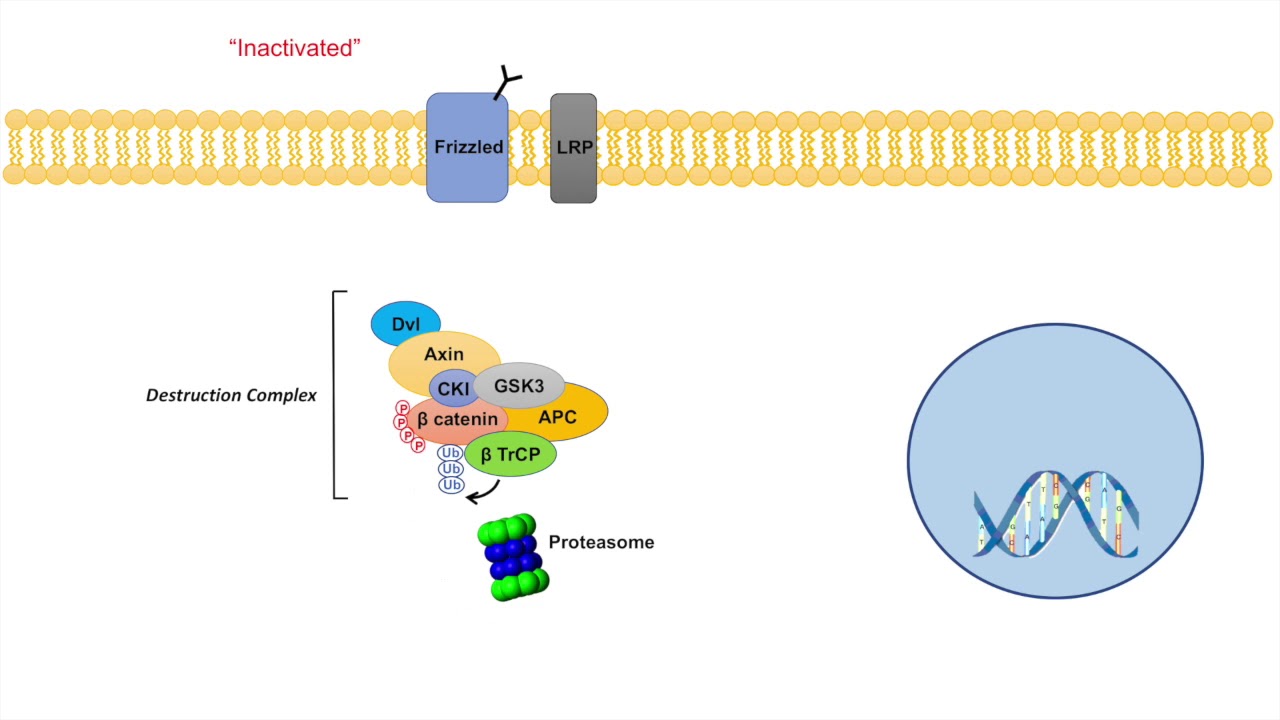
okay so welcome to this next video on the vogelstein model of colorectal carcinoma okay right so we were talking about if we have a complete loss of function of the addendum ators polyposis coli protein then we wouldn't be able to make functional etiquette in in destruction complexes and basically that will cause the cell to completely over divide so how do we actually get complete loss of function of a b c well you have to remember the fact that in every cell your body you have two APC genes because you have two homologous chromosomes with the
APC gene on okay so let's say this is the APC gene well you have two copies of it basically so if you are going to lose complete function of APC then you need something to affect both of these genes and stop them working so you need a loss-of-function mutation in both of the APC genes so a cell in the colon has to be unlucky enough to suffer loss of function mutations in both of them otherwise basically if one of them is still intact that will produce a B C and you'll still have some functional APC
and maybe just the expression of that single intact gene will just be increased so that the APC content in the cell is exactly the same as it would have been even if the cell hasn't undergone the first mutation so in order to get lots of the APC function you have to take out both these genes have to suffer two loss of function mutations on both the APC genes he need loss of function mutations so how could you guess a loss of function mutation well maybe you could have the gene completely deleted that's a possibility so
deletion of the gene is a way you can get loss of function also an actual mutation that leads to the proteins still being made but the protein no longer actually functions as part of the btik Athenian destruction complex so some sort of mutation that leads to a dysfunctional protein rotation needs to dysfunctional protein or potentially you could get some mutation in the promoter region of the gene which means that the expression of the gene goes completely down to zero that with also function to if your loss of function so maybe a mutation in the promoter
regions there's lots of ways you could get also function mutations okay but if you are going to get a problem you need to have both of these APC genes knocked out so you need the loss of function in both genes and that is going to be a rare event because if you think back to our color code on that the helium here okay what needs to happen is in one of these cells on this COBOL epithelium this double loss of APC needs to occur basically so let's say it's this curve on they can defeat yourself
but the actual chance of it's suffering mutations in both of the APC genes is low if you think about you know all the mutations that could happen the chance that you're going to get both of those specifically is very low so it takes a long time it's very unlikely but if it happens what's going to happen so let's say this specific colon epithelial cell here has undergone this loss of function mutation in both of them it was unlucky enough to suffer a loss of function mutation in both of the APC genes then what's going to
happen well it's going to lead to that self totally over dividing so basically what's going to happen is you're going to get loads of these green cells okay so it's going to produce a whole population of green cells that are genetically identical to it so they all have loss of function of ABC's you making more more of them so all its daughters as well we wanted to fight as well so going to end up with this large mass of cells which all have lost the function in this APC gene both of the APC genes that
are all genetically identical to each other so you end up with this large mass of cells which have all both were also all lost both the function in both their ABC teams now this mass of cells is known as an early adenoma and at the moment I want to stress this is not cancer at the moment this is a benign tumor so the tumor basically just means a mass of a mass of cells the tumor is not necessarily cancer to be cancer you have to be invasive and metastatic you have to be destroying the normal
cells these cells are not destroying the healthy tissue they're just growing out basically you've just got on mass of them but they are not destroying the normal tissue so they are not yet cancer so they are a benign tumor at the moment so benign tumor just means a mass of cells that's new but which are not yet cancerous so they're not attacking the healthy tissue yet so this is an early adenoma and it's an example of a benign tumor okay right so now the next stage happens so this is our first stage we form this
early other Noma so one cell in the colon epithelium is unlucky enough to gain this double whack on it's ABC genes and then it produces an early adenoma now you've also have your large population of cells here what happens next is one of them is unlucky enough to get another mutation so out of these green cells one of them is unlucky enough to go through the next stage of the process of going towards colorectal carcinoma and the next stage is to get again the function in a protein known as K wrasse okay so we now
need to discuss what hey Russ does and for this we need to look at the growth factor receptor pathway but we'll do that in the next video