Thank you to Squarespace for Supporting PBS. I’m going to tell you about the craziest proposal for an astrophysics mission that has a good chance of actually happening. A train of spacecraft sailing the sun’s light to a magical point out there in space where the Sun’s own gravity turns it into a gigantic lens.
What could such a solar-system-sized telescope see? Pretty much anything. But definitely it could map the surfaces of alien worlds.
Thanks to the Kepler mission, we now know that there are billions of extrasolar planets - exoplanets - in our galaxy. And we’re learning a ton about them - for example, we’ve figured out that there are 40 billion or so Earth-like planets, at least in terms of size and mass. Of course if we want to find life or actually visit these planets it’d be nice to know a bit more than that.
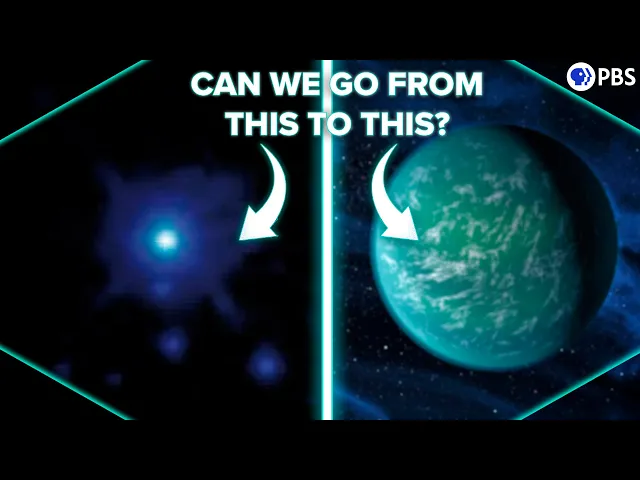
The James Webb Space Telescope is helping - it can detect different molecules in the atmospheres of exoplanets a bit larger than the Earth. JWST will even take images of some exoplanets. But those images will never reveal anything more than a single dot in orbit around a star.
If we find evidence for life, we’re going to want to study it in detail - ideally with images of the planetary surface. And if we ever want to visit one of these exoplanets, it sure would be nice to know what lies at the end of such a many-decade journey. But resolving the surface features of an exoplanet seems pretty impossible.
There’s an absolute limit to the resolving power of any telescope, and it depends on size. Bigger is always better. When light passes into a telescope, its wave nature interacts with the edges of the aperture, causing diffraction, and that blurs the focus of the mirror or lens.
The bigger the aperture, the smaller that blur. A telescope’s diffraction limit is the best possible resolution it can achieve. If you try to create an image of anything smaller than this limit, it will always get blurred to the size of the diffraction limit.
That’s a problem, because planets are pretty small when you’re trying to see them from many light years away. For example, to see a planet 100 light years away as anything more than a dot you’d need a telescope way bigger than New York City. You might recall these pictures of the black holes in the M31 galaxy and the center of the Milky Way.
These were taken by bringing together radio signals from telescopes all across the planet, effectively giving us a planet-sized telescope with a tiny diffraction limit. We are not yet able to repeat this trick with visible light because this requires exact measurement of the arrival time and phase of the electromagnetic wave - which gets harder the shorter the wavelength. But there is one way to take a direct image of an exoplanet in visible light that could reveal it’s detailed surface features.
And that’s by sending a spaceship. Not TO the planet - that would take way too long. In fact, it’s by sending a spaceship in the opposite direction.
If you travel directly along the line connecting your favorite exoplanet and the Sun, but away from them both, you’ll reach this spot where light rays from the exoplanet are bent inwards by the Sun’s gravitational field to all come together. Forget about a New York sized telescope - at this spot, we have a star-sized telescope. The result is an amplification of the brightness of the exoplanet by a factor of a trillion, and a magnification of the surface details by a factor of 100 billion.
The technical name for this location of incredible light-converging power is the locus of focus hocus pocus. LFHP. OK, that’s just what it should be called.
For some reasons scientists went with SGLF - solar gravitational lens focal region - missed opportunity if you ask me. But if we can get a telescope into the “SGLF”, then we could start making detailed desk globes of alien worlds. Let’s talk about how we might actually achieve this.
Because the plan is further along than you might think. Actually, first let’s review gravitational lensing. Einstein’s general theory of relativity tells us that gravity is due to curvature in the fabric of spacetime due to massive objects.
But that curvature also bends the path of light. You know what also bends light? Lenses.
So a gravitational field can also act like a lens, although admittedly a kind of crappy one. Regular lenses are designed to bring light from the same point to a single focus point, allowing an image to be formed. Gravitational lenses produce highly distorted images, like these stretched out galaxies seen through the gravitational field of a giant galaxy cluster.
If the alignment is close enough, we can see an Einstein Ring, like this galaxy being lensed by an intervening galaxy. The sun also has a gravitational field that would create an Einstein ring of any distant object - including an exoplanet - as long as you were watching from the correct location. Let’s just imagine that we can find that location.
So let's imagine we can find that location. As I mentioned, you'd catch something like a trillion times more light from the exoplanet, making it possible to even see the thing in the first place. And the planet's surface area would be expanded by a factor of around 100 billion.
If only it were possible to remove the distortion we could map that surface in intricate detail. Well, it’s not only possible. It’s kind of easy.
Gravitational lens images pretty messy. For example, here are some simulations of distant galaxies that have been lensed by a second galaxy much closer to us. The detailed structure is scrambled.
But this is what you get when you try to reconstruct the original galaxy. The results are remarkably close to the originals. We can go into the details of this process another time.
And we should, because it’s a big part of my own research. But not today. Today we’re looking for aliens.
If it’s possible to reconstruct the image from a messy galaxy lens, then it’s completely straightforward to do it with the very clean, well-understood gravitational field of our Sun. All we need to do is get our telescope to the right spot. Unfortunately that spot is pretty far away.
Like,10 times the distance of Pluto, or well over 500 times the Earth’s orbital radius. Around 550 “astronomical units” or “AUs” in astronomer-speak. For comparison, Voyager 1 is our most distant probe.
It’s been traveling for 45 years and is now around 150 astronomical units from the Sun. To get a telescope to the SGLF we’d want it to travel a bit faster than that. So the researchers outline two possibilities in their report to NASA: one is the “flagship” model, in which a single craft with a 1-2 meter telescope is sent to do the work.
The second is the string of pearls option, in which many so-called small-sats are sent in a long train, each riding on the light of the sun with a solar sail. That second seems the preferred option, and it’s alway way cooler, so let’s talk about that. Just as regular sails accelerate a ship by catching the momentum of the wind, solar sails catch the momentum of light - of photons from the Sun.
More traditional propulsion methods that carry their own fuel have hard constraints on payload size and acceleration period because they’re weighed down by their own fuel supply. But a solar sailing vessel doesn’t carry fuel, making them great options for long-range missions. And this isn’t even some sci-fi far-future tech.
In 2010 the Japanese space agency sent the IKAROS probe to Venus using a 20 meter solar sail, and plenty more solar sails missions are in the design phase. But getting to 550 astronomical units would be the most ambitious among these. In order to reach the destination during the working lifetime of at least some of the astronomers and engineers who witness the launch we need a travel time of 25-30 years.
So our spacecraft need an average speed of more than 100 km/s - several times faster than Voyager. We’d want each craft to be very light - ideally under 100 kg. But with advanced modern materials that seems possible.
Even with that mass, the solar sail would need to be enormous - with more surface area than a football stadium. Unfurling and then controlling such a giant sail is very difficult, so the scientists are proposing an advanced solar sail design called the SunVane - multiple controllable sail panels mounted along the narrow structure of the craft. These sails would need to be made of some advanced, low-density metal alloy that’s A) highly reflective, B) has a high melting temperature because, as we’ll see, it actually gets very close to the Sun, and C) is only a few hundred atoms thick so it doesn’t blow out our mass budget.
Solar sails experience more acceleration the closer they are to the Sun. To reach the speeds we need, our spacecraft can’t start their outward journey from the Earth - they needs to get closer to the Sun first. This is how the proposed mission would play out.
Our spacecraft starts out by launching backwards compared to Earth’s orbital direction, using sails to slow down and sort of tack inwards. They speeds up rapidly plummeting towards the Sun, ideally at around a quarter of Mercury’s orbital radius, assuming we can make the things sufficiently heat resistant. Then the craft then whip around the Sun and set their sails squarely against that intense up-close solar radiation.
That propels the craft on a trajectory that will take them out of the solar system and towards our first image of an exoplanet. Hitting the right spot is a feat of incredible astro-navigation and maneuvering. The solar gravitational lens focal range is indeed a range.
While a regular lens creates a focal point, the Sun’s gravitational field creates a focal line, starting at 550 astronomical units, and extending indefinitely, with the Einstein ring getting wider and more diffuse the further you go. The column for an Earth-sized exoplanet at 100 LY is only 1. 3 km across, so this really is like threading very, very tiny a needle.
To hit the right spot the craft will maneuver with tiny ion thrusters. Once in the zone, the craft deploys its telescope. One possibility is that multiple craft will assemble into a larger scope.
It may even be possible to repurpose the light sail as a mirror, if we want to get really clever about this. Once in place, our telescope just needs to point back at the Sun and take an image of the faint einstein ring surrounding it. You might note an issue here.
The last thing you ever want to do with a telescope is to point it at the Sun - that’s a great way to fry your camera - and good luck seeing anything next to the Sun’s intense glare. To deal with this our telescope will use a coronagraph - a giant circular mask that’ll block the Sun’s light. From any one location within the focal column, the newly deployed telescope will see an Einstein ring formed from a single tiny patch on the surface of the planet, only 10km across.
In order to see the entire planet it’ll have to move around the focal column, mapping the surface one patch at a time. The ion thrusters come into play here also. On top of this, the entire Einstein ring will be moving due to the motion of the exoplanet but also due to the wobble of the Sun as its tugged by the planets of our solar system.
Our telescope is going to execute this shifting pirouette as it races away from the Sun, and that entire dance will have to be performed without any guidance from Earth due to the several day light travel time back to Earth. As you might have noticed, our spacecraft have no way of actually stopping. But that’s OK.
The long focal line means that an Einstein ring will be visible for years of travel time, slowly expanding outwards as we get further from the Sun. Remember that the scientists called this a string of pearls. That first cluster of craft was the first pearl.
Even if that wave doesn’t get it quite right, its data will help the next pearl learn, which will be following in about a years time. And improved positioning and observing strategies will flow down the string of pearls. Over time, the image that the train of spacecraft sends back to Earth will get clearer and clearer.
It should be possible to achieve a resolution of around 25 km on the surface of an exoplanet 100 LY away. We could map coastlines, see islands and mountain ranges and lakes and ice caps and even vegetation - all of which we may be able to distinguish from their colours. And if we spot bright points of light on the planet’s night side - aka cities - that would be pretty compelling evidence of a technological civilization.
And over time we’ll see changes in all of this. That means we can remove cloud cover, track the change from day to night, see seasonal and tidal and changes, and even changes due to the activity of life. Every exoplanet that we want to image requires a new fleet.
That sounds like a lot, but remember that we build dedicated spacecraft for each of our solar system’s planets - usually more than one of them. And these little small-sats are designed to be cheap, so hopefully we’ll eventually be able to do this for many exoplanets. And, actually, for distant galaxies and black holes and literally anything else for which we want extreme resolution imaging.
Maybe this all sounds a bit out there. But all of the technology involved is either existent, or in the development phase. Nothing seems like a dealbreaker.
There is no funded mission yet, but the scientists involved have been advanced to the phase 3 stage by the NAIA program. The step after that, hopefully, is for the mission to be picked up by NASA. We’ll let you know how that goes.
But it’s crazy to imagine that within our lifetimes we may have mapped in detail the surfaces of distant worlds, brought into focus by our own Sun and its lens of curved spacetime. Thank you to Squarespace for Supporting PBS. Squarespace is a website building and hosting company.
With Squarespace, you can connect with your audience and generate revenue through gated, members-only content. Users can manage members, send email communications and leverage audience insights all in one platform. But one of their best features is their collection of website templates.
They have templates for all types of websites including media & podcast, restaurants, community and non-profits, as well great photography templates. So if you wanted to display your astrophotography, you could easily build a great portfolio site using squarespace. Go to Squarespace.
com for a free trial. Hey Everyone before we get to comments I want to let you know that this “It’s never Aliens” t-shirt is now available at our merch store at PBSspacetime. com.
It’s a great way to support the show and let everyone in your immediate patch of Space Time know that it’s never aliens until it is at any rate. There’s a link to the merch store in the description. And speaking of support, we’d like to thank all of our supporters on Patreon.
Today we have a very special shoutout to Vikram and Sujasha Vaka, who are both supporting us at the quasar level. Guys, we wanted to show our appreciation by naming something cool after you. Well, assuming that the whole solar gravitational lens thing pans out, we’re going to have countless geographical features on alien worlds that’ll need naming.
We’ll try to get you guys a supercontinent or an ocean or something nice like that. But, while you wait for your alien geography, you have our heartfelt thanks for this generous support Today we’re doing comments for the last two episodes; the one on how to use the James Webb space telescope, and the one were we talked about the mysterious meaning of the fine structure constant. AJMansfield asks whether JWST also have a program for doing just, whatever incidental extra observations that can be packed in with whatever the proposal is doing?
And the answer is yes it does. There’s a special type of proposal for so-called parallel observations. Each primary observation uses one of the telescopes instruments.
Parallel observations just turn on one or more of the telescope’s other detectors. These collect data a little off the field of the primary observation. Sometimes these happen to land on a useful object, and sometimes they’re more blind surveys.
NASA is very careful to squeeze every bit of value out of the telescope that they can. Lyle Goodwin asks if the JWST completely supercedes the Hubble. Well this is a great question, and one I should have addressed.
Actually no - Hubble was most sensitive at visible and ultraviolet wavelengths, while JWST is an infrared scope. These are very different instruments and Hubble is still invaluable. David Hauka asks how long did it take for the fine structure constant to drop to its minimum value of 1/137 after the Big Bang.
First let me say that in the extremely early, the 3 quantum forces were coupled with a high joint interaction strength. However it’s really only meaningful to talk about the fine structure constant later on because it is the coupling strength of electromagnetism, which didn’t exist at very early times. About a trillionth of a second after the big bang the EM force separated from the weak force, and then the fine structure constant was within 10% of its current value, and quickly approached 1/137 as the universe cooled.
By the time fhe first stars were formed ti was essentially as it is today. Radoslaw Garbacz ask What does exactly "energy of interaction" mean? Well this is just the amount of energy available in a particle interaction for the creation of the interaction products.
It comes from particle kinetic energy, photon energy, even particle rest mass. The energy liberated in the interaction effectively raises the temperature of that tiny patch of space, and that can change the way the quantum fields behave - including raising the fine structure constant. We routinely reach temperatures where the fine structure constant changes in our particle accelerators.
After all, we recreate the energies of the electroweak era, when the fine structure constant isn’t even relevant. There aren’t many natural places in the universe where this happens today. Not in the centers of stars or accretion disks.
But perhaps in the cores of neutron stars could get there. Also some transient phenomena - like supernovae, or cosmic ray collisions. deathw8sf0rno1 asks, If the fine structure constant wasn't constant (like during the big bang), wouldn't the relationship between the other constants also be different during that time?
Well yes! The fine structure constant is defined as the electron charge squared divided by 4pi time the vacuum permittivity the Planck constant times the speed of light. If the fine structure constant was different then one or more of these other constants would have to be different also.
Could the Planck constant or the speed of light change? In principle, maybe, but the most natural thing to change is the ratio of the electric charge squared to vacuum permittivity. Remember that the find structure constant represents the strength of electromagnetism, and the classical equation for electrostatic force - coulomb’s law - has charge squared over permittivity.
So changing these changes the strength of that force, which is the right effect. Michael Niles speculates that the fine structure constant was set when the 4D experimentalists coding our universe meant to type "1337" for the seed phrase and made a typo. Look, if this is true then we should expect other leet-speak messages in other constants.
I looked, extensively and didn’t find anything. Bit then I realized that pi is an irrational number with infinite digits, which means if you look far enough it says “LOL noobs”. Infinite times.