hello welcome to the a Dallas's educational video series in this video we're gonna look at the best ad testing metrics for your PPC account based upon what you want to accomplish one of the issues we run into as we look at all of our data it's really difficult at times it's how which ad we should be choosing we may have one end that's a winner in CTR another in conversion rate a different one and cost per conversion so we're gonna look to these metrics to see which one you should be choosing based upon what you
want your PPC account to accomplish so we look at what metrics apply to ads we have impressions how often it's displayed we have clicks how often is clicked on conversions cost and sale amounts these five metrics are generally used to derive then your click-through rate conversion rates and so forth so let's look up the derived metrics to see what metrics are actually using and then where they have failures so we look at click-through rate it's a simple formula clicks divided by impressions so it's only using two of your five metrics so it's ignoring the quality
of the click itself so click the rate it's a really common a testing metric but it's got a lot of problems with it because if you've got one ad with a really high CTR and a really high bounce rate a different ad with a lower CTR but a much lower bounce rate your lower CTR ad is actually bringing more qualified users to your sites regardless of the actual conversions and so forth so CTR is rarely a good metric to use unless you're purely focused on quality score next we have conversion rate so this is just
a simple formula of your conversions divided by clicks so now we're ignoring opportunity which is impressions CPC our sale amounts so conversion rates again don't look at how often someone comes to your site which is your overall impression based data combined with clicks next we have CPA or cost per acquisition cost per conversion this is cost divided by conversions we're again ignoring impressions and click so how often someone comes to our site and sale amounts so while sometimes you want to work towards a specific CPA in the account that's often more bidding or an ad
testing it can be a filter when used with other metrics which will address in a moment next we have row us over turn on ad spend so this looks like your total sale amounts your revenue data divided by cost so again we're ignoring how many people are buying right which is our convert overall conversions so if you have one click one sale one it was really high check out another ad that's got a lot of clicks a lot of sales but lower checkouts your ad that's bringing in more revenue would actually have a lower row
us so when we look at these metrics here's sort of the problem right we have one ad winner by CPA and conversion rate a different ad whenever I click the rate so what's better a high click through rate ad with a lower conversion rate or a lower click the rate ad with a higher conversion rate and so that's what we want to really address with some additional ad metrics we can use so we think about opportunity of conversion this is at the impression level you chose a keyword every time someone searched for your keyword you
have a chance for a conversion so moving up our testing metrics to the impression level takes advantage of entire volume of conversions that's possible now it should accommodate cost and sales when possible so when lead-gen you could accommodate cost and your average CPC is but looking at your CPA data in e-commerce you can look at your actual revenue and this determines your row washing or ROI numbers now actual revenue is nice for lead gen but sometimes it's not possible especially if I a six-month or two-year sales cycle so we want to think about our cost
and sales that are also brought in by our ads so this leads us to one of our first metrics that's impression based which is conversions divided by impressions because it looks at impressions and clicks which is CTR and clicks and conversions which is conversion rate conversion per impression says this ad will get the most conversions out of the number of impressions available so when you want most conversions possible and you have these mixed metrics high CTR low conversion rate low CTR high conversion rate conversion per impression blends click-through rate and conversion rate together with one
simple formula so if we then go back to our ad test and we say ok well let's just take our conversions divided by impressions it turns out our winning ad is actually number two it's the second best click-through rate it's the second best conversion rate in an aggregate when that particular ad is displayed you have a higher chance of a conversion than either one of the other ads and so that's where conversion per impression it gives you a better view of how likely someone is to convert after just searching for your business now of course
the one downside to CPI our conversion per impression is we are ignoring our CPC and cost data so revenue per impression looks at here's all the sales we made the actual sale amounts themselves and divides it by impressions so now we're using click the rate conversion rate average CPC s.r.o us so forth because we're using all five of our metrics to determine revenue per impression so this is also a really simple formula to do revenue total revenue that ad brought in divided by that impressions in this example ad 1 when it's displayed makes 286 ad
to makes 73 cents at 3 makes 221 well every time an ad is displayed making 286 is definitely about on the other two numbers there's your winning ad from a revenue standpoint now we can move even further in some cases so your profit is your revenue minus your cost divided by impressions so cost data can at least be the cost of the ads if you have cost of hard goods you can push that information back and now you're taking your entire revenue minus your ad costs minus your cost of goods divided by impressions so most
systems will use revenue minus ad cost divided by impressions that can easily be automated cost of hard goods pushing it back as a little more difficult so then if we again take a look at our numbers and we're doing revenue at minus or ad costs we see a very different picture suddenly of this particular Adsense ad 3 is leading to very very small average sale amounts and it has such a poor quality score and click-through rate that it has a much higher CPC in cost than some of the other ads it's not unusual sometimes find
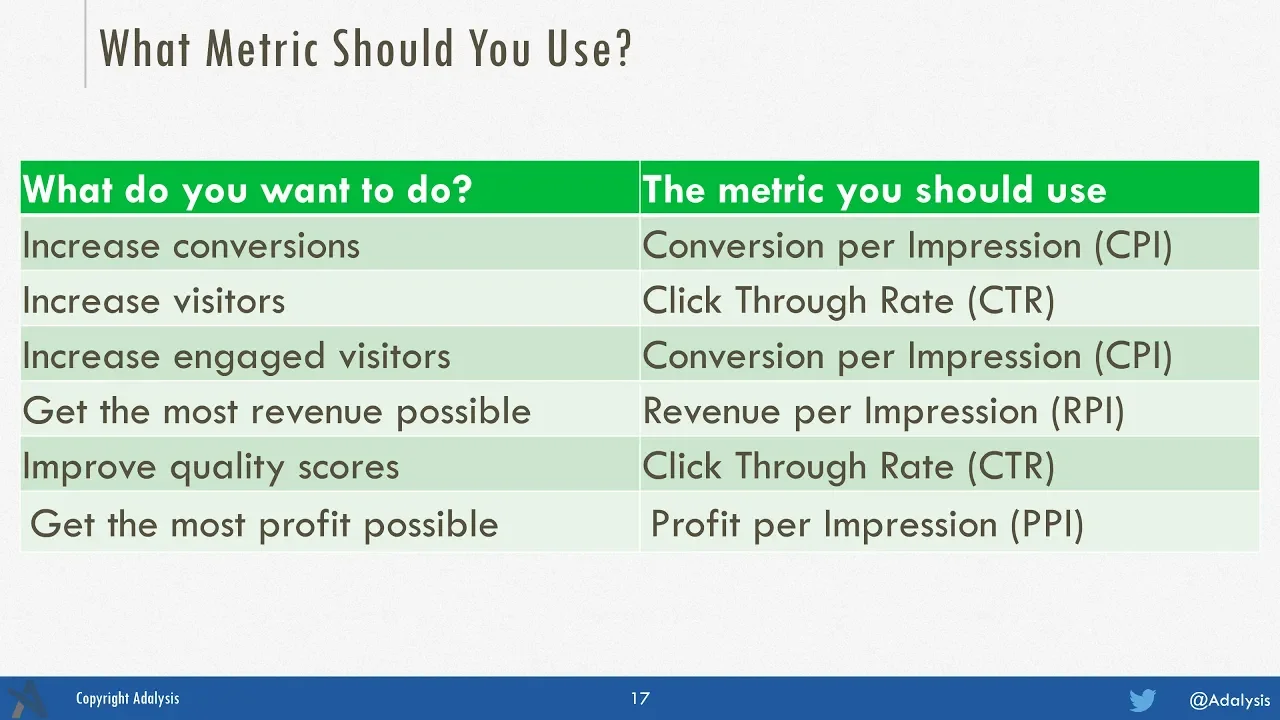
an ad where it cpc's are significantly higher than other ads and so using profit per impression revenue minus cost of auto buy impressions will use all the metrics including your ad cost and potentially cost of hard goods so what metrics you do use so if your goal is most conversions possible that's conversion per impression real simple formula if it's the most visitors that's click-through rate now if it's the most engaged visitors then you'll define a conversion as a three minute website visit 30 seconds of video watch two plus pages on your site make a conversion
goal and now you go back to conversion per impression your conversion it's just an interaction metric as opposed to an actual lead form being filled out or an e-commerce buy if you want the most revenue possible you use revenue per impression eath your goal is purely improving quality scores CTR is one to use CTR is a very good tie breaker because the more clicks you get the more people in your audiences and so forth so if you've got two ads almost identical CTR is a good tie breaker if you want the most profit possible that
be profit per impression now sometimes you have metrics you must hit you must have a 400% robust or a $32 CPA in the case like that we would look at our ads Hess would say okay we want the most conversions possible but we must have a $32 CPA or less so than any ad above that target gets xed out just filtered out then among the ads below your target which is the highest conversion per impression that's your winner so using Ross or CPA is filter metrics that these ads cannot win and then your highest conversion
per impression and revenue per impression really lets you take advantage of the entire search opportunity by showing the best ad possible for every impression out there you can do this math yourself you can use a system like ad alysus which will automatically figure out all these metrics and alert you when you have statistical significance in one of these chosen at testing metrics so hope you've enjoyed this short video on choosing the best ad testing metrics for your PPC account