Hello. I'm Terry Fisher. This is the third in a series of twelve lectures on copyright.
The topics of the lectures are set forth on your screen. In the first, I examined the foundations of copyright, specifically the set of treaties that cause considerable convergence in the copyright systems in various countries of the world. The concept of originality, and the so-called idea expression distinction.
In the second lecture, I discussed two of the four main theories of copyright, the fairness and the personality theories. In this lecture, I put theory to the side and return to the law, focusing on the subject matter of copyright, the kinds of things that copyright law applies to. You can see from the slide where we're going after this.
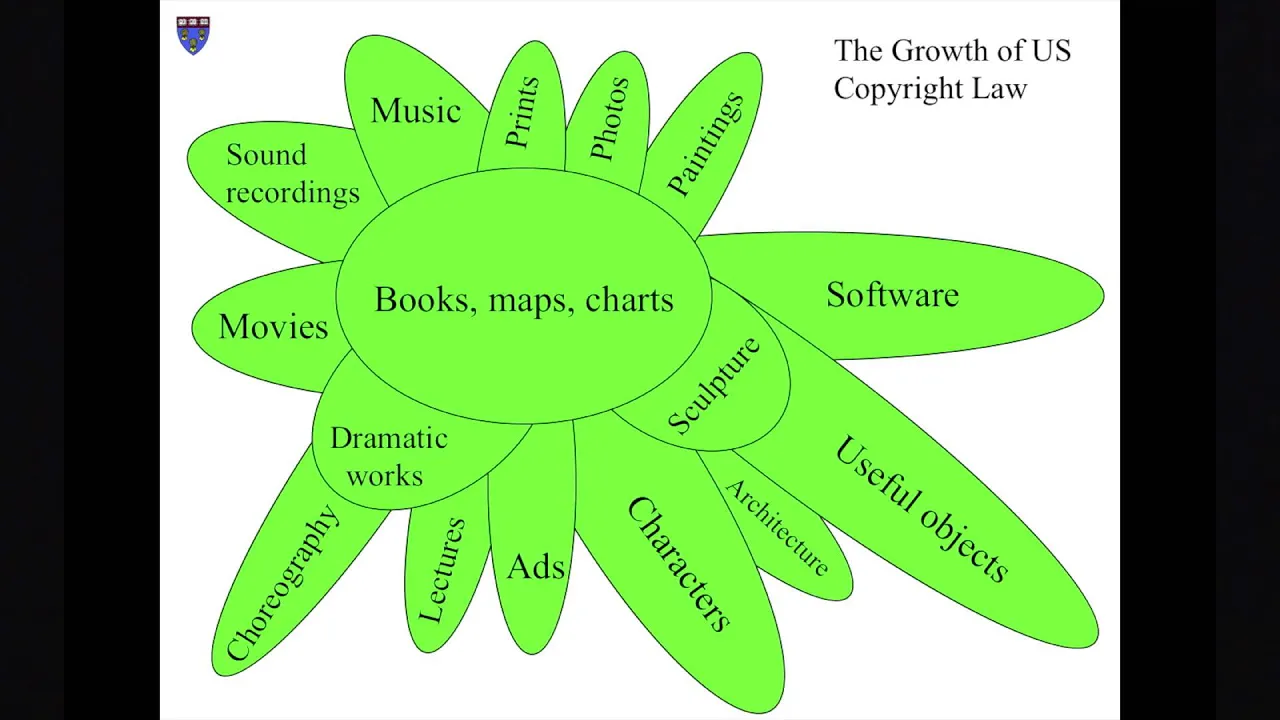
There are two main themes to this lecture. First, the subject matter coverage of copyright law has grown dramatically over the years, and is now a good deal larger than you might think. Certainly it reaches far beyond its core, namely fine art and literature.
Second, copyright law is not unitary or homogeneous. Rather, the rules governing the different kinds of things now subject to copyright protection vary considerably. Partly as a result, the business models associated with the different kinds of works also vary.
This second theme I refer to as the disaggregation of copyright. I'll begin to develop it in this lecture, but it will figure in future lectures as well. As usual, the lecture will be accompanied by a fair amount of illustrative graphic material.
So I hope you're watching this recording on a computer or a device with a reasonably sized screen. One source of illustrative material will be a map, which summarizes the main features of the US Copyright system, and some ways in which the copyright law in other countries differs from the US model. An interactive PDF copy of that map can be downloaded from my home page, the address of which is tfisher.
org. I'll begin with a brief overview of the history of the subject matter coverage of copyright, and then start over and examine each of the sectors in more detail. US copyright law originates in a 1790 federal statute.
Only three kinds of works were protected under the original statute-- books, maps, and charts. Over the course of the 19th and 20th centuries, Congress and the courts cooperated in expanding the set of protected creations. Prints were added by statute in 1802.
Musical compositions added in 1831. Drmatic works, in effect, were added to the cluster by an 1856 statute which granted the owners of copyrights in books the right to control public performance of their works, which is the only form of protection truly valuable to playwrights. This extension was confirmed by subsequent statutory amendments.
Photographs were added by statute in 1865, as we saw in the first of the lectures in this series. In 1883, in the Burrow-Giles case, the Supreme Court rejected a constitutional challenge to the addition of photography, but only because this posed studio photo of Oscar Wilde was, in the court's judgment, a quote "useful, new, harmonious, characteristic and graceful picture". Gradually, the aesthetic requirement implicit in this ruling was softened, and copyright protection was tacitly extended to photographs of all sorts.
Paintings and drawings were added to the set of protected works in 1870, as were statues-- meaning three-dimensional works of fine art-- a type of work later subsumbed into the broader category of works of art and reproductions of works of art. Around the turn of the century, advertisements were accepted into the fold. During the 19th century, courts had generally been hostile to the extension of copyrights to ads, on the ground that they did nothing to quote "stimulate original investigation, whether in literature science, or art, for the betterment of the people".
This skeptical position was rejected by Justice Holmes in the Bleistein case, which was also discussed in lecture number one. Bleistein, as you'll recall, extended copyright protection to a circus poster. Holmes reasoned, quote "a picture is nonetheless a picture, and nonetheless a subject of copyright, that it is used for an advertisement".
Motion pictures were invented by Thomas Edison and his assistant William Dixon in the 1890s. Shown on your screen is a photo of one of the first machines that they developed to view their primitive movies. By 1903, an intermediate appellate court had recognized movies as copyrightable subject matter, a position later confirmed by Congress.
Lectures, sermons, and addresses were added to the list of copyrightable materials by statute in 1909. Subsequently fictional characters and plots were recognized by judicial decisions as objects of protection. This, as you might imagine, is a tricky subject to which we'll return shortly.
A complex series of steps between 1909 and 1954 had the overall effect of extending copyright protection to some useful articles. Which ones, we'll consider in a moment. Sound recordings, as distinct from the compositions they embody, were added to the fold in 1972.
Pantomimes and choreographic works were added as part of the 1976 general reform of the copyright statute. Software was formally added in 1978, although, as we'll see, early forms of protection for software occurred in the 1960s. Last but not least, architecture was grudgingly given special protection by statute in 1990 in response to the United States's belated accession to the Berne Convention.
That's where things stand today. Two gradual, intertwined conceptual shifts underlie this steady expansion of the zone of coverage. The first, which is nicely traced by Oren Bracha, is a movement from a conception of copyright as trade-specific regulation to a conception that sees copyright as founded on the general principle of the right of creators to control their original works.
This change was partially completed in the 1909 general reform of the copyright statute, and fully completed in the 1976 reform. The second of the overall changes, emphasized by Peter Jaszi, is a shift in what copyright is thought to protect, from the text to the work. At the start of the 19th century, lawyers and judges thought that copyright law protected the sequence of words used in a book-- in other words, the text alone-- against verbatim reproduction.
By the early 20th century, by contrast, they thought it shielded the market value of the underlying work, no matter how it was expressed. As we'll see in lecture number seven, the effect of this reconceptualization was to render illegal, for the first time, many forms of unauthorized use, including translations, abridgments, and, perhaps most importantly, motion picture adaptations. Now that we've completed a brief historical overview of the growth of US copyright law during the last two centuries, let's go back and examine in more detail each of the sectors of copyrightable subject matter.
For this purpose, we'll be using the map on copyright law, which I hope is by now familiar to you. As I mentioned, during this survey I'll highlight the ways in which the rules governing the different kinds of things now subject to copyright protection vary, and how, as a result, the business models associated with those types of works also differ. The underlying thesis, to repeat, is that the copyright system is disaggregated.
As the map indicates, the statutory basis for the subject matter coverage of copyright is Section 102 of the federal statute. In the first lecture in this series, we discussed subsection 102(b), which embodies, as we saw there, the idea/expression distinction, and related grounds for excluding work from copyright protection. We now focus on 102(a), which details the kinds of things that copyrighted law includes.
As you can see, the language of 102(a) is capacious. It itemizes various kinds of things that are subject to copyright protection, but it also includes a blanket clause indicating that quote "original works of authorship, of any sort, can be protected". In other words, the itemized list on the left of your screen is non-exhaustive.
The first entry in the itemized list consists of literary works. Such works are often thought to be the heart of copyright protection. Included in this category are many things you would naturally think of as literary.
For example, novels, short stories, poems, newspaper or magazine articles, and so forth. Also included are some less obvious things, such as catalogs, and, as we saw earlier, advertising copy. Last but not least, the term "literary works" is now construed to incorporate computer software.
The history and economic implications of this highly counter-intuitive interpretation are very complicated. Here's a brief introduction to the topic of software, a subject to which we'll return several times. Before plunging into the details of the law, it's important to differentiate the kinds of activities that some-- not all-- software firms hope to curb.
They're listed in the map. The first consists of consumer reproduction of object code. By object code, I mean the collection of ones and zeros that embody the working version of the program.
By consumer reproduction, I mean the behavior of individual software users. So for example, if I borrowed a disc that you had purchased containing PowerPoint or Final Cut Pro and made a copy of one of those programs onto my own laptop hard drive, my behavior would fall into this first category. Commercial reproduction of object code consists of the same conduct on a commercial scale.
The vendors on the streets of Beijing or Rio selling discs containing pirated versions of the Microsoft Office Suite are engaged in commercial reproduction of object code. Much different is the activity of incorporating parts of the source code of a software program into a new program. Source code is the version of the program in a human-readable language, typically the language which was originally written before it was converted or compiled into object code.
Copying portions of the source code is sometimes known as follow-on copying. This behavior includes a wide range of behavior, from the creation of modestly improved versions of existing programs, to the creation of radically new programs that incorporate small bits of existing programs. Fourth and finally, some developers-- not all-- wish to prevent what is sometimes referred to as "non-literal" copying.
This consists of the creation of new programs that have the same structure, sequence, or organization as existing programs, but use none of the code of the existing programs. Suppose, for example, that I created a program that worked exactly like Photoshop, enabling me to compete with Adobe, but I wrote my own code from scratch. My conduct would fall into this fourth category.
The reason for differentiating these four categories is that, as we'll see often during this course, both the legal doctrines and the policy issues that they raise differ considerably. Now let's turn to the law. The history of efforts to use law to discourage or penalize the behaviors I just summarized proceeded roughly as follows.
In the 1950s and '60s, when the computer industry was just getting off the ground, a few integrated firms provided-- typically industrial-- customers both hardware and associated software. These products typically were task-specific, and thus were often customized for each client. The sellers and buyers of software were usually-- though not always-- in contractual privity.
Under this combination of circumstances, the existing law of trade secrecy provided reasonably good protection against competitors. Typically, the software and hardware firms would provide their customers copies of the object code of their programs while retaining the source code. US courts ruled that public distribution of object code did not result in forfeiture of trade secrecy protection, so long as the source code was kept secret and was reasonably hard to reverse engineer.
The combination of trade secret law and the concentrated structure of the software industry made non-permissive copying rare. Gradually, however, the effectiveness of trade secrecy protection diminished. Several factors were at work.
They included the gradual improvement of decompilers, which facilitated reverse engineering, the increased demand from customers for access to source code, and the fact that, in any event, trade secrecy does not inhibit verbatim reproduction of object code, which is made public. Some firms responded to these changing conditions by increasing their reliance on the law of contracts. They began to demand that their customers agree to various contractual restrictions on their ability to reproduce, modify, or redistribute the programs provided to them.
This strategy also worked reasonably well for awhile, but its effectiveness was undermined by two circumstances. First, the firms came increasingly to depend not upon expressed voluntary acceptance of contractual terms by their customers, but instead upon so-called "shrink wrap" or "click-through" licenses. The phrase "shrink-wrapped license" refers to, ostensibly, contractual commitments that were printed on the outside of the boxes that were sold to customers.
A common term provided that, by breaking the cellophane that enclosed the boxes, the buyer agreed to all the other provisions. The validity of such commitments was far from certain. A decades-long struggle to settle this question was, in the end, inconclusive.
If you're curious about the details of that struggle, including the efforts of a group of academics to prevent the modification of the Uniform Commercial Code that would have resolved the matter in favor of the software firms, follow the link in the map associated with the topic Contracts. The second limitation of contracts, from the standpoint of the software firms, grows out of the peculiar structure of the law of federalism in the United States. Briefly, contract law is state law, whereas copyright law is federal law, and under some circumstances, federal law will trump or preempt state law.
Skeptics of contractual limitations on modifications or redistribution of software sometimes challenge those limitations on the grounds that they were preempted. Another struggle, this time over the scope of copyright preemption, ensued. Most of the cases that were fought over this issue eventually upheld contractual limitations against preemption challenges, but the controversy undermined the overall effectiveness of this approach.
By the late 1970s, the structure of the software industry was changing fast. The increased use of integrated circuits and microprocessors made the price of microcomputers drop rapidly. No longer was software produced and sold primarily by the hardware manufacturers.
Instead, separate software firms began manufacturing and distributing both operating systems and application programs designed to run on devices produced by other firms. These changes, combined with increased dissatisfaction with trade secrecy and contracts-- the reasons I just suggested-- prompted some software firms to seek increased protection from the law of copyright. Initially, copyright law was not very hospitable.
To be sure, as early as 1964, the register of copyrights in the United States had expressed a willingness to register copyrights in software, but several uncertainties in the relevant law and procedural hurdles limited usage of this option. As of 1977, a total of only 1,200 programs had been registered, 80% percent of them by either IBM or Burroughs. In 1974, as part of the long ramp-up to the '76 general reform of the copyright statute, Congress created a commission known as CONTU to consider the extent to which copyright protection for software should be clarified and expanded.
The 1976 act itself recognized copyright protection for software, but did not settle all issues. CONTU's 1978 report, which was adopted and implemented by Congress in 1980, cleaned things up. The net result was that software developers came to enjoy, in the United States, all of the entitlements enjoyed by authors of other, more traditional works.
Europe soon followed suit. And finally, copyright protection for software was mandated by the TRIPS Agreement, and is, thus, now close to universal. This is not the end of the story, however.
Copyright protection to not proved to be a panacea, partially confirming the arguments raised by CONTU's critics, who thought copyright protection for software was a bad idea from the beginning. The limitations of copyright prompted a subset of software firms to press for patent protection, first in the United States, then in Europe. They met with only mixed success.
How and why copyright law proved less than ideal is a large and important question, which we'll take up in another lecture.