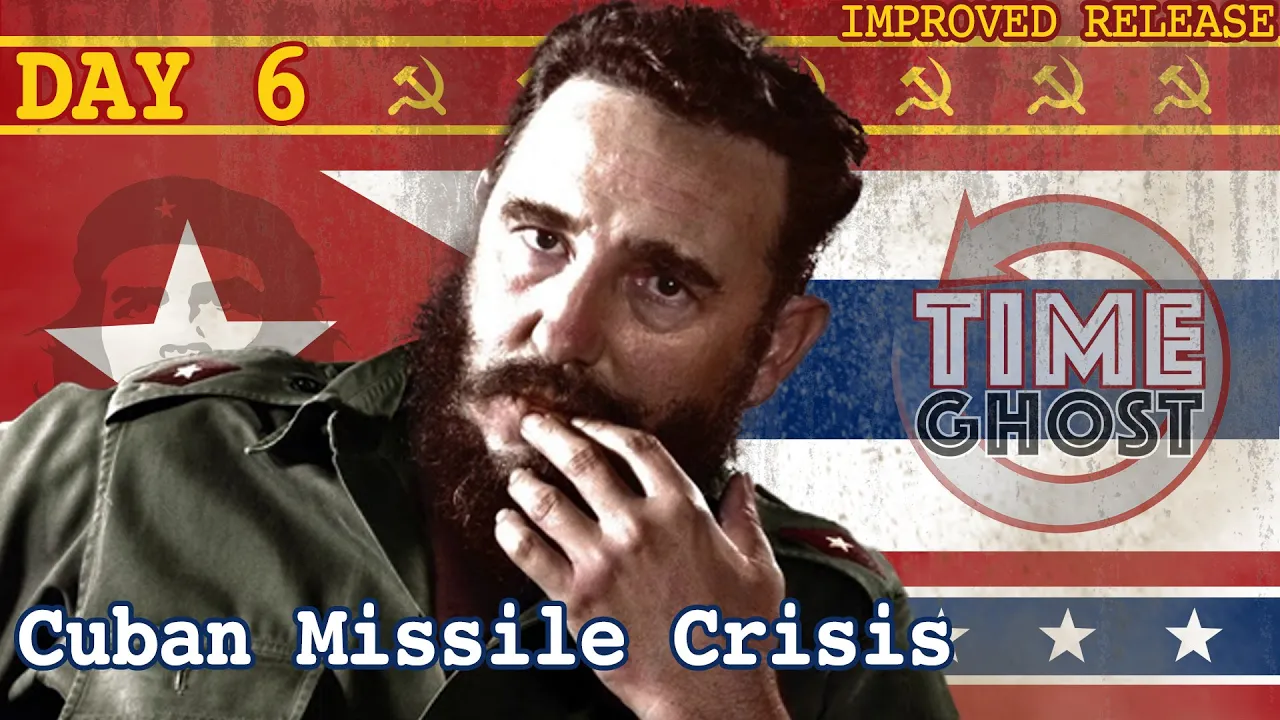
Day 6 Preparing hundreds of thousands troops for war is a complicated thing. Clear and precise directives are an essential part of such adventures, especially when the troops are armed with nukes. Politics on the other hand is fraught with ambiguity and lack of clarity, especially when it involves a potential nuclear war.
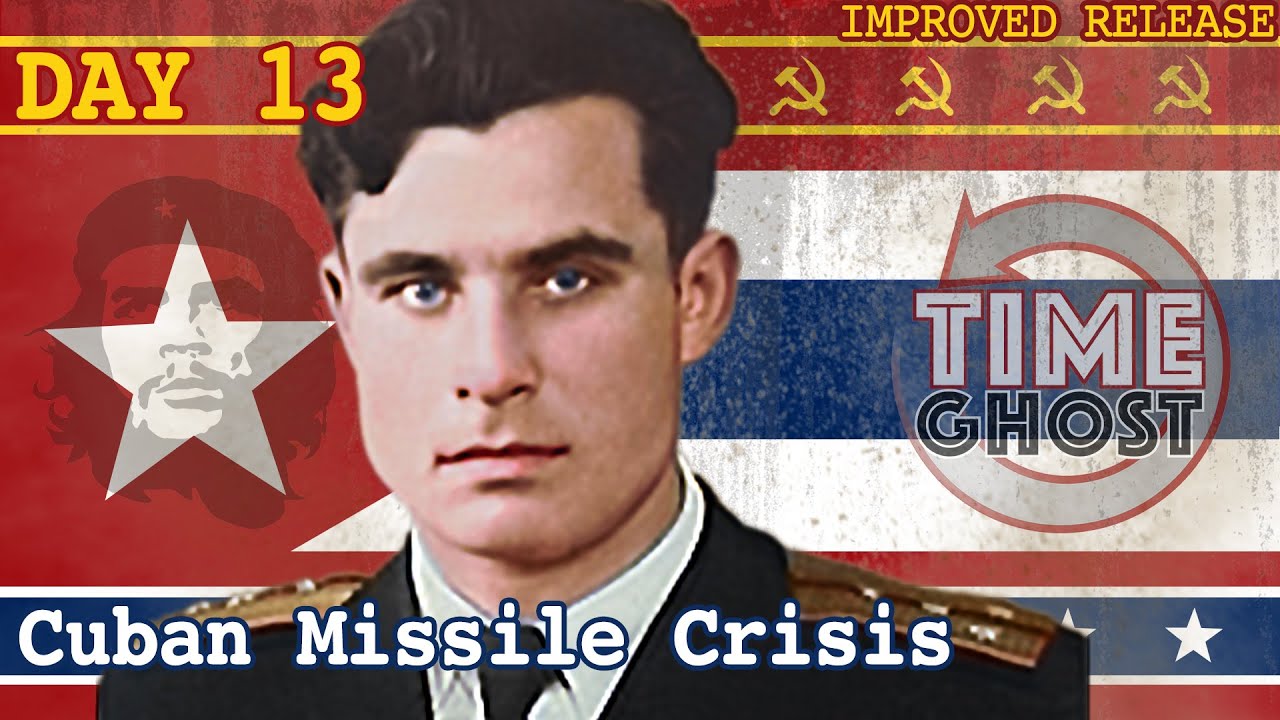
And when military clarity confronts political ambiguity, it has explosive potential! This is TimeGhost, the Cuban Missile Crisis. I’m Indy Neidell.
Yesterday, October 20th, the crisis had heated up significantly when the US administration decided to impose a naval blockade on Cuba beginning tomorrow the 22nd. The Soviets were deeply mistaken in thinking that they had deterred the US from decisive action on Cuba. The preparations for the blockade and for a possible war are underway today, Sunday October 21st, 1962.
It’s virtually impossible to mobilize the armed forces of the United States without someone noticing. All you need are a few people in the right places, observing the movement of people and material to connect the dots. That’s exactly what happens today when the Soviets are alerted to the fact that their assessment yesterday is inaccurate.
Moscow is to start looking at the various scenarios at hand. The central question is how to react in case of an American invasion of Cuba. That they will fight back is clear, but will they use their tactical nuclear arms?
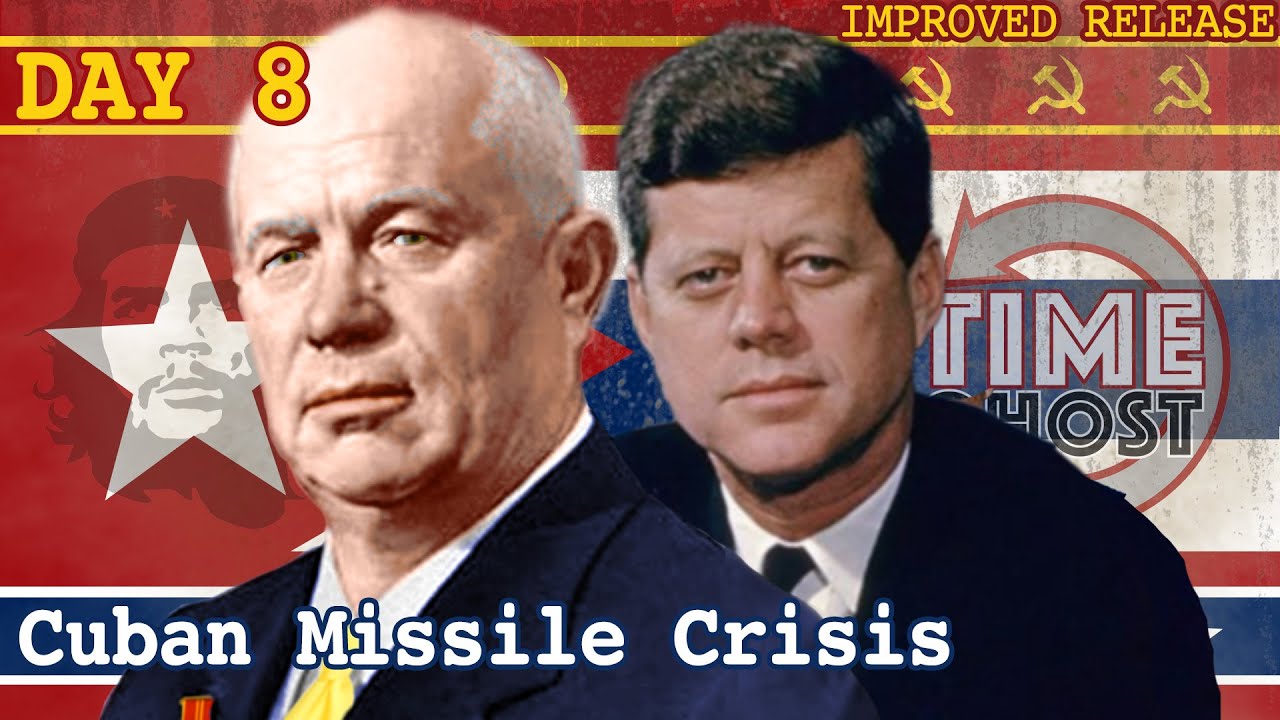
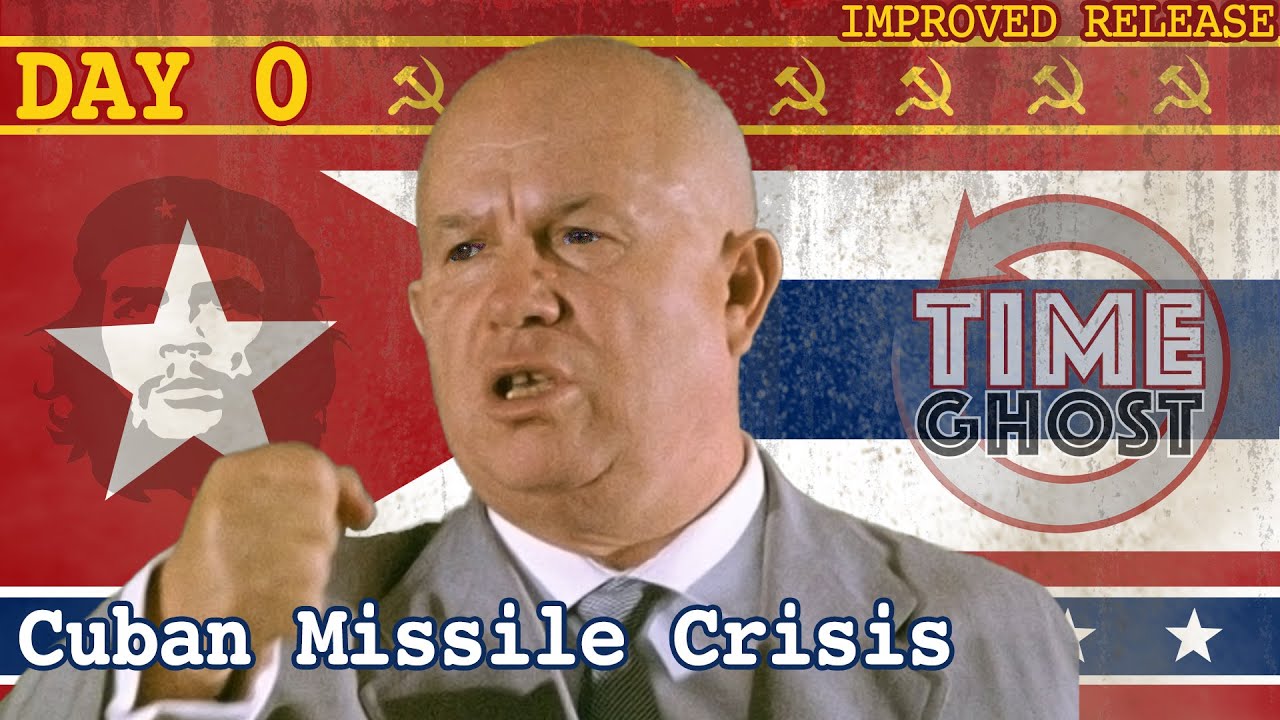
More importantly, will they give their commanders in the field discretion as to when to use those nukes? This is a discussion that has actually been going on for some time. It was already debated in the summer by Soviet leader Nikita Khrushchev and Foreign Minister Andrei Gromyko, the architects of the whole Soviet-missiles-on-Cuba plan, along with Marshal Matvei Zakharov, the Chief of the Soviet General Staff, who argued for allowing the use of tactical nukes in a case of an American invasion.
They met opposition from Deputy Chairman Mikoyan and Defense Minister Marshal Rodion Malinowsky, a veteran of both world wars and the Russian Civil War. Malinowsky is an outstanding military leader who is in the process of turning the Red Army into one of the most fearsome fighting forces ever seen. But he is also an outspoken pacifist and a believer in a conventional defense policy.
To him, nuclear arms should only be used strategically as a deterrent to keep the peace, never on the field. In the end they can’t find common ground, but Khrushchev prevails, or at least he thinks he does. An order is drafted, but when it lands on Malinowsky's desk for signature, he stalls and just leaves it there unsigned, so when the battle orders are formally issued it’s not part of Malinowsky and Zacharov’s signed memorandum.
Unfortunately, the unsigned instructions have already been given orally to most of the commanders on the ground. The verbal briefing is along the lines of how the unsigned order reads: “In a situation of an enemy landing on the island of Cuba… when the destruction of the enemy is delaying [further actions] and there is no possibility of receiving instructions from the USSR Ministry of Defense, you are permitted to make your own decision and to use the nuclear means of the "Luna," IL-28 or FKR-1 as instruments of local warfare for the destruction of the enemy on land, and along the coast in order to achieve the complete destruction of the invaders on the Cuban territory and to defend the Republic of Cuba. ” The Luna missiles can carry a nuclear warhead with an explosive yield as low as 3 kilotons and has high as 200.
The lowest yield would kill about 65,000 and injure almost 250,000 if blown up over Paris- which we’ve used as our model in great detail before. The 200 kiloton bomb would kill over 900,000 people and cause up to 1,8 million further casualties. The Russians have at least seven missiles ready to fire from land and 12 from ships at sea An estimated additional 70 warheads are also in storage together with the strategic warheads.
So, today the Soviet forces have both been ordered to use and to not use these tactical nukes at their own discretion. For now, the Soviet Forces on Cuba remain on alert with tactical nuclear readiness, in a political vacuum. Meanwhile, the US armed forces find themselves in a remarkably similar situation.
As we’ve already seen, President Kennedy has walked a thin line between decisive military actions and diplomatic restraint regarding Cuba for some time. At the famous press conference back on September 13 he said: “If at any time the Communist buildup in Cuba were to endanger or interfere with our security in any way, including our base at Guantanamo, our passage to the Panama Canal, our missile and space activities at Cape Canaveral, or the lives of American citizens in this country, or if Cuba should ever attempt to export its aggressive purposes by force or the threat of force against any nation in this hemisphere, or become an offensive military base of significant capacity for the Soviet Union, then this country will do whatever must be done to protect its own security and that of its allies. ” He doesn’t explain what exactly he will do when faced by such a threat, but says: “We shall neither initiate nor permit aggression in this hemisphere.
With this in mind, while I recognize that rash talk is cheap, particularly on the part of those who do not have the responsibility, I would hope that the future record will show that the only people talking about a war or an invasion at this time are the Communist spokesmen in Moscow and Havana, and that the American people defending as we do so much of the free world, will in this nuclear age, as they have in the past, keep both their nerve and their head. ” That leaves a lot of room for interpretation and one journalist asks: […] at what point do you determine that the buildup in Cuba has lost its defensive character and become offensive? Would it take an overt act?
[…] when we talked about the presence of offensive military missile capacity or development of military bases and other indications which I gave last week, all those would, of course, indicate a change in the nature of the threat. In another answer, he diplomatically sums up the ambiguous situation he’s stuck in: […] the United States will not take any action that the situation does not require and will take whatever action the situation does require along the grounds which I indicated in my opening statement. Kennedy is trying his best to satisfy everyone and still stay his own preferred course by not getting involved in another embarrassing adventure on Cuba like the Bay of Pigs Invasion, but the situation he has tried so hard to avoid is now facing him.
After all that’s been said, after all the actions that have been taken, and with all the pressure that Kennedy faces both at home and abroad, he believes that the blockade, or quarantine as they call it, is the compromise that will allow him to avoid a war. He hopes that the Soviets will back down; he also hopes that he can reign in his own hawks who are pressing hard for an invasion or at least air strikes as a show of force. In fact, he has set a machine into motion that is almost pre-programmed to end with war.
Remember that yesterday it was decided to not go for airstrikes and to not invade Cuba, yet the President also told the Joint Chiefs to continue preparations for the exactly these things - should the USSR not back down. This the Chiefs have done, and begun doing the following plan: A total blockade on Cuba to stop any ships leaving or entering Cuban territorial waters. They can call it a quarantine as much as they want, but by international law this IS an act of war.
The blockade line will be set as an arc 800 nautical miles from Punta de Maisi, Cuba. The line will initially be held by 12 destroyers, with the aircraft carrier Essex leading an anti-submarine warfare carrier group, and aerial anti-submarine warfare squadrons based in Bermuda and Puerto Rico. The naval force will be gradually increased to include the aircraft carrier group, two cruisers, 22 destroyers, two frigates carrying tactical nuclear cruise missile, and an undisclosed number of submarines with nuclear arms.
The blockade line will be expanded into two lines called “Walnut” and “Chestnut. ” The quarantine announcement will be accompanied by a demand to the USSR to withdraw the missiles from Cuba. If they do not withdraw the missiles, the destruction of the missile sites will follow.
Several hundred jet fighters and bombers will fly more than 1,500 sorties on the first day alone. After seven to eight days of continuous air strikes, the plan is to invade Cuba with an initial force of 200,000 troops. These troops already have permission to use tactical nuclear arms to respond to any tactical nuclear strikes by the Russians.
Finally, should these actions fail to eliminate the missiles, there is a contingency plan to drop kiloton range thermonuclear charges on the missile sites. Even by the most conservative calculation, that last action will wipe Cuba out of existence. Now, you might think that this is just a theoretical contingency plan, but it’s not - this is exactly what the US military is preparing for and what some of the generals are even hoping for.
This is what the Air Force Chief of Staff, General Curtis LeMay, said to JFK only two days ago: So I see no other solution. This blockade and political action, I see leading into war. I don’t see any other solution for it.
It will lead right into war. This is almost as bad as the appeasement at Munich. [Pause.
] Because if this [unclear] blockade comes along, their MiGs are going to fly. The IL-28s are going to fly against us. And we’re just going to gradually drift into a war under conditions that are at great disadvantage to us, with missiles staring us in the face, that can knock out our airfields in the southeastern portion [of the United States].
And if they use nuclear weapons, it’s the population down there. We just drift into a war under conditions that we don’t like. I just don’t see any other solution except direct military intervention right now.
Okay, politically that has been rejected… sort of… but in practice it’s still the direction that the military is taking. Boats full of bombs, missiles, aircraft, and troops are already at seas sailing heading for Cuba. Hundreds of fighter jets and bombers are being armed and made ready at the East Coast military airfields.
Paratroops and infantrymen all over the US are confined to quarters and 150,000 reserves have already been called in. The nuclear forces of the United States are preparing to go on high alert. So far, very few of them know why, and the world in general has no idea that they are about to be shocked with Cold War steel suddenly glowing hot with the threat of radiation.
See you tomorrow on day 6, when the Cuba Crisis grows ever hotter and the Kennedy cabinet carefully weigh their words before they announce their actions to the world. We’re at the mid point of this series of daily episodes, but we’re already planning out next big project, which will be covering Pearl Harbor minute by minute in ten episodes December 7th in real time. To get that off the ground, we need your support, so join us and the TG Army at TG.
tv and patreon. com. And do not forget to subscribe to never miss an exciting episode.
Good night and good luck.