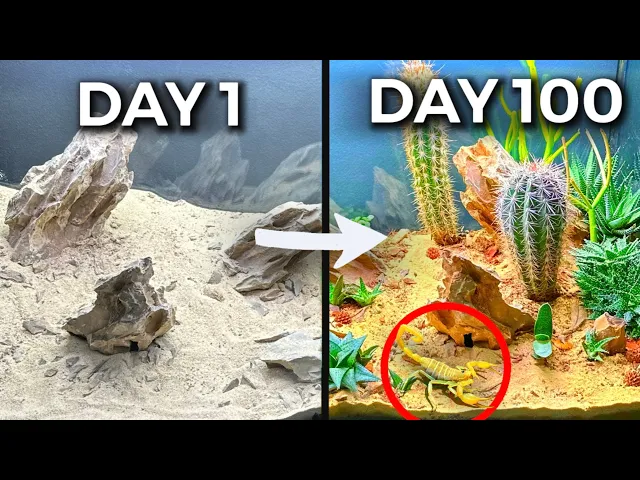
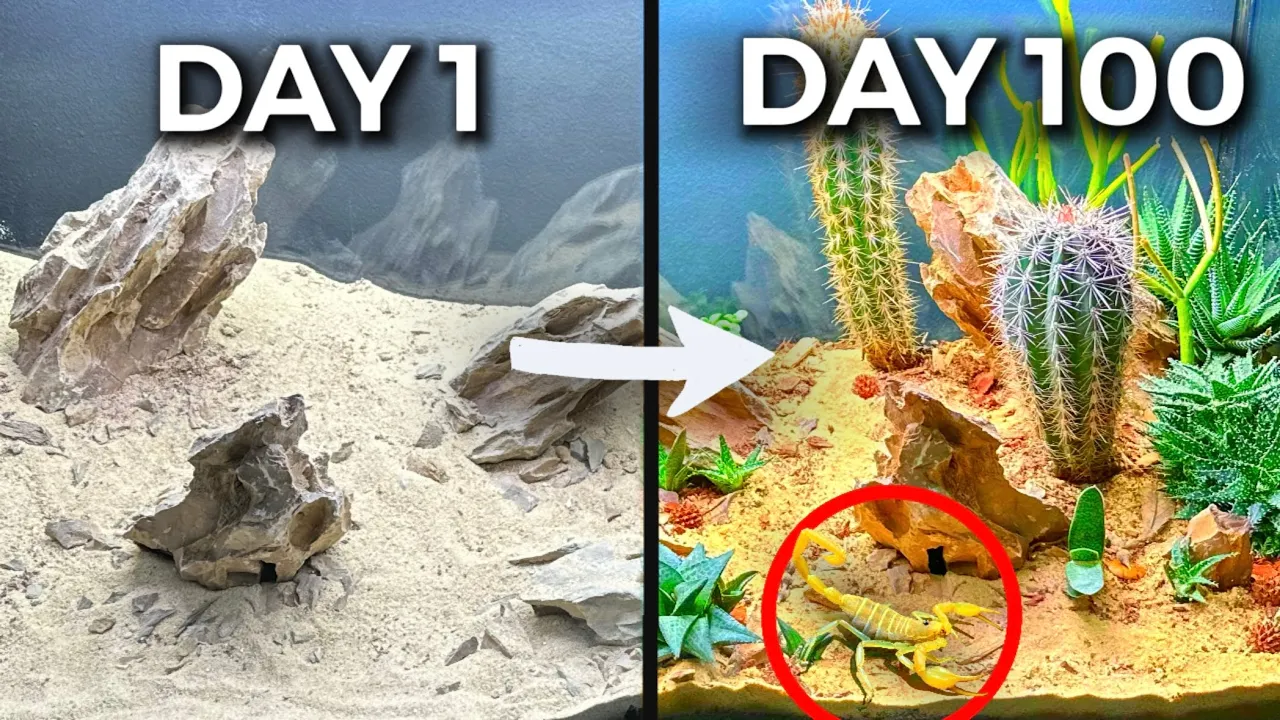
Within this tank lives a miniature world. There are predators and prey. Wind and rain.
This desert is a dangerous place. But despite all odds, some animals have evolved to survive it. Transformed from an empty wasteland to a thriving ecosystem.
To understand the mysteries within. First we must go back to day one. It all started when I got the tank, some materials and a whole lot of cacti.
I proceeded to mix up some dirt and then build up the substrate. After placing in some rock, I began to plant the cacti. Ouch.
Their spines are extremely sharp and it was a huge pain to plant anything. I added in some final touches and the tank was complete. This will serve as the foundation for a thriving ecosystem.
On day three, I introduced the first animals. These are called isopods. As you can see, I have two varieties here clowns and zebras.
After I placed them in, they began to search for shelter. Alongside the isopods. I introduced springtails and buffalo beetles.
These two detrivores will eat pretty much anything they can find. All of these tiny bugs will eventually be food for a future predator. By day 50, the isopod population began to boom in the shaded areas of the tank.
They would form small little herds. The juveniles looked almost identical to their adult counterpart. Here you can even see one shedding its skin.
While the zebras were thriving, the clown seemed to have disappeared entirely. On the other hand, the buffalo beetles were taking over. I placed a dead cockroach into the tank to show just how many there were.
Soon there was nothing left but a hollow skeleton. They were running rampant and I needed a predator. I needed something deadly, something fast.
Something almost as terrifying as my mother in law. Let me introduce you to the Dune Scorpion. He is a vicious predator and will make short work of a beetle or isopod.
Do you see that tiny white drop on his stinger? Well, that is a potent venom. And I have to be extremely careful.
I picked him up and prepared to place him into the tank. After a gentle love tap, he took his very first step into the new world. Scorpions are almost completely blind, so they don't use their eyes to get around.
Within just a few minutes, he managed to take down a buffalo beetle with a full stomach. He began to search for a place to burrow. After a few hours, his burrow was complete and it just looked like an ordinary hole.
But if we look underground, we can see it is so much more. It is his home. He would spend most of his time here, but as day turned to night, he would emerge.
Under ultraviolet light. He will glow a radioactive green. On day 60.
I realized the scorpion wasn't going to be enough. The beetles were breeding faster than the scorpion could eat them. I needed to add competition.
Meet the blue death feigning beetle. This is no ordinary bug. They have three superpowers.
First off, they make their own sunscreen. This white powder on their shell will protect them from the desert sun. Secondly, they have a huge abdomen to store water, kind of like a camel.
They can last for ages without any water at all. But if a predator tries to eat them, that's where its third superpower comes into play. They are indestructible.
Their thick armor will protect them from sandstorms and strong desert winds. I added them into the tank and immediately one was making a fatal mistake. He wandered towards the scorpion burrow and then down inside.
He was walking towards his doom. There was a stalemate. The beetle made his move.
He tapped the scorpion and then retreated deeper into his burrow. The scorpion gave the beetle a gentle push. And then made his journey back to the surface.
That was a close call. I decided to let them be overnight. As the sun began to rise, something extremely rare was about to happen.
It was rainy season, and one of the few storms of the entire year was about to commence. The tank began to flood. As the storm faded away.
Animals began to emerge. The rain brought new life to the desert landscape. This Rose of Jericho opened its leaves after receiving water.
By day 63, the water area was teeming with life. Hundreds of tiny eggs that lay dormant in the sand began to hatch. The pond was swarming with these tiny white dots that were going to become something incredible.
Meanwhile, on land, I figured it was time to introduce a new animal. Here is a Mexican jumping bean, and here are 30 more. These are not what they seem.
After I added them in, they began to dance. They seemed to roll around mindlessly, but each one is on a mission to find shelter. They jump to escape the desert heat.
It didn't take long for them to huddle under whatever they could find. Now inside every bean lives a caterpillar. One day they will emerge into a beautiful little moth.
By day 72. Life in the water had grown substantially. These little white crustaceans are called fairy shrimp.
They glide through the water, filtering out whatever food they could find in the shadows. Lived an animal much larger and less delicate than the fairy shrimp. Meet the triop.
I put one on my finger so you can get a sense of scale. They look completely prehistoric. They look to be thriving now.
But there is a problem. Every day the water level got lower and lower. The desert sun was quickly drying up their little pond.
On day 81, the pond was almost dried up, but life was more active than ever. Many of the triops were carrying bundles of eggs and needed to find a safe place to lay them. Here you can see a female carefully digging her nest.
She will lay her eggs in this hole, and they won't hatch until the following rainy season. The fairy shrimp had also laid their eggs and their life cycle was reaching the end. Only a few days later, the pond had dried up completely.
The rose of Jericho had closed and life seemed bare. But after closer inspection, you will notice hundreds of tiny eggs waiting for the next time it rained. Life was booming, but it was time to introduce a new predator.
This animal will easily find her way to the top of the food chain. Let me introduce you to the bearded dragon. I'm just kidding.
She's way too big for this tank. But I have many more projects on the way. So do me a favor and like this video.
Subscribe and I'll be sure to see you in the next one.