♪♪ Music is all about sounds. We're here at Georgia State University, listening in on the university's symphony orchestra rehearsal. An orchestra or band combines so many varieties of sounds, and what better way to learn the physics of sound than with music?
First, you have to know, all sounds are caused by vibrations. A vibration causes the air to move. That motion of molecules in the air creates sound waves, and musical instruments control sound waves.
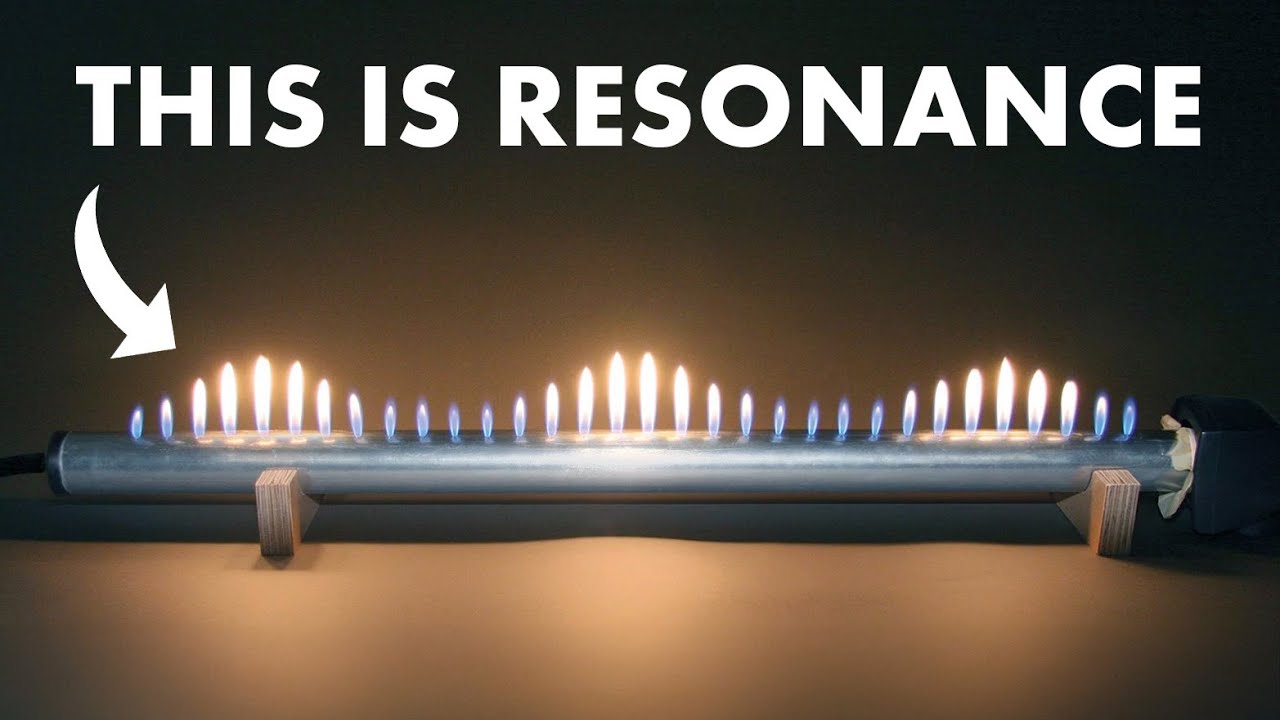
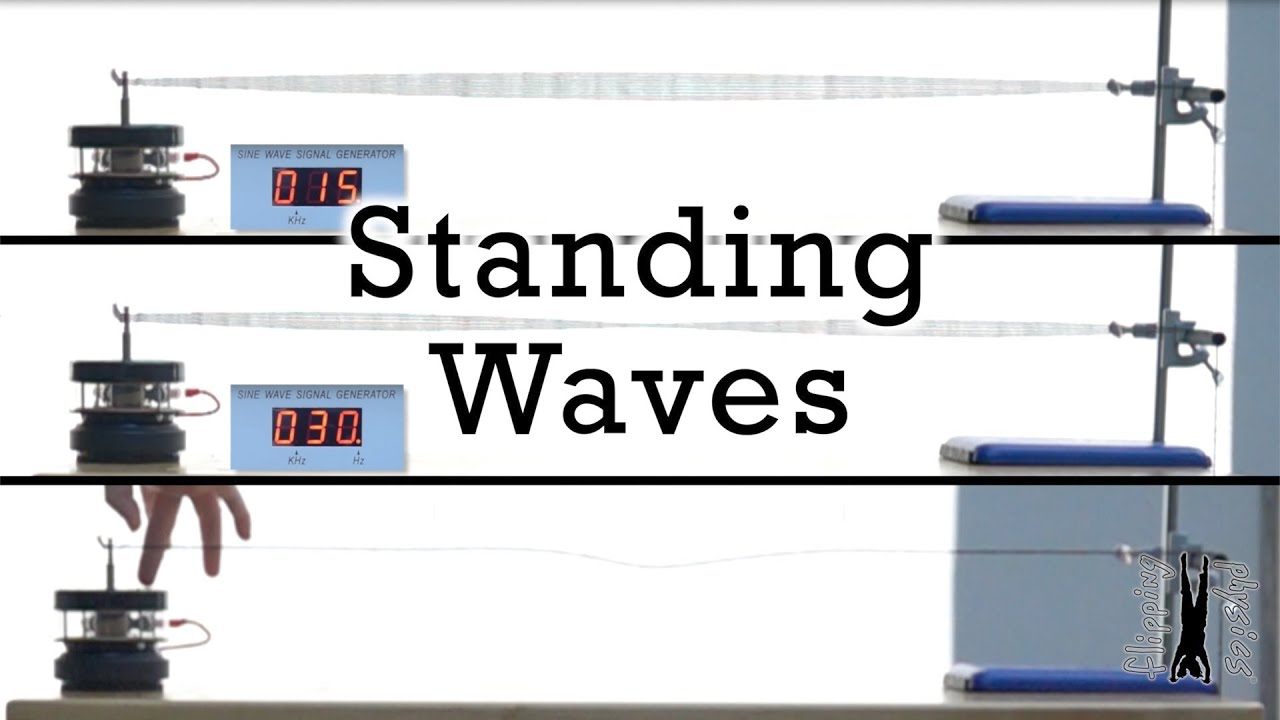
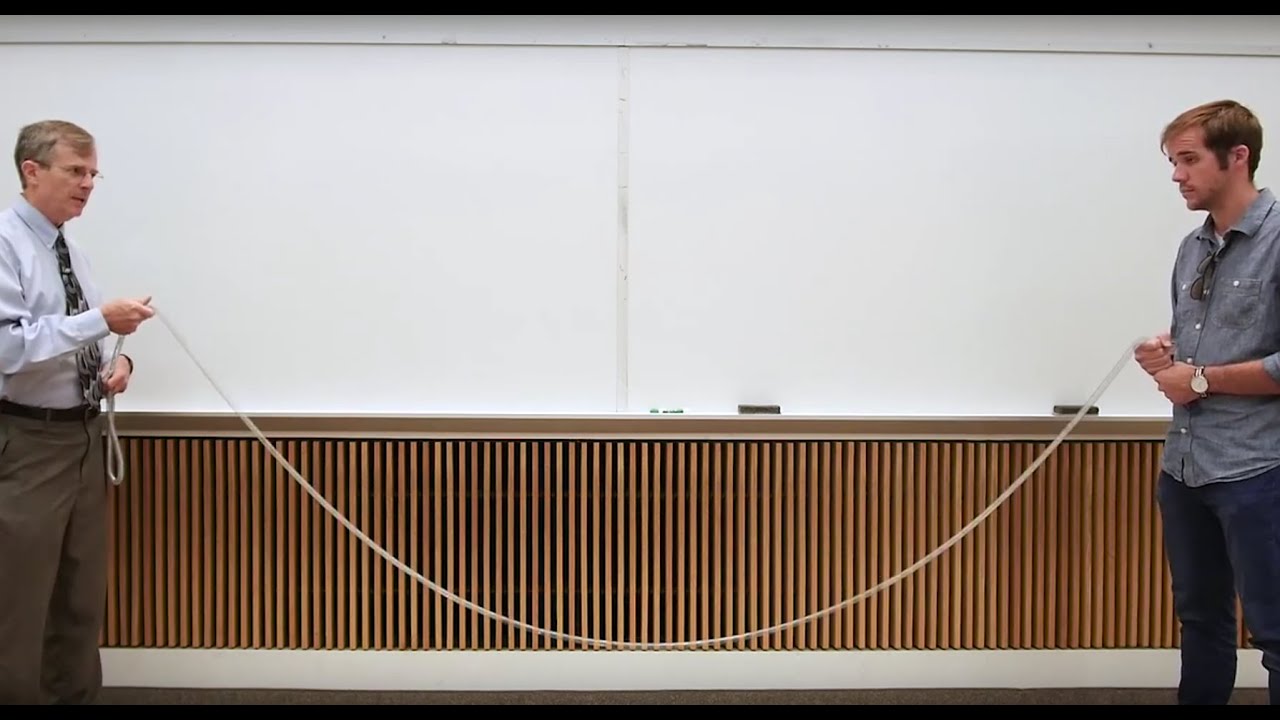
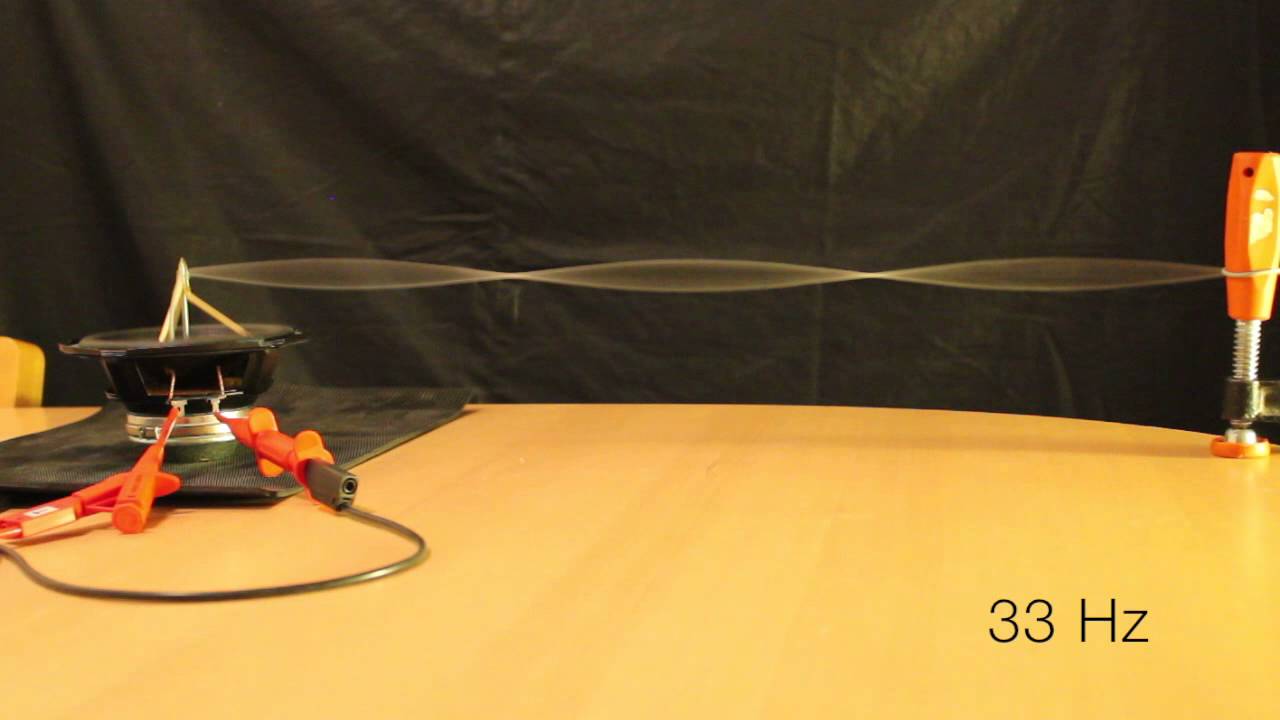
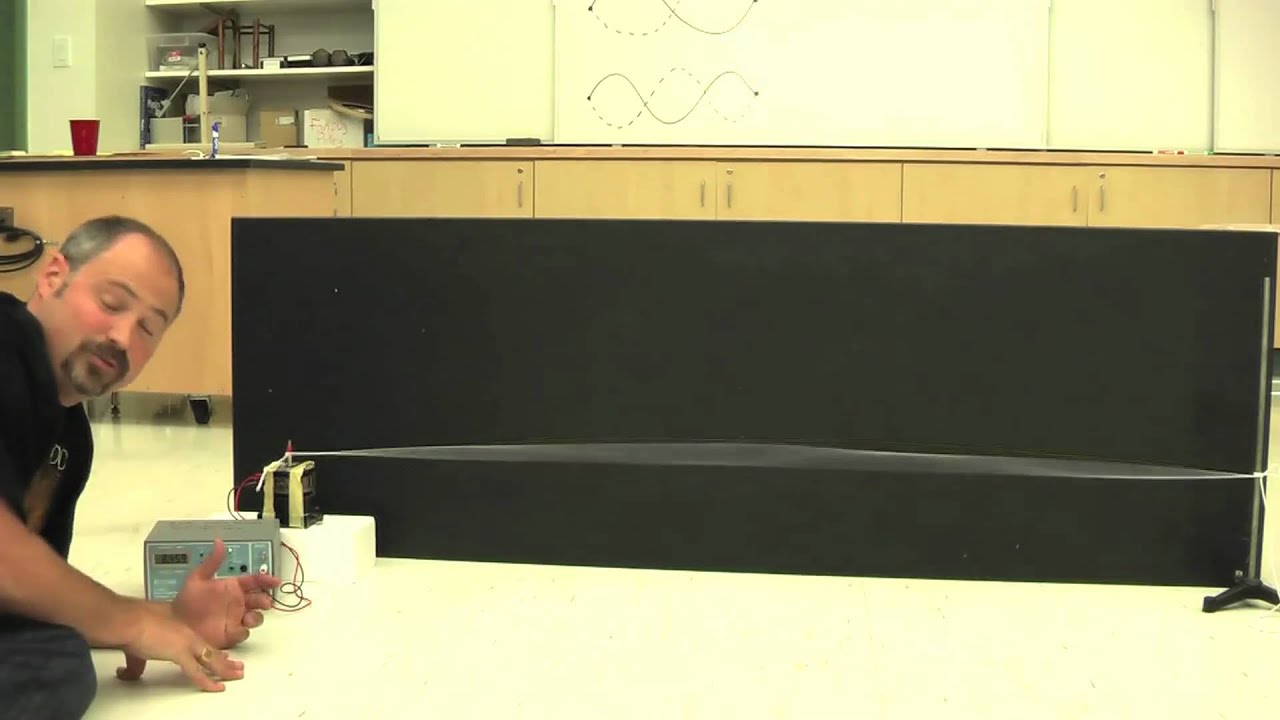
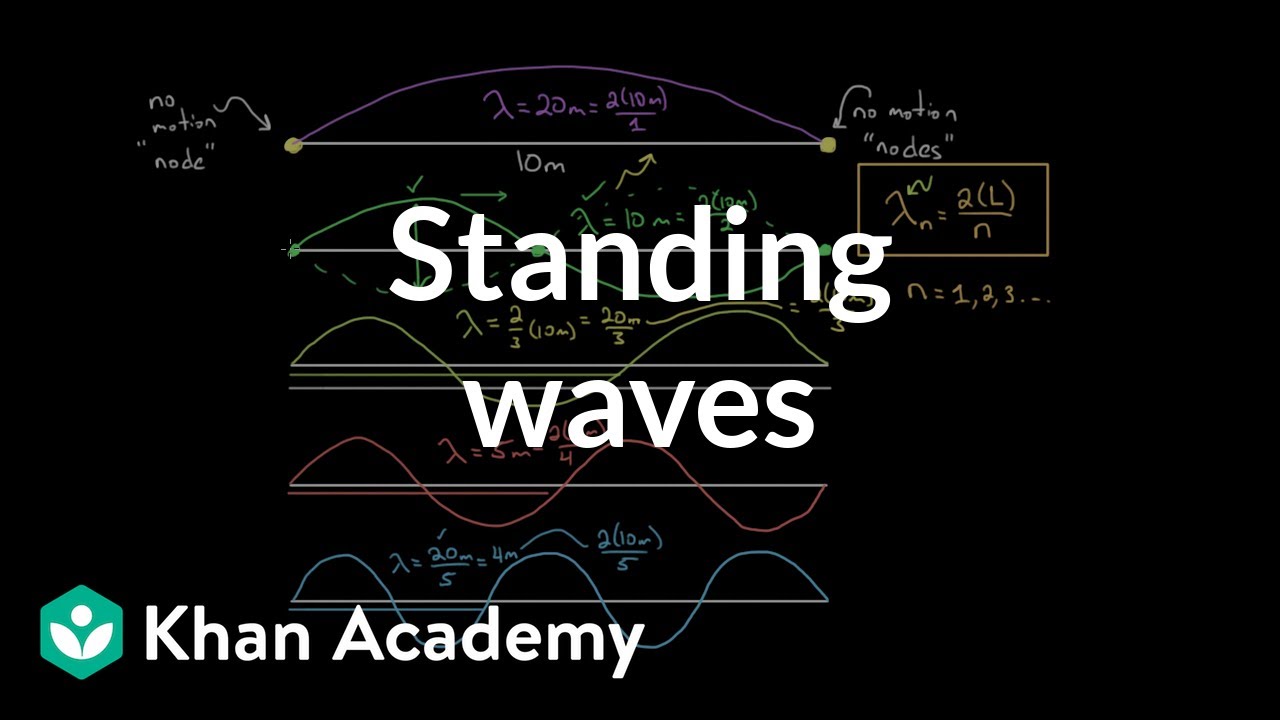
To make music, you want to control those vibrations. Creating standing waves is one way to control sound waves. Standing waves are produced by the interference of two traveling waves moving in opposite directions, but appear to be standing still.
Objects when struck with a force have a characteristic vibration, a natural frequency at which they vibrate. That's called the object's resonant frequency. The resonant frequency of an object depends on what it's made of and its shape.
Resonance occurs when small forces are applied at the resonant frequency of an object and the amplitude of the vibration increases. It isn't how hard or soft you exert a force on an object. It's the rhythm with which you hit it.
[chimes ringing] The resonant frequency stays the same. The amplitude can change, which means it can get louder or softer. [chimes ringing] [chimes ringing softly] But the resonant frequency doesn't change.
Thanks, Shawn. Sure. Let's take a look at some natural vibrations or resonant frequencies created by three different instruments.
A stringed instrument, an open tubed instrument like a flute, and a closed tubed instrument like a clarinet. <i>Even though we're dealing with sounds,</i> <i>which are longitudinal waves,</i> <i>we're going to use transverse waves to help us visualize</i> <i>areas of high and low pressures within a sound wave. </i> <i>It'll help you see how these waves interact.
</i> <i>If sound waves strike a barrier of any kind,</i> <i>the waves are reflected back. </i> <i>The incident wave is the wave</i> <i>that first strikes the surface. </i> <i>The wave bouncing back is the reflected wave.
</i> <i>The reflected wave has the same frequency</i> <i>as the incident wave,</i> <i>but is moving in the opposite direction</i> <i>and interferes with the incident wave. </i> <i>When a wave hits a solid wall,</i> <i>the reflected wave will bounce back 180 degrees</i> <i>out of phase with the incident wave,</i> <i>and they'll cancel each other out. </i> That's destructive interference.
So, there's no sound at that point where they interfere. You can call that dead air. <i>When a wave hits a loose barrier,</i> <i>one that gives, like a curtain,</i> <i>then the incident wave will be reflected back in phase,</i> <i>creating an area of constructive interference</i> <i>at the curtain.
</i> <i>The amplitude of the two waves that come together</i> <i>will double and create a louder sound. </i> <i>In this example, the blue wave is the incident wave</i> <i>moving to the right,</i> <i>and the green wave, the reflective wave,</i> <i>is moving to the left. </i> <i>The black wave is their sum, or the resultant wave.
</i> <i>Also known as the standing wave. </i> <i>Notice, along the standing wave,</i> <i>there are places where there are no vibrations,</i> <i>a dead space,</i> <i>where destructive interference occurs. </i> <i>That place is called a node.
</i> <i>The places on the standing wave</i> <i>where the wave has its maximum amplitude,</i> <i>or where constructive interference occurs,</i> <i>is called the antinode. </i> Now that we know how waves behave, let's return to resonant frequencies of an object, which depend on what it's made of and its shape. Here is an interesting shape.
A tuning fork made of steel. Tuning forks come in different dimensions and produce different and unique resonant frequencies. [tuning fork resonating] <i>The shorter the tuning fork,</i> <i>the greater the resonant frequency</i> <i>and the higher the pitch or note.
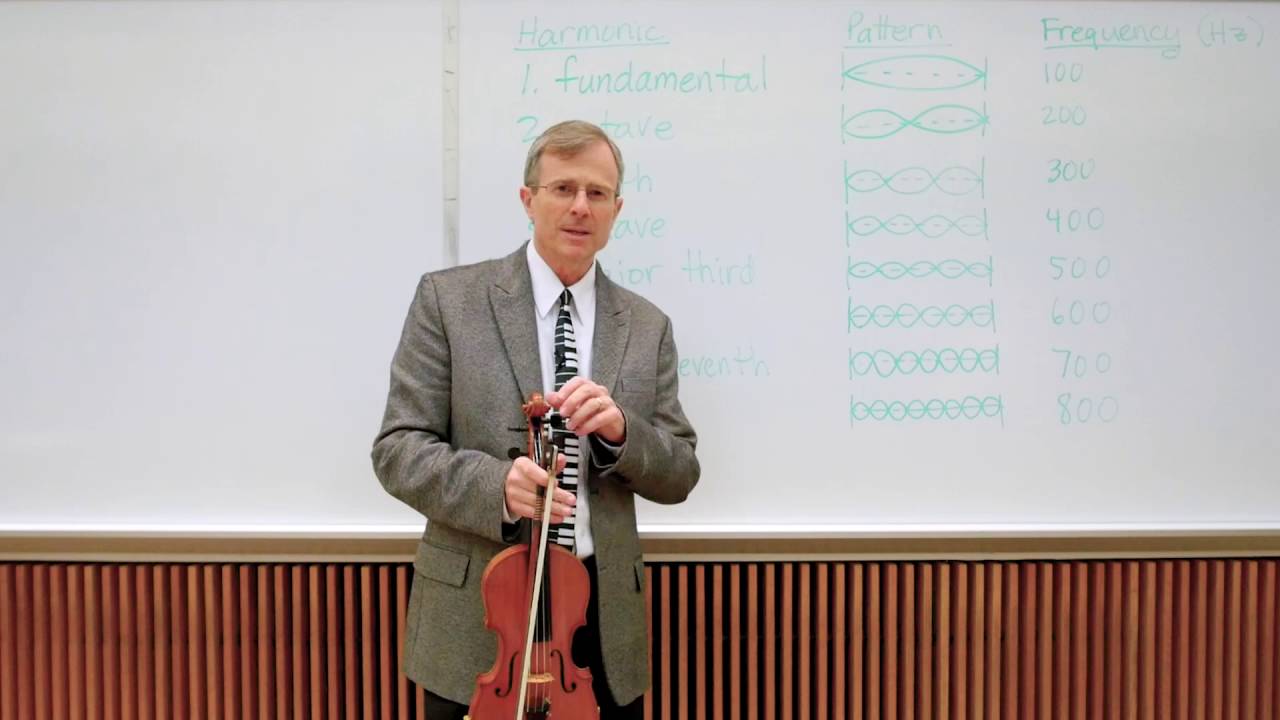
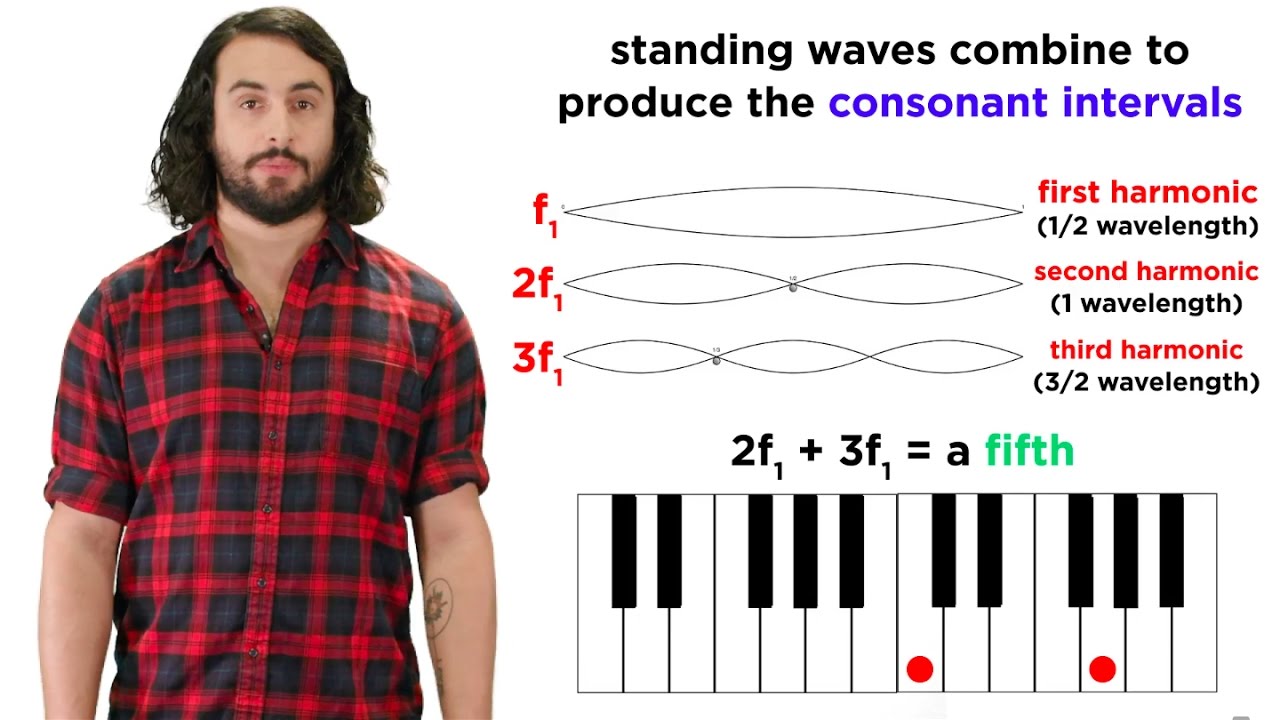
</i> The lowest resonant frequency at which an object will resonate that produces the simplest standing wave is called the fundamental frequency, f sub one. <i>An object will resonate at other frequencies, as well. </i> <i>These other resonances are what we call harmonics.
</i> <i>The fundamental frequency is known as the first harmonic,</i> <i>and the harmonics above it, also known as overtones,</i> <i>are numbered f sub two and above. </i> <i>Now, let's see how this applies</i> <i>to playing musical instruments. </i> ♪♪ <i>First, let's look at a stringed instrument,</i> <i>where the string is attached at each end.
</i> <i>When the string is plucked,</i> <i>that creates a vibration that moves through the string</i> <i>and is reflected at both ends. </i> <i>Remember, any time a wave hits a rigid barrier,</i> <i>like the ones created by the attached string on this violin</i> <i>and the musician's finger on the string,</i> <i>there will be a node at that point and at this point. </i> <i>The vibration of the string happens</i> <i>on a microscopic level.
</i> <i>It is only thousandths of a millimeter</i> <i>between the crests and troughs of the standing wave</i> <i>created by the string. </i> <i>We'll magnify what the vibrating wave looks like</i> <i>so that you can see it more clearly. </i> <i>So, pluck the string,</i> <i>and the first position of the string we see</i> <i>is the incident wave.
</i> <i>That's the solid line. </i> <i>The wave opposite is the dotted line,</i> <i>and that's the reflected wave. </i> To find the wavelength that corresponds with a fundamental frequency, what would be the most basic shape that would have nodes on both ends?
Would it look like this? <i>How much of a wavelength can be seen here? </i> <i>Remember, a wavelength consists of one complete crest</i> <i>and one complete trough.
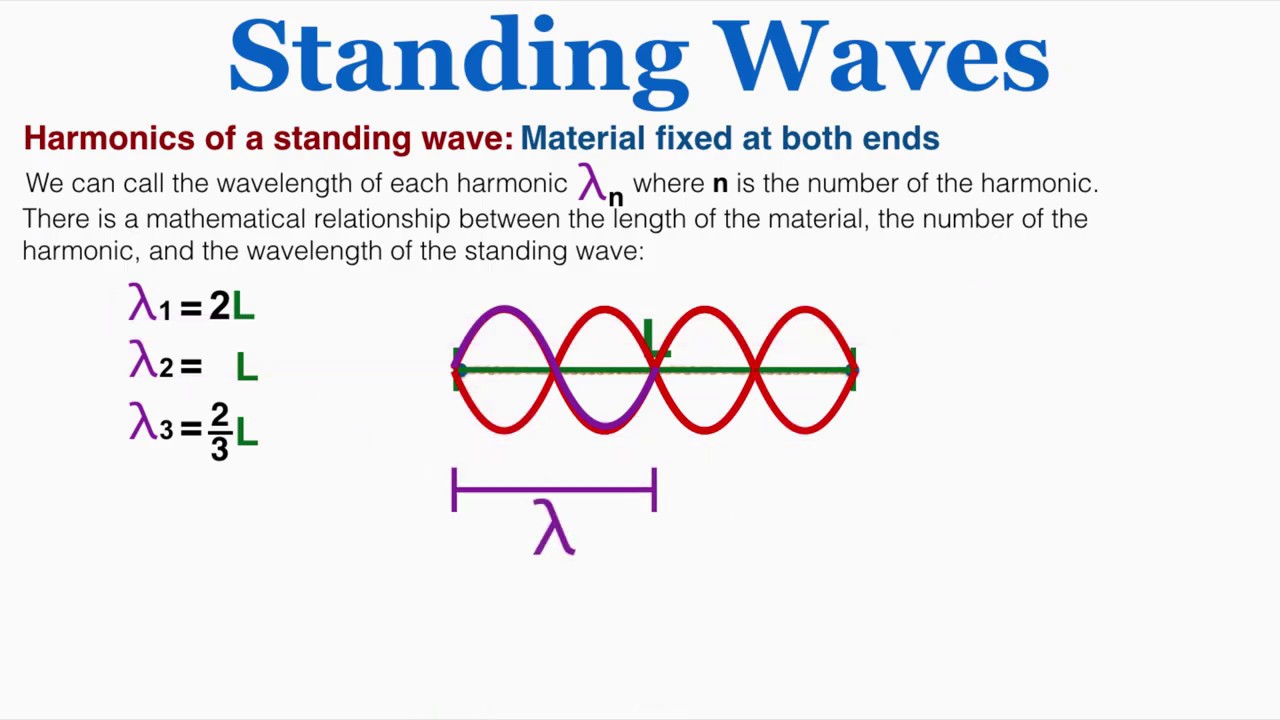
</i> <i>There is one half of a wavelength present</i> <i>within this given length of string, L. </i> <i>So, mathematically,</i> <i>the wavelength equals two times the length of the string, L. </i> <i>The simplest standing wave shape</i> <i>corresponds to the fundamental frequency,</i> <i>written f sub one,</i> <i>also known as the first harmonic.
</i> Each harmonic must have a node on each end, since both ends of the string are attached to a rigid barrier. <i>But we could also have a standing wave like this. </i> <i>Again, with a node at each end,</i> <i>but now with a node in the middle.
</i> <i>This is the second harmonic</i> <i>with one wavelength corresponding</i> <i>to the string's length. </i> This is Jacob, our cellist for the day. Thanks for joining us, Jacob.
You're welcome. Can you please play a fundamental frequency? <i>Sure.
</i> <i>(string vibrating)</i> And what about the second harmonic? <i>(string vibrating at higher pitch)</i> <i>Which is lower? </i> <i>Correct.
</i> The fundamental frequency or the first harmonic. Within a harmonic series, the fundamental frequency will always be the lowest. <i>The diagram now shows six different harmonics</i> <i>with the same string.
</i> <i>All harmonics higher than the fundamental frequency</i> <i>will resonate when the wavelength is equal</i> <i>to two times the length of the string</i> <i>divided by the harmonic number. </i> <i>So, the second harmonic's wavelength is equal to</i> <i>two times the length of the string divided by two,</i> <i>which is just equal to the length of the string. </i> <i>The third harmonic's wavelength is equal to</i> <i>two-thirds times the length of the string.
</i> <i>This pattern continues with each higher harmonic,</i> <i>where the wavelength is equal to</i> <i>half of the length of the string times n,</i> <i>which is the harmonic number above the fundamental. </i> ♪♪ <i>Strings on stringed instruments</i> <i>are tuned to precise frequencies,</i> <i>related to exact wavelengths. </i> <i>So, when replacing strings,</i> <i>you buy specific strings for each series of notes</i> to be played.
And if you look at strings, <i>you'll notice they're different from each other. </i> <i>Each one has a different and exact thickness,</i> and a mass to cover specific ranges of sounds or notes. <i>And increasing the tension on a string</i> <i>changes the pitch or the note.
</i> <i>So does changing the changing the length of the string. </i> <i>When the cellist, for example,</i> <i>is turning this string to a certain note, like 'A',</i> <i>we already know the exact frequency</i> <i>and wave speed of that note. </i> <i>So, the wave speed along the string</i> <i>depends upon the tension of the string</i> <i>and characteristics of the string,</i> <i>called the string density or mu.
</i> <i>Mu equals the mass per unit length of the string. </i> <i>The exact relationship of wave speed or velocity</i> <i>is found with this equation. </i> <i>Velocity equals the square root of tension,</i> <i>F sub T, divided by mu.
</i> <i>To find the wave speed on the string,</i> <i>we could measure the string tension and its density. </i> <i>Or, knowing the frequency and the string length,</i> <i>we could calculate it using our equation for wave velocity. </i> <i>V equals wavelength lambda times frequency, f.
</i> So, Jacob will pluck the 'A' string, which, when properly tuned, has a fundamental frequency of 440. 0 hertz. [string vibrating] The length of a cello string is 0.
690 meters. Since the wavelength equals two times the length of the string for the fundamental frequency, the wave velocity equation becomes wave velocity equals two times the length of the string times frequency, or two times 0. 690 meters times 440.
0 hertz, which gives us a wave velocity of 607. 2 meters per second. ♪♪ Now bring on the wind.
♪♪ <i>Wind instruments, like flutes and clarinets,</i> <i>also use </i>resonance and standing waves to make beautiful music with lots of different frequencies. <i>In both cases,</i> <i>standing waves must form inside tubes or pipes. </i> <i>If the tube is open at each end</i> <i>and doesn't have rigid barriers,</i> <i>the standing wave that forms will produce an antinode</i> <i>on each end.
</i> <i>The fundamental frequency, which, again,</i> <i>is the first harmonic and has the simplest wave form,</i> <i>has a single node in the middle of the tube</i> <i>with an antinode at each end. </i> <i>Like the stringed instruments,</i> <i>the fundamental wavelength, or lambda sub one,</i> <i>equals two times the length of the tube, L. </i> The relationship between the wavelength and the length of the air column is the same for stringed instruments and for air columns that are open on both ends.
<i>And for all higher harmonics,</i> <i>lambda sub n equals two times L</i> <i>divided by the harmonic number, n. </i> <i>The same as stringed instruments. </i> <i>Likewise, since wave velocity</i> <i>equals wavelength times frequency,</i> <i>you can substitute two times the length of the air column</i> <i>for wavelength to find the velocity of sound</i> <i>through the air column for the fundamental frequency.
</i> The difference between a stringed instrument and a wind instrument is the temperature of the medium through which the wave is traveling. Like air, for example. The temperature of the air changes the density of the air dramatically, and can change the pitch produced by a wind instrument.
<i>As the air warms,</i> <i>the pitch of the flute actually gets higher. </i> <i>Now, let's look at a wind instrument with one end closed</i> <i>and the other end open, called closed-ended. </i> <i>A clarinet is an example.
</i> <i>Even though one end is slightly opened,</i> <i>where air is being pushed through by the musician,</i> <i>acoustically, it behaves like it is a close-ended. </i> <i>By the way, when musicians want to change the pitch,</i> <i>that is the frequencies of any wind instrument,</i> <i>they change the length of the tubes</i> <i>by pressing the various keys. </i> <i>This changes the length of the air column,</i> <i>which changes the length of the harmonic wavelengths.
</i> <i>In a closed-ended tube, like the clarinet,</i> <i>to get a standing wave,</i> <i>a node must be at the closed end</i> <i>and an antinode at the open end. </i> <i>The wavelength of the fundamental frequency</i> <i>is only a fourth of a wavelength long. </i> <i>That means that the first harmonic</i> <i>or fundamental frequency wavelength, lambda sub one,</i> <i>forms at the length of the air column times four.
</i> <i>Because the antinode is at the open end</i> <i>and the node is at the closed end,</i> <i>each harmonic only happens</i> <i>with the addition of half of a wave,</i> <i>which means the harmonics are odd multiples. </i> <i>One, three, five, etcetera. </i> <i>Those odd numbers are significant</i> <i>because you can see that the harmonics only occur</i> <i>when you have an odd number, a fourths of a wavelength.
</i> <i>They are called odd fourths. </i> You find wave velocity and frequency the same way as the string and flute, which is velocity equals wavelength times frequency. But now the harmonic wavelength, lambda sub n, is equal to four times the length of the air column, L, divided by n, the harmonic number, which must be odd.
And now you should know the physics of music and how it relates to standing waves and resonance. For more information on the mathematical relationships of standing waves, check out our Closer Looks. That's it for this segment of "Physics In Motion," and we'll see you guys next time.
♪♪ <i>For more practice problems,</i> <i>lab activities, and note-taking guides,</i> <i>check out the "Physics in Motion" toolkit.