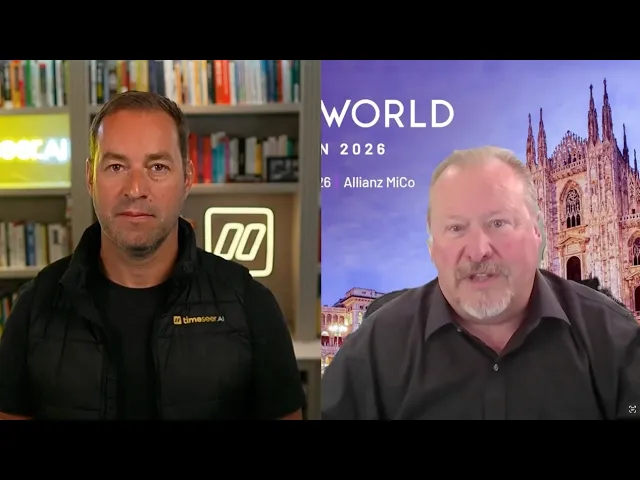
Welcome back to the true north, my podcast where I have fireside chat conversation with pioneers navigating industrial data and AI. Today episode is a special one to me personally because I've been working with Aviva already since 2015. First with trend miner and now with time app as an ISV both in connect and also in the normal system. Over the years I've always experienced a lot of support and openness. So first of all genuine gratitude for that journey. But today like I said is different because I'm not just talking to someone but someone who co-shaped and
responsible for the whole ecosystem going forward of first OSI and now Aviva. John Bayer has been the part of industrial beta for decades and he's played the role first at OSI to the PI system and now he's also part of Aviva. Today he's the VP of solution strategy for Viva and he's driving forward the modern infrastructure that we today call connect. And so today we're going to have an impact that story that journey from Pi to connect from data to decisions and ultimately what it takes to make industrial AI actually work at scale. John much
welcome to this podcast. Hey Burge, thank you for having me and and for the invite. Uh look forward to a great conversation. Yeah, super. Looking forward as well. Let's maybe kick off. Um John, my first question for you I have is that you've been in the center of industrial data for 20 plus years. If you now start and zoom out for a second, what has fundamentally changed for you and what didn't change over the last 20 years? Well, it's uh it's pretty funny because a lot of the you know, as they say, the more things
change, the more they stay the same. And a lot of the ideas that we we even uh had in industrial automation in the in the '9s are are still uh here in in in the the 2000s, and the 2020s. maybe a different name uh and and different uh technology to to get them done. But uh a lot of the issues around standardization and heterogeneous environments in the manufacturing world and handling all of that data uh at scale are are still issues. We've gotten better but uh always challenges to right. Yeah. Okay. But of course I
know you, you know me. But for the people maybe who wouldn't know you that good, can you maybe for a very quick couple of minutes tell us more about your background? Where did you start? How did you end up in this company? What was the evolution? Just a little bit of your personal background. Ch. Great. Yeah. So um so I um graduated with a computer science major and um was a developer my first job. uh worked for what's now Rockwell Automation. Uh it was Allen Bradley at the time. Uh and I had no idea what
I was getting into when I took that first job at at Allen Bradley. I didn't even know what a PLC was, but ended up uh doing programming inside the PLC, which was fun. Uh I just took the job because they were they were uh saying I get to use this new programming language called C. It was new back then. So um anyway, I worked for Rockwell for a very long time and and eventually Rockwell built a software division uh called Rockwell Software and I built and and was development manager for some some big products like
RS Links that has been around for a long time at uh RS networks. uh then worked on the uh was uh deeply involved with the factory talk architecture which is still sold by Rockwell. It's morphed quite a bit since the early days, but uh uh worked on Factory Talk and um and that's where I met Pat and the OSI crew is we at Rockwell, we we used to have a SQLbased uh historian and for those who don't know um a lot of a lot of companies have tried to create a real historian with just SQL
servers Or or SQL databases and it just never really works. it never really scales. And so, um, somewhere around 2004, somewhere in there, we we started looking for historians, uh, to partner with or or buy and and determined uh, PI was by far the best. So we couldn't buy it. So we partnered and uh started partnering with OSI and got to know them and eventually liked them so much that uh uh joined them in 2009 and uh as and led their product management group and uh so and and the rest is history really um working
with Pat and the OSIsoft team until we joined Aviva officially in 2021. Um and then been working with uh Aviva and bringing in uh connect and our cloud software into um into the Aviva hole. They they say John one's a software developer always a software developer. We also going to talk about AI today but I would be curious like with the whole evolution from vibe coding to cloud AI and cloud coding. Have you been been playing around in your weekends co coding again a little bit like you might use with AI or or not yet?
No, I I definitely have. Uh I I I learned Python um at at least um good enough enough to be scary. Um and the people who work for me will tell you I am I'm quite scary when it comes to that stuff. But um uh and and really Python's a great environment. Um, I think the bigger challenge I see with with a lot of the cloud stuff is how different you have to think about things versus a client server kind of mentality. And when you're talking about cloud native software, it's a whole different it's a
whole different beast. And um, it's fun um and it's fun to think about. And I still spend a lot of time on architecture, but not too much on hands-on coding. Um, except when I get to play around with AI or some of the new products that we work with. Uh, uh, we just, uh, um, brought in a company acquired Crosser and they have some really nice add-ins to be able to execute Python codes. Okay. Yeah. So, it's fun. those those kind of low code no code environments are really kind of really a dream for for
somebody like me. Yeah. Yeah. I can imagine. Yeah. We're going to talk on that topic of how software development changed now with all evolution of VI later on. But maybe back to where we started like um the start at from Rockwell to um to to OSIs Of back then. So you joined during the Pat Kennedy days. Uh I did a podcast recently also with Richard Bon, your former colleague. Uh tribute a little bit to Pat. Uh how was it? Maybe one question there. How was the work with or for Pat? Um it was great working
with him uh when we were partners. Um and I got to know him well and the team, Richard and John Peterson and the team. It was very much a kind of a family atmosphere. It's what kind of drew me to join them. Um, and I love Pat's sensibility. I mean, he was just a a super um downto- earthth, straightforward shooter. Um, and and he was a good leader that he didn't try to uh overmanage you. What he what he brought is, and I don't know if Richard talked about this in his thing, but had these
nine tenants of things things to believe in. And if if you followed those all the time, you would be good. And um he was right. Anyway, so he was really good to work with, but boy, he could be tough on you, too. I mean um so when when Pat wanted something, he was very straightforward and he tracked you down. He was he was the guy convincing me how to start Tread Miner. So you I'm forever gratitude for for for him. even he's not amongst us anymore but uh forever gratitude yeah he yeah I learned a
lot from him I learned a lot Can imagine can imagine I heard it from many many people so that's why I always try to ask that question to Aviva people so yeah and but if you look like Rockwell or OSIsoft what was different in a way if you compare like a company like OSoft back in the days with other industrial companies you worked or you worked with or any kind of yeah feedback there or yeah so if you start to look at companies like you know Rockwell or or even Schneider or Seammens the big automation
majors um they tend to be a lot more focused on the hardware and and as they should be um PLC's and data you know uh switching centers and and sensors and panel views and all that kind of stuff. It's it's it's there's a lot at stake. There's human lives at stake and controlling the equipment at stake and um so software becomes a little bit of a sideline and and and I always kind of felt like in Rockall this software you were kind of h you're there, you're strategic, but you weren't really in the main flow
of things. And I I that's one of the reasons I joined Pat at at OSI is I really wanted to be in a company that was focused completely on software. Um one of the nice things about Aviva now um Aviva is, you know, a separate company. It's owned by Schneider, but but a a separately owned company with a a Edict to be um open and agnostic across the industry. And and I think that's important. I think I think having software focused that way and to be agnostic if you if you really want to be a
platform and you really want to play in that game, you have to have that. Yeah. So are you saying that there's still big parts of the original DNA within Aviva now? Yeah, I think so. Um I you know some people have left or like Richard or or or moved on and and it's inevitable with uh mergers but um you know there's still a lot of the a lot of what we brought from the OSIsoft side into Aviva was the data platform mentality and and that we needed to be a a data platform and focused on
being a data platform first and foremost. And so you combine that with kind of great applications as well, you you kind of have a really strong uh company. Yeah. And if you if you re you go back in time, what did OS back then already got really right about industrial data that others missed at that time? What what was so different? Yeah. So you know Pat was so focused on just being the best at being a data provider being managing the data. So he he believed and and I totally agree that You know he wanted
to enable engineers not try to do all the applications for them. So he always said look you if you get good quality data you make it available to engineers they'll do great things with it. And so simple tools like our Excel addin were as popular as any any other tool that we we built. Um because guess what? Engineers love Excel and they could do all kinds of great stuff, right? Um it it's kind of like a a this the Swiss Army knife of do just about everything. So, um, that was one of the things and
Pat kept us focused. Every time we tried to drift off into doing other applications or doing stuff that was vertical, too vertical specific, he he would bring us back back to Earth and say, you know, here's your true north since you use that term. Yeah. Uh, that's the true north is is feeding the data, being good, um, industrial data. uh purveyors. But the other thing that that we did and and I think was really really right with OSI is I mean I I think about three things. One is data quality um and just um and
quality of the software. I mean they used to all all of our customers used to say look I can always trust OSIsoft. I can always trust Pi. um it's always going to perform and we we took quality really really seriously um above all other um um two we added the context layer of AF For PI asset framework which really made a huge difference and part of that was not just the context layer because that's important but also we enabled um AF analytics which is a calculation engine that was a self-service for for engineers. So again,
focusing back on the engineers, something that they could do in the OT space without needing a project. Yeah. With it. And then the last thing in that context was event frame. So in time series data, it's not just about you know continuous collection. Okay, what are the key, you know, startup shutdowns, uh events, uh shut uh break, you know, break events that that you need to capture and overlay on top of that time series data. And all of those things together created a really really solid data platform, but I don't think any of them just
by themselves would have would have made it that. Yeah. Yeah. But impressive. And I also admire the fact that stayed one product for the entire course and and and and if you became that big just with one product in this industry, it's it's great. It's yeah, remarkable. So that's uh really something I have to agree to agree on. But if you of course now fast forward where we are today and you're coming out or with connect the second version, the first version was already released. What is Aviva today try to solve with connect that pi
alone Couldn't do anymore these days like modern 2026 what is that can you weigh in on that job? Yeah. Yeah, it's a great question. Um, so you look at uh one of the things that we we also did at at uh OSIsoft was we we started our enterprise agreement program and and and basically it it was a commercial program to take the all of the shackles off off customers so they could deploy all the pie that they wanted. And so what we ended up what what that ended up doing though is creating lots of different
PI servers to manage. So manageability of all that data at the aggregate level became very very difficult. And um in a client server kind of architecture you can only get so much scale by vertical scaling. And we we we you know re-engaged and re-engineered every piece of that PIS PI server to get the most out of it we could. But at some point you hit kind of the limits of VMs were were you know physical machines in the early days but VMs later um you just can't scale anymore. And what you end up starting to
do is trying to invent these systems to horizontally scale. You need machines that can together create scale and Cloud is a way better way to do that and but you have to kind of engineer for the cloud to get that benefit. So uh and this is why a lot of companies at least in my mind don't do well in the cloud is because they try a lift and shift approach from a client server mentality. But that mentality is not going to really get you the elasticity and the horizontal scale that you need in the cloud.
Yeah. And you also touched on AF fast framework event frames. Now you're also incorporating design elements like knowledge graphs which is very important these days for what you want to do with analytics and AI. That's also an evolution probably from the newer versions, right? Absolutely. That's a that's a great point. So I mean you know There there was an evolution even within OSIsoft of originally it was called module database and it was an older version then we we built AF and and that was a big transition but even once AF started to take hold we
were always dreaming of something more dynamic something that could capture multiple hierarchies and lots of different relationships and that's what we've built now with the knowledge graph up and up and connect so the focal point there is really every kind of relationship you might want. In in addition, it's not just time series data and operations data, but it's the um asengineered data coming from our engineering products, our unified Engineering suite. So all of the P and ID diagrams, the instrumentation sheets, the uh ma operating manuals, maintenance manuals can all be brought into a customer's uh
knowledge graph so that they have access to everything about those those assets and and what they're how they're operating. And if you look to the to the architecture, John, um what is architecturally different if you compare connect with traditional data platforms out there? Maybe more horizontal, but can you weigh in on that for a second? Well, you know, if I compare it against things like, you know, data bricks and snowflake and and and others. First of all, we have a built-in time series database that is focused on industrial time series. So our we have our
just like in this one of the things that we learned from PI and we brought forward but we've we've completely re-engineered it from the ground up to be cloud native and so instead of uh the PI data archive that we had back way back when um we're we're using you know modern cloud blob storage and and time and storing all the time series data there completely lossless completely uh high fidelity as high fidelity as you need um we also have the AF equivalent in our Knowledge graph right and and it's this very malleable uh model
we've also brought forward uh the whole events model and so we have a whole uh part of the knowledge graph to capture everything from alarms and SCADA systems to you you know, the big events, shutdown events to kind of batch events that you see in a S8 model. You look at all of that together, you just don't see that in a data bricks or snowflake. It's very industrial specific. No, I was I was concluding for myself. So, we can conclude that it's a fullflexed industrial data plat platform, right? And not just an ecosystem layer. It
is a full-fledged one. It that's that is definitely our intent is to make it and but now that said that's great for our industrial partners as an ecosystem layer. So um and we do have connections into data bricks and snowflake and uh Microsoft fabric and AWS. So we we don't see we see ourselves partnering with those companies. they they focus at the at the high-end enterprise layer. uh we're really focused on on operations and industrial data and I I see you partnering with these players which you just mentioned AWS, Azure, Microsoft so data bricks, snowflake
and maybe for you it's clear But still I hear from many prospects and clients that sometimes they think it's not ant but or like should we move to the cloud but can you weigh in on that because I perceive it that it's an ant and not an or but Maybe it's good to make your argument why do you need the Aviva connect clear and also your your hyperscalers or then your data warehouse like like data bricks would be good with your own words that you can explain that for people who are maybe less educated on
this. Yeah. Well, I mean, I think when you're up at the enterprise layer and that enterprise data links and everybody's uh has has something like that these days, um you're really talking about a place for multiple applications, SAP and maybe a Workday or Service Now, all contributing to a data lake. But I mean, when you start to think about how big enterprise systems are for our biggest customers, they're humongous. copying all the data to one spot just doesn't make sense. Um, so you end up having specialty data providers and for us we want to be
that specialty data provider for the OT space for really the rich operational industrial data. Linking that data without copying to to these these other players I we think is a huge benefit for our customers. It takes the burden off of them of wondering whether the data is trustable. Um, and it also provides integration of the OT side without the data bricks or snowflake having to know that. But in those vendors, as much as you could integrate directly with a PI or even a PLC in the data bricks, the data is really focused on row column
data. it doesn't fit its uh that paradigm all that well. And so you you I talked about early this the SQL paradigm uh and us trying to create a time series database uh in SQL back in Rockwell days. Well, the same thing's true now column data and the the thinking at the enterprise level is is a bit different. And so uh that industrial context is really really important. Yeah. I think 10 years ago I perceived that there was a fight fight from the hyperscalers that it looked like they all wanted the the OT data in
their clouds. It did that stop did they abandon retreats or what what happened according to you because it felt feels like it's less of a fight these days. Yeah, I think I think those who tried it have found out that um some of the downfalls of that. So I think it's it's without calling it a total failure I think you miss a lot um when you try to just put it in a put all the time series data and the industrial data in a in a data lake customer ends up taking the burden on of
putting all that in industry specific knowledge that we put Into connect they end up doing it themselves on top of the the uh data lake or they pay uh Accenture or other SI lots of money to help them do that. So, I think they found that that it just really wasn't a very economically sound platform and it didn't provide the value that they they were looking for. And it also doesn't make sense, right? If you talk to a resolution like minutes or second data, minutes data, hour data, that's so close to the shop floor that
it doesn't even make sense to put it in the cloud system first and start from there. It's linked to the shop floor which means like level one, level two, level three mees layer stopped but it doesn't make sense to put it in the cloud and then do your magic there if you talk on that resolution. If you indeed talk to uh things you want to do forecasting on months of data there more makes sense but for me it's really tied to the use case but it doesn't make sense at all to just copy all your
data in in the in the cloud. That's my perspective. Yeah, and I I I I agree. And I think even you're starting to see this no copy integration from people like SAP. If you look at what they're what they're doing with the their integration with data bricks, it's they talk about it. You know, data stays in place because it it's constantly changing constantly adding all the records. trying to do data copies and data mirroring at at large large large enterprise scale just seems like at some point it's going to become a big burden to keep
that up to date and to Make sure that it's it's correct and if the data is not correct if you can't trust it how do you make an AI decision how do you make any decision on data that you can't trust correct correct could you maybe win one last part here of this part is Where do you create defensibility as a viva versus plain commoditization this new kind of stack? Where where do you see you're really creating defensibility or unfair advantage towards other players who cannot do what you can do as a viva? Well, I
I'm not sure we do have, you know, undefensible. It's never it's never that that easy cuz as soon as you create a a differentiator um your competitors will will race to equal you. So um it's all a matter of how long how long and the timing but um given the amount of knowledge that we have within Aviva and the I mean and the where we came from the the companies that we came from we have three big players in from industrial automation OSI softpar and that whole stack um leader in in HMI SCADA and our
unified engineering from the original Aviva in the uh building tools for for construction. And you think about those three things together and a layer like connect to bring it all together. You've Got a lot of the industrial data that already exists in the world to be able to bring it together into one spot is pretty tough act to follow. even if people have a similar software uh they maybe don't have the knowledge and the nuance associated with it. Yeah, that that really makes sense. We already briefly touched on it like data moving from the from
the OT systems to the cloud. When we do that or we think about or we speak about it typically there's a term that comes up more and more being the medallion architecture bridging it the convergence bronze silver gold kind of architecture is this real necessary or is this forced what is your opinion on that I like I like thinking about it in those terms um it makes sense to me when we present and and look at like what we how we've integrated with data bricks. So um we're we're doing a no copy data sharing with
data bricks through their uh delta sharing protocol um using delta paret file format. That said, that data starts in time series typically and um we overlay the the events and and knowledge graph to create a row column shape. So that data starts As the bronze layer raw. It is raw. It is absolutely every every sensor reading we get up through pi or system platform or MQTT or any other source. when we turn it into a what something we call a data view in in connect that's basically creating a curated data set. It's perfect. It's silver.
So we we add some knowledge to it. We add some maybe some filtering. Um and then we we move from silver and we share it with a datab bricks or a snowflake in a no copy format so they can combine it with other data from an SAP or a limb system or whatever it it makes sense to do and they can create gold layers that that are used for reporting and analytics. So to me from that aspect it makes tremendous sense. Um yeah, I see it being most adopted in industries like for example utilities where
they are indeed taking need that data for billing for example where customers are built like for example water meters in households measuring consumption while indeed if you have that raw data and you don't do any magic with it to create to make it trusted cured and also auditable uh and the validation s on top it's never going to work out and you're going to have billing mistakes. So I see it most the most adopted in those industry who really do a lot already with the data if it's we we had recently a podcast also with
a joint customer being Sango um and indeed like 80% of their dashboards are built on the on the Bronze layer which makes sense because it was shop floor dashboards but it's different the moment indeed it you coming across uh other departments or you need to report emission reports to the government or energy consumption across all all factories then it starts become really critical that that data is not just raw but cleaned trusted verified and yet need those different deers right exactly and and this is where I think even you know the work that we're doing
with your team on on time seer uh time seer can be and other products like yours can be enrichment layers on top of that that raw uh bronze 's data. And so once you have a good enriched and upto-date data set that you're going to share and and we keep them those those curated data sets at this overlay are up to date constantly. So as new data comes in or even late arriving data comes in we update all those delta parquet files and and share them uh you you actually make sure that it's the data
is totally curated. So I think that data curation is something I see a lot of customers struggle with. Um they they are trying to use AI, they're trying to use machine learning. Um but you've got to you've got to get that data curated a bit. Um or you end up doing it in your own AI tooling. You end up doing a lot more data wrangling than actual analysis. Yeah. And also to to to go further on that one. If you say curation, curation is much more than just detecting you have a gap or a flatlining
sensor, right? You also need to the whole handling of that like flagging it to people. The the cle if it's important, you need to use it. The cleansing part, the monitoring part, is it going away? So it's much more than just writing in your AI stack a rule for detecting a gap or an outlier. That is the easy part, right? It's it's the whole periphery you needs to make it manageable to do the first triage that makes it more complicated in the end. It does. It does. I mean, one of the things the notions of
uh with time series data that a lot of people especially that that haven't worked in OT or work with time series much time series data you you want it to be sequential. Yes. when you store it, but it doesn't always arrive in order. So you you have, you know, a mining truck going in or a a a something that digs a hole that and digging in the mine goes in and out of service constantly. So it's collecting data and then when it reconnects, all of a sudden you get this big push of data in a
in a in a batch. And so, um, you have to be able to handle all these scenarios. And so, um, it's just not easy to do unless you're familiar with it, unless you're specially built for, uh, that task. Yeah. And also very difficult for IP to do in my opinion because your example with the mining truck, they would see in that example that the freshness of the Data is suddenly different. yet because your there was no data coming in. It could generate an alert and it wouldn't know what was going on in the in the
field. But a different example there is maybe it's perfect that your data is coming in fresh is there no schema changes but your sensor is not reliable because it's fing or it's aging or it's we think well it can never judge that right so you need to bring that intelligence to the manufacturing people. Yeah, I think there's I mean a lot of that nuance um is just it's not easy to get unless you've worked uh in the industry. You know, one of the things OSIsoft did um that was h always kind of was a little
disturbing to me at first and then I I I figured out why why it made sense. But he always wanted to hire chemical engineers out of school. He said, "I can if I have a chemical engineer, they understand what the customer is trying to do with their with their processes. I can teach them computer science. harder to take a computer scientist and teach them chemical engineering or or or and and it's true because if you don't understand how control systems work and how to keep a uh a control loop in control, it's easy to to
make the wrong assumptions and to make the wrong decision. No, that's a very u yeah that's a valid point. Yeah. Now we started touching the topic on data liability and maybe to go Further on that industrial data ops in general. There's a conclusion today that think the general public accepts that a lot of industrial AI or analytics projects are failing. There are stats on that but according to your perspective how much is actually caused by unreliable data or integrity that's not there from the OT layer? I think I think a big part of it is
is uh data quality and and data um uh the contextualization has to be there. So this idea of a knowledge graph or an ontology on top of your data really needs to be there because if you can't find some commonality the AI tools make the wrong assumptions. Um but I think that's also a second tier of problem is that you know it our industry and and computing in general people love silver bullets and suddenly agentic AI is the silver bullet it solves everything but you know you you whether it's aentic AI or LLMs that they
have a purpose they do some things really well but if you try to take that tool and use it for something it's not good that you're going to get bad results. So I think I think it's a combination of those two data quality and using the right tool for the right job. I mean we see it all the time that a lot of times our our OT customers want just simple machine learning yet and we I say Simple now it was very difficult and challenging for quite some time but now it seems like everybody knows
how to do a machine learning algorithm or or create a a model. Um and there's lots of tools to be able to do that. Um but but a lot of times that solves the problem perfectly and you don't need to try to do it with some other newer AI technique. Yeah. The building software is always a timing thing. I I tend to say is it for you a surprise that we went first from data collection then we went to data activation and now we going back to the infrastructure solving a lot of yeah infra things
like data op structuring harmonization quality. Is that for you? a a surprise that that's that it's happening or it's completely predictable for you? Well, I mean, working in OSIsoft as long as I did, um it's not a surprise. I mean, that was Pat's whole thing was, you know, start with the data, everything else gets the apps get a lot easier. And, um, so it's not a surprise. It's also not a surprise that we follow the shiny object in in tech and and we get over enamored with whatever new technology comes out and it go everything
goes through the the Gartner hype cycle and you know gets overhyped sometimes comes back to earth and then finds a a middle ground and I think AI Is bound you know it's we're starting to see that that trough of disillusionment a uh because of those those factors and and I I certainly believe AI is here to stay. Um it's not going anywhere and we'll find a good uh happy path with it and and have be very productive. But um there's there's a lot of learning industrywide to do around that. And I do think data it
gets you back to the data foundations. Do you have quality data? And that's kind of where the medallion architecture also plays a role for me to be think about how your data it how mature is your data not so much how mature is your AI or your your your company. Yeah true and for me it's also linked to the fact something I tend to call the great unlock. We can store at scale both on prem cloud we can compute at scale that check box that's done. That's equation is now solved. That's exactly the moment in
time where organizations, industrial companies start to build datadriven applications. But that's also the moment in time where the quality of your data starts to matter, right? And that's I think for me the logical kind of conclusion of the why now. Yeah, I do think as we uh see better partnerships, more cooper coopetition uh out there, being able to put a a score or a a a Grade on data quality is going to be really really important. Um because you know our uh our CEO Casper Hersburg calls this radical collaboration and I love the term but
what he's he's kind of getting at is that you know there's a lot of companies out there for us to be successful globally and to make companies successful nations successful we need to collaborate with with different companies and sometimes they're your your partner and sometimes you're collaborating and sometimes that you're competing fine, but we all need that data sensibility and to be able to to to collaborate, you need to be able to kind of put a a grade on the on the data and on the data quality. And I think that's something that's a still
to be uh you know, I I think we're all chasing it a little bit. So, I like I like the term Casper gives to this, but think about the following. digital transformation they all pushing the whole workforce to do more with data being an AI enabled workforce and indeed at that moment in time it becomes very important from a data governance perspective that you can assure your data that we cons that we collected is reliable right because you cannot force or encourage your workforce to do more with data and having a big question mark regarding
is it reliable don't know That's that's a liability and I think that's why these tools are are so important. Well, and you also see data, you know, lots of data privacy issues. Yeah. Uh you know, um individual privacy issues, you know, with with uh all of all of uh all of that. And then governance issues like who's even if you have trust between the parties and trust between the data when you're sharing it even among a in a big corporation who's allowed to see that data you know public company data is not allowed to be
shared right I mean not until the appropriate time uh this is all in it gets very complicated very fast anyway I This is why I think the radical collaboration is going to happen and continue because I I don't think any one company has the answers. No, no, no. And look what's happening. Microeconomic it's needed necessary right resurrection from the old industrial world is just necessary and collaboration is part of it. So I completely am in line with that with that vision. But if we touch now collection uh the evolution to connect we talked briefly on
quality and the importance but of course we all do this to do more with the data. So we move from simple analytics statistics now to More complex AI and also like the buzz the new buzz word the kit on the block agentic AI. What is it changing John? What is agentic AI in the industry changing? Uh can you can you weigh in on on on that for for yourself? Yeah, I think um you know we're we definitely are looking at it quite a bit for um at least initially um automating their close um uh kind
of taking the uh action part of physical plants and and helping humans automate the the meat the simple tasks and the the the tasks that um are are are just you waste a lot of time sending emails and creating work orders and checking boxes. And so but initially I think it agentic AI will will start to replace um and and make it better for humans so that the the people who do have knowledge about the processes and the equipment can focus on on those issues and not about all of the work that they have to
do to to keep the corporation happy and keep reports moving and etc. Over time though, if the data is truly trustable, those AI agents should be able to execute more and more and you start to think about, well, can they, you know, can they replace people to Make those decisions? And I think I I uh I'm excited by that prospect and I worry about that prospect because there's a lot of uh potential danger there. there's a lot of great things that can happen there. So, yeah, that's another thing. I also look at the workforce, you
know, and the aging workforce and you you start to say, okay, how many pe, you know, um people coming out of university really understand the process systems and it's less and less that they're trained in this way. And so, um, I think we're going to need aic AI to help start to automate some of this. Um, but with the right governance oversight and that that's that is uh that is the key especially in if we talk on that use case right if indeed agency is a good evolution but then indeed you extra need a safety
layer that you can trust your data. So I I agree on that. Um yeah, with the topic you touched like the the the whole evolution of the workforce exodus, that's a topic for for 20 years now. But today it makes sense to do it, right? You can look to your history. You can see what kind of knowledge is in there. The young workforce can start to ask questions to the data. If there's an unsolved thing, it can be distributed to the right expert who's still available. He can rich enrich a system. Yeah, you can make
very powerful systems these days which was basically already an Expert system idea 10 years ago but it's now possible with the new evolution of tech. That's how I perceived it. I know how you look to this but uh it's really now that it's possible. Yeah, I think so. And I think you know regarding the aging workforce, capturing best practices and knowledge and back into uh systems and documenting that and and creating uh what used to be you know uh you know a best practice or or a a work instruction that everybody followed. Now we can
we can instead of writing it down and saying everybody follow this, we could just automate it. And yeah, there there's a lot of benefit to that. Um I still think there's going to be plenty of applications. I mean I I think a lot of the other thing I think about with Aentic AI is what's going on in the market right now and people call it SAS magdon or or what have you that hey all these applications just go away. Well, I don't really see it that way. I mean, I do think that it's it's gotten
a lot easier to create a custom application on top of any data source. And um with MCP, MCP has been a a big factor in that, right? And and um I see my team do it all the time and they're coming up with these apps. I'm like, "Wow, you could do that in a couple hours. That's pretty pretty incredible." But um to really do that again at scale across an entire corporation to do it consistently may be a bigger challenge. So I I think the the SAS players will just change how they how they how
they go to market commercially, how they they'll change their value prop to be more data focused to to feed the SAS to feed the agentic AI and and not so much on the users of the applications themselves. But you're the system of records. We enrich it. We make it trustworthy. But indeed if you're just the front end like you're just user interface and the new workforce starts to work different with software like prompt or LLN based just asking questions to data and get the answer uh or for example with the all evolution of the VIP
coding I going to write my own front end in a couple of minutes there is a big pressure on the front end right so if we I think we have a good position being infrastructure players where both are necessary But I I have some some some doubts on the who's going to own the front end because I think front ends are so yeah are so different coming up than a couple of years ago. Yeah, absolutely. There's some great free open-source tools out there that you can use to that sit on top of MCP and you
create some incredible uh applications really quickly and and some one-off apps. That's a perfect way to do it. Yeah. And many of them they charge per se like per user. Well per user how are you going to charge if your people are just asking question MCP wise different difficult business model for them or evolution and I think that explains the whole collection of the multiples of the of the public SAS companies that there is something happening there. Oh yeah there is. Um most of them um we we we partner with service now as a good
good example. and they've been one that's been hit really hard with the uh stock price. Yeah. But I look at what they're doing and their their software is a lot more than just SAS applications and and users. Um it's it's the whole data structure and how they structure the data. And then they have their own agentic AI including uh an an Agentic AI, you know, quarterback or or top level uh control room. Um, I think most of these players, and I say the same for Salesforce.com, very impressive agentic AI work that they're doing, they're just
going to have to commercially change like you're saying from being user based to being more data usage or or uh usage based. Yeah. If you take us together time a viva with allution of connect um the data is now there it's it's stored at scale wherever clients want structured harmonized with the right trust verification are our clients ready for autonomous decision making you think is that is that is that near future or still promise promised land a bit of promised land I think I think when push comes a shot. One of the the phenomenons I
see a lot, you know, um even with our machine learning applications, we have a uh a layer that we we sell called advanced Analytics and it's really a a machine learning for the for the process engineer. Um uh this is based off a a product from a company called Twin Thread. And I think you've had as well. Uh you've you've uh had Rick Rick Bada on here and on this podcast and and I think he's involved with that. Anyway, it's a great product and but one of the funny things is people build these models and
they they see confidence at it, but when it actually gets sometimes it gets down to the plant, people don't want to the the operators don't actually want to trust the recommendations and follow them. And so there's a whole cultural aspect of okay, I got the recommendations, but will I really follow it? Will I really trust it to run my plan? And that's a a much harder thing. And even if a person's not accepting the the the set point recommendations and and applying them, if they're happening automatically, you still have to question, will there should there
be and what is the fail safe? If somehow I get some bad sensor and I suddenly have some really bad recommendations. Well, that's that's a valid point, but that's the the same point as 10 20 years where people do not trust black boxes. But yes, some models are black boxes and still we have to we have to believe in the evolution. But I think indeed again with all these safety layers we have in On the on the on level one, level two, level three safety safety system, a control system, an alarm system, there is there's
an operator, a human in the loop. If you then indeed add integrity scores to give indeed real-time feedback and I trust my sensor, my data at one point you have to adapt, right? That takes baby steps. But you have to believe that a computer with all these dimensions, calculation power, and then having all these safety nets, we have to adapt and have to believe that closed loop will will be necessary. I I I believe it will be. Um, I don't know if you've ever gotten in a Whimo or a a full self-driving taxi, but uh
I did for the first time last year down in San Francisco and uh it was a cool experience. Um, but I I can say I trusted it more that many of the Uber drivers I've had. So once I got in it, but getting in that first time in a Y, you know, driverless car can be a little daunting. So it it'll take some repetition and and um to get people to trust it, right? Yeah. And and if you look to uh the layers of of AI, the the the latest layer like the physical AI, you
need need machines, eyes, cameras, robots, you all need these because they going to need they're going to generate a new data that is necessary to take the next step in in maturity. So you need those technologies and some of them will maybe feel weird. Yeah. But we need the data to take the next step, right? Yeah. Yeah. Exactly. So I do think it'll it'll happen. I think um culturally it's going to be a a shift and then also just that belief system, the repetition enough to where you know there'll be some early adopters like there
is with every technology that really paved the way and then once they've shown the repetition and shown the success then others will come along. Yeah. A topic that fascinates me John because I'm like I'm already like now 20 years in data and AI is if you look back in history every time in history markets or governments institutions have spent more than 3% of GDP uh typically for example it was linked to electrification railways if you look back in the past every time that happened that more than 3% of GDP was spend on infrastructure it led
to a a bust like overspending on infra leads to a correction of the market and then if you think about railways well railways was a lifetime 30 50s 100 years but if you then are now spending even more than 3 4% GDP on cloud infra calculation data centers well if you look to the lifetime of these of this hardware is not 30 years right you know how how short lifetime of hardware electronics exist. But is what according to you what will happen? Like are we going to see a correction soon? Uh what will trigger it
is just waiting. It looks like everyone's still dancing in a way but what if the music stops? Because you have to expect that something needs to correct, right? We overspending and nobody's really paying the bill already. So what is your kind of take on the whole AI economics and a reality check? No. I I'll offer my opinion. I mean, this is it's a like you're saying, it's a very dynamic space, but you look look at okay, you got all these data centers going in and and you need them for the for AI. So, I think
one piece there is AI, there will be a correction where you start to see better and better use of the compute power um for AI. So as Nvidia and other chip makers start to build it into the chips, you won't need as much power, but that's the key. So right now, you need all this power to run the data centers and to build the energy infrastructure is even difficult. And we're through our our current uh uh war conditions and and things going on, we're creating another energy crisis. and and and um effectively the all the
all the AI is is actually creating even more pull on those those energy resources. So, we're going to have to have some time when we're starting to either run out of compute or the energy to run the compute or both and and we can't build as fast as we Want to consume. So, there will be some correction there that has it has to happen. Um, so, so I I I think it's going to be an interesting time. I think as we all three of those things happen and and we start to build up more energy,
more power uh resources and we build more efficient data centers and we get more efficient with executing AI that will will that issue will lessen and eventually the things will become where AI is pretty much everywhere and but there I think there is a correction coming around that that issue. They say AI is deflationary, which is a good thing for the economy. But if you look to who's paying the bill, do you think AI will become more expensive when that correction happens or what is your what's your take? I think um I think it will
get more expensive for a little while. Yeah. And that's that's to and and I think energy will continue to inflate for a while until we can uh keep uh keep up with the demand and once supply can can keep up then things will will regulate again. But it's it's going to be interesting. I you know you haven't seen this many data centers or you know this anything that's so hungry for for power uh in quite some time. Yeah, it's crazy. I think uh if if you follow those podcasts from leaders like from open AI Sam
or from cloth and tropic and you see what they are predicting like how many people will lose their job. There's also a scary part about that, right? Like how how are things going to evolve and then linked to that often those those um yeah those people tend to start talking about things like UBI and robot robboex and I think we have an interesting evolution the next coming years. Uh typically when those big new evolutions come up they always tend to go slower than one expect which is a good thing so we can adapt but also
hope we can have the time because it's such a different kind of disruption we see now possible that you need to give people the time to adapt right how many people really fully grasp the entire disruption that is coming up it's crazy but I I think it will it will there'll be additional I mean I I think the AI I evolution is just starting. Um so there'll be some other further developments that surprise us and bring a whole new set of opportunities. So it is going to be an interesting time for tech uh in general.
Yeah. But I think there's a like you said I mean I live here in uh San Francisco Bay area. There's a lot of people losing their jobs and you can say it's because of AI or maybe even not but it's certainly having an effect. Um it is it Is a in a way it is like uh low entry jobs are at stake. Um jobs that can be automated are at stake. If you look to service centers or things like accountancy so many things are disrupted. So it's uh interesting. jumping to a Viva Milan. It's coming
closer. Yes. Anything anything that will happen there in a scoop you can give or any anything that will uh be announced that is so exciting or Absolutely not. Absolutely not. Other than expect some great announcements. Uh expect a great uh show. You know, we always have lots of customer stories. And for me, that's the best part of of uh of a show like uh Aviva World is we hear what our customers are doing with the data and what they're doing with our products and with with partner products like Times. And so we we that that's
the best part. And then in of course interacting at at uh the the product expo and the and in the booth that's you know uh my job is focused on customers these days almost completely. Um I I I run our our lighthouse early engagement program and uh uh which is a fun job. It's a great job to have but that's the part that you really like to see customers being successful. Uh, also expect some great announcements, right? And, uh, we always save up the good stuff for there, but I would I would probably wouldn't get
to go anymore if I if I uh, spilled the beans before we got there. So, yeah, I understand though. I'm looking forward to shake hands there. Um, f as a closing, I always tend to stop these these talks um, with turn the tables. I've been asking a lot of questions to you. Thanks for that, by the way. um any kind of turn the table question you would have for me or one or two unscripted. Yes. So, you know, I I do as I said before I I see a lot of customers starting to pay more
and more attention to data quality especially coming all the way from the the plant floor. Um my question is a little bit of a two-parter. First of all, what what differentiates kind of time seere for for you in the market and in terms of helping provide uh data quality and where do you see the data quality being applied? Is it down all the way down into the control system layer or or you know mid tiers layer three layer four? How do you see that happening and evolving? Yeah, you the first part of your question is
more why did you make a bet on on on OT IoT data quality. I think for me the most important observation there is that the normal data quality resides at IT level and and more of the business business layer is when you observe an instrument a valve or a sensor measuring something that there's always the first principles the physics you need to understand of what am I measuring and it's sometimes the data can be right but the sensor is not trustworthy or opposite or both And that is just something that it cannot crack Because they
they don't understand the physics and dynamics of sensing systems because that really deep is deep inside level two instrumentation control theory and I think because that the background that we had with our trend miner experience that's why we decided to go back to the trenches to solve this equation because we were well placed with enough background knowledge that this would be important and also having the head start in building this. So I think it should be developed more on the OT side and bridged and br together with the IT side. But it needs to be
solved by people who understand sensing and instrumentation technology and then where will it sit? I think it really depends. So if you look we talked about the medallion architecture for a lot of business decisions it makes sense to do correction validation at the level of bronze or or or gold when it's being for consumed for an AI model or for report or for billing when it's not like critical in in time like it's not just minutes or seconds when it will be critical like in the model for predictive maintenance that's important that you have second
base resolution it will be pushed more to the edge because then you need feedback on the edge like hey your sensor is stuck or it's fouling or it's a it's it's drifting. So it really depends on the use case. So I I my my opinion on that is that the quality scanning will be residing where the data sits and where the use case sits. But on a central level, I see it really more shifting left like becoming part of the data infrastructure like a Component like on top like top of connect and less analytic stack
because what I really think is necessary is that clients need one single version of the truth like it needs to be governed central one one one level truth and not like every application doing some quality checks themsel because then we end up again in the out west. So from a governance perspective, I would say shift left but also tackle it where the data is residing and where the use case needs the the requirement of what is fit for purpose. That can be edge, can be for cloud, it depends on the use case. That would be
my uh my kind of observation. Yeah, that makes sense. I mean I I do think that um the there will be a thinning of of the on-prem components um out there over time um just because it's it takes a lot to maintain um physical machines whether it's a PLC or some other machine and and you don't have the people to do it. So there will be a thinning there. So I think it inevitably is going to move up up into the cloud layer. But I also agree with you for for industrial data, it's you got
to have some context and some knowledge of the processes and the equipment to really um understand how to how to correct the data. fully agree on that and I think we are concluding in my in our digital original Business plan which is by the way 2019 I expected to be late to the table which we were still early today in reflection and hindsight I I I wrote it the first kind of sentence that I think that all data that is stored and is being used has to be scanned or verified for liability because it doesn't
make sense to have data and use it without verification. So I think it will become a very critical building block but let's see how the evolution will will play out. Yeah, I agree. I I think you guys are well placed. We're uh we're happy to have you as a part. So and John, I'm really also happy that you joined me on this talk today and um I'm looking forward um to shake hands in Milan. It's a beautiful city. Have you been in Milan? Yes, I have. I have. I I and I' I've enjoyed it as
a tourist. This time is probably going to be mostly business, but uh it'll still be nice to be there. So, hope you can have some time to have some good pasta because that's what you need to eat in Italy, right? So, exactly. So, thank you for having for joining me here today and looking forward in shaking some hands in Milan. Thank you. I'm here for Thank you for having me and uh look forward to pasta or a nice glass of wine or or both in Milan.