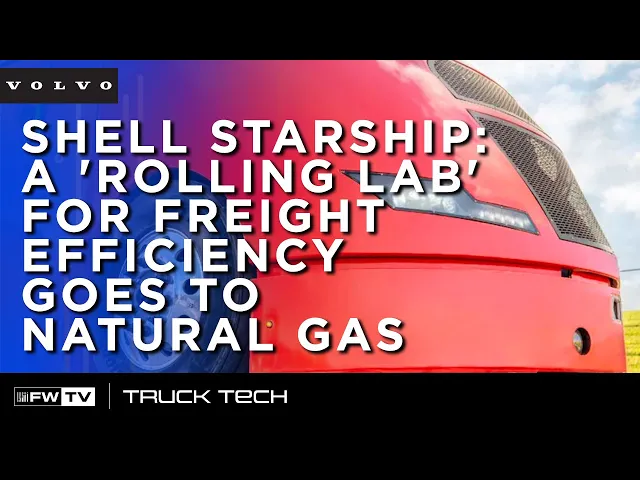
la [Music] welcome back to truck Teck everyone you know this week we're in Birmingham Alabama where shell is showing us the third version of the shell 3.0 Starship this truck is a test bed really for Shell to test out its own oils and lubricants and things like that but they've also created an awful lot of great data that has helped the trucking industry figure out how to run less expensively and more efficiently we're going to talk to several people in today's show that will give us more details on that including Mike Ro from the North
American Council for Freight efficiency who will kind of look at the whole idea of Now using natural gas in the new comm's 15 lit natural gas engine in the Starship hope you enjoy the show Heather Duffy you are a marketing uh specialist with the shell Starship program I am this is the third one we're now at 3.0 tell me a little bit overall what what shell has learned so far and what you've been able to transfer to fleets so the Starship program started as a as a test program for readily available technology for fleets to
learn what they can adopt to help reduce their carbon emissions as well as total cost of ownership uh so we we started in 2018 with our first cross country uh test run we we learned a lot from that um one of the things that we we tested with that one was our new low viscosity engine oils that were released in 2016 so that was um that was a big part of why we did the the program to begin with but as we've continued to go and and grow the program we've been able to work with
a lot of different uh Partners like uh Cummins and Bridgestone for tires and really learn a lot about fuel efficiency changes that fleets can make that may seem small but have a big impact on the on the overall operation cost of a fleet right so one of the things that you know that's new this time around is using the x5n engine uh first two uh runs were were you know diesel engines and now you've got the opportunity to run both compressed natural gas as well as renewable natural gas um there's some differences obviously those engines
uh you know burn hotter and so you know get quite the fuel economy but actually you really did pretty well right yes so we were able to achieve 9 miles per gallon fully loaded at 880,000 lbs um that was all over California um up hills and and over normal terrain that a truck would encounter uh you know that was the biggest thing going from a 12 liter to a 15 liter natural gas engine was um was you know making sure that it has the torque and towing capacity that a diesel engine has um because that
was maybe one of the biggest drawbacks from the 12 liter um so we were excited to to test out the new the new 15 liter Big Board natural gas engine and uh and it performed really well and 9 miles per gallon is a is a benchmark it's well above Benchmark for diesel for the average for for North America but it's also you know for a natural gas engine that runs hotter it's an excellent um fuel economy number one of the things that you mentioned about uh you know using uh commercially available Technologies you know when
you started the program and you have developed Partnerships along the way at this point I guess the question has to be you know you're up to the third version abs a new power train I mean be it battery electric which again right now probably not greatest for Long Haul uh or fuel cell which still has some issues to work through not so much on the technology side but but infrastructure um are we looking at sort of the best has been gained from this program now I mean is there much more to learn you know that's
uh it's one of the questions we ask ourselves with every iteration of the Starship right like what's next what what can we do better um I do think that we've learned learned a lot over the the you know six years of the program I think there's also a lot more to learn but one of the things we're learning is that some of that technology is just not there yet um so you know if we were to switch to a to a hydrogen or a or electric vehicle it um it may be a different version of
the Starship it may not be what you see today it may be that we uh we wait a little while to see if the infrastructure catches up it's you know kind of the age-old chicken or egg uh scenario where you know it's nobody's going to buy the trucks until there's the infrastructure nobody's going to build the infrastructure until people buy the trucks so you know we um we we recognize that and understand that that's a that's a a constant challenge in the industry so you know we uh we keep our our eye on Trends and
what's happening and what we can do to help evolve the uh the fleet industry but for now we're going to focus on the natural gas truck and um and just enjoy the the numbers that we've gotten right you know I I have to I have to think too that you know when you see things like super truck out there and they're coming on their third run now third generation the next one's and they will use fuel cells um it you're not really a competitor to that but there is you know and those are concept trucks
where you know you can actually and they do apply things uh you know for example uh Cascadia is using you know some of the the New Cascadia is using some of the arrow gains that that showed up in the Super Truck too so you know you do see things out there that that you know make you think well yeah they did find a way to apply that in your case though you're more of a test beted you know you're you're more to convey information that you gain you're not going to build trucks that's not what
you're gonna do right no shell is not in the business of building trucks for sure uh we call it our lab on Wheels it's a it's a way that we can test out uh different Technologies of our own we've got all of our our lubricants uh running in the truck we've got our natural gas 5W30 uh Shell Rotella product running in the engine we've got our spyx transmission fluids we've got all of our greases running are are in the truck um so you know for that it's it's a way that we can test out our
own products but also you know like I said readily available technology that fleets can adopt today to make changes today like the Bridgestone Steer tires that are are wider have a low roller rolling resistance that um you know things like that uh uh engine oil low rolling resistance tires those are fairly easy for fleets to stop now with their current uh Fleet of trucks that can affect a pretty big change in their um their savings from a fuel economy and total cost of ownership and yeah I was gonna say if it's not TCO it's nothing
righta believe it is all right well Heather thank you so much for spending few minut us with us yeah thank you Kevin Otto you are with the North American Council for Freight efficiency thanks for spending a couple minutes with us really need to play dictionary here I need to understand and our audience needs to understand a term that isn't really common to many people and that is Freight ton efficiency this is one of the measurements that you at uh that Nai have looked at in all three versions of the shell Starship so go ahead tell
us what that means so the traditional way of measuring efficiency with a vehicle that's that's hauling goods from point A to point B is miles per gallon another way to think about it is Freight ton efficiency how many tons of freight have you moved moved from one spot to another versus how much fuel have you used so the efficiency is is about how efficiently you're moving the pounds of freight as opposed to the truck that's why when the shell uh unit or when the Starship goes out on runs it goes out full at 880,000 pounds
right and that's why that's where you're able to get a good measurement obviously if this was a less than truckload or something like that it wouldn't count as much it it it doesn't count I ltls have their place in the marketplace of course uh but uh in terms of efficiently moving Freight uh a freight train is a better way probably from a freight Town efficiency standpoint to move Freight uh as opposed to a truck that's 70% of the the freight that's moved here in the United States is actually done by trucks so Freight ton efficiency
is very important for that part of the business so what did you find in your latest study you analyzed the freight ton efficiency what did you find and was it a big change from the from the second generation truck uh it was it uh from the second generation truck to the third generation truck it was a little bit of improvement but not as huge as as the previous ones uh but there was still some gains in efficiency due to lightweighting uh better Tire efficiencies and things like that so they use less fuel than they they
did before now they're using natural gas which is a little bit different in terms of the measure sure so you have to have to take that into account as part of it as well it does bring up a question there you know we've watched this truck it hasn't changed a lot from the outside it looked very futuristic when it first appeared on the scene now it doesn't look maybe as futuristic but the question really comes up is has this program proved as much as it can and what kind of future do you see for it
well I think I think the future for a program like like uh shell Starship is what kind of powert trins might be even more efficient for moving Freight around than uh than what they've had so far they made a lot of aerodynamic improvements rolling resistance improvements and some of those other things but but uh uh if you have a Powertrain that's way more efficient say a battery electric uh drive system as an example is much more efficient than an internal combustion engine uh the bad news with battery electric is is you got to carry batteries
along with you so it hurts how much Freight you can haul right right but but the equation still probably works out with battery electric that it's a little more efficient than than the diesel and at this point as you say you're not really able to get the range on battery electric without Lo too many batteries therefore there goes your Freight efficiency right out the window um I guess you have a fuel cell is a possibility as well but the question really I think becomes when is it prime time for those things you know we used
to hear fuel cells were 10 years away maybe they're not that far away now but they're still out there ways they're still out there ways because frankly with when it comes to fuel cells in hydrogen you have to wait have to have a way to get the hydrogen to the truck right and there's really not a way to do that today yeah for all intents and purposes right uh whereas battery electric the technolog is there the the uh the trucks are actually for sale uh the bad news is is they're not very suitable for Long
Haul because just like you said you can't package enough battery on the vehicle to take that Freight very far but you can sure do it for local deliveries and things like that pretty darn efficiently so so very quickly just to wrap up with with this uh using natural gas and the new cumins X 15n engine obviously there's learnings to be had from that right uh you know when this was running California you ran up mostly on renewable natural gas which obviously improves the emissions profile um quickly what were the biggest learnings that you found with
this new new engine uh well I think one of the biggest things is Cummins has has uh uh with their X15 and has come up with an engine that is a lot closer to diesel like power delivery response and those kinds of things so you can whereas their previous engines uh were either too small or not responsive enough to actually do the job yeah whereas the X15 in is a much better match for a for the comparable diesel product right so and therefore it's a little more suitable to that Marketplace than than the previous engines
were sure all right Kevin thank you so much for spending time with us you're quite welcome I'm with Mike Ro who is the executive director of the North American Council for Freight efficiency Mike coined a term a while back called the messy middle explaining just where all of these Technologies be it electrification hydrogen natural gas where they all are going to ultimately net out Mike thanks for spending a few minutes with us I think it's really important just to focus on natural gas for right now you know we came to Alabama so that we could
get a look at the uh shell of uh uh Starship again it's right here on my sh uh but the the thought being that you know natural gas looks like it might be able to step away from that 1 to 2% penetration yeah so um you know we we know natural gas as an industry we started to scale it about 10 10 years ago um there were some issues and quite honestly diesel price dropped significantly and kind of uh let it go away uh and so there we went back to Diesel and now we're looking
at electrification and other things but there is definitely a part of the market where natural gas will make a lot of sense especially over the next two decades I would say Alan so when we talk about natural gas at this point you know one of the drawbacks honestly has been you've only had kind of a 12 L engine out there good for you know certain use cases but not uphills not Long Haul things like that now Commons has come with the engine that is powering the Starship but also beginning production now for I think tar
first and then di 26 we've got an engine now that cleans 500 horsepower 18850 pound feet of torque that's diesel stuff that's Diesel power really that's exactly right so um the natural gas engines we in the past 9 L and 12 lit I mean they were good for regional Hall mostly daycab predictable routes where you may not have Mountain to deal with you may not have heavy loads to deal with and uh those those uh engines really did the job but they didn't meet all of what's needed in trucking and so now as we're looking
at decarbonizing really the hardest group to to get there will be the Long Haul whether or not it Returns the base or whether it's over the road so day cabs versus sleepers and natural gas just very well might be um that solution for for some of those carriers who want to you know decarbonize be sustainable and so forth another key element is tanks so you know 10 years ago we thought we would have to have liquefied natural gas with its expensive tanks and challenges and we've been able to package uh we've been able to package
compressed natural gas tanks uh with enough with given the the U the efficiency of the truck to get that five six seven 800 miles on a single fill which is really important to these to these carriers well the talk now with this cummin engine is you know 1,200 is not out of question the other piece of this that that seems most interesting though is as we talk about decarbonization you get that what 20% break with petroleum based natural gas if you go to renewable natural gas or RNG which seems to be the focus here you're
talking potentially 300% below if it's Dairy ones yeah so uh that that's a very good point and you know not all RNG is not the same so you know the dairy waste is is really the the worst for the environment and the best for burn and in a in a truck so you know renewable natural gas really gives you uh a double benefit with the fact that we're not letting that methane get out into the atmosphere and we're taking it and preventing using petroleum which also puts you know particulates uh and carbon into the air
so it gets that double benefit couple of questions though is how much RNG is really available I mean how you know there's only so much Dairy waste there's only so many cows uh there's only so many landfills to get that was waste off of but uh come on I mean we're going to have waste forever and we might as well use it this way well Clean Energy Fuels talks about potentially 40 billion gallons I me that's the kind of numbers that they're talking about it's 98% of all the natural gas in California is RNG close
to 80% nationally according to hexagon agility I guess I'm wondering at this point uh between the potential for RNG and I don't want to be talking Anish about it but between the potential for RNG and this new Eng do you buy the 10% penetration number that we're hearing from that Eng 10% is big I mean I even heard numbers of 20% so um I I think uh those are kind of maybe questionable we we at na I mean we work really hard to help the industry understand the best Duty Cycles for all of these Technologies
whether it be battery electric hydrogen fuel cell engine hydrogen uh etc etc and so we think the best place for natural gas are those longer distances uh that is uh is difficult now let's face it to do for a fleet to move to Natural Gas they got a year of planning get the trucks in order they've got to get infrastructure in place unless they're using public infrastructure where there is some um not a lot but some uh and and uh so they have some you know a period of time to to go there and then
you can only buy so you only replace so many trucks a year sure so you know you really want to have as a fleet a 10-year roadway at least so where will we be with battery electric where will we be with hydrogen and fuel cell what will be the regulations and the and the Dynamics around Zer emission I mean we understand that a bit right now but all that up for change so I think um you know we we say that uh you know you said that Nai is uh you know really thinks and and
understands what the future is going to be I'm not sure we are I mean I'd say Hold On Loosely to what we think we know things like battery cost might surprise us um and some other things from a technology standpoint so um yeah yeah we think uh uh Natural Gas Works for heavy duty tractors in long distance and there's probably enough time uh to take advantage of that in this messy middle last question for you and I guess it's really more of a an opinion and that is do you see this as a as a
transitional move that is RNG or compressed natural gas or is this something that actually fits in the pantheon as we told that's a great question uh and so we we uh we believe that the future uh will be can be um electric battery electric trucks hydrogen fuel cell trucks from completely renewable fuels so zero emission truck zero emission fuel uh now whether that's and you know whe that might still not replace some you know mining trucks and so this that and the other logging trucks and so forth so let's call it 95% can be solved
the question then is is a very good one about how does natural gas fit you know there's still a combustion process there's still some uh you know emissions even even though they're very very low and the RNG piece is uh quite important to keep our eyes on and and not move solely to compress nroog gas so um could RNG trucks be part of the ultimate solution and be there you know very well maybe could be Mike thanks so much for the time I appreciate it yeah I love this thank you very much well we hope
you enjoyed learning more about the Starship 3.0 today the opportunity for sh to really help the industry is pretty apparent here and we don't know exactly when you'll see shell Starship 4.0 or if you ever will but the gains that they've made over the years of working on this program are notable and we hope you enjoyed Today's Show [Music]