Hello. One of the main principles of the circular economy is to integrate sustainability from the BEGINNING of the life of a product or a service. That’s played out at the design stage.
. . This is called eco-design.
It can be applied either to existing products, in which case the product will evolve, or to a brand-new product. Eco-design is an overall approach. .
. It is multi-stage: it measures the environmental impacts of a product or service at all stages of its life cycle. It is also multi-criteria: its philosophy is to consider all environmental dimensions, like greenhouse gas emissions, resource depletion, biodiversity, etc.
This also helps to avoid the transfer of certain impacts from one dimension to another. . .
In other words, it avoids reducing the carbon emissions of a product or service at the cost of increasing its impact on biodiversity. This shows there is no simple and obvious answer. Let’s take this electric car.
We know that it can make a significant contribution to decarbonizing transportation. But the carbon footprint is not the only thing to consider. We must not forget the resources used, such as metals, and the pollution generated at different stages of its life.
All its impacts must be considered in a holistic approach. But to achieve this, we need to measure these impacts. .
. This is what eco-design is all about. It is therefore ALSO a decision aid.
So how do we go about eco-designing? Well, there is a recognized tool, the Life Cycle Assessment method. We call it LCA.
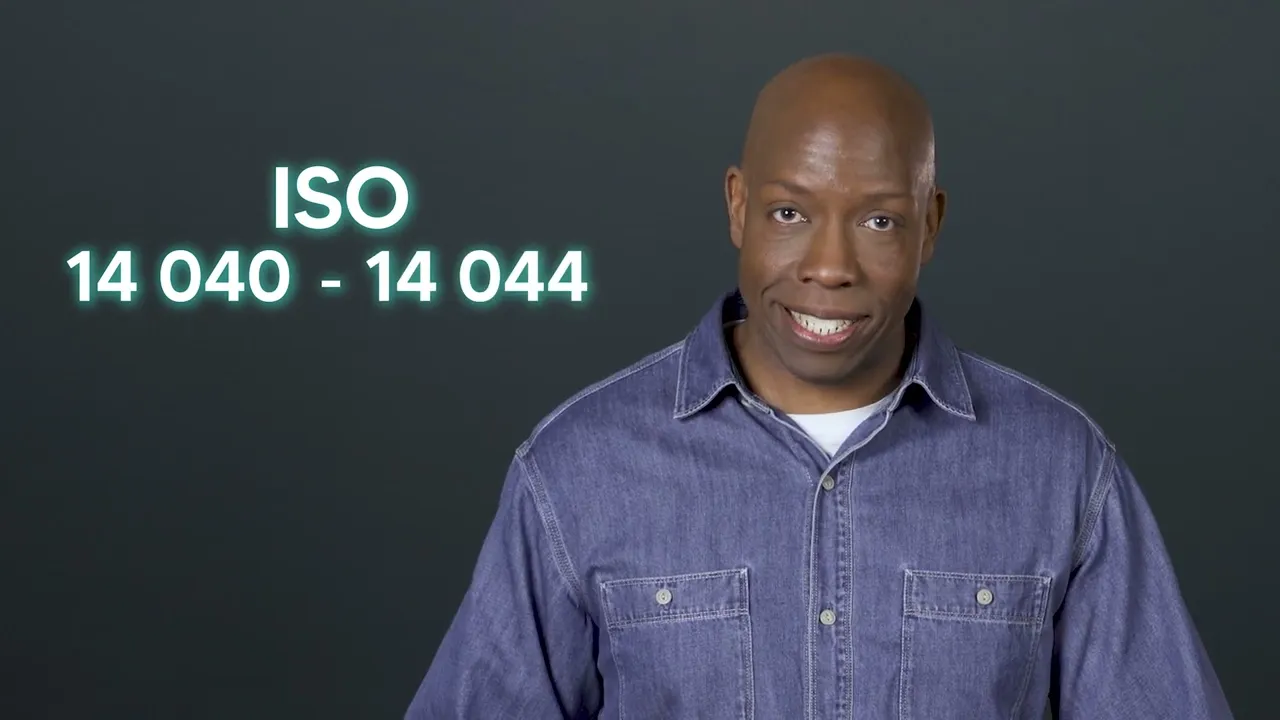
LCA has been standardized at the international level, through the ISO 14 040 to 14 044 standards. Using this tool consists of making an inventory of all the flows linked to a product or service’s life cycle: - input flows: energy resources and raw materials. - and output flows: waste, gas emissions or liquid discharge.
Then, based on this inventory, the impacts on different indicators are evaluated: the greenhouse effect, water resources, land use, etc. But eco-design is not just a tool! It is a new way of producing and therefore it implies a GLOBAL reorganization.
Let’s take a quick tour of a company’s services. Thinking everything through from the design stage is R&D’s job. Modular design can be introduced, for example, so that at the end of the product’s life, one of its components can be replaced without damaging the other components.
It must also be possible to disassemble the product: this needs to be planned from the design stage. It can also be made easier to clean, to help reconditioning. For example, by improving the shape of parts FROM THE START.
To do all this, we will need new R&D skills. Secondly, it is a question of designing products that are less resource intensive. We talk about material efficiency: the ability of a product to use less raw material for the same purpose.
We need to work on materials and supplies to improve the ecological performance of the product. This will have a big impact on the Production and Purchasing departments. We also need to be perfectly aware of a product’s usages.
. . to make it more robust and repairable, or to remove some superfluous functionalities.
So consumers must be listened to carefully. And that’s the job of the marketing teams! It is also marketing’s role to educate customers when it comes to promoting more sufficiency, or if they need to be convinced of a price increase.
In reality, ALL the functions of the company are concerned by circularity: R&D, purchasing, marketing, yes, but also sales, logistics, and quality. . .
To eco-design products and services, all these professions must undergo a deep transformation. . .
and the company must reorganize itself. And eco-design is not only about reducing the impact of your existing offerings, but also about imagining NEW products or services that aim FROM THE START to create value for your customers AND for the environment. Here, your innovation teams are at the forefront.
At the same time, you will have to think about removing from your offer products and services that are not compatible with planetary boundaries. As you can see, eco-design is about shaking up the organization from the inside. It involves breaking down barriers and innovating.
But innovating often leads to multiple benefits: improving efficiency, creating jobs, reducing costs, proposing new offers and standing out from competitors. . .
In short, eco-design requires effort, but as you see, you have everything to gain.





![🔴[LIVE] Dog Music🎵Dog Calming Music🐶💖Separation Anxiety Relief💖🦮Dog Relaxing Music for Sleep🔴14](https://img.youtube.com/vi/pgyUg7OCZak/maxresdefault.jpg)