All right, founders. In this video, I'm going to show you a go-to market content strategy that investors will love. The reason investors will love this is because this strategy works.
Not to mention, content is a great strategy because it is free. Doing a content marketing strategy to me is the best way to go after the low-lying fruit to get that initial traction for your startup, which of course investors are going to love, but also your customer acquisition costs are going to be substantially low. So, they will love this strategy and it's also the strategy that I use every single day.
This is how I do my content and how I've been able to generate significant returns and traction that investors love to look at and motivate them to invest in my startups. Before we continue, my name is Ed Kang and if we met before, just use the chapter markers and skip to the main part of this video making it as easy as possible for you. You are absolutely welcome.
If we haven't met before, I'm a seven-time funded founder with two axis. That's just a fancy way of saying I failed a bunch of times to your benefit because I like to use videos like this and my channel to try and help founders, especially early stage founders getting that early stage traction, avoid some of the catastrophic mistakes that I've made. Not to say you're not going to make mistakes, but I'm going to try to make your life a little bit easier because you know what?
It's hard enough as it is. I'm also the chief strategy officer for startups. com.
I'm helping hundreds of founders get traction every single week. Also raise money and build their products. You name it, we do it all at startups.
com. If you haven't checked us out yet, go to startups. com.
Easy URL to remember. A lot of free resources there. If you're joining us from startups.
com, thank you so much for your participation in our community. Means a lot to me. While you're here, leave a like, comment, and subscribe.
Do the YouTube thing. Everything you share is totally appreciated. I'd love to hear what you think.
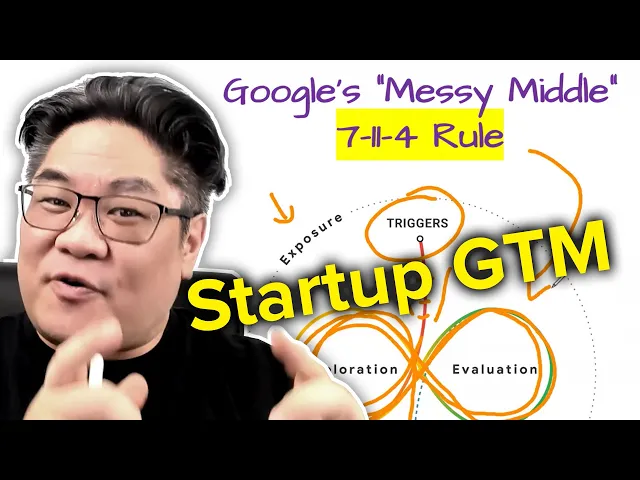
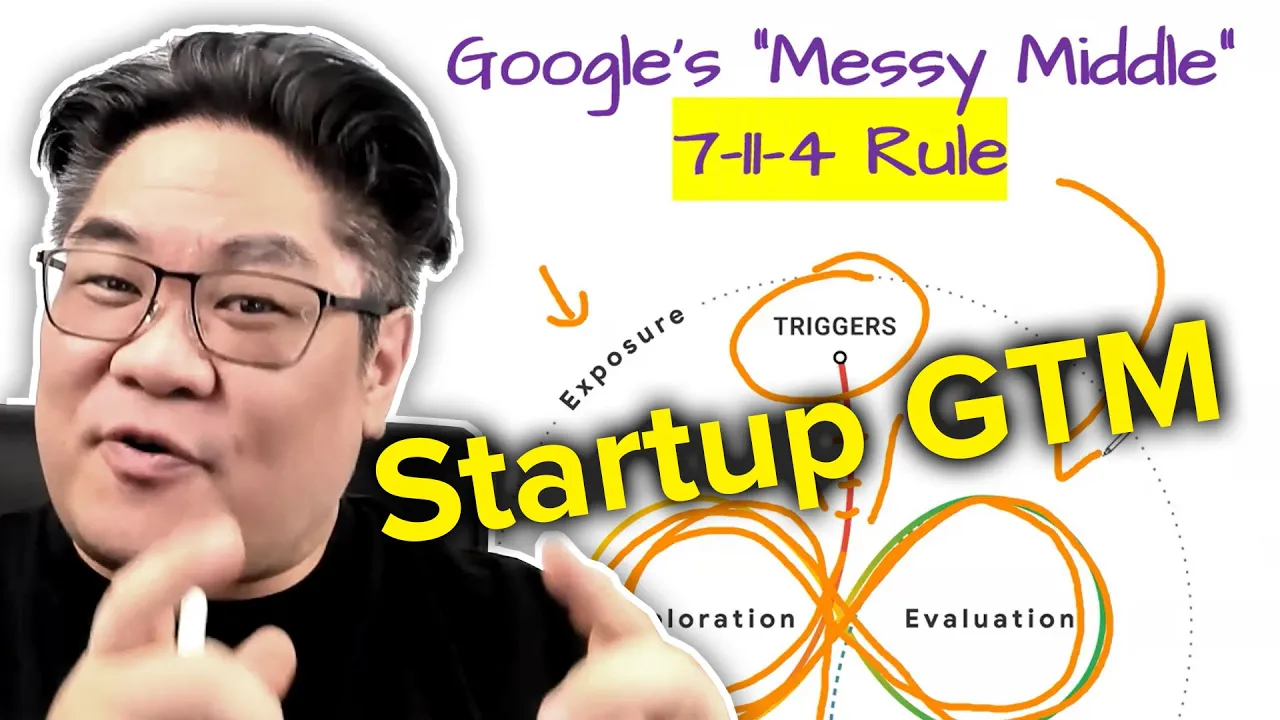
All right, with that, let's get into the content strategy that I use that you want to show investors. This content strategy addresses what Google calls the messy middle. On average, if you want someone to buy from you in today's current market, today's current landscape, they need to spend 7 hours with your content, they have to be engaged across 11 touch points.
Touch points are any type of interaction that they have. Maybe watching this YouTube video is a touch point. Getting my newsletter, coming to the website, watching the next video.
Those are all touch points across four different platforms or channels. And that's important because no longer is it going to be just about watching YouTube. You have to be able to see that content or that brand, that message, whoever is selling to you on different platforms.
So, for example, in my case, a lot of individuals come to YouTube and then they go to LinkedIn and then I'm on Reddit a lot. Like, I like to be exposed there. And then you've got my website and there are so many different ways.
Some people follow me on X. You just have to be able to get to four of them. So, it's no longer good enough just to be on one channel or one platform.
Now, what happens is that it's no longer about just a funnel. Before it used to be about a funnel and you would come in and let's say you would do some type of free thing. Maybe you saw an article online and then you went to a free webinar and then they would say, "Okay, now upgrade and pay for your trial, something like that.
" And then eventually you drop into the funnel. And that implies that there would be a stepbystep situation going on where you are planning your funnel and then you manage it all the way down and you convert, convert, convert until you're making that sweet, sweet cash right at the bottom there. The problem is nobody likes to be in a funnel anymore.
Nobody likes to feel like they're getting pushed down a funnel. So they like to engage, disengage, go here, go there. They like to have that choice and the internet has made it quite easy for everybody to do that because you got so much content going on out there.
This is why Google tracking everybody's behavior says that you first start with exposure and there are multiple triggers and it's not a funnel anymore like you would expect here. They basically go around in something called the messy middle exploring, evaluating, and then something happens where they have enough of an experience where they decide to purchase. In other words, they need to spend the 7114 rule experiencing the messy middle, being exposed to it, triggered by it, exploring it, evaluating it for all the experiences that eventually get to the point where there's a purchase.
And you might be thinking, Ed, are you crazy? 7 hours? That is absolutely insane.
In startups, aren't we trying to convert people as quick as possible? And yes, you want to convert people as quick as possible because in startups, it's all about hyperrowth. The problem is everybody else is trying to convert everybody as quick as possible.
And they're putting out lots of free content. Tik Tok, Instagram, articles on LinkedIn, the website, all of that is free. So there's so much noise competing for your users attention.
And guess what happens? Those platforms know this. So they say, "Hey, how about you pay?
Pay for an ad. Pay for an article. pay for exposure, pay to be listed at the top of the results, and that's how they make money.
The problem is that investors don't like that. So, if you went out and said, "No, we get all our customers by paying for them," investors aren't going to be too excited. But if you can say, "Guess what?
We're actually building an amazing content engine, a machine that addresses the 7114 rule because 7 hours does seem like a long time, but guess what? When you put content out there, like I have an entire library of YouTube videos where thousands of hours are being watched all the time, that happens without me actively being engaged or having to do something with all those customers. That's why I love content marketing because even though it might take a little longer, eventually you build up that library, the content works for you even though you're not actively participating.
So basically, your stuff sells you or whatever your product is, your stuff, while you're sleeping. And that's the ultimate form of a system. And you can hack that all day long to increase those results by putting out better content, looking at the metrics, putting out the better content.
The question is, how do you go out and get started? Well, there's a simple formula for that, a model that I've created. And like I said, this is what I use every single week without fail.
This is what I do. And let me just say, I do not pay for any marketing or sales whatsoever. And it all comes to me.
I have a system, a machine that handles the messy middle for me and leads and sales just continue to generate. Is it any less work? No, it's not.
There's more work upfront with this than going out and paying for somebody to convert. But in the long run, it's way better, more worthwhile, and that's what investors are interested in. Investors will love this if you're able to set this up.
Here is a graphic that you might be familiar with. It's going to be your TAM, Sam, SOM. And we can overview this as I go, but I break up my content in those exact same segments.
TAM content, SAM content, SOM content. First, you have your TAM content. And this is total addressable market content.
Everybody content. And it's the content that I put out to get everybody to know me. So, you are going to say, I want you to know me.
Therefore, I'm putting out this type of content. In my particular situation, I want every startup founder to know me, know of me at least. Therefore, I'm putting out content that addresses every single startup founder out there because that is my target market.
Now, let's say you're doing a B2B SAS product and you want every executive out there to know your stuff. Well, you're going to put out content for every executive in the types of companies that you want to be selling to. Let's say you have a BTOC health type app.
You want everybody who's thinking about health who could use your app. You want content that resonates with them. Pretty straightforward.
The problem is when you sell to everybody, you sell to nobody. But that's okay. This is how you get your engine going because you're going to need the 10 content to help you determine what the next type of content is.
And that is your SAM content. This is when you get a segment of your market to like you. The same way that SAM serviceable addressable market is the segment of the TAM that you are targeting because there's a business model advantage some strategic advantage.
Maybe it just has to do with geography. There are different reasons for SAM just like when you're doing Tam Sam. And by the way, I've got videos to help you do Tam Sam like a total pro.
But SAM content is what you put out there to get the target market, the segment, target segment to like you because you want them to know you first and then when you do that, you can get them to like you. And that brings us to the third type of content, the third bucket, which is my SOM content. The SM content stands for serviceable obtainable market.
And that's the part of the TAM that you realistically can convert when everything is going well. you're executing against your strategy and they will not convert. They won't buy from you unless they trust you.
And this goes in sequence. You want them to know you, like you, trust you. So all you have to think is Tam Sam, know me, like me, trust me.
The problem is, as I alluded to, that people don't know what content is going to work for their SAM and their SOM. Here's what you do. You first start off by understanding what your ICP is.
Your ICP stands for your ideal customer profile or your initial customer profile. That is the persona, your avatar, however you want to call it that you are going to be targeting. And that starts with your TAM.
In my case, I said I want every startup founder to know me. That's my TAM. My workwithstartups.
com and what I do for a living appeals to every startup founder. Once again, it's a totally massive market, but I don't have to worry about that yet because I'm just going to start putting out content. I'm going to start testing it.
But the next decision I have to make is figure out, okay, how do I put that out there? What channels? And that's what you have to figure out.
You have to analyze your ICP and you have to say to yourself, okay, where do the users in my TAM my TAM market go to basically learn about what type of solution would be out there for a very specific type of problem? Because remember, all startups are about solving a problem. We're going to go out and solve a problem for our ICP.
So, you want to figure out, okay, my ICP, where do they go? What channels do they go to talk or learn about how to solve the problem? That gives you an idea of the type of content that you're going to be experimenting with.
I happen to know startup founders go to YouTube all the time. How do I know this? Because there are a lot of videos about startups, helping startup founders on YouTube.
You look at Y Cominator, the biggest game in town. They went out and they said, "Hey, YouTube is the place to be. " So, they created a prolific YouTube channel.
I also know this because I use YouTube to learn about startups. I learned how to do startups to begin with by taking the online course on YouTube from Stanford put on by Y Combinator on how to start a startup. So, I knew that was one of the channels that I need to participate in.
You got so many different channels. You just have to understand where your ICP goes. Maybe they go to Instagram.
Maybe they read articles on LinkedIn, Kora, Reddit, Facebook. There's so many choices out there, and I get it. But the easiest way to answer what channel they're on is to go study your ICP.
Go talk to them and find out what social media, what channels do you use, where do you get your content? Maybe they just read blogs. Maybe they go to chat groups.
It's total Discord type of community that they're into. Whatever it is, you're going to be learning. Forget your assumptions.
Go find out from your ideal user. From there, what you want to do next is you're going to test test test the different type of content. So, you're going to test TAM content.
And that's all this content talking about the problem. I want to emphasize, no matter what you do, do not go out there and put out content pitch slapping your TAM market with the solution. When it comes to content marketing, understand that nobody gets up in the morning and says, "Gee, I want to read all this content that's going to pitch me and sell me all day long.
" Nobody wants that. In fact, we've gotten so good at filtering out all those messages. It's just going to be noise.
Think about your LinkedIn inbox or any inbox. I get spammed all day long. Dozens of messages pitching me.
Do you do this? Do you want this? I can get this for you.
I want to sell you everything under the sun and I just ignore it right away. As soon as I see it, I turn my mind off. I say, I can't be bothered.
Remember, you want to get them to know you, like you, then trust you. And you're not going to do that by pitch slapping them. So many founders go out and they just start talking about their solution.
They say, "Would you buy this and would you need that? " And it doesn't get to the point where there's any trust because if you're starting right off on the wrong foot of trying to sell, nobody's going to like you to begin with. And nobody wants to know you.
They might know you, but you'll never get to that next stage of liking you and then eventually trusting you. Let me repeat one more time. You're going to experiment with content that talks about the problem.
Let me reiterate. When you are thinking your TAM market, the first thing that you should be thinking of in your mind is how do I create problembased content? And there's so many ways that you can figure this out.
Go ask Chat GPT. I'm trying to target this market and I'm solving this problem. What type of content are my users looking for?
What is most helpful? What will engage them? I want enticing headlines and different types of content.
And you will see on my YouTube channel, I experiment with all different types of TAM content that talks to every single founder, general things about founder life and founder philosophy and how to be successful as a founder, the industry as a whole. We're talking about startups and I want to see which ones get me more exposure and I measure it. The metrics are there.
These are not the vanity metrics. These are metrics that happen to tell me that my content is working. I get views, but then there are comments.
How many people subscribe from that type of content? How many people go to the next stage? Remember the 7114 rule.
How many go and watch another piece of content of mine contributing to that 7-Eleven rule or go to another platform? I'm measuring everything. So, you want to test test test and know that it is a moving target.
You are not going to figure this out overnight. In fact, I would recommend that you get ready to put out 100 pieces of content and then say, "What did I learn? " and learn along the way.
Try to improve it every single step, but don't make some major conclusions on whether content marketing is going to work for you or not until you put out 100 pieces of content. Once you've tested on different types of channels, you are going to then repurpose your content. And here's what I mean.
Let's say you put out a piece of TAM content out there and it starts to go really well. All right, this is fantastic. Then you're going to repurpose that TAM content to target your Sam.
You're going to add certain things to get them to like you and then you're going to figure out how to repurpose that if it goes really well in all your tests. There's three levels of tests. I'm testing TAM content.
I'm testing Sam and then I'm going to test some content. And you want to repurpose. And not only do you want to repurpose the content, you can also repurpose the content across different channels.
And that's what makes this system so efficient eventually if you're doing it properly. Let me give you an example. I'll put out a piece of content out on Reddit that's general.
So, Tam, I'm going to put out just a post on Reddit. It'll be a quick post and I'll see how many upvotes, how many comments that I get. Then I will repurpose that same topic into the SAM and I'll turn it into a video on YouTube.
If you're following me on all these different platforms, you'll see it. And then eventually, if that works, I'm going to focus on my psalm and maybe I'll create a bunch of LinkedIn posts. And that is how I start to reuse that content.
It's not reposting, it's repurposing. So many founders make this mistake. They've put out one piece of content and they cut and paste it across all the different channels.
That does not help because customers aren't going to engage and you're not going to fulfill the 7114 rule. Because if they go and they spend 1 hour with your content, let's say it's a long piece of content, a video, and they see the exact same video on your LinkedIn profile, then they're not going to keep engaging and add to those seven hours because they've already seen it. So repurposing means you have to put a new spin on it.
It's almost like a series. Well, at the same time, you never know who sees that piece of content on that different channel repurposed for the very first time. Now, you know why they call it the messy middle?
It's not just neat and clean boxes that you can control like the oldfashioned funnel days. It's the messy middle and you have to keep working at it. And what helps me trying to create all this content to fulfill the 7-Eleven 4 rule, I repurpose it.
I don't have to rethink of themes. I can just experiment with my TAM. And once that pays off, I can go Sam and S content based upon how I know things have done because I measure the metrics.
I don't have to test new topics. I just have to reformat them here and there. And the tools these days are amazing.
You can create a video, cut and paste that transcript in chat GPT and say, "What would this look like in an article? " Adding a few more steps. Maybe you show the video and then you say, "Hey, on my LinkedIn, you can get all the different steps written out.
" And maybe on that LinkedIn article, you can paste your video and say, "If you haven't watched my video, go watch my video. " And now you're creating so many interconnected pathways for that messy middle so that you can fulfill the 7114 rule. Let's get real specific for just a moment and use some of my other examples here.
Let's say you're doing your B2B and you want to target every single worker. Then you want to talk about workbased content. Talk about the problems.
I don't know what problem your solution could be solving. Let's say something as simple as coaching for all executives and corporate training. You've got a enterprise platform, a SAS platform for all that education out there.
You want to be putting out content about the problem and you want to dribble in some of the solution, but it's going to get there. Maybe you talk about workplace challenges or staying engaged at work, but then you're going to drop that and test it into the SAM content. And remember, this is where you get people to like you.
So maybe you start sharing some of the stories. You talk about the problem, but then you start talking about some of the stories that you've experienced with the problem and you're getting them engaged. And it's easily accessible.
Someone could come in new into your SAM and say, "Hey, I want to check out the story. " Or let's say they saw one of your posts, your articles in some blog somewhere and they say, "Hey, now I get to find out about this individual's personal story. " And then finally, you talk about your psalm.
And then you talk about the solution. But remember, you're going to be putting out value in this. And the value might be here's how you can explore the solution yourself because this is how I did it with my story.
And if you want my help, contact me. They might not be ready to trust you as of yet, but if they spend more time in these other forms of content, seven hours worth of time on average, they'll eventually get to the point where if they've seen enough of it, they are going to trust you and give you a little bit of a chance. Let's look at your BTOC health app.
For TAM content, talk about general health problems that relate to your startup. Let's say you're doing a diet and weight loss app out there. There's a lot out there.
I'm just using this as an example. You want to talk about why people struggle to lose weight. Maybe you put out content talking about what are the different types of diets that are available out there to you.
Now you get into the SAM content and let's say for example you want to target people who are on the keto diet. Well, guess what? That content seems pretty easy.
Go from health problems to talking about how you should do keto diet specifically because your app is all about tracking keto. And then finally, you have your SM content. Trust you.
Maybe you've got some articles or white paper out there that talk about the results of your app on the keto diet. Now, here's the key. Every single segment is going to get you less and less of the target market as well as potential exposure, but that's okay.
Not all exposure is created equal. Let's say you reach 100 people here with your TAM content or it's designed to target 100 people here. Then for your SAM content, only 50 people are going to be interested in your keto articles or your articles about your personal story with issues at work.
And then finally, you get to the point where only 10 people are going to trust you and they're going to convert. But guess what? That's a 10% conversion if you're looking at the 100 people who started.
And again, the best part is all this can be automated. I love that word. It's manual at first.
The testing is going to be manual. Don't get yourself worked up and say that's not going to scale. Don't avoid it.
Do things that don't scale. Do it manually. You're testing the content.
But eventually, you get it out there and it just works for you. Like my YouTube library continues to work for me. It's all automated and it just converts on its own and investors are going to like that.
I can't stress that over and over again. If you explain how you got there with investors, they are going to love it. I repeat, they will love it.
Let's hammer this home one more time for TAM content. Me, this channel, it's for all startup founders. That's who I'm trying to appeal to and I've tested.
But guess what? My SAM content, you know what it is? It's all about fundraising, funding.
That's my most popular SAM content. I found that out by testing all the way through. And now I repurpose that type of content.
And you see my LinkedIn, my Reddit, everything follows the same type of pattern. But my s finally are the type of people who become members at startups. com.
And you see I lace or embed or sprinkle startups. com in every single place because I know once they start to trust me they will become members. Maybe you're watching this right now and you're somewhere in this total messy middle and I know members who have fulfilled the 7114 quota a time with me and then they finally became members.
But I didn't go pitch you all individually. I don't have time for that. My content did the work for me.
Unfortunately, there isn't one ABC123 model that fits everybody. There is not a one-size glove fits all, nor is there an overnight silver bullet that's going to magically make all this happen for you. Let me break down the steps one more time in case you're wondering what you need to do after watching this video.
And I want to challenge you to go out and try it one more time. You want to figure out what is your TAM. That is the know you content.
Write down who your TAM is. Then think about your SAM and say which part of the market are we going to target to eventually grow in our TAM. Where's our focus because of the business model, strategic insight, competitive advantage, I don't care what it is.
Just make sure it makes sense for you and you can describe them. And then you're eventually going to get to your SOM who you're going to convert because they're going to trust you and that will reveal itself. Then you create the initial customer profile, ideal customer profile for your TAM and you start talking to their problems by experimenting on the different channels with different content about their problems.
Then after that, you will continue to test test test across the three different spheres because you're going to be repurposing them. Don't try and create something new every single time. As soon as you hit something that works, let's say you put out five articles and one of those articles really pops for you and is an outlier, gets you more traffic than you normally get, then you have to figure out how do I repurpose this over and over again till you basically ring it dry.
You squeeze every single ounce of value from it. And then you just put it in your system and you let it keep working for you. That's how you create this content strategy that investors are going to love.
And the final step is tell the investors what you did, what you're learning. And keep track of your metrics. Keep track of what percentage goes out to your TAM and how many of them become SAM and how many of them buy and eventually hit your SOM.
You want to focus on that because investors are going to see not only can you target and can you measure how you're converting, but you're also building sort of this backwards regression model where eventually you're going to grow into the rest of your TAM which makes the investor even happier because you're going to just make more money for them and everybody's going to get rich. The more you know your numbers and the more you understand your strategy, can explain it and if the investor asks you questions, you say, "Here's what I learned from doing it myself," the better off you will be. But let's not forget, if you do this right, you may not need investors at all because you're making so much money.
You're converting for no customer acquisition cost. Hey, what do you have to lose by trying this system out? Check out the notes that I'm going to put into the description.
If you want a clear understanding of all this, watch this other video that I'm going to put on the screen of a different type of method that's going to complement the Tams content model. You're going to like it. Let me know what you think.
I appreciate you spending time with me here in this video.