If you've watched any of my videos on YouTube, you know that I'm as well as trying to educate the public about what economics should be, I'm also promoting an online course. And I've decided to put the overview lecture for the entire course up on YouTube now for a few reasons. One, simply to help public education. Second is because I'm now seeing neocclassical economists popping out and promoting their approach to Economics as if the global financial crisis didn't even happen and as if they did not see it coming, which of course was the case. The crisis
happened. They didn't have any idea that it was going to occur. And what are they doing almost 20 years after the crisis now? They're coming back and pushing the same methodology that failed to see it coming in the very first instance. So I want to make this available as a public service to show the holes in mainstream Economics that they often aren't aware of themselves and then also to show that there is an alternative approach. It's going to be very fast and very long. This may take me 2 hours to get through. So if it's
too much for you in one sitting bookmark and come back to it later. I hope this will be a useful antidote to seeing neocclassical economists popping up on the social media now saying how great their methodologies are when they completely Failed to see the global financial crisis coming when they've misled us about economic policy. I don't want to see them do the same thing they did after the Great Depression which they also didn't see coming of just going back business as usual as if the Great Depression didn't happen. So let's get rolling. So, this is
an introduction to the 7-week rebel economist challenge that I'm now giving online. And my basic argument is we need a new economics and It will not be built by universities because universities are dominated by neocclassical economists. And one of the reasons they never reform themselves is they frankly don't understand neocclassical economics. They have a superficial knowledge of the discipline and the literature and that makes them very arrogant about their methods. But deeper knowledge shows that they're wrong. So here's one very recent example from Twitter. This is towards the end of 2025. So a neocclassical economist
I hadn't heard of before, but he's got quite a substantial publication record turned up and ridicule anybody who doesn't understand modern economics and in particular doesn't understand the concept of equilibrium. And that's standard for neocclassical economists to believe you've got to model the economy as if it's an equilibrium. Now he later explained that the concept of equilibrium he prefers and which he Argues is the one used by modern economics today was first developed by Irving Fischer in 1907. So here's him making that statement 1907 with Irving Fischer not the later concept of equilibrium that came
out of Arrow and Dra. I don't know whether he realizes that Irving Fischer disowned that very thinking himself in 1933 because looking back at why he was destroyed I mean literally destroyed financially destroyed reputation destroyed by the Great crash of 1929 he realized that what led him astray was believing it could model capitalism as an equilibrium process in the first instance this is a easily found paper on the web very popular paper but most people skip over this detail. He said theoretically there may be in fact at most times there must be over or under
production, over or under consumption, over or under spending, over or under saving, over under investment, and over under Everything else. Here's the punch line. It is as absurd to assume that the variables in the economic organization will stay put in perfect equilibrium as to assume that the Atlantic Ocean can ever be without a wave. In other words, we should not use equilibrium modeling. It mits leads us about the nature of the economy. What happens after event like the great depression which misled Fischer? Neocclassical economists rebuild the equilibrium analysis that he Said we should cease using.
Now, you won't learn any of this if you do a university economics degree because with a handful of exceptions, universities around the planet are dominated by neocclassical economists and they use supply and demand analysis. They model capitalism as an equilibrium system. They hit students with lots of algebra. As Gary Stevenson has said, it has to be replaced. And there are many, many reasons why it should have already been Replaced. In the mid 1910s, completely by accident, mathematicians solving an issue in pure mathematics accidentally proved that Volra's process of reaching what he called general equilibrium by
a process of what what he called detonement or groping towards an equilibrium price vector would not converge to equilibrium. And there's a very excellent exposition of that in John Blat's book. During the Great Depression, they didn't see it coming. Fischer himself, who was neocclassical at the time, assured people that nothing bad would happen. Everything would be back as normal after a few months of getting what he what he called the lunatic fringe. Instead, he was destroyed by the collapse. In the mid 1930s, in the middle of the Great Depression, economists started to have meetings with
businessmen and they found much to their surprise that the upward sloping supply curve that is such an Essential part of neocclassical thinking did not apply to real world firms. In the 1950s, mathematical economists found that the demand curve, which is the other half of the overwhelming meme of neocclassical economics, the intersecting supply and demand curves, they found they couldn't derive market demand curves that had the same properties that they could derive for individuals. And then in the 1980s, the whole idea that we have to force reality Into an equilibrium straight jacket was eliminated by the
development of computable system dynamics programs like at this stage stellar were first developed. My program Rabble is an inheritor of that history. We haven't had to use equilibrium for 40 plus years and yet neocclassicals still shove everything back into an equilibrium box. And of course in 2007 it should have been the death nail for neocclassical economics because they didn't see the Global financial crisis coming whereas postcansians like myself and wind godly did and warned about it beforehand. So why does it survive? It's largely because neocclassical economists, as I've said, don't really understand neocclassical economics. And
the public and economists forget their failings over time and let them get away with putting forward these useless methods 20 or so years after they completely misled us about where the economy was going. So, I've developed a realistic course on how economics should actually be done. And I call it rebel economics. And I cover seven topics in seven weekly lectures. The first is why economics does not reform itself. The fallacies of supply and demand. How the macroeconomy really works. Understanding money using ravel or revel my software package I've I've invented to enable us to look
at the monetary system in the same way that galo's telescope enabled us to look at The the universe. Why economists are wrong about both government debt and private debt. and then financial instability which is why most economists missed the global financial crisis because by putting everything in equilibrium framework of course they couldn't see an instability event coming and then energy ecology and economics the three E that economists do extremely badly so this is an overview of my entire course in just one talk and I'm Going to cover an enormous range of issues and probably about
2 hours so think of it like speed dating it has to be superficial but you get the broad outlines of my approach to economics And then if that wets your appetite, you can go on a second date and come and join me at wwsteveken.com. That's the login page there. Takes a bit of time to get through the marketing, but it'll ultimately join my online course. Let's start with the first issue Now. Why does economics not reform itself? And this comes down to what are called paradigms which are a intellectual framework that exist in all academic
disciplines. And also economics does not advance as uh the great physicist Max Plank once put it. Economics does not advance one funeral at a time whereas genuine sciences do. So let's start with the fact they've got an incorrect model of the economy. It's neat. It's plausible and it's wrong. And The model was first constructed back in the 1870s before we could actually work out whether it actually fitted reality or not. It's completely false about the nature of the economy and obviously the failure to see the global financial crisis was a major sign there. So the
question is how does it survive? Why does it persist despite failure after failure? Well, it has to do with paradigms and that's a way of thinking about a scientific topic which is Accepted by most professionals in an academic discipline. They're a bit like the word of God for religions. Okay? If you're Christian, you know the Bible. If you're Muslim, you know the Quran, etc., etc. In that sense, the paradigms are the word of God for that particular discipline. And they tell you how to think about the world. They also tell you things to look for
which are going to confirm your beliefs about the world. Now they can persist despite anomalies Turning up against them but they will ultimately fail in a genuine science because science tests its theories and ultimately as despite massive resistance finally a paradigm which can't suit what's found by real world experiment will be replaced by one that can. This happens in what's called the scientific revolution. a term that was first invented by Thomas who was a philosopher of science looking at the development of astronomy over time. Economics should have undergone a revolution at least 80 years ago
but it didn't. So let's go through an example of a scientific revolution. The very first one that studied which was the move from believing that the earth is the center of the universe to knowing that the sun is the center of our solar system. For millennia, roughly 1400 years, the model that said the earth was the center and the sun and the moon and stars and planets orbit around it was The conventional knowledge. So arro Aristotle's paradigm was that the earth is fixed and immovable at the center of a set of perfectly concentric crystalline spheres
and the moon and the sun and the planets and stars all rotated around the earth on these spheres. Now the problem there was that there were what are called planets and apparently that's the ancient Greek word for wanderers which reversed direction in the sky and they got closer and Further away and so on. These are the planets they only observe five by eyesight at the time. So Tommy took the core hypothesis of Aristotle that there's these set of concentric crystalline spheres that surround the earth and he added spheres on spheres which he called epicycles. He
also argued that the earth wasn't quite at the center of the universe because then it would be perfect. Uh and a range of other little modifications like that. So This is a a mathematician sketch of the geometry involved in Tomy's model. The big circle are what are called difference and that's those are the original crystalline spheres. The small ones are called epicycles and those are spheres on the spheres on which the planets rotate. The earth is over here not quite at the center of the universe. The center of rotation is also not quite at the
center of the universe. So it's an extremely complicated vision of how The planets function and the science of astronomy became fitting what could be observed by eyesight because of course this predates the telescope. What you could see by eyesight of the planets movement to a Tomlmake model. Lots of algebra lots of geometry. Now the structure that all tom astronomers agreed was the structure of the universe was first of all you had the earth at the center then you had the moon then mercury then venus then the sun and mars Jupiter and saturn that was commonly
agreed what they debated was how big were the circles how fast did they turn etc etc and fitting all the circles to a pattern like this was an extremely complicated task that's what research meant uh for an astronomer before Galileo so this is an earthcentric vision of the universe. Now comes Capernacus and says actually it makes more sense to say the sun is the center given the observations we make of how The planets actually move and one group couldn't understand the other. Paradigms are incommenurable. For a simple example, the tomic paradigm tells us the earth
is the center of the universe. So when you throw something up in the air, it'll fall back down again towards the center of the universe. With the capernican one, that was no longer the explanation. And why wasn't there a wind? Because the only way the capern vision made sense was the earth is Rotating. Why don't we feel this crazy wind all the time? So all these things means that people from one paradigm simply can't understand what people from another paradigm are saying. Now this persisted in astronomy until Galileo perfected the telescope. Didn't invent it, but
he improved what he heard about from a three times magnification to a 20 or 30 magnification. And he made quite a reasonable living on the side. actually actually making these telescopes. These Are two of his originals here. So, Soulmaker astronomers could use these to look at the spheres, did they? No. They actually refused to look through Galileo's telescope. And Galileo got so frustrated that he wrote this note to his fellow heretic astronomer Kepler. My dear Kepler, what would you say to the learned here who have steadfastly refused to cast a glance through the telescope? Shall
we laugh or shall we cry? I really know how Galileo felt Because I'm both laughing and crying at the behavior of neocclassical economists today. So there's many many parallels I believe between what Galileo experienced in the state of economics today. We have a dominant paradigm called neocclassical economics. It developed in the 1870s well before any form of observation of the economy was possible. We have many techniques we've developed since then. mathematics, especially matrix algebra and differential equations let us Analyze the behavior of a dynamic system. We now do surveys of both consumers and corporations. So
we can actually find out what people say they think and we can simulate dynamic systems using computers with technology like Stellar and now like Rell. All of these contradict the dominant paradigm in economics and it ignores those values. And one reason it can do it is because at a superficial level, it's actually quite a reasonable looking Hypothesis. What you have is the idea that was first footboard by Alfred Marshall in 1890 that you can show demand and supply using a downward sloping demand curve and an upward sloping supply curve and everything happens in or near
equilibrium. And when Marshall first put this idea forward, he basically treated it as something that you couldn't refute because he said, "We'll study what equilibrium means more carefully later and we'll look at the Controversy between whether the cost of production sets price or utility sets price." But he said, "We may as well dispute whether it's the upper or lower blade of a pair of scissors that cuts a piece of paper as to whether value is governed by utility or cost of production. Now today price and quantity is set by supply and demand is accepted by
most people just as they used to accept Tomy's model of the astronomy with the earth at the center of the Universe. So supply and demand curves may be the most successful meme in history. It permeates everybody's minds and economists use them for everything even when they've been told by central banks that their model is wrong. This behavior of economists of not reforming themselves after a major anomaly isn't unusual. It's not even unscientific because Max Plank who's the physicist who first developed the concept of quantum mechanics saw the same thing in Physics and he wrote in
his scientific autobiography that is one of the most painful experiences of my entire scientific life that I have never succeeded in gaining universal recognition for a new result. The truth which I could demonstrate by a conclusive albeit only theoretical proof. instead paraphrasing his argument, "Science advances one funeral at a time." What he actually wrote was, "A new scientific truth does not triumph By convincing its opponents and making them see the light, but rather because its opponents eventually die and a new generation grows up that is familiar with it. Now, this doesn't happen in economics for
a number of reasons. Firstly, the anomalies in economics, the empirical ones anyway, like the Great Depression or the global financial crisis are transient. You can't reproduce them and check and see how different theories might work out Against them. But also I think more importantly the current dominant school of economics which is neocclassical economics describes a utopia. You got this perfect competition a meritocratic income distribution they call marginal productivity equilibrium uh in the ideal situation there's no concentration of power. This is the wonderful vision of a self-managing system. Neocclassical economists, whether they're conscious of it or
not, become zealots for the Positive vision they have of capitalism. And this is just like Marxists at the other extreme who come zealots for their negative vision of capitalism. The facts aren't going to make either group change from their rigid set of beliefs. Now what that means is particularly with looking at neocclassical economics at universities that professors can easily replace them with somebody in the student model who shares their vision even if the real world contradicts that Vision at the very same time. So you can have an experience like the great depression and in the
middle of it you can find people who still believe that capitalism doesn't suffer from great depressions. This happened in the great depression. It's happening again now because we all know, we should know that neocclassical economists didn't see the global financial crisis coming. But they're back pushing their methodology again. And so generational change Doesn't happen in economics. Economics, unfortunately, does not advance one funeral at a time. The undead ideas live on in students who swallow the vision that they were taught by their lecturers. So how can you get rid of a Paul's paradigm? One of the
ways the tomic paradigm was finally killed was because to explain comets, the only explanation the Tomlake theory had was that comets were atmospheric phenomena because their vision was the heavens Were perfect. Earth was where change and decay occurred. A comet is a sign of change, possibly also of decay. So therefore that had to be atmospheric. Now Haley who not only followed Newton but financed a lot of his work took Newton seriously and said comets must be heavenly bodies that orbit the sun. So he saw a comet in 1682 and he predicted it would return in
1758 and he was right. If there was any final nail in the tarmac coffin it was Hal's accurate Prediction about the return of what we now call Hal's comet. Now in neocclassical economics depressions are unpredictable. They're stochastic events. Some random combination of factors gives you a great depression. Postcanesian economists like myself argue instead that you can predict them using sectoral balances and that was done by wind godly back in 2000. And he argued that there were public sector surpluses. So the government was running A surplus rather than a deficit. The international account for America was
also in deficit. So he said the only way that can be maintained is if the domestic private sector continues to spend more than it's earning therefore owning up private debt. He said this can't be sustained. Once this is understood it will become clear that what was called the godly economy at the time is doomed. I started warning of the crisis in 2005 and my foundation was Minsk's financial instability hypothesis and I argued in May of 2007 that the private debt to GDP ratio must stabilize and on past trends when it does stabilize it'll do more
than stop. You'll have negative credit and when that inevitable reversal of the unsustainable occurs we will have a recession. Now we got it right. These are accurate predictions. The neocclassicals got it wrong. We're still stuck with neocclassical thought. And This incredibly frustrating to me because wind godly and I and most of the postconians are aware that what caused the great depression was a boom and bust in private debt levels and it sticks out like two sore thumbs on the data. There's the huge level of private debt at the that the time of the great depression
and it's collapsed at larger level but smaller fall in private debt at the time of the global financial crisis. neocclassicals had no idea that This was going to happen and they still don't take a look at that data when they try to explain what actually happened. So what tends to happen is when they make such a catastrophically bad prediction predicting there wasn't going to be a great depression that there wasn't going to be a global financial crisis they retreat back into microeconomics again which is their real home and then they revive as the great depression
became history and they Expelled what they called Keynesian ideas from the textbooks. The same thing is happening again now 18 years after the global financial crisis. We have a bunch of professors on social media and obviously in their classrooms pushing the neocclassical paradigm as if the global financial crisis didn't happen. This was a recent tweet by somebody who's got quite a quite a publishing profile in economics and he said here are 10 statements that showed that Somebody doesn't understand modern economics or what an equilibrium is and how important that is. And Roger Farmer who's somebody
I have met on occasion cames out with the same uh pro proposition saying he agrees with Yaz's above and he'd add the need for an equilibrium concept and in this both these cases this is anathema to my approach to economics. Now students who were infants at the time of the global financial crisis and therefore didn't Experience it personally are starting to fall for this stuff. So here's a fairly young student somewhere between 22 and 24 I guess and he's saying we have to get rid of uh macro without micro foundations when I see that as
one of the reasons neocclassicals didn't see the crisis coming by obsessing about micro foundations. Now what's the reality in all of these things is they believe equilibrium is a critical concept you must have in economics to be Able to understand the economy. But in fact, what this shows is not only they're wrong about the need for equilibrium, they're also ignorant of economics itself. So I showed the point with Yazes's tweet beforehand that he didn't realize that Fiser whom he based his equilibrium concept on had disowned equilibrium thinking. Farmer is much the same. He uses John
Hicks's concept of equilibrium. This is a tweet where he's uh makes this particular point I'm Highlighting down here is that he says he uses Hicks's idea of a temporary equilibrium as the way he organizes his thought about the economy. Now the concept of temporary equilibrium was later disowned by John Hicks. He wrote a paper called ISLM an explanation and frankly I think a better title would be ISLM an apology and he explained that first of all the ISLM model and for those of you who don't know it this is called investment savings liquidity Money and
it draws a pair of intersecting curves for the macroeconomy and says everything happens in the equilibrium. This became a major part of neocclassical economics for quite some time until they supplanted it with what they call dynamic stoastic general equilibrium models then but they thought was Keynesian. Hicks actually said no it was a vrazian comment or a neocclassical concept and in thinking about it 50 years after he came up with it he said It doesn't make sense and we should abandon it. So looking at the ISLM analysis, he said the only point that makes sense in
terms of how this valian model is constructed is that everything happens at the intersection. Nothing else on the canvas makes any sense whatsoever because if you're out of equilibrium in one market, you're out of equilibrium in all the others. And so it just does not make sense to use anything other than the intersection. But he says If you do that, you've got to assume the economy is always in equilibrium. and writing shortly after a financial crisis that began in 1974-75. He said, "We know in 1975 that the system was not in equilibrium." And then looking
at what equilibrium actually means, he realized that it had to involve people's choices being consistent over time and being fulfilled by reality. But he said, "If that's the case, then why do you need a liquidity Money curve?" Because there's no sense in having a liquidity preference unless you're uncertain about the future. If you're certain about the future, why do without making some money by putting your money into something that yields a return? Why keep it in form of money? The only way you can justify holding money is the future is uncertain. We hang on to
money as a way of quieting the possibility that our expectations of the future will not be fulfilled. He's Then looking at policy. It's even more suspect to use equilibrium methods. So again, here's farmer saying he's basing his work on Hicks, which uses temporary equilibrium. Hicks, after much experience, realizes that's a false way of modeling the economy. So neocclassical economics is kept alive mainly because neocclassical economists don't understand it. They never read the full detail. So that's the overview of why economics doesn't reform itself. Let's now take a look at the classic supply and demand curve.
The way in which economists intellectually think about virtually everything. Firstly, I'll show that the idea that the rising supply curve exists is wrong because a foundation for it which is called diminishing marginal productivity is a myth. And then I'll show the supply curve not only doesn't doesn't it not slope up, it arguably doesn't even exist. They're as fictional constructs As the crystalline spheres were for the Tomlake astronomers. And market demand curves, even if you can derive individual demand curves, market demand curves can't be derived from individual demand curves and have the characteristics that economists pretend
they have in their textbooks. So if you look at a modern textbook like Manq, boring bloody piece of work, um he shows Marshall's supply and demand being this way. you have, you know, exactly the Same basic idea, intersecting supply and demand curve, equilibrium in the middle, setting equilibrium uh quantity and equilibrium price at the same time. And a cartoon in the book just points out how widespread the belief in this meme is with a Eskimo discussing supply and demand with another Eskimo. Anybody can draw two lines on a sheet of paper and show their intersection,
but you need a backstory. Why does one curve slope down? Why does the other slope up? Why Is equilibrium where the action is? So you need a backstory. And in the case of the demand theory in Manq, this doesn't turn up to the very last chapter in the book, but the supply curve backstory starts on halfway through the book. And it's called diminishing marginal productivity. The idea is the supply curve rises as quantity in demanded rises because the cost of production per unit rises as output rises. And the basic idea is you have two types
of Inputs to production. You have fixed inputs which you can't vary in the market or short term. There are things like machines and factory builders and so on. So you're stuck with what you've got in terms of those resources. And they're also variable inputs, labor and raw materials which you can vary in the short run. And they're assumed to be of equal quality and cost. Uh so that you're not saying you've got less productive workers being used as you Expand output and that's why output gets more expensive. The argument instead is that to produce more
output, you've got to add more and more variable units to the same quantity of fixed units. Now, let's say you've got a machine that requires 10 workers to be operated properly. You start with one worker, that one workers got to run around doing the work of 10. Then you have two and they can run around doing the work of five, etc., etc. So as you go up towards From one worker towards 10, you actually get increasing productivity and you can get diminishing marginal cost at that stage. But ultimately you get to the point where you've
got 10 workers for the machine. And if you want to produce more output, you've got an 11th worker, 12th, 13th, and 14th. They're going to start bumping into each other and they're going to produce less per person than their predecessor. And that's where diminishing marginal productivity comes From. the idea that the variable inputs are getting in each other's way as you produce more and more output. It's a nice fairy tale, but it's simply not true. When you look at real world firms, you find that they operate below full capacity. And there's several good reasons for
this. One is that if you're in a growing economy, then you're going to be building new factories. And when you build a factory, it must have unused capacity. Otherwise, you made too small A factory. You've got to have some room for growth when you're building new factories. Secondly, spare capacity in any point in time means that a firm can expand output if it finds an opportunity in the marketplace if a rival makes a mistake that they can exploit and so on. You have to have room to be able to respond to what happens in the
market. And thirdly, factories, thank God, are designed by engineers, not economists. And they're designed to reach maximum Efficiency at maximum output. What you get is a completely different real world to what the textbooks teach. And this is despite the fact that there have been over 70 surveys which have found this result and neocclassical economists have just ignored all of them. So the most recent example I see this is quite literally pathetic. This is the Wikipedia definition of pathos. It's it's a complaint of the soul. It's responding to an erroneous response to Some information it's received.
And this is an error. It's an intellectual mistake. So the most pathetic example of this I've seen is Alan Blinder who did this research. He surveyed 200 firms that represented about 7% of America's non-farm GDP about their cost structures. And at the time he was vice chairman of the Federal Reserve and vice president of the American Economic Association. So you couldn't get a more establishment figure to go looking at This information and you couldn't get somebody who obviously understands the theory that he's assessing by using these surveys. I've had quite a few Twitterers tell me
that I don't know the literature. If if Alan Blinder got to being vice chairman of the Fed, I think you can expect he understands neocclassical theory fairly well. At least he did before he did this research. Having surveyed those firms, part of the survey was looking at the Actual cost structure of firms. And here's his reaction to that. Another very common assumption of economic theory is that marginal cost is rising. This notion is enshrined in every textbook and employed in most economic models. It is the foundation of the upward sloping supply curve. And what's the
result? He said the overwhelmingly bad news here for economic theory is that apparently only 11% of GDP is produced under conditions of rising Marginal cost. almost half is under constant marginal cost and another stunning 40% is in firms with declining marginal cost. He he then provided what I'm sure is the ugliest diagram ever published in an economic paper or book to show his results. So here's the 32.5% of firms who said marginal cost falls. Another 8% said it falls but we have spikes when we bring when we bring new production facilities online. Here 40% saying
it's constant. Another 8% saying Constant but again spikes when we bring on a new facility. Only 11% gave the result that the textbook teaches. Now how did neocclassical economists react to one of the most powerful and influential and well-known figures in neocclassical economics finding that the textbook story was wrong. I hope you guessed it. They ignored it. He published this book in 1988 and it has had only one review since it's been published. I got 25 years there. now 27 Years. That's the book. There's the one review that's been done of it. And a prize
for anybody who guessed it, I was the one who wrote that review. I wish I'd written it April 1st rather than April 2nd. But anyway, what I said is it speaks volumes for how the e economics profession handles contrary evidence that they've simply ignored Blinders research. It was at the time I wrote this review about 750,000th in Amazon's bestseller list. It's now About the 2 millionth. And I wrote the as I said the very first review. Whereas at the same time an excruciatingly boring and and tedious mathematical economics book called microeconomic theory which is still
uh being sold today uh was in the mid 100,000s and had over 80 reviews most of them extremely favorable towards it. I wrote that in 2006 19 years later. My review is still the only review and neocclassical economists ignore it. And I just Realized recently that one of the people who ignores this result is Alan Blinder because he maintains a textbook. One of the uh perks of being a top ranking neocclassical economist is you get to take over somebody else's p uh original textbook and republish it. So he took over Bormal's textbook called economics principles
and policy. in this textbook which well after he did this research he doesn't even cite his own research and like all other textbooks he has a madeup Example what he calls Al's garages which shows diminishing marginal productivity and rising marginal cost it's the same guff get in all the other textbooks that he does know is false but he doesn't actually communicate it now clearly he was disturbed by what he saw that was obvious in the paragraph I quoted earlier and he even mangles up the concept of diminishing marginal productivity when he writes this textbook for
students. But he should Have rejected it. So why didn't he learn from experience? Because the only way he could accept what he observed in the real world was to cease being a neocclassical economist. And that's just too hard for most people. He ignored the evidence of his own research. Now the research that's been done in his and the preceding 70 surveys found that this is a reasonably accurate description of the cost structure of a a real world firms. They have constant what he called Average direct cost that's average variable costs falling average total cost because
average fixed cost obviously decline in a hyperola as you increase the amount number of units being sold. firms have a planned level of output they're hoping to achieve and there's a limit of plant capacity and as they sell more and more their cost per unit falls. So we can turn this into a mathematical model. I've done this just recently where we take a look at the the Curves uh and we add in a price. Price is a markup on variable cost of production. So therefore, as the firm reaches its target level of output, it makes
a target level of profit per unit and a target level of sales. If it gets a higher level of sales, it makes a higher uh per unit profit and a higher level of sales. It wins out twice. So the basic answer, and anybody working in marketing knows this, you maximize profits by selling as many units as you Can. You do not stop when marginal cost equals marginal revenue. That's a fictional point in the first place. What real world firms do is use marketing, use product differentiation to try to drag customers away from their rivals. And
this gives you an evolutionary nature to competition. You don't get equilibrium coming out of this. You get evolutionary change. And what that gives you in terms of what the industries look like is the classic sign of an Evolutionary process. Rather than having monopolies and igopies and perfect competition, you have a spectrum of firms of different sizes which fits what's called the power law. This is first identified in 2001 by Bob Axel. And if you plot the size of the firms on the horizontal axis uh in in a log term so 1 10 100 a thousand
and then the frequency of those ter firms on the vertical axis you get a straight line fit and that applies to anything which Is generated by an evolutionary process. It includes for example the pattern of earthquakes. So this is a sign that we need to use the same thinking that people use to analyze dynamic processes like earthquakes and that means forget about equilibrium work in dynamics. Now the demand curve is equally another fast because the way they drive the individual demand curve is they show the uh consumer's preferences using what they call indifference curve. So
that Shows your utility from consumption. And then they draw budget lines which show your income and the relative price of whatever commodity you're looking at here. They hold the the consumer's income constant. And they then vary the relative price for the good they're trying to derive an individual demand curve for. And then what you get is a combination of price and quantity levels that gives you that downward sloping individual demand curve. So here's the Curve. So, we've got bananas as the commodity we're looking at on the horizontal axis and all other goods on the vertical.
Uh here's the map that supposedly shows the consumer's uh desires between bananas and everything else the person might be able to consume. Uh you then have income and price held constant. So there's a point over here where you divide the income of the consumer by the current price level and then you draw different lines uh for Different prices for bananas. So P1 is more expensive than P2 and more expensive than P3. So you get these triangles coming out of it. The points of intersection on the horizontal axis show how many bananas you could buy if
you spent all your income buying bananas. And then you take the points of tangency there and drop them down to a a diagram showing you quantity on the horizontal axis and price on the vertical. You've already determined what The price is. So you draw your coordinates here, draw a line linking the two, and there you've got a downward sloping individual demand curve. Now there's a bit of extra work to get to what they call the law of demand. I'll cover that in the full lectures, but not here. But that gives what they call the law
of demand. Demand falls as price rises. This model actually failed empirical testing. Uh there's a wonderful experiment from the late uh uh Late 1990s where an economist attempted to show students what their indifference was curves were and it completely failed. Now most economists of course ignore that result they continue teaching their juvenile theory of individual behavior. But even if it was empirically accurate even if it survived that test how do you derive a market to man curve? Now, if you read the textbooks, they just tell you simply add up horizontally. Here's man Q again. And
You've got uh down demand for Katherine, demand for Nicholas, and you add the two together to get market demand. But mathematical economists realized there was a problem here because to derive the individual demand curve, you held the consumer's income constant. But prices affect incomes. So you can ignore the effective price on income for a single individual but you can't for the entire market because that includes everybody who shops in that particular economy. So What that means is you can't hold income fixed anymore. So I can now show this diagram here and argue that uh when
the when relative prices are P1 for bananas that's the income that the consumer gets divided by the overall price index. And let's say Y 2 is up here, higher income for that particular price. And then say Y3, it's down here, the income is lower for that particular price. Well, if you go through the same exercise I showed on the previous slide and try to derive Your demand curve, you get one that slopes backwards. Okay. Now when you do this at the mathematical highly sophisticated mathematical level and sum up demands of individuals what is found is
that a market demand curve that you derive by adding up demand from consumers who are individually rational utility maximizing consumers. It can have any shape that you can fit using a polomial. And that basically means any shape you can draw on a sheet of paper By putting your pen down going from left to right never going up above where you are on the page and never intersecting yourself. Any curve that looks like that is a valid market demand curve. And the author uh who one of the many authors who found this result finally says the
utility hypothesis tells us nothing about market demand. So you can't even get to that point. Now, how did neocclassicals who discovered this result react? Well, they made batshit Crazy assumptions. Here's the first one to discover it in 1953. And he said, "The necessary and sufficient condition quoted above is intuitively reasonable." What is that condition? It says in effect, "An extra unit of purchasing power should be spent in the same way no matter to whom it is given." So, if you give a homeless mother an extra dollar, she'll use it to buy powdered milk. and if
you give it to Bill Gates, he'll also buy powdered milk. That's not Intuitively reasonable. It's intuitively crazy. Well, that's the sort of assumption they make to get over this problem. Samuelson, when he first encountered the same issue in 1956, started off properly and said that unless basically changing income has no effect at all. It's absolutely impossible to derive the foundations of a downward sloping market demand curve. But then to get himself out of this spot because he actually created this way of Thinking about the economy, he then assumed that optimal reallocations of income occur at
the national level. So he starts off by saying every family is a happy family. And so in the family, you can assume that there's an optimal reallocation of money so as to keep each member's dollar expenditure of equal ethical worth. You do that and the family shops as if it's shopping as a a group preference function without a break with no change whatsoever. He goes On to the next point. The same argument will apply to all of society. If optimal reallocations of income can be assumed to keep the ethical worth of each person's marginal dollar
equal. If we live in a benevolent dictatorship, the market demand curves will exist. It's beyond crazy. Now, ordinary neocclassicals, most of them don't even know that there's an issue here. They simply think they can add up horizontally. Those that do except the Way that Samuelson portrayed his result which say hey I've solved it like a Eureka statement ends up with this wonderful I've solved it here. You don't need to check and see how I've done it. You can just take my word for it that I've solved the problem. Okay. The foundation is laid for the
economics of a good society where that good society necessarily involves a benevolent dictatorship. or they use Gorman's way out and that's effectively assuming not Only all consumers are the same but all goods are the same. It's basically this is proof by contradiction that you can't derive market demand curves uh at all. What textbooks taught this is the var variance textbook uh you can use individual utility functions where they are independent of the level of income of any consumer. So spending doesn't change as as income rises and constant across consumers. So you're all the same. That's
a great solution, isn't it? Or they literally tell the students, let's assume we have a benevolent central authority that redistributes income before trade. This is a mascal that turgid book I mentioned earlier. Let us now hypothesize that there is a process a benevolent central authority perhaps that for any given set of prices and aggregate wealth redistributes wealth in order to maximize social welfare. Then we'll have downward sloping market demand curves. It's just Insane. You simply can't make this up. But this is what they do. Now the only sane reaction to this is to cease being
a neocclassical economist. And some people like Alan Kerman managed to do that. So when Alan found this result, he said it's extremely strong assumption and we know that that to be feasible individuals must have very similar behavior. But of course people don't have that unless you work at a very high level of aggregation. All capitalists, All workers, etc., etc. aggregate and then at the high level aggregation which corresponds to what the classical school used to do with social classes then it might work but he said the idea we should start at the level of the
isolated individual is one we may well have to abandon now Allan has and he's done much better work ever since most economists just do a told me and they refuse to look at this information at all so again neocclassical economics is Sustained by the ignorance of neocclassical economists not just about the economy but even about neocclassical economics itself. The next topic I cover in my third lecture is understanding money. And that's one reason I invented the software package Rell, which I call the monetary telescope. And I can show very easily that the model that textbooks
teach about how money is created, which is called the money multiplier, is a myth that only works if All loans are in cash. And that ceased being true sometime in the 19th century. And you can model the monetary system in general to get a realistic look at how the economy actually functions. So again, economists are ignorant about how money is created. They use supply and demand curves to try to understand it. And using those supply and demand curves, you get all the policies that governments are following around the world these days which focus upon Austerity
and trying to get rid of the budget deficit. Banks don't use supply and demand curves to make loans. They use double entry bookkeeping. And I can put the neocclassical model into double entry bookkeeping terms and see how it functions. So what they teach the students is first of all that a bank receives a deposit and then it keeps a fraction of that say 10% what's called the reser required reserve ratio. They lend out the other 90%. The borrowers Then deposit that at another bank and the process repeats and ultimately you create as much money as
the deposit divided by that ratio which means a deposit of $100 can create $1,000 by this process of iteration over time. Now you can take a look at an argument there in typical YouTube economists making that case. But it only works if all loans are in cash and that just of course is not the real world. You can see this easily by putting this idea in Rell. So Rell, what Revel does which is unique. If there's another software package that did it, I'd be talking about that too, but it's literally the only software package that
lets you do this. It lets you model the economy. the let's model the financial side of the economy using double entry bookkeeping which is the way that banks operate. So first of all you have to classify accounts as either assets or liabilities. Your financial assets are Your claims and other people. Your financial liabilities are other people's claims upon you. Your net worth is the gap between the two which means this equation applies in general and in every transaction. Assets minus liabilities equals equity. And then to show this in double entry bookkeeping, you show each transaction
twice. And it must be the case that this equation is obeyed when you put this together. So if I apply this to fractional reserve banking, the First step in that model is making a deposit at a bank. So here you have first bank and depositor puts in $100 in cash and the bank then records that as $100 in cash and gives them a receipt saying that's the amount of money you've deposited with us. And so far this rule over here that assets minus liabilities minus equity equals zero is obeyed. So that particular part of the
argument is fine. Now what about lending from reserves? Well, here we start getting Problems because if you're going to lend from reserves, obviously reserves have to fall. So I've got a negative there and the program is telling me at the moment with only one entry rather than having zero here, which is what is required for the transaction to be properly recorded, I've got minus lend. So I need a plus lend in there. But to put money in the depositor's accounts, I've got to put a positive amount there. So I put a positive amount in and
the Program tells you, "Sorry, you've made a mistake. You've got minus two times lend there. It's got to be zero." This can't be how banks lend under fractional reserve banking. So what's the alternative? Well, you've got to now do something that doesn't violate the rule of double entry bookkeeping. And that is reserves can go down, which gives you a minus. loans go, which gives you a plus. That gives you a zero on that line, which is what is necessary. What about The borrower? Because there's the extra liability the borrower now has. But how does he
get the money? There's no money being shown here. You can only have two entries in double entry bookkeeping on one line. So, the only way that this increased liability can be offset by an increased asset on behalf of the borrower is if their cash rises. So, the liability has gone up by loan. the amount of cash they've got has gone up by loan. So this model works if all Loans are in cash. Now that ceased being anything like reality about 150 years ago. So how do banks actually create money? Well, it's extremely simple. They simply
mark up both the asset side and the liability side of their ledger. So if you sign a contract with the bank, a loan contract with the bank, they'll record the new debt you've taken on in a debt account for you and they'll also enter the same sum, precisely the same sum into your deposit account. And this Is the basic idea here. Loans create deposits. Reserves play a role ultimately, but it's after the event. It's not something which is necessary for lending. So economists are wrong about money creation, which of course means they're going to be
wrong about both government debt and private debt. They portray government it is extremely dangerous and it's really important to run a balanced budget otherwise we're all going to be ruined. Okay, that's the Basic story you get in textbooks and you get it from politicians as well. But it's actually private debt which is dangerous and government debt plays the role of a stabilizer in what is actually an unstable system. So, so much for the theory that maybe private debt's trivial. It's much larger than government debt. So, the argument they give instead, and this is Bankei from
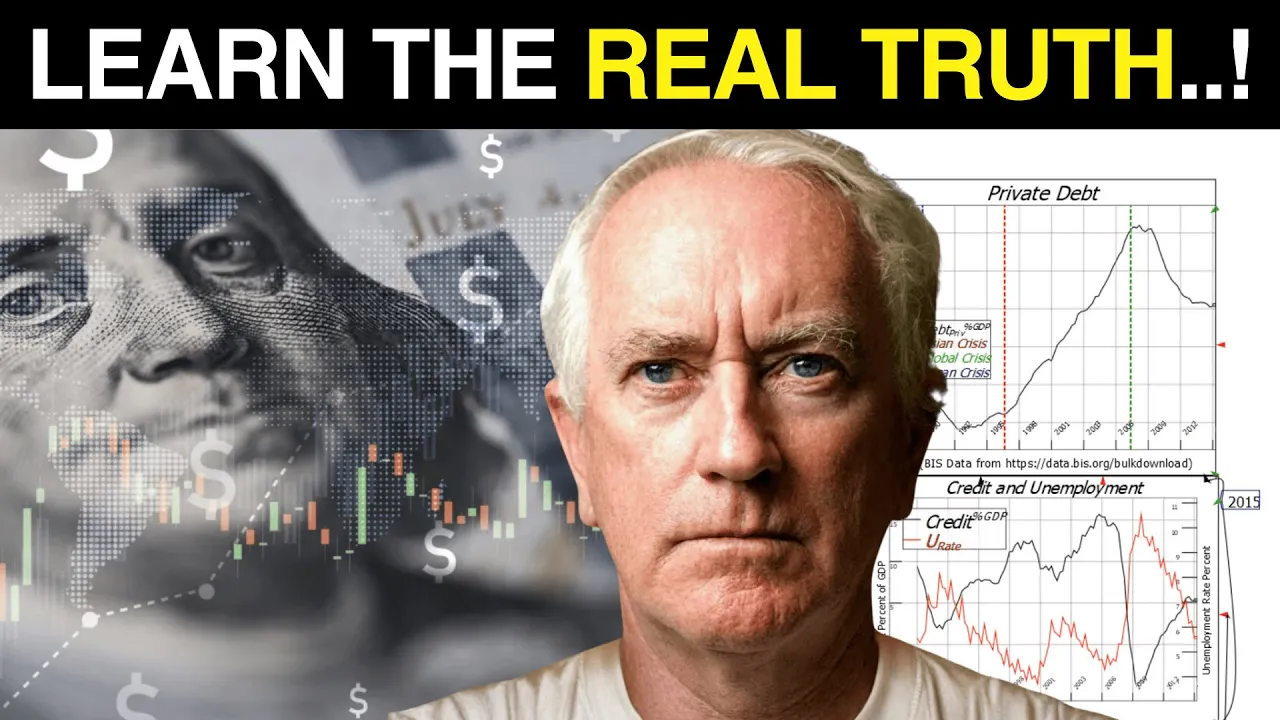
his essays on the Great Depression book, is that private lending has no Significant macroeconomic effects. This simply doesn't stand up to scrutiny. This next chart takes a look at the annual change in private debt, which is I call credit, and the unemployment rate. And the two are massively inversely related. When credit goes up, unemployment goes down, and vice versa. The correlation between the two, the correlation coefficient is minus.9. It's ludicrously high. That ain't zero, Ben. That's massively negative. This is Something which is an anomaly for neocclassical economists, which of course they ignore. So credit goes
up, unemployment goes down, and vice versa. And of course, neocclassical economists are completely wrong about this. So if they're wrong about private debt, what are the odds that they're right about government debt? because they see a crisis coming out of government debt. That's why we have the panic about must make sure the government runs a balanced Budget, cutting back government spending, increasing taxation. It all comes out of this obsession of neocclassical economists. And that's caused by another model of banking they have which they call loanable funds. And in loanable funds, if you set it up
properly in an accounting, as I've done here, yes, you get a crisis. So what mainstream economists tell us is that a deficit will cause a future catastrophe because the level of government debt and Interest payments will compound. And they're right in their model. So here's putting this model together in revel. I explained this in detail in my online lectures. Of course there's no deficit nothing happens. But whack a 1% of GDP deficit in there. And you can see the debt ratio and interest payments are taking off and in fact they're rising exponentially. Nothing's happening to
GDP or the money supply in this model. This model doesn't explain how money is Created. And if you keep on going for long enough, you're going to get a government debt ratio of 2,000% of GDP. Interest payments 100%. It simply can't be sustained. But it's not true that the government lends to households, which is what they teach. The the first people to buy debt off the government are actually banks in what are called primary auctions. So I simply change those details of the model here. And I also changed the assumption that the Government banks at
the private sector. It does, but it mainly banks at the its own bank. And why wouldn't it? So I put the government account there. Then all those transactions happens through reserve accounts. So I now so res reserves are used to buy bonds. The deficit increases reserves. Interest payments on outstanding bonds also increase reserves. They now turn up in the top thing for the banks here. And now I have to show that the banks are The ones who receive the interest. Just for simplicity, I flick a little switch here to so I can leave the the
banks out of the argument to make the model simpler. And then no deficit, nothing happens. But when I hit a deficit, watch what happens to GDP. The deficit is not just increasing government bond issues, otherwise called government debt. It's also increasing the money supply. Money turns over. GDP grows. And because the GDP is growing as well as the level of Government debt growing, the ratios ultimately stabilize, there is no future crisis. It's a total myth to believe that we're going to have a crisis. This is how governments create what we call fiatbacked money and this
finances public services to some extent and also enables economic growth and the debt level stabilizes. So there's no debt crisis. And in fact, by getting rid of this, we've made the system less stable than it was back in the 1950s when America didn't particularly worry about the level of its government deficit. But there can be private debt crisis. And again, the mainstream completely missed this because private credit can cause a boom, but it also increases the level of private debt compared to GDP. And the increase in debt and the boom change the distribution of income.
And after a series of booms and busts, you can have a debt deflation like back in the great depression. So Irving Fischer explained The crisis this way by saying that having get into a high level of private debt with inflation zero or negative, the effort of people to reduce their debt actually increases the burden of debt because they reduce prices and they actually reduce nominal GDP by more than they pay their debt level down. So this is what I call fish's paradox. The more debtors pay, the more they owe. That's what causes a great depression.
So depressions occur when private debt is Extremely high and then the rate of change of private debt, which is credit, turns from positive to negative. This is looking at data now back to the early 1800s for America. You can see that private debts been higher than government debt with the sole exceptions of the Civil War and World War II. But each of those spikes in the level of private debt when they then turned negative was followed by a severe economic crisis. And when you take a Look at the great depression which is the greatest downturn
capitalism has suffered. You can see the role of credit there is obvious in the data. High level of credit means unemployment is low. When credit goes negative, unemployment explodes. Government money creation increases at that stage and acts as an automatic stabilizer which stopped the Great Depression being as deep as it could have been. We should have learned from that. Instead, we reproduced the Same conditions to give us the global financial crisis. Banks and money. What about macroeconomics? How does the macroeconomy work? Well, first of all, you can't derive macro from micro. It's a fool's errand
to even try. But you can derive it, amazingly enough, from a strictly true macroeconomic definition. So neocclassical economists believe you must build macro from micro. That's the quote I took from that kid uh on the first slide here. And but this is a Slightly older gentleman Olivia Blanchard who at the time was chief economist for the International Monetary Fund saying we should be trying to get a accepted analytic macroeconomic core. And I agree we should okay but he then says well the only way to do that is to start from micro foundations because I don't
know where else can you start from. Sorry, read outside your own literature, Olivia. There is plenty of ways to do this and physicists have Developed them because they realized over 60 years ago that you simply cannot build a high level of analysis from a lower level of analysis. There's a brilliant paper called more is different by a genuine Nobel Prize winner Philip Anderson a physicist and he said that the main fallacy in believing you can build a high level of analysis from a lower level is that reductionism which is going the opposite direction taking a
complex picture and breaking it down Into its components does not imply the opposite process of constructionism. The ability to reduce everything to simple fundamental laws does not imply the ability to start from those laws and reconstruct the universe. But that's what economists are trying to do. Now, I've only recently realized that I can build the postcanesian approach to macroeconomics by working from strictly true macroeconomic definitions with extremely simple realistic simplifying Assumptions to live them together. So take definitions like the employment rate. That's the number of people with a job divided by population or the wage
share of GDP. Total wages divided by GDP, the private debt ratio, private debt divided by GDP and net government spending, government spending minus taxation divided by GDP. Those are definitions. Okay? But you can easily turn them into dynamic statements using what we all know in terms of percentage Rates of change. that you can separate the percentage rates of change of a ratio into the rate of change of the numerator minus the rate of change of the denominator. So I do that with the employment statement up here. And I can then say the employment rate will
rise. So this number will increase if employment which is this bit grows faster than population which is that bit. This is still working in terms of what is a strictly true definition. Wager share of GDP will rise of wages grow faster than GDP. private debt ratio will rise of private debt grows faster than GDP and the government deficit ratio will rise if the deficit grows faster than GDP. Those are still factual statements. Now, to make them into a model, you've got to make some simplifying assumptions. I'm going to make a few very simple genuine simplifying
assumptions here. Not assuming that all commodities are the Same like neocclassicals are forced to do, but quite realistic. Workers capacity to get wage rises is going to be higher with a high level of employment than a lower level of employment. Capitalists will borrow to invest during booms and then have to repay part of that during slumps and the government spending will rise at the employment rate falls. Those are simple reasonably factual statements that link those different system states together. Now when I do that using a bit of algebra, nothing particularly complicated, nothing that an engineer
couldn't do in half an hour, uh what I get the first model was just employment and wages. I get Goodwin's growth cycle which shows capitalism is inherently cyclical. If I add private debt, I get Minsky's financial instability hypothesis which says that capitalism can collapse into a debt deflation as happened in the Great Depression. And if I add in deficit spending, I get a complex systems version of modern monetary theory saying that government spending stabilizes the economy, but it doesn't stabilize it by pushing into equilibrium. It simply means you don't get breakdown. So here's running the
model with just wages and the employment rate. This is in ravel again and using its modeling component here and you get continuous cycles. If I then stop the system and add in private debt then I Get a remarkable outcome that surprised me when I first saw it back in 1992. The cycles are no longer closed. There's a tendency for a rising level of private debt to GDP. That increased in private debt actually comes at the expense of workers rather than capitalists. It causes the economy to appear to stabilize for a while with less extreme cycles.
Then it goes into more extreme cycles and finally it goes into a breakdown. So that's what can happen if You have no government sector or you have a government sector which ignores what's happening in terms of the level of economic activity in the economy. Ultimately you'll have a final destructive crisis in the system. That's what turns up there. Now if I add in the uh government spending here. So I've got the deficits being related to the level of employment. So going in the opposite direction and you'll see that on this chart here. Uh government spending
rises And employment falls and vice versa. So it slopes in the opposite way to these two. You don't get equilibrium but you don't get breakdown either. Those cycles continue indefinitely. You get complex cycles coming out of it. This is what we're observing in the real world. More complicated again than I'm showing just in this very simple model. But what it shows is that capitalism is inherently cyclical and they try to argue it's inherently an equilibrium system. It can Collapse into a debt deflation in the absence of government spending. Whereas neocclassicals are trying to get rid
of government spending in excess of taxation. And so stability in this system isn't reaching equilibrium. It's avoiding a breakdown. and the policies that neocclassical economists are succeeding to impose on governments all around the world makes a crisis like the great depression more likely not less. Now that's complicated. I had to do a Bit of algebra there. But one of the beauties of system dynamic software is that you can actually build models like this using flowcharts. So this is the same cyclical model built using a flowchart where level of capital determines GDP that determines employment etc
etc and you come back to where you started from again and if I include debt in this system then I get exactly the same dynamics I showed from the definitional approach beforehand. So In a sense this is the analytic foundation that Olivia Blanchard was looking for but it's based in macroeconomics and it uses non-equilibrium and that's what economics should do but it never will. It's stuck in thinking in equilibrium terms. So I used the concepts of Minsky's financial instability hypothesis to explain the great the potential for a great depression. I wrote the bottom model back
in 1992 and I was quite stunned by its behavior. I had no expectation that it would behave the way that it did. And I got the shock of my life when shortly after I wrote that model in August of 1992, the American economy started to behave show the same characteristics as as my model uh exposed. So Minsky wrote Minsky is somebody that neocclassical they'll use his name. They probably haven't read anything that he wrote. Uh if they did, they wrote read probably the wrong References anyway. But here's Minsky in 1982 writing brilliantly about the post-war
economic period and why we have to understand why we had stability between 1945 and 1982 whereas we had breakdown before World War II. So he said the most significant event of the of the era since World War II is something that has not happened. There has not been a deep and longlasting depression. They said to go by the record of history to go more than 35 Years without a severe and protracted depression is a striking success. This empirical fact is what drove Minsk's research agenda. He said, "Can it a great depression happen again? And if
it can happen, why didn't it happen in the years since World War II?" These are questions that naturally flow from the historical record and the comparative success of those 35 years. that to answer these questions it is necessary to have an economic theory which makes Great depressions one of the possible states in which our type of capitalist economy can find itself. Now neocclassical economics is not that theory because of its religious belief and equilibrium. So Minsky argued that instability is a observed characteristic of our economy. So for a theory to be a useful as a
guide to policy for the control of instability it must be able to show how instability is generated. And the abstract model of the Neocclassical synthesis cannot generate instability. When the neocclassical synthesis, boy, I hate that word, is constructed, capital assets, financing arrangements that center around banks and money creation, constraints imposed by liabilities, and the problems associated with knowledge about uncertain futures are all assumed away. For economists and policy makers to do better, we have to abandon the neocclassical synthesis. We have to Examine processes that go forward in time which means that investment the ownership of
capital assets and the accompanying financial activity become the central concerns of the theorizing. Once this done then instability can be shown to be a normal result of the economic process and once instability is understood as a theoretical possibility then we are in a position to design appropriate interventions to constrain it. Now, Minsky actually never managed To build a decent mathematical model of his excellent verbal theory. I did that in 1992 as part of my PhD thesis, and it wasn't published until 1995. But the model had an extremely strange characteristic to it that I had no
expectation of it I'd actually generate uh when I first built the model. The volatility declined before the crisis began. So, when I graphed it in three dimensions, this is the shape I got. The horizontal axes are wager share on one Side and the employment rate on the other. The vertical is banker's share. You had this period where the cycles got smaller and smaller, appeared to disappear entirely and then you came out the other side and they got more and more violent. So I was stunned by that result and that's what I focused on in the
conclusion to my paper. So I said from the perspective of economic theory and policy this vision of a capitalist economy with finance requires us to go Well beyond the habit of mind that Kanes described so well the excessive reliance upon the stable recent past as a guide to the future. The chaotic dynamics explored in this paper should warn us against accepting a period of relative tranquility in a capitalist economy as anything other than a lull before the storm. Now I got the shock of my life when that turned up in the data. what neocclassical economists
called the great moderation and they started taking Credit for it. I thought, "Oh my god, what's on our way?" So, because they have this linear and equilibrium way of thinking, they saw the great moderation, they thought they they should be rewarded for causing it. This is what they saw. You had peaks of inflation, which is the black dotted line, getting lower over time. So, they saw declining inflation in peaks, negative levels of growth. They got higher over time. So, you got closer and closer to recessions With no actual negative economic growth. And they basically forecast
that forward and took credit for it. This is of course is my good mate Ben Bani. Improved control of inflation has contributed to this welcome change in the economy and we've got to pat Paul Vulker on the back and and so on for what they did. Well, they had no idea that this was about to happen. Inflation went from plus 5% or more than plus 5 to minus2. We had a brief experience of Deflation early in the crisis. The growth rate went from strongly positive to negative which they had no idea would happen. and we
had a double dip into negative regions as well. So, they didn't have any idea that this was going to occur. And that's one reason I stuck my neck out at the time to say that a crisis was going to happen because if I hadn't made those sorts of warnings before the crisis occurred, I wouldn't be taken seriously afterwards. Of Course, it's an incredible frustration to me to see neocclassicals being taken seriously in the aftermath of this crisis. They had no idea that the crisis is going to happen. One of the reasons I stuck my neck
out at the time was I thought this has to be the anomaly to end neocclassical economics. They're predicting smooth times ahead. We're going to have a crisis. But in fact, that didn't happen because as I mentioned earlier, economics doesn't Advance one funeral at a time. Instead, they find students who are going to believe the new the religion despite the fact that the uh event they said wouldn't happen did happen. And what's now a result of that is that after the global financial crisis, if anything, neocclassical economics is even more delusional than it was beforehand. Also,
the policies they put during the global financial crisis, which they had no idea was going to happen. They weren't Prepared for it at all. They equally had no idea of what to do to remedy it and the policies they put forward in 2008 2010 actually made the recovery slower. Now after all that and as you saw by those comments from the neocclassicals I mentioned earlier in this talk so they still think equilibrium modeling is sensible even after the failure to see the crisis coming even after the failure with the great depression before that and all
they've done is what they call Financial frictions to their models. Now friction is something that slows down how fast thinkings operate but finance doesn't do that. Finance isn't a friction it's a lubricant but they can't put that in intellectual framework. So all they can talk about financial frictions slowing down the return to equilibrium when Irving Fischer told them almost a century ago now abandon equilibrium thinking. That's what you have to do to be able to model Capitalism realistically. Now thanks to their ignorance about what causes financial instability. We're still stuck with too high level of
private debt. And as a result of that we have low levels of credit based demand and that gave us a form of stagnation after the crisis. The only thing that's kept economies floating after that is government deficit spending and they're trying to eliminate that. So neocclassical economists are incredibly bad for the Health of capitalist economy. But it's even worse when you take a look at what they do when we go beyond the economy and look at ecology as well because as a starting point neocclassical economists have no understanding of the role of energy in production.
And there's an enormous gap between what scientists are saying global warming is likely to do to our societies. Economists are completely wrong about this. Unfortunately, politicians have followed the advice of Economists. So it's not inconceivable that thanks to economists, we could witness the ecological destruction of capitalism. So economists use what they call production functions when they model the physical economy. And in that there are two functions that dominate. The neocclassicals use what they call the Cobb Douglas production function. And that shows output is being produced by a combination of labor and capital and technology. That's
the equation. But I won't worry much about equations in this presentation. So A stands for productivity or what they call total factor productivity. L is the number of workers and K is the number of machines and alpha is the share of labor and GDP which is roughly 70%. So alpha is 7 and 1 minus alpha is the capital share which is 30% or.3. Now post Keynesians use what they call the leontf production function after vasel leontiaf first suggested this and they simply say Output is proportional to how many machines there are. So they take the
number of machines and divide by an empirically derived ratio to say what output is. Now neither of those functions neither the neocclassical nor the postconian has any explicit consideration of inputs from the real world things like energy and raw materials. But you simply can't produce anything without energy. And I realized the problem with these models back in 2017 that labor without energy is a corpse. Capital without energy is a sculpture. So therefore energy is an essential input to both labor and capital without which they can do no work. So the link between energy and gross
world product is extremely high. This is two separate data sources. One is World Bank data on gross world product in American 2017. The other is consumption by uh energy consumption recorded by the OECD. Obviously, the two have got a strong positive correlation because they're both rising. But when you look at the change in energy and the change in gross world product, you still get a ludicrously high correlation of 888 in both these cases. And the only explanation for that is that to a first approximation, what we call gross world product is actually energy turned into
useful work. And this justifies the scalar that the postcanesians use. The Basic reason why we're wealthier now in a punchline is we're wealthier than our ancestors because we consume more energy. Leontf model can easily be modified for that because the empirically derived capital output ratio that Leontef worked out just use its inverse and that tells you how much energy that's put into machines is turned into useful work. Now the remainder represents waste. So this is consistent with the second law of Thermodynamics. We dump that waste into the environment and that gives us an integration of
economics and ecology at the absolute ground level. Now you can't do that with a neocclassical model. For a start, you can't fit the data on energy. Stats behind it were facious. Anyway, I've only recently realized that, but the correlations that Coburn Douglas argued for was spurious. They actually got negative values for the uh coefficient, not positive values. It's Should be abandoned. It's useless model. Uh that's just looking at the way they model production in general because they're naive about the nature of the economy at that level. what they've done on climate change and global warming
is equally naive. In fact, it's beyond naive. It's even beyond negligent. So, we're going to pay very seriously for the mistakes economists have made over the role of energy in production and how they've misunderstood what global Warming actually means. Now, there's a recent paper in Nature which economists are attacking now because it gives a very high prediction for damages in the future. They're saying 19% fall in GDP by 2050 if we continue on the current path. That sounds scary and that's one reason neocclassical economists are attacking this paper right now. But if you convert this
into what they're saying in terms of the rate of economic growth, it turns out that you take the Damage they're talking about, which is 19% or 0.19, subtract that from one, take the log of that number and divide by how many years in the future they're saying it's going to happen, and you get a prediction that you're going to have a 0.8% fall in the annual rate of economic growth. Now, that's severe, okay? But it's nowhere near as deep as the global financial crisis. And it's trivial in the real terms. It's saying global warming isn't
going to have much of an Impact upon the economy. Now, I know this is nonsense, not because I know the future, what global warming is going to cause. I know that economists have simply made these numbers up. They might as well have pulled them out of the back end of their bodies rather than the front. They made up everything they've used as their estimates of the economic impact of global warming. And consequently, they're predicting minor damages to the rate of economic growth From temperature increases that scientists are telling will drive us extinct. There was a
survey about 5 years ago of climate economists, roughly 2 and a half thousand economists published on climate change. 300 of them answered this question and they said that if there was 7° warming by 2220 so two centuries on from now that will make GDP or that that will make gross world products 25% less than it would have been in the complete absence of global Warming. Now when you convert that into a prediction of what what's going to happen to the rate of economic growth between now and 2220 you find that it's a prediction that the
rate of economic growth is going to fall by 0.14%. Now at the moment the way statisticians measure changes in GDP and changes in gross world product is only accurate to one decimal place. This is saying we going to get damages out of seven degrees of global warming we can barely measure. Now scientists on the other hand are saying that dangerous warming is anything more than 1.5°. We're already reached that level. Three degrees is catastrophic and anything over five is unknown implying beyond catastrophic including existential threats. In other words, scientists think if we hit the level
of global warming that economists think will only make a tiny difference to the rate of economic growth. They'll saying we'll all be dead. That's what we Face courtesy of economists. In 2008, Tim Lenton, who's a professor of climate change at Exity University in the UK, organized a survey of climate scientists who are experts on different tipping points. And this is the conclusion to that paper. Society may be lulled into a false sense of security by smooth projections of global change. A variety of tipping elements could reach their critical point within this century. The greatest threats
are the tipping of the Arctic sea ice and the Greenland ice sheet and at least five other elements. They looked at nine in total could surprise us by exhibiting a nearby tipping point. I learned about that by reading William Nordhouse because in his manual for his integrated assessment model he calls DICE which stands for dynamic integrated climate in economics. He says that DICE assumes the damages of a quadratic function of temperature change and does not include sharp Thresholds or tipping points. But this is consistent with a survey by Lenton. He then followed up on that
with a book he wrote in 2013 where he said there's been a few systematic studies of tipping points. A particularly interesting one by Lenton finds no critical tipping elements with a time horizon of less than 300 years until global temperatures have risen by at least 3° C. Now he's saying this is consistent with a survey by Linton. Garbage. It's utterly incontradictory. If I had a student who published this sort of nonsense, here we go. a false sense of security by smooth projections of change. He has a quadratic. Okay. A variety of tipping elements. He says
none within this century. He says 300 years away until temperatures have risen by 3°. If I had a student who submitted what Nordaus wrote about this paper in an university essay, I would fail them. I'd probably also kick them out of the Course. This is how much attention neocclassical economists actually pay to what scientists write. So, we now know unfortunately that we're starting to see dramatic climate instability. The crazy uh atmospheric river floods that are occurring, they're just the the first taste of how bad this is going to get. And looking back at their work
in 2008, scientists have actually reduced the numbers that they think are going to cause various tipping points to trigger. So, Greenland, they say 0.8 already at 1.5. The West Antarctic already at 1.5. uh media under overturning circulation. That's the scariest of the lot. We've already exceeded the minimum they think could cause that tip to occur. So if those changes do occur, then conventional farming is going to fail. There'll be mass famines. And in that situation, the limits to growth, which economists have rubbished and not taken any notice of whatsoever, they said we Have to put
high value on producing sufficient food. Even if it turns out being uneconomic to do so, you simply have to have food security given what we likely experience if we experience further global warming. We are experiencing it. Economists are a major reason why we haven't taken serious action against it. So in this sense I believe neocclassical economists have set capitalism up for its own destruction and possibly in our own Lifetimes. That's how negligent their work has been. So that's a very very fast overview of what I cover in seven lectures in the rebel economist course. And
of course I've there's about 60 slides I've been through in this presentation. There's roughly 60 per topic in the sevenweek challenge. So, a lot of things I had to gloss over here, you'll get in much more detail in the 7-week challenge. And I also have what I'm calling a legacy lecture series, Which is a complete alternative to what's taught by neocclassical economists in university degrees. I cover about 12 topics, each of them in multiple weekly lectures. In fact, there's about there'll be a hundred lectures in the course at least by the time I finish fine-tuning
it. And I give these lectures uh live in both the Rebel class and the legacy. plenty of time for discussion afterwards. And there's also, as of next year, we're going to have What we're calling Ask Steve, which is a a free form weekly discussion on any topic of interest. I give the classes twice each week, once for Western Hemisphere and one for the Eastern Hemisphere. And the Rebel classes at 1:00 on New York Times on Wednesdays and 6:00 p.m. in Sydney on Thursdays. A similar pattern for the legacy class. So if you join me in
this class, you'll learn what you won't learn at university because it's completely dominated by Neocclassicals. And now they charge a fortune for university degrees. They used to be free when I went through and did them. Now, thanks to economists largely, they cost tens of thousands of dollars. So if you do a university economics degree, you're paying to be indoctrinated in a false paradigm. So if you want to avoid that fate, sign up with me instead and get a far more realistic approach to economics at a far lower price. And there's something for Everyone in how
we set the overall structure up. I I think about it like a set of those Russian babuska dolls. There's a small one on the inside which is free to everybody. That's this overview lecture. Uh the rebel economist challenge and then I cover this in substantially more detail in those seven lectures. The legacy is much much longer but it will help you work out how you can make a contribution to realistic economics over time. and then the ask Steve which is interactive and the funding for that will help me establish a keen institute because I need
to have the support of a large research group to be able to do the work properly in the time that's necessary. So the funding that goes towards the uh this the ask Steve helps me establish the keen institute and if you sign up for any one of those you get all the smaller ones. So just like a babushka doll contains all the smaller ones if you pay for the Ask Steve program you get all the others as well. So, if you want to join in, uh, you go to triplewte.com. Uh, and I look forward to
meeting you in 2026. And you'll also enjoy meeting the crowd of people who are currently there. There's close to a thousand students already. We have fabulous conversations. These people have become an important part of my social network and they've become an important part of each other's social networks as well. So, consider Signing up to steve.com and getting realism rather than fantasy in your economic education. If you're like many other truth seekers and want to learn 50 years of real economics from me in only seven weeks, you'll love my new 7-week rebel economist challenge as well.
To apply, go to stevek.com. If you qualify, you can attend my lectures, ask me questions personally every week, and make friends with a great group of like-minded