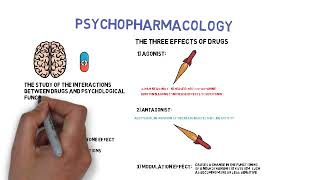
[Music] my name is Christina Schnitzer I'm a fellow in public and Community Psychiatry at Massachusetts General Hospital and through the Department of Mental Health psychopharmacology is the study of the action of various drugs on the mind brain and behavior we do this frequently by looking at chemical neurotransmission how different neurotransmitters are interacting in our brain and then the effects that the drugs that we take may have on how those neurotransmitters interact in thinking about medication and talking about it with patients you know it's a helpful tool that we have it's something to help them on
their way to recovery but it's certainly not without its limitations the wide array of evidence-based psychosocial treatments that we have can be incredibly helpful in getting someone back on their feet so things like cognitive behavioral therapy CBT support of family Social Work supported employment as well as somatic therapies like electroconvulsive therapy or ECT all of these things can be a part of the pie medication can be a small piece of that pie but for many people it's a very important piece and a necessary piece a positive response to medication can be life-saving life altering and
I've seen that a lot in my work with patients with schizophrenia individuals with schizophrenia commonly suffer from what's known as positive symptoms delusions hallucinations paranoia can be really prominent and cause a lot of suffering for these folks and so the medications we have are good at targeting those positive symptoms and seeing that turnaround in someone is really incredible to see how much they're suffering and if the treatment is successful have that really be quelled how do we choose a medication we think about prior treatment responses was someone on a medication before that worked well for
them or more importantly were they on something that they responded really poorly to we want to think about the side effects that we know these different classes of medications may cause and how those side effects can help or hurt the patient depending on what they are ease of dosing and monitoring is a big one I'm thinking about the limitations that patients may bring so is someone able to take a medication for times a day or do they have a visiting nurse and are they're only able to take a medication one time a day that'll affect
what drugs we prescribe and how often we prescribe them drug drug interactions really important we'll go over some of those today comorbid conditions so are they suffering from neuropathic pain obesity that could be affected positively or negatively by side effects and the medications themselves and then also thinking about cost working with a patient looking at what their insurance is is this something that will actually be covered or that they can afford if not we have kind of broad classes of medications so we have antidepressants anxiolytics mood stabilizers and anticho discs and those can be used
alone or in combination to treat a variety of psychiatric disorders for things like depression and anxiety our first line is usually an anti-depressant for psychotic disorders our first line is typically an antis psychotic mood disorders such as bipolar disorder may require a combination approach with a mood stabilizer and an antis psychotic and there's a lot of intricate ways that the medications can interact and supplement each other that can be beneficial for the patient so sometimes it requires some creativity key to starting a discussion of any new medication is thinking about or having the concept of
shared decision making in your mind and so that's where the patient and the provider share available evidence that both know so the provider can often give more information about risks and benefits altern atives to the drug potential side effects when those might occur how long they might expect to be on the medication before they experience benefit from it or how long they may need to be on the medication in general and that the patient should be informed about all of these things before deciding with the physician to start a new drug side effects can differ
from Individual to individual so the key is to really listen to the patient have a shared conversation with the patient and take it from them you know what they're experiencing is real the key is to walk along with them for medications with known metabolic side effects for example we will do a lot of coaching around healthy lifestyle Behavior choices diet exercise things that can really impact physical and mental health but can also help when patients are experiencing the metabolic burden of some of our medications in particular antis psychotics we can also add on other medications
to try and counteract some of those metabolic side effects in general you can think about decreas in a dose of medication switching to another medication in the same class or another class entirely if some side effects are too burdensome for a patient when thinking about medication adherence there's really two big buckets of things you're thinking about patient attitude towards the medication and then also the behavior of taking the medication itself with attitude you want to really explore does the patient feel that this medication is necessary that it's warranted that it's actually treating something that they
believe they have or can be helpful and if that's not the case it's a bit of an uphill battle from there and thinking about behaviors are there things potentially getting in the way of patients taking a medication are there cognitive limitations where they may forget to take the medication is it not built into their habit or part of their routine are they not able to access the medication due to copays or not being able to get it at the time that they need so thinking really about those attitudes and then potential barriers and as a
physician working to educate the patient and also help reduce those barriers to the extent that you can by problem solving with them marijuana is a big issue that we deal with in our patients particularly those with schizophrenia and becomes very complicated because marijuana can exacerbate psychiatric in particular psychotic symptoms causing a relapse for patients who are previously doing really well and it can also induce a lot of the negative symptoms social withdrawal a motivation apathy that you see with the disease process of schizophrenia itself use of marijuana can really compound that and make matters worse
and and make it really hard to treat or activate the patient to be involved in their treatment cultivating an honest relationship with your patient is really important so that they can feel comfortable sharing when they are using these substances and you can problem solve around the other things so when patients tell you that they're using substances you want to talk to them more about why are they choosing to use that substance is it to relieve anxiety is it to feel some sort of Escape or release and when you're to have that honest conversation with a
patient then you can discuss with them what are some other ways not using that substance that has other harmful consequences to Target those issues that they're trying to get [Music] at the question of tapering comes up often in some situations because a patient doesn't want to remain on a medication they don't like the side effects associated with that medication they may think that it's not working or want to try something else and that's best done in collaboration with their provider so that we can take them off of that medication safely and replace it with something
else if if that's needed for treatment we think about tapering safely and strongly recommend against patients just stopping their medications cold turkey as some often do because some of the medications we use can be really unsafe if stopped immediately and in some cases such as with benzodiazapines it can be deadly if patients stop at Cold Turkey while we certainly recommend people being on as little medication as possible that they need sometimes medication can be life-altering and and as we mentioned life- saving and I often tell patients that the goal of being on medication is to
get back to feeling more like yourself not less like yourself and when these diseases can take hold and and cause impairments that you know make someone not who they used to be the goal with medication is to get them back closer to that person it's my hope that over the course of my lifetime as a psychiatrist that will first get a lot better at understanding the disease processes themselves what is actually going on and what is changing in the brain and elsewhere that's causing some of these symptoms that our patients are experiencing so first I
would hope that we get better at understanding the processes underlying the diseases themselves and in doing so can then develop more targeted and precise treatments that have less side effects that we have to deal with now that are more targeted to exactly the problem at hand I think the field in general is a lot less black and white than people may think we wish that there was a magic pill that someone could take that would fix everything in reality psychiatric diseases are incredibly complex there's a lot of overlap comorbidities and in some cases we still
are figuring out what is the disease process itself what actually are we treating and it can be really hard to say so I I think in Psychiatry we live a lot in the gray and a lot in the details and the minutia of people's lives and it's figuring out how to help them move forward to take this course and learn about others click on the link in the description and subscribe to this channel