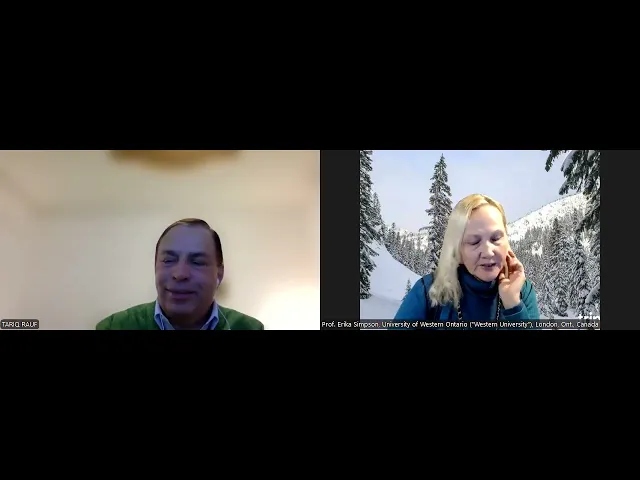
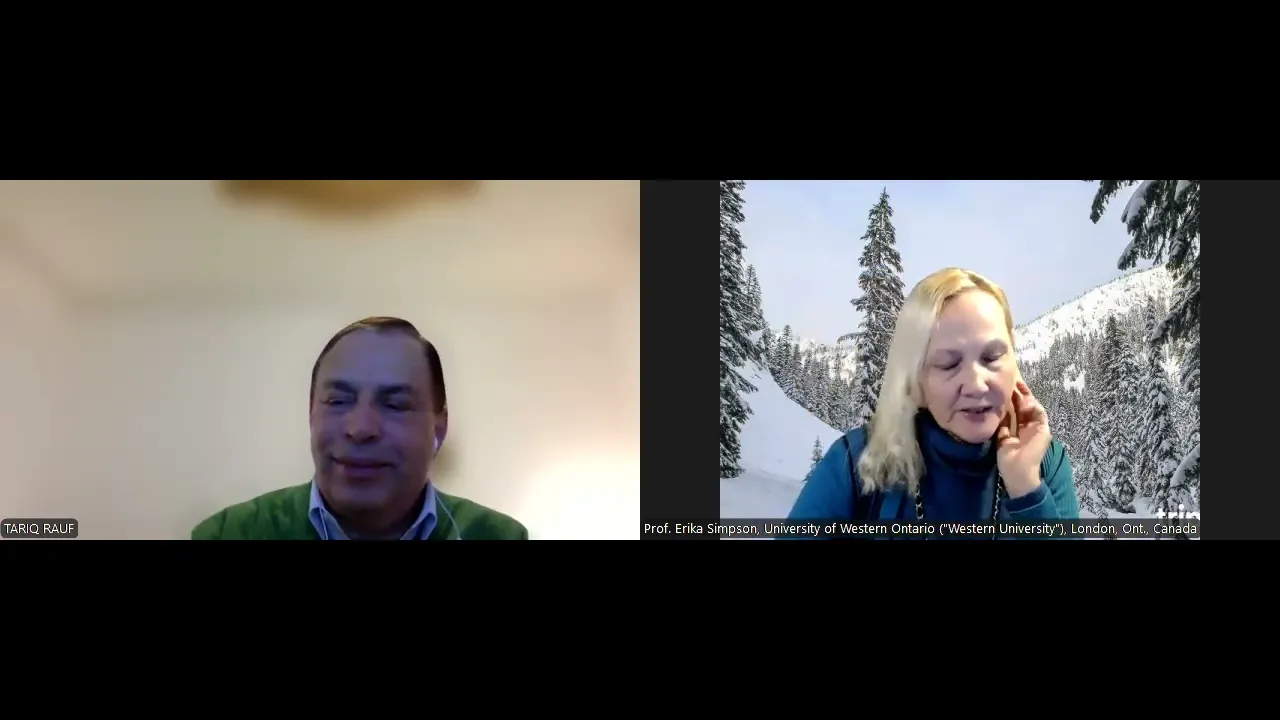
so you want to record the hi thank you very much I want to introduce you to Dr Tariq Ralph who is a very longtime Diplomat very famous in terms of the international atomic energy agency and has spent a lifetime negotiating with other diplomats all around the world regarding the nuclear nonproliferation treaty and I've asked him to come on tonight he's actually speaking to us from Europe from Italy where he's teaching an arms control thank you very much Tariq for coming on um and maybe just wave for can I hear you hi oh okay I wanted
to ask you a few questions I know that we don't have a lot of time um I'm wondering whether you think that the uh United States and Russia have violated many of the bilateral and multilateral arms control treaties that have been negotiated during the Cold War and beforehand for example the biological toxic weapons convention the chemical weapons convention and so on do you think that they've violated those and that's why they've withdrawn from them so that's a good question Erica and hello to all the students so as as Erica mentioned there are two categories of
Arms Control treaties between the United States and the Soviet Union Russia in the bilateral treaties each country makes the determination whether or not the other party is in non-compliance with the the treaty obligations so for the most part it is the United States that has first raised non-compliance concerns regarding the behavior of uh the Soviet Union and then of Russia and then usually the Soviet Union or the Russian side would reply uh accusing the United States of non-compliance as well so they tried to match each other now uh the United States withdrew from the 1972
anti-b IC missile treaty in 2002 but they did it legally they used the withdrawal Clause they gave the required notice and at the end of the notice they stepped out of the uh anti-ballistic missile treaty now the international sorry intermediate and shorter range nuclear forces treaty the INF treaty which was signed in 1987 uh the Obama Administration starting in about 2016 started uh accusing Russia of developing a cruise missile that in the US's opinion exceeded the 500 kilometer uh range uh that was not allowed under the INF treaty so the Russians said well this uh
missile is a derivative of a conventionally armed cruise missile so the conventionally armed cruise missile the Russians said had a range of 49 kilometers and the nuclear armed version the Russians said had a range of 480 kilometers and therefore the Russians said that it was within the allowed limits the United States responded that this was not their interpretation and that if the missile was F fully fueled uh it would travel a distance in excess of 500 kilometers but the United States never made public to us these this detail that I just talked about they just
said Russia is in violation so it took the Trump Administration which identified this missile as the 9 m729 and citing that as a violation the United States withdrew from the INF treaty and then the Russians said well if you're withdrawing we are withdrawing as well now in your previous getting into a lot of detail I was on radio about the INF treaty and I was allowed 5 minutes and that was it nobody knew the INF treaty was um you know was all across Canada that the United States had withdrawn um and so people were alarmed
and I think we're alarmed at all the arms control treaties that are falling by the wayside and we're entering a nuclear jungle are you worried about accidental nuclear war to deliver it strategic War do you think there's going to be AAL nuclear war in Europe at the moment the yes at the moment there is only one treaty standing between Moscow and Washington and that is the new start treaty which will expire on the I think 8th of February 2026 yeah there are no negotiations and no talks so as of 9 or 10 February 2026 for
the first time in more than half a century neither Russia nor the United States will be constrained by any treaty although both sides have suspended new start but both sides have committed that they will remain within the numerical limits and thus far neither the us nor Russia has accused the other of stepping over and they're not testing above ground either and they're not testing underground so that's kind of optimistic well that is because of the comprehensive nuclear testband treaty yeah although uh United States rejected ratification in 1999 Russia withdrew its ratification in 2023 but is
still committed to uh the treaty now uh Eric for the first time we have six nuclear armed States engaged in an armed conflict United States France and United Kingdom on the one side in the Ukraine war Russia supported by China and North Korea on the other side in the Ukraine war and for the first time a major nuclear power is being attacked on its own territory these are the long range fires from Ukraine into Russia beyond the occupied territories this has never happened before yeah I Al have been sounding the alarm for many months and
you would have seen my posts on Canadian pagash yeah that we seem to be sliding towards an accidental nuclear war much like we slid into a war the first world war so people are dismissing Russia's threats to use nuclear weapons saying they are not credible we don't believe them but we never know when we will have the proverbial straw that broke the camels back yeah I'm very very concerned about a limited nuclear war uh what about are you concerned about the Saudis obtaining nuclear weapons in reply to Iran and then Israel uh having it its
bomb in the basement revealing it are you concerned about proliferation and do you think that's another reason do you think that's another reason that we should be worried I mean we're worried about the the six nuclear Powers engaged in Ukraine but we are also worried about a small tactical nuclear war between let's say India Pakistan leading to nuclear winter I I this here in andelo I've been criticizing all my colleagues who for years have been lecturing India and Pakistan on avoiding a nuclear war and guess what they themselves are doing so I am not worried
about the nuclear war starting in South Asia in the current circumstances okay so um coming back to what about between North and South Korea then you're not worried about that either in Japan this is an issue that has what is being discussed here actively uhuh the the president of South Korea this president who has now been arrested yeah if you remember in January came out openly and said South Korea would acquire nuclear weapons and then he was beaten down by the United States and two weeks later he recanted so there is concern about South Korea
then this would not be the first time that South Korea has made noises about getting nuclear weapons so I don't think that South Korea is going to go down that path at the moment now coming to Saudi Arabia y so it's interesting that I was told by my Israeli colleague here that recently Israel Declassified some commentary by some scientists who had built the Demona facility where uh Israel's nuclear weapons were built so they were signaling something now your previous guest Guy Roberts in my view was wrong when he said the nuclear power reactors under construction
in turkey or Arabia could be used to make nuclear weapons this is just not factually correct both will be under I safeguards the technology and the nuclear material is not the same but Saudi Arabia has said on the record that if Iran develops nuclear weapons it will also develop nuclear weapons but Saudi Arabia would have a long way to go it has no nuclear material it has no nuclear expertise couldn't it just buy couldn't it buy some nuclear weapons on the black market no there are no nuclear weapons on the black market sorry to say
this is just wrong information yes someone guy Robert said that it is possible I seem to recall and um that was maybe after I finished taking so I would recommend to your students to read this article by benoa pelop Pedas p l o p i d a s okay called the Oracles of proliferation okay and this is a very good yeah he's a professor nuclear history professor at sanpo okay in Paris he has written a very good article on how The Narrative of proliferation has been developed yes of castigating some states and whitewashing the actions
of other states so today we have nine countries with nuclear weapons none of these nine countries nuclear weapons program was truly indigenous all nine countries have received and are given help to another country build nuclear weapons including the Manhattan Project yeah Canada helped out there SCH gave a but you know all the major discoveries in nuclear were done in Europe yeah yep but I think that's what people are worried about is an aqan figure teaching because the nuclear Genie is out of the bottle teaching more and more countries including terrorist organizations to somehow build a
dirty bomb I'm not so worried about that because it's a smaller dirty bomb and I think they would be caught I'm not I am not worried about yeah I think ER that is also false narrative that was developed some years ago uh actually it's not that difficult for a country to make a nuclear weapon if they have the nuclear material and at the moment except for Iran where its program thus far is under safeg guards Iran has not threatened officially to leave the non-proliferation treaty though individuals have threatened to do so so on Monday and
Tuesday uh the British the French and the Germans met with Iran in to restart a discussion so that they could invite the Trump Administration to join it because they're very worried that the Trump Administration after January 20 might fall into the Trap of prime minister Netanyahu to launch an attack on Iran's nuclear facilities even the head of the CIA has said there is no indication that Iran has taken the decision to build a nuclear weapon and also and a military attack will not eliminate Iran's new nuclear expertise or nuclear potential they will be able to
reconstitute in two years and go ahead and build a nuclear weapon so we don't we need not to be emotional about this unfortunately in today's hyper media world we have to be careful this is the public recording in that there are like thousands of students in the class and so I cannot control where the video goes so if you don't mind I would like to move away from speaking about a possible attack by Israel on Iran's nuclear facilities um although the osara reactor is part of history and also Israel has attacked with pagers and radios
and and so on there's been different attacks but I have to be very evenhanded here um and and rather than dwell on um The Narrative regarding Israel and Iran I I want to um talk a little bit more about the finger the president Trump's finger on the nuclear trigger are you concerned that President Trump because of some of his irrational statements let's say regarding North Korea um would be irrational and that that would undermine deterence deterrence would be undermined because it is not evident that he's making clear cost benefit rational considerations or do you think
his irrationality and his apparent um kind of anger and vitriol and so on that actually but's deterrence it makes it stronger so in the United States starting uh with the President Truman I think the concept of sole authority to use nuclear weapons residing in the president uh was established and it continues to this day today although the military also has said that they have the responsibility not to follow an illegal order or an order that they feel is coming from a president who might be mentally Disturbed so there are concerns but I don't think we
need to Hype that either yeah I think so you're feeling confident that certainly in the United States but what about in Russia or let's wait you know I don't think it would be possible in China but are you concerned about an accidental a launch between the Strategic nuclear Powers not so much between the wouldbe uh nuclear Powers well this is a concern with regard to the ongoing war in Ukraine it's more likely that it would not be a use of central strategic forces but more likely a missile with the regional range of the type that
was eliminated under uh the INF treaty now Germany is clamoring for the United States to bring nuclear weapons back to Germany and there is also talk of uh US nuclear weapons returning to South Korea they were withdrawn by the senior President Bush in 1991 as a result of presidential nuclear initiatives now the Russian nuclear doctrine that your previous guest was discussing has also been misrepresented so I'm not defending Russia here what the Russians have said is they basically harmonized at one level their nuclear weapons employment policy with what the United States Britain and France have
donees so what the Russians are saying now which is what uh the other nuclear Powers except for China which has a no first use policy have said in Security Council resolutions 255 on positive security assurances of 1968 and resolution 984 of 1995 that they will not attack a nonclear weapon state party to the npt except if that non-nuclear weapon state in association with another nuclear weapon fate attacks me aren't those called negative security insurance is not positive yeah positive the positive would be like Japan or something yeah no no no the positive in two in
1968 was that if you're attacked with nuclear weapons I promise to come to your help okay we will call a meeting of the security Council and then decide how to help yeah and then the negatives are negative is but you know the nuclear posture review of the Biden Administration like that of the Trump Administration with with which I think your previous guest was involved says that they will not attack a non-nuclear weapon state in compliance with the non-proliferation treaty now who decides that the United States have has left that decision to itself they normally it's
the international atomic energy agency that reports whether a country or not is complying with its verification um obligations to use nuclear material only for peaceful purposes and not make a bomb here the US will decide with the country X is in compliance with the non-proliferation treaty if Washington decides that it is not it potentially could be open to a US attack and um there was also the discussion with Mr Roberts about the Russian uh Doctrine about escalating to deescalate now the US incorrect but that's okay because it was an informal discussion and we're not you
know this that is not that is this wrong this translation but it's not totally wrong but the US also in its nuclear posture review has said that it could use nuclear weapons to restore strategic stability so the two of them are not that far apart so this is the problem with nuclear weapon states that you know they decide and they keep on changing and so we cannot be confident under what circumstances they may or may not use nuclear weapons and therefore for people like you and I who've been fighting the struggle for a long time
to reduce nuclear weapons and eventually to try to seek a world without nuclear weapons and we should remember that Canada was the first country to renounce nuclear weapons in the three Nation Declaration of December 1945 where the prime ministers of Canada and the UK and the US president met and Canada said we contributed to the Manhattan Project we do have the expertise yeah we had the technology everything we had the urani we were the only country you know people always say oh Kazakhstan and Ukraine made decisions to get rid of of the arsenals that were
on their territory but Canada actually had the capability to build its own nuclear weapons and decided not to and you're a Canadian and you've been a longtime stalwart defender of nuclear disarmament and nuclear and and nuclear abolition and so I brought you on because I wanted a counter to guy Roberts who was at the you know he's the one who who who steered the nuclear modernization review and a program he was in charge of seven more than 70 billion dollars of spending and yet when I asked him well what about the Russians and and modernizing
that so that we're safer he didn't think about that he was thinking more about modernizing I think because they want to get into space and they want to get involved in a ballistic missile defense project and so I think underlying all that although it was not brought up is the whole race to get into space well the Russians have modernized as well so the United States is a little bit behind so we may not agree with their rationale but the US wants to replace the landbased intercontinental ballistic missiles with the new one they want to
they need to they say they need to make new ballistic missile submarines and new bombers and uh for that they have Congress has authorized production of 990 plutonium pits per year for new nuclear warheads but but in the past 2 years the national nuclear Security Administration has only been able to deliver one pit per year so the US modernization which actually started under Obama even though he gave the Prague speech is a trillion dollar modernization trillion dollars yep great article in the New York Times did you see that one on the New York Times on
the modernization which is permeating all of us Society every Congressional district is involved in the modernization but I'm I'm I'm curious why you said that Russia has modernized because I understood the global partnership program was Desperately Seeking money to give to Russia so that it will modernize no no no this that program was directed at to its at emergence of Russia in 1991 to secure Russian nuclear weapons so they were provided safe secure transport so that the nuclear weapons that were withdrawn from bellarus Kazakhstan and Ukraine could be transported safely back to Russia and then
there were more than 100 disused cores of nulear reactors of nuclear powered submarines which were up in the Arctic and had had the Arctic being poisoned we would be affected as well in Canada so the G7 money was used to take those reactor cores and the plutonium to be taken out at the mayak facility in the middle of Russia and that plutonium to be denatured so several years ago the G7 Global Partnerships stopped giving money to Russia and also Russia said I don't need your money anymore so now the money is going for other projects
in other countries although Canada is still contributing I think a billion dollars it's one of the global Affairs biggest projects and um I think uh the spending on that is enormous and Canada's quite proud of it and because I'm teaching a course on can in the world abroad then not to Russia that yeah yeah not to Russia yeah not they're not giving it directly to Russia no I no but it's now more towards uh building up capacity on chemical and biological weapons defense and non- proliferation yes yeah um well I'm hoping that students in the
future will be interested in participating and if there's any hints that you can give them in the last few minutes on how to forge a diplomatic career I met you back in 1987 when I brought a group of 10 students from the University of Toronto up to Ottawa and you kindly granted us um 20 minutes and we were extreme that was that was 30 God knows how long ago that was when I first met you Tariq and since then um I've admired greatly all the work that you've done you have a gift of uh getting
a different diplomats together understanding what they're agreeing to deleting the words and getting them to agree behind the scenes did you want to give the students any kind of hints about how to forge a career in diplomacy um yes a is to work hard yeah to develop some specific expertise um one one career path is to join either the department of Foreign Affairs uh Department of National Defense also is supposed to have an arms control yeah component you would know more about that but there are also International organizations like the UN office for dis government
affairs with head office in New York and branch office in Geneva there's International atomic energy agency the comprehensive nuclear testb Treaty Organization and Erica at the Ia there are two specific projects basically aimed of bringing women in nuclear one is the least smer um no Mar Mari curri slatka scholarship which is for women students engaged in Master's programs and those who are selected can will also get one year of internship at the Ia and then there is the lease smer program for women who have already graduated and it gives them an opportunity for one year's
work I've never been selected for anything because I'm a woman um I've never never not even my job it was it was but this is because of the I'm always reluctant to advertise things that say well because you're a woman you get to to to you get yeah but you know these are gender uh equality programs and um so the Ia has committed to have 50 50% staff professionals is women and 50% men really so we we've progressed from gender balance to gender parity to gender equality wow but not all countries accept the concept of
gender equality not at all well gender balance can be 6040 gender parity could also be less than 50/50 so this is not being um condescending to women but it's basically providing opportunities where previously these opportunities were not available to women yeah that's but there is a backlash where they will say that you got there because you're a woman um and that's called well you know you can can't stop people from talking but also you know globally people would like more diversity in stem subjects generally men go women have stayed away so we need to break
down those barriers and and not get ourselves involved in the politics of gender politics because it doesn't get us anywhere and so I would rather not get into that discussion so it's fascinating and it affects so many people that are in my class and so um you know they're all in in all sorts of fields and I think this is a good note to end on because when you said work hard you have worked extremely hard you got a PhD in arms control and you you didn't mention that that's an important thing is to get
further education publish a lot and then just stay on top of everything all the time you have always stayed on top of all every I mean it's just unbelievable to to me how much you stay on top of everything and I want to congratulate you that on next week the last time we actually saw each other was in ASA um on the bus there uh going in Kazakhstan when we were there um quite a few years ago but I hope that we can see each other again in person someday and if you don't mind if
a few students reach out to you um we'll let them reach out to you in person and maybe you can give them more advice thank you can I can I plug can I plug the course that I'm teaching here along with my colleagues because it's done every year in January it's called isod Darko i s o d a r Co International School on disarmament and conflict okay so they have money to pay for airfare and one week of board and instruction here in andala which is a ski resort plus you get that's I put up
this picture actually yeah plus the students get time to SK ski in the morning and afternoon and they still get six hour six hours of instruction because we even have an after dinner lecture from 8:30 from 9:30 to 11: oh that's you're absolutely yeah and in in previous years there have been some Canadian students who have come okay so this this year nobody identified themselves as coming from Canada unfortunately well I'll I'll get the information from you and I'll be sure to hopefully track and we are doing a course in August in in tusy more
on I think autonomous weapons and Ai and nuclear weapons so if those who might be interested I will send you the details and they can yeah and I can post that well that's excellent yeah thank you thank you um it's very interesting that that's available well thank you very much Tariq this wonderful to speak to you only for a few minutes and I appreciate this and um I hope that we can meet again and talk for uh on another topic another time but this has been great thank you thank you goodbye okay bye