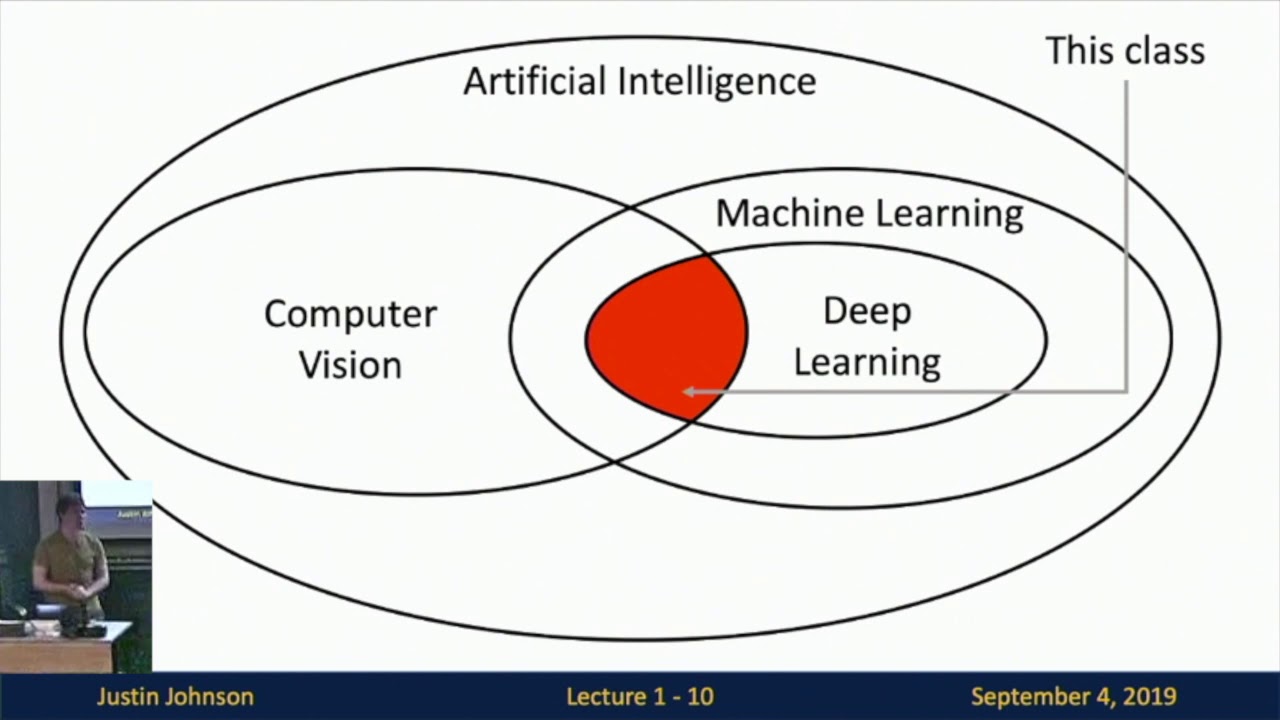
[Music] foreign [Music] so what is artificial intelligence and what makes it so special that it has become the driving force of social change talking about technology and social change this can be a driving force of this of this Paradigm of this current Paradigm so so what is that all about what it has to do with machine learning for all practical purposes nowadays when people talk about AI you can replace it with the word machine learning that not not all AI is necessarily machine learning but all the cool the sexy the fancy things that make all
the buzz that is machine learning and um and there is a reason to it so I I mean the idea of intelligence machines goes back to the creeks and the Romans and lucky for us that I'm not gonna go back there now I'm just making a little bit shorter and we can start with the with the Dartmouth uh Workshop in 1956. so there was a workshop that they often refer to as as the beginning of of the systematic way of using computer science to create machine intelligence and what they did is we propose a two-month
10-man study of artificial intelligence two months they dedicated to it an attempt will be made to find how to make machines use language form abstractions and concept solve kinds of problems now reserved for humans and improve themselves we are still not there yet maybe good for us no well we think that significant Advance can be made in one or more of these problems if a carefully selected group of scientists work on it together for a summer you know like wow so in the 50s when we got and you know what it was a very carefully
selected group I mean this was the cream the LA cream like the best and the brightest Marvin Minsky Claude Shannon Ray salmonov and uh and and John McCarthy you can see some of them here in the picture and fantastic group but well no they did not solve it in uh in two months they they did not they did not solve it over a summer and it became pretty frustrating after that and there became what is known as the that became into what is known as the AI winter so during the 70s the the 80s many
people lost interest in AI it realized it was just too hard Machine Vision for example they assigned I think the story is actually they assigned a graduate student to solve the problem of Machine Vision just over the summer and it's like yeah can you solve and no it wasn't as easy to solve that like nowadays we have it solved but it was a long and hardest time like nothing happened to the 80s and 70s and the 80s all the finances was gone until then more recently uh AI came back so the AI winter started to
melt away and more recently 70 years later an artificial intelligence has become the fastest grow growing Innovation that humankind ever saw jet GPT in 2023 reached 100 million users faster than any other technological innovation so it certainly it certainly kept its promise they didn't solve it in the summer and how did they do it well they did it basically how we achieved that is with machine learning we got rid of the idea to try to imitate thinking and focusing on the thinking we basically what we did is we started to focus on the data and
then just ask the machine to make decision derived from data and the decision gives the power to predict who will click buy lie or die and here are some of the books I invite you to read them that explain how the data Revolution the Big Data Revolution and data science Revolution day and the analytics Revolution enabled this machine learning Paradigm where we then had our neural Nets convolutional Nets Transformers very important nowadays that can execute that and that is quite different than how we try to do that back in the days and it's quite different
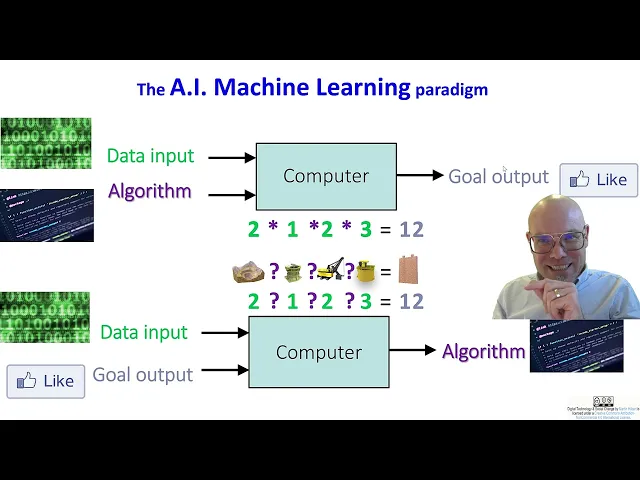
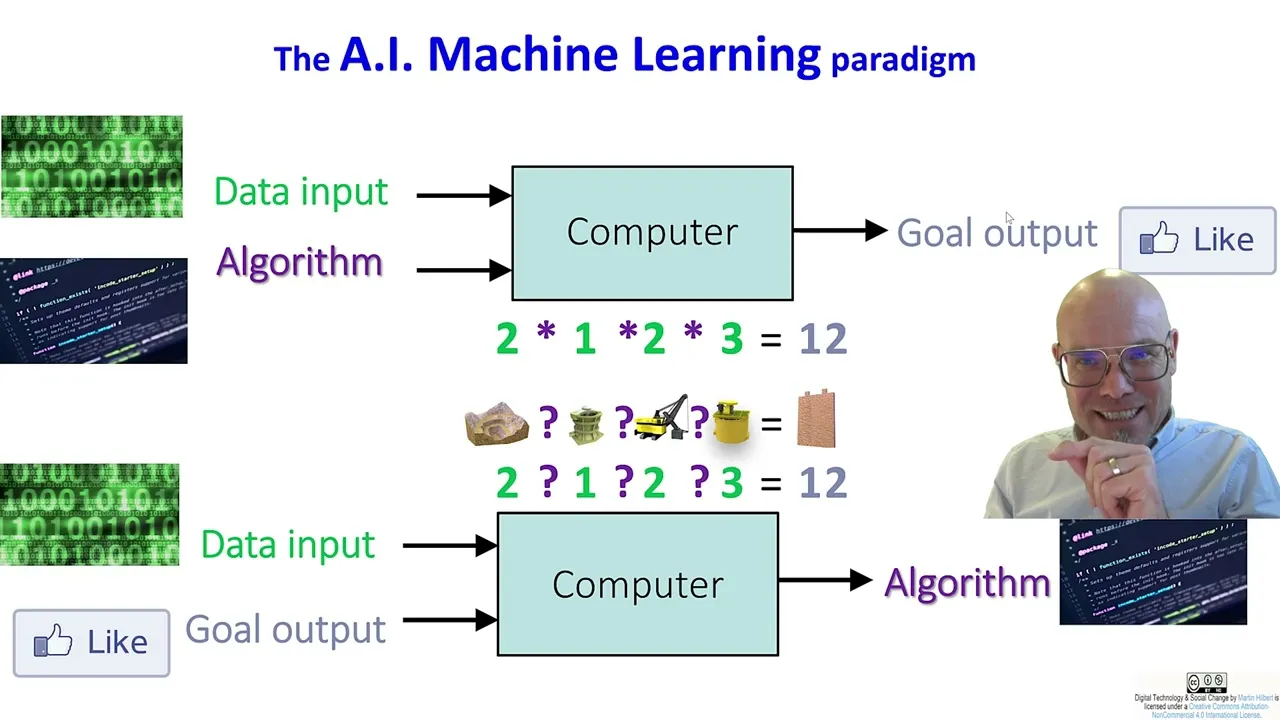
from how we traditionally think about it uh if you think about the problem of of knowledge so traditionally and here's here here's the difference traditionally when we think about an algorithm we say we have data input and then we use an algorithm you know what what we replace it with right recipe we have data we have a recipe of what to do with this data we observe reality observation data then we have a recipe of what to do with it and then we compute some kind of goal output that's how we traditionally do it now
what the machine learning Paradigm does it turns that on its head it has this data and the goal output and then it asks the computer to compute the best recipe now let me break that down so traditionally what we do is really and that's how I also we teach in classes right we have data and then we have some observation of reality or we're given something we have two one two three something that for example we count in reality we observe and then we give you the recipe the algorithm of what to do with it
so okay so multiply that and then we compute the code output and that's how we still teach like here in educational sector that's how we teach that's how we teach our students that's how we think and that's how we try to solve the machine intelligence problem from the beginning we try to find out okay so what is the algorithm what is the recipe in order to compute something be focused on the rules now what the machine learning Paradigm did it turned it on his head it said here's the data and here's the output now find
me the best way of how I can combine the data in order to create the output find compute me the best algorithm now you might say okay you can multiply two times one is two times two is four four times three is twelve yes you can do that but you could also do that but if you don't trust me check it out two plus one is three three squared is 9 plus 3 is 12. now what's the better way well that depends on you know there are many ways lead to Rome as they say and
you can get to Rome all these different ways now you can classify some subcon strains for example you could say you want to get to Rome fast or you say you want to get to Rome safe or you say you want to get to Rome with most energy efficient I mean these there might be some Traders also between them and you can then Define that but what the machine learning does it explores all the different possibilities and finds the optimum there might be local Optima and total Optima and so they're different ways that the search
goes and these manifolds these high dimensional spaces that it searches and then you can also fine tune it a little bit and say like no I I wanted I want it more like that right but that's what the machine does it basically it looks for the best way of doing things now applying machine learning to some of the examples I showed you before the idea would be that I have different data different inputs so for example if you take you know companies from the Stone Age here um and then we say yeah you want to
compute something you want to compute some raw material out of you have a mine and you want to compute some copper out of it a gold out of it or whatever you you're trying to compute what's the best way of combining this input in order to compute my output so the machine learning computes the best way of doing things it computes the recipe itself so that's why Dominguez calls it the master algorithm it's the algorithm that computes algorithms and the idea is you can apply it to different things even to problems that we haven't solved
yet for example you have a world full of hunger of War of climate crisis and and racism and what you want to compute is a word full of love so artificial intelligence machine learning if I give you all the data can you help us to solve The World's problems now of course there's a caveat to it because if you have a machine that can solve problems that we couldn't solve before that means it attracts extrapolates on data that we give it the data and then it goes they call the dignitarins out of distribution right it
makes it it extrapolates and say like well you have this world full of hunger work and a climate crisis and racism and so forth now you can do this in order to make the world a better place now if the machine is as powerful then potentially this can also go the other way around right the machine could also then think like well actually you could also like blow all of that thing up and that's why if we go that way and I just like very quickly now when to save the world or to destroy the
world but you know all of this is isn't baked in this Paradigm because the Paradigm is that the machine comes up with the best way of doing things and if the machine would decide that the best way of doing things is to get rid of humans then we might have a problem and that's why all these warnings and these letters and I also assign assign some of these letters you know it is it is a real problem and we will talk much more about that at the end of the specialization in the last few lectures
when we talk about about policy and strategy it becomes very important the problem of AI and AI alignment but before we go in there let's go step by step through through this Paradigm the machine learning Paradigm the master algorithm Paradigm we have these three parts we have data input we have goals which is actually becomes an input now uh and we have the algorithm so let's start with data very important so data has been the key of success in this entire story it was the amount of data that enabled the machine learning Paradigm and finally
solve these problems that they thought they're going to solve in two months in the 1950s so it allowed us to create machine intelligence and that is because we suddenly had a lot of data so the digital Paradigm remember it first started with communication telecommunication that connected a lot of databases and we filled up the world with starting from telephony mobile telephony the internet we filled up a lot of databases we had a lot of data then and with this data then that we are creating the knowledge Paradigm now there is a lot of data in
the world and it's grown a lot in Academia most people in Academia only know me for this one study uh we were the first two ones estimated how much information they actually is in the world and how it has grown and it has grown a lot and I'm not going to bore you with the details it doubles every two and a half years every two and a half years we create more informational capacity than we had since the beginning this is this is a lot um and uh no I know I get a lot of
requests but I have not thought about updating it I got a little tired of counting bits if anybody wants to wants to help me here please I'm very happy to update everything but by myself uh no thank you but long story short there is a lot of information there's a lot of data in the world it has grown in the digital Paradigm we estimate the beginning to be the year 2002 2002 for the first time there has been more digital information and analog information and by now the vast majority 99 on something percent of the
information technologically stored information on the world and communicated information in the world is in digital format now once it's in digital format I can use it for my machine learning and there's so much data that is produced all the time actually in real time you can see it you don't need you know a big scientific study you can check it out yourself for example I don't know if that still works but Oracle at one point has been offering this extension that allows you to see what's in your Google Chrome browser so if you use your
Google Chrome browser frequently so I checked out a Google Chrome browser here and that's Martin Hilbert's and you can see here my Google Chrome browser has almost 10 000 variables about myself and I downloaded the report to see what they are it's a 300 page report I'm happy to share it with you you can scroll through it and see all these 10 000 variables that describe me for example here family composition uh job status the languages that you speak hobbies and interests from pets to charity interests Auto I have no idea why you know data
about your oil change and and and and the tires of your car at different interests traveling video games are you more like a candy crush or a FIFA person then of course household income very important because we want to do marketing with that so that's important to put you in these kind of boxes all kind of Investments do you have residential investment properties oh health and wellness the diets uh are you somebody who likes grass-fed beef or alternative Meats um important then also what surprised even me a little bit is there was a section about
offline consumer package Goods so offline purchases that were still stored in your browser and you can see here the categories are very complementary you can see on the same page the amount of candy and chocolate as well as the Dental Oral Care so perfect is probably a trade-off in there and uh and also what surprised even me a little bit is uh after after the pandemic the covid-19 social distancing pandemic there was a category into it that looked at the country re-emergent style and how you re-emerged from from covid-19 was it more were you into
arts and crafts High activity or into Home Improvement now some people really worked on the houses other people like did a lot of arts and crafts and then we cautiously re-emerging or did you just already re-emerge I mean and and these are things that are classified and that's just in your browser right and then of course very important is um I think yeah that hit very good at World Cup Enthusiast for sure I identify with that so some things you'll learn about yourself and some things um some things are well known already so how do
how do how do we leave this digital footprint it's a technical term that I use this digital footprint behind well we leave it behind proactively but I really focus sample posting on social media and social media has become very prominent already for years on average people are like two hours a day connected interacting somewhat not not full but somehow connected to Social Media Services in some countries in Latin America it's three and a half hours it's more and Debbie actively interact with it we give it content but there's also passive observation for example Google monitors
eight of ten web pages that you visit eighty percent of the web pages that you visit are monitored by Google and Google is looking at what you're doing and all these web pages so if what you're clicking on how much time you spend on also Facebook uh is one in four web pages Amazon one in five veg Pages twenty percent of it and they just basically so what you do on social media is the cherry on top of the cake what is the cake is every digital step you take uh and that basically is creates
this data that that is then being used and the companies are very open about it so Facebook uh for many years made a public statement and said well when you visit a site or app that uses our services we receive information even if you're logged out if you don't have a Facebook account this is because other apps don't know who's using Facebook and by the way we're just doing that because many other companies do it too so that's why they do that and I invite you to do that I don't know if you have a
Facebook account but it doesn't really matter if you have one or if you have one uh yeah why don't we do that together take out your phone and go to your emails go to your emails and it can be your professional email for example your school email or your work email maybe not your personal email and then in the search bar put in the word Facebook now Facebook is still the biggest social network right and then see in the search bar of your professional email not of your personal email what kind of um what kind
of search results you get so what do I get here oh I get search results from the University of California I get search results from from my health insurance I get search results from well from a car intro from the car in general I get search results for my healthcare provider so you know Mark Zuckerberg is already well collecting all of that so why how does he do that that's not nothing I left on on Facebook I didn't tell Facebook about like I didn't post on Facebook about my health insurance now the thing is that
they use Facebook Services as it says right here right so the the insurance company has a little thing that says like us on Facebook and of course this little you know the Facebook pixel it's called it's not coming for free it's basically a Tracker that tracks you and it's not only Facebook it's it's literally every digital step you take many interested party are observing what you're doing what I did here is another browser extension uh that a colleague developed there where you could see actually how many trackers and how many cookies track you so I
went here on different website having post Fox guardian and and BBC and you can see when I log into these websites immediately there are some trackers and some cookies that observe what I'm doing and there's like over 60 trackers well that was with my privacy filter turned on not just just you know I didn't realize I had it turned on so let's let's turn the Privacy filter off and you can see now immediately and that's been years ago that I already did this so uh it's probably much more now you can see here there's you
get almost 200 cookies and crackers in absolutely no time extremely quickly and you can see what they are from well that's page Edge by Google syndication here for example we can see uh some other one again this is also Google um another Google one here you can see secureus okay so well the three letter agencies are also probably interested in what you're doing on the internet and uh there are some other ones what was there um there's for example also Amazon and we said is interested in what you're doing so they're collecting this uh this
information and that is basically the cake that feeds that feeds the the machine learning about us human we can do machine learning on other things too we have a lot of sensors in the world that that observe the physical or the biological reality and we can use data from the sensors but we humans alone we leave a lot of digital Footprints behind most of them passively but some of them also actively when we really interact and and post on on the internet the second input to machine learning is actually the goal output is that's the
goal and you have to give it so you observe reality that's the data that's what you have that's what people do for example and then you have the goal of where do you want to go and that's actually an input into machine learning and that has different names it's called the reward function you give it the reward function because you give the machine rewards for fulfilling whatever goal you defined it to fulfill or a loss function which is kind of like the same thing you kind of like punish the machine for not going closer to
the goal that you gave it or the utility function and the objective function and you can have the goal of making money or you have the goal of protecting children or you can have the goal of being safe and conservative or you and and classifying information when it's doubtful or you can have the goal of allowing complete freedom of speech so all of these discussions of these different goals that we give the machine are becoming very prominent in today's discussion and the most important question in all of that and maybe the most important question in
machine learning therefore is WTF always ask yourself WTF what's the function right so what is the reward function that we give the machine that will tell you then of what the machine is is optimizing for now there are three broad classes of of function the families of function I'm not saying like this or that is the goal and say these are families a function there is supervised learning reinforcement learning and unsupervised learning and these are different families of how I can give goals to the machine right so forgive the goal of going to Rome and
then against that's that's one goal and there are different ways I can achieve that I could go I could go by airplane I could go by ship or I could you know I could be myself there so these are different families of ways of helping to achieve a certain goal and and the goals also matter it differ in these different that's why my analogy with the Rome breaks down they differ in the the way the kind of goes okay maybe I just tell you about the difference so supervised learning um it gives you a classification
it learns by giving Rewards or losses towards working with pre-established classifications reinforcement learning goes with an objective and unsupervised learning goes with a pattern it is still even what's called unsupervised it still gives a goal so let me just maybe just walk through the three of them and and that that makes it clearer instead of having um empty definitions here so supervised learning is maybe the most intuitive and a lot of machine learning nowadays the supervised learning so if if social media recognizes images and recognizes your relatives all of that is supervised machine learning so
and this is also how a child usually works like we humans we work a lot we learn a lot we supervised supervised learning so if you want to for example if you want to teach a child what's the difference in a car and a motorcycle what do you do I mean the parent doesn't come up with a recipe book and say like here's here's here's the rule book a car has four wheels a motorcycle is two wheels a car but what if a car is three wheels well what if a truck like you know this
doesn't really work what we do when we teach a child difference in a car and a motorcycle we just drain it by showing the examples and that's what we do the machine we show the machine this thing here and we say that's a car then we show the machine this thing here and we say well that's a motorcycle and then we show this thing here and say well it is a car and then we say well this here is a motorcycle and then we show the machine this one here and it's supervised learning so we
Define what that thing is and I think most of us would agree on that this is a motorcycle right now I think we would say that's a motorcycle so the machine would learn that this is a motorcycle now even so it has three wheels but what is this well this also has three wheels but I think most of us would agree that this is a car funny huh yeah but you know so the machine would then learn that this is a car and then this one here well that's a bad mobile but you get the
drift right so we supervise we train the machine you need big data sets but you can do really useful things for example this year's from from the Working World from from a company in Chile and a study they did Ignacio Flores did in UC Berkeley and you can see here that basically what they did in this company is they trained the machine to recognize if workers in this company were wearing their safety outfit if they're wearing their reflective vest and if they were wearing their helmet and they said like yeah this person does wear it
and this person no this person forgot to put their reflective vest on top and this can save lives maybe the person just didn't realize that you know they walked into a dangerous Zone and there are many accidents happening in the Working World because the safety measures they exist but they are not implemented so if you have a machine just you know double checking saying like Okay you do a cool you look oh no no I can even see the vest underneath and didn't put it on top right so that is just not okay that is
very dangerous now you have that in you have these algorithmic helpers on top you can save lives you can really make the world work a better place so supervised learning you need big data sets for it a lot of data sets to it but then the machine can learn and you know also humans we need a lot of data sets humans actually you know they look at a lot of cars and motorcycles and so forth and machines maybe a little bit more we have we have a pretty good base base here but you know and
then you can you supervise it to learn that you have these pre-classified boxes and then you learn the machine to sort things into boxes basically that's it that's supervisor now what is reinforcement learning a lot of a lot of other machine learning today is reinforcement and reinforcement learning I basically I give the machine some kind of landscape and then I give it a goal and it explores itself how to navigate that landscape it explores this environment this landscape and I give it rewards or punishments so reward function or loss function for achieving a certain goal
so for example this is a famous example here of of deepmind this is you remember this game Atari game I think I played it as a kid and they basically what they gave the machine at the beginning is just you know just the the environment just the landscape they gave the machine the ability to recognize pixels and then they told the machine well sometimes you get points and the Machine didn't even know what it was doing it could move this arm but it didn't even know what it did when it moved this arm we just
could recognize pixels but then when it realized like oh I get points that's a good thing I get rewarded or I get punished for not getting points it started to adjust this strategy now for the first hundred runs it was it was horrible it didn't really know what it was doing it was just like walking around the landscape bumping against things then after about 200 training episodes after two hours it was better than any human it would never it would never miss the ball it like humans will eventually miss the ball after after two hours
it was it was more precise than a human then after six after four hours 600 episodes something very interesting happened it became Innovative it realized that if it made a tunnel and tunnel the little ball on top it would rattle down all the points and from then on it basically solved the game the game became very boring because the machine immediately went to make this tunnel and rattle things down look me as a kid I probably played that game longer than four hours I I I'm not sure if I had ever discovered that guy kind
of trick right so the machine really it becomes Innovative it finds new Solutions now that's a far cry from you know solving the problems of you know the big problems we have in the world of crime and poverty and and global warming and so forth but you know that's the idea it looks for Innovative innovative solutions now we can then also fine tune it because we just say there's the goal right there's the goal of like I want you to go to Rome but I want you to go to Rome not in like in a
safe way or in an energy efficient way and so that's where this important term comes in rlhf reinforcement learning from Human feedback and people say in the industry people say that very fast it's rhf you think like almost it's a word so rhf uh is then when we fine-tune the reinforcement learning when we say good you made this point but now you know what this tunneling trick is not prohibited or it's only prohibited like you know once in an hour or something like that you you kind of like you fine-tune it and many of the
very successful um Technologies we already talked about this technology which was the the fastest diffusing technology that we ever had uh has a lot of rhf so a model language a chatbot for example you can ask for advice gets fine-tuned by humans so these goals are given then humans fine tune it for example you could ask your GPT how to set up a perfect crime now should chat gbt really tell you all the things that what I deserve that's perfect time so rhf is used in order to say like okay you say you want to
go to Rome but you know go in there in in an acceptable way we align it in the technical term and we will talk much more about that at the end of the specialization when we talk about strategies and policies we align in AI alignment with the human values so that's the second part it's reinforcement learning and the third one it's a little bit more crazy it's called unsupervised learning so they say it's completely unsupervised it's not there's still a supervision and the supervision is that I give it the mathematical family of what to optimize
in so I have here my observation of reality I have my data so that's my data input and now I give him a certain class I give the machine a certain class of what to do for example I could say give me a sparse representation of all these data points in the machines as well these two data points are the ones that actually best represent what you had here right you had this and then I say like if you want to really break it down to only two I mean this now I learned the machine
learned that this is the sparse's representation of this reality I could also say you know give me a low dimensional representation and says okay now actually you know what it comes down to like like three big dots or I can say give me an independent representation then it looks for the orthogonal vectors I mean if you heard about that so and then it's just like well so if I tell the machine to optimize this way look for patterns so basically we're unsupervised machine learning does is it looks for patterns in the data and the family
of pattern it looks for matters and that's still given by the researcher it matters if you say like use a Markov model for machine learning or use a neural net the machine will produce something something different so still you are still giving it the goal because people always say It's Magic it's like no and but unsupervised learning finds a lot of patterns that we previously didn't discover for example machine translation machine translation we just give it you know two different things we give it uh documents that are in English and documents that are in Spanish
and let the machine figure out how I can translate it and many of these language models originally have been unsupervised learning you just take language and you represented in a big multi-dimensional space with many dimensions and then the machine basically studies this this Vector space for example and it looks around in this Vector space and it sees what it what it can find so for example in this Vector space you will then find that words like John Paul my Kevin um they are together in some corner of this Vector space with words like office and
words like Amy Lisa Sarah and Anne they are in a corner of this Vector space with the word home and if you look closer you know you really find more meaning it says that male names go together with things like management executive salary and career and female names go together with parents and family and marriages which is very interesting because her biological definition there as many male parents as female parents right so but the machine what it will pick up on is in this unsupervised machine learning is that actually you know very many parents and
men are Executives you know it's a pretty sexist machine at the end and that's not all if you can trade it with other things and what we also find in these unsupervised learnings is that names like European first names Harry Katie and and Nancy are together in this multi-dimensional space with Concept like freedom and peace and love and African-American names like Jerome Ebony and just mean are together with Concept like sickness accident grief and prison now you ask this artificial intelligence who to invite for a job interview it will tell you with 50 to 80
percent in white a man with a European first name because the probability that a black woman will go prison is pretty high according to my data so you know if you if you just give it the data the some things might happen that you actually don't want to happen and of course where does why is the artificial intelligence so racist and sexist where did it get it from we got it from us it basically you know it just read everything we have written in the last 300 years or longer and it read that and said
like you guys say that this is what's going on in reality so I'm just learning from that and it learned out there because it was so that's a danger I use this example here as an unsupervised example because I want to say if you really unsupervise it really dangerous thing can happen and that's why we also like usually nowadays we combined it a little bit and we use the rhf you do not know what it is right rhf reinforcement learning with human feedback because we want to fine tune in a little bit so we need
to give we need to give the machine some sub goals and there have been studies I can show you one here that we actually we can make a machine that is not biased at all so for example you have here one machine that has a certain bias and a certain accuracy so it can make predictions that are pretty good 85 predictions but it has a bias and not necessary to go into these numbers but just say you know it's a six percent bias a bias like I showed you before now you can eliminate this bias
cut it 10 fold but you will lose some accuracy and what this study here showed is that actually you you almost lose in accuracy almost you will lose some accuracy because there are some variables that you don't use now in your computation for example you say don't use the variable gender and don't use the variable race now you have less data machine learning is all about the big data so if you if you hold back some data the machine cannot be as good right so it will lose some Precision by holding back data but it
almost uses like almost uses it almost loses any Precision right from 85.3 to 84.7 however the bias you cut by 10 fold so we can and this is a sub-discipline it's called algorithmic bias studies here machine behavior and people through these algorithmic audits in order to see like how does the machine behave and how can we optimize the machine and that becomes a very important field in order to align the machine with human values the important AI alignment field here and especially I just put it as an example in unsupervised learning because don't leave the
machine completely unsupervised right you need to kind of like make sure that there is you know something there because we also wanna we don't okay we do not want the machine learning Paradigm basically says that we will be locked in the past forever because we feed it on data from the past now we need to make sure that we don't want to repeat the past forever if you want to pass that is better that is different so therefore we need to make sure that we also align it a little bit okay we have to talk
more about that but basically what I wanted to tell you so with regards to Google and I'll tell you this or that goal I tell you there are three big families of course supervised learning reinforcement learning and unsupervised learning and here you can pause the video and read through it please these are some different definitions so basically in supervised learning the machine learns in existing classification something that we know and we want to automate difference between cars and motorcycles and we just the machine learns to put things into buckets under our supervision reinforcement learning we
give the machine just an objective a goal we say gain points or whatever make the world a better place and then give good advice but then the machine will optimize for that in the landscape and we might want to fine tune that that's when we give human feedback in order to fine-tune the goals so make sure there are no unintended consequences when the machine implements that goal and the non-supervised learning where the machine basically it's a data mimicry it's a mimicry of the mathematical representation so I have some kind of mathematical representation and that can
be a neural net or Markov model and then or a regression and then I say you know from this regression versus the Markov model you can you you try to fit the data best you can within the in the parameters of this of this family of model you try to mimic the data in order to fit a pattern but I still give it a go I still give it the kind of pattern I want to optimize for I can optimize for a line or for curve now that matters right so you try to mimic the
mathematical representation of it and try to mimic a pattern now again also here it's important that you kind of like you know at the end you fine tune it to make sure there are no unintended consequences all right so we did the data with the gold output and now we need the algorithm that's the last part of our machine learning Excursion and the algorithm is actually what we all do it for the algorithm is to find well optimal ways new ways the best ways whatever you might call that of doing things so for example if
you ask the algorithm uh to make the perfect drawing you say a girl stood in the blossoming Sunset Valley pondering the mountains in the distance peaceful pastel parade and mod painting then this according to this database is the optimal implementation of that description that's what the algorithm computed or if you ask the algorithm to compute a Google soup that's what you get right and we have a lot of these models right now and very so this is examples of generative AI generates new ways of doing things and I started this lecture already with jet GPT
so here's another example we can also just basically ask jet gbt instead of me talking about in this lecture let's just let jgbt lecture what is actually let's ask it um what is this machine learning stuff all about so that's what it says machine learning is a method of data analysis that automates analytical model building it's a branch of artificial intelligence based on the idea that systems can learn from data identify patterns and make decisions with minimal human intervention there are three main types of machine learning supervised machine learning unsupervised machine learning and reinforcement learning
the my lecture before I recorded it I must have learned from data okay well that is that's a little bit too intelligent for me so yeah um wrapping this up the algorithm is so important because at the end once the machine once they Master algorithm the machine learning computed the best algorithm we will use this best way of doing things and running our business and solving our problems so for example when a social media company has looks for goals it says well I have data input I have you know people what they do online what
they like or might not like I have the news I have their friends and so forth and I have to compute some gold outputs and that's like I'm a company it's a pretty definition the goal output is to make money and then I'll see algorithm what's the best way of doing that so persuasive technology is recommender algorithms for example as an application is the outcome what I compute here's the best way to capture people's attention in a later lecture on social media in a later session we will talk about that in a later course so
here you can see how actually social media algorithms use machine learning or to create recommender algorithms that then fulfill their business mission converting social networks well into Financial output so that's the goal of what we're doing we're Computing the algorithm in order then later on use it in order to run our business or go about our things and that is why machine learning has become the driving force of current social change machine learning looks for the best way for new ways for more efficient for safer for whatever for other ways of doing things it computes
the algorithm itself