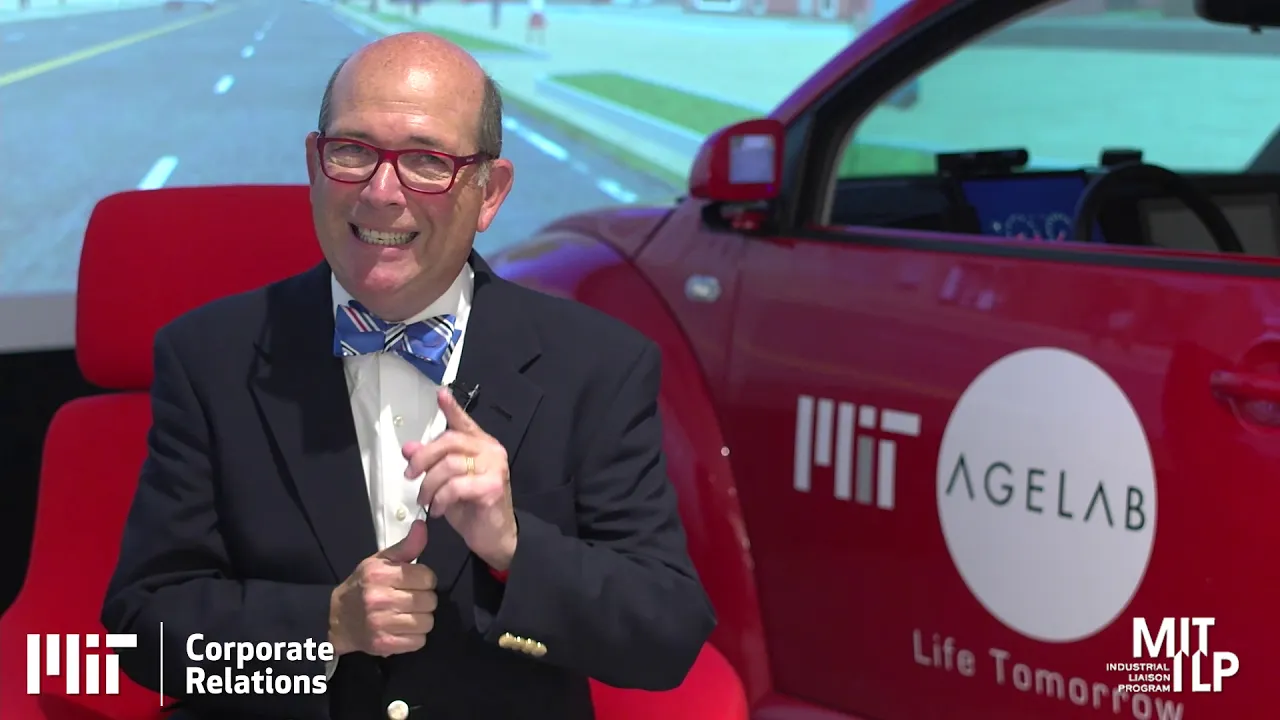
the age lab started here in the center for transportation of logistics we wanted to look at not how old was an older driver that is birthdays don't kill health conditions do but how does new technology enable drivers of any age to drive longer safely and seamlessly so we've been looking for years using our driving simulator right here Miss Daisy as in Driving Miss Daisy digitally to understand how new designs in the car new technologies enable drivers of all ages to not just fight distraction and that's just to understand what health conditions do but to ensure
that the new distraction which is driving itself is not a problem at any age as the car gets smarter that transition is going to be very difficult we have a fleet of vehicles on the road we have five cars that are instrumented out to understand your physiology your behavior and how the vehicle works to start paving that road to the future of the autonomous car the driving is not the only way to get around we're doing work on what is the next generation community look like we're using Agnes the age game now empathy system a
suit that shall we say gives you the experience of the friction the fatigue and often the frustration of feeling older how do you get around in the town what are the future design of retail stores and public spaces and places that are not just able for you older people to get around but are more joyous and seamless even for younger people transportation urban design real estate in retail all fit into designing what is that physical space that we call home to live work and play getting from point A to B is often how engineers define
transportation it's not incorrect but it is woefully incomplete in my classes and urban planning I try to tell my students the following transportation at any age but particularly older age is defined as freedom and independence imagine this 70% 7 0 % of the 50 plus the United States live in suburban and rural is where walkability and transit either is not practical or does not exist so if they don't drive they don't get out the progress toward the autonomous vehicle the driverless car provides a great dream of what that could be for tomorrow but before we're
there there's going to be a lot of shall we say bumps in the road on how people will learn to use new technologies when will they learn to not just trust but to adopt and take their hands off the wheel and let a robot drive but another question we're looking at even the vehicle that may be driverless and seamless is not solving for the last and the first 50 feet a mom who's 80 something years old with cognitive impairment or physical disability how does she get into that driverless car how does she get out of
the driverless car at what point do you trust mom to be in there by herself and it's not just mom at what age do you put your child in there by themselves so while the vehicle is certainly part of our seamless transportation system tomorrow it is incomplete because for now transportation professionals are defining transportation is a to be we have to back up a little bit and extend that trip a little bit more to understand the true meaning of transportation and the true meaning of what that trip is and that's what we're doing here at
the age level the age lab is comprised of a multidisciplinary team we have nearly 40 people that are essentially one third every flavor of psychology you can imagine social psychology cognitive psychology data science in engineering and then all the social sciences and the humanities anthropology Social Work yes and medicine because aging or longevity is a multidisciplinary sport no one discipline can say that simply a device or a service is going to make living longer better so my team comes up with many different methods to help companies and organizations and governments worldwide better understand not just
the needs but what are the products services policies and experiences that will excite and delight an aging society one of those methods that we've developed agnus the age gain now empathy system an Agnes has helped us work with retail companies to better design stores that are not just more convenient for the young but seamless for older adults to rethink how sidewalks and public spaces and places are designed to make it possible not just to be accessible but to make it fun to make it something that has the intensity and density to be liveable and that's
simply livable communities but places that you want to be and want to be exciting on to improve public transportation from Transport London to here in Boston Agnes has ridden the rails and the buses to better understand how to make transit seamless for all ages in all capabilities and the reason we developed Agnes was that's simply because we couldn't ask people in fact we asked lots of people we have panels we have the 85 plus lifestyle leaders a group of people that work with us on a monthly basis to look at products service and ideas and
give us their understanding of needs we do surveys around the world just last year five different countries and certainly many in the United States on topics like finance and housing and transportation but Agnes is different Agnes provides that aha moment empathy where the student the engineer the marketer the planner the retailer can wear the suit and have that aha moment to realize that gee it doesn't have to be this way or to feel that friction that an older consumer often will not report because they don't want to admit that they while they may be youthful
they're no longer young so Agnes gives that designer and marketer and student and engineer that moment where they understand that says this is difficult but because they have the knowledge of how to make things better they can also make the decision this doesn't have to be this way so whether it's changing pill reminder systems opening bottles redesigning stores or spaces and places Agnes provides a new empathy tool to understand the older consumer the research here at the Age lab is not just about technology and about behave it's about the fact that old age as we
know it today is actually believe it or not made up the story of old age the idea that eventually we get tired or that we were imbued with a certain amount of what's called vital energy and as we get older and use it unwisely which many cases means anything fun we get tired we get low on energy and we have to retire we need to create a new story mit has been vital in creating a new frontier of science whereas Vannevar Bush the former dean of engineering here at MIT science advisor FDR said science is
the endless frontier mit has been critical in making it possible for us to live longer in our lives around the world the inventions innovations that have made that happen here at the Aged lab and my colleagues across the campus are now saying let's translate that longer life into something different a new story of old age that is not about getting tired and retired and having a glass that's half-empty but rather starting to envision new products services experiences rituals myths and stories that encompass a 100 year life that is 100 years of quality living that is
the new endless frontier no I started the lab based upon Miss Daisy here because I was intrigued and my background is transportation and urban planning but then I realized that frankly even if I have for instance a home that can provide me a checkup a day three meals of day of good food medication and health all taken care of you know something I just defined believe it or not prison because if I don't have a life where there are things to do and purpose and things that are exciting to do and people to engage with
that's not that's not better living that's simply more life and time spent and so the Aged lab we kind of dawned on us that we could make perhaps a safer car or a better house but doing those things in a vacuum many other people are doing the Aged lab really that aha moment was a life is about how do you integrate all these instrumental activities together to create a life that's worth living and at the end of the day that's the goal of life tomorrow