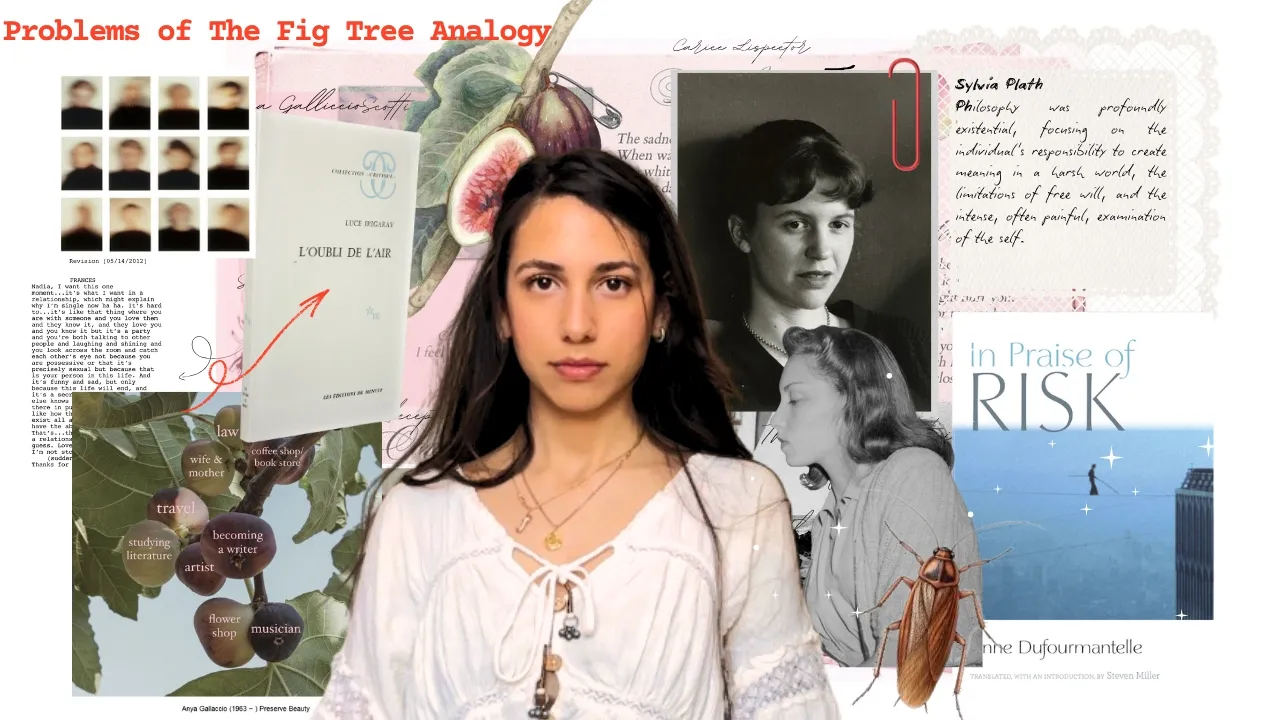
I saw my life branching out before me like the green fig tree in the story. From the tip of every branch, like a fat purple fig, a wonderful future beckoned and winked. One fig was a husband and a happy home and children.
And another fig was a famous poet. And another fig was a brilliant professor. And another fig was E.
G. , the amazing editor. And another fig was Europe and Africa and South America.
And another fig was Constantin and Socrates and Attila and a pack of other lovers with queer names and offbeat professions. And another fig was an Olympic lady crew champion. And beyond and above these figs were many more figs I couldn't quite make out.
I saw myself sitting in the crotch of this fig tree starving to death just because I couldn't make up my mind which of the figs I would choose. I wanted each and every one of them, but choosing one meant losing all the rest. And I sat there unable to decide.
The figs began to wrinkle and go black. And one by one they plopped to the ground at my feet. So, if you've not heard of that, which I feel like at this stage is highly unlikely if you follow me, um that's uh an extract from The Bell Jar in which Esther Greenwood, the protagonist of this book, is trying to figure out what she wants to do with her life.
I mean, the whole of this is sort of a um coming-of-age story of a protagonist, a female protagonist. And it's important I say female because during this period of time um women, well, are still up to this day, I guess. Women, um were, you know, forced into certain kind of positions and areas.
So, this author trying to figure out where she belongs in in the world is particularly important to both the protagonist and the author, which is cuz this book is sort of a it's sort of a semi-autobiographical book of Sylvia Plath. And Sylvia Plath, that was her only novel. So, she did actually go on to write poems uh predominantly and also some of her letters have later been published between her and her husband um after she died.
And also I don't think fully under the control of what she wanted. So, that's that's not great, obviously. But today, I wanted to discuss life paths and how to feel secure in choosing what you want in life.
But I also want to kind of dissect the fig tree analogy that I think has gained a lot of widespread um popularity on the internet. Um and I want to sort of break it down, but also discuss what I think is wrong with the fig tree analogy. And again, I didn't go into this thinking it was wrong.
In fact, I thought it was quite a a great analogy. But until I've done like kind of more research and um I'm going to just be discussing today um Dufourmantelle. I'm going to be discussing some of Heidegger, his critics specifically his critics.
And also some of Clarice Lispector, who is one of my favorite writers. In particular, the book The Passion According to G. H.
, which is my favorite book. So, I'm really excited to talk about that. And actually, that inspired uh this painting I did here, the idea of the cockroach.
But we're getting into that. I'm skipping far too ahead. First of all, let's get into the analogy of the fig tree.
So, in this passage from The Bell Jar Esther Greenwood is imagining all her options being these kind of figs in these branches. And she's sitting in the in the kind of crotch, as she says, the crotch of the tree gazing up at all these kind of opportunities, all these pathways, and uncertain of which one to choose. And in doing so, in having this uncertainty is allowing the figs to fall and rot and drop to the ground and missing her opportunity.
That's kind of the metaphor going on here. And with this analogy I was thinking actually here, without perhaps meaning to, and bear in mind that like Sylvia Plath wasn't that old when she wrote these, so and she never lived to very old um because she she did pass away from like self-inflicted reasonings. There is this kind of presumption that a path exists before any action is taken.
Identity exists before action in this metaphor. And there's kind of visual aspect of someone choosing life. The self stands outside of life as a chooser.
And there's also this undeniable element of time being this seen as this thing of scarcity, you know, as the fig uh eventually rots over time, falls from the tree. And also of of choice being a loss. Like once you choose one aspect you lose the option to have the other.
And the resulting kind of feeling I get from this, and I think perhaps unintentionally and perhaps intentionally for the book, but perhaps unintentionally for in terms of like philosophical thinking is this kind of paralysis. There is no possibility. There's this feeling of starvation in the face of abundance, you know, the tree above full of all these fruits of possibility.
But I find the fig tree an analogy to be um somewhat limiting. In some in some senses ontologically incorrect. I think this is because she is in this analogy mistake or this character is mistaking life for selection instead of life being a form of actions and production and a flow.
The this kind of uh frames life as kind of end points. After kind of doing a lot of this research I've come more to the conclusion that you don't need to choose between lives, but you become through movement. And I've actually spoken about this in the last two videos.
Um but I want to get into more of like how I came to this conclusion within the fig tree. And this is not to deny the feeling that one might have that if I don't choose this, I lose it. Because I do think that is a feeling that we often in life contend with.
And I don't think it's always like fully, fully incorrect. I think there's just nuance needs to be involved here. The fig tree almost doesn't describe paralysis.
The fig tree analogy almost actually creates paralysis. Thinking in these terms creates that paralysis. And I think this kind of issue issue occurs actually because um of the very uh nature of the metaphor being that this metaphor is grounded in physical, non-moving objects and is also grounded in like rootedness.
Um and what I sort of mean by this is so, I started to look into this more and the philosopher Heidegger came up. And I I know of Heidegger, he's one of the most famous philosophers Western philosophers. And formed a lot of thinking for uh modern-day contemporary philosophers such as Byung-Chul Han, who a lot of people on the internet at the moment have been speaking about.
But I've never really spoken about him before too much because if you research him, you'll see that he has a a quite a dark history rooted in nationalism and uh further, if you catch my drift. He naturally came up here because he does have theories on rootedness, um hence also the nationalist aspect. But the main premise of this video isn't going to be like super going into his ideas.
I just need to bring them up in order to sort of talk about what I think the issue is of um the fig tree analogy. Sorry, if I look like I've moved, it's because I have because I had to answer the door for a delivery. But anyway, and he really focused on elements of being being about being being about rootedness.
He often uses the terms like soil and earth to represent like the ground that human beings exist connected to. That really roots human beings into existence. And this isn't like a nostalgic desire necessarily for like uh traditional ways of being, like tradwife stuff, things like that.
But more in his view an ontological reality where humans find their foundation in their relationship to being. Um like foundation meaning rootedness. And a lot of this um he he then kind of spoke speaks a lot The reason it goes into like why it kind of relates to like some of Byung-Chul Han's thoughts um is because then he kind of describes uprootedness and uprootedness being the thing caused by um technological and industrial advances, meaning that we view the world in a very consumerist and consumption-based through a consumption-based lens.
I'm being very brief here. He's written extensively on this, so like please forgive the very short and brief um, introduction there to Heidegger. But this isn't actually about Heidegger.
It's just more that I wanted to talk about this idea of rootedness and the idea of um, something very fixed. But I want to move away from that and speak about a criticism I find particularly interesting that then can relate back to the fig tree analogy. So Luce Irigaray um, is a French philosopher and linguist and she specifically criticizes some of Heidegger's thoughts on this kind of rootedness and therefore I think yeah, as I've said so many times, can be applied to this fig tree analogy.
And she specifically wants to focus more on the the importance of air, which sounds really really funny. But um, there's this quote actually I can read from one of her books um, that I have written down here. Breathing corresponds to the first autonomous gesture of the living human being.
To come into the world supposes inhaling and exhaling by oneself. So since the the day we are born to the day we die, um, breathing and air are these things that involve self-autonomy and make us individual. You know, giving birth, giving birth, um, allowing the child to be in the world is the first kind of autonomous act the child is able to take from being a part from the mother.
To breathe is to take care of one's own life, to carve one's own path separate from another from mother. And in Irigaray's view, there is like two types of breathing, which is corporal breathing and cultural breath. So corporal breathing is like the breath we first take at birth and cultural breathing is more of this sort of spiritual breathing.
Now this essay isn't really about Heidegger, but I do just want to point out it's not that he completely disregards this aspect at all, but we're going to move on from him now and I want to focus on this idea of air because it's this very reciprocal element that we engage in with our with living, with being. It's invisible and it's very, you know, omnipresent, everywhere around us and air sort of represents the intangible and it represents the relational space between beings. And it's also this ever-changing thing that we interact with.
And air resists any kind of possession. Um, it's one of the actual one of the only things really that we can't fully own or that we don't have to like pay money towards having, especially in the Western world, although obviously you can choose to live in a cleaner um, air quality, a less polluted environment and it might cost you less. Um, sorry, it might cost you more to live in a cleaner kind of environment.
For example, not having like mold in your house, which is a big problem in the UK. Um, you'll know this if you if you rent in like places like London. And yeah, so there is obviously that side of it, but it is just generally air is one of the things that we interact with that we don't have to um, we cannot possess.
Air resists any kind of stability or domination. And with air, there is this real feeling of, you know, like I said, relational um, there is a relational aspect to air. It is responsive and um, involves reciprocity, exchange and a um, shared existence.
By the fact that we live with air around us, we are existing in a a moving existence. So then going back to the fig tree finally, if we are to see the fig tree as this very rooted and um, tangible example where um, there is a very clear root, very clear path that doesn't really require a constant exchange with its existence. Um, the fig tree analogy no wonder it can make us feel stilted and like yes, we understand it because in a way if we are viewing choice in this way, we are limiting ourselves, if that makes sense.
So like because we are using the analogy of a fig tree and applying that to how we make decisions, we are automatically viewing decisions as these very um, stilted and rooted and end points. Whereas like actually decisions are not necessarily these very unmovable things. And this also makes me think about the fact that um, like in this analogy to get to a point, there is like a clear kind of route or path, but actually there are many routes and paths towards becoming something.
So say for example, it is that you want to become, I don't know, you have a certain profession in mind that you want to be, you want to be a teacher. There are actually different routes to to becoming this teacher. Um, and I don't mean this in terms of like the schools you go to or anything like that.
I mean sort of like things happen in life that perhaps make you then want to become something and it it it can almost never be the same for everyone. So trying to like follow this very clear instructed way of being um, in this very rootedness and tangible immovable um, analogy is somewhat um, problematic and limiting and no wonder it can make you feel um, like you will lose if you choose one way. And then this kind of made me start to think about, okay, so then is there risk involved with making decisions?
And then I came across this work by um, Dufourmantelle, another French philosopher. And she actually quotes in one of her books called In Praise of Risk and I want to preface this by saying that so Dufourmantelle um, And Dufourmantelle, she passed away because she um, went to go and save some I think like children that were in trouble. I think they were drowning.
And she passed away in this process and she has been criticized for her views on risk because of what happened to her when she took a quote unquote risk. But I think what the the critics of her fail to realize is that she's talking more of a an existential risk as opposed to like a physical um, bodily risk. Um, I think this fig tree analogy and all of these kind of like trying to make a decision or path in life needs to be aware of the kind of existential thoughts that we have surrounding this because it isn't just rooted in like what's physically available to us and I think that's why also the fig tree sort of fails as an analogy and can, you know, reinforce the feelings of feeling lost because it's framing reality as this very immovable thing.
And in this book she actually quotes um, Spinoza and it says, "No one knows what a body can do. What we know about ourselves are only the surfaces of our consciousness. And risk works as a catalyst in uncovering our conscious self that remains hidden from our view.
Risk is that by which we constantly exceed ourselves. " So risk is not really about danger here, it's about a self-transformation. And that's why when I say this I I mean it's more existential than than a physical um, tangible, fully tangible thing.
Here I think risk is being spoken about more as a letting go of a fixed identity. And also in this quote we can see that she is also touching on the subject of that of the fact that we can accept the fact that we don't fully know ourselves. And if we really try and set up a pathway for ourselves, we are limiting ourselves by kind of putting ourselves in a box, in a fixed line.
The thing the true thing is that we don't fully know ourselves and you know, because there are so many outcomes and pathways we can take in life, we in some ways we will never fully fully know ourselves because we cannot live out all these versions of ourselves. But I think a key element that Dufourmantelle speaks about is being aware that there is this kind of unconscious level to us and why risk is really important in Dufourmantelle's theories is that risk enables us to reveal these hidden capacities and unknown aspects of ourselves. And she has a few examples that she um, uses in her writing.
So I think there was like the story of this person who um, had a terminal illness and they had decided, you know, I am going to die not not so long away. Sorry to like suddenly go into death, but obviously, I'm talking about existential things, so this is naturally where the conversation kind of goes, but they had you know had this predetermined path that they weren't going to live for very long, and the they call them an analyst, but the the analyst who is speaking to this person who is kind of the one guiding this person through through that illness, they actually unexpectedly pass away, and in doing so, a certain level of certainty breaks and or authority the authoritative voice in this scenario kind of collapses and a rupture occurs, and this person had strangely a new lease of life because now they weren't under the constraints of the idea that you know this person will live for a really long time and I'm going to not going to live for a really long time. Um, and yeah, that all their sort of uh version of reality had broken down in this because they had set up in their head a pathway that was very clear to them, and uh a way of thinking and being that they thought was um completely correct and didn't sort of allow for the things that they weren't aware of happening.
I hope that this makes sense, but that's just the example that she uses. So, this is why risk allows us to exceed ourselves. And I also want to point out that she is not saying that um she thinks she mentions that courage is not the same as risk.
So, courage pursues existing goals, whereas risk questions the very foundation. And also, risk is not necessarily choice. Risk is something that is more that happens almost to us, where a certainty of your trajectory um collapses, so giving us a new kind of lease of life.
And in this sense, risk is about possibility and openness and becoming otherwise. And again, going back to the fig tree fig tree analogy, that's also why I think it's a very limiting analogy. To be clear, risk isn't about danger, and it's not about sacrifice or kind of like dangerous scenarios, adrenaline fueled scenarios, and that's why her death is not um actually related to this kind of concept at all.
It's about a rupture of your identity. Even in her writing, she doesn't sort of um there is some ambiguity left, which I think is very um fitting for her theory in a way, and she doesn't say that risk doesn't come without courage. So, there is like yeah, some ambiguity left to this, but the main idea here is that risk initiates transformation.
So, risk is not a heroic act in any way. It's really really about um self-discovery on an unconscious level, things that you were not even aware of that your body could um could do or that you knew had the capacity to live out. So, having kind of this really set path in the sense is very limiting again.
Hi, sorry, this is me editing, and I was just thinking actually that this is very very similar to what I've seen online recently about lucky girl syndrome or increasing your area your surface area for um opportunities and increasing your luck. I think that risk in this sense is also about openness. Um so, not about danger, but being um open.
What actually could do to kind of combat a lot of these um feelings um and suggestions brought up by the fig tree actually is to rephrase nouns into verbs. So, rather than saying I want to be a writer, you would just say I you would like talk about the the verb to to write, writing um rather than like the end goal, which is like sort of what the fig tree does. Just it's just the end goal at the the top.
The fig is like the prize. Rather than this kind of destiny, it's more of a movement towards, and nothing a lot of things like some things yes are um unchangeable, but um with this kind of idea of like choosing a life path a lot of things can also be um you know, somewhat experimental. They're not final destinations.
So, the fig tree sort of traps you in false choices that you have to make, but to become someone you don't yet have to have the name or the language to name it. So, like, you know, because there are things that we're just not aware of that possibility, and by trying to reduce it down, you are a lot uh kind of stopping yourself from just being. And then um lastly, this made me think of Clarice Lispector and The Passion According to G.
H. because obviously, well, actually not obviously, but if you've read it, um it's about a woman who coming face to face with um a cockroach, and in doing so, she has kind of an existential crisis. And I like the the metaphor of the cockroach I like the the symbolism of the cockroach because obviously, a cockroach is very primordial, so it's very um set in the beginning of time almost.
And there's a specific quote I've written down here >> [snorts] >> kind of on depersonalization where she says, "Reality prior to my language exists as an unthinkable thought. Life precedes love. Bodily matter precedes the body.
And one day in its turn, language shall have preceded possession of silence. " So, I'm going to leave you with that thought, but I think it's basically kind of saying that we should try and allow the meaning to follow the action rather than you know, creating the the meaning before the action begins. Um I hope that this has somewhat been a coherent video or essay.
I feel like my ideas were a little bit all over the place here, but I I did have a kind of through thought with the with the fig tree. Anyway, if you enjoyed this video, please um let me know in the comments below. As always, I will be on Spotify as well, and I hope to see you all again next time.