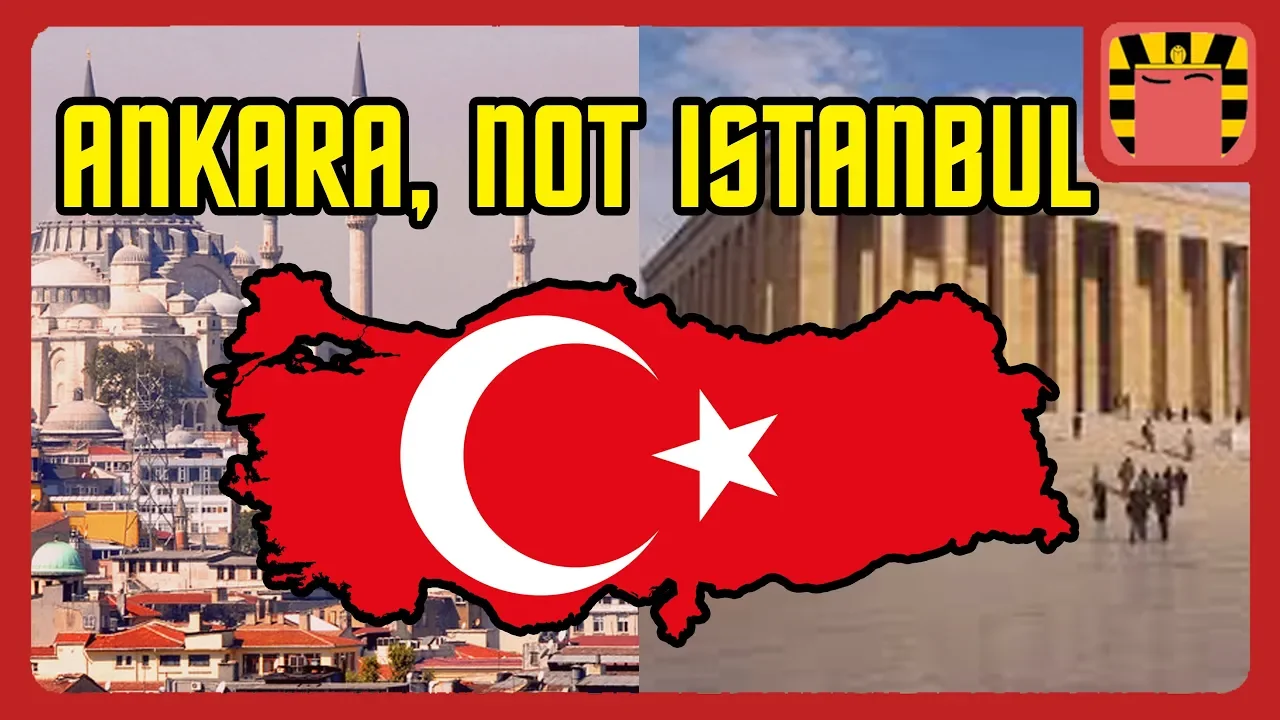
Istanbul, one of the world’s most important cities for over 2,000 years, and widely said to be the only major city in two continents. Even then, at over 15 million people, it is the largest city in Europe, tenth largest in the world, and by far the largest in Turkey. It was the capital of the Eastern Roman Empire from its reestablishment in 330 AD until it was conquered by the Ottomans in 1453, from when it became the capital of the Ottoman Empire.
With the Ottoman Empire gone since 1922 however, Istanbul no longer serves as the capital of the Republic of Turkey, that honor now goes to the city of Ankara. So why was the capital moved away from a city as important as Istanbul? [Thanks to CuriosityStream for helping support the channel] Let’s go back in time a bit so we can see the full story… Istanbul, one of the world‘s most important cities… okay, a bit further back than that!
In 1453, after years of Ottoman expansion all around the Byzantine/Eastern Roman Empire, the Ottomans surrounded the remains of the old Empire, which was now effectively a city-state consisting of Constantinople and a few other scattered territories. The Ottomans had moved their capital a few times already from Söğüt, down to Bursa, and then over to Adrianople (now Edirne), and now thought Constantinople would be an awesome city to have as the capital. Without going into too many details (which I should definitely make a future video about) Constantinople was conquered after years of siege, decades of Ottoman attempts, and over 1,000 years of attempts in general.
The city was made the new and final capital of the Ottoman Empire, the Hagia Sophia was made into a mosque (hence the minarets), and the city was not actually renamed, yet. The Ottoman Empire ruled these lands and expanded into surrounding lands for over 500 years afterwards, but by the 19th century it would be given the nickname “the sick man of Europe” as its foundations started to weaken and province after province started to gradually break away (even if only to become part of France and Britain’s colonial empires). Shortly after the turn of the 20th century, Europe set itself on fire in what would be known as World War I, in which the Ottomans joined what would turn out to be the losing side.
At the end of the war, British troops made their way into Constantinople, and the Ottoman Empire was confined to the borders that make up modern Turkey and then split up amongst the victorious powers after the Treaty of Sèvres. The treaty was signed in 1920 between said powers and the Ottoman Empire, now confining Ottoman control to this part of northern Anatolia. Looking at these borders however, one thing people probably aren’t thinking is “yeah sure, that’ll work perfectly fine”, and it didn’t work perfectly fine, as it almost immediately escalated the Turkish War of Independence.
The conflict had already been underway for the past couple years, as Allied forces had already occupied parts of Turkey previously, but disagreement about the treaty effectively split the Turkish government into two camps: the old imperial government based in Constantinople who had agreed to the terms, and the Turkish National Movement-- established just a few months prior in Ankara (then still known in the west as Angora or Ancyra)-- and who fought against the Allied powers to restore their borders in an incredibly complex war that you can learn more about from this video by Jabzy. In summary though, Greece was basically the only power that really actually fought the Turkish resistance; Italy pulled out almost immediately, Russia allied with the movement to establish a puppet state in Armenia, and France didn‘t want to fight a war like Greece and basically decided “screw this, we’re out! ” The Turkish National Movement was essentially an amalgamation of various different Turkish revolutionary forces, with one prominent figure being Mustafa Kemal, who of course would later adopt the surname Atatürk, meaning “father of the Turks”.
Looking at his legacy in modern Turkey, this might seem like an apt title, and not just because his face is on all the money. The Ottoman Empire was a very different country from the Turkey we know today, as modern Turkey is now way more secular and westernized, largely due to efforts from this guy, with his new government being a strictly secular one and even going so far as to ban traditional dress for a time (to use some slightly polarizing examples). In fact, he even changed the writing system used by the Turkish language from a modified form of Arabic to a slightly modified Latin alphabet, and even brought back old Turkic words for various administrative purposes, which had previously been based off their counterparts of Arabic and Persian.
The Treaty of Lausanne was signed in July, 1923, and the new Republic of Turkey was proclaimed on 29 October, 1923, with Atatürk as its first president. One matter that also needed to be addressed though, other than religion and language, was which city was to be the capital of this new republic. Although Constantinople was officially renamed to Istanbul, to Atatürk the city simply didn’t spark joy as a capital for his new republic.
The largest reason for this was because Istanbul was the capital of the old empire, meaning that it simply wouldn’t fit as the capital of the new republic. That wasn’t the only reason though, since keep in mind the city had also hosted the headquarters of the resistance, though Atatürk’s movement originally started in Erzurum, but moved to Ankara seeing as it was-- to state yet another reason for its selection as capital-- a big city smack-dab in the center of Turkey. Today Istanbul is still Turkey‘s largest city and an incredibly important financial hub, as well as a strategic location for NATO, of which Turkey is of course a member nation.
Ankara however has seen a massive population boom, now taking the place as Turkey‘s second largest city at over 5 million people, nowhere near Istanbul‘s 15 million but definitely not nothing to sneeze at. Of course there‘s a lot of stuff I wasn‘t able to cover in the short lengths of this video, but there‘s one place you can learn all the history you want. Sponsor time!
Of course modern-day Turkey sits on a piece of land filled with history going back thousands of years. If you want to go back a little further in time, I would strongly recommend you watch the documentary Bronze Age, available on CuriosityStream. CuriosityStream, if you aren‘t familiar, is a subscription streaming service that features some of the best, highest quality educational documentaries out there.
CuriosityStream has sponsored KhAnubis for a couple months now and you may have noticed that in every spot I make sure to recommend a different documentary that I haven‘t mentioned before, something I‘ve found trivially easy with their selection of thousands of documentaries on history, science, culture, politics, and virtually any other general interest you might have. To get access to this amazing library and help support the channel, simply go to the link below or go to curiositystream. com/khanubis and use the promo code “khanubis”.
From there you will get a one month free trial on an already absurdly cheap service, at just $2. 99 per month or $19. 99 per year for all the amazing documentaries you could want to watch.