Okay, let's talk about transient plugins. They seem to split into two different types at the moment, but they tend to all get lumped into the same category, and I don't think they should be. First of all, there's the classic transient designer, which I'm representing with this SPL plugin, as it was SPL that originally pioneered this type of processing with their transient designer hardware unit.
Basically, you get two main controls, attack and sustain. Turning up the attack boosts the attack transients like so. This seems quite exciting when you first discover it.
You mean I don't have to mess about with compressors and attack times to add punch to my drums? I can just turn up one knob. It's not the same, though.
If you have very consistent attack transients, like from a drum machine, for example, then this is a useful way to shape them and make them hit harder. But if there's any kind of variation in the source signal, the transient designer will tend to exaggerate the inconsistencies. You can hear that in my example, I think, especially if I turn off the limiting.
Some snare hits are getting way more transient boost than most of the others. That's less likely to happen with a snappy or punchy compression setting because the boost to the transients doesn't come from the compression rather from the makeup gain which remains static. Of course, you can also turn down the transients instead.
You might not want to do that on drums so often, but it can be useful with signals that have an ugly too prominent attack, especially when that would be hard to tame with compression, like for example a PZO pickup in an acoustic guitar. In that case, the fact that it reacts more strongly to more prominent transients is probably a good thing. It's the sustain control that I find invaluable.
However, turning it up is a valid alternative to heavy compression on drum room mics or might help to bring out the room in your drum bus if you didn't have room mics. While turning it down is a great way to control the decay of a kick or especially toms. Setting a gate to do that can be tricky, sometimes impossible, while a transient designer lets you fix it just by turning one knob.
It's this application that makes a traditional style transient designer an essential part of a mixing engineer's toolkit in my opinion. You might be thinking at this point, however, yeah, sure, but everything you just did with it sounded a bit How is that useful? That's a fair observation, and I kind of agree because with all due respect to the SPL people, this is my least favorite of the Transient Designer plugins in my collection.
Here's one from Native Instruments, Transient Master. That was my go-to for many years when I wanted something simple. It sounds better, right?
I also like this one from Soft Tube. This one has split band options, which could be useful for taming those PZO attack transients I mentioned earlier. Let's boost the sustain, [Music] though.
Also better than the SPL, right? Here's Alicia envelope also with split band options. Also sounding better with a sustain boost.
I have to say I'd be more likely to use this one if the interface was resizable. So why do they sound different? Obviously they all have different parameter ranges and some allow more extreme gain changes than others.
But that's not the whole story. The SPL starts to distort in ugly ways with the sustain [Music] maxed. While my other examples can apply equal or more sustain boost without that kind of ugliness.
What's up with that? I'm going to load Fab Filter Saturn to demonstrate how this kind of processing works. Let's start with an envelope follower.
These days, if you want to manipulate attack transients, the easiest way to do it is to switch the envelope follower to transients mode. I'm not going to do that, however, because before that feature was added, we could do the same thing by using two envelope [Music] followers. I'm going to link one of them to the gain parameter and then quickly invert the modulation so you can hear me talking.
Now, we have a weird kind of compression with a threshold at minus infinity. Now, I'll also link the other envelope follower in exactly the same way, but I'll leave this one positive so the two modulation slots cancel each other out. And this setup doesn't do anything at all, unless the two envelope followers have different settings.
Let's slow down the attack for the first envelope and set the second as fast as it will go. Now, there's a difference in the attack stage. The upward expansion reacts almost immediately.
While the downwards compression takes a bit longer. The difference means a boost for each transient. If I increase the modulation depth, I can exaggerate the effect.
Of course, I need to keep both slots set the same. I could add a slider, set both slots to zero, then control them both from the slider instead. which is now equivalent to the attack knob of a traditional transient designer.
If I invert the modulation, so the faster envelope is compressing while the slower one is expanding, we get transient softening instead, like turning the attack knob down instead of up. [Music] Okay, so what about the sustain knob? Let's set both envelopes to their fastest possible attack, but then it significantly slow down the release for just one of them.
There's the tightening effect you get when you turn down the sustain knob. And if I invert the modulation again, there's the hyped roominess you get when you turn the sustain up. Here's a slightly more complex setup, which recreates the full transient designer experience.
The attack and release sliders are now birectional and can either boost or cut. And this full setup requires four envelope followers, assuming a mono side chain. If you wanted independent processing for stereo channels, that would mean eight envelope followers.
Amusingly, this setup in Saturn also sounds better to me than the SPL plugin. But as you can see, there's not much more to this processing than just envelope followers. And I guess better envelope followers make for better transient designers.
Most envelope followers are in fact just a special type of lowass filter anyway. So perhaps it shouldn't surprise us that the Fab Filter devs made a good one. Okay, so that's the classic transient designer effect.
Here's a very different approach. This is Quantum from Waves Factory. If we ignore the bottom section for the moment and just focus on the controls at the top, it seems like it's doing the same kind of thing.
We can boost the transients or cut them or boost the sustain. The first clue that this is a different category of processor is the solo buttons for each section. We can totally isolate the transients or everything else because Quantum actually splits the transients and the body of the sound into separate channels internally.
That's what makes the bottom section of the plug-in possible with a variety of effects available to process just the transients or everything except the transients. But if we continue to ignore that for a little while longer, it also means the behavior of the attack and sustain knobs at the top is quite different from the classic transient designer. The attack boost from the classic opposing envelope followers approach will vary continuously in its strength according to the transientiness of the input signal.
And yes, I think I did just make up a word there. On the other hand, with the quantum approach, it's much more binary. Either it is a transient and it gets all the boost, or it isn't and it gets none.
This potentially could help with the inconsistency issue that I mentioned earlier, and even more so if you use compression or limiting for the attack section, but it swaps in another potential issue instead. How clever is the plug-in at working out what is a transient and what isn't? And also, how well does it avoid clicky discontinuities when splitting and recombining the signals?
Actually, I think Quantum does this rather well. So much so that you could mistake the top section for a classic style transient designer if you didn't look too hard. But of course, the more complex the input signal gets, the more likely it is to miss transients or misidentify things as transients that aren't.
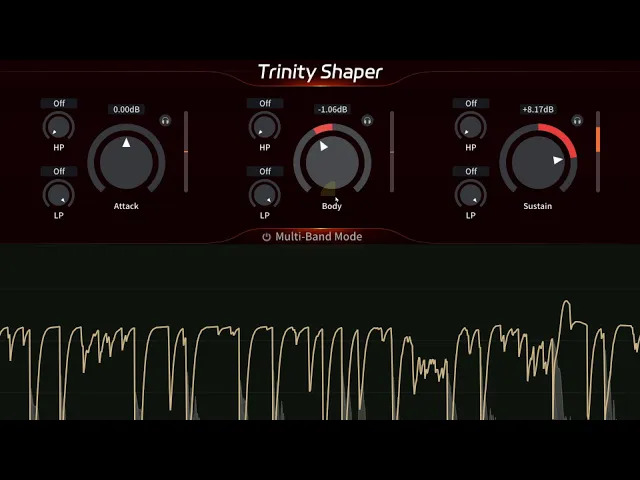
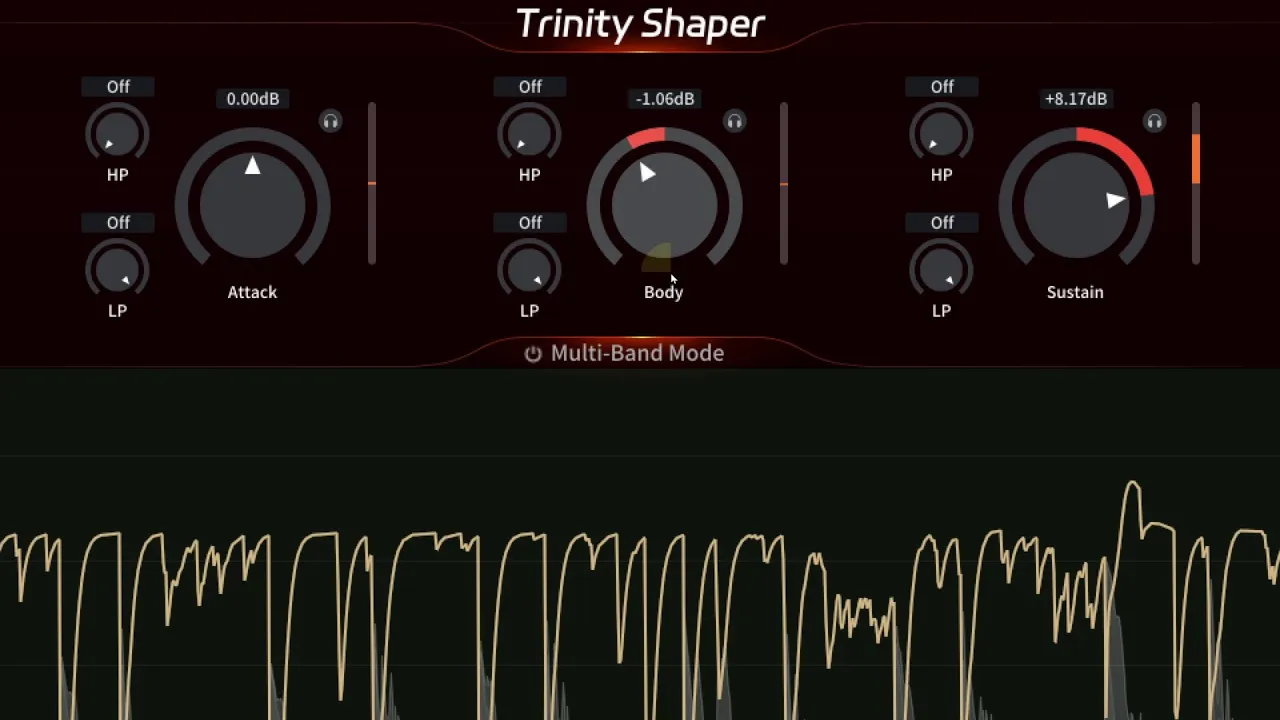
I'm going to throw in a curveball. Now, this is Trinity Shaper from Freebody Technology and Plug-in Alliance, and it's a bit of a monster with a full-on multiband mode available. I'm going to ignore that, though, and just focus on the main transient controls.
We have attack and sustain as before, but now also a body parameter, which is kind of exciting. And also, we get to solo each of these stages like in Quantum. Does this mean it's splitting the signal into different internal channels like Quantum does?
Well, I don't actually know what's going on under the hood, but I'm guessing that no, it isn't. I think this is probably an opposing envelope follower style processor, but with an extra pair of opposing followers, which they found some other way to set differently to handle the body part of the sound. And I think the solo functions are a clever way to isolate the delta for each part.
So, kind of an extra step rather than just a solo option for a channel that's already isolated internally. I could be wrong about that, but the closest I got to proving it was by running three instances in parallel with one section soloed in each and observing that adding them all together didn't sound the same as a single instance with no solos. That test works fine with quantum, though, because that's exactly what it does internally.
Anyway, if I'm right, then the presence of a solo option for the transients isn't definitive proof that it's a quantum style transient splitting effect. However, these transient sensitivity and transient detection mode settings definitely give the game away. These are the types of settings you'd expect to find on a sample replacement plugin, nor something like cable guys snapback that I featured not long ago, for it needs to identify transients and do something in response.
If you find this kind of setting on your transient plug-in, then it's definitely a binary quantum style processor rather than a continuous transient designer style processor. And the lack of any such option in Trinity Shaper is the other main reason I'm convinced it's using an evolution of the opposing envelope followers approach. As a side note, if I'm right about the body section requiring another two envelope followers, that means there are six of them running under the hood in single band mode and 24 in multiband mode, assuming a mono side chain.
Anyway, to wrap up this little Transient Designer diversion, I consider a classic Transient Designer style plug-in to be a must-have for a mixing engineers toolkit, as there are fairly common problems for which it's the optimum solution. Unfortunately, I can't really recommend the SPL plug-in for that, but there are plenty of good alternatives. A quantum style transient splitting processor, on the other hand, is a bit more esoteric.
It might allow you to surgically fix very specific problems that a traditional transient designer wouldn't help with. Or more likely, it can provide interesting sound design [Music] options. But I'd put it in the nice to have category of the essentials list.
Okay, diversion over. Let's get back to the point.