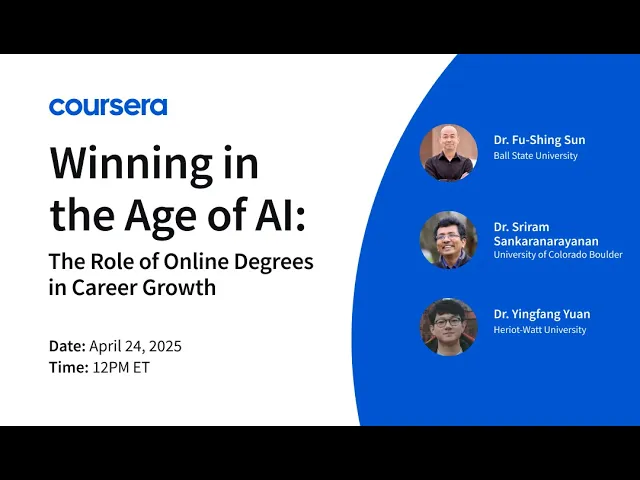
great I think I can we can start now Today we will be talking about how AI continues to shape the future of career evolution and how you can stay ahead of the game with degrees and course work available on Corsera We'll be also be joined by a few keynote speakers who will be sharing some of their expertise and participating in a panel discussion at the end of the session To kick things off I want to introduce my other co-host for the day Nisha Khan is another enrollment representative here at Corsera and will help us guide
through the presentation Nisha feel free to come off mute and introduce yourself Thank you so much Herman It is a pleasure to be here Hi everyone my name is Nisha Khan I'm currently a senior enrollment representative here at Corsera I work on the computer science and data science domain and I have over several years of experience working on these subject areas I've had the privilege of partnering with prestigious universities across the globe naming some to be HC Paris Goldsworth University of London University Housesfield University of Michigan just to name a few I'm here to help
learners across the world to gain access into their dream degrees and help the enrollment process go as smoothly as possible So thanks Hamman Back to you Thank you Nisha Great Let's get started We have the pleasure of being joined by three experts in the AI industry Dr Fingon from Ball State University Dr Shriram Shankar Narinan from University of Colorado Boulder and Dr Yang Fuang Yuan from Harriet W University will all be presenting a bit later on Great As a reminder this session will be recorded and sent out afterwards Throughout the session you may also submit
questions through Q&A feature as the chat feature will be turned off We will do our best to answer your questions throughout and also have a formal panel with our keynote speakers at the end of the presentation Please note if you are asking a question about a specific program please include that in the question so that we can better help provide an answer Great So here's a look at today's agenda It's a fun-packed agenda and we will begin with an AI overview and have a brief discussion about the importance of AI in today's job market Then
we will have our three keynote speakers followed by an overview of AI related degrees on Corsera and lastly we'll finish up with our keynote panel All right before we jump in we have a quick survey Are you considering a degree i'll give you a couple of minutes to respond All right seems like many of you are considering a degree in next 12 months That's good to hear and you have been also thinking about it but you know you're not sure whether you should start now or maybe you know need more time to decide one more
quick one I have how often do you currently use AI this might be at work or in your personal life let us know all right it's a mix of sometimes uh daily multiple times a day or there are very few who says that never seems like many of you are already familiar with AI let's dive in So what is AI and how does it work ai or artificial intelligence is a growing theme across various jobs and industries At the heart of AI are algorithms These are set up by humans within a computerized system Algorithms are
clear set of instructions that the computer then follows to solve a problem or a task When algorithms received input and processed data they learn patterns and characteristics that help computers make more intelligent decision over time To continue on AI uses different technologies to carry out these and many other tasks such as speech recognition world translation maps and navigation image search and more And these in in technologies include machine learning deep learning neural networks natural language processing computer vision and cognitive computing which is pretty impressive So why should we care about AI here's a good reason
for from the World Economic Forum As of January 2025 170 million new jobs are projected to be created by AI in by 2030 So where it can be common for AI to replace certain jobs there are actually millions of opportunities on the horizon for people who could understand and work with AI This includes more than just tech or computer science jobs More and more we are seeing the need for AI roles in life sciences business finance medicine writing and so many more So in fact online job postings that require AI skills more than doubled in
the first eight months of 2024 And in 2023 LinkedIn's analysis of fastest growing skills in 2023 put AI literacy at number one Recently our chief content officer Mani Baker was featured on Talking Businesses Listen as she discussed the demand of AI upskilling in today's job market Less than three years after the launch of chat GPT into the world it seems that the ability of computers to generate new content is a gamecher that is rapidly spreading into every part of the world of work In fact generative AI has been taken up more quickly than the internet
itself was According to a study by Harvard Business School by August last year four in 10 working age Americans were using generative AI My next guest is one of the big bosses at one of the biggest places people go to upskill for the AI age Corsera Many Bakerstein welcome to the program Let me begin by asking you about this massive rush for AI training that appears to be happening It's up 800% this year according to your 2025 jobs report Have you ever seen anything like it i have never seen anything like it You know we
we see the different waves of tech uh tools and uh data crazes um at Corsera that uh the generative AI because it is pervasive in its use across every sector every role from computer scientists to teachers healthcare workers and everywhere in between is just it is a gigantic wave of reskilling that we're seeing going on right now around the world How big a part of what people are coming to you for is AI compared to other subjects in 2024 40% of our top courses were on AI or generative AI And that was about seven enrollments
per minute in Gen AI courses so far in 2025 That's up a little bit from last year but we've gone from one enrollment per minute in 2023 to seven enrollments per minute in Genai courses today Uh it's just an incredible showing over 5.3 million global Genai enrollments to date As you just heard AI courses on Corsera have seven enrollments every minute with over 5.3 million enrolled globally to date On your screen now you will see some of the top skills that technical AI roles are looking for Some of the degrees we'll discuss today dig a
bit deeper into these skills and their application But this is a quick overview just to get us started So it's really important to note that there are also a range of soft skills that job seekers are looking for within their AI job openings Analytical thinking flexibility and communication are just a few But this ultimately underscores the importance of being able to combine technical AI know-how and very strong interpersonal and cognitive skills So for example an engineer who not only builds models but can also communicate business implications or a manager who understands AI enough to strategize
and lead teams effectively can provide exceptional value So in the development and progression of AI there are new career opportunities on the horizon As you can see here on the screen here are four that we've seen on the rise Um AI prompt engineer AI ethicist AI product manager AI trainer or data curator I'm seeing a lot of questions in the Q&A So just as a reminder uh we will be sending out the recording with these resources resources after the presentation as well Great In the fastmoving world of AI online degrees are best known for their
flexibility with working professionals being the majority of our online learners AI is developing fast and a online degrees can help So as we saw on the last slide online degrees are increasingly more accepted by employers especially post pandemic So in fact in a study done by the National Association of Colleges and Employers 87.4% of employers hired new graduates with an online degree in 2024 And to top that off 100% of those employers paid online degrees highers the same starting salary as traditional graduates Meaning as an online degree student it's not only more and more common
to find employment postgraduation But in terms of pay parity you will be more than likely to be compensated the same as a traditional in-person graduate With that we will move on to our keynote presentations who all join us from top university hosting their degrees on Corsera All right Dr Dr Funingf joins us from Ball State University where he has been teaching and working since 2002 With a PhD in computer science from the University of Texas at Dallas Dr Sun conducts research in data mining related area in particular data clustering data classification and text mining His
recent work focuses on mining social network news to understand how different types of news being broadcast and consumed over various news channels Dr Son we are so happy to have you join us here today Please begin whenever you are ready Okay Uh uh my name is Fushin Sun Uh thank you uh for the very kind uh introduction uh one of my uh research uh areas uh is in the social network uh data analytics So basically uh the idea is uh uh these days uh we uh pretty much uh consume uh everything uh through uh the
social networks including uh interact with the world interact with our friends and colleagues and also uh provide our responses or feedback to uh any uh uh news or uh you know broadcast that uh relates to Okay So uh this area apparently fits into uh the big data domain Uh that is it has a lot of data in terms of its volume and uh the data being accumulated so fast Uh so it satisfied the velocity requirement for big data and also uh everything uh posted on social networks uh has all kinds of uh different uh varieties
uh information data formats etc So uh it also satisfy the variety requirements Okay So we are interested in uh this uh uh domain and uh basically you can see on my slide right here So uh this is one uh post uh uh on the Facebook and uh he has say an image sometimes he has a short clip of video and uh the the we have a posting and sometimes about news sometimes about story of all kinds of information and the important thing is uh the users or the readers are able to provide a real-time feedback
and you can see Um there's another uh you know screenshot right here uh to the one of the social network posting Okay So uh in terms of the data uh we have uh a traditional uh text and the static images and also if you see my uh right bottom right corner we have a video here like say today like the Tik Tok or Instagram and a lot of posting be made by using a video instead of a traditional like you know uh classical a text text news basically All right So we are interested to uh
find out the interaction and first of all the trend about the multi uh the media uh you know u mechanisms and feedback and also we want to find out that how you associate uh the text with uh the other multimedia like a video and image Okay And then uh we would like to find out uh the responses from the audience as well Okay And uh all these are also tied up with the time series data consideration and because everything uh posted or responded will have a time stamp associated with it So we can find out
uh the trend for for instance like users sentiment in terms of the time and also uh response to a specific event like say a specific screenshot uh within a clip a video clip So this uh will be uh considered and also because u the users if they turn on their location uh been detected then we will also get to know where the response got sent from Europe from United States or from Africa uh etc Okay All right So from our uh research perspective we would like to uh find out the correlation among all the media
uh between times and among locations these kind of things and uh from AI's perspective uh we are moving toward that direction as well and there are two things important right here and first uh for the uh news agencies how could we uh you know create a use automatically uh through AI and this is a great debate these days uh do we uh need to uh follow traditional approach everything should be made by humans or uh we uh it is acceptable to have AI to help us at least do the first round drafting of news and
the second thing will be the responses from the audience and how do we detect a certain uh piece of response is from a real human or is from a bot and uh the a bot generated uh responses or uh reviews uh may impact uh the for instance like u the following consequences or the sentiment analysis and those are the things that we are interested uh in analyzing these days Okay Uh I think that's it I think I've used all my time now So uh should we move on or Okay Thank you Thank you so much
Dr Sun That was incredible to understand And just to jump in briefly we do have some information about the Ball State Masters of Science and Computer Science degree here I've seen some questions in the Q&A box So if you are interested as a highle overview this degree does not require an application Instead you can let your performance pave your way to admissions with performance-based admissions Additionally there is no computer science background required for this program So hopefully that should answer a few questions for people As you can see B state student and Nicholas Eaton has
mentioned if you have questions about this program please scan the QR code on your screen and book a meeting with your enrollment representative We're happy to help you prepare for that May 18th enrollment deadline What I'll do is I'll just leave this up for a minute before we move on Great Now to introduce our next keynote speaker Dr Dr Shriram Shankar Narayan is the associate dean for digital education in the college of engineering at the University of Colorado at Boulder Being with Boulder since 2009 he teaches a variety of courses in the areas of programming
languages algorithms mathematical optimization and specialized courses related to his research areas With a PhD in computer science from Stanford University we are extremely excited to introduce Dr Shankar Narinan I would also love to sh you know share a fun fact about uh Dr Shiram Uh so he loves reading books He's always reading a book and he plays South Indian classical music on the Vina Welcome sir Over to you Uh thank you very much for that very kind introduction Maybe we could go to my first slide please Uh oh hi everyone I'm so glad you were
able to join us today Uh I'm going to be talking about AI in medicine Uh before I start a legal disclaimer so you don't sue me Uh the doctor in front of me is a PhD I'm not a medical doctor So I cannot give you medical advice and I'm not really qualified in medicine really The only qualification I have in medicine is I'm married to a doctor My wife is a is a doctor So she knows what she's talking about Uh but I know a little bit about AI So I thought I would talk about
AI and medicine But in all seriousness I've been working in this area for the last 15 years and I've been very fascinated by how AI is evolving in medicine and it really relates to some of my research themes that I have spent my lifetime researching So I would love to talk to you about how uh this drives some of the theoretical research we do uh into practical applications So before I dive into that let me first at a broad level uh picture what is the future of AI and medicine and that future is now Um
so when we think about AI and medicine maybe some of you have seen this science fiction movie that I saw a long time ago uh you basically have someone swallow a pill and the pill kind of goes into their body and starts to go through different blood vessels and and all these passages finds out that they have something wrong and then shoots laser at it and and cures them and the patient feels really well So that's the science fiction Uh and to be honest one of my colleagues Dr Mark Wrenchler actually has such a pill
that you can take in and it it does a colonoscopy uh but that's different from what I mean by AI in medicine I'm talking about real things that can help doctors and patients today And when we talk about that uh what is the main uh reason that AI is being integrated in in medicine uh so one of the things right now in medicine the biggest challenge is availability of care uh we all take the fact that when we feel sick we can go to a doctor we can talk to a doctor but that's not really
the case for for the majority of the people on planet earth and even in countries like the US that is a challenge delivering medical care uh consistently to patients is a challenge uh the volume of doctors like my wife has just kept increasing and surprisingly they spend a lot of their time not treating patients But uh charting writing notes uh doing things that are not the most productive thing maybe that a doctor could be doing Not that they complain about it but it's still uh nice to see a doctor working with patients and and then
computers or AI taking care of the remaining things So when we talk about AI in medicine the biggest things we are talking about today are AI being integrated into electronic medical records So the kind of medical records that keep your chart and all your doctor's visit now will be empowered with AI which can look into your medical records and start to bring information together uh which has been a big challenge and and uh time sync for doctors Uh then there are new emerging uh applications like chatbots So uh you don't feel so good you're not
feeling great One of these days you can instead of going and scheduling an appointment with your psychotherapist you could go talk to a chatbot and the chatbot will do a good job of making you feel better And that's the theory Or uh you want to type in your diagnosis on in a chatbot Right now you you use Dr Google for that uh and and you could probably go type it into Dr chat GPT and that will give you a diagnosis and tell you what's wrong Uh once or twice that I've tried it uh it scared
me really badly right uh it tells tells me I have something serious I run to my doctor and the doctor laughs about it Uh so uh really this brings me to the challenges of AI and medicine So I would say from my perspective the biggest challenge is safety safety safety safety U if you have uh depression clinical depression uh and you have a chatbot it can do very serious harm to you if it's not able to treat your uh to talk to you in the right way and if it suggests things that are destructive or
if it tells you for example uh oh you know you have a pain in your left arm oh it may be something bad go to your doctor at once um maybe there is some harm done there so you want some notion of safety Now as a technical person uh how do I realize safety uh in a system that is very hard to reason about uh we don't understand how AI algorithms work They are black boxes to us Neural networks are uh we know how they work but we don't really get I mean we can't really
reason about them that well So a lot of my research is looking at these black boxes and thinking about how do these black boxes work can I prove something about these black boxes or can I make them explain their work so there is a very big area of research into explainability like if AI tells you my arm hurts AI tells you oh you might have a serious broken bone in your arm I want AI to explain to me step by step the reasoning it used to arrive at it So I can then figure out whether
it's making something up or whether it's saying something real Okay So explainability is a big deal uh ethics is a huge deal in AI Uh a lot of times we are concerned about many ethical issues in AI and and finally I will say human- centered AI You really want AI that works with people Uh and you know that really means that there's a challenge there uh in terms of aligning the expectations of what people want from the AI and is AI being able to deliver that and and there are lots of issues there These are
important research questions that are being uh discussed at the major conferences in AI and some of the experts here are are looking into these uh issues and I just wanted to say AI and medicine brings all these issues into very important applications Maybe we go to the next slide Uh I'll tell you a little bit about my own research Uh for many many years I've been looking at this uh closed loop medical device called the artificial pancreas uh it's actually in the market So if you're uh in the US and your insurance allows you uh
you can buy a device like Metronic 670G or there is uh some devices from other companies as well like Tandem Uh and this is actually a device that senses your blood glucose levels and is able to make decisions on how much insulin you need to receive And if you have type 1 diabetes then this is going to be very important uh and we call this kind of a device a technological cure uh type 1 diabetes cannot be cured uh using medicines the using today's medicines Uh but it can be cured using technology by having a
technology behave and do the functions of what a pancreas does inside the human body without type 1 diabetes Um and so this kind of a device is very challenging to make it work to make it safe Uh a lot of my research is about how can we make this kind of device safe make it work well with humans who are using this device Uh how do you get around challenges uh all these challenges where that I have uh put with the little pictures of the devils in my slide I don't want to go into detail
If you're interested there are some online talks There are some really nice papers by Clauddio Coolli uh we wrote a paper like a broad survey in this area uh quite a few years ago with my former PhD student Dr Tisa Kushner uh and we have an online NIH funded research project that's in collaboration with people in uh the medical school who treat patients and we are looking at how AI technologies are coming into this area How can we make them safe and so on uh so I'll stop my talk here and say uh AI and
medicine is a very very very important area there is a lot of opportunities uh not just to make money uh but to deliver value and and reduce suffering and uh help people like my wife who are doctors and who want to be with patients rather than sit behind a computer So uh and if done right it can be the next big uh advancement in human uh uh technology right and if done wrong it opens up a can of worms and a nightmare So well thank you Dr Sam Just as a bonus uh we'd also like
to formally announce a new degree launch coming this month uh the masters of science in artificial intelligence from CU Boulder which will soon be available through the Corsera platform and I know uh Dr you have a lot of information on this so I will pass it back Uh yes um I'm pretty sure we'll have dedicated sessions on this degree as the plan develops It's going to launch uh very very soon uh the courses will will start uh hopefully this fall Um but in the meantime uh this degree is really going to be an in-depth degree
in artificial intelligence Uh AI uh started off maybe as a sub field of computer science uh math and statistics involved in it but now it's coming into its own as an as an area of research and study Um and so we are hoping that this kind of a degree will have uh AI intensive courses The big difference between a master's in CS and a masters in AI is that in a master's in AI uh we wouldn't uh have requirements on taking a class in networking for instance or taking a class in algorithms which is the
one I teach Those classes uh need not be taken by a masters in AI Instead you focus on machine learning uh planning robotics computer vision natural language processing uh pretty much all the important application areas of AI and the core areas the statistical background you need the background in math that you would need uh learning theory and calculus and a little bit of logic and automated reasoning So all of the things that AI encompasses uh will be part of this degree It will be a specialized degree Though uh we are hoping through our performance-based admissions
that uh students who are don't have a CS background could level up and benefit from this degree being available So it's open to all through performance-based admissions You'll have pathway classes and once you clear them uh you will be able to get into this degree without requiring recommendation letters or any of that Uh but yet you do you do need to clear those pathway classes they'll be difficult classes but uh if you can uh if you have some CS background coding knowledge knowledge of the basics then you should be able to uh get through this
degree and I hope at the other end there's a lot of interesting things you can do maybe revolutionize AI and medicine Thank you Thank you so much for that discussion It was great and it makes me want to sign up for it So just to let you know as a quick note the C Boulder Master of SC Science and Computer Science is 100% online and is actively recruiting for their June 13th deadline So for this program there is no formal application and performance based admissions is available to all learners with a pay as you go
tuition and a flexible async class schedule Students like Mark Setter are able to learn at the pace that makes uh sense for them and their really busy lives So if you have questions about this program and I can see a few students have put questions in the Q&A chat box Thanks so much Please scan the QR code on the screen and book an appointment with one of our enrollment representatives who will be able to answer those questions for you Great Our final keynote speaker of the day comes us from Harriet W University as an aluminous
of the school himself Dr Nuan is a research fellow in the school of mathematical and computer sciences His research focuses on machine learning and deep learning and has a particular focus on graph neural network and AutoML Thank you so much for being here Dr Yuan Uh before you begin I would like to share a fun fact about you uh to all the everyone who have joined us So Dr Yuan is a passionate uh interest in such as art especially oil painting uh he loves sports uh you know like snooker swimming table tennis basketball and he
also enjoy watching all kinds of sports including Formula 1 the NBA and the Premier League gaming and crypto trading as well That's so good to know about you Dr Yan Over to you Thanks for the introduction and it's very good to see everyone online today And uh today we're going to talk about graph networks And before we dive into graph networks I would like to quickly share why uh interdisciplinary and multi-disiplinary AI research is both interesting and useful And as you know AI is growing really fast uh nowadays and new models algorithms technologies and approaches
are being developed almost every day And from my perspective the next big uh the next big challenging uh is how to turn this technique improvements and advancements into real impact In other words how can we use advanced AI tools and methods to solve real world problems and speed up scientific discovery and bring benefits to society and now let's focus on growth networks um as known as GNS competitor uh models like transformer diffusion models and GNS might not be um as widely known but you may have heard about this term before but perhaps not in detail
and anyway uh gen have received a lot of attention in AI field and they now being used to solve many different problems across virus domain uh for inance like drug discovery and weather forecast and so on Yeah And uh at first uh we're going to know what is graph U can you show the picture yeah thank you Um so what is graph a graph is a type of data structure made up of nodes and ages And here are some examples um including skeleton graphs computer networks transportation networks and molecular graphs citation networks and social networks
right and the graphs are very common in our daily lives And there's one example when we try to use uh graph to represent moleculars So in a molecular graph um atoms are represented by nodes and bounds are represented by ages right So once we have the graph now let's move to the next question why we need graph learning Uh so yeah here thank you Much of deep learning and AI research focus on image and test such as large language models and um image recognition models But graphs obviously are different right from this picture Uh you
can see and graphs have structure and they are irregular I mean um graphs could be in alien arbitrary sizes and they do not follow the gridlike patterns uh in images or the sequence of word in test So because of these u methods developed for images and test often do not work well uh for graphs So that's the reason why we need graph learning And uh here's a statistic from ICR uh AI conference uh so that the shoe so the figure shows that growth uh univer uh research right and next now we going to focus on
message passing so we're going to talk about a little bit briefly about graph networks GN so GN is a special type of new network designed for graphs um it still have like multiple layers I mean you can stake multiple layers within uh GN So the structure is similar to the other neural networks The main idea behind of most of GN is called a message passing and it it is it is used to guide the learning process So here's one example So we have a graph um which has six nodes from A to F right and
during the learning process we are trying to learn the appropriate representation of node A So what we going to do so based on the message passing principle So we're going to collect the information from neighbor nodes BCD and then we gather all the information together and use those information to update the representation of node A So and then we do the uh same operation for all nodes and then we can find the the appropriate representations of all nodes and those representations can be used to do some downstream tasks for instance like uh node classification or
graph p graph prediction or graph classification right and even I think um graph networks attracted a lot of attention from um practitioners But there are still some like um challenges like over smoothing and over scorching and over smoothing it means uh uh when we increase the dips of GN um leads to the uh homogeneous node reputations especially making different nodes looks the same right um because in deep learning we are trying to stake multiple layers and but when we try to stake multiple layers within GN it uh has like over smooning problems So I mean
it needs uh our effort to address uh those problems right and next uh we going to see one example of using growth networks So uh here's uh an example of using GN to predict u interactions between proteins In this case uh proteins are first processed by a graph layer before being passed to the following layers right and the GCN and the GAT are two common types of uh graph layers Uh GCN stands for the graph convolutional layer which borrows ideas from convolutional uh um operation um from computer vision and also uh GAT stands for the
graph attention layer So it borrows the idea of um attention mechanism um from NLP and the information from both protein is combined and then used to make the um make a a prediction at the later stage of this model Right in addition um I think there are a lot of research combines the combines g with other deep learning approaches for instance like computer vision models or large language models and the also I think the six and 7 uh there are two examples for the combination of graph networks with other deep learning approaches right um GN
can be used to improve retrieval in question answering systems powered by larger angry models And another example is using graph neur convolutional uh neuronet networks to improve uh image classification And the main benefit of these combinations is better performance as they can bring in extra information from different resources Yeah And right now I think in deep learning it is called a multimodality model Yeah Something like that Yeah Thank you so much and that's all from my end Thank you so much Dr Juan That was amazing and great to understand as well So the MSSE in
computer science also does not require an application and instead allows you to pave your way to admissions for the performance-based admissions This degree also offers unique opportunities to have industry specializations recognized as part of your degree making your resume even more outstanding to future employers As executive dean of the school of mathematical and computer sciences Harriet W We're committed to equipping tomorrow's leader with the skills to drive this change and shape the future Scan the QR code on your screen to book a meeting with our enrollment team for any questions you have about this degree
program And I can see there's been a few questions so feel free to scan and book and someone will get in touch with you shortly Great A big thank you to all three of our keynote speakers In just a few minutes we'll welcome them back for our panel discussion For now me and Ham will talk briefly about a few more computer science and a focused degrees on Corsera platform All right If you're interested in bachelor's degree that specializations in topic in AI and computer science Corsera partners with University of London and the Indian Institute of
Technology Gojhati to offers top two programs 100% online Both of these programs are actively recruiting for their next cohort So take a look at the links in the chat to learn more For M's degrees we have two more programs in partnership with Clemson University with no professional background required The Masters of Science and Computer Science is 100% online and features the same professors you would have seen um on campus student Second we have a degree for Spanish speakers offered from Uniandez with an AI master track Um this is a great opportunity for Spanish speakers to
dive into an AI focused curriculum and it's completely online on the Corsera platform Both of these programs are actively recruiting for their next cohort So take a look at the links in the chat to learn more As a bonus we'd like to share this exclusive announcement that we have two brand new degrees launching on the Corsera platform this spring The Master of Science and Engineering Management from Northeastern University offers an eight course curriculum for learners who are interested in leveling up their engineering leadership and technical skills With no application required the fast app enrollment process
is now open Next we have the Master of Science and Artificial Intelligence degree we mentioned earlier from the CU Boulder This degree can be completed in as little as 12 months Offers a deep focus in AI and is recommended for those who may already have a computer science background Check out the degree page and enroll in open content The first cohort starts in August To learn more about new northeastern degree join us on May 28th to hear about how you can get started and to learn more about the new AI program from Boulder Join us
on May 29th for more information We'll leave the QR codes up for just a minute to make sure you have the chance to scan and register for that All right Now we would like to once again welcome back our three keynote speakers for a brief panel In the meantime uh feel free to submit your questions while the Q&A function and be sure to specific if the questions pertains to a certain program AI topic or a keynote speaker All right I think I can go with with the first question So my first question to all the
professors is what is your favorite or your most commonly used application of AI at work i think I can start with uh Dr Shram Shankar Narendon Uh yeah I right now I'm using AI I'm writing a paper research paper and I'm really using AI to get me the citations So I'm I'm on chat GPT and Gemini and there's a lot of grunt work in getting citations and AI is just giving me the citations that I can use for my paper So that's that's a useful thing All right thanks for sharing Sad I will pass on
to Dr Yuan Would love to know from you Yeah I think um CH GBD is my favorite AI tool Uh yeah because in my daily work I need to debug So it's very efficient when you ask a chbetd even uh not always give you correct answers but you can try to teach to give you like a correct answer Yeah Thank you Thank you And I would also would love to hear from Dr Sun Uh yes Uh so my job is basically about teaching and research just like the other two professors mentioned Uh so I would
say uh about like say teaching uh so in the past we use we prepare new subject we will like say request like 10 books from different publishers and these days you can ask JDBT and they will give you the most updated information references books and papers so that your course will step stay updated in you know like say within like one month's delay but in the past they say if to copy something from my book The book has been published for two years and the material kind of slightly old but these days because of the
AI uh we can always stay current Thank you Really great points Thank you all I really appreciated that Um one question I'd love to put out to the panel is what is one skill uh pertaining to AI do you think job seekers are looking for the most and I will pass it on uh to Dr Yuan first Yeah From my perspective I think critical thinking is very important for the AI because I think there are many many uh new research um appeared every day If you check Google Scholar you will find like many many research
papers published every day right related to AI And I think it is very important for people to identify the advantage and disadvantage of those research and critical uh critically thinking uh the most appropriate methods or idea you adopted from other research to fit your problem I think this is very important Thank you so much Dr room Do you have anything to add um yeah I mean maybe critical thinking is really important too I completely agree with Dr Yuan Uh I would say um generally knowing uh keeping up with advances in AI um is probably uh
important and much more challenging than one realizes So so if you go interview for positions in in this area they will probably expect you to to know a lot about what's happening in the field and maybe the latest and greatest which keeps changing day by day Thank you That's a really interesting point And of course Dr Sun what are your thoughts on that uh I think depending on uh which uh domain uh you are targeting in terms of your uh future uh job expectation uh if you uh uh looking towards a engineering or math or
programming side and like Dr Sharen just mentioned you had to already step on top of all kinds of skills and new algorithms have been published So uh but if you are looking for into some more uh uh application oriented domain I would say data should be the uh the one you should care about like say when we say this JBT learns to write an article and what kind of data you're looking for or like say for instance these days they mention a lot about the rag after the large language model you try to focus on
your own specific domain like medical literatures if you will or or or patients are medical records and how how you the the system of solver can convert this doctor notes into some diagnosis pattern I think that's very important for a job seeker to be focused Thank you Thank you all That was great to hear and understand Thank you so much I'll pass it back to All right I think we have a a learner who had a follow-up question on this Uh so one of our learner Scott uh his question is how do you use AI
while maintaining critical thinking skills So I mean any one of you can uh you know share your thoughts on this Yeah maybe I just share some like my personal experience So once you ask some questions um for CH GBT and GBT definitely give you some answers but I think if you want to really at first I think you need to critically think the answers provided by the CH GBT right and you can do online check you can read the paper and and you need to think about whether also I think you you should try to
like validate the responses from CH GBT yeah all right thanks for saying I believe Dr Dr Sham you also agree with what Yuan you know has shared Would love to hear from you as well Yeah 100% agree with what Dr Yuan said In fact I would stress it even more Uh when I said I'm using AI to uh to get me my citations uh every one in three citations uh is actually wrong It's uh no such paper was ever published This morning I was interested in a paper that appeared in 1952 AI just made me
happy uh gave me this paper from 1952 No such paper existed So when you talk about this question of is AI making my critical thinking skills wrong actually it's making my critical thinking skills sharper because instead of me generating an answer I am often evaluating an answer that AI is giving me and I it's on me right no one's I cannot blame chat GBD I I have to take responsibility so often uh I am having to debug a lot of code when I use copilot uh a lot of times it introduces mistakes It doesn't quite
do what I want So my uh my fingers are happy I'm typing less but my brain is happy too because it's thinking more Uh that's how I would put it All right Thanks for sharing So I will go with next question and I would would love to start with Dr Su and I think this is one such question which has been you know searched and googled a lot The question goes like this uh you know if you have to predict how AI will be used in next 10 to 20 years what innovations do you think
are coming next uh I think the biggest challenge to me this uh I would say uh to uh learn uh the same thing or even stronger but with much less data I think we have been a witness in this right uh no matter uh how many uh GPUs uh you purchase from Nvidia and no matter how many uh nuclear power plants uh you uh rent and still not enough uh in terms of the data uh computation but uh if you look at like the old story right look at our threeear toddler uh those little boys
little girl they learn things with with only a few pictures you don't need like a 10 million images from Google images I think that will be the uh the AI really to mimic or surpass human intelligence Right now uh a lot of people worry about AI but I don't worry about that If you unplug the the the the the unplug the power the AI just die right away because they need to learn so much computing so much But for humans you don't have to learn patterns by consuming the whole power nuclear plant So that that
will be uh I think the true breakthrough or or at least a very significant breakthrough uh for the coming years Thank you Great I do have another question for the panel Um in your opinion how would a computer science or AI degree help set learners up for success given it's such a fastmoving industry and is constantly changing in your own opinion and thoughts what advice would you give learners uh I think uh no matter how this world changes the foundations are still the key Uh especially we are educators I think the fundamentals like Dr Strange
just mentioned in their AI degrees if you have the math training statistics programming and algorithm crit critical thinking like Dr you mentioned and uh you complete the whole course with hands-on projects like supplied by a corsera platform you will be good to go I mean new algorithm new neural network architectures they just keep popping every single day but uh people with good training I think that you have no trouble to stay on top of it thank you that's comforting to know thank you and Dr What are your thoughts on this i 100% agree I will
I will in fact emphasize it more strongly I tell this to my students The the future is going to be a partnership between people and AI Uh it's not going to be just people It's not going to be just AI The most likely thing that's going to happen is you're going to have to be much more productive uh using AI technologies That's what your employer in the future is going to expect you to be And with that being said foundations are super important And I tell my students don't let AI rob your learning opportunities away
from you Uh it may be the case that your programming skills are not quite up to date with what chat GPD skills are but if you work on it your skills will be really really good And at that point you and AI together will make a really uh good and powerful pair programmer Like I turned on Copilot a year and a half ago when it came and I have been programming with it and it speeds me up so much Uh things that I used to do in 2 days I do in one day Things that
I can get done in 2 hours I can get done in 1 hour But that's because I I know how to do these things My foundations are strong and it keeps me that way But I also see that for a student you know it may be a big learning curve So exactly what Dr sunset Focus on foundations Um learn your foundations really well and then start using AI to speed you up I think you'll be uncatchable in the industry That's really encouraging to hear and great to understand It's kind of like a very nice relationship
with AI and you're just growing upon that So it's really good So Dr Yuan anything to add towards this no I I think I totally agree with um uh their um opinions Yeah I think at first you need to like have a robust foundation about AI and then I think even there are a lot of like fancy AI research but once you have the robust AI foundation you will be uh quickly to learn them and stay on the top of them Yeah Awesome Uh I mean I think uh we are almost towards the end of
the you know of the Q&A and uh any any closing notes uh you three would love to share uh to all our learns and who have joined from different part of the world u you know anything that you would love to add before we wrap Yes sir please over to you I I would emphasize that a lot of uh currently a lot of conversation is happening in very few countries in the world So one thing I'm really interested in seeing is you know I see a lot of people from around the world people from the
Middle East people from South America people from Africa you know there's there's so much opportunities uh for people locally uh where you know you can use AI and and help your society and your community in terms of things that it needs that that I I would really encourage you to engage and and and make use of any opportunity you get uh to to to do that because it's it's very fertile ground right now and and I think people who get in there early can really make a big impact Thank you sir Uh I would also
love to hear from Dr Yuan Yeah I just hope everyone enjoy AI and um when you use AI just be careful Yeah Because just like Dr Zan um mentioned there are a lot of like security safety problems and as issues Yeah All right thank you so much for sharing that and we'll have final words from Dr Song Oh I fully agree with the other two panelists and I'll encourage everybody interested just jump in Don't hesitate right and then uh use the AI and help you learn Don't just uh use AI to cheat right especially for
students uh you use AI to help you learn to help you uh do the interaction with the AI It's like a free tutors uh online and they are they are super smart these AI tools Thank you Couldn't agree more Well thank you so much to all of our wonderful panelists uh for joining us and sharing their expertise with us today It was amazing to understand more about you all And seems like we're at time So just want to say thank you to all of our panelists and attendees once again for your time today We wish
you the best of luck with your learning journey Hope you have a great rest of your day Thanks everyone Bye now Bye now Thank you Now You put my love on it