This is the third and last segment of a lecture on the Welfare Theory of Copyright. In the first segment, I discussed the so-called public goods problem; the kinds of circumstances that either exacerbate or mitigate that problem; and the five ways in which governments have, over the past several centuries, attempted to overcome that problem. One of those five mechanisms, as we saw, consists of the creation and enforcement of intellectual property rights, including copyrights.
In the second segment of the lecture, I used a stylized version of a real case study, involving sales of copies of a documentary film to examine in some detail how the copyright system does, or might, advance the goals of the welfare theory. In this third and last segment of the lecture, I'll do two things. First, I will explore a few of the many applications and refinements of the welfare theory that economists and legal scholars have developed recently.
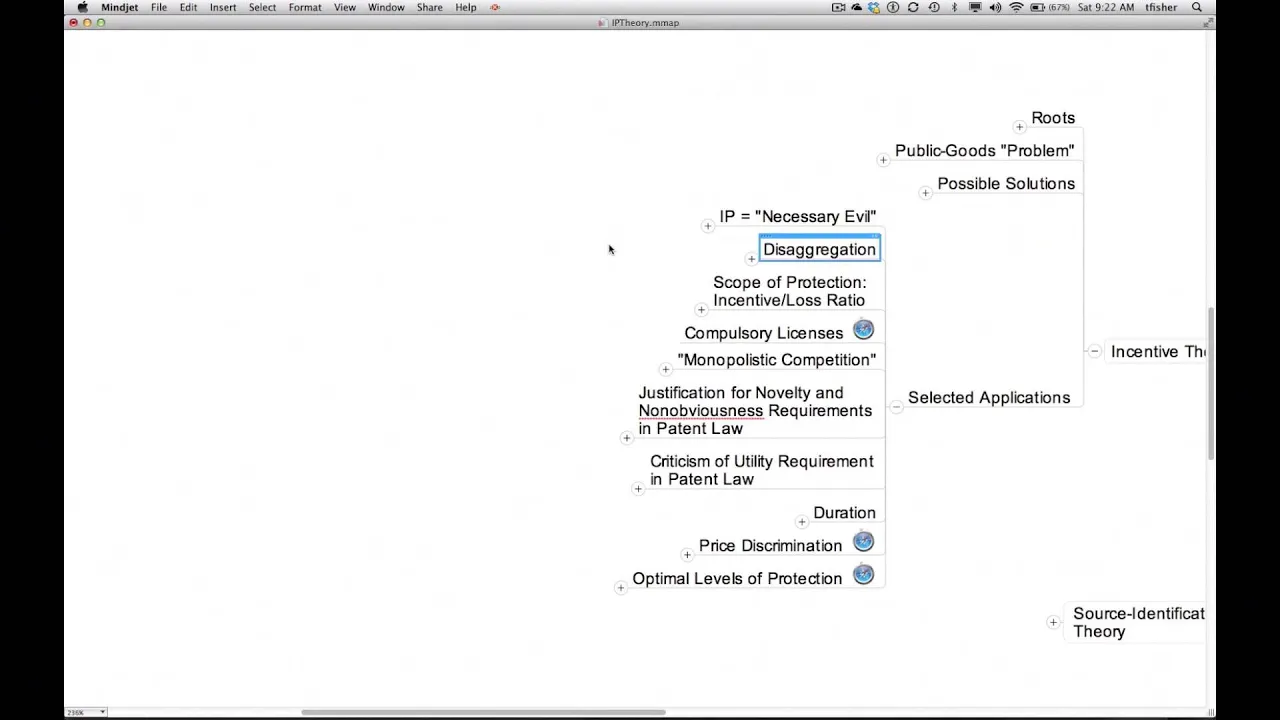
And second, I will offer a preliminary survey of the strengths and weaknesses of copyright assessed from the standpoint of utilitarianism. The first and most general application of this theory begins with the observation that from a utilitarian standpoint, copyright is not an unalloyed good but is rather a necessary evil. Social welfare is advanced when ideas flow freely and when producers compete to satisfy consumers' desires efficiently.
Copyright impedes both of those ends. The reason that, nevertheless, the copyright system is in the aggregate of socially beneficial is that it is necessary-- so the argument goes-- to stimulate the creation of intellectual products from which we all benefit. Notice that this orientation differs very sharply from the way in which copyright is seen through the lenses of the fairness theory, or the personality theory-- both considered in lecture number two.
Viewed through those glasses, copyright deserves our unqualified support, because copyright law tracks and enforces the natural rights, or the fundamental human needs, of artists and authors. The support provided to copyright by the welfare theory is more grudging. The conception of copyright as a necessary evil has a crucial practical implication.
Copyrights should not be used in context in which they're not necessary. In particular, copyright protection should not be extended to kinds of innovations that would be produced in optimal numbers without those protections. So what kinds of innovations might fall into this category?
I mentioned a few in the first segment of the lecture, when discussing circumstances that can mitigate the public goods problem. Perhaps the most obvious candidate, already mentioned, would be advertisements. You will recall, I hope, Justice Harlan's dissent in the 1903 Bleistein case in which he contended that advertisements should not enjoy copyright protection.
A welfare theorist might agree with Harlan, not on the grounds that ads are not art, but on the ground that companies have lots of other incentives to produce and disseminate advertisements. So if you eliminated copyright protection for ads, you would not likely see any diminution in their output. Much the same could be said for scholarly articles, also mentioned in the first segment.
Arguably, these are already produced in numbers that exceed the social optimum. But putting that source of unease to one side, the various non-pecuniary motives that drive scholars-- such as tenure, reputation, fame, altruism, insecurity, boredom, and so forth-- are more than adequate to incentivize the creation of those articles-- a possible objection. Well, maybe so, but social welfare requires more than inducing scholars to write articles.
It also requires the establishment of adequate incentives to publish them. Copyright protection may not be necessary for the authors, but it is necessary for the publishers. This is a very important refinement of the welfare theory.
Indeed nowadays, economists, who write in this vein, tend to be as or more concerned with creating optimal incentives for the commercialization of innovations as they are with creating optimal incentives for generating those innovations. However, arguably, this legitimate concern has little grip in the context of scholarly articles, at least nowadays, when the cost of publishing them has, courtesy of the internet, dropped so low. So here's the general guideline suggested by these two examples.
If you find the welfare theory congenial, you should be watchful as we proceed through this course for circumstances in which copyright entitlements are not necessary to stimulate creative activities or the commercialization of their products. In such circumstances, the policy argument for the elimination of the entitlements at issue is strong. Here's the second implication of the welfare theory.
You'll recall, I hope, that in the previous lecture, I discussed the disaggregation of the copyright system-- the ways in which the rules applicable to specific types of innovations differ. The welfare theory offers potential justification for this disaggregation. Why?
Because as we've seen, the severity of the public goods problem varies by type of work. In addition, the best way of offsetting the hazard of under production varies by type of work. Thus, the scope of the set of entitlements enjoyed by different creators should differ.
Here's an example, duration. Currently, both patents and copyrights last for the same period of time, regardless of the type of work they're applied to. Patents last for 20 years from the date of the patent application, while-- at least in the United States-- most copyrights last for the life of the author plus 70 years.
Those terms don't change when the type of work changes. Arguably, from the standpoint of welfare theory, they should. To be sure, there are welfare-based counter arguments for the impulse toward disaggregation.
Most importantly, subdividing the universe of copyrighted works into even more distinct varieties, each subject to even more customized sets of rules, would increase administrative and litigation costs. Equally serious, that the risk that the lobbying power of companies that stood to gain by tweaking the increasingly specialized sets of rules would grow, which would be good for those companies but bad for the public at large. These competing considerations are nicely explored by professors, Mark Lemley and Dan Burke.
A third application of the welfare theory consists of a guideline for comparing the relative desirability of the various rights that we might give to copyright owners. Specifically, it suggests that when choosing among possible rights, we should attend carefully to the ratio between the incentives generated by each entitlement and the social welfare losses that come with it. Other things being equal, we should strive to give copyright owners entitlements that have large incentive-to-loss ratios and deny them entitlements that have low ratios.
Here's an example. Should we permit copyright owners to prevent quotation of excerpts from their works in critical reviews? Viewed from the standpoint of welfare theory, the answer is probably no.
Why? Because on one hand, giving copyright owners this power would not enhance their revenue, much. On the other hand, it would lead to large social welfare losses by reducing the informational value of critical reviews, thereby diminishing the ability of customers to decide whether they want to go see a particular movie, to read a particular book, and so forth.
In sum, the incentive-to-loss ratio associated with this particular potential entitlement is low. Therefore, if we are faithful to the welfare theory of copyright, we should deny this right to copyright owners. And in fact, most jurisdictions do deny it to copyright owners by creating an exception or limitation on copyright for critical reviews.
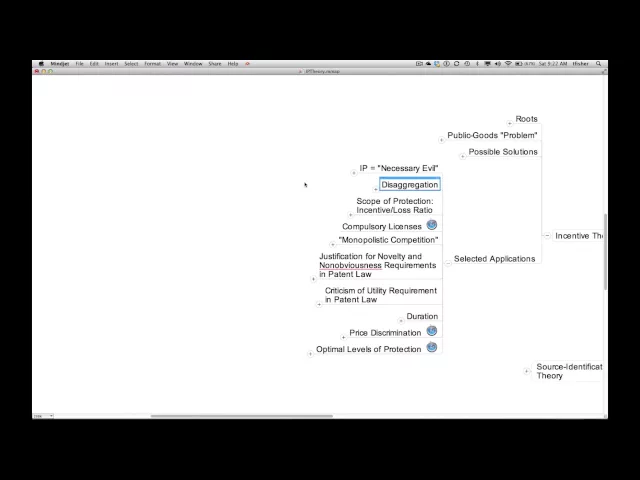
As you can see from the map, there are many more potentially illuminating applications of welfare theory. Some of them, I'll take up in subsequent lectures. So now, armed with these various applications and insights, let's return to a general question I implicitly left open in the first segment of this lecture.
Copyright law, I argued, is only one of five possible ways in which governments could and do seek to offset the risk that public goods will be under-produced. Is it the best? Or somewhat more subtly, what are the advantages and disadvantages of copyright compared to the other four strategies?
One of the motivations for undertaking this survey is that it's far from obvious that copyright will always be the best way of stimulating every type of intellectual product. As sectors of art and business evolve, it's possible that one of the other four strategies may surpass it in relative social desirability. So the map sets forth an initial catalog.
As a mechanism for inducing socially beneficial creativity, copyright has four main advantages. First, it relies upon the market to drive innovation toward areas of high social value. Potential creators, knowing that their revenues will be increased by the number of people who will purchase their products, direct their creative energies towards zones where there are lots of potential customers.
And that, usually, corresponds roughly to high social value. Now, not always. Research on new drugs, which tends to focus on ailments that afflict the rich and neglects ailments that afflict the poor, is perhaps the sharpest counterexample, but roughly.
Second, the copyright system does not rely upon government administrators to determine the best paths for research and innovation. Instead, it places control in the hands of private parties, who typically have better knowledge than the government administrators concerning the costs and benefits of alternative potential lines of research, writing, artistry, and so forth. Third, the copyright system, like the patent system, has the social welfare advantage of imposing the costs of innovations upon the users of those innovations.
The practice of recouping costs through monopoly pricing-- that we've explored in detail in this lecture-- has a commendable ancillary benefit. The people who benefit from a film or drug pay not just the marginal costs of reproducing it but a share of the cost of creating it in the first instance. Not only does that seem fair, it avoids the kinds of slippage and inefficiency that result from misalignment of payers and beneficiaries.
Fourth and finally, copyright, and intellectual property in general, tends to foster fast, focused research and innovation. Why? Because innovators know that only if they reach the finish line first-- produce the film, create and test the new drug-- can they recover their costs of expression by securing and then exercising-- as we've seen-- market power.
In this respect, copyrights and patents contrast sharply with government grants as a mechanism for stimulating innovation. Grants are less likely to generate the same aggressive, fast, focused innovative activity. Because the government grantees, once they have the money in hand, have no special incentive to hurry.
So those are the four primary advantages from the utilitarian standpoint of the copyright system. They are substantial. Historically, they've been widely thought to be decisive with respect to alternative ways of generating most forms of art and literature.
There are, however, some disadvantages to intellectual property as a response to the public goods problem. And in some contexts, those disadvantages may be increasing. The first, we've already discussed in some detail.
The pricing practices enabled by copyright usually give rise to socially pernicious dead weight losses. To review, when the prices of films or drugs rise, some people cannot afford them. At a minimum, that's a cause for regret.
In some contexts, it can be tragic. Next, copyright and patent systems have administrative and litigation costs. Significant resources are devoted to lawyers and courts necessary to interpret and enforce authors' rights.
From the standpoint of social welfare, that's a waste. Third, copyright and patent systems sometimes create impediments to cumulative innovation. That phrase refers to the common phenomenon in which one innovator builds on the work of another.
It's not inevitable that copyrights gum up cumulative innovation. As we saw in lecture number three, licensing systems, for example, of the sort that are well-developed in the film industry can enable, even catalyze, sequential innovation. But licensing systems work well, in this respect, only when they can rely upon comprehensive registration of intellectual property rights.
If you can't ascertain who owns the rights to a particular work, you can't get a license to build upon it. Copyright-- as we'll see in lecture number six-- is notoriously bad from this standpoint, because it has no comprehensive registration system. The fourth disadvantage is known by economists as rent dissipation.
What does that mean? It's shorthand for the unfortunate tendency of intellectual property rights, both patents and copyrights, to draw excessive numbers of people into the competition for generating a socially beneficial innovation. Sensitivity to this effect has recently been heightened by the work of Chris Yu and Michael Abromovitz.
Last but not least, as we saw in the final phase of the CDF case study, the copyright system works optimally as an incentive for creativity only when there are reasonably effective mechanisms for enforcing the copyrights. As undoubtedly you're well aware, the mechanisms for enforcing copyrights with respect to digital recordings of entertainment products are deteriorating. Consequently, the frequency of non-permissive, presumptively unlawful redistribution of those recordings keeps going up.
And the business models that depended upon the suppression of that behavior are crumbling. There are many possible ways of responding to this crisis in the entertainment industry. Some of them involve reinforcing the failing enforcement mechanisms.
But if that proves unfeasible, or to have excessive negative side effects, we may have to consider one of the other four possible ways of ensuring that the music and film we so much value continue to be produced. Thank you.