Want to reclaim your personal data, protecting you from identity thefts, hacks, or worse? Then try incogn and get a 60% discount on an annual subscription when you use offer code skillup and incogn. com/skillup.
Click below to get started or stick around to the end of the video to learn more. Okay, we're going to talk about Luminous Arise, but in order to truly understand it, you first need to understand the studio that made it because this is not your typical game studio. It starts with this guy, Tatsuya Mizaguchi.
He worked at Sega for a while, working in their arcade division on games like Sega Rally before eventually going on to lead Sega's United Game Artist Division, a team that produced something a little different from a racing game. To this day, Resz remains a singular, unique, and peerless experience. It was an on-rails action shooter where every action you took helped create the music, the press and depress of the shooting button, targeting of enemies, the number of enemies you would target before you released your volley.
All of it made unique sounds. And while Res could be played as a video game, it was more important to play it as an instrument and let the music you made be the ultimate reward. Rez would go on to define the rest of Mizuki's career.
Not in the sense that he kept pumping out sequels for it, but rather it set him on a path where he'd become obsessed with the concept of synthesia and how he might be able to deliver that phenomenon through the video game art form. What is sinthesia? Well, I'm glad you asked.
In simple terms, it's when one of your senses triggers another sense in a way that it probably shouldn't. One example is something called graphim color synesthesia, where for some people, certain printed letters or words appear to have a specific color even when written in black and white. So imagine every time you read the word cog, it appeared in green with all the other text around it appearing black.
Weird, huh? A more common and popularly referenced variant is called chromosthesia, which is where sounds can trigger flashes of color in people's visions or at least the sensation of seeing a color even if they can't actually see it. So imagine every time you heard an electric guitar, your brain felt like it was looking at the color red.
Now imagine what this might look or feel like when you have this association with dozens of sounds and dozens of colors. But Muchisan wasn't content with asking you to just imagine this. And that's why he and his team created Tetris Effect.
Tetris Effect was not about the Tetris. It was about everything that sat around the Tetris. The music, the lighting, the particle effects, the visuals of these blocks.
Through the inherent tension and release of clearing blocks, Mizuchi could lead us on undulating journeys where great crescendos of sound and color could create these euphoric explosions in us, only for us to then be emptied out by periods of calm and serenity. [music] But at this point, video games were not the only way that Mizaguchi was exploring this phenomenon of sinthesia. The studio he founded, Enhance, has a game-making division, but they also have a division devoted to synthesia research and development.
Take a look at one of their projects from 5 years ago. As a part of introducing res to a whole new generation and in the spirit of syninesthesia and experimentation that it represents, we developed the sinthesia suit, a multi-disiplined collaboration designed to enhance the experience of playing res infinite in VR. To create the senesthesia suit, we first tested various types of actuators [music] in different locations along the body.
Ultimately, we decided on 26 spots to place them. Each actuator can produce a wide range of tactile sensations from a gentle touch to a hard impact. From feeling percussive beats pulsing in the hips and legs to a guitar strum wave [music] of tingles running over the entire body.
Each and every sensation was created to match the in-game action and [music] sounds through an elaborate trial and error process. So, that's pretty cool. But that was just the warm-up round.
Meet the X1, a synthesia inspired experience that combines sound, light, and 44 actuators, all with the goal of simulating senses within senses. >> For me, it was better than any VR because [music] my mind was creating its own colors, shapes, and images as I listened to music. [snorts] One minute I was flying through a purple tunnel.
The next I was swimming in an ocean near my own island. At the end, the moment you, for lack of a better term, flatline, I saw a beautiful sunrise, all in my imagination. No VR headset required.
Sadly, the X1 is X one of a kind and you will probably never get to experience it. But you can experience the next best thing, Luminous Arise. I can feel you.
[music] I can feel you. I can feel you. I can feel you.
[music] [music] Looks pretty cool, huh? But let's rewind a little bit. Let's go back to where the series first began.
Luminous was a puzzle game first released for the PSP back in 2004. Like many of the great creative breakthroughs, Luminous only exists because a rights holder wasn't willing to play ball. Mizuchi wanted to make a Tetris game that incorporated music elements.
He couldn't get the rights to Tetris. So, he made his own puzzle game. Luminous was born a game all about creating squares with larger squares awarding more points and squares only clearing when the metronomic line marker would wipe across the screen.
[music] But do note the starting point for Luminous. Mizujian didn't want to make a puzzle game. He wanted to use a puzzle game as a platform for his exploration of the relationship between sight, sound, and emotion.
That's why the soundscape of Luminous was so rich with a soundtrack that sat at the foreground and the dropping and breaking of each block would make different sounds depending on the active tile set or how many squares you were breaking at once. When Mizuchi did finally get his hands on the Tetris license, it allowed him to fulfill a long-held ambition. But the technology of 2014 allowed him to go so much further than he was able to back in 2004.
Tetris Effect would go on to win game of the year from both Eurogamer and Giant Bomb for the simple reason that it offered a transcendental gaming experience unlike anything that had come before it. With sights and sounds now elevated by the inclusion of VR for an even more immersive experience. >> The birds are happy.
The dolphins are happy. I'm happy. Hope you're happy.
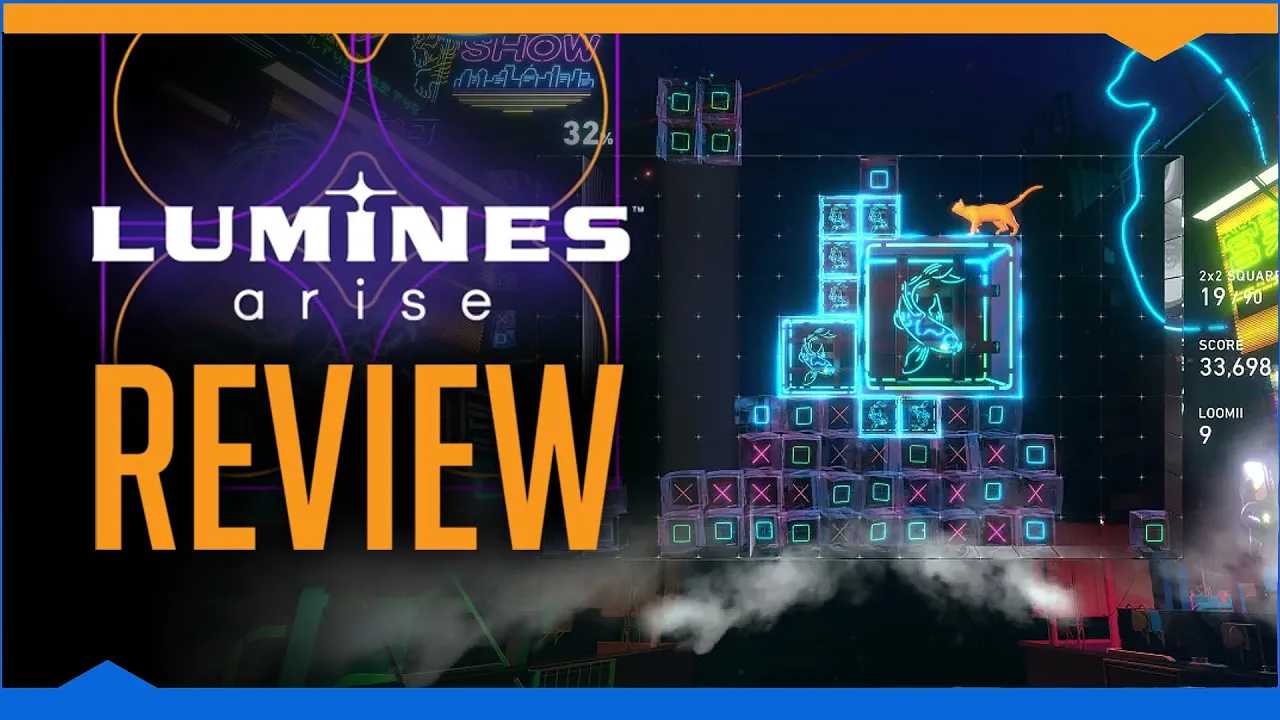
This is beautiful. Tetris Effect was always really nice to look at, but even in its absolute best moments, it doesn't hold a candle to how luminous Arise looks. I mean, just look at the way this one level transitions in.
There are over 30 levels in Luminous Arise, and each of them have their own stunning transitions, their own stunning block designs, their own stunning backgrounds, and their own stunning particle effects. Playing through this game for the first time and unlocking new levels was such a treat. Just a total joy.
I'd liken it to moments in 3D adventure games where you unlock a stunning new biome and you step out onto a landing pad that lets you survey it all. That feeling of awe is the same feeling you get when you see a new luminous level for the first time. [music] But the first time you see them is only the first stage of their visual evolution.
Take this train inspired block set here, which begins at a standstill at a train station. As it begins, the horn blows and the blocks shake as a train pulls away from the station. It starts slowly and quietly, but begins to steadily build as you clear more and more blocks.
Eventually, the sun sets and some of the stems are pulled back to create some build. Eventually, with the soundtrack settled into a dury trance, nightfalls and you hit maximum intensity. [music] All of the levels have the same evolutionary quality, starting somewhere and then taking you on a journey, shifting tempo and intensity and visual motifs to create an experience that is always responding to you, but also guiding you.
That concept of Journey is actually extremely central to Luminous Arise, just as it was central to Tetris Effect before it. One of the goals that both of these games had was to use a puzzle game as a storytelling platform. Never with words, but always with emotion.
Tetris Effect and Luminous Arrive both have these core playlists that Enhance calls journeys, and they're meant to lead you on an emotional journey that explores different things. Here's what Mizaguchi told Push Square when asked about those journeys. quote, "Whereas Tetris Effect provided more of an inner discovering yourself journey, Luminous Arise is more like expressing outwardly like you're releasing energy or imagining yourself going to a concert and you really feel the music through your body.
" That's the big difference on how we approach the journey mode between the two games. " End quote. And that is so true because Tetris Effect felt quite spiritual and yeah, transcendental.
Luminous Arise feels far more human and mechanical and terrestrial. It's about gears and clocks and cars and going to work. And then interspersed between these mundanities are these trance anthems where you and your lizard buddies are just cutting loose in the club.
That feeling of luminous arise being more human and mechanical and terrestrial. That feeling exists because it's been carefully cultivated by the game's director, Takahashi Ishihara. Speaking to Push Square in the same interview, he said, quote, "One thing you'll hopefully see as you play is we put a lot of very detailed, sophisticated touches on the blocks.
The approach we took is to make you feel the blocks as if you're touching them when you control them. It's very much a physics-based calculation. It's not just about blocks dropping.
It's when they come together and split apart and when they fall. It's more of a natural organic feel, and it comes down to the sound waves, how that's analyzed in real time and reflected in the visuals. " End quote.
And let me tell you, to play Luminous Arise is to feel it as no other puzzle game has allowed you to feel it. It's not just about the feeling of emotion or these journeys. It's the feeling of the blocks themselves and how they feel as you drop them and how they feel as they clear.
Every single one of them has this precise sensation that you can feel as it pops. It's the haptics in the controller. It's the visual animations.
It's the sound. And in aggregate, this is probably the closest this game gets to delivering on that feeling of sinthesia because it shouldn't feel so different to pop these broccoli blocks as it does from popping these, you know, clock blocks. But I swear to God, as I write these words and as I said them aloud, my brain is remembering two distinctly feeling feelings because Enhance knew exactly what they wanted to accomplish with this and they completely nailed it.
>> [music] >> By the way, this clock level, my god, zooming out on all this stuff, it is crazy how harmonized some of these levels are. You got this clock motif where all of the sounds are based on clocks and wind up toys and gears. And you've got these clocks and these gears that sort of merge to create new bigger clocks, bigger gears when you form squares.
And you got this song in the background that really isn't doing too much because it's relying on the sound of all these mechanical objects to create the music. is unbelievable. Easily my favorite level in the entire game.
[music] But Luminous Arise is not just a game about its vibes. It's also a deep, sophisticated, and very challenging puzzle game. I will say this, playing through the journeys, I started playing them on normal, but had to drop down to easy because I was just finding it too hard.
But now, having sunk over 20 hours into the game, I'm able to keep up at normal difficulty. There is a substantial learning curve here that's based on smartly creating bigger squares and doing so quickly. And when you start to think in those terms, then things really start to flow.
But before that though, the game is very tricky. And I meant the game over screen far far too many times. Luckily, there is a dedicated puzzle mode which is extremely useful for teaching you more advanced techniques and getting you to think in the way that the game wants you to think if you're going to be successful.
There are a few dozen of these puzzle challenges, and I'm not ashamed to say that I've been stuck at a whole bunch of them. They are just as humbling as the journeys are, but they're also very satisfying to complete since you spin things this way and that and time things slightly differently. When it all comes together, it just feels great.
[music] One of the other things that gives the game a lot of depth is the new burst mode. This is similar to what Tetris Effect added where time stops and you can try to build out as big a square as possible. Again, it takes a little while to understand what this is asking you to do.
When you get it and you hit this massive like 100 plus burst, it just feels absolutely incredible. [music] Luminous Rise is also an extremely expansive puzzle package for how much it offers on day one. You do have these journeys and these puzzle challenges, but you also have a playlist builder.
And this is great because it actually tracks the tempo of each track on a line chart at the top, allowing you to visualize how intense your current playlist composition might be. >> In addition to that, it also has a PvP mode. This is cool because it includes what are called garbage blocks.
Basically, every time you combo, you add blocks to the sides of your opponent's screen, giving them less room to move. They can clear these blocks by building squares adjacent to them, but it's another thing to consider in a game that already has you considering quite a bit. There's also a layer of strategy to managing these garbage blocks since you can trigger a burst mode just as a bunch of them are about to appear, which stops your opponent from dropping them on you, and you can time your own burst to hit just when your opponent is looking particularly boxed in since a big burst clear from you will drop a ton of garbage on them.
The final, and arguably the most important mode, is VR. Sadly, I couldn't get any footage for this since there's a bug affecting VR recording where it records on a weird angle. So you can't actually see the screen.
Enhance are aware of it and will be fixing it in a future update. But the playing of VR works perfectly and you better believe that this is the way to experience Luminous Arise. It doesn't add anything to the gameplay and visually all it really adds is more flourishes that are visible at the edge of the screen.
So the bullet point list of VR features isn't all that impressive. What it does though is that it immerses you in this experience in a way that Enhance Invisage when they created it. Tetris Effect only exists because Mizaguchi and his team were excited to see VR hitting the mainstream and they saw the VR platform as a means of delivering on their goal of simulating sinthesia.
Luminous arise in VR is the next step in that journey. Putting the headset on and putting on a good pair of closedback earphones. You're just so locked in, so immersed, so transported.
The highs become even higher and your connection to this impossible dimension of sound and color becomes even stronger. And to cap all of this off, enhance left room for the little stuff, too. The menu screen you see is immersive in its own way with you flying your little loom dude around to select things as you progress through the journey, so you'll free other loomies that are trapped in the blocks, and they hang out on your menu screen and may or may not make a big appearance during the game's final journey.
The multiplayer lobby is this really cool interactive space where you can walk around and view the player cards for other players and see their custom Lumies. And speaking of which, you can customize your own Lumi. As you play, you'll earn a currency that you can use to roll for new customization options like heads and logos and face plates and more.
It's all totally superfluous, but it's nice. I will finish this review by saying this. I've put over 20 hours into Luminous Arise now, and a lot of that has been driven by this like urge to boot it up.
like I'll be writing a script about something else and it'll suddenly enter my mind. When that happens, I'm not thinking about the puzzle aspect of Luminous. I'm not thinking, "Oh, I bet I can beat my high score this time.
" What I'm actually thinking is, I want to feel what Luminous Arise makes me feel when I boot it up. I'm not thinking about playing Luminous Arise. I'm thinking about experiencing Luminous Arise.
That is the goal that Mizuchi and his team have been chasing for decades now. And while further technological leaps are likely needed before that goal is fully realized, Luminous Arise is a great step forward in that journey. I strongly recommend it to puzzle fans, to music fans, to fans of experimental avenguard experiences that push the boundaries of creative mediums.
This is so much more than a simple puzzle game. It is an experience that's trying to test the limits of what video games can make us feel at a deep sensory level. It is amazing.
I love it. Please go and play it. It's incredible.
[singing] Here's a scary figure. Did you know that the rate of identity theft increased by 211% between 2023 and 2024? Mainly due to just five mega breaches that leaked terabytes of personal data.
If it feels like there's nothing you can do about that, well, you're wrong, because this video sponsor, Incogn specializes in helping you reclaim your online data in order to protect you from identity thefts, hacks, or worse. Sure, we know that big corporations like Apple or Google have our data because we hand it over to them. But what you probably don't know is that hundreds of other companies that you've never even heard of also have your data because it's been onsold by various data brokers.
These companies can then sell your data to whomever they like and you have absolutely no say in it. Now, the loophole here is that you can technically contact these companies and ask them to delete your data. But not only do you not know who has your data, but there are so many of these data brokers that it would be impossible for you to contact them all.
That's where Incogn comes in. You sign up, you enter your details, you grant it the required permissions, and after that, Incogn does all the work for you, sending out hundreds of automated requests to reclaim your personal data. Take me for example.
Incogn sent out over 177 requests on my behalf, which has resulted in my data being removed from 171 data brokers. 171. I had absolutely no idea that 171 data brokers even had my data.
And now, thankfully, they don't, thanks to Incogn. If I was to have submitted all those requests myself, doing all the paperwork and back and forth, it would have taken me around 128 hours, making Incogn incredibly well priced given how much value it delivers. In addition to this, Incogn also offers a custom removal option where you can tell it to remove your personal data from specific entities that may not be included in Incogn's automated removal process.
Some exclusions apply here, but this gives you even more control over your personal data. It's super easy, super effective, and best of all, super affordable. You can use offer code skillup at incogn.
com/skillup to get 60% off an annual subscription. Take your personal data back and get a 60% discount while doing it by visiting incogn. com/skillup and using offer code skillup at checkout.
Thanks incogn for sponsoring the video and thank you for watching it.




![[Lumines Arise] Infinite Burst even possible?](https://img.youtube.com/vi/NMyPrJS_jVo/mqdefault.jpg)



![1 A.M Study Session 📚 [lofi hip hop]](https://img.youtube.com/vi/lTRiuFIWV54/mqdefault.jpg)