Hello everyone and welcome to the summer academy 2026 openhouse brought to you by the School of the New York Times. My name is Tom and I'm part of the marketing team here at the School of the New York Times. It's great to have you with us today.
Um we'll just give uh some people some time to join the call. Um I'm sure there'll be many joining. We're expecting another big crowd uh today.
So, we'll just give people about 30 seconds or so and then we'll get started. Hello everyone and we'll get started now. Um, welcome to the summer academy 2026 openhouse brought to you by the School of the New York Times.
Um, thank you so much for joining today. My name is Tom. I'm part of the marketing team here at the School of the New York Times.
And over the course of today's session, you will meet the outstanding team behind Summer Academy, bringing the program to life ahead of another busy summer of immersive journalism and reporting in New York City. Um, you'll notice on your screen that there is a Q&A box for you to use throughout the duration of the session today. Um, we encourage you to use this box uh to ask any questions that you have throughout today's open house and we have a fantastic team monitoring the questions and we'll be replying to as many of those as possible throughout the next 45 minutes.
Um, we're hopeful that we'll answer many of your questions as we go through today's slides. Whether you have questions about academics, admissions, or student life, we should be able to answer your questions and support as much as we can. So, let's get started.
So here's a a quick agenda to go through for today's session. Um so we'll start with a welcome um followed by some academics and then into a faculty representative. We've got Sara on the call today who is the journalism education editor at the New York Times.
Um we'll then move on to program highlights and some student testimonials and some admissions information. Um, as well we have some fantastic panelists on the call today, including Jonathan from our academics team, Sara, who I've just mentioned from the New York Times, and also David, who represents our residential and student life team. So, welcome.
Uh, as we approach spring break, what better time is there to be thinking about summer plans and enjoying the New York City sunshine? So whether you're already enrolled and will be enjoying and will be joining us this summer uh in New York and we can't wait to see you uh or if you're here to find out more information before you apply. We hope that you'll come away from today's session feeling excited and enthused about summer academy.
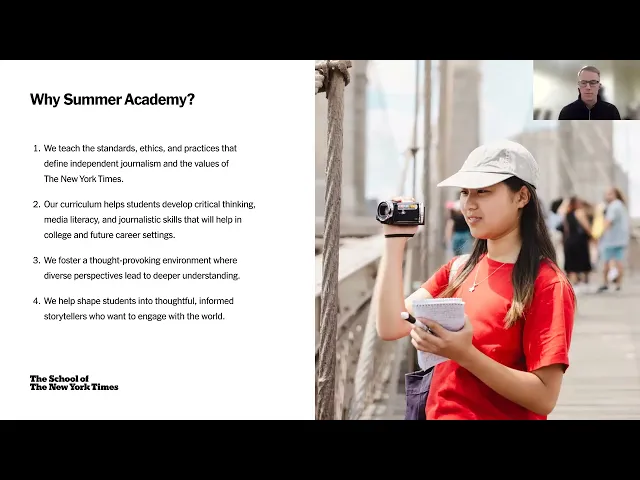
So let's get started. Summer Academy isn't an ordinary summer program. In fact, there's no other summer program in the world for journalism like this one.
You don't just study in a classroom in New York City. New York City becomes your classroom through a series of immersive experiences. In New York City, there is inspiration around every corner.
And there is something here for everyone, no matter what your passions or interests might be. This is your opportunity to explore one of the world's iconic cities while sharpening your reporting, editing, and multimedia skills. We have a wide variety of courses that give you the opportunity to enhance your experience by studying your passions and interests.
You are in control of what you choose to study. We highly recommend visiting our social media channels to watch some students stories from summer 2025. We have some amazing alumni who shed some light on their experience with us in New York City as well as some advice for the class of 2026.
So we do encourage you to take a look on Instagram or Tik Tok for those videos. The School of the New York Times has been in existence for over 10 years and the course catalog that we have has such a wide and diverse variety of courses available which reflects the modern journalism industry. Whether you want to dive deeper into a passion or hobby or try something completely new, you won't be short of exciting courses led by industry leaders.
The Summer Academy pre-ol experience empowers students with their next decision in life, whether you choose to apply for college or start your career straight from high school. So now I'd like to welcome Jonathan Perez, our associate director of academics to walk you through the academic components of the program. Jonathan, >> thanks Tom.
Hello everybody. So my name is Jonathan Perez. I'm the associate director of academics.
So my role um essentially oversees curriculum development and program implementation. I'm also going to be one of the first faces you see upon arriving to campus. So I'm really looking forward to you know welcome you later this summer and you know you'll really come to see that you know the school is such a unique space of you know intellectual exploration while making some lifelong friends and colleagues.
So let's get into like what is summer academy. So we like to approach the learning experience this holistic immersion model from class discussions, guest speakers, site visits, final projects. And all of this is really geared for you to, you know, to invite you to, you know, explore journalism and its many facets ranging from arts and culture, sports storytelling and media law.
Our courses are, you know, structured to explore, you know, critically what's happening around the world at such a global scale, but also really considering what are the local stories. And, you know, New York City is like a perfect place to be doing all this. And Tom calls it, you know, the classroom, but I call it the playground where we get to really explore and learn and play.
So when you come to the the school, you know, really thinking about, if you can go to the next slide, please. Thank you. You know, thinking about what what your schedule can really look like.
So this is what it typically uh can look like. So, you know, the earliest class starts at 8 a. m.
and ends at 3. The latest class starts at 9:30, ends at 4:30. Uh you will have homework assignments.
So assignments can range from readings uh like short readings like articles, New York Times articles on you know guest speakers that are coming up or you know to provide you the language to really engage with the content. Uh we also have assignments ranging from you know drafts or outlines or pitches. So really thinking about uh what's the necessary skills that you will need to kind of be successful in in um the classroom.
And our courses are taught by reporters, editors and media experts who all you know participate in the designing process. They, you know, they design the classes, they bring in their colleagues as guest speakers, and they take you on site visits like city hall for your political reporting where you get to see it through their eyes. And, you know, this summer kind of is just this unparalleled opportunity you where you get to learn from the thought leaders who really have shaped their own respective disciplines.
So, I really encourage you to, you know, take uh our classes and come and explore especially if you look at this on if you go to the next slide. Uh uh well um oh sorry I'm a little lost here. I can go back one more time.
Thank you. Um so really thinking about you know the type of courses that you can take. We'll also have the final projects.
So the final projects allows you to really think about you know how you can um really build upon these skills. So each day is kind of oriented toward your own uh you know uh uh assignments and kind of like how you're going to produce or create a writing assignment. And what you'll ultimately do is my favorite parts about this is that you're going to create final projects that are just the stepping stone to your next chapter.
So, you know, my favorite part about, you know, learning from our students is when they say, "Hey, I turned my final project and I, you know, got it published in a local newspaper. " So, really thinking about how our final projects are meant to build skills, but also to have a, you know, continuence. And you'll have a lot of support in the classroom as well.
So, you'll have lead instructors, you'll have instructors. Um, so the lead instructors are the content experts. So they've designed the classes.
You'll have instructors who are co-teers and support um the the lead faculty and you'll also have teaching assistants. So the teaching assistants are you know undergraduate mentors who are going to support you in the your writing endeavor. So say for example you want support in um an a writing assignment or your final project you know come to our office hours and the teaching assistants will support you in this um but also if you have other writing projects such as you know if you're writing on the uh for the college essay or if you want to you know get feedback on another narrative piece you know come to our off hours and get this additional writing support.
Now uh another consideration that I want you to really think about is uh you know who um is coming and what our faculty entails. So, I'm going to encourage you to uh you get to know uh my colleague Sorrow, who's going to introduce, you know, everyone who's involved in the learning process and kind of like really thinking about what what uh four categories or tracks you can really take um that might match your personal career interests. >> Thank you, Jonathan.
Um hi everybody. My name is Sara Ariti. I'm the journalism education editor at the New York Times and I'm really excited to speak with you all today.
Um so, just a little bit about me. I've been at the Times for 10 years. I was actually an instructor at the school back in 2019, which I really enjoyed.
Uh, in my current role, I help oversee the journalistic content at the school. So, for those of you who'll be with us this summer, you'll definitely see me around. Um, first I want to talk about what students can gain from attending the School of the New York Times.
Each course covers skills and topics that are really important in today's world. Whether you're interested in writing for your school paper, majoring in journalism, or studying something else entirely, the first core skill that the school teaches is media literacy. Understanding how to navigate all of the media and information and disinformation that's out there.
For instance, what's the difference between news and opinion or content created by an influencer? Where can you find factual information? Right?
Really important questions. The second core theme um is the fundamentals of journalism. skills that are crucial to journalism but also translate to other industries.
For instance, learning how to communicate effectively and find information. Students get experience conducting interviews, asking smart questions, and they gain the confidence to approach strangers and strike up a conversation. Communicating effectively also means learning how to write effectively.
This will help you at every level in your life. right now in high school, but also in college and in the workforce. Whether you're writing emails, stories, college essays, or grant applications, clear writing really goes a long way.
Finally, students will also gain multimedia and digital skills. You know, journalism is told in so many formats now. It's no longer just the written word, uh, from videos to audio to graphics.
So you'll learn about those types of storytelling formats, but you'll also learn how AI has turn has changed certain aspects of the field for better or worse. Um, but also how it helps reporters do things they couldn't have done in the past. So as Jonathan mentioned, I want to briefly go over the four tracks that we offer and how they can help you pick a course that suits your interests.
First, we have news and opinion. These classes cover journalism basics, writing, reporting, opinion, and what we call hard news like politics, business, and the rest of the the list that you see here. In these classes, students will report and interview New Yorkers across the city.
They'll fact check what they found. They'll write, and they'll consider important ethical questions along the way about the topics, but also how they cover the topics. Right?
So, for instance, our tech reporting instructor, who's a Times reporter, has students analyze how technology influences our daily lives. Everyone can relate to this, right? Uh from surveillance cameras on city sidewalks to privacy issues on social media and how we all interact with AI.
She does a really good job, I think, at covering big tech from a personal human perspective. Then we have a culture and lifestyle track. These courses cover some common topics or what we call beats in journalism.
arts and culture, style and fashion, sports, and health and science. The classes will still cover media literacy and the journalism essentials that every class covers, but you're going to learn about those through the lens of one lifestyle topic. So, if you're taking sports storytelling, you'll learn about timely issues affecting the industry, and you'll hear from top sports journalists.
You might also get to visit or a stadium or a live game, depending on what's happening in the city. If you're taking the science journalism class, you'll meet journalists who cover everyday topics that readers really want to know about like wellness, mental health, medicine, diseases. Um, but you'll also learn about broader urgent issues that are very complex like climate and the environment.
So, if you're curious about any of those topics, that's the class for you. Next, we have editing and ethics. These courses cover the backbone of journalism.
You know, nearly every creative project in journalism and outside of journalism has an editor. Someone who revises your draft, who polishes it, and helps shape the final product. We have two classes on that role.
The first is how to be an editor. This is about how to edit journalism across platforms, not just words. But you'll definitely learn about copy editing, style, grammar, and you'll learn about how to think about structure and framing and fairness and sensitivity issues.
We get a lot of questions about bias and how we navigate sensitive topics in journalism. This is a great class for that. Um, and I have to say, not just because I was a former editor, but editors are really the unsung heroes at the New York Times.
Then we have a class on newsroom leadership. This is a a broader look at how editors manage teams and problem solve. How do you decide what's news?
You know, what's the best way to tell it? If you ever want to run your high school paper or work on your high school paper, this is a really good class for you. And finally under that track we have um a class on media law.
You know publishing any information comes with risks. It might not seem that way given how inundated we are but it is true. Um and so this class delves into how to prepare yourself against those risks and what to look out for when reporting.
It also covers press rights which are increasingly coming increasingly coming under attack. Finally we have a multimedia track. So this is for students who are interested in visual and audio storytelling.
You'll get to gain technical skills and learn how to tell stories. And don't worry, all levels are welcome. You really don't need any experience in multimedia to enroll in these classes.
So, just touching on a couple of them, video is of course how the majority of people consume news, information, and entertainment these days. So, learning how to tell stories through video in a way that's both entertaining and accurate is a huge priority in journalism, especially at the times. The same goes for audio and podcasting.
You know, that's a huge part of what we do. We have podcasts like The Daily and Popcast and a bunch of other shows from our opinion section. Um, in this podcast and production course, students will learn how to interview and edit for audio along with all of the logistical, technical, and editorial considerations that go along with the format.
So, next I want to touch on our faculty. Uh, if we can go to Thank you. Thank you, Tom.
Um, so here are just some of the instructors that will be teaching this summer. Many of the the lead instructors are Times journalists, freelancers or alumni. So they've worked with us in some capacity.
They're very familiar with how the Times works. They can show their own example of Times journalism. But we also have lead instructors from other reputable outlets.
We have freelancers and we also have journalists who are full-time academics. So students will get to hear from a range of perspectives. And as Jonathan said, um every student will hear from guest speakers while they're taking their class.
Um, and of course a lot of those speakers are Times reporters, but again, we want people to have exposure to different types of perspectives and to really get a broad sense of the media landscape. So speakers might come from places like the Wall Street Journal, the LA Times, Forbes, The Athletic, NBC News, and more. Um, and of course, this goes without saying, many students will get to visit newsrooms just like the ones I mentioned.
And all of the students will be able to visit the New York Times newsroom. I myself often lead those tours. So you might see me in the building at some point.
Um so there's really never a dull moment. Finally, I just wanted to touch a little bit more on the robust structure of the school's academics team that Jonathan was talking about. Um so each class has a lead instructor, which is probably a little self-explanatory.
You know, those are the folks that you saw on the previous slide. They create the syllabus. They come up with the activities and assignments and final projects, and they plan the field trip.
and they bring so much experience both as academics and journalists. Um they'll always have the support of an instructor or you know something of a co-instructor and that's usually someone who also has experience in journalism, academia or both. That person can provide support in a bunch of different ways but they can also provide another perspective just so that the students can hear at least two different opinions every day.
And then as Jonathan mentioned, we have TAs who are much closer to the students maybe in age and so they can kind of be a liaison between them and the the instructors. And then we have instructional accommodation coordinators which as the name suggests ensures students accommodations are met throughout their experience. Um so with that I'll hand it back to Jonathan.
>> Thanks Sara. Um so let's get into some more detail about the program highlights. So our site visits are you know pretty integral ingredients to the process of active learning.
I always say that you know learning here is processoriented rather thanoriented. So you know in sports storytelling you're not just going to the National Basketball League offices for a tour. You're you know you're asking them the hard-hitting questions for your reporting.
You know in the introduction to investigative journalism course you're going to the municipal archives to find artifacts for your final project. We also have the speaker series. So this is led by Theodore Kim who's our director of newsroom career programs at the New York Times and also Sara who you just met and they're going to lead a discussion on what does it mean to you know approach your work through the values of independent journalism and then we also have uh one of my also like favorites uh is the photojournalism challenge.
So this is an opportunity where students compete um each term to submit a photo that best captures the moment of each term and we always announce the winners at the closing ceremony and I'm just always wowed by what everyone produces. you know, you're you're going to some very cool places and, you know, you'll be inspired to take some equally cool shots. So, these are, you know, the the program highlights, but once you get your syllabus and have access to your course, you're going to see how iterative the curriculum planning process is.
So, on average, each course has at least three guest speakers and foresight visits as S mentioned, and one of them obviously being the New York Times building. And once you have access to the syllabus and academic course, you know, I really suggest that you explore it u and really see what's coming um coming. So you'll you'll see who the guest speakers are and you can start reading up on them and really just preparing for when they come you can you know ask them questions.
Uh I always say our guest speakers are always impressed by the questions that our students ask them because our students take the time to really you know optimize this experience and you know read up on the final project and really start dreaming about what you'll do in our class and you know each day is you know is described as a play-by-play description of what you can expect where you'll go and all the things that you'll do as well. Um, and then lastly, there are moments, you know, that, you know, there's so much learning, but there's also going to be a lot of opportunity for you to go into the city, make beloved memories with your peers or program counselors. So, with all of that, you know, I welcome you to the School of New York Times.
I challenge you to come learn with us, and most of all, come meet your peers. Um, there's such a uh you'll be impressed with uh who your peers are. um we have a really great learning community and we have some amazing students who are doing some amazing things and we're really just excited for you to be part of this community.
So I really look forward to welcoming everybody and then also you know uh just make sure that when you come here you know uh you know step out of your comfort zone and you know really get to know people and get to know your faculty when you um once you come on campus. So I'll pass this now to my amazing colleague David who's going to discuss the residential and student life component of our program. Hello everybody.
Um, I'm David McBar. I am the associate director for residential and student life. So, essentially what I typically work on is everything that you know goes on outside of the classroom before the day and after class.
Um, one of the main things we're basically going to be covering today is just where things are going to be located. Also some coverings about, you know, the campus lifestyle and also the optional programmings that we typically have after class. So, where we're going to be located for the school of New York Time for the entire summer is going to be at the form university Lincoln Center campus.
Um, it's going to be moving located on the 62nd Street um entrance as they have, you know, multiple entrances. Um, this is where we are dormed in the McKon Hall uh section of Forom. And in true New York style, it is a skyscraper building.
We have access to the dorms all the way up to the 22nd floor. So, it is a really nice experience to come to New York and get views that you would not normally get walking through the normal streets. Um, most of the rooms are traditional college setups with twin XL um beds in addition to bathrooms in the the rooms.
There are also communal kitchens and common spaces for the students to congregate outside of their rooms if they want to. Um, we also do have access to the campus cafeteria. they are getting a proper college experience when it comes to eating food and experiencing you know that college experience.
So forum's main um food provider is our mark. They are able to provide food for all nine of the typical allergens that are most common and then all of the food options are listed um clearly on the labeling whenever we're doing any types of meals that way. um we do have access to there Monday through Friday and then they do some type of brunch um staggered schedule on the weekends.
Uh students also are paired within smaller living and learning communities to give them a chance to you know to communicate with students on a smaller scale in addition to anything else that you know gets them more direct access and support to their camp counselors who will be there with them and on site 24/7 as they do live on the dorms. Um there also are optional co-curricular activities or weekend um activities for the students to partake on which are again led by their counselors. Um it is just a way to experience New York and also you know be around people that have interest.
So some of the activities that we have range from going to the museums, going to Central Park. We also do some things inside with like movies and writing opportunities, writing workshops just to find spaces for the students to creatively express themselves and their writing opportunities. Um, we also do travel throughout the city using the MTA subway service.
Um, it's a really immersive experience and I think it's the best way to get around and enjoy New York in that type of way. Um, that's basically the residential life experience. I hope you guys come and enjoy everything you can that you experience from New York.
And with that, I'll pass it back to Tom. >> Thank you, David. And thank you to all of the panelists.
Um, always so interesting to hear from you. Um, at this point before we continue, I'd just like to mention that the Q&A box is open and I can see questions are coming in. Please do keep asking questions.
Our team are on hand to answer those as we go through today's presentation. We will have some time at the end of the session to answer some questions live on the call as well. So if you have questions for any of our panelists, please do start sending those in now so they can have some time to read them before we reach that section.
So as mentioned earlier, the School of the New York Times has been welcoming students to New York City for over 10 years. We have an international community of alumni that continue to share praise for Summer Academy. So let's take a look at some examples of alumni that are now working in the journalism industry.
And question is, could you be next? So, former School of the New York Times student Angela Mecca is a 25-year-old editor from Northern Virginia. After attending Summer Academy in 2017, Angela studied at the University of Maryland where she earned a bachelor's degree from the Philip Merrill College of Journalism.
She currently works as a copy editor at the Washington Post. And she said, "After summer academy, I felt solidified in my decision to pursue journalism. Abby Coutra is a 22-year-old photojournalist from Nashville, Tennessee.
Abby attended Summer Academy virtually in 2020, and she recently graduated from the University of Kentucky in Lexington with a bachelor's degree in journalism. She currently works as a photojournalism intern at the Atlanta Journal Constitution. And Abby said, "The instructors at the School of the New York Times truly care about your passion and want to set you up the best they can.
So, for those of you who have already enrolled, we're so excited to welcome you to New York City in the summer, but it's not too late to join us and be part of this community if you haven't already enrolled. So, here is some of the admissions information that you'll need to proceed with your application. So, how to apply?
First of all, this program is open to rising high school student grades 10 to 12 and graduating seniors. Uh some tuition prices and application processes are now on the screen for you to read. Um we do have another application deadline coming up tomorrow.
So for students who apply and enroll by March 13th during the round one regular admissions enrollment deadline are likely to secure a spot in their first choice course and courses are filling up very quickly. So we highly recommend you get your applications in as soon as you can. Payment plans are still available at this stage for all families.
It's also worth noting um we also have a referer friend scheme and you'll both receive $250 off of your tuition. Please visit our website or contact the admissions team for more details about this offer. So, we've now reached the end of the presentation and we'll now take some questions from the Q&A box.
Uh first of all, thank you so much for listening and we hope to have answered many of your questions as we walk through the slides. But as mentioned earlier, if you do have any more questions, please continue to submit your questions into the Q&A box. Our panel and also our team behind the scenes are busy answering those um throughout the session and continuing to this part of the session.
So uh as we'll get started, I I'll start with you Sara. Um my my first question for you, which is always good to hear from from the panelists, is what advice would you give to a student who is attending the program this summer to get the most from their experience? >> Sure.
Yeah, I mean I I kind of touched on this earlier, but one piece of advice I'll give is really don't worry about your skill level. You know, we've tailored these classes so that someone who has no experience in writing, journalism, or multimedia can really kind of catch up. They'll be able to do the work and hit the ground running.
Every person I speak to says the students are always so impressive and they almost have to kind of speed through their material sometimes because they would have felt like the students knew much less than they did. So, um I wouldn't worry too much about that. Um another bit of advice for when the students are here and even beforehand is to just ask a lot of questions.
You know, whether it's right now or in the classroom, not only is that what a journalist does, but that's just how you learn more and you'll gain more from the program. So, never be afraid to speak up. Um and finally, just be, you know, be prepared to have fun.
The the classes cover a lot. Like Jonathan said, you'll be listening to lectures, engaging in class discussions, and working on daily assignments and a final project, but you'll also be exploring New York and visiting a variety of sites and meeting so many peers like you who you might actually collaborate with in the future. I've just heard as a little uh anecdote, I heard recently that three students from the same class, I think it was a sports class, ended up creating their own sports Instagram channel or sports YouTube channel after the the school program ended and they kept collaborating even though they didn't even live in the same places.
So, these might be friends that you meet and make for 2 weeks or they might be people that you connect with for years to come. So really just um make the most of the program. >> Thank you Sara.
Um I have a a really good question here for you David um in terms of the student experience. So someone in the in the question box has asked um do the students have a go-to person who is their person to help them navigate any issues such as a league counselor? It would be great to hear more from you about the team looking after the students outside of the classroom.
Yeah, absolutely. So, in those smaller living and learning communities, the students are paired basically in groups of three with a bunch of students. And this is their opportunity to really talk every single day at during bed checks or during um after class about, you know, what's your experience like?
Do you enjoy your classes? What did you do today? and this is, you know, their opportunity to speak and really get an opportunity to share their experiences with somebody that, you know, can give them the insight on New York, to talk to them about what they're going through and just, you know, a more consistent closer relationship that would really make an impactful memory for them in their experience in New York.
Um and then also they also have regular access to all the other counselors even if they aren't their direct person that they would speak to on a normal occurrence that can you know still be that voice still be that person that they can talk to um even if it isn't as close as their mainly coordinators. >> Thank you so much David um for answering that question. Um Sara we'll come back to you.
I've seen another question come in um from a student that says, "If I have a lot of experience in writing, such as short stories or poetry, but not a lot of journalism experience, is this a good opportunity for me to broaden my horizons? " >> Oh, for sure. I mean, the fact that you have writing experience is great because frankly that is probably the hardest thing to learn to do.
Um especially because students are coming from high school, right? you're learning how to write for your classes and and academic writing is very different from journalistic writing. So the fact that you have experience writing other things like poetry and maybe other personal projects will really help because you would have already practiced the art of forming your thoughts on your head and putting them on paper which is really hard no matter how experienced you are in doing it.
Um if I may Tom can I answer another question I'm seeing in the chat that's relative to relevant to journalism and academics. >> Of course. Great.
So I see that um someone asked you know where have students work uh been published in the past. So um understandably we don't personally publish the students work because we're very serious about their privacy. We never really allow their full names to be published anywhere unless we have their permission or their parents' permission.
Um the one um let's say scenario where that differs is our photojournalism challenge. So students who are interested in photography, they don't even have to be in the photo class, but any student who is interested in photography can enter this challenge. And by the end of the program, we have judges from the New York Times choose the best photo and that gets published in a full page ad in the New York Times newspaper.
And I'll tell you, I mean, that's a really rare opportunity. Most people don't get that to be published, you know. Um, in terms of other publications, we have had students reach out to faculty after they graduate, either weeks after they're done with the program or even years, and they tell them how inspired they were by their writing, how they managed to kind of elevate their work or kind of workshop something and then publish it in their school paper on sites like Medium.
We had one student who attended another program that's affiliated with the Mercury News in San Jose and they published a story there. Um, one student took the tech reporting class and was able to take what she learned from that and implement it as the editor-in chief of her school paper in Brooklyn. So, it really varies, but I think a lot of them, whether they publish the work that they did at the school or whether they create something new, they gained a lot of that experience and inspiration from their instructors.
>> Thank you, S. >> Thank you so much. Um, we'll take a few more questions.
So if you if anybody has any more questions, please do submit them into the Q&A box. We'll answer two or three more questions live here on the call. Um Jonathan, I'll come to you with this next question.
Um a a student has asked, can we share a bit more um of the difference between being a residential student and a day student in terms of their experience? >> Yeah. So I would say that you know on average it's not too different because you know if you are a day student you still get um to go to the uh office hours as as well the residential students you still get to go to u participate in the in the co-curriculars.
So uh really uh the only difference primarily is that you know when curfew hits you probably are not allowed to you know stay in the dorms. So is probably the only difference. Um so uh really thinking of yourself as part of the community um whether you are a residential student or a day student.
Um, there's so much to really optimize in this experience. So, I wouldn't say there's too much of a difference beyond, you know, where you're sleeping and maybe the commute home uh and maybe the commute in the mornings might be a little bit busy, but um you'd be surprised how, you know, how bustling uh even the residential dorms get as students are going to their classes as well. So, not too much of a difference.
>> Thank you, Jonathan. Um, another question's come in. I think David, you'd probably be best placed to answer this one.
Um I know you touched on it on your slide about um Forom and the college campus. Um a student has asked if the dorms are on a college campus and I think one of my favorite elements of this is that students literally travel from the elevator from their dorms down to the classrooms. It's all in one place.
So would you be able to speak to that a little bit about that student college experience? >> Yeah, absolutely. So in most in almost every college, you know, there really is the college dorm.
There is the college eating space and that is really the main forom setup. So basically, as I said before, you know, we have access to the dorms going all the way from the 22nd floor all the way down to the ground lobby. So there really is that traveling of, okay, I'm hungry.
Let me go from my dorm room on the 17th floor to the first floor to go eat and then also to be able to go right back upstairs and eat in my room. So that is a real college experience that you guys will have access to you know during the program and also access to the academic buildings since it is a university campus and a university space. Um you guys are basically traveling from the dorms across you know a courtyard through you know one building if that and then you're in the academic space.
So you really have the roll out of bed, go down, have class, and really get the college experience of, you know, not having to travel to the subway in the morning, anything like that to get to your academic day. So yeah, absolutely. Forom is a full college university experience and between the residential halls and the dining space, it really is everything you would think college would really look like.
Thank you, David. Um, I think we have time for one final question and I I'd love to to ask Sara about this question. Um, so Sarah, what you've seen in previous years at the program, students who who uh arrive on campus may be nervous to go out into the world and interview people.
It's a skill that that takes time to master, of course. Um, but what advice would you give to students who maybe are putting themselves out of their comfort zone to really find those stories that are hidden in the world of New York City? Um, what was the best way to approach those first few days on campus and and getting used to those experiences?
>> That's a really good question. I mean, let's be honest, it's nerve-wracking, right? It's nerve-wracking to be a public speaker.
It's nerve-wracking to approach strangers, especially if you're not from New York and you've never been there. Um, and to also kind of be brave with your thinking and and your thoughts. I would say, you know, just know that everyone goes through it.
Everyone is nervous at that stage. But living in New York, I've been here now for 12 years, and I've gone through that process, right? When I was a young reporter, I was always so nervous to approach people.
I would hesitate. I would stand around for a while. Um, New Yorkers are actually very open to talking.
And if they're not, they'll politely say, "No, thank you. I'm not interested. " Right?
Um, almost every time I've approached someone to interview them, they have said yes. People like to talk. People like to talk about themselves.
So, if you ask them their opinion about something or something that affects them, they're more than willing to share. Um, and remember that what's what I think is really nice about journalism is that it's an interpersonal role. So, at the end of the day, you're a regular person and so are the people you're talking to.
You can be a little um let's say casual, right? You can be yourself. You don't have to worry about seeming like this extremely robotic professional when you're around certain folks.
Obviously, if you're interviewing someone like the president, it's a different story. But the kinds of activities we're having the students do when they're going out and doing what we call man on the street reporting or you know meeting um professionals in the classroom, you should be yourself. Um and you should also follow your gut.
I would say a lot of the stories that I've written and my favorite stories are the ones that I just had this inkling about. You know, it wasn't necessarily that I poured over so much research and obviously I do that at at some point, but it's usually just something I think about that interests me and that I wonder that's interesting like maybe others would find it interesting. and 99% of the time people do.
So really just be yourself. You'll get over those first day jitters and you'll relate to all your classmates who are feeling the same thing. So I think it's once you're over that hump it gets really really exciting.
>> Thank you Sara. And I think that's a perfect place to bring an end to today's Q&A. Um so thank you so much for joining.
That brings us to the end of today's open house. Um we really hope this was beneficial and interesting for you all. Um, if you have any more questions or would like to speak to a member of the team, you can use the contact information on the screen and we have an email for our admissions team which is info@nytedu.
com or you can call the number on screen and our team will be happy to assist you. You can visit our website at nyedu. com which has all of the information and some extensive FAQs um to find out more information about the program, student experience, academics, and also follow us on social media at the School of NY Times.
As I mentioned earlier, there are some amazing student stories from the summer of 2025 that really brings the program to life in an exciting way. Um, we will be sharing a recording of this session with all attendees uh tomorrow. So, be sure to keep an eye out for that.
Um, and we look forward to seeing you in New York City uh in the summer of 2026. So, thank you so much for joining and we hope to see you all in New York City very soon. Take care.
Have a great rest of your day.