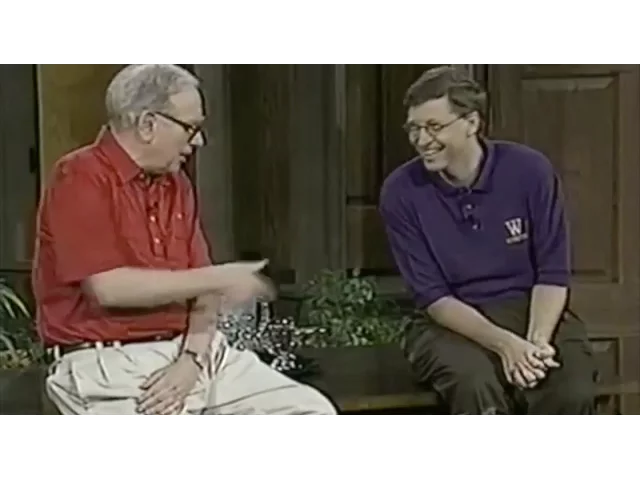
bill gates and warren buffett share a restless curiosity and fascination with the future together in the spring of 1998 they came to the campus of the university of washington in seattle they came to share their experience and their combined wisdom in conversation with students from the university's business school young people overflowed the student union auditorium for an extraordinary conversation with two of the most successful business leaders of our time proceedings so please join me in giving a university of washington business school welcome to bill gates and to warren buffett [Applause] [Music] well i thought i
ought to uh start this off by announcing that bill and i uh have a small bet as to who would get the most applause and i suggested that i bet my house against his but uh but we settled on a small sum but evidently it isn't so small to build because because just before we came out he gave me this nebraska cornhusker shirt to wear and he puts on this purple shirt we're going to uh we're going to answer your questions whatever you want to talk about is is fine and we we don't want any
softballs and i i thought by wearing this corner shirt that i could guarantee hardball's right in my head when we went to the game last year about halfway through the first quarter bill said what's that big n stand for on those guys of yours i said i said what the hell i said it's knowledge we all agree on that nebraska well they've asked us to start out talking uh with the two of us uh on one question but then it's going to be your questions and we're going to just have you line up behind the
microphones and we'll go back and forth they they did ask that we might uh start off with talking about uh sort of what got us here and uh it's pretty simple in my case it's it's not iq i'm sure you'll all be glad to hear that uh but everybody in this room has more iq than they need to do my job the uh the big thing is rationality and others you know i always look at iq and and talent as sort of representing the uh the horsepower of the motor but then in terms of the
output the efficiency which the motor works that depends on rationality because a lot of people start out with 400 horsepower motors and get 100 horsepower of output and it's way better to have a 200 horsepower motor and get it all into output and so why do why do smart people do things that interfere with really getting the the output they're entitled to and it's uh it gets into the habits and the character into temperament and it really gets into behaving in a rational manner it's not letting not getting in your own way as i say
everybody here has the ability absolutely to do anything i do and and much beyond and and some of you will and some of you won't but it it will the ones that won't it will because because uh you get in your own way it won't because the the world doesn't allow you to it'll it will be because you don't allow yourself to so i have one little suggestion for you pick out the person in the class that you admire the most and then write down why you admire them put down a list of qualities you're
not to name yourself in this and uh and then put down the the one uh uh that frankly you could stand the least in the whole group and put the put down the qualities that that uh turn you off in that person and look at that list and and you won't find it's a bunch of things like throwing a football 70 yards or you know or anything of the sort the qualities of the first one that you admire are qualities that that uh you with a little practice uh can make your own and which if
practice will become habit forming the chains of habit are too light to be felt until they're too heavy to be broken i mean my age i can't change any of my habits i'm stuck but at your age you know you will have the habits 20 years from now that you decide to put into practice today so i just suggest that that you you look at the habits you admire in others or the behavior you admire in others and and make those your own uh habits and you look at what you really find uh somewhat reprehensible
in others and just decide you know those are things you're not going to do ben franklin did that a few hundred years ago and it still works today and if if you do that uh you'll find that uh you convert all your horsepower into output so with that sermon i'll let bill give you another one and then we'll get into your question well i think warren's absolutely right about habit um i was lucky enough when i was quite young to have an exposure to computers which were um very expensive and and kind of eliminated and
limited in what they could do but but still fascinating and some friends and i really talked about that and decided that uh they they would change because of a miracle technology of of chips into something that everybody could take advantage of and we really thought writing software was a neat thing we hired our friends who wrote software we thought about uh what the potentials were and really didn't see any limit and so that that vision of of getting our friends together uh getting them to work as a team uh really seeing uh what kind of
tool this could be a tool of of what we talked about as the information age where the key thing is magnifying your brain power instead of of just your muscle power and by pursuing that with a pretty incredible focus and being there at the very beginning of the industry we were able to build a company that has played a very central role in what's been a pretty big revolution now fortunately uh the revolution is still at the beginning it was 23 years ago when we started the company but there's no doubt that taking the habits
we formed and sticking with those which would be hard to change the next 23 years are going to give us a lot more potential and maybe even get us pretty close to that original vision which was a computer on every desk and in every home and that's a fun fun thing to be involved with okay fire away i was wondering how you define success personally well i i can certainly define happiness because that's what that's what i am i mean i i and if that if that i mean i get to do what i like
to do every single day of the year and i get to do it with people i like i get to i get i don't have to associate with anybody causes my stomach to churn and uh the only thing in my job i don't like and this only happens about every three or four years occasionally i have to fire somebody and i don't like that's the only thing other than i tap dance to work and i get down there and i think i'm supposed to lie on my back and paint the ceiling you know or something
like microwaves i mean that's the way i feel and and it it it doesn't diminish it it's it's tremendous fun so uh you know if uh uh they say that uh uh success is uh uh uh getting what you want and happiness is wanting what you get well i don't know which one applies in this case but i i do know that i i wouldn't be doing anything else i mean uh i do advise you you know when you go out to work go go to work for an organization that you admire people you admire
because it'll it'll it'll turn you on and and uh you ought to be happy where you are working and i always worry about people who say you know i'm going to do this for 10 years i really don't like it very well and i'll do 10 more years of this i mean that's a little like saving up sex for your old age i mean not a very good idea so get right in recommend that get right get right into it get right into what you enjoy you know and and and you'll be successful at it
you really will i mean you won't be able to miss and uh um you know that's uh uh i don't regard what i do is the most important thing in the world at all but it's right for me i mean i happen to be wired in a certain way that what i do works in this if i had to do what you know bill does i mean it lasts about 10 minutes and that's true of a lot of things but i luckily i kind of stumbled into the thing that i i do best and and
that you know that it's worked out well bill well i think that the key point there is you've got to enjoy what you do every day and for me that's working with very smart people it's working on new problems you know every time we think hey we've had a little bit of success we're pretty careful not to dwell on it too much because the bar gets raised people's expectations of the the products we've always got customer feedback telling us the machines are too complicated they're not they're not natural enough and the the competition uh the
the the breakthroughs the research make uh the field on i'm in i think the most exciting field there is there's some other good fields biotechnology is a good field because it's changing the world of medicine and health but the computer industry in particular software you know i i think uh is the most exciting and i think i have the the best job in that in that business don't you think dairy queen is more important to the country you can manage dairy queens i'll go and buy the billy bars i've got i got it we'll raise
the price when you come okay yeah you don't want it you don't want to get in i i have turned down business deals that were otherwise decent deals because i didn't like the people that i would have to work with i didn't see any sense pretending it and to take on to get involved with people that really cause your stomach to turn i you know i say it's a lot like marrying for money that it's it's probably a bad idea under any circumstances but it's absolutely crazy if you're already rich right hey both of you
are innovators in your given industry i was wondering what your definition of innovation is well i don't i don't do a lot of innovating in what i do i mean i i my job i really have just two functions in my job one and one is to allocate capital which i enjoy doing and and the second one is to have a group of managers to keep a group of people 15 or 20 managers uh enthused about what they do when they have no financial need to do it whatsoever three at least three quarters of the
managers we have um are rich beyond any possible financial need and and therefore my job is to figure out how to cause them to want to jump out of bed at six in the morning and and work with all of the enthusiasm they did when they when they were poor and starting and and if i do those two things they do the innovation of it bill innovates now he can tell you about it well the technology business has a lot of twists and turns and that's why partly why it's such a fun business is that
you know no company gets to rest on its laurels and ibm was as dominar are more dominant than any company will ever be in technology that's just just not going to happen again and they had the smartest people and they had all the customer feedback and yet they missed a few turns in the road and so that makes you wake up every day thinking hmm let's try to make sure today's not the day we miss the turn in the road uh let's uh you know find out what's going on in speech recognition let's go find
out what's going on in artificial intelligence let's make sure we're hiring in the kind of uh people who can pull those things together and make sure we don't uh we don't get surprised sometimes we do get taken by surprise for example the internet came along and we had it sort of as a fifth or sixth priority it wasn't like somebody said internet to me and i said oh i don't know how to spell that i said yeah i got that on my list i'm okay but there came a point where we realized it was happening
faster and it was a much deeper phenomena than it had been recognized in our strategy and so that was a case where as an act of leadership i had to create a sense of crisis and have a couple months where we all just threw ideas and sent electronic mail around went on a bunch of retreats and then eventually coalesced around a few ideas where we said okay here's how we're gonna here's what we're gonna do here's how we're going to measure ourselves internally and here's what the world should think here's what we're going to tell
them about what we're going to do and that kind of crisis is likely to come up every three or four years or so next time it comes up remember yogi berra bill when when you reach a fork in the road take it growing up who were your biggest role models and what kind of a role did they play in your success you know i had uh great parents uh both of whom were involved in lots of interesting activities and would come home and talk to us about you know the world of business or law or
politics or the charitable activities they were involved in and so that made us my myself my sisters always thought about well what are we going to do out there they had us as avid readers and so we uh had pretty broad interests in reading scientists were a group that i gravitated to because this notion that just you know out of their heads they came up with neat ideas uh that sort of fascinated me so quite a quite a bit of the time i thought i'd be a mathematician or a scientist it was only when i
got to harvard that i started to think of this sort of all-absorbing hobby i'd had computer stuff which i just thought okay i got to get rid of this and decide to do something serious i started to realize you know this is pretty serious and it's actually more interesting and more impactful than uh you know going and trying to come up with a new theory in math or anything else and so i had that dilemma for a couple years but eventually decided that uh computers really was a great a great thing to be involved with
yeah i think you're 100 on the money in in focusing i would instead of calling them role models i call them heroes actually and and i think if you tell me who your heroes are i can tell you how you're going to turn up to quite an extent by this point in life and i i i have been extraordinarily lucky and that none of my heroes ever let me down i mean the ones i came up with uh throughout their lives that i've never felt that i've been let down in any way with it number
one was my dad and and uh had a huge impression on me um my wife who is heroes is one of my heroes i mean she is you know in terms of of she's taught me a tremendous amount and and never seen anybody any better with human beings than she is and uh you can you know yogi bear again said you can you can observe a lot just by watching and i you know i i watched my dad and i watched her and uh i had a professor ben graham uh back at columbia and had
a huge impact on me so i have been lucky in that i've had terrific heroes and they they haven't let me down and and uh that that takes you a long long way i've gone through one or two periods where we're kind of tough in life but not any i mean everybody had had that but but having the right heroes will take you right through it the internet exposes us to vast amounts of information and in particular children are being exposed to more and more complex issues at very young ages yourself being a father mr
gates i was wondering if you had any comment on the access now to information and how do we handle that definitely the internet has every kind of in information you can imagine all the the worst things and best things that people are interested in are out there in uh great great quantity and so there there's a decision a parent has in terms of do you let your kid go out onto the internet one one great thing about the internet is if you set it up the right way there's a log of exactly what the person's
gone and looked at and so you know you have to decide up to what age do you think it's legitimate that you have access to see where they're going and what they're interested in and personally i'd rather see what my kid is interested in and talk to them about it then try and block all together them ever learning anything about it because some day in their life whether it's a you know a magazine or a friend or a terminal that i don't i don't control if they're curious about something they're they're going to find out
about it and you know my so my my theory is not that you know my child will be okay as long as they don't hear about things that you want to have the full experience and but i think on the whole the fact that a kid has this tool to be curious about all these topics that's got to be a fantastic thing i can't improve on that but i am i just got to the age where bill lets me watch the internet alone i've been crying that's good sorry i you know i've been trying to
evangelize personal computers to warren ever since we met which is uh over about seven years ago now and uh it was amazing you know i talked about stock quotes and spreadsheets and all these things and in the end it wasn't uh my uh talking at all that got him on it was the ability to play bridge with his friends now he's he's incredible he's an addict yeah do you feel that technology has made businesses more efficient to the point where you can pay more for him well it i i'm sure technology is made more efficient
and if i thought otherwise i would i'd be afraid to say so with bill sitting next to me but a lot of things in business including maybe much of technology really amounts it has the same effect as if you went to a parade and the band started coming down the street and all of a sudden you stood up on tiptoe i mean in another 30 seconds everybody on tiptoe you know it'd be hell on your legs and you wouldn't be seeing any better and there is that aspect to business that there's a self-neutralizing aspect now
bill tell them how much technology you'll make for us no i think there's definitely a lift a one-time lift where you go from not using technology well to using it well particularly if u.s companies are doing that better than their competitors uh outside the united states and so you get all this ability to communicate so you get global scale and a lot of businesses that wouldn't have had it before if you look at the really big earners in that who are generating this 20 return on equity a lot of them are companies like coke or
microsoft or boeing or ge which are going to that that worldwide marketplace and i know every one of those has been helped by technology but that that cannot explain why 10 years from now they'd be getting that type of return on equity there's something almost certainly ephemeral about about current conditions capitalism tends to be self neutralizing in terms of improvements but that that's marvelous because it means we've got better everything otherwise but the real trick is to stand up on tiptoe and not only have anyone notice it i mean if you can do that for
then you do very well yeah bill warren the world is becoming a much smaller place both in technology and in finance how do you see yourselves as businessmen taking your businesses globally and how do you view that individually as a person well i've got an easier answer so i i'll i'll let bill think while i get the easy answer we don't do it directly i mean our two largest commitments are are coke and gillette and uh coke has 80 of their earnings coming from abroad and it will be larger in the future gillette has two
thirds of the earnings coming from abroad and that'll be larger in the future so they are participating in in a worldwide improvement in in living and they'll continue to participate so we do it by piggybacking them and i can sit in omaha you know and and let let doug ivester and coke fly all over the world and do a tremendous job doing it bill has to get out there and and do it for microsoft now let him tell you how one great thing about our business is it is it is global uh that what do
you need in a spreadsheet about the same thing in korea and egypt as you need in the united states and the pc standard is a global standard we have to do some adaptation for the local languages and that's a fun part of our business understanding bi-directional languages and the large alphabets that you have in chinese japanese and korean and over the years we've gotten very very good at that in fact our market share is much higher outside the united states than it is inside the united states because it's relatively hard to set up subsidiaries understand
local conditions local distribution and relationships and so since most of our competitors are in the us and aren't as good at doing international business we thrive uh even better in these other countries most of our growth will come from outside the united states the united states will get to the point where it's largely a replacement market most homes and business desktops will have pcs now that doesn't mean they won't replace them they won't want better software that can see listen and learn but outside the us we still have that that early slope phenomena so it's
very much a global global business when you think about it many of you are probably too young to remember with clarity anyway 15 years ago that this country almost had an inferiority complex about its ability to come compete in the world and and you know and with software and and and the whole uh development of the computer uh now the rest of the world is looking to us and you know and and you know villas played a big part in that i mean he is he has contributed in a major way to a change in
our attitude about this country and and the world's attitude about this country so what impelled you to make a trip together to china in 1995 and what's your perception before and after the trip and most of your next question is what has that trip affected your global visit decision that region since well we went to china for a lot of reasons partly to relax and and have fun we found a few mcdonald's there just uh so we didn't didn't feel too uh away from home it was also exciting to go and see all the changes
taking place i mean it's so amazing uh what what's going on there and we saw different parts of the country got to see some of the leaders uh it's a market that uh you know we microsoft had already been investing a lot and we've upped that quite a bit since then although about 3 million computers get sold every year in in china people don't pay for the software they will though it's sort of a as long as they're going to steal it we want them to steal ours i sort of sort of get addicted and
then we somehow figure out how to how to collect sometime in the next in the next decade so you know it's a great great place to be involved in and it was a lot of fun which was i guess the the key goal my family was amazed i went i never traveled more than maybe you know the outer reaches of the county in nebraska and and i i just went and had a a a terrific time and and also confirmed my feeling that there were going to be a lot of coca-cola sold in the future
i told everybody over there and acted as an aphrodisiac as two of the most successful business people in the country what role do you see for yourselves in giving back to your respective communities and how do you use your influence to get others to give back as well well i think we both have a quite a similar philosophy on that i know in my my own case that 99 plus will go back to society and that'll actually count everything that my family and i have have lived on during our entire lifetimes but just because we've
been treated extraordinary well well by society you know i'm lucky bill said if i've born a long time ago i've been some animal's lunch you know i mean i don't run very fast but but i'm wired in a particular way that in the market economy big capitalist economy lots of action uh i i'm i'm well adapted for that i'm not adapted for pro football i'm not adapted for violent playing this i just i happen to be in something that pays off huge in the society and basically i i get the fun of playing around with
that while i live but it it will all go back to the society and and uh i think it would be i think it'd be wrong to be to be otherwise frankly i've if i'd been dropped down and you know in in in uh some remote country or in almost any other place in the world i would have been worth a damn i mean i i i am here because of a tremendous society that surrounds me and and the fact that i happen to be well adapted to a certain part of it and so it
it's all going to go back to society and i know bill feels very similar i think that's a great philosophy not to mention the fact that uh passing along lots of money can be a bad thing for the people who receive it they might not think so at times but uh i really don't think it's i don't think it's right that the uh frankly i don't think it's right that the quarterback of the nebraska football team next year should be the eldest son of the quarterback of 22 years ago nor do i think that our
olympic team in 2000 should be chosen as to be from the same family that was on the olympic team and all the respective sports in 1976 i mean we believe in the meritocracy when it comes to athletics and uh all kinds of things now why not have a meritocracy in in in terms of what you go out into the world with in terms of the productive goods let's let let the let the resources flow to those who use them best but then i think they ought to give it back to society primarily when they get
through i do not believe in the divine right of the womb i mean i do not think that you you know that if you select the right womb that you're entitled to do nothing the rest of your life it doesn't make any sense [Applause] [Music] all right there's been a lot of discussion about how the information age is revolutionizing society and i would like to get your opinion about which countries and industries and companies are best prepared to take advantage of these changes and what factors would account best for their success maybe i'll i'll start
with that if you look at what's happened in personal computers or what's happening in business in general in terms of how we allocate capital and let labor move around the united states is has emerged in a very strong position and so the the first beneficiary of of all this information technology will be the united states there are a few other areas like singapore hong kong the scandinavian countries where they're adopting the technology at basically the same rate that we are there's a few countries that even relative to their level of income are going after the
technology because they believe so much in education in korea and many parts of china we see incredible penetration of personal computers even at very low income levels because they basically decided it's a tool to help their kids uh have access to information and and to get ahead uh the whole world is going to benefit in a big way you know the there'll be this shift where instead of your income level mainly being derived by what country you're in it'll be derived by what your education level is so today a phd in india doesn't make nearly
as much as a phd in the united states well as you get the internet allowing services and advice to be transported as efficiently as goods are being transported through shipping and all those things then you'll get essentially a open market bidding for that engineer in india versus the engineer here in the united states and that benefits everyone because you're taking better advantage of those resources and and people are better off so they'll be the developed countries will get the early benefit from these things in the long run the the people who are lucky enough to
get a good education in developing countries will actually get an absolute the biggest boost from all these things that go on it i didn't get it at first but it it's huge and it it will change the world the technological revolution in in in dramatic ways and and and quick uh quickly uh ironically our approach to that is is just the opposite of bills but that his his is the right one for the world's ours is the right one for me uh i i look for businesses that where i think i can see what they're
going to look like in 10 or 15 or 20 years we don't own any but if you take uh wrigley's chewing gum i i don't think the internet's going to affect how people shoot government you know and bill probably does i mean but but i i don't think it's going to affect the fact that that the coke will be the the drink of preference and will gain in per capita consumption around the world i don't think it will change the whether people shave or how they shave or the fact that they like a better better
uh shaving system as the mach 3 is going to be very shortly on my dad so i we are looking for the very predictable and you won't find the very predictable in what build us you'll find the more exciting things the things are going to change society more and and so i have a little different opinion i as a as a member of society i applaud what he's doing and as a as a an investor i keep a wary eye on it and that's uh you know it's it's it's a different approach to investing most
people think about all this opportunity and it has been operating every internet stock has gone crazy here in in recent months but i don't know how to look at one or the other and and and tell the winners yeah i i this is an area i agree strongly with warren on i think the multiples of technology stocks should be quite a bit lower than the multiples of stocks like coke and gillette because we are subject to complete change in the rules you know i know very well that in the next 10 years if microsoft's still
a leader there will have been three at least three crises that we will have had to really prove our uh our excellence in uh i accidentally once we were on a panel with the ceo of coke i said something like i couldn't run my business when i get to be 60 because it's such a hard business not like coke and i i offended him uh without meaning without meaning to you won't offend me i want to be in business i can run when i'm 100 because i plan to do it i'm going to retire about
five years after i die maybe starting a new company is very risky how do you determine when is the best opportunity to start a new company and how can you get people to support you well it when i started microsoft i didn't think of it as all that risky i mean i was so excited about what we were doing it's true i could have gone bankrupt uh but you know i had a set of skills that were highly employable and in fact my parents were still willing to let me go back to harvard and finish
my education if i wanted to you've always got a job with me bill and the only the thing that was scary to me wasn't quitting and starting the company it was when i started hiring my friends and they expected to be paid and then we had customers who went bankrupt customers that i'd counted on to come through and so then i got this incredibly conservative approach that i wanted to have enough money in the bank to pay a year's worth of payroll uh even if we didn't get any any payments coming in and you know
i'm almost uh true to that the whole time we have about 10 billion now which is is pretty much enough for the next year anyway you know i if you're going to start a company it takes so much energy that you know you it better overcome your your feeling of risk i don't think that you necessarily if you're going to start a company should do it at the start of your career i think there's a lot to be said for working for a company learning how they do things you know if you're young it's hard
to go lease premises they they made that hard for me you couldn't rent a car when you were under 25 at the time so i was always taking taxis to go see customers and the people with you know people say well we're gonna go have a discussion in the bar well i can go to the bar and but you know that's fun because i'll tell you when people are first skeptical and they go this kid doesn't know anything then when you show them you've really got a good product and you know something they actually tend
to go overboard and they think whoa you know they know a lot uh let's really do an incredible amount with these people so our youth at least in this country uh was a huge asset for us once we reached a certain threshold it is hard it's hard to hire old older people um because they'll be a little bit conservative about whether they should come and take the risk and it took three or four years before we could go out into the normal sort of employment pool but those those problems that come with starting the firm
you better think of those as as part of the the pleasure part of the the the challenge that that is part of the the excitement i was curious what each of you felt was the best business decision you had made um throughout your career the best part business decision uh i think just getting in jumping in the pool basically i mean i i i i've always enjoyed what i've done and and a few things have worked out very well and and the nice thing about the investment business is that you don't need very many joe
you'll see plenty of times when you get chances to do things that just shout at you and the thing you have to do is is when that happens you have to take a big swing i mean there's that is no time to be reading a book on the theory of diversification i mean you know i mean that is the time to put you put very significant when you find something that where you know the business it's within your circle of confidence you understand it the price is right the people are right then you know you
take you take your thumb out of your mouth and you barrel in we were talking at breakfast this morning about uh of all warren's investments decisions which was the worst decision which it's amazing and they're tough to find because he uh he's you know the tracker it's unbelievable uh but we i think decided that by uh some metric the buying the company that he his company is named after was probably the worst investment decision uh that's true i mean we went into a terrible business because it was cheap and it's what i referred to as
the the used cigar butt approach to investing you know that you see this cigar but down there it's soggy you know it's terrible but there is one puff in it it's free and and that's what berkshire was when we bought it i mean it was selling below working capital actually buying berkshire hathaway buying control of it was probably the biggest single bad decision that i've made and then the i made all kinds of decisions that have cost us billions of dollars but they've been they've been mistakes of omission rather than commission i mean there were
businesses that we knew enough to buy a lot of i don't worry about not buying microsoft because i i didn't understand that business i don't understand intel but there were businesses that i did understand fannie mae was one i mean i made a decision to buy it and i just i didn't execute and we would have made many billions of dollars on something that was within my circle of confidence and i didn't do it and you don't see that accounting conventional accounting doesn't record that but believe me it happened in in my case i'd say
my best business decisions really have to do with uh picking people you know deciding to go into partnership with paul allen is is probably at the top of the list and then subsequently hiring a friend steve ballmer and having somebody who you totally trust who's totally committed who shares your vision and yet he has a a little bit different set of skills and also acts as a check on you you know some of the ideas you come up with you run by them because you know they're going to say hey wait a minute uh you
know have you thought about this and that and just you know the the benefit of sparking off of somebody who's who's got that kind of brilliance it's not only made it fun but it's really led to a lot of success so picking picking a partners is crucial yeah and i've had a partner like that charlie munger for a lot of years and and it it does for me exactly what what bill was talking about charlie and you have to calibrate with charlie though because charlie says everything i do is dumb but but if he says
it's really dumb then i know it is but if he just says it's dumb i take that as a affirmative vote go ahead if you can change one thing in your life what would it be and why my age you know i i never look back i i just don't i don't worry about anything i mean i i so i consider myself unbelievably lucky so the idea of saying i could have even been a little luckier if this or that had happened you know i mean you know i could have been a lot better looking
or i could have been a better athlete all that stuff but so what you know i i you play the hand you get you play it as well as you can and and you're thankful if you're lucky enough the odds were when i was born the odds were over 50 to one against me being born in the united states i mean i had a two percent probability you know if i'd known that i might have given up and not come out i mean but here it was you know i was lucky enough to be born
here and i was lucky enough to have two terrific parents and they uh they raised the the three kids in a way that that helped me enormously uh in life so i mean when you got all that going for i just don't think you look back and think about anything it could be changed better i'm thankful isn't there at least one bridgehand you would have played different well i have a partner because i should have played everybody i asked her one time i said how should i play that hand and she said under an assumed
name i think the the key resource you have to deal with is your time and how you spend time and i'm pretty rigorous looking back each year i even get my friend steve ballmer to come in and look at my schedule and criticize hey you didn't really need to spend time on this or that and that's pretty useful because you know if i can get more time to sit down with the engineers if i can get more time to get up with some customers those are the things i just love to do and you know
it just gets me excited it clears my mind and and so you know i'm always trying to make sure that that i'm only doing the things that are important hypothetically if you were to lose everything today keep everything in the past but right now starting fresh and you could only keep three things in your life tangible or intangible what three would those be well i'm not sure how you define the three i mean i i i you know you'd like to know everything that you now know i mean because that what what essentially the things
i've applied in the past are going to be applicable in the future uh this may sound if i if i lost it all without losing any any money of any other people it wouldn't bother me a lot if if i if i took other people down when they would kill me i mean you know that that is the one thing that would just that that would destroy that because i just i wouldn't be able i i'm not sure i'd recover from that but if it was just my money it wouldn't make any difference at all
because i keep living about the same i have to give up the plane but i mean i i eat this i eat the same way everybody in this room eats you know he eats a lot worse than you guys did friends i need to fight worse but i think you're right and you can get i mean in terms of medical care anything i there is virtually there's very little difference in how how the people in this room live now and are going to live in the next 10 years in the way the way i do
so i'm i wouldn't miss anything i mean i don't have i would like to keep playing the game because i enjoy it so if i had the knowledge that i've had that gotten me here and i had anything to work with at all and i could probably talk somebody into giving me a few bucks to start it i but i would have a lot of fun playing the game again i mean it it it it it might be you know i'm i'm not sure i want to follow your experiment but i i think i i
think it'd be just about as much fun as what i do yeah as long as people didn't go down with me that wouldn't that would be no fun bill yeah starting out at a small scale again you know it's got a certain attraction to it uh but you know i think uh it's interesting our our business is not one where money makes that much difference at all uh in fact somebody was saying to me recently that microsoft has such a a strong position in our business and i was saying hey if you took 30 of
the top people and drafted them over to the other team the score would change you know very very quickly first of all not only would the 30 go the people who like working with the 30 would go with them and so that it's not there's not some asset there it's you know all the products are going to be obsolete very very rapidly it's it's the people and their sense of how to do things in their enjoyment and working with each other and you know it'd be a shame to give that up but you know starting
another company like that again i i'd have a blast doing it in light of public controversy that's caused a lot of confusion in my mind and has polarized most of my friends and associates and perhaps has caused one or both of you to lose some sleep i'd like to ask you to share your perspective of what purpose or what appropriate role anti-trust legislation should play in american business i am no andy andy trust a scholar i think that that well i met bill eight years ago and he's and he was he's a terrific teacher and
so he spent about six or seven hours explaining his business to me and he actually i mean here i am the world's biggest dummy on technology but he he explained it to me pretty darn well and when i got through when he got through with it i bought 100 shares of stock just to keep track of them and i think that shows two things one is that i got an iq of about 50. and the second is i didn't think he had any monopoly [Music] well the key goal of competition law is to protect consumers
and to make sure that new products get created and and that those products are very innovative and you can look at the economy at different sectors and say you know where is that happening very well and where is it it not happening as rapidly no matter how you score it there's no doubt that one sector of the economy would stand out as absolutely the best and that's the personal computer industry and so the price of computing before the pc came along was going down at a certain rate the pc came along and now it's gone
down at an at an incredible rate uh the variety and quality of software has also uh increased at a phenomenal rate we're absolutely at the peak of that today the number of new software companies being started the number of software jobs the level of investments the number going public i mean it's way beyond even what it was three years ago it's on a big uptake um and so consumers are doing very very well and so it's it is somewhat of a surprise to find ourselves in an anti-trust controversy and you know thank goodness for the
judiciary which is an environment where facts are tested in an appropriate way and people can see you know has the competition worked in the way it should has been beneficial to consumers and and there's no doubt in our mind where that's going to come out and it seems to a lot of people that both in both your companies the success is driven by your enthusiasm and your leadership skills how do you see your organizations in the post buffett and postgates era and how do you prepare your companies for that period well your your assumption is
wrong because i i i will i will keep working until about five years after i die and i and i've given the directors a ouija board and i'll be in touch but but but but if the ouija the ouija board is it doesn't work uh we have outstanding people that can do what i do and we've got the people identified to do that and the board of directors of berkshire knows who they are and uh in fact i've got a letter i've already sent out a letter that tells what should be done and i've got
another letter that's addressed which will go out at the time and the and it starts out yesterday i died and then it just tells what what the plan for the company is and it's all it's all taken care of it's all written i put down at the bottom of it i put dictated but not red yeah my attitude is a lot like warrants i i you know i want to keep doing what i'm doing for a long long time i think probably a decade from now or so even though i'll still want to be totally
involved with microsoft because it's my career i will pick somebody else to be ceo and see some hands in the audience that's an a big transition for a company you know sometimes you find somebody who does better uh and and sometimes you don't and no i actually i'm interested in people who want the job it's got some fun parts to it [Music] i just want to make certain that they hear that we specifically and formally thank warren buffett and and bill gates for visiting the university of washington business school and please show them your appreciation
as i show them out of the artichokes [Music] you