See you tomorrow. Let's go. Dubs in the chat, baby.
Come on. [screaming] NC's career high. Period.
Kayn Clark master class. A beauty perfection of 45 double D. a a 45point double double.
Caitlyn Clark done turned up on you. Caitlyn Clark put on a spectacular show. Chef's kiss versus the Seattle Storm.
Oh yeah, I put on my shirt and tie cuz damn it, we mean business. What's up everyone? If you love WNBA news, basketball history, and the biggest stories surrounding today's stars, you're in the right place.
So without wasting any more time, let's get right into it. All right. What you're about to hear isn't just another WNBA record.
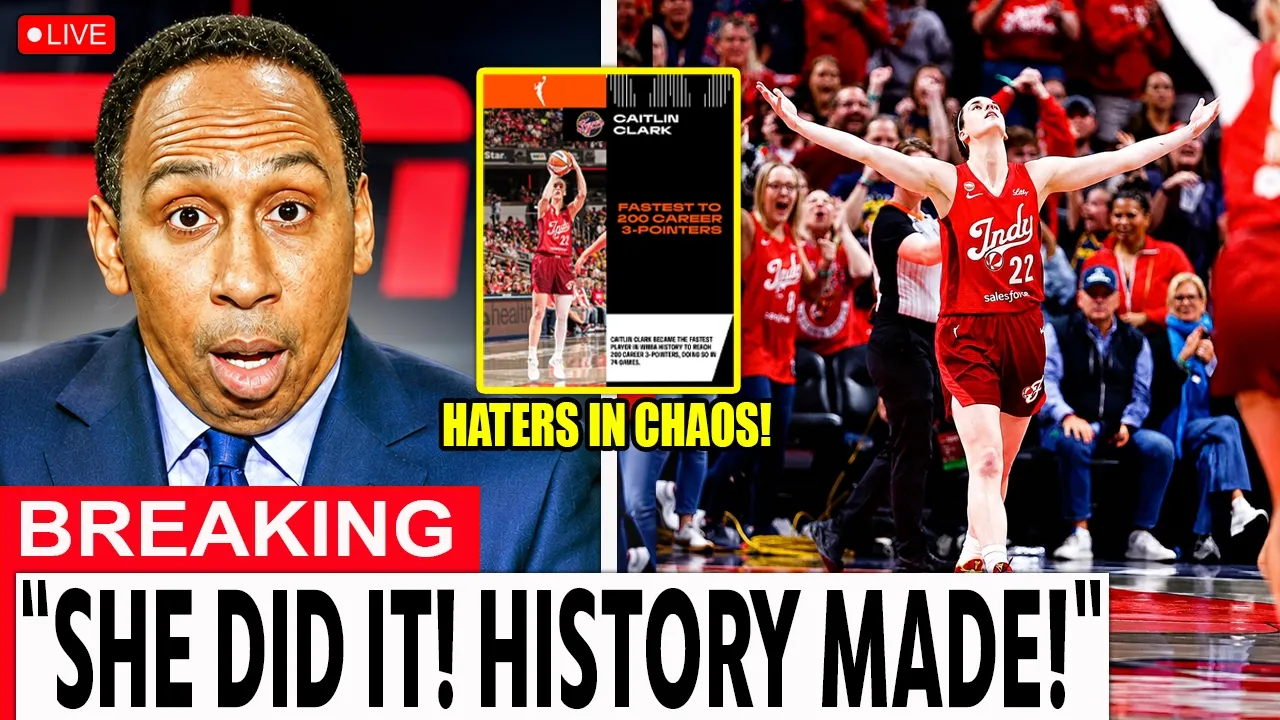
It's a moment that could be remembered for years. Caitlyn Clark has officially become the fastest player in WNBA history to reach 200 career three-pointers, accomplishing the milestone in incredible fashion. But what makes this achievement even more impressive is the way she did it and why basketball fans everywhere are talking about it.
Stay with us because this performance was nothing short of remarkable. If you appreciate this content, consider giving this video a like and subscribing to the channel. Believe it or not, more than 93% of viewers haven't subscribed yet.
[music] It's free and only takes a second, but it means the world to us. So, did you subscribe already? [music] Great.
Thank you so much for your support. Now, back to the video. History was made the moment Caitlyn Clark knocked down her milestone three-pointer.
With that shot, she officially became the fastest player in WNBA history to reach 200 career three-pointers. Think about that for a second. The WNBA has featured some of the greatest shooters the game has ever seen.
Just when some critics thought Caitlyn Clark might finally be slowing down. Just when they believed the pressure, physical defense, injuries, and constant expectations were beginning to catch up with her. She responded by doing something no player in WNBA history had ever done faster.
200 career three-pointers. Not after five seasons. Not after four seasons.
Caitlyn Clark reached that milestone in only 74 career games, breaking the previous record of 81 games held by WNBA legend Katie Smith. And somehow that historic three-point achievement was not even the biggest story of the night. Clark did not simply break a shooting record.
[music] She delivered one of the most complete and unforgettable performances the league has ever witnessed. 45 points, 10 assists, four steals, two blocks, six made three-pointers, and a dramatic 110 to 107 Indiana fever victory over the Seattle Storm. It was the first game in WNBA history in which a player recorded at least 40 points and 10 assists.
Her 45 points also established a new Indiana Fever franchise record. We are breaking down the record, the performance, the pressure surrounding Caitlyn Clark, and why reaching 200 three-pointers this quickly is about much more than one number. Because love her or criticize her, one truth is becoming increasingly difficult to deny.
Caitlyn Clark is changing the speed at which WNBA history is being written. Before we continue, subscribe to the channel and turn on notifications because moments like this deserve more than a 30- secondond highlight. They deserve the full story.
And this story begins with a player who entered the night surrounded by questions. Clark had recently returned from a back injury that forced her to miss time. She was still rebuilding her rhythm and working her way back toward a full workload.
Her previous three games from beyond the ark had been difficult. She had made only three of her previous 19 three-point attempts and her season percentage from deep had fallen to around 32% entering the Seattle matchup. Players, that kind of stretch can create hesitation.
A missed shot becomes two missed shots. Two misses become doubt. The player begins thinking instead of reacting.
She starts passing up opportunities she would normally take. Every attempt begins to feel heavier because everyone is waiting to see whether the next one will fall. And when you are Caitlyn Clark, a shooting slump does not remain a quiet basketball problem.
It becomes a national conversation. Every miss is analyzed. Every decision is debated.
Every expression is turned into a headline. Some people wonder whether the defense has solved her. Others question whether she is fully healthy.
Some argue she takes too many difficult shots, while others demand that she become even more aggressive. That is the strange reality of being one of the most discussed athletes in women's basketball. [music] Clark is rarely allowed to have an ordinary game.
She is either making history or being asked what went wrong. But great shooters are not defined by the nights when everything feels easy. They are defined by what they do after the ball stops falling.
And against Seattle, Clark did not play like someone searching for confidence. She played like someone who had already decided the confidence was still there. From the opening stages of the game, Indiana played with speed and purpose.
Clark was not only hunting her own shot. She was creating opportunities for the players around her, forcing Seattle's defense to make uncomfortable choices. Defenders had to decide whether to step toward Clark several feet beyond the three-point line or stay attached to Indiana's cutters and shooters.
Move too close and Clark could attack the space behind the defender. Stay too far away and she could launch from a distance that many players would consider unreasonable. Send a second defender and the passing lanes opened.
That is what makes Clark's offensive impact difficult to measure with points alone. A deep three-pointer changes the scoreboard. The possibility of a deep three-pointer changes the entire defense.
And on this night, the possibilities quickly became reality. Clark finished 11 of 18 from the field and six of 10 from three-point range. She also attacked often enough to earn 19 free throw attempts, making 17 of them.
Bears reveal something important. This was not simply a player standing behind the ark and waiting for open shots. Clark scored from distance, created in transition, attacked defenders, drew contact, and generated opportunities for her teammates.
The three-point record will receive the headline, but her overall performance showed why she has become more than a specialist. She can punish a defense in several different ways, and that is exactly why the milestone of 200 career threes matters. Caitlyn Clark reached the number in 74 games.
Katie Smith, one of the most respected scorers in the history of women's professional basketball, previously held the record at 81 games. Breaking a record associated with a player of Smith's level is not a small accomplishment. Mees may not sound like an enormous difference until you understand how difficult consistent three-point production can be.
Defenses know what Clark wants to do. She is on every scouting report. Opponents prepare for her range.
They pick her up far from the basket. They place physical defenders in her path. They attempt to deny her the ball, force her toward help, and make every possession exhausting.
There is very little surprise involved. Clark is not reaching these milestones because teams are unaware of her abilities. She is reaching them while entire defensive plans are being built around stopping those abilities.
That is what separates an impressive statistic from a meaningful record. The opposition knows what is coming. The opposition prepares for what is coming and Clark continues finding ways to produce it anyway, but the night was far from finished after the milestone.
Indiana needed more than a record. The fever needed Clark to deliver when the game became uncomfortable. Seattle stayed competitive, continued attacking, and eventually placed Indiana under real pressure late in the fourth quarter.
The Fever had led earlier, but the storm pushed back. Indiana found itself trailing by eight points midway through the final period. The celebration surrounding Clark's record could have become a footnote in a frustrating loss where the performance moved from impressive to unforgettable.
Clark scored 16 points in the fourth quarter. But one of the most important plays did not come from her shooting. With less than 1 minute remaining and the score tied, Seattle appeared to have an opportunity for a fast break layup.
Clark sprinted back. She recovered and she blocked the attempt, sending the ball out of bounds. It was the kind of play critics do not always associate with a player known for long range shooting and creative passing.
[music] Then moments later, Clark delivered the shot everyone will remember, a three-pointer from the left wing. Indiana took a 105 to 102 lead. The Fever surrendered it.
Clark then made four free throws during the final 17 seconds to help secure the 110 to 107 victory. Out that sequence, a defensive recovery, a block in a tied game, a go-ahead three-pointer, four pressure free throws. That is not simply scoring.
That is control. It is understanding that a historic individual performance means very little if the team walks away with a loss. Clark had already reached 200 career three-pointers.
She had already produced a career-high scoring night. She had already created WNBA history. But the final challenge was completing the victory.
And she did. This is also why focusing only on debates about popularity can cause people to miss what is happening on the court. Caitlyn Clark entered the WNBA with extraordinary attention.
That attention created passionate supporters, intense critics, enormous expectations, [music] and constant comparison. Some fans celebrate every achievement as proof that she is transforming the league. Some critics respond by pointing toward other great players who have built the WNBA over many years.
But appreciating Clark's historic start does not require disrespecting the legends who came before her. In fact, Clark's accomplishments become more meaningful when the history is respected. Katie Smith's record mattered.
That is why breaking it matters. The players who built the WNBA created the standard that Clark is now chasing. [music] And each new generation is supposed to challenge the previous one.
That is how sports move forward. Records are not insults to the past. They are conversations with the past.
A great player establishes a mark. Another great player spends years trying to reach it. and eventually someone arrives who changes what people believe is possible.
Clark reaching 200 three-pointers in 74 games does not erase anyone. It adds another chapter. However, there is also a reason this particular record feels connected to Clark's identity.
Long before she entered the WNBA, her shooting range had become one of the most recognizable features of her game. She did not merely take three-pointers near the line. She regularly stretched defenses several feet beyond it.
Those shots were not only visually dramatic, they changed how defenders had to approach her. Traditional defensive spacing became dangerous. A defender who believed she was standing at a safe distance could suddenly realize Clark was already within her shooting range.
That ability forces the defense to expand. Once the defense expands, the floor opens. Drving lanes become larger.
passing angles become clearer. Teammates receive more room to operate. This is why Clark's three-point shooting and passing are connected.
Her range creates fear. That fear creates movement, and that movement creates opportunities. The record tells us she has made 2003s faster than anyone else.
But it does not fully show how many other baskets became possible because opponents were worried about three-pointer number 201. This performance also arrived at an important moment in Clark's development. Early in a career, opponents gather information.
[music] They study tendencies. They learn which direction a player prefers. They identify the spots where she is most comfortable and the situations where she becomes vulnerable.
Then comes the adjustment period. The league changes its approach. The player must respond.
For Clark, the attention has been intense from the beginning. Physical defense, traps, fullcourt pressure, changing matchups, and constant contact have forced her to adapt quickly. Her response has not been perfect.
No young players responses. There have been turnovers, difficult shooting nights, injuries, frustration, and games in which the defense appeared to win. But growth is not the absence of struggle.
Growth is what happens because of struggle. Against Seattle, Clark showed a version of her game that combined the spectacular with the practical. The deep shooting was there.
The playmaking was there, but so were the free throws, defensive effort, composure, and late game execution. And that may be the most concerning part for opponents. The player who entered the league with elite range is becoming more comfortable influencing every part of the game.
Her head coach, Stephanie White, described the final stat line as almost surreal. Clark herself spoke about believing and visualizing that kind of performance before it happened. DSCT is important.
Confidence is often misunderstood. It does not mean expecting every shot to go in. It means believing the next shot deserves to be taken even after the previous one missed.
Clark's recent three-point struggles could have caused her to become cautious. Instead, she trusted the work. And that trust produced six made threes, including the shot that gave Indiana the lead for good.
This is the cycle every great shooter must survive. Shoot. Miss.
Hear the criticism. Return to the gym. Shoot again.
The public usually sees the result. The player lives through everything that happens between the results. That is why the phrase haters in chaos may be entertaining, but the bigger story is not really about defeating strangers on social media.
Clark's real battle is against the standard she has already created for herself. When a player makes history repeatedly, history begins to feel normal. People stop asking whether she will break a record and start asking which record will be next.
That creates an almost impossible expectation. A strong performance is no longer enough. A normal double double can feel ordinary.
20 points and eight assists can be discussed as though something is missing. That is the price of extraordinary beginnings. But it is also evidence of how far the expectations have moved.
Before Clark arrived, reaching 200 career threes in 81 games was the fastest pace in league history. Now 81 has been replaced by 74. And the next great shooter who enters the WNBA will see Clark's name at the top of that list.
She will know exactly what number must be beaten. That is how a player influences the future without ever meeting the players who will eventually chase her records. Young athletes watching this moment are not only seeing a star make long-d distanceance shots.
They are seeing the boundaries of acceptable shooting range continue to expand. Coaches may encourage players to develop skills that were once considered too risky. Guards may enter the league believing they can be both high volume scorers and elite playmakers.
And teams may continue designing offenses around space, range, speed, and decision-m. Clark is not solely responsible for the evolution of basketball. No individual player is.
But she is one of the clearest symbols of where the game is moving. More space, more range, more creativity, more responsibility placed in the hands of dynamic guards. The most exciting part is that this was only career game number 74.
200 three-pointers already. More than 600 career assists already. Another milestone she recently reached faster than any player in WNBA history.
The first 40 point 10 assist performance the league has ever seen. These achievements do not guarantee what will happen next. Sports never offer guarantees.
Injuries matter. Team development matters. Playoff success matters, longevity matters, and the WNBA is filled with elite players capable of challenging anyone on any night.
But records are evidence. They show what has already happened. [music] And what has already happened is remarkable.
Caitlyn Clark has reached 200 career three-pointers faster than every player who came before her. She did it during a 45point masterpiece. She did it while leading a comeback.
She did it while creating for her teammates. She did it after a difficult shooting stretch. And she did it in a victory that required her to make decisive plays on both ends of the court.
So, what does this night truly mean? It means the shooting was never just a college phenomenon. It means WNBA defenses have spent more than two seasons studying her and she is still finding ways to break records.
It means difficult stretches have not removed her willingness to take responsibility. [music] And it means the conversation surrounding Caitlyn Clark is unlikely to become quieter anytime soon. The supporters will celebrate.
The critics will debate. Analysts will compare eras. Fans will argue about rankings, teammates, officiating, pressure, and expectations.
But while everyone talks, Clark continues collecting milestones. 200 career three-pointers, 74 games, a new WNBA record, 45 points, 10 assists, a franchise record, the league's first 40 and 10 performance, and a go-ahead three-pointer when Indiana needed it most. That is not hype.
That is not projection. That is what happened. The greatest response to criticism has never been an argument.
It is performance. And on this night, Caitlyn Clark allowed the scoreboard, the record book, and the final result to speak for her. The only question now is not whether she will make more history.
The question is how quickly the next record will fall. Do you believe Caitlyn Clark is already the greatest three-point threat in WNBA history, or does she still need several more seasons before earning that title? Share your opinion in the comments, but keep the discussion respectful.
And if you enjoyed this breakdown, like the video, subscribe to the channel, and turn on notifications for more WNBA stories, records, [music] and analysis. Because Caitlyn Clark has reached 200, and judging by the pace she is moving, she is only getting started.