It is noon in Jerusalem and the city is at its brightest, Passover week. The streets are packed with pilgrims. The temple courts are with animals and money and the smell of blood and smoke.
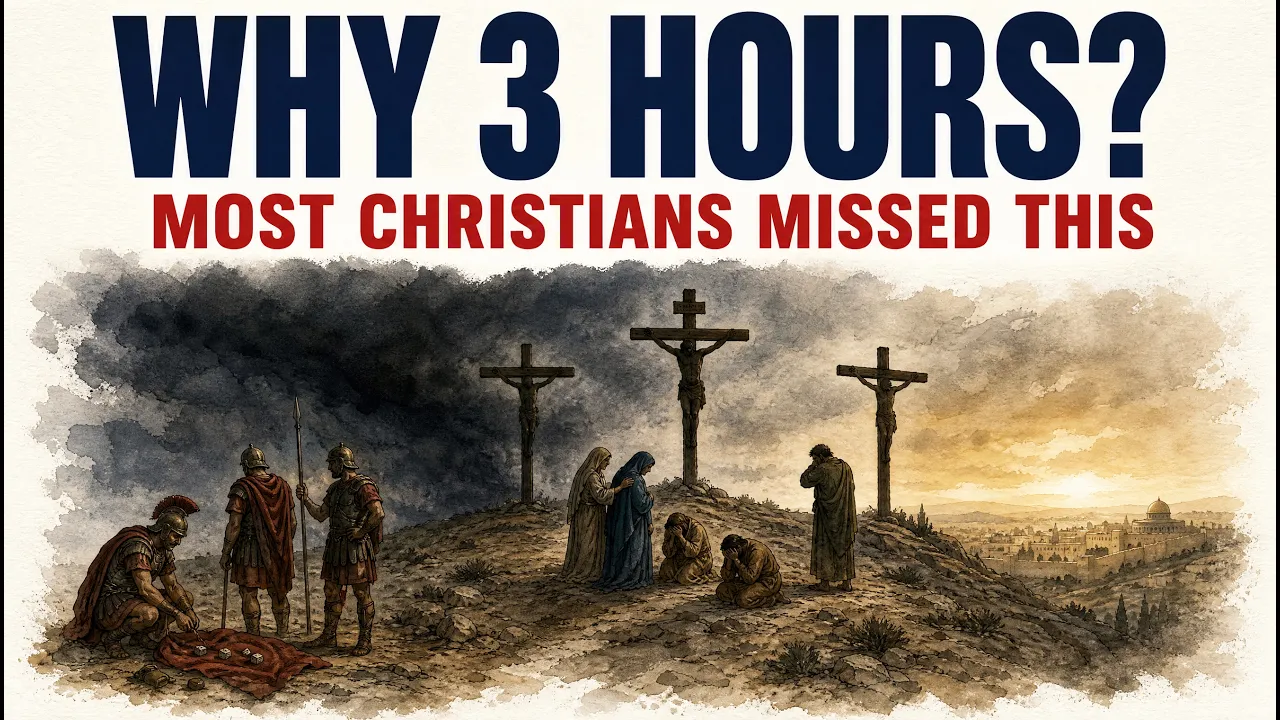
Outside the city wall on a low rise beside a road, three men are dying and one of them has been hanging there since 9 that morning. And then the light goes out. Not slowly, not the way evening comes.
The sun is directly overhead at the top of its ark in the clearest part of the day. and the land goes dark. It stays dark for 3 hours.
Then, at the exact moment the darkness breaks, the man in the middle cries out and dies. Most people read past this in about 4 seconds. It gets treated like stage lighting, something dramatic that the gospel writers added to set the mood.
The way a film score swells before somebody dies. And so, the darkness becomes background atmosphere. But that is not what it is.
The darkness is not atmosphere. It is a quotation. Here is the claim this whole study is going to prove.
Every Jewish person standing on that hill knew exactly what a sudden midday darkness meant because it had happened before in their national memory and their prophets had promised it would happen again. When the sun failed over Jerusalem, God was not creating a mood. He was speaking in a language Israel already knew how to read and he was saying three specific things at once.
We are going to look at all three. We are going to start with what the text actually says in Greek, including one detail in Luke that scribes tried to fix for centuries. Then we are going to follow the darkness backward through the Bible to a night in Egypt to a warning from a farmer prophet in the 8th century before Christ.
And finally to a much older and much stranger darkness that fell on one man in the middle of a covenant ceremony. By the end, I think the three hours will read very differently than they did an hour ago. All three synoptic gospels record it and they record it with a precision that is easy to skate past.
Mark 15:2 tells us when the crucifixion began. Now it was the third hour and they crucified him. In the Jewish reckoning, the day was counted from sunrise.
So the third hour is roughly 9 in the morning. Then Mark 15:33. Now when the sixth hour had come, there was darkness over the whole land until the 9th hour.
The 6th hour is noon. The 9th hour is 3:00 in the afternoon. So the arithmetic is this.
Jesus was on the cross for 6 hours. The first three were in full daylight. And those are the hours of the mocking, the dividing of the garments, the sign above his head, the conversation with the thief.
The last three were in darkness, and the record of those hours is almost completely silent. Matthew 27:45 says the same thing. Now from the sixth hour until the 9th hour there was darkness over all the land.
Now the Greek the word Matthew and Mark use for darkness is scotas and it is the ordinary word for darkness but the phrase around it is worth slowing down for. Matthew writes epipan tengen. The word gay can mean the land in the sense of a specific territory or it can mean the earth in the sense of the whole inhabited world.
The New King James Version renders Matthew and Mark as over all the land and Luke as over all the earth. And honestly, both are defensible translations of the same word. Nothing in the grammar settles it.
Some readers take this as a regional darkness over Judea. Others take it as global. The text allows either, and I am not going to pretend it settles a question it does not settle.
But Luke gives us something the other two do not, and it is one of the most interesting textual details in the Passion narrative. Luke 23:es 44 and 45 in the New King James Version reads, "Now it was about the sixth hour, and there was darkness over all the earth until the 9th hour. The sun was darkened and the veil of the temple was torn in two.
" That phrase, "The sun was darkened," translates a Greek verb, escatiste. It is a flat, ordinary word. It just means the sun went dark.
Let us start with the text. Here is what most people never realize. That is what the majority of Greek manuscripts say.
But the earliest manuscripts we have, including some of the oldest and most respected copies of Luke in existence, do not say that. They say to Helioontto. And that phrase is built on the verb eclipo, which is where we get our English word eclipse.
It can mean simply that something failed or gave out. It can also carry the technical sense of a solar eclipse. And that is a problem because a solar eclipse at Passover is astronomically impossible.
Passover falls on the 14th of Nissan and the Jewish calendar is lunar. The 14th of Nissan is a full moon. A full moon means the earth is between the sun and the moon.
A solar eclipse requires the opposite arrangement with the moon between the earth and the sun which only happens at a new moon. You cannot have a solar eclipse at Passover. It is not a matter of probability.
It is a matter of geometry and even if you could it would not help. The maximum duration of a total solar eclipse at any point on the ground is a little over 7 minutes. The gospels describe 3 hours.
So what happened in the manuscript tradition is that later scribes copying Luke ran into the phrase about the sun failing recognized the astronomical impossibility and smoothed it. They swapped in the flatter, safer word, which is exactly why most textual scholars think the harder reading is the original one. Scribes tend to simplify difficulties, not create them.
Luke, a careful writer who tells us in his opening lines that he investigated everything closely, most likely wrote a phrase that describes the sun giving out. And he was not writing an astronomy report. He was describing what people saw.
The light source failed. This is worth pausing on because it cuts both directions. It rules out the tidy naturalistic explanation and it also rules out the sloppy apologetic version that says an eclipse proves the Bible.
Neither one works. Whatever happened over Jerusalem that afternoon, the Gospels are not describing a predictable orbital event. Before we get to the best part, which is why you clicked on this video, I want to quickly make this clear.
Also, there are non-Christian writers who get cited at this point, and I want to handle them carefully because they get oversold constantly. The first is a historian named Thalus who apparently wrote sometime in the first century. We do not have a single line of Thalus.
His work is completely lost. What we have is a 3 century Christian writer Julius Africconus saying that Thalus explained a darkness as a solar eclipse and then Africanis arguing back that an eclipse at Passover is impossible. So we have a Christian writing roughly two centuries after the event characterizing an argument in a book nobody has seen since that is thin.
It may indicate that a memory of an unusual darkness circulated outside Christian circles. It may not scholars genuinely disagree and the case has been argued in both directions in peer-reviewed journals. The second is Flegon of Tales a Greek historian writing around the year 137.
Flegan is quoted by origin by Ucius and by Jerome. And the quotation describes a great failure of the sun in the fourth year of the 202nd Olympiad with darkness at the sixth hour so deep that stars appeared and an earthquake that damaged the city of Nika. The date works out to roughly the year 33.
But Nika is in Bethnia in what is now northwestern Turkey about 800 miles from Jerusalem. Fleen does not mention Judea. He does not mention Jesus.
So here is the honest assessment. These sources are suggestive. They are not proof.
And anyone who tells you they are proof is overselling. The primary witness to the darkness is the gospel record itself. And the gospel record is what we are going to work with.
Because the gospel record is also the only place where the darkness is given a meaning. And that meaning starts in Egypt. Turn back to Exodus 10.
Nine plagues have already fallen on Egypt. The ninth one is the strangest of them, and it is the one immediately before the last. Then the Lord said to Moses, "Stretch out your hand toward heaven, that there may be darkness over the land of Egypt, darkness which may even be felt.
" So Moses stretched out his hand toward heaven, and there was thick darkness in all the land of Egypt 3 days. They did not see one another, nor did anyone rise from his place for three days. But all the children of Israel had light in their dwellings.
The Hebrew word there is koshek. And notice what it is doing. This is not nighttime.
Hebrew has a perfectly good word for night liel. And this is not that word. Chosk is darkness as a condition.
Darkness as something that presses in. The text says it could be felt. People did not move.
They could not see each other. For 3 days, Egypt sat still. And there is a reason this plague comes ninth and not somewhere else in the sequence.
Egypt's chief deity was a sun god. The darkness was a direct strike at the thing Egypt trusted most and it landed right before the blow that broke Pharaoh. Because what comes next in Exodus 11 and chapter 12 is the death of the firstborn and the blood of a lamb on the doorposts and the first Passover.
So hold the sequence in your mind because this is the whole point. Darkness, then the death of the firstborn, then a lamb and blood and deliverance. Now go back to Golgatha at Passover at noon.
Darkness falls over the land for 3 hours. And when it lifts, the firstborn dies. Paul calls him exactly that in Colossians 1:15.
He is the image of the invisible God, the firstborn over all creation. And back in Exodus 4:22, God had given Moses a message for Pharaoh. Thus says the Lord, Israel is my son, my firstborn.
In Egypt, God spared his firstborn son and struck Egypts. At the cross, God struck his own. And here is the detail that should stop you cold.
In Egypt, the darkness fell on Egypt. And the children of Israel had light in their dwellings. At Golgtha, the arrangement inverts.
The darkness settles over Jerusalem, over the covenant people, over the holy city at its holiest week. And the one inside the darkness is the sun. The plague did not skip the house this time.
It landed on the doorpost. If you have ever wondered whether the God of the Old Testament and the God of the New Testament are the same God, this is one of the places to look because he is doing the same thing with the same signs and the second time he absorbs it himself. If this is opening the passion narrative up for you in a way you have not seen it before, help us get it to somebody else.
Subscribe, leave a comment, share it with a friend who reads their Bible closely. That is genuinely how more people find this. Now the second meaning and for this one we go to a prophet.
Amos was not a professional. He tells us himself that he was a herdsman and a tender of sycamore fruit from a small town called Takcoa in Judah. And God sent him north to the wealthy, comfortable, religiously busy kingdom of Israel in the 8th century before Christ.
Israel at that moment had money, a functioning temple system, packed festivals, and enthusiastic worship music. What it did not have was justice. Amos spends chapters describing people who sell the poor for a pair of sandals and then go sing at the feast.
And then in chapter 8, God tells him what is coming. Amos 8:es 9 and 10. And it shall come to pass in that day, says the Lord God, that I will make the sun go down at noon, and I will darken the earth in broad daylight.
I will turn your feasts into morning, and all your songs into lamentation. I will bring sackcloth on every waist and baldness on every head. I will make it like mourning for an only son and its end like a bitter day.
Read that again slowly and put it next to the crucifixion. The sun goes down at noon. That is the sixth hour.
The earth darkens in broad daylight. A feast is turned into morning. And what is Passover if not a feast?
And then the last line which is the one that undoes me every time. The grief of that day is compared to mourning for an only son. The Hebrew word for only son there is yahed.
It means one and only, singular, irreplaceable. And there is exactly one other place in the Hebrew Bible where that word carries this much weight. Genesis 22:2.
Then he said, "Take now your son, your only son Isaac, whom you love, and go to the land of Mariah, and offer him there as a burnt offering, same word, Yakaid, a father, a mountain, an only son, and a sacrifice. " Amos was not the only one. Joel 2:31 says, "The sun shall be turned into darkness, and the moon into blood before the coming of the great and awesome day of the Lord.
" Zephaniah 1:15 describes the same day, a day of darkness and glooiness, a day of clouds and thick darkness. Isaiah says, "The stars will not give their light. " The pattern is consistent across the prophets, and it is not subtle.
In the Hebrew Bible, a sun that fails at midday is not weather. It is the signature of the day of the Lord, the day when God finally settles accounts. So when the sun failed over Jerusalem, anyone who knew the prophets knew what was being announced.
Judgment day had arrived. And here is what most people miss about that. The day of the Lord did come.
It landed. It fell with full weight. It just did not fall where anyone expected.
Isaiah 53:10 says something that people rush past because it sounds harsh. Yet it pleased the Lord to bruise him. He has put him to grief.
And Paul puts it in the plainest terms anyone has ever put it in 2 Corinthians 5:21. For he made him who knew no sin to be sin for us, that we might become the righteousness of God in him. The darkness of the day of the Lord came down on one man at noon outside a city wall, and he was the only one there who did not deserve it.
Amos said the day would be like mourning for an only son. He was more right than he could possibly have known. Which brings us to the third meaning and this is the one almost nobody teaches.
Go back further than Egypt. Go back to Abram before the name change before Isaac when he is an old man with no children and a promise he cannot see how God intends to keep. In Genesis 15, God tells him to bring animals and cut them in half and lay the pieces in two rows with a path between them.
That sounds bizarre to us. It was not bizarre to Abram. This was how covenants were sealed in the ancient near east.
The parties to the agreement would walk between the divided animals and the walk was a spoken oath in body language. It meant if I break this covenant, let it be done to me what was done to these animals. People sometimes call it a self-meloic oath, which is a formal way of saying you are calling down a curse on yourself if you fail.
So the pieces are laid out. Abram drives off the birds of prey. And then Genesis 15:12, now when the sun was going down, a deep sleep fell upon Abram, and behold, horror and great darkness fell upon him.
The Hebrew there is amah hoseka gedola. Terror and a great darkness. And that word hashek is the feminine form of the same root we saw in Egypt.
Hosek. This is the same family of darkness. Thick, pressing, dreadful.
Then verse 17. And it came to pass when the sun went down and it was dark that behold there appeared a smoking oven and a burning torch that passed between those pieces. Now here is the detail that changes everything.
Abram does not walk. He is asleep. He is on the ground in the darkness unable to participate.
God appearing as fire and smoke walks the path alone both directions. God takes the oath for both parties. Think about what that means.
God is saying in the most binding language that culture possessed that if this covenant fails from either side, the penalty falls on me. If Abrams descendants break faith, the curse comes to me and he swears it in the dark. Now come forward roughly 2,000 years to a hill outside Jerusalem where a descendant of Abraham is hanging on a Roman cross and the sun fails at midday and darkness covers the land for 3 hours.
The covenant did fail. Israel broke it repeatedly, and the prophets say so at length. And the God who swore in the darkness that he would carry the penalty personally came back into the darkness and carried it.
The smoking oven and the burning torch walked that aisle alone in Genesis. And he walked it alone again at Golgtha. If you are finding connections here you have never seen before, take a second and pass this along to someone who loves digging into the text.
Hit subscribe so you do not miss what is coming because the last piece is the one that ties all three together. Now the silence. Something is easy to miss about those three hours.
Almost nothing is recorded from them. During the daylight hours, we have the mocking, the soldiers gambling, the criminal on the other cross, the words to his mother. Then the darkness comes and the record goes quiet.
Then right at the end at the 9th hour, one cry. Matthew 27:46. And about the 9inth hour, Jesus cried out with a loud voice, saying, "Eli, Eli, Llama Sabaki.
" That is, "My God, my God, why have you forsaken me? " That is not a spontaneous cry of despair. That is a quotation.
It is the opening line of Psalm 22. And he is not speaking Greek. And he is not quite speaking the Hebrew of the psalm either.
The word Sabbaki is Aramaic, the everyday language of first century Galilee. Matthew records it as Eli. Mark records it as Eli and that small difference explains what happens next because some of the bystanders mishar it and think he is calling for Elijah.
But go read the psalm he is quoting. Psalm 22:es 1 and 2. My God, my God, why have you forsaken me?
Why are you so far from helping me? And from the words of my groaning, oh my God, I cry in the daytime, but you do not hear. and in the night season and am not silent in the daytime and in the night season.
On a hill where the daytime had become night, he quotes a psalm that names both. And then there is the timing of the cry which is not an accident either. The 9th hour 3 in the afternoon was the hour of the evening sacrifice at the temple.
Josephus writing in the first century says the Jews offered sacrifices twice each day in the morning and about the 9th hour. The Mishna gives slightly different times, saying the afternoon offering was normally slaughtered around half the 8th hour and offered around half the 9th and that on Passover Eve everything shifted an hour earlier and 2 hours earlier when Passover Eve fell on a Friday. Josephus elsewhere says the Passover lambs themselves were killed between the 9th hour and the 11th.
So, the sources vary by an hour or two and I want to be straight about that rather than flatten it. But they all put it in the same window of midafter afternoon and the 9inth hour sits inside that window. The practical picture is this.
At the moment Jesus cried out and died, priests a short distance away were at the altar and the smoke of the evening sacrifice was going up over the city and lambs were being killed by the thousands for the meal that evening. I should flag something here because you will hear it in a lot of sermons on this passage. The claim that the high priest declared it is finished as he killed the Passover lamb at the same moment Jesus said it from the cross is repeated everywhere.
I went looking for the source. It is not in the Mishna. It is not in Josephus or Pho.
It traces back to modern popular books, not to any ancient record of temple practice. It is a beautiful idea and there is no evidence for it. And this channel would rather hand you a smaller true thing than a larger one that will not hold weight.
The real connection is stronger anyway and it does not need help. Jesus died at the hour of sacrifice that is in the text. And one more thing happened at that hour and it happened in the dark or right as the dark lifted.
Matthew 27:51 then behold the veil of the temple was torn in two from top to bottom and the earth quaked and the rocks were split. Sit with the order of those two events. God shut off the light and then God tore open the curtain.
The last thing closed was the sky. The first thing opened was the way in. So what were the three hours of darkness?
They were Egypt replayed and reversed with the plague landing on the firstborn instead of passing over him. They were the day of the Lord that the prophets had promised for 800 years, arriving exactly on schedule and falling on the wrong person on purpose. And they were the darkness of Genesis 15 where God had sworn to carry the covenant curse himself coming back to collect on his own oath.
Three hours, three testimonies, one verdict absorbed by one man. So what does this mean for you sitting where you are right now? First, it means that God's judgment is real and it is not softened.
There is a version of Christianity floating around that treats sin as a misunderstanding and the cross as a nice gesture. The darkness argues against that something happened in those 3 hours serious enough that creation itself shut down for it. If you have ever felt that your own failures are too heavy to be waved away, you are reading the situation correctly.
They were not waved away. They were paid. Second, it means that the worst thing that ever happened was also the most planned thing that ever happened.
Amos saw it seven centuries out. Abram walked into the edge of it in a trance. Moses watched a rehearsal of it in Egypt.
This was not God improvising in a crisis. If you are in a stretch of your life right now that looks like chaos, that does not feel like a plan. Hold that next to a hill where the sun went out and everyone present was certain that God had lost.
They were watching the plan. And maybe the part that stays with me most is this. Jesus quoted a psalm about being forsaken while he was inside the darkness.
He was not describing something he observed. He was describing something he experienced. Which means when you are in your own version of that in the hospital corridor at 2:00 in the morning, in the silence after the diagnosis, in the room where the marriage ended, you are not talking to a god who is unfamiliar with the territory.
He has been in the dark. He knows what the inside of it looks like. And he did not stay.
Because here is the last thing, and it is the simplest thing in this entire study. At the 9th hour, the darkness ended. It did not last.
It was measured. It was bounded. It had a beginning and it had an end.
And on the far side of it, the veil was open and the way to God was standing wide. John writes in his first letter that God is light and in him is no darkness at all. And Paul writes to the Colossians that he has delivered us from the power of darkness and brought us into the kingdom of the son of his love.
The sun went out over Jerusalem for 3 hours so that it would never have to go out over you. If this opens something up for you, help us reach someone else with it. Subscribe, leave a comment.
Even one word helps more people find this. Share it with somebody who needs to hear it. Pray for us.
God bless you.