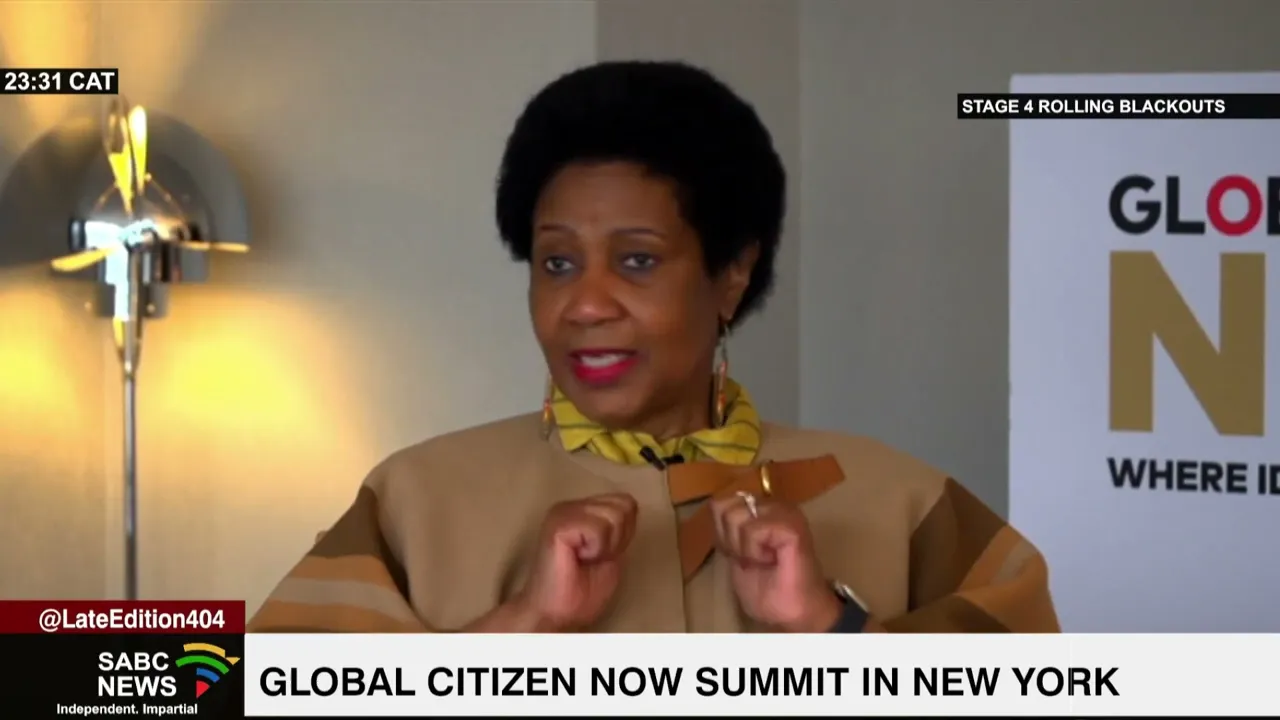
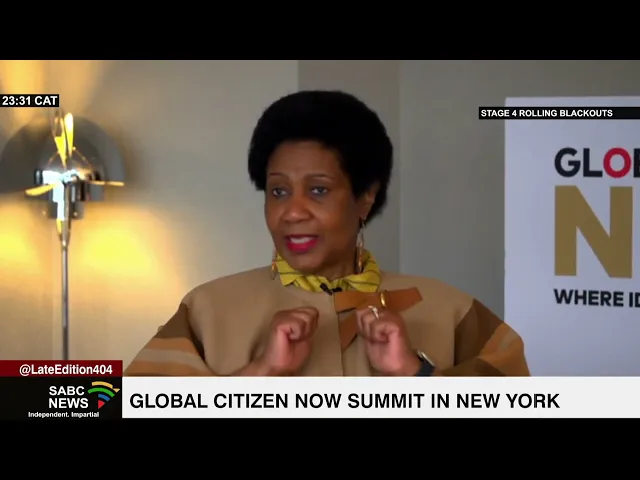
welcome back former deputy president Dr pumzilim lambonuka has described South Africa's foreign policy as fuzzy right now and called for greater government engagement with civil society and human rights activists she was speaking to sabc news on the sidelines of the global citizen now Summit in New York that focuses on tackling poverty and climate change among other sdgs she called on the government to use its proximity to Russia to call for the cessation of hostilities in Ukraine and to put pressure on Moscow to come to the peace table she also talked about her recent visit to
Ethiopia women's rights in Afghanistan and the broader implementation of the sustainable development agenda as always thank you for making time for sabc news thank you so much it's it's wonderful to be back in New York you've come straight to New York from a visit to Ethiopia where of course you played a very key mediation role in the peace deals struck in Pretoria last November what did you find in Ethiopia and what messages do you bring to this Summit in New York a lot of progress has been made in the implementation of the peace there certainly
Association of hostilities which was a priority and silencing of the guns we still may have a sporadic skirmishes and people dying but nothing like what was there before the withdrawal of the foreign forces Eritrea in particular and the moving away of heavy artillery which was a dangerous the restoration of services like telecommunications banking not to the full extent we still need to see more progress there we also need to see more progress in the opening of the schools because we have many idps who are taking hostage in the schools who are afraid to go back
to their homes because the evacuation of foreign forces has not been completed but so we're pushing to complete that process the implementation of any PC will always take time and while you you focused on that you now see what's happening in Sudan two male generals at each other's throats creating additional instability in what is already a very fragile region in Africa and of course this also speaks to you know the au's ambition of silencing the guns come 2030 that is seeming to be further and further away given what we're seeing happening in Sudan now yeah
just important to say that I'm still worried in Ethiopia about the engagement of women in the peace process this is something we still have to to work towards and of course we as you see we have a sudan as well it is a difficult neighborhood and that's for sure and the fact that the fighting in Sudan as well is internal it's uh two forces fighting within the same countries living very little space for for people to find a safety uh the Au does need all the help it can get for assist fire for ensuring that
the two generals realize that the the fighting that they have started there is actually alienating them and their leadership from the people they want to to rule over so we're looking forward to see who the African Union will send to to Sudan to facilitate peace I know that in South Africa they have sent or identified the deputy president is an Envoy who will assist in bringing about peace are there any immediate lessons that you know every situation is different obviously but are there any immediate lessons that one can learn from the process in Ethiopia that
might be able to be applied in Sudan my biggest takeaway is that if the two fighting parties have not reached a point where the fighting does not serve their interest it is difficult to stop them in Ethiopia the tplf and the government wanted the fight to stop because on the part of tplf the dying of civilians children women and all the suffering that was happening they had just reached a point where it was unbearable on the side of government the decline in disruption in the economy was very difficult and was causing a lot of hardships
as well as the loss of life on the parts of the soldiers of in the Ethiopian Army so on both sides there was something that they wanted to sort out and they were able to come together to the negotiation table both of them really committed to get a cessation of hostilities of course when we talk about the eradication of poverty one cannot ignore the proliferation of guns and conflicts around the world no less with the global implications that have been wrought by the war in Ukraine what have you made of South Africa's neutral position in
terms of the war and and its subsequent position vis-a-vis the arrest warrant issued by the international criminal court I think it's important to continue to call for cessation or facilities in in Ukraine anymore fighting in Ukraine is not only horrible for the people of Ukraine and the region it is a problem for so many other people um in the world so one of the best things that South Africa can do is to use its proximity to Russia to put pressure on Russia to actually come to the peace table there is growing concern about South Africa's
foreign policy positions under the uh administration of former president Nelson Mandela Adams an Administration that you were part of Human Rights was at the center of South Africa's foreign policy there is concern that that is no longer the case once you what's your view I think we need actors such as civil society human rights activists to actually engage government about the forecast of South Africa's foreign policy so that we can all recognize the strings of foreign policy key points in whatever they are doing it in whatever country that they're doing it's a bit fuzzy right
now and it's important to have clarity does South Africa require additional Clarity on its International obligations as it pertains to its membership of the Rome statute and the international criminal court is there a debate to be had about what South Africa should do if an indicted person of the ICC sets food in the country well the we have South African government and we have the parties and sometimes the two don't want the same thing and that is the challenge that we have there has to be an effort to make sure that the the the what
the party stands for and what the government stands for are aligned I think right now there are challenges as far as that is concerned you might be heartened by the resolution that was passed in the U.N security Council yesterday on condemning the taliban's position as it relates to women in Afghanistan particularly women working for the United Nations for ngos and of course the ability of women to go to school and to get a tertiary education what do you make of that resolution and you know the difficulty always comes down to implementation we've seen this before
How concerned are you that this is another resolution that might just be ignored well the situation in Afghanistan is atrocious uh but definitely is the need for everyone to continue to to continue calling for peace and the United Nations is an important voice so it's important to listen to The Voice Global citizen has supported the un's call for peace and I think we'll continue to to to to to do so but we actually need also to support the United Nations with the implementation of these many resolutions that are being passed I think it is going
to be difficult because access to Afghanistan is itself a difficulty to work in Afghanistan to move around continuous uh to to to to be a problem and of course two-thirds of that population isn't reliant on humanitarian relief yeah and we need uh foreign governments to stay in Afghanistan and not abandon Afghanistan in order for any change to happen we require people who believe in the affirmation of of women and the empowerment of women and the involvement of women to be on the spot this is not something you can do from outside one of the core
issues of global citizen is of course the eradication of poverty and of course a very big focus on climate change and mitigation in that regard but the big concern in terms of the sdg agenda is of course the lack of implementation as the 2030 agenda Looms on us the uh this Summit has now launched a power our planet act today save tomorrow campaign what do you make of this initiative as it feeds into the broader International agenda around the sdgs well it's it's important to send messages especially to young people because honestly I think young
people are the ones that are going to help us to move forward so a call from Global citizen which will land on young people is important but I think we also need to as globalism to follow up with those young people and give them the means the capacity for them to make the follow-through impactful then the last the young people have got numbers so you are able to implement in many parts of the world and this is about their future if we are not able to do something about the climate crisis now we are living
these young people in a terrible situation I was in the plenary earlier and there was a bit of a discussion around artificial intelligence and of course I I recently interviewed a professor chiditsi marwala the new director of the UN University and he talked about how digital literacy needs to become a human right you talk about young people the role of Technology young people in this ambitious agenda that is the sdg yeah well this is now the work that I do this is my everyday bread uh and I see in schools in South Africa the challenge
of young people and teachers who are digitally illiterate it's a big problem it is a big problem women who are digitally illiterate who were obviously left out in the first Industrial Revolution second in that third the fourth Industrial Revolution is critical we cannot leave women young people poor people because this is now the language of the future if you don't speak the language you will not hear what everybody is saying about you and it will impact you in the most negative way if you are unable to be part of the conversation so this is a
this is a priority work in our work it's um Foundation we find that once the teachers get it and they are able to see the need to transmit their skills and capabilities to to to the Learners their anxiety you know they want gadgets they want infrastructure and it's good once you reach that point because at least you are both working for the same goal doctor as always thank you for sharing your perspectives with us we certainly do appreciate it thank you thank you thank you very much

![[FULL INTERVIEW] Namibia's President-Elect Netumbo Nandi-Ndaitwah](https://img.youtube.com/vi/q_svSXqBoJk/maxresdefault.jpg)