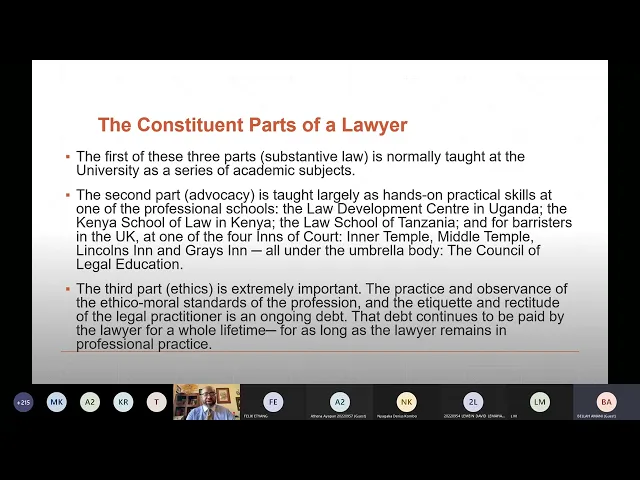
Right good morning so uh uh so yeah so let's uh continue off from uh where we left off last week i hope everybody can hear me i hope uh if but um felix thank you okay so uh i trust that you've all received the materials that uh i had shared with your class reps and that they've gotten them out to you uh i think i shared with you approximately four or five uh four or five readings uh in terms of just uh priority as to how i probably want you to to to to look at
these readings and i hope that you've had the opportunity to to to go through them but in terms of how i would want you to to to to look at them i'll just tell you what's important so uh there's one uh article uh which i shared with you uh and this is by uh [Music] this hold on one moment uh there's a a brief history of Professional ethics by mark humphries who's an english practitioner and it's a fairly and uh enlightening article about the history of the legal of legal ethics his title ethics in the
legal profession and what mark humphreys does is that he takes he walks you through essentially the evolution of professional ethics from the start of the legal profession as we know it formerly uh in the 13th century and the various iterations of uh codes of conduct and so on that have happened uh throughout the next uh you know 800 years or so and he then eight nine hundred years and of course he talks about significant litigation the sources of these ethical rules of conduct starting off with uh the fact that the earliest lawyers were practicing in
canonical courts and and so the the various reasons why these rules have evolved uh rules against lawyers double dealing uh you know avoiding conflicts of interest working for the indigent without a fee and so on and so forth so it's a useful article to read in terms of just giving you that historical perspective and of course because we've inherited uh our legal traditions from the english common law so this history is useful to us in terms of understanding the evolution Uh of of of of the practice of law over the years okay so that's uh
that's an important article uh then i also shared with you uh uh [Music] an extract from the book by justice ogola who had uh i've cited in last week justice ogola of course being a former chief justice of the republic of uganda and he has written a book called legal ethics and professionalism a handbook for uganda but again it has lots of useful things to learn specifically because it's contextual and a lot of similarities between the practices in uganda and our practice here in kenya so again that is a useful introductory text for you to
get a quick overview of ethics and he has titled the heart and soul of the legal profession uh then i shared with you also the code of ethics and conduct for the legal profession which was issued by the law society in january of 2016. However you will note that if you look for the gazetted version these were gazetted in 2017. so when i refer to 2016 code of conduct you know 2016 2017 uh it's the same document it's just that the gazetted version was in 2017. okay so just to make that clear so we're not
talking about two different uh documents so the code of ethics and conduct is going to be a significant uh the source uh of uh information for us during the course by the end of this year you'll probably have internalized the code of conduct uh completely for those of you who have managed to have a look at it you will see that it is organized in in by way of three sort of categories or in a hierarchical manner so you have values and principles of professional conduct uh right at the top you then have uh rules
of professional conduct and then you have guidance or interpretation of those particular rules okay so you will see that for example the overriding rules uh will be set out right at the beginning i mean the overriding principles okay uh and these are uh there are eight nine ten ten Uh principles that you need to internalize uh we will not go into them now but it's just important that you start familiarizing yourself with the 10 overriding principles you then have rules of professional conduct again you'll find that the rules are only 12 they're easy to again
to internalize and then you have guidance and interpretation on the rules okay which now expands and explains the rules and how this should be applied how they should be interpreted so that's a significant text and i hope you will take time to familiarize yourself with that with the code of ethics what i have not shared with you of course is the advocates act which is a primary statute that regulates the legal profession i assume you have access to it so i don't need to share that with you and you will also need to have an
understanding of the law society of kenya act so again those two statutes are very significant i'm not going to mention the constitution because that goes without saying uh and just as by the way you should be able to get the detailed course outline by in the course of next week uh just being fine-tuned between the the four lecturers who teach this course so once we've agreed on it it will be distributed to you uh sometime next week or even as early as us as today okay then The other thing of course then that there's one
text again that i would really urge you to read and this is an extract from a book called inside lawyers ethics and i shared with you chapter one and chapter two of this book inside lawyer's ethics by christine parker uh australian uh lawyer commentator author scholar okay and and uh again that's an important read if you just uh read those again it introduces you to certain perspectives of of professional ethics of legal ethics uh unfortunately because we don't have enough contact hours this is a text that i would really want you to get into depth
with okay inside lawyer ethics uh if you read it there's a series there two case studies that are quite um illustrative in this particular text now if you read those two case studies uh they start giving you a very good understanding of some of the ethical dilemmas that lawyers face in the course of practice within that text as well you will find that there are some questions which are posed at the end of the each chapter there's a series of discussion questions now i expect you within your firms to spend some time trying to address
those questions first of all individually as you read the text look at the questions that are posed at the end of the chapters and then have a Discussion within your firms as to you know uh what those questions uh you know how you've approached them what your thinking is and so on and so forth okay now again like i said because of our contract hours uh i wish i could go get into a lot more detail on some of these issues but the challenge is that we would probably take a whole class discussing just for
example the case study on what you call slapsticks or suits that are filed to just prevent for example human rights activists or labor activists or unions from challenging let's say large corporations so the large corporation will go and sue an ngo and uh and and you know uh and that ngo will then you know to just stop them from or to keep them so tied up in litigation okay and uh trying to answer lawsuits and so on that they get intimidated so that any other let's say uh human rights activist or gender activist trying to
sue this organization will think twice about it because the litigation they know that this this corporation for example or the government will go after you uh and you'll have to spend a lot of money defending yourself and so on now lawyers who engage in that kind of thing is it ethical to do that Okay and so on so these are very interesting uh debates that are stimulated by that that particular that particular reading okay and then there are two other readings which you can read now or you can decide to read them as we go
along uh one is an extract from a book called tomorrow's lawyers i'm not sure whether that book is in the library had asked them to buy it i have not checked whether they it was actually bought and stocked in the library by richard suskind professor saskind is a professor of law at oxford university and he talks about the future of law so i've i've shared with you an extract from his book okay uh interesting reading in terms of uh trends as to where the legal profession is going uh and then the other article that i've
shared with you that we will refer to probably again later in the course but i'm actually introducing you to it very early is the one titled law business or profession this is from the yale law review 1908 okay and that's right 19 the year 1908 okay which is uh a century plus ago when this this this was written now that is uh it's written in a very interesting style it has never gone out of fashion Everything that is shared in that particular paper is relevant today as it was relevant in 1908 okay and it's written
in a manner of a discussion between two distinguished uh older lawyers and a young lawyer is listening in on that conversation very interesting read and i can tell you that in one past paper there was a compulsory question that was based around this particular particular reading okay so tomorrow's lawyers and law business or profession you probably can read them later you can read them now depending on what your what your preference is okay but the others i would hope that by now you have you have covered them okay so that's just by way of uh
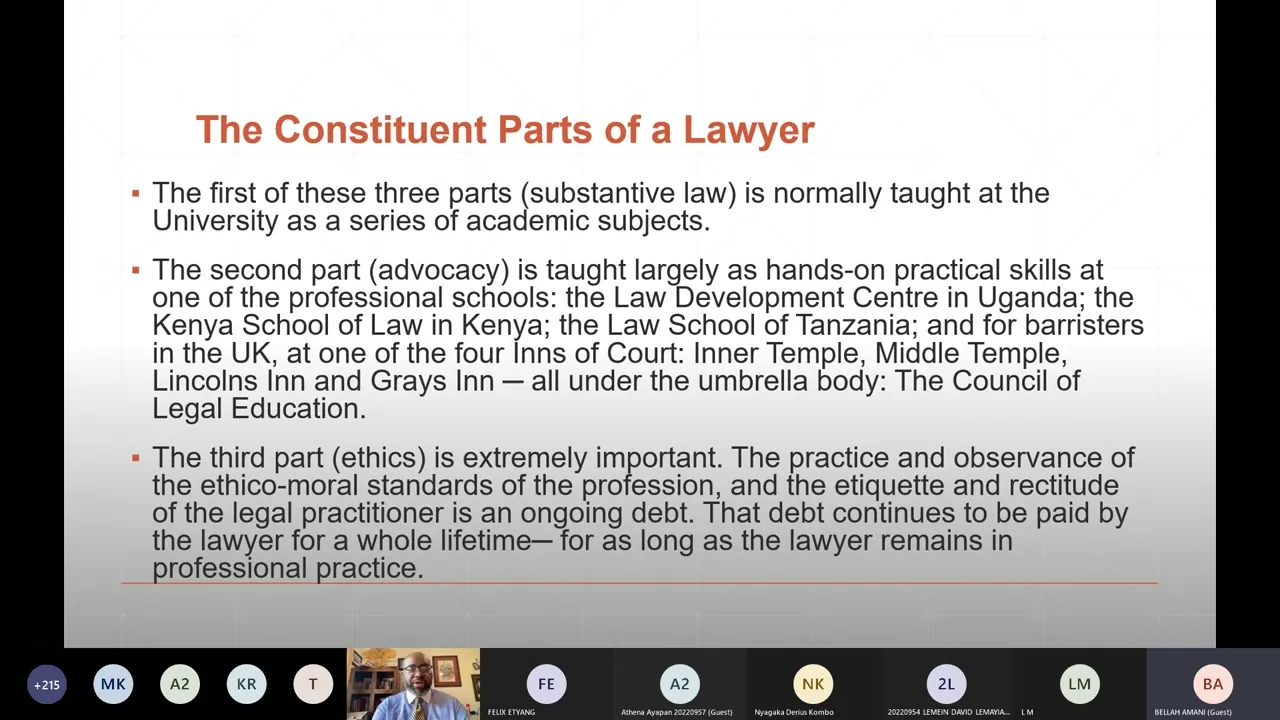
introduction or rather just walking you through the readings now so where we are cut off where we had stopped last week was we had started looking at or explained that the lawyer is constituted of three parts and uh that the first part is essentially uh you know the stuff that you learn at the university the knowledge part uh knowledge of the law then the second part is the practical skills that you obtain or your you know is given to you at bar training institutions like the kenya school of law and then The third part is
the ethics okay the law of lawyering uh as you shall see as it's described in one of the readings okay the law of lawyering or the practice of the observance of ethical and moral standards of the profession okay and so those are the three constituent parts of a lawyer so we're going to continue with this introductory part and please just note that you know in this particular part we're just sort of like introducing uh ideas as we go along we shall get a lot more granular in terms of the issues and ideas that will be
introduced uh we'll get into a lot more depth uh and a lot more discussion okay so and uh this will be probably the last introductory class now for those of you who will have done the readings by the time we get to the next class we're going to have a quick dive into into the the philosophy philosophical underpins of ethics okay that will be the next class so ah this is not moving okay okay and i think we also talked about we may have mentioned that uh the reason why their ethical cause of conduct for
the practice of law is because in this adversarial system that we Operate in what tends to happen is that things can get very heated okay if you have two competing sides uh and like i said it's like a boxing match then you must have a system of sure that everybody who's losing something much of this fight or this engagement is playing within rules okay that ensure that there's order the civility uh and so on okay and that is why to an outside observer the practice of law has a lot of you know unnecessary etiquette and
norms of behavior that look outdated and which you know look like they're exaggerated and so on so the practice of calling each other you know my learned friend the the use of certain terms the use of objective or you know objective terms and correspondence and so on trying to avoid subjectivity these are all for for specific reasons okay so the reason why you don't want to write emotional letters to your colleagues okay although i have seen nowadays some very interesting examples of of lawyers writing to each other and referencing premiership matches and so on you
know somebody in submissions referring to manchester united and so on i mean we see these examples circulating In social media but the idea has always been that uh that good manners decorum politeness uh civil language all these things are designed to make sure that even when you're involved in a very heated adversarial combat that nonetheless at the end of the day when you leave this matter it's about it's a client's matter it's not the advocates matter so advocates are not supposed to take things personally okay and that objectivity should come through in your submissions in
your arguments and so on you can be passionate yes but you can be passionate without getting overly emotionally uh involved and when it comes to this issue of decorum so there's a very interesting debate that was going on in social media and i think i may have shared this last week about whether you know when the supreme court reprimanded these three advocates in various stages of their practicing lives and the debate was whether you know the supreme court was infringing on their freedom of expression and of course one of them uh one of the younger
ones both the most senior one and the and the younger one took very actually all of them took rather competitive approaches towards this particular issue but one question which some neutral observers asked Was that as an advocate when you go to court to represent a client okay and your client and the you know you either win or you lose right but what happens if you lose is it you the advocate was lost personally or is it your client who has lost and therefore how much to use a common expression how much feelings should you catch
if your clients matter is uh is is lost okay do you get to the point where you get into verbal altercations with the judge or the magistrate or the bench merely because the matter is lost i mean how far do you take uh representation okay uh so interesting debates being thrown around there okay but like i said a lot of these issues we shall get into them uh in in a lot more detail especially when you start looking at the role of the advocate as an officer of the court so now let's let's segue into
another issue that we are going to touch on in some in some in a few classes from now now we are all very familiar with the issue of uh lawyer jokes okay and lawyers are the branch of jokes uh You know if you go online and you just google lawyer jokes in fact just i'll do that just as a matter of as an idol exercise you just google lawyer jokes okay google lawyer jokes and see google will hit you with 29 million 200 000 results okay in less than a second okay 29 million hits on
lawyer jokes okay now a lot of them tend to be very harsh okay we laugh we may laugh at them a bit but they tend to be very harsh and i think last week uh i talked about the issue of acceptance and you know this issue of how the public perceives the legal profession okay but every time you see a a joke that is made at the expense of lawyers you sometimes you do then get the impression that to be honest sometimes some of the things that in these jokes there's a kernel of truth hidden
in them somewhere because there's a rogue lawyer who has done something or behaved in a manner that has warranted this kind of harsh uh joke okay so when lawyers misbehave uh you know and they they they make the public lose trust and again i think i spoke about this last week that every time a lawyer does something wrong He's eroding the trust that and the confidence that the public has in the profession and so we are called upon to basically ensure that we behave in ways that that uphold the trust that the public has in
us okay and uh the idea of a noble profession right is born out of this idea that look the only way we remain relevant is by the public believing that lawyers at the end of the day are forced for moral good okay and that the profession is on the side of the if you want to call it the righteous but uh that law is a force for moral good as opposed to being law being a force for oppression or a force for you know uh uh for you know oppressing people and so on okay and
so uh by adhering to the codes of conduct by sticking rigorously to ethical standards we maintain the profession the reputation of the profession okay and so the codes of conduct all the rules and regulations that we shall cover in the course of the year all these are just designed to make sure that lawyers maintain a minimum level of Of professional standards below which if you fall you'll be subjected to severe disciplinary action okay and we will talk about discipline and sanctions and we shall see again when you talk about these issues that the legal profession
is probably the most is a the one that is harshest to its members when a member of the profession transgresses we are actually very very hard on those transgressors and we shall do some comparative analysis and look at doctors we will look at journalists we will look at other professions and see how they treat errant members vis-a-vis how lawyers treat their errant members and we shall see that lawyers in fact do it in the public domain other professions will discipline the members behind closed doors in processes which are opaque nobody really understands and so on
a lot of professions will defend their members to the hilt and we shall look at the medical profession in particular and see how doctors uh protect each other and so on even when they are glaring incidences of of of you know of negligence and so on okay yet lawyers on the other hand are very quick to condemn to punish in a very public way uh people who breach the disciplinary codes and so on again again we will look at the justification for that Uh okay so my thing is on the moving so these flights by
the way are just uh sort of placeholders for our conversation so i don't really have to follow them religiously okay so though so the thing about lawyer jokes like i said so you know the lawyers don't think they are funny okay and no one else thinks they're jokes so and like i said there's so many of them if you go online you'll find so many you know they'll tell you about uh you know so for example you look at some of these cartoons you look at this one okay so our learning friend has just shown
up at uh this is not the polly gates and that's not saint peter okay clearly peter doesn't have a trident a three-pronged trident so the landed friend has showed up at this desk and the gentleman behind the desk tells him that i hope you're not a lawyer or a politician you're trying to diversify down here yes i'm sure you all get what what that that joke is about and there's so many others you know but now when we talk about uh the the so we talk about upholding standards you talk about you know behave in
a way that does not uh bring the the profession into disrepute But again like we said last week it's not that you're existing you know that we're operating in a utopian world that we are living outside kenyan society okay professional lawyers live work operate in the real world okay every day you're transacting with clients be they politicians but they be tender premieres uh billionaires you name it okay matter to touts corrupt traffic officers it doesn't matter we are dealing with these people on a daily basis okay and if we are to look at the legal
profession as some sort of sanctified noble profession but at the end of the day we are operating in a secular world okay uh to use the nomenclature of of of you know of clergy so we are operating in a circular world right so the opportunities that this world offers to you are endless okay the opportunities for you to take in proper advantage of your of your position and your knowledge and numerous okay you can do this against the opposite party you can do it against your client okay so the opportunities are endless okay so you
can con your client you can con the opposite party uh you know and so on and so forth the opportunities are there okay and so the temptations are massive all The time constantly you're in a situation you know somebody comes to you with a brief tells you i want you to do this abcd uh for me i want you to help me hide this money oh i want you to help me pull a scam on this organization or i want to use your client account for this that and the other so these things are always
there i want to use this vehicle to avoid paying tax so the opportunities are there it's not like they're not there and it's very alluring okay for those of you are familiar with the reference those of you are star wars fans i don't know but uh you would know what the allure of the dark side is okay and so it is very tempting to cross that line because the apparent rewards are very great okay instant gratification instant wealth uh and so on okay so lawyers do fall prey to to the allure of this of of
of the dark side okay but the issue is that as a profession we still have to to to believe in certain certain things you know the same way that people who are religious believe in things unseen you know uh you know people are not religious because they have seen god you know they've seen jesus or and so on but it's because they believe they have a whole belief system which keeps them religious okay and they believe in the life uh ever after hereafter and so on which is fine okay And so even for lawyers you
must believe in some higher ideal okay that this profession of ours it cannot just be about making money okay because if you don't have that belief then your effectiveness as a lawyer as an advocate will be severely compromised if you really think that this is just a money-making trade that i mean this thing just to make money then you will find that you may have significant difficulties with the profession and that is why i admire my colleagues who have been decided very early on that they just want to okay the result of your skill the
excellent uh i heard that my internet seemed to be fluctuating foreign oh [Music] okay you can't hear me so i think there's a problem with your connection we lost you we couldn't hear you at all okay let me log out and come back in just make life easier okay let me know if you can hear me now i'll see your hand is up so let me know if you can hear me okay yeah so i was saying that uh one of the if you're going to offer yourself to be to be an advocate then you
need to then tell yourself that look uh i am going to also ensure that i adhere to the uh cause of conduct the doctrines of ethics and so on because you cannot argue and this is what i was saying i think when you couldn't hear me is that you cannot argue and say that you know what i'm just one person i'm just one advocate the profession is so big even if i do something wrong here i'm not going to affect the profession okay you cannot say the legal profession is out there and i am here
i am an individual okay you have to understand that the legal profession is you it doesn't matter how senior or how junior you are every single member of the profession represents the profession if you got admitted today and you went back to your village everybody will call you akili because You are a wakili and you'll be the one who'll be representing okay and the way you behave is the way people will perceive how lawyers behave in their minds they may have an understanding that this is the way lawyers normally behave so if you go and
become the local village drunkard okay then people will say that hey these lawyers of nowadays have become complete drunkards you know whatever happened right so every single member of the profession is a representative of the profession and that is why it is so critical that individual behavior matters because every individual advocate who behaves well means that the entire profession has a good reputation and when one individual behaves badly he trains the entire profession okay and so uh the reputation and structure of the entire profession is dependent on each individual's strict adherence to the creeds and
to the doctrines of ethics okay so every individual matters and individual behavior matters in the profession and this is what sometimes you know people a lot of people lose sight of okay so we have had uh for example when we had a lost society that was very tumultuous and there were a lot of wrangles and infighting and so on and you could see that the newspapers And the commentators and everybody was asking what has happened to the lawyers you used to be so organized used to be so united used to be so disciplined what is
going on this is not lawyer-like behavior this is not what we expect of you yet you will find that the vast majority of the members of the law society were completely disgusted by these ongoing these things going on and saying this is not representative of who we are okay you go to these law society meetings for example and you find a hardcore group of people causing disruption when the news runs in the evening nobody is focused on the good things that are discussed or resolutions that are passed but every focus is on their angles on
the insults and so on and so forth okay so the whole point about professional ethics is that individual behavior matters okay individual conduct matters so never ever imagine that you as a practitioner doesn't matter that your behavior doesn't matter that the fact that you are in some place somewhere behaving in a manner and becoming of an advocate doesn't matter it actually matters okay and that is why the discipline also is very very severe okay we punish misbehavior quite quite severely okay so you can be struck off The role of advocates okay uh you can be
suspended from practice you can be given monetary fines but we'll get again into the whole idea of sanctions okay so let's uh start now getting into you know a bit more substance of what we want to discuss okay of the subject matter uh now i am going to [Music] talk for another 10 minutes and then we can get into a bit of of of a discussion okay so when you want to understand what professional ethics are okay uh there are sort of five issues that you want to wrap your mind around very early on and
when you go to the readings you find yourself being able to address these questions okay so you know questioning first point is what is professional ethics okay so again uh we can look at definitions as to what it is there are definitions which are technical that definitions which are descriptive okay then we can ask ourselves what are the sources of ethics okay and you shall find that there's a myriad of sources we have a black letter law whether it's advocates act whether it's A constitution whether it's you know various statutes you have then regulations and
you have codes that are written by the lawyers themselves because at the end of the day uh the law society of kenya is a members club so it has rules of membership okay so all these are there's common law okay so there are various sources of ethics again we will get into deep dives as to what resources are then of course the question why do they matter again from the readings you'll get a good understanding you'll be able to answer this question why the f why ethics matter and remember we said that the practice of
law is a public service okay it is a service to the public and that is why ethics matter right then another question what are the sanctions when you violate the code of ethics the code of conduct again we will answer that question in due course and what are the mechanisms for enforcement of the codes of ethics and this again is an interesting question you get into various areas you will start seeing that that when you get into the practice of law again it is so tempting to think that because the practice is so individualistic that
there are no oversight mechanisms and then you get very surprised when you when you realize that actually things like Mishandling of clients money there is a whole mechanism as to ensuring that advocates don't do that okay that every advocate has to go through an audit process your books have to be audited every year and so on okay so we'll get into that when we start looking at things like handling client money for example what are the checks and balances that ensure that there's oversight and enforcement of the code of ethics okay now the other day
you know when i got into a bit of uh some twitter beef okay well i didn't i don't beef so it wasn't really a beef you know i don't respond to trolls on social media but the issue was what does it mean to be an office of the court and again you shall very quickly see that one of the strongest oversight mechanisms over the behavior of advocates is actually the court itself okay so when you appear before the court the court has uh supervisory jurisdiction over advocates okay and so you must behave in court you
will be punished okay everything that you do that you write okay uh and again we shall get into all the issue of duties of court so there are many mechanisms that are available for enforcement of these codes of ethics right so that is what we shall spend the next several weeks looking at so let's Attempt to define ethics okay but because ethics ethics is one of those terms that does not lend itself to an easy patch definition okay and so if you look at dictionary definitions of ethics for example you know you will be told
that ethics are the moral principles that govern a person's behavior or the way they conduct an activity okay so moral principles that govern behavior right but we all sort of know what ethical behavior is okay so when when when when you see it when somebody is behaving unethically sometimes you can tell that really this is not ethical okay if you're in a if you are driving and you're in a queue or you're standing in a queue let's say at the bank and somebody comes and walks past you in the queue and goes right to the
front of the queue instinctively you will tell yourself that no that can't be right okay but even the person who's walking past all these people who are who have queued up or driving past all these cars overlapping as we call it in this country even that person themselves know that and yeah what i'm doing is not right right i really should not be doing this okay But nonetheless they do it okay and they do know that twinge that what i am doing is actually wrong but they still go ahead and do it anyway okay so
we know what when somebody is behaving ethically when somebody has been truthful and instinctively we also tend to know when somebody is being unethical okay and we know that ethics are positive and unethical behavior is negative okay so the concept of ethics sometimes is said to be self-evident okay uh so we know that there are certain characteristics that are attributable to ethical behavior you know honesty honor trust integrity you know somebody who is ethical will have these attributes so these words can be ascribed to that behavior okay uh they are selfless you know uh they
have self-esteem they're all these attributes okay okay and then you can tell the opposite you know dishonesty lack of integrity you know immorality there are many things that you can say oh that is not ethical behavior okay when somebody behaves in a certain way right so ethics moral principles that govern a person's behavior okay but the the reason why the definition of ethics is also very problematic is because ethics can also be very contextual And because it's also associated with this concept of morality remember i've talked about moral principles that govern a person's behavior but
then if you use the word morality to describe ethics okay then you have to take a step backwards and then say okay and what is morality okay and so again morality is another difficult uh concept to define okay so if ethics is a moral principles that govern people's behavior then what is morality okay and what is moral okay then you get to morality and morality then is described as those principles that that help you to define the distinction between what is right and wrong or what is good behavior and bad behavior okay principles that help
you determine you know the distinction between what is good and what is bad or what is right and what is wrong okay again you're not sure whether defining morality helps you now to get a better understanding of ethics okay because morality again contextual situational okay so for example at the moment we say that uh childhood marriages are immoral the idea of marrying off girls who are you know 16 and below is immoral okay You know and so on even though communities have practiced this for for centuries you know marrying off uh girls you know as
soon as they you know hit puberty and so on okay but when you go to medieval england for example you'll find many examples of people being married at 14 and 15 even nobility you know queens being married off at 14 at 15 and it was seen to be perfectly uh and morally acceptable okay polygamy seem to be morally wrong in a lot of western cultures yet in a lot of african cultures is morally acceptable okay so again difficult uh concepts okay so in a lot of legal writing legal texts you'll find terms like moral turpitude
and so on but you know uh so so when you know that somebody's immoral you're basically saying this person is doing something which is contrary to usual and accepted and customary rules of right and wrong which somebody should follow okay so when you talk about usual accepted and customary you then move into the realm of the subjective okay so in this society these are the things that we consider to be right and these are the things that we consider to be wrong okay in other societies they may have a Different view of the same type
of behavior okay so what is acceptable to us and seems to be morally right in another society would be seen to be wrong or in another time and place okay would would then be seen to be wrong okay so when you talk about of being of good moral character you're talking about somebody who is you know of good character good behavior uh who's who's honest who has integrity and so on okay so sometimes we find it easier in the profession to talk about the concept of integrity okay integrity is defined again as one of those
things where the simplest and best definition is uh you know integrity is doing the right thing even when no one is watching okay so you don't do the right thing merely because there's an audience merely because there's a risk of uh of of punishment merely because there's a reward for good behavior so you would be you do the right thing whether you'll be rewarded or not whether you'll be applauded or not whether people are watching or not whether people are judging you or not okay that is what integrity is uh okay and so the general
belief is that for lawyers who who are considered to be the custodians of the guardians of of of the Administration of justice and please remember that all judges and magistrates are lawyers first okay uh because they're considered to be the guardians of the system of administration of justice there's a belief that they should avoid impropriety okay or even the appearance of impropriety you know you should not even appear to look like uh that you're capable of doing something wrong okay these are ideal you know ideals that uh probably in real life are impossible to meet
okay but nonetheless the friction is there okay now before we go into sources of ethics what i would like us to do is uh to have a brief conversation around what i have just talked about okay the idea of every individual being important comments questions reactions or maybe it's too early for us to get into into into into into some of these discussions because the reason you know why it's uh mr diablo william your hand is up yes sir yes Oh i just i just wanted to make a brief comment on issues dealing with uh
with that maybe when you look at uh uh issues to do with the morality then i think that it is kind of more of a personal choice because uh you see someone can can can decide to do some things when he's being uh when he's being watched or understood but when he's left alone or in the company of other people then they might they might engage in activities which might not be deemed to be moral so i think when you're talking about uh the legal profession i think it would be more of those are maybe
written if we could say that maybe they're spelled out somewhere so that we know that these are the uh standards that are an advocate is expected of and this is how they're supposed to carry out their work this is how they should uh behave when within or with uh uh within the premises or whether they're away so i think when you're talking about the regulation of ethics especially in our profession then i think they would if they would focus more on the written ones where they could where we could uh go and actually have a
look at them maybe memorize them so that we have a standard but when we are talking about also issues to do with morality then it may it might depend upon individuals as they might not be having they are not they must be people of integrity that was my contribution okay well uh i will agree with you to a certain extent that yes ethics Tend to be external rules morality is very much an individual issue but let's get a few other comments bella uh good morning yes yes um in regards to ethics and morality i'm looking
at a case scenario where a lawyer has delivered these services to a client and then the client refuses to pay and then this lawyer holds on um maybe some property the other client's property because he has not been paid is that immoral is it unethical but again doesn't the lawyer have a right to be paid for the services he has given to the client so maybe you just advise me on that whether it's right for a lawyer to do that and is it regarded as being unethical and immoral okay uh mr john mariela good morning
sir yes good morning on the issue on the issue of morality and ethics i don't think the two can be separate because if you separate the two then it brings about a very harsh quagmire in the profession so you'll find that the ethical are written so you cannot depart from them but now it comes to things that are internal that is the morals if we depart from the moral then it means the ethical aspect of which also will be in question and then going to bella i think you can't hold on to the clan's property
because there are other ways the other Means of you going after your money after you've delivered your services okay okay you know let me let me just answer those before we move on to to to somebody else now the issue of holding on to uh a client's property because you have not been paid okay we will get into that issue of uh of remedies that are available to a lawyer who has offered services and has not been paid okay because remember also that the lawyer wears many hats sir and one of those is that you
are providing a professional service okay and for which you require to be remunerated okay now because of the nature of the legal profession right we get paid for for the work that we have been done that has been done we don't get paid in advance okay please note we will get into into a lot more detail on this but legally speaking a lawyer is only entitled to fees upon completion of the work that the lawyer has been instructed to do okay so we don't get paid in advance a client can give you a deposit yes
but a client does not pay you in advance so if a client gives you a deposit and then you don't do the work you have to return the money because you haven't earned the fees so fees legal fees are actually earned okay uh i thought you could Come we've lost you sir yeah i'll say that you have to earn fees you can you don't get paid in advance but if you have done the work then of course you're entitled to fees okay and that is why the common law allows lawyers the remedy of overlean that
you can withhold the client's property until the client pays you now we were going to learn in a lot of detail because it's a controversial remedy yes and certain jurisdictions like india have actually passed certain the indian supreme court has given [Music] a ruling about that particular remedy okay so we will get into it in details but one of the things that i want to say generally about morality is that we are going to see that for lawyers the morality of a lawyer does have certain distinctions from the general moral code that The public operates
from okay and we shall see what that distinction is uh when we cover a topic called the morality of a lawyer right and we shall see that there are certain things that lawyers do that in any other circumstance would be deemed to be immoral okay the society would say that is immoral but from a legal a lawyer's lens and a lawyer's perspective it is actually morally acceptable for you uh to for example not whistle blow if a client comes to you and tells you that i have committed this most heinous crime okay a normal actor
would say they would rush off to the police immediately and say look this person has done abcd or has told me they've done abc a lawyer the morally correct thing to do is to say nothing okay so so that is why we will examine the morality of a lawyer okay and how that creates certain then ethical dilemmas for us because you have to sometimes make a choice between doing something which is ethically correct okay but morally maybe uh repugnant to you and then deciding whether you know which of those two choices is the correct one
and why right so for example okay i'll give an example which is i Don't want us to get into this debate now but i'm just giving you the example now because we'll come back to it okay assuming that you're a very staunch roman catholic okay and you're a very conservative catholic very very conservative i assume you know the conservative wing of the catholic church would be what opus dei maybe say opus dei is conservative as opposed to maybe like the jesuits who are seen to be a bit more liberal so you're very conservative and you're
an advocate but you're also the top constitutional lawyer in the country you have a you know you are known as one of the top constitutional lawyers in the country so the lgbtq and whatever alphabet association come to you and they tell you that look we have applied to be registered the registrar of societies has refused to register our association and we have a constitutional right to freedom of assembly right you as a top constitutional lawyer then have to decide i don't agree with your cause and the cause which you front i find it morally abhorrent
against my religion and my beliefs and so on and so Forth okay now you then have to make the way the decision but i also believe in the constitutional right to freedom of assembly and association so what did you do that's uh that's a dilemma okay uh we are going to get into in into some of those those sorts of dilemmas okay so yes much as we try to isolate morality from ethics we shall see that the two are so interrelated that they reaches a point where we have to tell lawyers that we can't be
prescriptive we can't tell you uh that in this situation you must behave this way because every person is an individual with beliefs and with points of view okay so we can only tell you that in an ideal situation this is what would be the ethically correct thing to do but we understand that [Music] you as an individual your your morality shapes your decision making so we might tell you that you take up the case so for example this lawyer then takes up that case of the lgbtq plus You know association information whatever and then you
go to court and you argue so half-heartedly right you have no energy you are like you know or you go and you have a this vigorous vigorous strong case you argue forcefully you do all your research you have very excellent submissions and so on okay but who makes a decision as to the standard of advocacy that you're going to apply okay it is you nobody can come and tell you that once you have taken this case now you must argue for it the same way that you argued in that other case uh concerning some other
cause that you identified with very strongly let's say freedom of religion okay so these are complex issues but we again like i said we we will get into them and increasingly you will see that uh ultimately there's a lot of choices that are left to the individual advocate okay let's let me let me go to a few more of you let me start with felix because i think i saw felix satyang your hand was up quite early felix felix good morning good morning can you hear can you hear me yes i can hear you i
heard that concern are concerned like from your introductory statements That the legal profession is the only profession that punishes its members harshly and it does so in the public now my question comes in this manner there is one of the senior advocates who has always been at loggerheads with the judiciary during the reign of cj maraga senior council and the national foundation with the judiciary the same thing is happening with the cj corporal what is the why has he not been punished or what is the society doing about the same thing or is that discrimination
who on whom can be punished and who cannot be punished okay okay now let me address that fairly quickly i want to say that the judiciary in kenya has to walk a bit over of of a fine line in terms of [Music] allowing free expression by advocates without then getting to a point where the dignity of the court is uh is is Lowered and what is legitimate criticism and why it crosses the line now into essentially whether it's abuse or disparaging or lowering the dignity of the court now uh i have had some discussions with
uh with a supreme court judge but completely off the you know off the record and you know just basically a casual conversation about how the courts have been reluctant to exercise their supervisory jurisdiction over advocates okay we don't have that tradition we have not yet developed it because the courts i think are trying to navigate without looking like they're trying to strive for speech and so on and so certain advocates and maybe even the one that you have mentioned take advantage of that forbearance on the parts of our courts and i tried to raise that
in another forum and people you know didn't take it very kindly saying that in other jurisdictions for example in the u.s the courts take a very harsh view of misconduct by advocates and are very fully uh seized of their powers of supervision over the lawyers who appear before them okay if you for example those of you who followed the u.s presidential And mr trump filing various cases and so on challenging the elections and all the lawyers who filed the cases on behalf of mr trump have been punished by their respective bar associations as well as
the courts before whom they appeared because the courts say that as an office of the court you cannot come to my court you cannot come to our courts unwillingly mislead or present a case or present facts that you know are false so the courts are not punishing the litigants the courts are punishing the advocates who have brought a frivolous case okay because they are saying you as an advocate would be able to look at these things and know very well that they are not true yet you still come to court you file a case you
come and argue on facts that you know are not verifiable that you you know that are not true okay and so a lot of those advocates have been suspended some of them were struck from the bar you know and some of them and immediately you started seeing a lot of lawyers were withdrawing from those cases because they knew what was coming so we have not yet developed the tradition where the courts exercise that supervisory uh jurisdiction over advocates and there are many complex social reasons to show economic reasons for that but i can assure you
that if today the courts wanted to flex their muscles on the individuals that you're talking about there's absolutely nothing that those concerned individuals would be Able to do okay if the supreme court sanctions you for example uh for contempt there is no way you're going okay there's no request there's no way you're going to go and argue and so on right and the law will fully support them because the law states very categorically that the the the high report okay an advocate an officer of the high court and subject to the jurisdiction and supervision of
the high god okay so if you are found in contempt for example you will be punished but our courts have restrained from doing it then our law society unfortunately is also not is has not been assertive in exercising its uh this motto sort of disciplinary processes we'll get into all this stuff about how you know so the law society waits for a complaint to be filed and you know and so on and so forth but if nobody is complaining right they will not act on their own accord to try and discipline a member even though
theoretically they have the power to do this i think that the legal profession for very long time was based on rules of uh it was a gentleman's club where it was understood that and gentle women as well that everybody would have conducted behavior and so on so it's only now when we see The advent of social media that we see things that would have even been set behind closed doors okay so in a private conversation i could disparage a judge for example and say oh that judge is like this and that court is like this
and like that you know that judge is incompetent but now with social media those conversations are now amplified and they get out there into the public okay and maybe we then need to relook at how we we we deal with those those sort of aspects okay we are going to talk about responsible use of social media and you shall see what other jurisdictions have done [Music] okay so all it means is that we are not enforcing other jurisdictions are okay so yeah you have a long-winded question solomon your hand has been up then we'll go
to bets and then uh christine solomon okay thank you can you hear me yes can you hear me sir okay okay mine is okay mine is more like of a rejoinder to one of the former speakers in this conversation he talks about uh ethics being more personal to us it's uh to some degree i agree with that but uh i tend to have just to be motivated by the some of the comments of johan justice Sogola in his book uh the ethics being the art and soul of the legal profession why i just are asked
to look at the bigger picture in that one's action uh a representative of the world profession in our world so and as much as it's a personal choice to be ethical we should look at a bigger picture whereby sorry i don't hear you go ahead can i continue okay yes so uh in as much as yeah my i was saying because one of the speakers alluded to the ethics being of a virtual personal choice i was writing the class and asked that future advocates to be motivated by the words of one justice sogola in his
book the ethics being the heart and soul of the legal profession where he urges us to be motivated by ideas and that i'm doing this as one inventor but it's a reflection of the old profession uh similarly i'll also like to comment on he talked about uh there have been written rules that we should memorize and all that i think he should be aware of the existence of the subject and other rules of ethical conduct that actually given that we are talking about uh the bb uh that meant where call me commented about the use
of social media so that's one of the actually standards of good ethical contact so there are six rules so maybe what could be a challenge is the compliance or advance to the the Same thank you okay thank you uh yes your point is well taken that there's a lot of individual responsibility the rules are there but now you have the responsibility to to adhere to them angelica morning my questions um after a statement you made with regard to morality being um subjective um i thought that being principles which are increased intrinsic in nature they come
these principles can be subjective if we follow through natural law or whatever it is that is informing our morality because the very nature um prescribes that the inscribed in us so if morality is subjective from what angle does it become a moral compass or guide for other people to follow and it's not objective i don't know if you get my question no i i i actually do get your question but my only answer to you is this that uh that these are debates that uh where we are not going to start today because uh a
lot of people who are much clever than you and i have been grappling with these issues about you know whether you know morality is objective or subjective okay and then you so a bit of a deep dive into some of these Issues as to whether you know these principles of good and bad and so on are they instinctively within us or are they uh external to us so for example if you argue that that let's say killing is bad okay you know taking the life of another human being is bad okay now is that something
that you need to be taught or is it something that you would know even without you being taught that it is bad so whether you are an aboriginal uh indigenous or okay or you are an indigenous north american or you are you know a native american from south america you know or you're from scandinavia would you need to be taught that taking the life of another human being is bad yeah or is it something that you [Music] know through some process that we don't know okay uh and so yes there are a lot of people
who argue whether you know some values moral values are intrinsic in us or there are things that need to be taught okay and we'll go for those of you like philosophy you'll enjoy those sort of sort of debates okay a priority knowledge your Apostrophe and things like that okay i don't have an answer but let's get into that in a bit more detail in the next class and you can decide to take a view okay you can say that inherently we all know what is good and what is bad other people say these are things
which are taught okay and that's why morality is subjective okay um okay my question is there's this principle in taught for medical practitioners the berlin principle where a medical practitioner when they are when they are accused of medical negligence uh the problem principle is used to measure what a competent and reasonable medical practitioner of the same standing would have would have done and it has been criticized because most of the time this when a medical practitioner is called out for medical negligence the another practitioner can come and say they were not negligent because they would
have acted the same but my question is is there the same is there something similar for the legal profession in the event where an advocate has been accused of being an ethical and then another one can come and say no they were not unethical because they would have acted the same okay now like i said one of the things that we are going to really look at is going to be the distinctions in the Professions okay and i will share with you statistics that will show you the difference who have been struck off uh you
know who have been registered or stopped from practicing vis-a-vis the number of advocates okay and the differences are quite stuck okay and we will see that for doctors they basically argue that whatever a colleague of theirs has done they will say that if i was in the same position [Music] in the same circumstances it is not unreasonable to do the thing that that doctor did okay and this could be a situation where there's a an over prescription or uh you know or you know let's say somebody has been given uh some drug which they're allergic
to or whatever then they can argue all but you know in an emergency situation maybe there was no time to check whether or the patient was not responsive so we could not ask whether they are allergic or this is the medicine that you normally give in this situation and so on it's difficult to know if somebody's allergic you know they can bring all sorts of variables okay now the legal profession is uh different In the sense that when you are sanctioned when you appear before a disciplinary tribunal okay you are being judged by your peers
okay and you're also being judged against the code of conduct and the code of ethics when we get into looking at discipline you will then see that it is very obvious that it is difficult for you to explain how money that was meant to go to your client ended up in your office account for example okay it is quite difficult to explain that it happened by accident okay the cases which uh you can get away with is where there is uh exercise of discretion and we're going to see that the rules actually say that an
advocate is in complete control of of of their cases so uh for example if you get something wrong or you make a mistake in the practice of law there are circumstances where that mistake is excusable and understandable and there are others where it is not okay but where it is excusable and understandable are very limited cases nobody is saying that advocates are infallible that you will not make a mistake but the circumstances under which you are allowed to make a mistake are very clearly uh prescribed okay and this case law and this common law that
will tell you that these are the kind of things that an advocate can get Away with okay and we also have a lot of remedies as well okay so if for example you don't show up in court and your client's case is dismissed your client can file a complaint against you okay that you did not appear in court and the case was lost but equally at the same time the courts cannot reinstate the case say that it was dismissed it was not the fault of the client so we will reinstate the case and allow it
to proceed and so on and so forth so so the way lawyers treat disciplinary matters is very different from the way the medical profession for example treats so the medical profession closes ranks around their their their members and for them is very much about there but for the grace of god go i okay so if i don't protect my colleague tomorrow it will be me and and so on but for lawyers it's a bit different yeah well we say that if this person gets away with it then other lawyers will also do the same thing
and presume that they're going to get away and foreign of the profession will will be killed okay now i can't tell you whether what the doctors do is right or wrong i just know that the the effects are not particularly uh pleasant it generates a lot of Negative uh a lot of negative sentiments against the profession okay but remember the hippocratic oath you know do you know how so let's park that we will again we'll come back to it when we start looking uh this is [Music] good morning sir good morning uh for me i
want to ask a question but here we are talking about the code of conduct for lawyers yes and this conduct is guiding us to ensure that we preserve the sanctity of the profession and in this provision we have different players who are bound by this code of conduct so in most cases we have seen that um good orders are being disobeyed on several occasions so as as lawyers who wants to preserve the sanctity of the provision what are the mechanisms that we can employ to ensure that the orders are being obeyed okay now you know
Uh uh you don't know the the you know quote orders uh uh whatever the the the the courts the judiciary right out of the three arms of government okay the judiciary is at once very powerful okay but also [Music] okay the judiciary is the weakness and also the you know the weakest the least dangerous and also same time the strongest armed government now remember the judiciary has no uh has no force to i mean has no ability to enforce any of its orders okay it has no no no force of arms okay the judiciary has
no control over the past you know the the the the the the power spending okay so what is with the executive spending is the legislature okay even though your mp is like pretending that they have no control over expenditure okay but the power to spend is invested fully in the legislature okay the forces with the executive judiciary has none of those okay so When the courts issue orders right it is very much about morrow's supervision that you obey the orders because they have come from the court and the constitution has given the court the power
to do this and we respect the constitution and because we respect the constitution as public officers we obey court orders but the only people who don't obey court orders the executive branch no no there's no other you as a normal civilian you try it and see what happens okay now there are arguments and we shall get into this later on when we look at lawyers in the public service if you're the attorney general of the republic the attorney general is number one on the role of advocates okay the attorney general has completed has what you're
going to call it in the role of advocates remember seniority is based on when your name is entered into the road so the attorney general's name comes at the top of the road okay so when the attorney general enters any court uh or judicial tribunal he has immediate right precedence right of audience before everybody else okay by nature of that that position at the at the head of the bar you know being the head of the bar so when the attorney general then uh receives a court order Right [Music] an attorney general because you can't
be attorney general without being an advocate okay which means an advocate is an officer of the court so when you become attorney general you cease to become an officer of the court okay and if you then disobey a court order can you be sanctioned by virtue of being struck off the role of advocates where you are at the top of the road and if you're struck off can you then continue being attorney general okay uh i'm going to leave it there you know you can you can make whatever you want of it so we will
revisit that question when we look at the role of lawyers in the public service okay but strictly speaking nobody has the right to disobey court orders okay you have avenues to challenge them you have avenues to and so on and so forth even if there's some they are unreasonable okay let me leave that uh let me leave it there mr marie but we will talk about this again in in the future okay let's uh go to uh mustafa mustafa mr And my question is in regards to legal fees for example this usually happens in divorce
cases whereby the parties decide to reconcile even before you complete the case as an advocate are you still entitled to your legal fees or what happens next okay now uh yes you know legal fees uh not uh yes you're entitled to your legal fees if the parties reconcile you'll be entitled to some element of visa again the whole issue of remuneration is quite a lengthy one but yes you would be entitled to to a certain amount of fees either all of it or some of it depends on the circumstances yeah but you would definitely be
entitled at least to an instruction fee okay so instruction fees you may not get maybe at attendance court attendance fees and so on but instruction fees you will definitely be entitled to okay because you are instructed and if you had filed a mata you'll be entitled to fees for that as well okay tony tony and then give me a teach cosmonaut or tony has disappeared mr cosmas kim grantage Well once again good morning sir good morning allow me to holding the discussion keenly allow me to address the issue of ethics and morality my question will
then be in as much as we have talked about looking at the judiciary itself since lawyers play a play a role in the justice system looking at the judiciary in itself from time being maybe allow me to talk last to 2003 when he had the radical edition post 2010 again we are there please mute i was talking allow me to repeat 2003 then again coming back to 2010 we had the uh typical the led commission that was thinking was getting also just justices again looking at it again post 2010 after the promulgation of the constitution
and the bar that we have set so high with regards to the judges and magistrates but we still find ourselves that media reports issues so for rationing in the bench but again i don't know why we have never sort of put a stroke to all this despite looking at it that we can also discipline magistrates much more differently than their tribunal they will discipline our judges maybe how do we put how how then do we address the aspect of Corruption in the bar giving the whole aspect of ethics and morality the interplay between the two
does that work okay thank you sir now your question here unfortunately is really multifaceted and a bit complicated but the issue though is that uh unfortunately we have a code of conduct for judicial officers we do not have a disciplinary process for judges okay so please just note that there's a major lacuna in the the law okay that we can discipline magistrates but we cannot discipline judges okay now uh all sorts of reasons if you start looking at the way the constitution is written then you look at the various you know laws that are then
set up to create you know the you know judicial service act and so on you will find that that there is no procedure for discipline judges and therefore it has created certain i don't know how to put it there's certain challenges with to discipline a judge is a very convoluted process okay and that is why you can have a judge being recorded uh uh you know on being recorded doing all sorts of very interesting things and so on and yet the judge is still sitting and hearing cases okay in no Other area probably maybe outside
parliament could that sort of thing happen okay why you're so blatantly uh captured and you argue that uh you know unless there's a tribunal and then a tribunal is set up to investigate you and then recommendation to the president and then so on okay so it's a major major issue we're able to talk about the judiciary i think we have a class on the judicial code of conduct and some of those challenges and where now there have been attempts like creating you know it was a proposal in the constitutional amendment 2021 to create a judicial
ombudsman and there was a lot of resistance and push back to that but again when we look at the judicial service we will try and see some of the weaknesses that lead to the creation of rogue rogue judges and so on magistrates are dealt with because there's a code of conduct for them and there's a disciplinary process uh for them okay so they tend to be dealt with pretty fast but judges are unfortunate in a different different category and so you can do all the radical you see every time you do radical surgery you have
to come up with specific uh legislation and it can't be that anytime you pledge the judiciary it has to be a Major constitutional moment for you for you to do that yeah so again it's something we'll get into in a lot of detail okay so let me get back to this we have a few minutes left now there are a lot of slides here which uh are left uh but i would uh in the next class i will finalize this presentation the 20 or so slides left but very much we've talked about a lot of
these things and the reason why lawyers have to judge themselves okay and let me just finish let me just talk about the issue of uh of why lawyers police themselves because it came up in the questions and i might as well address it now okay so nyambura please mute thank you so the reason why ethics is important for the legal profession is as you have said the integrity and the reputation of the profession matters okay and the survival of the profession is also completely interlinked with the reputation of the profession in the eyes of the
public okay in the eyes and the ears of the general public so the best asset of any profession is its collective reputation so everything that we do is to try and protect the reputation of the profession And that is why hence this very robust disciplinary process okay and for the profession itself one of the people that we fear the most the most destructive force against the legal profession are the members themselves okay it is not outsiders please remember that this profession has battled with uh every government that we have had in this country before independence
and after independence when and we'll look at the history of the legal profession in kenya from the lawyers who are representing uh you know mao mao detainees to freedom fighters to and so on and so forth okay the initial asian lawyers you know who were you know the air capillas and so on who in the 50s 40s 50s were dependent defending people fighting for independence okay and thereafter you know successive regimes really took on the lawyers the maui regime was particularly brutal towards lawyers a number of them were detained and so on and so forth
okay detained without trial so lawyers are not scared about being fought by the government or by external forces the biggest fear is the lawyers themselves we have seen what happens when we allow our less I don't know how to put it we have had uh now uh getting into leadership of let's say the profession people whose attitudes towards the profession are probably slightly are not really grounded in the things that we talk about so for example the people who decided that they wanted to disrupt the profession they didn't like the way it was uh organized
they you know and they wanted to change and to disrupt okay but they could only do it from inside so for example all the turbulence at the law society and so on okay the governments of successive governments have tried very hard to weaken the law society to shake the law society to make it compliant to make it an appendage of the state okay and the law society has always resisted and fear for its independence but the lowest uh time uh in the history of the law society has come when the members were fighting each other
uh taking each other to court and so on and so forth it has never been monolithic the fights have always been there internally but they have always been contained internally even when there were factions pro-government anti-government and so on from the days of the paul mutas afraid of jambos you know gibson korea they've always been those challenges but we fear the enemy within okay and i've given you an example there but you can read it it's in the bible those of you and your bibles are online now You can go and read the story of
uh of uh of ephesus in uh the acts of the apostles 21 to 32 chapter 19 about how uh how uh we are so scared about the enemy within okay because the enemy within is the one who can destroy us the lawyer who knows knows the law knows the code of ethics knows how to evade how to avoid how to use how to take advantage how to argue okay even if you were to take the guy to court uh they'll be able to defend themselves they'll be able to hide behind the law and so on
okay so that is a person who the the laws the legal fraternity fears the most somebody who uses this knowledge these skills this training okay for nefarious purposes okay and that is why uh you know the enemy from within the profession okay the insider animal he knows the innards of the profession knows the terrain knows the weak links knows the fragile spots knows the exploitable loopholes okay knows where to hide within the law okay and this is a formidable adversary okay a lawyer who has gone rogue is very dangerous when you look at even the
ones who are taken before the disciplinary uh Tribunal and they will file motions and constitutional references and challenge evidence and challenge the validity of this and you know and so on and so forth and then people wonder oh why doesn't the disciplinary process move much faster you forget that you're dealing with people who know exactly how and where to hide right uh so that is why a judge can be caught on tape and can challenge the admissibility of that evidence okay they don't even argue that it's not me they just say i'm challenging how how
was it recorded when was it recorded without my knowledge my privacy was breached and so on and you don't address the issue of whether what you are doing or saying in that tip was true or not okay and that is why the insiders are the most formidable adversaries okay so that is why the law society the legal fraternity tends to be very harsh on its members because they know that its members are the ones who can do the most uh the most damage okay uh so and so the question is who you know if latin
we don't use too much latin nowadays but you can get the translation of this okay quiz question ipsos custodes which roughly translates as who will watch the watchmen okay so lawyers must judge themselves okay They must judge themselves okay uh uh we have one minute they must judge themselves they must be the ones who who basically uphold defend a professional creed okay impose strict disciplinary penalties and sanctions on their errant comrades okay and the reason for this strict self-regulation is survival self-preservation self-esteem i'm going to stop there because i know you have to prepare for
your next class so we'll wrap this up next week we'll get into philosophical theories for those of you who like philosophy we will talk about aristotle and plateau and emmanuel kant and nietzsche and all these famous philosophers and how they think about morality and and and so we look at ethics from the point of view of being the philosophy of morality okay so let me stop there and have a good weekend everybody and we will continue next week i will share the materials for the next class as well thank you very much thank you you