all right chapter three chapter three is one of my favorite chapters because ordinarily in a classroom we'd be talking about relationships I would of course get into your business and you know tell you that it's probably not going to last because you're young impetuous that longdistance relationship may not work but uh since this is virtual I guess you get spared all of that chapter 3 is of bionic compounds and chapters one and two were kind of about communication um chapter 3 is about relationships and it's relationships of atoms but if you pay attention you'll probably
soon realize that it's not just about atoms it's about people too so key terms we need to look at uh the first one bonding uh bonding is the joining of two atoms to form a stable Arrangement never hear of that before um ionic bonds bonds that result from the transfer keyword that's why it's underlined the transfer of el electrons from one uh species to another uh the calent bond that is actually covered in chapter 4 so I just need you to kind of understand the difference um between ionic and calent that ionic is transfer it
is I'm going to give or I'm going to take calent is sharing and as we'll learn in chapter four here's a little bit of a spoiler alert all sharing isn't equal sharing uh next we need to talk about a molecule that is a compound or an element uh containing two or more excuse me compound or element containing two or more element that's just really a compound so that's actually a typo so you can Mark through that it is um no I'm sorry that is correct because you can't have a molecule of oxygen um and it's
two oxygen so it can be a compound or element containing two or more elements so molecule is correct so just erase what you just scratch down an ion an ion is an atom with a non-equal number of protons and electrons that means that it's going to have a charge um remember atoms uh or elements had equal atoms excuse me had equal numbers of protons and electrons and now that we're talking about ions they are specifically atoms that do not have an equal number so the cation is a type of ion and it is a positively
charged ion in which the protons outnumber the electrons and so it's going to have a positive charge annion are negatively charged ions the electrons outnumber for the protons um so again it will have a negatively it will have a negative charge uh polyatomic ions are catons or annion hint hint test question polyatomic ions are cat ions or an ions containing one or containing more than one atom so poly meaning many Atomic ions a um it is an ion that has more than one atom and on the polyatomic front you'll see tables in your book I
don't expect you to memorize them I just expect you to be able to notice them when you see them so let's talk about bonding it's all about stability that's why we form bonds in the first place um even outside of you know whatever romantic relationship you're in humans form bonds and we could sit here and talk about maslo and his hierarchy of needs that's a little bit beyond the scope of this course humans uh form bonding um just because we're looking for stability we're looking for comfort so you look at at a family bonding situation
you look at an induced family bonding situation um there are all sorts of examples in which humans form relationships or we form bonds uh that we use um to get closer to each other um and ultimately in scientific terms we're lowering our energy because if you think about what when we talk about a positive uh human relationship it's something that's going to make you calm and that's calm overall because if you you know are fortunate enough to have you know a nice child Hood you think about it you're like man I had a really cool
childhood and most I don't think any of you are 80s babies so I'm just going to laugh at the fact that your childhood can't be nearly as cool as being an 80s baby which I am uh side note I am not like 50 60 years old which some of you all think um I've read some of the questions and they ask me anything I'm I'm not that old I'm also not that young either but I am an 80s baby and I can tell you that thinking about my childhood is awesome so that's stability we think
about those things and it lowers energy humans and atoms are are very similar in that regard atoms however are looking to lower their energy and they're looking to get to that eight veence electrons so remember your veence electrons are your pocket money so they're looking to have 8 $8 is the magic number um if you're I guess whatever costs $8 these days if you're trying to get to that that's what you're looking for so atoms are going to become ions to either give up money or to get money to get to having 8 and Adams
either transfer electrons which is chapter three or they share electrons which is chapter four uh and they do that to get noat um that's really the magic eight is the magic number that's the number that you really need to remember for this chapter is that we are doing these things so that we can get to eight valence electrons um and ionic bonds so we're going to put we're going to put um we're going to put these calent bonds away for a little while uh the ionic bonds form between a metal and a non-metal um so
that's that's rule number one if it's ionic it is going to be a metal and a non-metal when those two come together um they are going to form that and you can kind of dig into it that that rule is kind of hard and fast but another way to look at it is you're looking at a A cation and an anion because you can have polyatomics that kind of form up into weird things but I don't really focus on it uh for the for the sake of this class we're really looking for a metal and
a non-metal but I will also accept a cation and an anion metals tend to form cations for reason that we'll get into in a second and non-metals will form anion and the electrostatic uh attraction or they become opposites is what causes them to bond so much like in life um you think about you know if you're fortunate enough to have a significant other if you think about that person you may think well they're kind of you know people objectively or outside of you know just outside of the relationship may look and say you know what
yall are really different but that's really what happens with bonding is that you have this opposites um this Opposites Attract and it is that electrostatic um that electrostatic attraction and when I was in grad school thousands of years ago um my first boss in grad school told me that most of the things in the world happen because of opposites attracting and that's true kind of in life and that's true in chemistry um these metals that have formed cations ions they're basically they have this positive charge and these non-metals which have formed anions they're going to
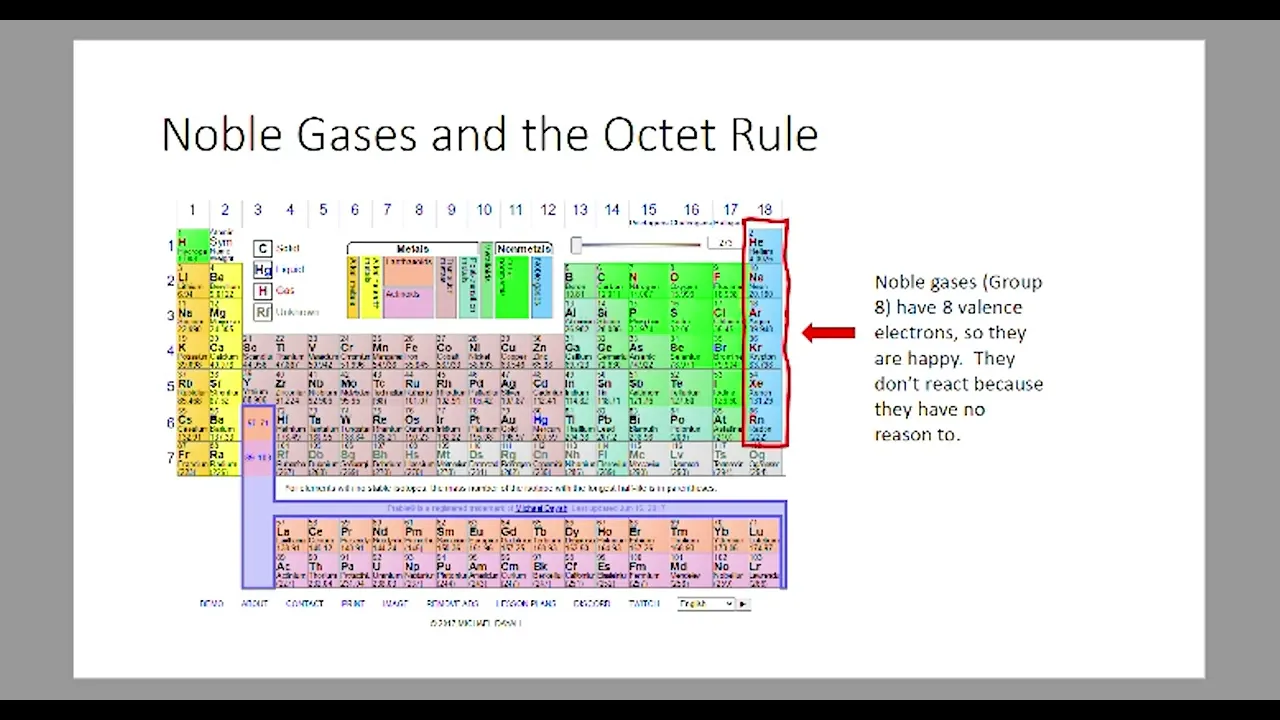
start to stick together um and it's basically because they have opposite charges so let's start with the noble gases because they don't they've already got their octet so they don't care so noble gases group eight have veence electrons they are happy they don't have any reason to react and they don't generally react if you remember I told you that Xenon you got to do a lot to Xenon to get it react and it's probably the most reactive of them um but you you got to run some current through it just to get it and the
only thing it really forms is Xenon Tetra fluoride which is which is a calent compound so your neon argon Krypton Xenon and Ron they all have eight veence electrons helium's happy with two remember helium's a tiny little atom so they are happy um with their Arrangement um they've got eight veence electrons so that's why they don't react there was a great question about reactivity um in the as me or in the in the AMA discussion board um in one of the sections and ultimately the the question came down to reactivity and the reason why a
lot of ionic compounds form is because something is looking for something else so the metals are going to be looking for someone to give an electron to whether that thing wants to accept it or not that metal is going to say here's here's this electron and the non-metals especially the halogens the halogens are just one electron away from that octet they they are they are looking to steal somebody's electron which is why you know you find these acids these H's which are going to have you know one extra electron and you have your HF your
HCL uh your hbr your hi these acids form so readily because they that hydrogen is willing to give up its electron um or more specifically the Florine chlorine bromine and iodine are more willing to take them so reactivity is about give and take and sometimes that give and take is not exactly um um what we would call kind of uh what's the word I'm looking for it's not mutually agreed upon let's put it that way um sometimes it's kind of foisted on the other party so that's really the breakdown of noble gases and the octet
rule is they've got their eight they're happy they you know they're Noble you know they have their nose up and they're you know eating sandwiches with grape Poupon now Metals forming cation so let's look at it these group one metals have a single electron in their s their outermost s orbital so hydrogen is 1 S1 lithium is 2s1 sodium 3 S1 so on and so forth so what they're going to do is they are going to take that one electron from their highest s orbital and they are going to look to give it to someone
whether that someone wants it or not and what happens is let's look at sodium sodium has 11 electrons if sodium gives up so sodium is number 11 and if sodium gives up that electron it's going to start to look like neon from an electronic standpoint so an electronic meaning that how the electrons are arranged not necessarily can you plug it in or you know does it need Wi-Fi or something like that but from from its electron configuration sodium now is electronically the same as Neons so sodium's happy so sodium is going to form a one
plus ion or one plus cation because sodium still has 11 protons but now it only has 10 electrons so it is going to have a plus one charge it has one more proton than electron so sod is going to become a OnePlus charge same thing with potassium if you look at pottassium it's got 19 uh protons but if I give up one I'm going to have 18 electrons and that 18 electrons makes me electronically the same as argon that's what makes that's what makes potassium happy is looking like argon so it is going to give
up uh its outer most s electron um and that's how they become stable and that's what makes them happy but in the process remember that in in the same process of I'm going to give up or I'm going to forcefully give up an electron um I've now become a cat which leaves me with a charge um I have an unequal number of protons and electrons so now I have a charge and I have something you know ultimately there are consequences from that now when we look at these group two metals they have two s electrons
in their outermost s shell so they're willing to give up those two outermost electrons um they're willing to give those up so that they can um again look like the noble gases so let's look at calcium calcium has 20 electrons when it is when it's just a regular old calcium atom now if I give up two I'm going to have 18 electrons which makes me electronically the same as argon but now I have two extra protons so those two extra protons are going to give me a plus two charge which makes me a calcium cat
I strums the same way um if I give up two electrons I'm going to electronically look like uh Krypton KR uh which is 36 and so again I have 38 protons but I only have 36 electrons so what this what this sets up is you see that in these columns um in the First Column or the first group um I'm going to form plus one in my second group I'm going to form plus two now your DB blocks you cannot determine the charge of a dblock transition metal just by looking at where it is on
the periodic table I'm going to repeat that louder for everyone in the back block D metals also known as transition medals you cannot determine their charge just by looking where they are you can do it with main groups but you cannot do it with transition metal so remember that d block those 10 across you cannot determine their charges just by looking at them um there's you can't that's why they transition they some of them have multiple um have multiple charges that are acceptable so um you can't you can't determine what they are but we do
come back to that um I do believe in part two of this lecture all right so let's look at non-metals forming ions group seven so we have our halogens in group seven they have seven seven veence electrons so what does that mean that means that they are on the hunt they are looking to get an electron now if you think about it NAC good old fashioned table salt sodium chloride it's everywhere because sodium has an extra electron that's willing to give up Florine has an electron deficit of one so it's looking for an electron or
excuse me chlorine same thing same way chlorine is looking for an electron so when they meet up guess what sodium gets What It Wants chlorine gets What It Wants both of them electronically will look well chlorine will look like argon electronically and sodium will look like neon electronically so that's what makes them happy is the simple fact that one of them is looking to give up and the other one is looking to grab one so these group seven uh nonmetals have seven veence electrons they are looking for an electron so this will give them one
more electron than proton so that is why they will form a minus1 anion so they form negative one anion group six um group six they oxygen and sulfur we don't really pay attention to selenium um oxygen sulfur these group six they have six veence electrons so they are looking to form a -2 they are looking they are in the market for two electrons so they will form -2 to for oxygen oxygen has eight electrons when it starts out it needs two to look like neon sulfur has 16 it wants two to look like argon so
what we're seeing is hopefully you're starting to see the pattern a little bit of what's going on with charges and location group five well 8us 5 is three they're all looking for three so nitrogen and phosphorus they will form a -3 ion um because they are looking for three electrons to get them to having a full oet all right so I'm going to stop at the formation of ionic compounds for the day I am going to send you this whole presentation um we will pick up back here I will also be sending out module 2
um but what I want you to do is start I want you to read all of chapter 3 um and I want you to start working through this and then next week um we will put we're going to start picking up the past just a little bit so next week what we are going to do is we are going to um complete chapter three uh because it is a relatively short chapter um we're going to pick up right here at the formation of ionic compounds we're going to complete chapter 3 and then we are going
to move into chapter 4 and chapter four kind of ends with a little bit of weirdness but we can get through it so if you have any questions please feel free to put them up in the AMA discussion um I'm going to offer probably offer up another discussion board for um other kinds of things um to kind of keep you all kind of engaged um because I know there's a lot going on and again I just really want you all to not kind of give up on everything um but if you have any questions if
you have any concerns please let myself know if it's kind of above my head do not hesitate uh to reach out um to the folks in admin um if there is a very specific issue that you are having so have a great day um have a great weekend please be safe folks please be safe I don't know if you're looking at these Co numbers um across Clark County across Georgia um across un you know I need you all please stay safe please make good decisions um and uh will see you around thank you very much
thank you very much thank you very much thank you very much thank you












![6 Ways to Edit Any Scene — Essential Film & Video Editing Techniques Explained [Shot List Ep. 10]](https://img.youtube.com/vi/FVR8zz8ci2k/maxresdefault.jpg)