this is a presentation of the natural stone Institute's natural stone University thank you for watching I just have to start off by saying I'm thrilled to do this I love rocks and it's really fun to share them with anybody who cares about it and typically in my life that's been students but this is cool I found a whole nother audience of people who also love rocks a little bit about me so I've taught geology face-to-face online and now I teach geology to people who love to talk about countertops and I do that so far via
the house worm and which formerly was the garden wit forum we all have this thing in common that brings us here today that natural stone has the use in our life what I would like to do through this series is not necessarily make you think about it scientifically or bore you with terminology or you have to see box the way we see rocks but just to sort of share the other side of the industry really how do y'all just go about looking at rocks what they mean to us and share with you I think just
the most relevant parts of geology that it can help you do your job better and have one fun when you're working with customers or working in the fabrication shop things like that so you understand rocks just a little bit more so our objective here follow all right along with that with that we want to look at what do rocks tell us about how they formed what qualities of rocks are gonna make them good or maybe less good for how we want to use them today we're going to just talk about granite and so what that
means in terms of igneous and metamorphic rocks our last goal is really the important one which is rocks are awesome so I'm starting with that yeah so you probably gather in the first few minutes that I'm pretty enthusiastic about this but I think we all share some affinity for natural stone and what I think is cool about it is that they all LOX tell you something and if you look at this picture this picture of a beach that's probably about where you'd like to be right now in spring weather and can be really sickle it's
actually sort of some combination of a raining and snowing here man that Beach looks really nice and it does from the geologists point of view I look at that Beach and I think oh what kind of rocks would form there that Beach is going to make future sandstone and future limestone and then you can take that in the other direction too you can look a piece of sandstone and go oh man that was a beach that that was a really nice about 250 million years ago so rocks are products of their environment and the other
way of looking at that is that they tell us something about that environment and that's what geologists love to figure out every rock has a story to tell so you look at something violent like a volcano and y'all just think first of all totally cool we love volcanoes also that lava that's spilling down the flank there that's a whole nother kind of rock and that's gonna tell us something about that environment so that's what geology is and the cool thing about the building stone trade is that you bring these rocks right into people's everyday environments
you put a rock on your kitchen countertop and that's really neat because you have a little piece of Earth's history you have minerals and textures and things that tell you something about where it's formed in about the history of the earth and which is why I would be a terrible salesperson for rocks because I would bore everybody all day long about all the cool things that they really don't need to know so that's where how would you felt to me along I saw this you can see the date here 2012 come on I just put
in a brand new countertop it was not behaving like they were hoping and they were posing the question hey should I cover it with saran wrap and tomato is an interesting red flag something has gone wrong here this person has ended up with a rock that is not what they expected and saran wrap was sort of a last ditch to try to make this work out so this particular rock super white you've probably heard of it it was an interesting one so I went to my rock yard and said hey what's going on Superbike can
you give me a piece can I check it out so I did and I started figuring out what was my alpha news rocks and then posting answers to questions here on the garden web so that's sort of the background they get us into our topic Carol do you want to jump in with our first poll see what you guys think about rocks so far nice yeah this seems to parallel probably about how they the popularity in the marketplace as well today we're going to get into granite rock ingredients rocks are made of minerals and it's
the minerals in part that determined how a rock is going to behave and sort of tells you it's kind of the ingredients it gets you down inside the rock a little bit these are just some examples quartz calcite garnet of common ones that we see so the minerals are going to tell us the color and sometimes they're the color is diagnostic like garnet is almost always this burgundy color the mineral chloride is what makes soapstone green some the color is not that diagnostic feldspar which is the most common mineral in the Earth's crust can be
a huge range of colors quartz can be a range of colors but in the rocks we deal with here it's normally white or sort of a glassy gray color so that's one thing that minerals help us with another is the hardness and so hardness is just simply how hard is it to scratch a rocker so talc is the softest one and we go on up the scale I didn't correlate these with the numbers on those hardness scale but these are just arranged in order from soft to hard garnet being way up on the hard end
of the minerals that we see for decorative stones and then Merrill's tell us how they act with acids that's a big problem for kitchen and bathroom and things like that and so calcite and dolomite are the two minerals that dissolve readily when exposed to Housel acids and those minerals that make up limestone and marble the strength of iraq is not necessarily related to the minerals themselves it can be but it's important to clarify the difference between the hardness and the durability so the hardness just how is this visit to scratching if you drag your cast-iron
pot across the countertop is it going to scratch or not that's the minerals but the durability of the rock is it going to chip on the corners is it going to break if someone fits on it that's also determined by how well those minerals are stuck together and by what process are they stuck together it differs with different rocks and so here are some cool examples quartz and stone on the last quartz is extremely hard mineral one of our hardest ones but in a quart sandstone in some quartz and stones not all they're not stuck
together very well and in this photo you can see that someone just carved their hearts just showing your love for the rock right into the rock so it's hard mineral but not very well stuck together some quartz and zones are extremely well stuck together and you don't have this problem at all see the hardened mineral and they're well stuck together next the other side of the slide here soapstone AAPIs the spectrum very soft mineral but very well stuck together so it's dense and it resists staining but it's super scratch 'full minerals alone don't tell you
the whole picture its minerals and how they're stuck on there some rocks have their own reasons for not being strong and durable the mica mineral so mica anytime you see a rock that really looks like it's made out of glitter that's probably mica because it's a little flat cheek just like a piece of glitter and so this minerals are very planar and flaky so anytime those have a chance to sort of creep out of the corner or the top surface of a countertop they will and they also tend to split along this layer sometimes the
mineral itself then does have a property that makes the rock less ideal any rock that's layered and lots of rocks are layered saying things always want to split out along those layers so that can determine the orientation that you're going to put it on the countertop and some rocks are extremely hard and they're hard in every direction so it doesn't have any layering like this quartzite here and sometimes when a rock is this super super strong it can just be brittle because those planes of weakness it doesn't have anywhere where it can sort of take
up some flak and so that makes these rocks almost act a little glassy as in glass is very strong but it chips and quartz chemically is pretty much the same as glass so it can have a little bit some of those same traits so those are some of the things that make a rock less strong here's why we love granite granite as part of the igneous family of rocks and it is a strong rock mineral grains are very well stuck together and almost every mineral in granite is in and of itself hard so it's got
lots of things going for it and that's why it's so popular so now we'll get into a little bit of sort of our family portrait of different kinds of oxygen will put granite and other rocks kind of on the napster we think of three rock families igneous metamorphic sedimentary and how do they relate to each other we in school we teach the rock cycle he is here looks like any more fun version of the rock cycle any rock if you melt it turns into an igneous rock in Iraq if you break it into bits and
pieces and lay down those bits and pieces called sediments you can turn that into a sedimentary rock in Iraq if you torture it and bury it and heat it up but you don't melt it you just torture it that becomes a metamorphic rock thanks for any rock can turn into any other kind of rock that's the rock cycle the perspective on the different definitions of granite to geologists granite is just one type of igneous rock so it's one character within this family for the building trade it's a different definition granite is all types of igneous
rocks but then a bunch of different types of metamorphic rocks - except for the ones that are sort of their own characters like marble and soapstone and sleep in quartzite so granite has a sort of split definition between all igneous and some metamorphic we'll get deeper into this and then I'll pull my judgment call here sedimentary rocks nobody not even you know not geologists and not the trade call sedimentary rocks granite so that's something to look out for that's usually just miss categorization so let's check out 80's rocks a little bit so igneous rocks come
from molten rocks molten magma it can be lava on the surface or can be magma under the surface of the earth igneous rocks by large super tough mineral grains are tightly locked together typically not very porous the minerals in igneous rocks are hard they don't get scratch very easily the minerals in the igneous rocks won't ex when exposed to normal household acids and that's why they're so darn good there they've got all the right properties to hold up well and take a lot of abuse over those same points here looking at this cool close-up picture
can show you what I mean because my favorite outcome for this would be that you guys go back to your showrooms and start looking at rocking going oh yeah that's what you've signed up so you can kind of get personal here this is granite this is geologists granite you can see that the pieces fit closely together but they all are stitched straight in there together and that there's no spaces or layers in there most Dignitas are made mostly of feldspar and feldspar can be a variety of color so this one's got lots of pink feldspar
in there it's that red arrows are pointing to I've got some white feldspar and both of those have a similar kind of blocky shaped and if you hold them up to the light you can actually also see these faint little lines in them sometimes quartz is another component of granite and of a lot of this sort of bigger family of granite rocks and quartz is usually gray or clear and it's not at all blocky if sort of a blob and it's really glassy you can see into it you can see right through it a little
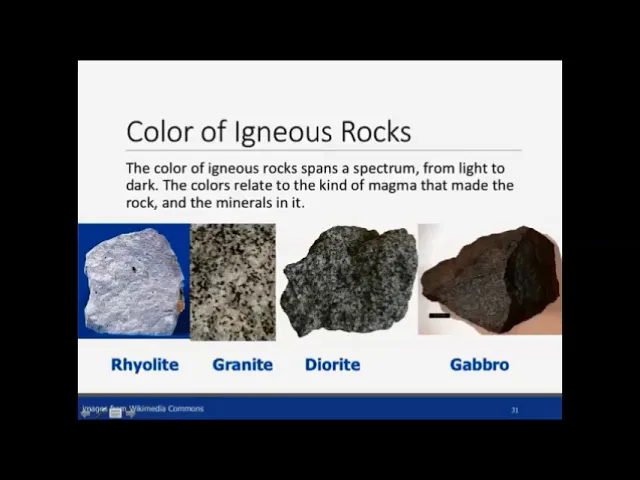
somewhat and then you get your dark minerals or a technical term there there's all a bunch of different minerals that can make things dark they can be biotite and hornblende you guys don't need to know the mineral names but that's what makes those darker specks in your granite and the wage y'all just look at igneous rocks as they go in this spectrum from light on the rhyolite and granite end of the scale on through dark down to gabbro and basalt and that just tells us what magma made it so you melt different types of rocks
you get different kinds of magma that has different minerals and then translate some the different colors I live right near Yellowstone Park which is made out of rhyolite which is a terrible rock for a countertop because it's basically like very ashy and it's a really explosive rock and Riley is usually a sign of a dramatic explosive environment one that we're really not looking forward to when it happens again in Yellowstone but rocks like granite form under the earth or within the Earth's crust and they cool over long periods of time and Rylan granite are made
out of the same minerals but they cool at different rates so that's what gives us these textures by large big crystals mean the rock cool deep underground and slowly and then small fine grain rocks cooled quickly on or near the surface and magma that erupts and spills out under the surface is lava and if it stays down under inside the surface then cool slowly and as a geologist I would call that an intrusive rock words just intruding its way inside layers of the Earth's crust and we have these cool examples of huge crystals and that's
called a pegmatite when the crystals are like the size of your fist or bigger if you extend the logic on the previous slide you'd say all that cooled very very very slowly maybe but also tends to be a magma that's got water in it and water is like your social facilitator water takes ions and introduces them to other ions that they think it'll get along with and it allows crystals to just form more quickly and so water just kind of facilitates this process and less really big crystals grow techno types are incredibly cool because there's
you know hunks and you can see all the features and felt bars you can see their little parallel lines I got going in court see it looks really glassy and so kind of amplifies all the minerals you already have so penetrates are definitely popular for the drama so now we got a couple of slides of just things you see around your showrooms and what are they so you see a lot of these ones these pink blocky crystals and that is Kim Cattrall tiara that's rich in potassium this particular rock geologists would call it granite but
this blocky crystal can be lots of colors can be pink it can be white it can be any shade of gray but the pink one is a definite call out like yep that's that potassium rich feldspar that same mineral can take on this bluish greenish grayish iridescent and again it felts are just different colors we will call it labradorite it's one of the trade rocks with that man that is blue pearl and that's super popular although it's kind of flashy not everybody loves it but that's where that comes from and that's the end of igneous
rock so Carol onyx you jump in with the second Pole no nice throwing at things that are unique and interesting and the idea of calming and durable is less important so yeah sort of the creative outlook on rocks we will now move on to metamorphic rocks the poor tortured rocks in this schematic diagram you can see this little wedge shaped section of rock in the middle and has all these wavy lines and it's kind of a cool sematic of this poor thing is like stuck in this collision zone of tectonic plates that are colliding it's
like sort of the collateral damage stuck in the middle there's magma coming up through here and that's heating it even more and adding a strange chemical broth to the mix so this is what I was saying before that normal rocks are any old rock that ends up getting tortured they all start out as something they start out as some kind of rock and then they get exposed to these tough conditions that's burial that's high pressure that's interacting with the chemicals and because of that it changes them they'll change textures they sometimes get a whole new
type of mineral sometimes not sometimes they keep the same minerals but they just get rearranged and typically they get denser because they're being compressed down and this swirly linear pattern is a common theme to just about all metamorphic rocks and that's a result of that high-pressure revisit to our rock cycle diagram metamorphic rocks basically you torture any other kind of rock and you can get them at a morphic rock go through a couple of those nice if you want to really confuse people they go what's that and you oh well it's nice and you're like
well I know it's nice the way so it's nice with a G nice for the G is the sort of your classic metamorphic rock you guys will call this command it starts out as granite or maybe it starts out of sandstone could go either way but you can see that this rock has been squeezed and compressed you can see this sort of taffy like wavy texture and what's happening is the minerals because of that pressure are getting organized into layers of similar minerals and then the whole thing gets squeezed it stretched and so you get
these because of the organized layers you get zone of pinkish white and a zone of gray and then pinkish white and then gray and so it kind of makes these stripes and then you take the stripes and you squeeze in some more this worlds so that's how you take start out as granite and make it into nice and you can see that the granite I was showing before with the pink blocky crystals and things like that overall it's got the same look the same color is the same minerals there's arranged differently because of their morphing
another one this is a common rock when people want something light but they don't necessarily want marble a lot of these white granite our rock that we call granulite and again it starts out like a regular granite but it's because of this squeezing and squishing it gets a linear fabric sometimes it's wavy and cemented straight and then you get this new mineral garnet and garnet almost always tells me the rock has been exposed to these metamorphic conditions and particularly at a deep burial a lot of pressure so granule I pretty close to granite but it's
gone a little bit down that path of metamorphic magnetite nigma tightening mixed rock this this one in the trade is called cosmos and this one's kind of cool because it starts out as granite more sandstone doesn't really matter but anyway you bury it and squish it and heat it so much but actually starts to melt and when that happens the first mineral to melt is coarse and so you actually get these sort of nodules or bands of liquid quartz inside the rest of the rock which is solid it's not too different from say a chocolate
chip cookie where if you put that in the microwave for a couple of seconds it's the chocolate chips it starts to melt first and everything else stays soft but still solid that's what magnetite is for the quartz tourneys liquid and everything else stays soft but solid and then you take that rock and you squish it up and it makes these creamy patterns with these liquidy bands of quartz making really wild patterns so people who like that high movement kinda rock love this it's quite dramatic sweets is yeah sort of run-of-the-mill metamorphic rock it started out
as shale and it got more compressed and it still kind of looks like shale but it's just harder little denser than shale just if you take shale and keep heating it the crystals will grow into the mica family and mica is again the ones that look real glittery and again you can add garnets and to shift and so they're hard to see on here because it's so reflective but garnet garnets are a little each little round shapes in the midst of the rock because mica minerals are so flat or this rock it's really flat almost
like fish scales and then garnets form you little beads almost inside of that so that is a shift and then these rocks form on us spectrum she said I would sail which is the rock that's not really good for much of anything it's made out of sort of weak clay minerals and you shows it to a little bit of metamorphism you get sleet and if you keep going it gets buried more deeply or heated up more it turns on rock called still light which is often still called sweet in the trade this is a common
tile rock and it's sort of a spectrum slate turns into fill light when it gets this luster that looks a little bit sort of waxy not quite towards glittery but just this little sort of satin Sheen and then if you keep on cranking on a thing the little satiny crystals are basically the beginning of those mica crystals growing they get bigger and now you have shifts and if you keep on going I'll turn into nice and if you keep on going you'll melt part of it and that'll be magnetite if you keep on going you're
gonna melt the rocks completely and so here's a little quiz I know I can't hear you guys but if you melt the rock then what kind of rock do you get and hopefully you're all thinking how you get an igneous rock so there's a spectrum of metamorphism you can torture a rock more and more and more and more till parts of it melt until eventually all of it melts and you go back to an igneous rock so that's sort of an up-close-and-personal example of how that rocks like we have questions quick question it does foliated
or non-foliated have anything to do with the porosity of a stone oh that's a great question definitely it does foliated basically means layered and often where we use that was specifically talking about metamorphic rocks how they tend because they're compressed they kind of rearrange long layers but really any rock can be foliated if it's layered like that and absolutely Slayers are where the pores are so water and other fluids are gonna want to travel across those layers sometimes the rock can heal up and so it can become foliated but not particularly for us so it's
not a guarantee that if it's foliated for us but certainly the any rock that's layered is gonna those are that those planes form thoughts where the rock is certainly more forced at some point I would like to know if industry in general stone industry in general would be able to identify stones that all foliated versus non-foliated because there is a big gray area in terms of moisture sensitive stones that can be used for exterior that have less capillary action to them versus stones that can be used in wet areas and I don't know if that
connection helps but if it does that might be something where the industry could look at and see if we could kind of connect the dots almost yeah that makes a lot of sense to me particularly for exterior when you have that slow creep of moisture and then frost and things like that I can undermine rocks also in exterior how they're exposed on all sides so the current water can get in and it's funny because we often like the rocks that want to be flat for exterior for stacking walls and things like that we love the
rocks that want to be flat rectangle shapes because they cleave you know along those nice Plains but that's the same reason gets us into trouble with the porosity so any rock that won't let prefers to be layered also is gonna be weak across those layers so you've got the same principle the same property being both an advantage and a disadvantage thanks Dan what rock type does black absolute granite falls under that's a great question and they're really popular one that is rocks the closest one we could probably just say gabbro which is Indian igneous rock
I'm gonna zip back up so on the spectrum of igneous rocks where they're very light on one end and very dark on the other this rock gabbro here if you look slow like absolute lack joven it's sort of fine-grained and very dark but not so fine grain like basalt basalt is the other rock that's similar to this and it's the same ingredients the same color just a little bit finer grain so absolutely black is somewhere between gabbro and basalt and you wouldn't be wrong for using either of those names you know it's somewhere in between
the two Chandra wants to know can we know how a geographic location can change types of rocks found and why they are different from each continent I'm so glad you asked that thank you it really doesn't matter that you hear that a lot you hear oh well this is a Brazilian quartzite which is totally different from an Italian quartzite right I assume that's the question you're asking that's generally not true remember that first slide of that lovely looking beach rock is the only reflective of its environment that it's one done and it really doesn't matter
where on the globe that is because the variability is much smaller than that more than the continent so it's like to say could you find a nice beach in South America and could you find a nice beach in Italy the answer would be yes of course you could so it's resist the temptation to lump rocks by continent by or by country of origin because it's not really that doesn't really hold up it's more of the individual quarry the individual rock itself what minerals is made out of how those minerals arranged and that doesn't really track
by geography necessarily so it's in this case where we want the geology and not the geography so the geology tells us about the rock specifically the geography tells us where it's from but that doesn't really count for much this was a presentation of the natural stone institute's natural stone University thank you for watching