>> Alissa Mun: Hello. My name is Alissa Mun, and I'm in the Clinical Center, Office of Research Support and Compliance, Clinical Research Quality Management section. And today I'm going to introduce good clinical practices that are known as GCP or ICHE6(r2).
The goals of today's session are understanding core elements of GCP -- I'll provide you a historical background, and then the core principles of ICHE6(r2). You'll be able to recognize who is involved in good clinical practices, and finally, how you implement GCP in your clinical research study. There are three critical principles that are universally recognized when we think about good clinical practices, and that is safety, ethics, and quality.
When we think about safety, it's to protect the rights, safety, and welfare of human subjects participating in research. And in ethics, it's to provide ethical standards and guidelines for the conduct of the research. And then finally, the quality of data that is being collected, and this also helps in promoting reproducibility of trial data.
Now, we did not come up with GCP on our own, and there were significant historical events which were the foundation of what is known today as GCP. In the 1940s, there was the Nuremberg Code, which was a direct result of the atrocities inflicted in the concentration camps of unethical human experimentations. The Nuremberg Code focuses on human rights of research subjects, and those three elements are voluntary participation, informed consent, and minimization of risk.
In the 1964, there was the Declaration of Helsinki, and this with the main principle to set ethical principles developed from the medical community from the WMA that are known as the World Medical Association. It is widely known as the cornerstone document of human research and ethics. They focus on the respective persons, the protection of subjects' health and rights, and when we think about this, we also want to ensure pre-clinical data.
And this was a result of the thalidomide trials where pregnant women were provided thalidomide and resulted in severe birth defects or deaths. There's also this special protection now of the vulnerable populations, the adults with the incapacity to consent, or we think -- we think about the minors. And this required a legally authorized representative to consent for these individuals.
In 1979, there was the Belmont Report, and there are three main elements in the Belmont Report that talk about respective persons with the informed consent and protection of vulnerable populations, beneficence, which means do no harm, better known in the medical community, and then justice, which is the fairness in selection of subjects. The Belmont Report was a result of the Tuskegee trials, and I highly recommend that -- considering reading the Nuremberg trials, the thalidomide trial, and Tuskegee trials to learn more on how clinical research has evolved over time. From these documents, a lot of countries then began to create multiple different guidelines, and it became problematic in the industry.
And thus, the International Conference of Harmonization was created to look at standardization of good clinical practices. So today we have the ICHE6(r2), which is the International Conference on Harmonization of Good Clinical Practices. What this does -- what it was -- it brought together regulatory authorities and the pharmaceutical industries to discuss scientific and technical aspects of drug registration and how to formalize the conduct of research.
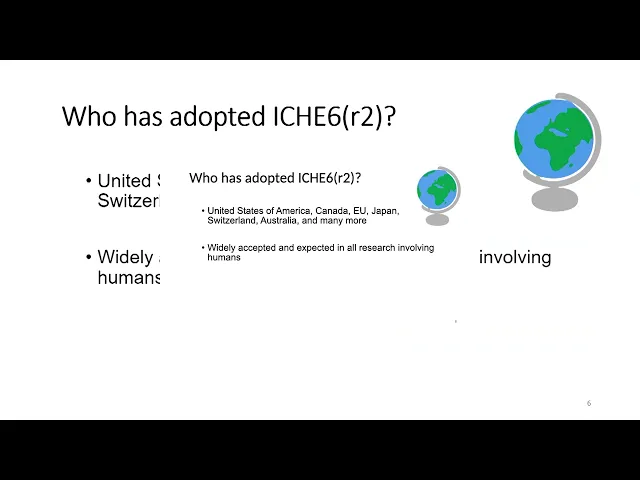
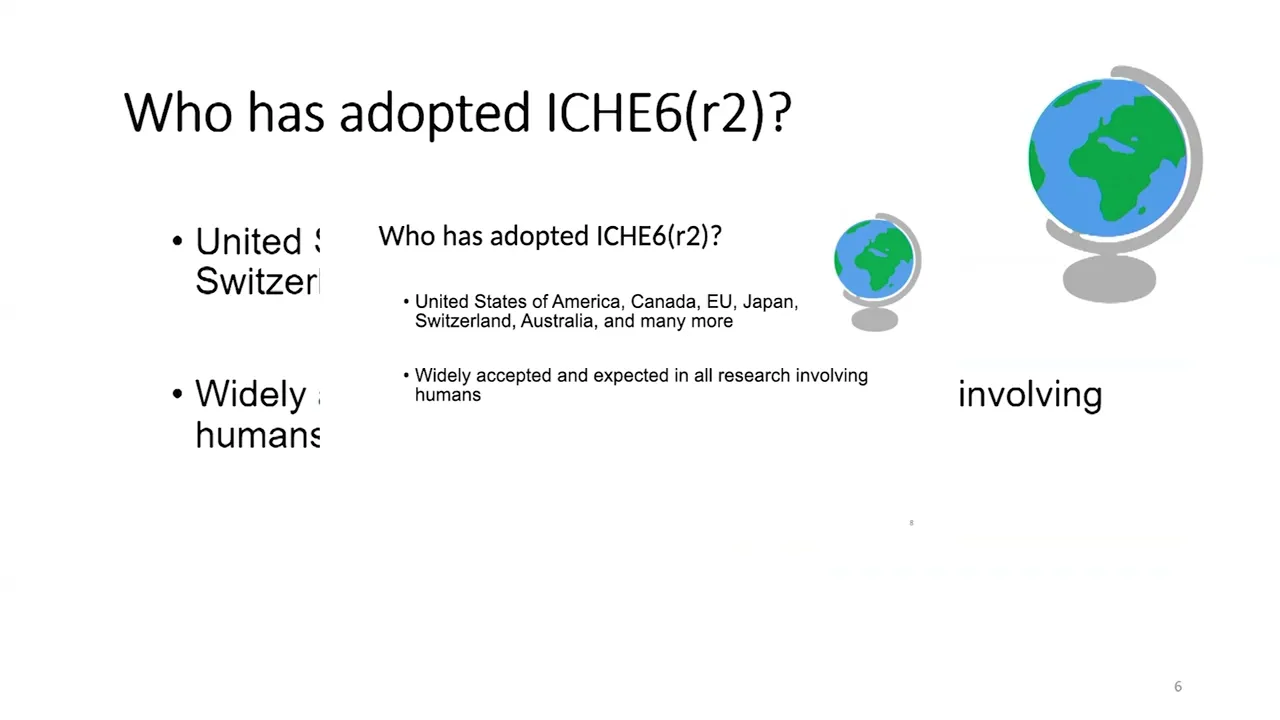
ICH has gradually evolved over time, and by responding to the increasing global development of drugs within the world, as well as the technological advancements that we have today. ICHE6(r2) is focused on the ethical and scientific quality standards for designing, conducting, recording, and reporting of trials that involve human subjects. So, who has adopted ICHE6(r2)?
Hundreds of countries have adopted this, and it is widely accepted and expected in all research involving human subjects. But there are 13 core principles of ICHE6(r2), and I'll go through each one of them now. There's the ethical conduct of research, ensuring that it is in accordance with the Declaration of Helsinki, as mentioned before, that the benefit justifies the risk of the patients, and that the rights, safety, and well-being of subjects prevails over all the interest of science.
And then when we think about the protocol in and of itself, we want to ensure that non-clinical and clinical information support the trial that you will plan on conducting and that it is in compliance with scientifically sound data. And that should be, again, detailed in your research protocol. There are major responsibilities when it comes to GCP, and those are, of course, within your IRB or your ethics committee, and there must be approval from these committees prior to the initiation of your research.
You want to ensure that the individuals that are providing medical care or decisions are done by a qualified physician or dentist and that any individual that is involved in clinical research and are delegated to perform specific tasks are qualified either by education, training, and/or experience. And of course, you have informed consent, that informed consent is provided to all subjects and that they are provided freely to make their own decision and there's no coercion involved. You have your, of course, your data, and they want to ensure that the data is accurately recording, reporting, and handling verification and storage of that data, and to ensure that there are special protections involved for the confidentiality of those records.
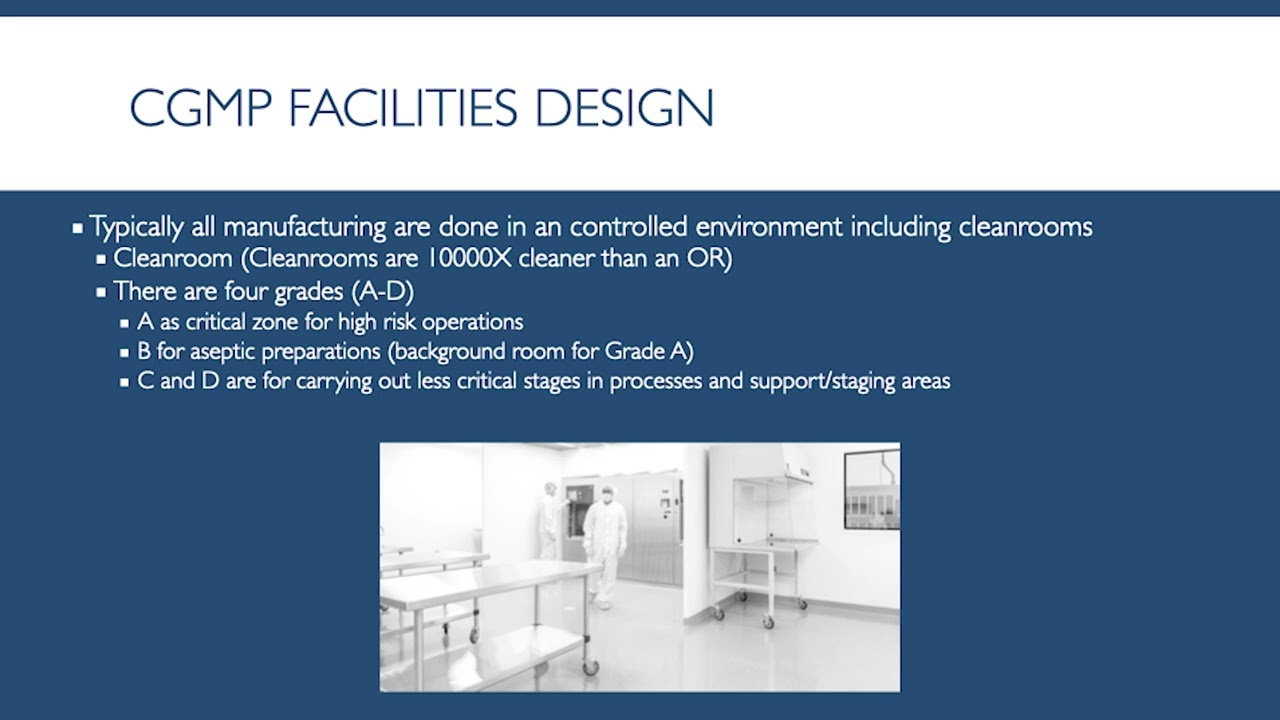
In your research study, you will have your investigational products, and you want to ensure that they conform to the current good manufacturing practices that are used in your protocol. And finally, quality control and quality insurance. You want to ensure that these are in place for the systems that you have to ensure the quality of all aspects of your trial.
That includes electronic systems as well as standards of SOPs or manuals of operations. So where does GCP apply? This really applies anywhere that clinical trial data is being conducted, collected, or assessed.
That is your research site, any laboratory, your pharmacy where they are maintaining your investigational product, imaging centers, CROs, the sponsors, and your other oversight committees. So now that we know where it applies, but who then is responsible for good clinical practice? That is, of course, the sponsors, and on a site level, the ultimate responsibility is of -- from the clinical investigators or principal investigators.
They are the ones that are solely responsible for the conduct of research. You also have your research staff, which could be research nurses or data managers, your CRAs, or protocol monitors, any medical monitor. The research subjects themselves are also responsible for GCP, and then any regulatory authority.
So in summary, protection of the rights and safety and welfare of participants are extremely important, and finally, to ensure the protection of their confidentiality. This, again, follows the three main things that I spoke of earlier, which is the safety, ethics, and quality. You want to ensure that there is informed consent process for all participants and that the data is secured in a -- in a secure location.
What that means is if there are paper records, they should be in a double locked location, and if it is electronic, that they are stored, password protected with limited access. You want to ensure you follow your approved protocol where you treat it like a contract. This is your agreement not only to yourself as the -- as the principal investigator, but also to the IRB as well as your research participants.
You also want to ensure research staff are appropriately trained and qualified. How you do this is you maintain a delegation of authority log which details each individual's responsibilities and what they have been delegated by the clinical investigator or the principal investigator. You can also develop manual of operations or standard of operations in order to convey consistency.
There's also the quality of data that you want to ensure accurate source documentation of your research data. This also means -- you will hear this consistently when people talk about GCP -- that if it's not documented, it didn't happen. And lastly, the investigational product should be manufactured in accordance to GMP.
So now that we've gone through the presentation, just a few questions to get a sense of your understanding. So, what are the three core elements of good clinical practice? That is the safety, ethics, and quality.
What is considered the cornerstone document of ethical human research? That's the Declaration of Helsinki. And lastly, who is ultimately responsible for good clinical practice at a site?
And that would be your clinical investigator and principal investigator. I hope you were able to learn some of the core elements of good clinical practice, ICHE6(r2), and thank you so much for listening.