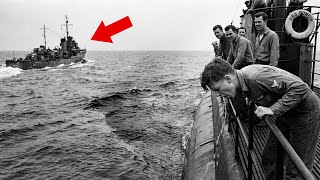
January 26th, 1945. Ramry Island, Burma. The British Royal Navy had surrounded the island.
The Battle of Ramry was effectively over. The Japanese Imperial Army had lost. But Colonel Konichi Nagazawa refused to surrender.
He had a thousand men left, elite troops. The British offered them an honorable surrender. Nagazawa sent back a message.
We will fight to the last breath. But he couldn't fight on the beaches anymore. The British battleships were pounding them with heavy artillery.
So the colonel made a decision that would doom his entire regiment. He ordered a retreat not to the high ground, but into the interior into the mangrove swamp. It was a 10mi stretch of mud, slime, and twisted roots.
The British commander watching him go through his binoculars lowered his glass. "Let him go," he told his officers. "We don't need to shoot him.
The swamp will do the work for us. " The British soldiers didn't envy the Japanese. They knew what lived in those swamps.
They knew that Ramry Island was home to the largest population of saltwater crocodiles in the world. And the crocodiles hadn't eaten in a long time. The descent.
The Japanese column entered the swamp at midday. Immediately, the war changed. It wasn't about bullets anymore.
It was about mud. The mud was waste deep. It was a thick black sludge that smelled of rotten eggs and ancient decay.
Every step was a struggle. Soldiers had to pull their legs out with their hands. Boots were lost.
Men sank up to their chests. and the insects. The mosquitoes were so thick they looked like gray clouds.
Leeches dropped from the trees, attaching themselves to the necks and eyelids. By sunset, the 1,000 men were exhausted. They had moved 10 miles.
They had moved two. Colonel Nagasawa ordered a halt. We rest here on the tree roots.
Do not touch the water. It was a strange order. The soldiers were thirsty.
The water was brackish, salt and fresh mix, undrinkable, but it was cool. Why not touch the water? Private Tanaka, a young conscript, didn't listen.
He sat on a low branch, dangling his tied legs in a murky water to cool his soores. He closed his eyes. He thought about home.
He didn't see the ripple. The water around his legs didn't splash. It just bulged.
A massive shape darker than the mud rose silently from the depths. First blood. The attack was silent.
One moment Tanaka was sitting there. The next he was gone. There was no scream, just a wet thack sound, like a wet towel hitting a rock.
The soldier sitting next to him turned around. Tanaka. He saw only ripples.
Then the water erupted. 10 yards away. Tanaka surfaced.
He was screaming. He was being thrashed from side to side. A crocodile 20 ft long, a dinosaur covered in scales and slime had him by the waist.
This was the death roll. The crocodile spun its body to tear the prey apart. Tanaka's scream was cut short as he was dragged under.
Bubbles of red blood rose to the surface. The regiment froze. "Shoot it!
" an officer yelled. A dozen Arasaka rifles fired into the water. Bang!
Bang! Bang! The bullets hit the water harmlessly.
The beast was gone. Colonel Nagasawa stood up on a high route. He looked out into the darkness.
The sun was setting. And as the light faded, the swamp began to glow, not with fireflies, but with eyes. Hundreds of small yellow dots appeared on the surface of the water.
Then hundreds more. They weren't alone. They had walked into a feeding ground.
Night began like a hammer. It was pitch black. The Japanese soldiers were clinging to the mangrove roots like monkeys.
They tied themselves to the trees with their belts so they wouldn't fall into the water if they fell asleep. But the crocodiles didn't wait for them to fall. Saltwater crocodiles are one of the few reptiles that actually hunt humans.
They are smart. They can launch themselves out of the water using their powerful tails. The first scream came from the rear guard, then another from the left flank.
Splash! Scream! Crunch!
The sound of bones breaking echoed through the trees. It was a wet, grinding noise that made the soldiers vomit. "They're climbing," a soldier yelled.
A massive crocodile had launched itself onto a low mudbank, grabbing an officer. The officer fired his pistol wildly, the muzzle flashes illuminating the yellow belly of the beast. It dragged him into the slime.
Panic broke out. The discipline of the Imperial Army, which had withstood American flamethrowers and tanks, crumbled before the monsters. Soldiers started firing blindly into the dark.
They threw grenades. Boom! The explosions lit up the swamp for a split second.
What the flash revealed was a nightmare. The water was churning with reptiles. Some were 15 ft, some were 20.
They were fighting each other for the bodies of the dead, and they were moving closer. 02 a. m.
2 miles offshore on the deck of a British Royal Navy patrol boat, a young signalman stood watch. The sea was calm, but the air coming from the island was vibrating. At first, the British thought it was a counterattack, a riot.
It was the cacophony of thousands of men screaming at once, not battle cries, screams of pure primal terror. Mixed with the screams was the sound of gunfire, sporadic, panicked bursts of Arasaka rifles, and under it all a low, wet, thrashing sound like a giant mixing bowl stirring meat. The British naturalist Bruce Wright, who was with the Navy, later wrote, "That night was the most horrible that any member of the ML crews ever experienced.
the scattered rifle shots in the pitch black swamp, punctured by the screams of wounded men, crushed in the jaws of huge reptiles. The British sailors stood on the deck, gripping the rails, their faces pale. They hated the Japanese enemy, but listening to them being eaten alive, that was something else.
No soldier deserves that. Back in a swamp, the Japanese soldiers discovered a terrifying physics lesson. Bullets don't stop dinosaurs.
A saltwater crocodile has armor-plated scales on its back. Small caliber bullets simply ricochet off the tough hide at nine angles. Corporal Yamada was clinging to a mangrove route.
He saw a massive croc sliding toward his friend, Private Sat. Yamada aimed his rifle. He fired three shots directly at the crocodile's head.
Ping, ping, ping. The bullet sparked off the skull. The crocodile didn't even flinch.
It opened its jaws, a mouth big enough to fit a human torso, and snapped shut on Sat's leg. The sound of the bone snapping was louder than the gunshot. Sat didn't just fall.
He was yanked into the abyss. Yamada realized with horror, "We are fighting tanks. Living, breathing tanks that can swim.
He dropped his rifle. It was useless heavyweight. He pulled his bayonet.
If he was going to die, he would die stabbing. By 4:00 a. m.
, the tide began to rise. This was the croc's advantage. As the water level rose, the mud banks disappeared.
The soldiers were forced to climb higher into the twisted mangrove trees. But the trees were covered in slick moss and slime. Men were exhausted.
They had been marching for days. They were dehydrated. One soldier fell asleep for just a second, his grip loosened.
Splash! He hit the water. Immediately, the water boiled.
Three crocodiles converged on the splash like torpedoes. The water turned frothy and red. The soldiers in the trees above watched in paralyzed silence.
They couldn't help if they climbed down, they died. They were trapped in a cage made of branches suspended over a pit of monsters. The crocodiles learned fast.
They started bumping the trees, ramming the trunks with their massive snouts to shake the fruit loose. Foot, shake, scream. The psychological toll was heavier than the physical one.
Captain, a proud officer of the Imperial Army, looked at his decimated platoon. Out of 40 men, only 12 were left in his tree cluster. Below him, a crocodile was chewing on a helmet.
Ido couldn't take the sound of the crunching anymore. He couldn't take the screams of his man begging for their mothers. He looked at his Namboo pistol.
He had one bullet left. He looked at the crocodiles. He looked at the gun.
He made the samurai's choice. Long live the emperor, Itto whispered. He didn't shoot the crocodiles.
He put the barrel in his own mouth. Bang. His body fell into the water.
The crocodiles swarmed it instantly. For the survivors watching, this broke the last shred of their morale. They realized that death by bullet was a luxury, a gift, and many of them began to reach for their own grenades.
As dawn approached, the frenzy reached its peak. The smell of blood in the water had attracted every scavenger from miles. Sharks moved into the river mouths to join the crocodiles.
Vultures circled in the night sky, waiting for the leftovers. The swamp was a churn and machine of biological destruction. The Japanese 54th Division, an elite fighting force that had conquered nations, was being erased from history, not by strategy, but by the food chain.
A soldier named Yukio managed to find a small island of solid mud. He collapsed on it, weeping. He looked around.
He was the only living thing in sight. Just piles of boots, torn uniforms, and red water. He tried to clean his raffle, but his hands were shaking so bad he dropped the boat into the mud.
He started laughing, a hysterical, broken laugh. He had survived the night, but the sun hadn't come up yet. January 27th, 1945, 0630 hours.
The sun rose over Ramry Island. The mist evaporated. The British commanders on the ships lowered their binoculars in disbelief.
The water in the swamp wasn't brown anymore. It was red, a thick crimson sludge moving slowly with the tide. The noise had stopped.
The screaming was gone. The gunfire was gone. The silence was heavier than the noise had been.
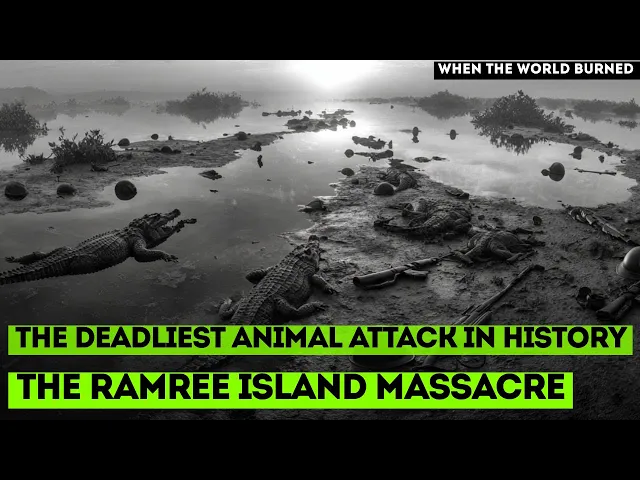
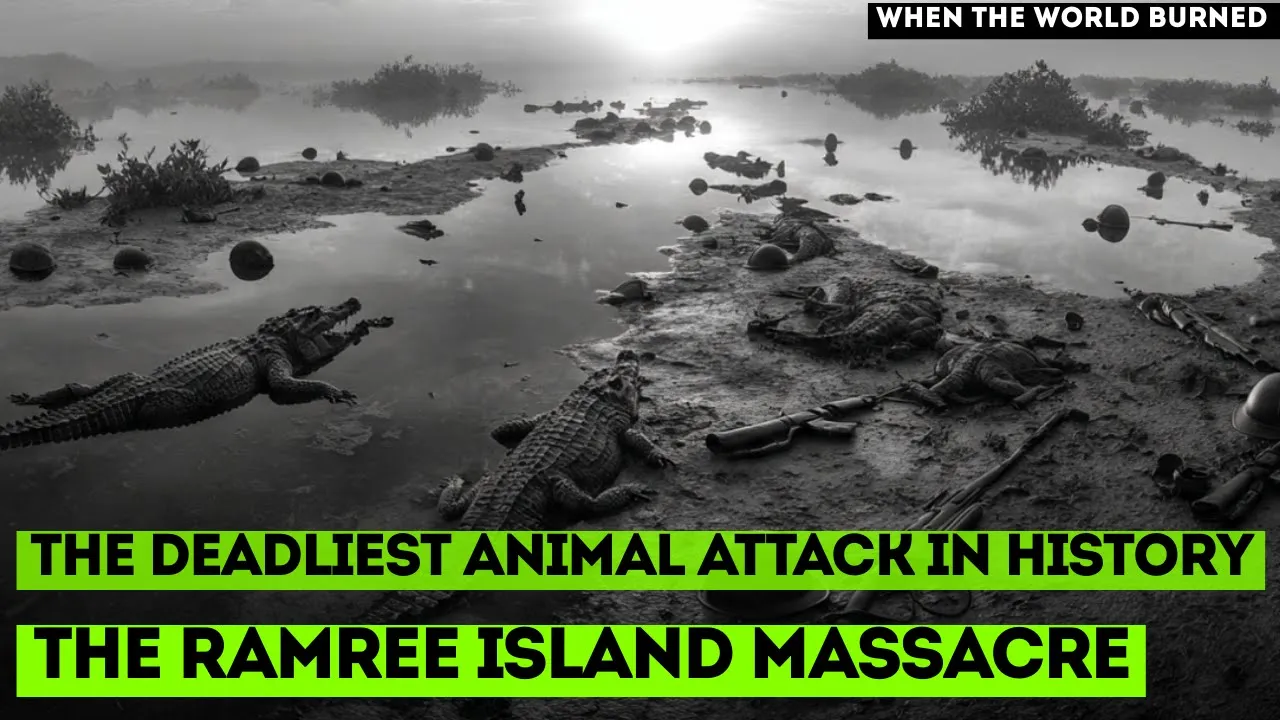
But the most terrifying sight was on the banks. Hundreds of saltwater crocodiles lay on the mudflats. They were motionless.
They were bloated. They lay in the sun, digesting the Imperial Army. They looked like statues carved from prehistoric stone, surrounded by the debris of war.
Helmets, rifles, and torn backpacks. Nature had won the battle. The British sent patrol boats into the swamp.
They expected a fight. They had machine guns manned and ready, but there was no one to fight. They found the first survivor clinging to a tree branch.
It was private Yukio. He was covered in mud and dried blood. He had no weapon.
He was staring at the water with eyes that didn't blink. When the British sailors approached, he didn't surrender. He didn't raise his hands.
He just shivered. A British sailor reached out to pull him into the boat. Yukio flinched, screaming.
He thought the sailor's hand was a jaw. They pulled him aboard. He curled into a fetal position on the deck.
They found another man buried up to his neck in mud, hiding from the monsters. And another. In total, they pulled 20 men out of the swamp.
They were the only ones left. Out of 1,000. The survivors were taken to a field hospital.
The doctors noted that the men weren't just physically injured. They were shattered. When a nurse tried to give Yukio a cup of water, he knocked it away and screamed.
He couldn't look at water. To him, water wasn't life. Water was death.
Under interrogation, they didn't speak of military tactics. They spoke of yellow eyes. They spoke of the sound of bones snapping.
One survivor told the translator, "The war is easy. Men shoot and miss the swamp. The swamp doesn't miss.
" They were prisoners of war, but they felt liberated. Any prison cell was better than that mangrove hell. The Ramry Island massacre entered the Guinness Book of World Records as the deadliest attack on humans by animals.
Historians still argue about the exact numbers. Some say 500 died. Some say 900.
But the math of the survivors remains the same. 1,000 went in, 20 came out. That is a casualty rate of 98%.
It wasn't a battle. It was a feeding frenzy. The Japanese 54th Division wasn't defeated by the British strategy.
It was consumed by the ecosystem. It serves as a brutal reminder to every soldier. You can have the best guns, the best training, and the strongest will, but you are still just meat.
Today, Ramry Island is quiet. The mangroves have grown back. The crocodiles are still there, the guardians of the swamp.
Locals say that on the anniversary of the retreat, if you listen closely to the wind in the trees, you can still hear the screams. The ghosts of the Imperial Army are still marching through the mud, forever trying to escape the jaws of the dark. If this story gave you nightmares, hit that like button, subscribe to the channel.
We dig up the history that others are afraid to touch. And remember, stay out of the water.