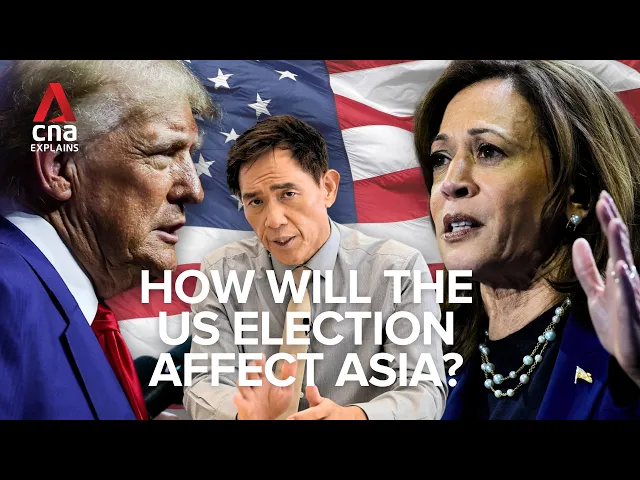
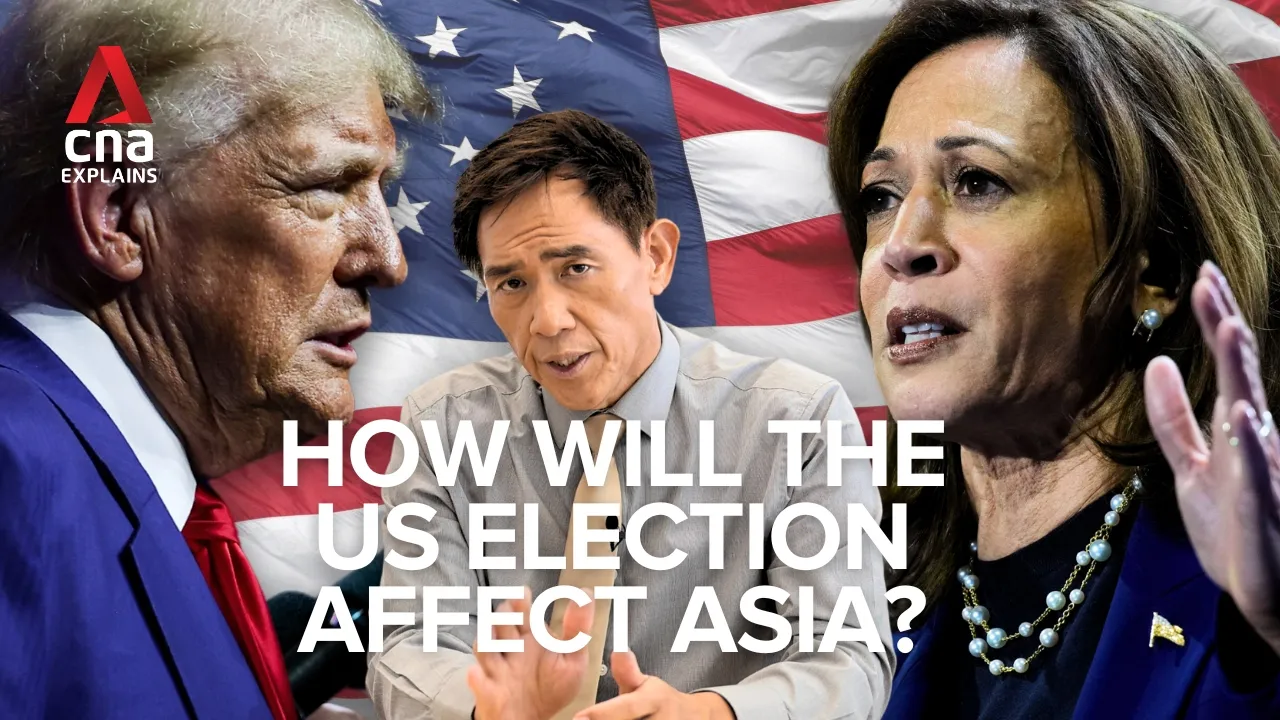
Asia is watching to see who the next American president will be. There's great interest because depending on the outcome, what happens in the US could have implications, from trade and security to how it engages with this region. Analysts don't expect the US to dial down its commitment towards the Indo-Pacific - there's too much at stake in trade, investment flows and global supply chains.
But US allies are bracing for another round of America First under a possible Trump 2. 0. And Harris, who is still relatively unknown, what could she bring to US foreign policy and relations?
All politics is local. The US Presidential Election is no exception and will hinge largely on domestic policies. You know the saying, "It's the economy, stupid.
" So being in Asia, how should we approach the question of how this election might affect us? I'll look at three key issues: US-China relations, trade policies, and security and alliances. First, US-China relations.
Experts we spoke to say America's China trajectory will largely remain regardless of administration. I think the long-standing principle for the United States is that they recognise China's position, and they acknowledge that there is one China as the legal government that’s representative of China. So it's always been the case that when a new administration takes over in Washington, China's approach has always been for decades now, the initial sort of six-month period to wait and see, to kind of read the tea leaves of what this new administration's priorities are, especially towards Asia.
But obviously, they do want certain things from the United States. It's the world's second largest economy. It has the largest military in the world.
So I think there is some sort of recognition that it wants to elicit from the United States, to gain that kind of parity with United States. US policy towards China is embedded in a regional policy and I think the primary interest for the United States in our policy towards Asia is our alliances. So Japan, Korea, Australia, New Zealand, Philippines, Thailand So that's really the first order of US prioritisation.
China, of course, is a major issue as are our partnerships in Southeast Asia, Oceania. So I think it needs to be seen in its totality. So, I think China policy is going to continue to be a combination of economic dependance, efforts to de-risk our economic relationship, much as China is trying to de-risk its economic dependance on the West, as well as an opportunity and seeking opportunities to engage China to reduce broader security risks and encourage China adhering to existing international norms that the region wants and benefits from.
So while the fundamentals won't change, the expectation is that both candidates will bring a very different tone of engagement with US allies and Beijing. I think we can look backwards and see how Trump took risks and really sought to fundamentally change the dynamic with China. He engaged in negotiations with China on trade, seeking to develop a much more equitable, balanced and and ultimately sustainable trade relationship.
And he was unsuccessful and that's what resulted in the trade war. So Trump may be incentivised to try again. China is in a different position.
They're much more interested in acquiring foreign direct investment and President Trump might try to leverage China's current economic condition. So I think for the Harris candidacy and her team, with continuation of a lot of Biden's policies and Democratic administration, there's always been sort of an emphasis on multilateralism, working with China on issues that matter to the United States through a multilateral approach. So you’ll see a lot of efforts for the United States to work in tandem with countries like Japan, Korea, Australia, to engage in issues that matter very much to the United States, values-driven, importance of human rights, respect for international law, I think those kinds of issues will be at the forefront of the Harris administration if she assumes office.
That brings us to the next issue, trade. Because like it or not, US trade policy will have an impact on global and Asia's supply chains and commerce. Take Trump's trade war with China that began in 2018.
The Biden administration wasn't much friendlier, it retained most of those tariffs, even adding on to them. Experts say de-risking and national security will continue to be an important part of US economic policy. There's very limited political currency to appear soft or weak on China in Washington.
And so even though on some issue areas it may make economic sense, to reconsider some of the tariffs against China, I don't think the tariffs will be repealed anytime soon. There's no support in either the Democrats or the Republicans in the Congress or the Senate for deepening trade relations, for outsourcing manufacturing. There's a great deal of attention on onshoring, building up manufacturing capacity, securing supply chains and that's driving a diversification of the economy away from China.
And I think that trend is going to continue regardless of who is the president. And of course, President Trump is quite enamored with tariffs and frequently declares his intention to slap them on everybody in varying degrees. The smaller middle powers in the region, they're not just sort of standing idly as the two powers intensify their engagement with one another.
I actually think that there's a lot of importance and significance in these smaller powers because there is no value in fighting over who's number one if there's no audience. And the audience is the 10 member states of ASEAN. It's the other Northeast Asian countries.
It's the countries in South Asia, in the Pacific Islands. They can provide a kind of legitimacy for whoever becomes the number one power. So I think for Southeast Asian countries in particular, that's actually making sure that whoever becomes number one is able to meet the demands and needs and the priorities of the region.
Very large amounts of capital from China come to Southeast Asia for investment. And great wealth has been developed in Southeast Asia because of the relationship with China. So I think it has a very important place, just as the US does.
And the real challenge for Southeast Asia is to figure out how does it balance all of those interests between China, the US, Taiwan, Japan, and Europe, of course, as well, which is a major consumer of products made both in China and Southeast Asia. There are many aspects to balancing those interests mentioned, which leads us to another important issue - security and alliances. The US military presence in this region has long shaped our security dynamic from the South China Sea and Taiwan to North Korea.
How alliances such as AUKUS and the QUAD evolve will also hinge on the new administration's approach. The US has a national interest in maintaining alliances. Not only do the allies want them, creating a demand signal, there is an intrinsic benefit to the US in terms of presence, access and influence in the region.
I think there's concern that China is using its military rather than its diplomats to resolve differences, and that's going to result in an enhancement of US alliances because US allies feel threatened. What we're seeing now, something we've never seen before, the US alliance structure was always a very hub-and-spoke system, with the US having bilateral partners with different countries in the region. And now we're seeing US allies integrating and cooperating much more closely.
We're seeing Japan and Australia, strengthening their partnership. We're seeing the Philippines and Japan strengthening their relationship. We're seeing Korea and Japan strengthening their relationship and considering their history, that's a quite significant change.
So we're seeing Japan becoming more important in the security network in the region. And I think that means that the alliances will get strong regardless of who the next president is. For the longest time, the US has always seen itself as a Pacific power.
And part of that narrative is to have a very strong, significant troop presence in Asia. So in the Philippines, for example, a lot of the collaboration security-front is about domestic security issues in the Philippines. Obviously, there are external challenges for each of these treaty allies in Asia as well.
North Korea being one, with the Taiwan Strait being potentially another. And of course, the South China Sea. And so, the United States military presence, I think, is intended to serve as a potential deterrence to potential adversaries.
That could make things challenging for these US allies in Asia. If we look at the last Trump administration, he placed a great deal of emphasis on what we call burden sharing. We wanted to make sure that US allies were contributing to their own defence, not just free-riding on the United States, not becoming a burden on the US taxpayer.
A Harris administration and President Harris herself, should she be elected, will need to learn a lot about alliances. She does not have much experience in foreign policy, unlike President Biden, who's spent a lifetime managing foreign affairs and building relationships with allies and partners and even adversaries. It'll be important for her early in administration to get out, travel, go to the region, meet partners, talk to people on the ground, get a first-hand experience.
So I think those are two different aspects for allies to consider, to be able to explain to the next American president what value America gains from the alliance. There are limitations though to America being laser focused on this region, given other competing foreign policy priorities and more pressing security challenges like what's happening in the Middle East and the Russia-Ukraine war. So should we be concerned that if the US spreads herself so thin, something's got to give?
And could this distract the US from its commitments in Asia? There's not a full-fledged war that the US is engaged with at the current moment. It is involved in the sense that it sees itself as a Pacific power.
It has always done that and it will continue to do that. So it'll have a longstanding interest in continuing to invest in its presence and strengthening its leadership and authority in Asia, likewise in the Middle East and Europe. But obviously, these things are quite costly.
And if you want to maintain your presence in three different regions simultaneously, it requires a lot of human power, military assets, to be placed to beef up your credibility and your presence in significant ways. But there's also political capital, right? How far can you stay involved and justify to the American public that all of these three regions are of significant importance to US national security?
I think that's going to be the big challenge. One worry in this region is that deteriorating US-China ties could put pressure on nations to choose sides, as long as Washington frames Southeast Asia as a battleground. While many leaders here take a pragmatic approach on national interests, will the next US president be able to move beyond a zero-sum mentality?
I don't think the next administration, regardless of who is elected, will call upon countries in the region to choose sides between the US and China. There is no choice. I think that the US is a willing partner economically, security, and almost any aspect.
The US is perfectly happy being a partner, close partner with Singapore that also has a close relationship with China. Many of US' allies, their largest trading partner is China, and the US doesn't reject them because of that. From Washington's perspective obviously, there is an intensifying competition with China.
So the rhetoric and the narrative is always framed as almost a zero-sum kind of narrative. But if you sit in this part of the world, that's not necessarily the priority, right? Very few, if any, countries in Asia would want to be forced to choose a side between Washington or Beijing.
There are both important economic and security partners. There is hope that they would focus their attention to better understanding what Southeast Asian countries' needs, priorities and interests are and to pursue a more multifaceted foreign policy agenda. The US Presidential Election takes place on Nov 5.
Now, experts say whether it is Harris or Trump who secures the presidency, every country will have to do its own calculations and roll with the punches. Some Chinese scholars that I've spoken to prefer Harris because they think it will be more predictable, less volatile. Very few of them think that somehow she will revert to a more accommodating relationship, that she'll somehow suddenly decide that Xi Jinping is right and we should do whatever they want.
Some feel that Trump presents both risks and opportunities because of his volatility, because of the transactional way that he tends to approach things. Trump's seeking a benefit, they're seeking a benefit, perhaps something can be negotiated that's mutually agreeable. So I think there's really two schools of thought.
But most importantly, they're going to have to adapt and I think every country does.