For over three decades in clinical practice, I have observed a distinct pattern in how patients enter my office. There is a stark contrast between those who walk in confidently on their own and those who require assistance, whether from a family member, a cane, or a wheelchair. Most people assume the dividing line between these two groups is simply age, or perhaps chronic pain, or even just bad genetics.
But the medical reality is often much simpler and significantly more urgent. The primary factor determining your independence as you age is leg strength. This is not about bodybuilding or athletics; it is about a silent biological process that begins to accelerate aggressively after the age of sixty.
We call this condition sarcopenia. It is the involuntary loss of skeletal muscle mass and strength. The statistics surrounding this condition are sobering and they demand your attention immediately.
Clinical reviews suggest that once you pass the age of sixty, you can lose between three to five percent of your leg strength every single year if you are not actively intervening. This happens quietly. You don't wake up one morning unable to walk.
Instead, the decline is insidious. It shows up in micro-moments: that split-second hesitation before stepping off a curb, the need to use the armrest to push yourself out of a deep sofa, or the feeling that a flight of stairs is significantly steeper than it was last year. These are not inevitable symptoms of aging; they are the early warning signs of muscle failure.
Now, let us address the most common misconception I encounter in my practice. When patients realize they are slowing down, their instinct—and often the advice they receive—is to "walk more. " While I will never discourage walking, as it is fantastic for your cardiovascular health, your circulation, and your mood, we must be medically precise here.
Walking alone does not stop sarcopenia. A pivotal study from McMaster University followed adults between sixty and eighty and found that habitual walking did not significantly preserve the type of lower body power needed to prevent falls or stand up independently. The reason for this lies in how our muscle fibers work.
As we age, we preferentially lose Type II muscle fibers—these are the "fast-twitch" fibers responsible for quick, powerful movements, like catching yourself when you trip. Walking primarily engages slow-twitch endurance fibers. To keep your independence, you must challenge the muscles against resistance.
The nervous system is very efficient; if you do not demand strength from it, it will stop maintaining the neural pathways that generate that strength. The result is a body that moves slower, more cautiously, and with less confidence. However, the solution is not to immediately join a high-intensity gym, which can be intimidating and risky for joints that may already have arthritis.
The most effective intervention is targeted, chair-based resistance that specifically isolates the muscles responsible for mobility and balance. We are going to discuss a protocol of five specific movements. These are safe, they require no equipment, and they directly reverse the neurological "shut down" of your leg muscles.
Before we go any further, please take a moment to write down your age and where you are watching from in the world. We make it a point to read and reply to every single comment because it is genuinely encouraging to see a global community of seniors taking proactive steps to protect their health. If you are finding this information useful, please like this video, share it with a friend who needs to hear it, and subscribe to the channel if you are new here.
We will begin with a movement that is frequently dismissed because it appears too simple, yet it targets the quadriceps femoris, the large muscle group on the front of your thigh. This is the seated knee extension. In geriatric medicine, we look at the quadriceps as the primary engine for standing up.
When this muscle weakens, you lose the ability to control your descent, meaning you start to "plop" into chairs rather than sitting down, and you struggle to rise without using your hands. A study from the University of Pittsburgh actually identified reduced quadricep strength as a potent predictor of future mobility disability. To perform this correctly, we focus less on the lifting and more on the lowering.
You sit tall in a firm chair, ensuring your hips are all the way back to support your spine. You extend one leg until the knee is straight, holding it for a brief pause. This is the concentric phase.
But the magic happens when you lower the leg. You must take a full three seconds to return your foot to the floor. This slow, controlled lowering is called eccentric loading.
It creates safe, microscopic adaptations in the muscle tissue that stimulate repair and strengthening without grinding the knee joint. If you do this for eight to ten repetitions per leg, you are telling your body that the knee must remain stable under tension. Moving down the kinetic chain, we address a muscle group that serves as your body's premier balance stabilizer: the calves.
Specifically, the gastrocnemius and soleus muscles. Many seniors ignore their calves, thinking they are only for athletes. However, biologically, your calves act as your connection to the ground.
When you are standing and you sway slightly forward or backward, it is the calf muscles that fire reflexively to pull you back to center. If they are weak, that sway turns into a fall. Research from Kyoto University has shown a direct correlation between calf weakness and fall risk, regardless of how fit you are otherwise.
The exercise here is the seated heel raise. With feet flat on the floor, you lift both heels as high as possible, putting pressure through the balls of your feet, and then lower them slowly. This strengthens the ankle complex.
As we age, our ankles tend to become stiff and weak, reducing our proprioception—or our brain's ability to know where our feet are in space. By mindfully pumping the ankles through a full range of motion, you improve circulation and reawaken that sensory feedback loop, which is critical for stability on uneven terrain. Next, we must discuss the hip flexors through seated marching.
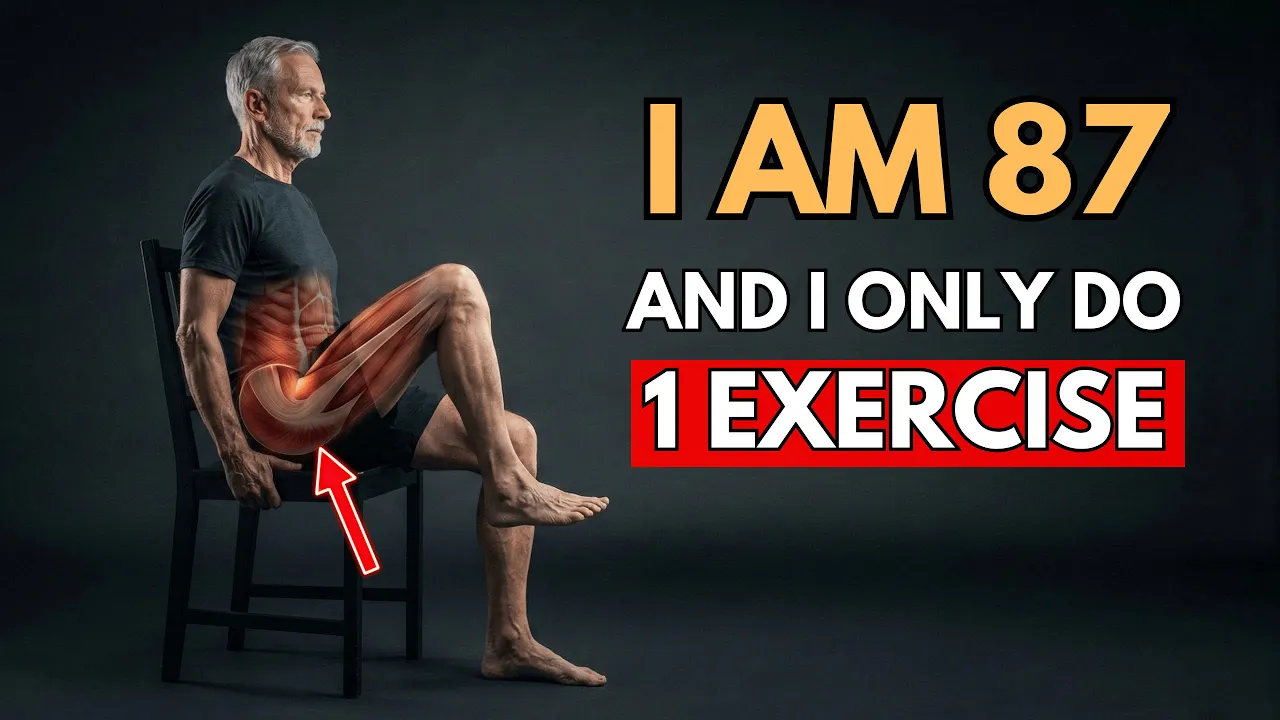
This movement addresses the "senior shuffle. " You have likely seen people who barely lift their feet when they walk, shuffling along the ground. This happens because the hip flexors—the muscles responsible for lifting the thigh—have become weak and tight, often due to excessive sitting.
When you cannot lift your knee high enough, you are at a catastrophic risk of tripping over rugs, door thresholds, or cracks in the pavement. A study from Monash University highlighted that hip strength is a key factor in gait stability. For this movement, posture is non-negotiable.
You must not lean back. Sitting upright, you lift one knee toward your chest, pause, and lower it with that same three-second count we discussed earlier. This demands that your core and your hips work together.
It forces the hip flexor to engage fully, which helps ensure that when you are walking in the real world, your foot clears the ground with every step, dramatically reducing the likelihood of a trip-and-fall accident. As we move to the final two components of this protocol, we shift our focus from simple muscle activation to the concept of control and neurological response. The second most critical exercise involves the posterior chain—the glutes and hamstrings—through a movement I call the seated sit-back control, or a partial squat return.
In my experience, the inability to control the body against gravity is a major precursor to injury. When the glute muscles atrophy, we lose the braking system of the body. A study from the University of British Columbia found that seniors who lacked this specific type of eccentric control were more than twice as likely to experience a fall.
To train this, we reverse the usual sit-to-stand advice. Instead of focusing on standing up, we focus on the descent. You scoot to the edge of your chair, feet planted firmly.
You lean forward slightly at the hips—nose over toes—and lift your body just a few inches off the seat. Then, and this is the crucial part, you take four to five seconds to slowly lower yourself back down. You are fighting gravity.
You are forcing the glutes and hamstrings to fire intensely to prevent you from collapsing back into the seat. This mimics the mechanics of daily life, such as using the restroom or getting into a car, and it builds immense stability in the hip girdle. Finally, we arrive at the single most overlooked yet medically profound exercise in this sequence: the isometric leg press hold.
This movement is unique because it involves no joint motion whatsoever, making it perfect for those with severe arthritis or joint pain. It relies on isometric contraction, which means the muscle generates force without changing length. A landmark study from the University of Copenhagen demonstrated that isometric training could improve functional performance and reduce fall risk by training the nervous system to recruit motor units rapidly.
In a fall scenario, you do not have time to think. Your muscles must react instantly to catch you. Isometric pushes train this rapid firing rate.
You simply sit in your chair and drive your feet into the floor as hard as you safely can, as if you are about to stand up, but you do not actually lift off the chair. You create a massive amount of tension in your legs, engaging the quads, hamstrings, and glutes simultaneously. You hold this tension for ten seconds, breathing normally, and then release.
This teaches your brain how to maximize muscle recruitment on demand. It is a neurological wake-up call to your lower body. When you combine these five movements, you are not just "exercising.
" You are systematically addressing the physiological deficits that lead to frailty. You are strengthening the knee extensors to stand, the calves to balance, the hip flexors to clear obstacles, the glutes to control gravity, and the nervous system to react quickly. This is a prescription for independence.
It does not require hours in a gym; it requires consistency. Two to three sessions a week can fundamentally alter the trajectory of your aging process. Remember, the goal is not to be young again; the goal is to be functional, capable, and independent for as long as possible.
Your body is incredibly resilient, and even after sixty, it stands ready to get stronger if you provide it with the right stimulus.