let's take a look at some common techniques for detecting and/or identifying proteins another powerful tool for determining the primary structure of a protein is mass spectrometry it employs differences in mastercharge ratio in order to separate and identify molecules the most common involves electrospray ionisation where a solution of molecules is sprayed from a capillary or small opening under an electric field the result is the ionization or charging of the particles differently charged species give a different series of charge-to-mass Peaks these can then be analyzed for amino acid sequence determination a powerful technique often used to detect
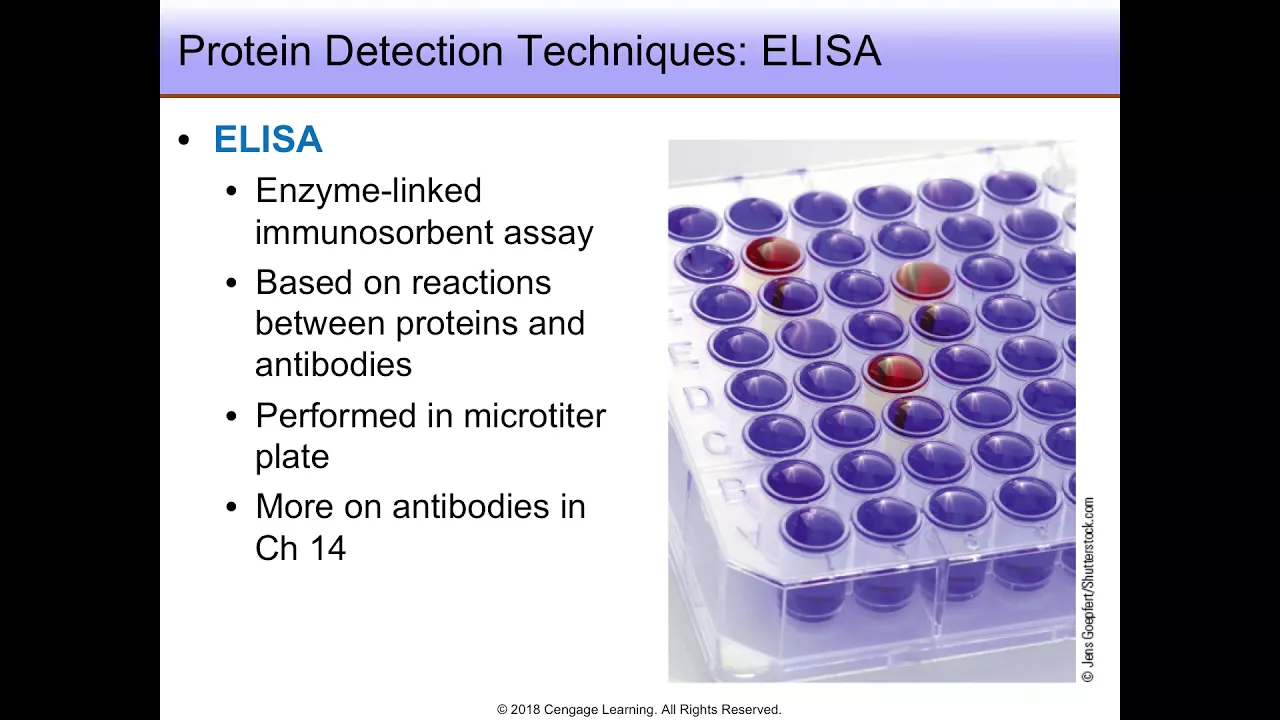
the presence of a target protein in a mixture of proteins is the eliza enzyme-linked immunosorbent assay it is based on specific binding interactions between proteins and antibodies and is performed in a microtiter plate Illustrated here it allows for analysis of multiple samples in low volumes we'll look more at antibody structure itself in chapter 14 in this assay two different antibody molecules are employed the primary antibody is one that binds specifically to the target protein it will be unlikely to bind to any other protein in the mixture the second area and a body is designed to
bind to the primary antibody and a kind of piggyback approach the enzyme linked in our method has to do with the fact that this secondary antibody is covalently attached to an enzyme when the enzyme substrate is added it generates a product that can be detected by color or fluorescence an advance over this technique and yet similar in design is the use of protein chips these are small plates of only a few centimeters that could have as many as tens of thousands of implanted proteins these are micro arrays and they have a similar purpose as the
microtiter plate of the eliza in this case detection is typically accomplished through fluorescence another technique involving the use of antibodies is the Western blot proteins are separated by gel electrophoresis and then transferred from the gel to a nitrocellulose membrane the purpose is to subject the sample to further analysis and identification using methods that are not applicable in a gel environment the transfer from a gel to the membrane is accomplished by preparing a kind of paper sandwich soaked with a buffer the membrane is placed underneath the gel and a current is applied the negatively charged protein
moves toward the positively charged anode on the bottom thereby leaving the gel and being deposited on the nitrocellulose membrane detection on the membrane is then accomplished in a similar fashion as the Eliza technique using primary and secondary antibodies these various techniques represent the application of known chemical and physical principles with the goal of the study of protein structure and function
















![I Replaced ALL my ADOBE APPS with these [free or cheaper] Alternatives!](https://img.youtube.com/vi/5EfqHg49kMk/maxresdefault.jpg)