Come okay welcome everybody thank you for making it this morning to our course on screen and early detection of prostate cancer so we have a few housekeeping rules that I will start with and so we this course is very interactive we have two hours together and if you have the app there will be audio audience response questions in there so we will have cases and questions so please feel free to Download the the mobile app and you can do that um using it the web AA website and use your um the email that you use
to register for the AA and I should also state that AA policy is that all authors and presenters must disclose um to the AA prior to their presentation all relevant Financial Rel relationships with any accme defined ineligible company and which is also known as commercial interest and the AOA determines if the Relationships are relevant to the educational con cont and mitigates any conflicts of interest prior to the educational activity and disclosures of relevant Financial relationships are posted on the aoa's annual meeting website at aa.org and a link is posted in the mobile app and so
some other houskeeping rules is to please remember to silence your cell phones we don't want any phone calls or alarms going off during the course uh and unfortunately No photos videos or audio recordings are permitted during this course and these courses are selected BAS based on evaluation results so so we were very happy to to hear your evaluations after the course and for every course you complete your name will be entered into a drawing for a complimentary registration to AA 2025 in Las Vegas so hopefully you can participate in that and hopefully you win um
so uh that's all I had in terms of Housekeeping rules and we have here our distinguished faculty with me and we will have a very fast-paced course and we will switch between the topics and cases and we hope that you will enjoy this session and feel free to ask questions we have a microphone here at the front and if you're watching this live you can type questions in in the AOA app and we will try to monitor the the chat and answer your questions okay great so let's get Started and put up our audio audience
response questions and you can scan this QR code and we will start with some precourse questions and after the course we will ask you the same questions again okay question number one what is shared decision making oh oh we don't see the response this like a cliffhanger I thought we would see the responses okay we will see afterwards then thank you okay so Pauling question Number two which of the following statements is true about consideration of previous biopsy before further management and repeat biopsy okay question number three a multiparametric proed MRI is performed for an
elevated PSA of 8.8 in which of the following scenarios should a systematic biopsy be performed okay question number four a 50-year-old Man without any family history of prostate cancer agrees to undergo an Initial prostate cancer screening with his primary care phys after shared decision- making his PSA comes back and it's 11 what is the best Next Step okay number five which of the following statements is false about prostate biopsy technique okay great thank you so much for filling out the poll and the results will be shown after the course so with that we will now
move to the second talk and I'm Sig Carson by the way I'm an Epidemiologist at Memorial slone caning Cancer Center in New York and I'm the director for this course this year and so next we will move to my colleague Dr simpa salami from Michigan who is also our golden sister scope Award winner this year so congratulations thanks Dr Carlson so I thought that will start with a case this morning uh that you will reference throughout the entire course uh this morning so you can go ahead and scan the QR code if you're not already
in the system so this is a patient 63-year-old patient who was referred to as essentially healthy guy with no family history of prostate cancer and you can see the trend in the PSA over the years uh with his primary care he had an MRI um that was negative so using this size of the pro of the MRI SPS density was 0.2 uh because the MRI was negative and suspicion for prostate cancer here on the way is systematic bsy that did not Show any cancer just at tpia and ASAP his PSA continued to rise so this
time his PSA density is now 0.42 it was repeated within uh a couple one to two months and uh the PSA still uh was elevated at 13.1 it is at this point that he was referred to us so the question is uh what would you do next okay so this patient um here we presented five different options Would You observe with your PSS probably not Because this PSA remains it will you give antibiotics no as you learn later from my colleagues um antibiotics have not been shown to be useful in R stratifying patients who are
at risk for prostate cancer uh would you repeat the MRI he had an MRI within a year that they so the question is will repeating the MRI actually make any difference uh here probably not so you're left with option C bioma testing or uh repeat the biopsy so I'll tell you what actually Happened so at the outside facility they did repeat the MRI still negative uh PSA density 42 the MRI indicated that there's some featur suggestive of prostatitis so he got antibiotics at the outside hospital but as you saw it didn't really make any difference
so you learn why later antibiotics is not really useful in rying patients at risk for prostate cancer so when he got to us what we did was to get a biom test uh locally at the University of Michigan we Have the my prostate score and and this was uh suspicious for prostate cancer and because he already had a negative systematic biopsy previously we decided to use a different uh biopsy strategy which was a saturation biopsy a mini saturation biopsy if you will obtained 26 cores and as you can see uh they uh they were um
four course that were positive for cancer and uh they they were all in the right interior L part of the prostate parts of the prostate that May be difficult to get to depending on what B technique you use and and they sh G group 3 Pros an and then he went on to to treatment so with that I will uh yield now to Dr sigaret Carson again who will uh give the next talk thank you thank you Dr salami so next we will have H Dr Scott egner from um Chicago and he's also the midcareer
award winner at this year's AOA for his contributions on screening and diagnosis Of prostate cancer that we will now talk about all right I'm going to throw out a bunch of thoughts I'm going to um mention a bunch of guideline statements and as you all know there are rarely occasions where there's absolute right or wrong answers there certainly are some I'm going to share my thoughts um and hopefully there's some utility to that uh there is nothing relevant that I'm going to go through some of these Are distant disclosures and um the ones at the
bottom are more recent but I'm not even talking about these products so but I still think it's important for you to know about none of these are relevant but I still always push them out there because I think it's important so the way I see prostate cancer screening it's kind of the The Good the Bad and the Ugly uh there are definitely some winning features to Prostate cancer screening most notably that since the the PSA era started there's been a 50% decrease in age adjusted mortality and that's a huge win and we've got a lot
of data to take a deep dive into I would also be the first to say we should shout that from the rooftops but we also need to be equally vocal about the Bad and the Ugly there remains a epidemic or pandemic of just indiscriminate screening and silly decision making and an extraordinarily High likelihood of over diagnosis and overt treatment and it's become a very expensive space the good news is we have a lot of new tools available that are you know scientifically based good evidence but they're all very expensive and we have to ask ourselves
what are we going to do so as I mentioned earlier death rates have gone down 50% okay that's a huge win there are many men that have had Their life saved primarily due to prostate cancer screening there are also other reasons it came down but the main factor was screening and you can see it here kind of compared to some other canc you've all seen this before I would also tell you the biggest win was amongst men of African ancestry which is the greatest relative decrease in age adjusted mortality and so there are different racial
and ethnic Um you know breakdowns of of how incidents and mortality but you can see in that green uh the great decrease in mortality uh the elephant in the room and it shouldn't be an elephant we should all be thinking about it when we're talking to our patients and talking about it publicly is the need to save these lives but minimize overd detection and overt treatment I would argue when you think of number needed to screen and number Needed to diagnose we're doing a pretty good job on par with our partners where things are more
widely accepted you probably saw there were updates in the breast cancer screening recommendations if you look at it the most optimistic that we have from the Well Done trials is high quality compared to other things that are more commonly accepted the issue is obviously the likelihood of side effects with treatment and I say this I've always said it sophomorically But it is true if the prostate was on our elbow there would be no controversy whatsoever you screen diagnose and aggressively treat everybody I try to break this down on some tips uh that I use regularly
and hopefully you either use or may consider we have a big problem with screening old sick men with a really low value to prostate cancer screening this is the AA guideline that goes along with it but basically use all the tools that you have available Usually cheap easy um and sometimes even free to decide whether they even need screening so this was a study that one of our students put together close to 10 years ago and it was almost literally jaw-dropping when I saw this data this is from the entire country of the us whether
they had a screening PSA in the year before and as you'll see only about 40% of men get screened but the rates of screening in 70 and 80 year old men are higher than in 40 and 50 year old men it Should really be the exact opposite and it didn't really change much over time over an eight-year window I'd love to tell you we've known about this Primary Care does most screening Urology does a fair amount but nowhere near as much as Primary Care I'd love to say hallelujah kumaya there's been great progress there's a
paper that literally came out next week uh last week uh and this was screening within the last two years based on age and we Haven't done much better so my argument and and part of my kind of academic mission is you know if we can minimize over detection and overt treatment I do think there's a win in that more men would be screened the ratio of you know benefit to risk becomes a lot better and all of a sudden whether it's guidelines or primary care doctors find it more attractive and then this is the disturbing
thing of and we saw this 10 years ago even the sickest folks you Know with an estimated you know 10year risk of mortality that you see there a striking number of them are still getting a screening PSA there are even studies in people with terminal cancers that are unlikely to live more than a couple years and 20% of them are getting PSAs it's ridiculous um and here's some other just kind of breakdown of the data uh that you can see but you get my point and I and I stop screening a lot of men and
I'm going to give you Some tangible info on it but even just based on their life expectancy it's okay to stop screening men and put it in their chart you know a oneliner and there's you know basically zero legal risk to it all so a 65-year-old US man okay what's the likelihood that they're going to live another 10 15 20 years the average life expectancy from the sickest to the healthiest 65y old man is about 17 years an average estimated life expectancy doesn't drop below 10 years Until you get to 76 years old so my
point is there are people in their 60s who aren't healthy that it's crazy to screen there are also men in their mid to uper 70s that are perfectly healthy that are going to live a while that I am absolutely fine screening the goals of screening are a little different than a perfectly healthy 15 year 50-year-old so here's your guideline statement on shared decision decision- making um I'm no Exemplar of this also I've tried to become better but we need to do a better job of explaining kind of the the Bad and the Ugly or the
risks and benefits of screening if you ask men in polls who have been screened what did your doctor tell you about it not surprisingly we tend to make it simple and easy and just tell them all the potential good stuff and not necessarily discuss you know some of the potential Downstream effects there are online C you know online shared decision-making Tools that some people use maybe you use those in in your practice so be familiar with these modified guidelines one of the wins of the updates of the guid guidelines is it's not that old school
you know everyone should be screened every year and then the last iteration was every other year there's a lot more flexibility now and we need to become more like you know colon cancer screening where you get your first Colonoscopy and they tell you to come back one year two years 5 years 10 years we can do the same and I'm going to show you some data on that here are the update updated guidelines um unless it's a strikingly rare situation uh you shouldn't be screening people less than 40 and then from age 40 to 45
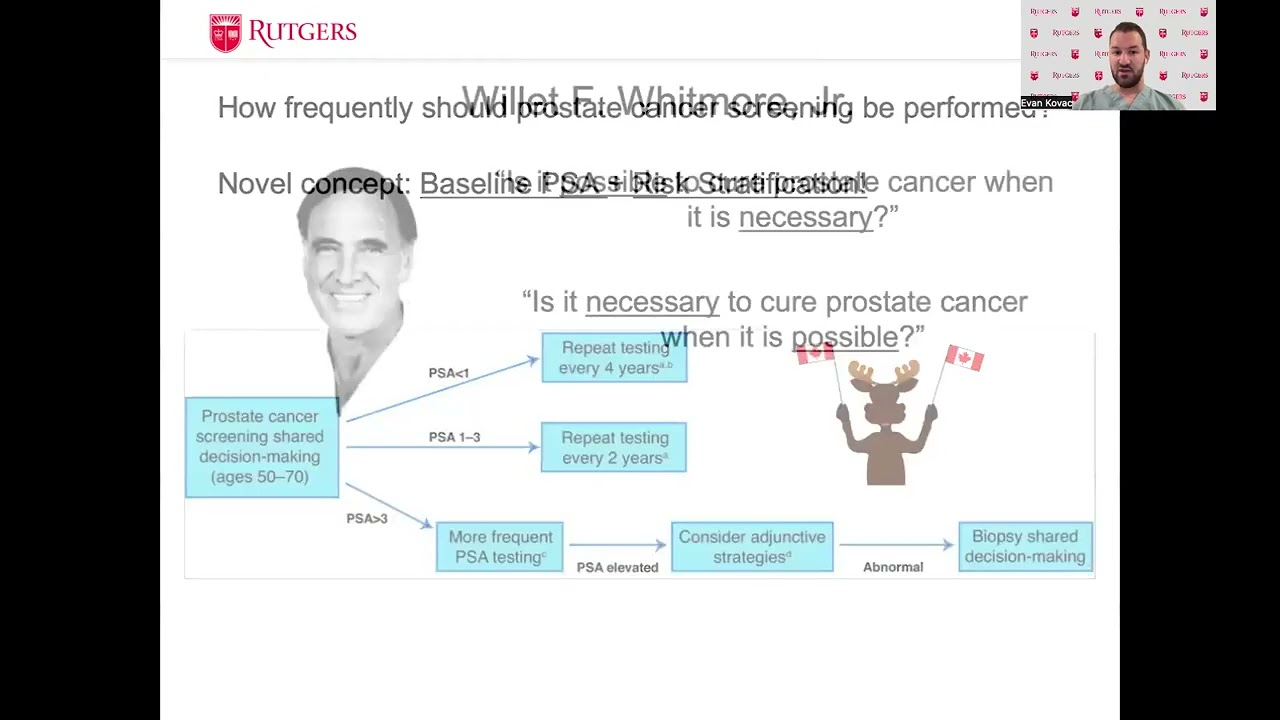
anyone that's at you know putatively higher risk and you know all the things I don't have to go through them um you know consider a baseline PSA there's Wonderful data that I'm going to show you on the power of a baseline PSA before BPH becomes a confounder we should offer regular prostate screening every two to four years for men in that roughly 50 to 70 year range and I'm going to go through some things that help tweak the needle you know more towards you know every year two years four years and personalize the rescreening inter
it's not just as simple as kind of Age And what your PSA is we've got a lot of other tools available that you can really personalize things I always make the argument to our trainees and whenever I talk publicly I can't think of a single situation in screening diagnosis or post treatment where I would change the recommendation or a plan based on one PSA alone so almost always I'm sure there's exceptions but I would always repeat a change in the PSA before or changing a Game plan particularly in the screening setting where there's so many
other non-cancer related factors that can influence a PSA I think we should just I think jamama should publish this every year as a reminder most people never knew about it or forgot about it but it's over 20 years old this is a colon pop prevention trial where they had banked blood and they looked at a definition of an elevated PSA various definitions and Without any intervention doing nothing in subsequent years basically 40 to 50% of those men were back in the quote unquote normal range so I'm not telling you to wait a year or two
years but we all know and live through this and see it all the time the fluctuation of PSA and the things that can confound it so always always repeat it it doesn't matter if it's a month like in the case two three months six months whatever you think is appropriate the halflife of PSA Is about 2 to 3 days so take that into consideration here's over a short window over two months and this hammers home the point this was from Sweden 1,600 men that ended up having a biopsy but before the biopsy they repeated the
PSA let me walk you through the Shaded area that's what happened to their PSA the peak in the middle is it basically stayed the same and then there were some where it went lower and some where it went higher and what's really Interesting and it's clinically actionable is if a PSA is elevated you repeat it and it stays elevated right at that level that's the highest likelihood that they have gleon 7 or grade group two or higher if it keeps going higher and dramatically higher that when you check it two months later there's a pretty
low likelihood they have it because there's likely something else it's pretty darn rare for a prostate cancer to make Someone's PSA rapidly go up in such short time span and same goes if it goes down obviously that one's a little bit more self-evident the PSA spikes up you repeat it two months later it comes down they're going to have a way lower likelihood of having grade group two hopefully you all know this I I'm still ashamed that I participated in this but when I was a resident everyone that came in with an elevated PSA got
Four weeks of cypro empirically I mean we laugh at it now the very first clinical trial I did as a young attending was to do a randomized study on uh cpro versus nothing it didn't make a difference and then not surprisingly would present it at meetings like this we gave in the trial two weeks of cypro um and basically the feedback was oh you young ignoramus you just don't know enough you didn't give them enough zpro it takes a while to penetrate prostate So someone did a six- week trial where they got six week of
cypro and you know this it didn't make a difference and we know obviously that it's harmful so use Baseline PSA to risk stratify Dr Carlson's going to go through this she's generated some of this data it's extraordinarily powerful so again walking you through what can sometimes be a little bit of a confusing curve so over 21,000 unscreened men okay they get a Baseline PSA in their 40s okay and you see the gray curve there that's the distribution almost all of them are quote unquote normal but there's a wide range and a huge difference in your
40s if your PSA is. 3.8 or 1.5 and we need to pay attention to that separate from that graph I on the left I drill into my head and try with our residents and fellows here are medium PSAs by decade and it's important to try to remember those but back to the Figure on the right these are men in their 40s unscreened okay so it's kind of a natural history because it was banked blood and you can see even within those quote unquote normal ranges that PSA level decades later predicts the likelihood of having any
cancer or a potentially dangerous prostate cancer so there is value in a baseline PSA there was a lot of enthusiasm for many years on PSA velocity it makes intuitive sense it wasn't quite as Simple and easy as oh if your PSA went up greater than 75 let's hop on that prostate and biopsy it there's a lot more Nuance to it here's a paper that came out a long time ago and on the xaxis is PSA velocity and yes if you use a cut point of 75 it looks like PSA velocity is important but as I
already told you the higher that PSA velocity is meaning the higher the spike the lower the like Ood that it's cancer and you can see that there based on Lower Likelihood of Cancer and a higher likelihood of inflammation on the biopsy if you look at larger data sets from prospective clinical trials the take-home message in both a huge us-based trial called pcpt as well as a European screening trial called erspc if you take basic information about a patient being screened total PSA family history Dr whether they've ever had a biopsy before PSA velocity does not
add anything to your ability to predict a Meaningful prostate cancer because most of the PSA velocity is baked into the total PSA and some of those other features so here it is from pcpt here it is from erspc I'm not going to run through it except to tell you once you have all that other information PSA velocity does not add much I am a huge fan of free PSA I order it on every single person that's getting screened and in fact for people with a mildly Elevated PSA from 2 and a half to 10 I
am way more interested in what their free PSA is than what their total PSA is and I want to show you some of that data first of all for the there's a lot of you know scientifically backed and very useful biomarkers most not all of them tend to be fairly expensive and sendouts and you have to wait free PSA is in your lab on a research setting at $6 I don't know what insurance companies charge for it free PSA and and total PSA are the Main drivers of the 4K and the Phi Mark Preston who's
done a lot of work on it with Dr Carlson and others likes to call it the 2K score I kind of like it total PSA and free PSA very powerful and here's just but one example the only online risk calculator I routinely use in clinic is in a screening setting but here's but one example that comes up all the time you take a man with a PSA of four normal Dr no family history no previous Biopsy based on their free PSA there can be up to a six-fold difference in their likelihood of having meaningful cancer
potentially meaningful cancer so this gets back to I mean we all kind of if you were like me and maybe I'm outing myself that first question on what is shared decision making is like come on I mean we all know what that is and we're all supposed to do it but to me this is shared decision- making this is kind of the Essence of it of trying to get granular data and more specific and not just categorically say oh your PSA is over four we're GNA do you know a biopsy every time here's some data
on free PSA these are men from the screening trial in the United States median followup was basically two decades and you can look at the breakdown here there's a ton of other great data baked into these studies but the take-home message is free PSA is extraordinarily Powerful and here's but an example you know know of of just bringing out you know Baseline PSA as a total PSA as a free PSA and the likelihood of having meaningful events you know decades down the road PSA density uh the great news is it's extraordinarily powerful if we could
start a company on PSA density based on the data it should be the winner of all of the screening biomarkers in my book okay it's not as Sexy it's not molecular but it's extraordinarily powerful it's it's mentioned 12 separate times in the guidelines it's really powerful in screening and in active surveillance which we're not going to talk about today if you wanted to draw a graph about a terrific screening biomarker look at that again the gray and going back to Sweden is the distribution of PSA density in over 5,000 men and that red line is
exactly what you want There's no step offs there's no ambiguity the higher your PSA density is the higher the likelihood you have a potentially meaningful cancer Dr are not particularly powerful we struggled when we put together the guidelines to come up with data that really supported Dr okay I think I mentioned it at the end but I find the the greatest routine value to a Dr is for me estimating the prostate size it's not nearly as accurate as ultrasound or MRI but you have a pretty darn good idea if it's a 2050 80 or you
know 150 cc prostate and that's a huge Factor looking here at your PSA density and here here's the Dr so I mentioned at the top I think you know routinely there's value in estimating the size there's obviously relatively rare patients that you're screening that you find a palpable abnormality the take-home of like kind of the Deep dive into the literature on Dr and it's Reflected in the guidelines the only time it was really shown to be additive above and beyond PSA is once the PSA was greater than three so an abnormal Dr in the setting
of someone with a p PSA greater than three adds to the positive predictive value of finding a grade group two or higher the evidence is pretty weak if you're routinely screening people with Dr when the PSA is less than three and lastly know when to stop Screening based on age and PSA amazing data some of it generated from Dr Carlson and her team huge um huge swats of people so median PSA at age 60 is one so half the men at age 60 have a PSA less than one and in an unscreened population followed for
the next 25 years if your PSA was less than one at age 60 the likelihood of you getting a metastasis from prostate cancer was 0.5% and dying from prostate cancer was 0.2% so I mean if there's anyone you want to dial back on those would be the guys okay um if you want to be really aggressive screen them again in 5 years or tell them at their PCP or to come come back to you Dr Carlson also generated great data on if your PSA was above or below two at age 60 remember medians one but
if you use two as a cut point they were not able to show any benefit to screening if your PSA was less than Two but it's rare you'll ever see a number needed to diagnose or a number needed to di uh to treat To Save A Life That's better than if you're screening people with a PSA greater than two at age 60 because you've minimized some of the ultimately incidental diagnosis by eliminating people who have a baseline PSA that's pretty darn low the other thing that's sometimes helpful and I I when I read this study
I Actually integrated it into my um you know talks with patients it it sounds self-evident but I got better at it after reading this study don't tell people you're too sick to be screened you're not going to live long enough you know that framing you basically frame it is such a low likelihood it's going to be of benefit there's an extraordinarily higher likelihood we're going to cause you harm or cause problems so here's the summary of all the things that I threw Out at you hopefully you find Value in it again I I I think
proudly you know most of these things are cheap easy and sometimes even free I absolutely would recognize there are wonderful secondary biomarkers you're going to hear about MRI obviously biopsy integral but I think screening starts with this foundational kind of uh these elements to screening so thanks thank you Dr egner for this road map to Screening so call some number four please and you will all get these slides you probably already have them in your course package so don't worry about taking notes or taking photos of everything because they're all in the your package great
and you also have there our full guideline of the AOA uh guideline for screening and early detection okay so let's move on with um PSA and isoforms and risk calculators and more about risk stratified screening Because that's is really where the field is moving towards and the first step as you heard is to always do share decision making before you draw the blood because it's the right thing to do and we still recommend PSA as the first screening test we've heard from Dr Ager about the extremely powerful value of PSA is a prognosticator of future
lethal disease and I can't think of any biomarker in oncology that's better than PSA for screening early detection and monitoring Of treatment so we're really blessed in urology to have the PSA test so that's why we recommend this as the first uh test and we have the evidence from our trials in Europe I've been an investigator of sspc and theoy trials that really shows that PSA screening reduces prostate cancer mortality by about 30% at more than 11 years of followup and the plco trial here in the U us um first was interpreted as a negative
trial but as we all know there Was a lot of screening going on and so when you take that into account you um also see a benefit of screening so this has been shown in in modeling studies and it's also interesting to see that the the cap trial in the UK that just came out about two weeks ago and was presented at the E uh all also shows that just a single invitation to PSA has an effect of prosate cancer morality over 15 years I was actually fairly surprised by this But it just shows the
point and the power of PSA but we think that if if you should do PSA screening it should be more of a dynamic uh approach if you want to have a greater benefit and Scott mentioned Dr uh we have it as optional in our guideline so some doctors might want to do it and some patients might ask for it but it has its highest utility uh when the PSA is above two so it can definitely you know be part of screening but it should More be part of the clinical workup should we uh put men
straight into an MRI that's another question that has been proposed I personally think that the number needed to MRI for the yield it will be too high so we would recommend starting with the PSA but it definitely can have some value and in this trial in the UK some of the men who had a PSA below three actually had some lesions so uh that also shows you know we need more studies about the cut point For further investigation and there's another trial in Canada that also shows that using MRI can reduce unnecessary biopsy so it's
definitely part of the pathway but we still think the PSA should be the first screening test and here is data from the yabo 2 trial that's ongoing that then combines PSA with the MRI and there are two two arms one has a cut of 1.8 and one with a three and going um forward just using the targeted biopsies to what you see on The MRI can then also reduce unnecessary biopsy and overdiagnosis so I think this is an interesting pathway going forward and the Stockholm 3 test uh is also one of these risk stratified Pathways
it's a multiplex test that combines clinical information and um age family history and prior prior biopsy and then going forward using stock 3 and MRI can again show kind of the trifecta of screening if you will with reduced unnecessary biopsy keeping the detection of Significant disease and reducing over diagnosis and here's another study that also just came out two weeks ago and was presented at e by Dr alinan it's called a pro screen trial in Finland and it's kind of a hop skip and jump so it's a three-step uh trial combining PSA with a 4K
score and then MRI and also again showing the same concept of detecting highgrade disease and reducing over diagnosis and I think this trial is interesting in terms of the negative Predictive value so at each step you can kind of uh reduce the number of men who continue in in the screening pathway so I think we need to think about that um more um when we think about screening what about genetics we will hear more about this from Dr salami and also about all the other biomarkers it can have a value for some men I don't
think we're ready to have population based screening based on genetics but it can definitely be incorporated in the Risk stratification and when you add this to the stock on free test you can see that it adds 1% to the Au and it's uh questionable if this will be feasible as I said on the population level when you do this there was a low uptake uh but it has been said by some as a measure of kind of Quantified family history if you will so so it can have some utility uh although it's a high bar
as mentioned the PSA test is so powerful that it's really hard to beat So once you add the polygenic risk score above and beyond the PSA does doesn't add to the prediction of the endpoint lethal disease so um we have a really good biomarker but we can definitely add some with genetics but perhaps not as much as we would hoped and we already talked about repeating the PSA and I wanted just emphasize and reiterate that that that's also a very simple thing you can do before referring men to biopsy and Baseline testing is again Really
powerful starting in midlife so once you know your Baseline PSA level and you you can then stratify future um risk so you can modify the next rescreening interval to a man's age and his PSA level and multiple studies on this and should you start at 45 versus 50 there's the probase trial in Germany that's ongoing and it would really answer that question once and for all so how many cancers would have progressed in the interim or can you wait until 50 So what we learned from that trial so far is that it's um PR cancer
is very rare among young men and MRIs can be hard to interpret in young men but the study is ongoing and we will have to wait future followup to see if you know it's really beneficial to start at 45 although we we in our guideline recommend starting somewhere between 45 and 50 and of course uh younger starting at 40 to 45 for minut at increased risk so black ancestry germline mutations and Strong family history and how often should you scream at the SBC trial which is a randomized trial recommends every 2 to four year you
know it could can be done at that frequency it can be done annually um and all the studies show that over longer term followup as Scott showed the number needed to screen and diagnose really become favorable and I think these numbers are really comparable to you know breast cancer screening choral Cancer screening but as Scott mentioned you know the prostate doesn't sit in the elbow so that's why the guidelines um perhaps disagree on the harms versus benefits but in terms of of mortality benefits it we really have the same numbers and then you can personalize
the the rescreening interval and as Scott mentioned you know if a man has a PSA uh of one or less than one at age 60 we he can he can go fishing basically because his risk is so so low uh we could also Um have a longer screening interval for those with lower levels and then of course most bang for the back as mentioned is for men about with a PSA above two and those should be screened more frequently another Power F thing is to use a PSA for older men um above 75 who have
a PSA less than three they also have a low risk and these are just some of the studies and you can just see the Beautiful separation of the curves and and PSA is really a strong uh risk stratifier in terms of prognostication and in our guideline we also have some cut offs there by by age for um further evaluation with prate biopsy and it's important to note that the Baseline PSA captures aggressive disease as well in white men as in black men with similar PSA distributions and risk calculators as we heard about there are several
out there And they can help with biopsy decisions and we have reviewed these in detail in our guidelines if you want to read more about them and Dr salami will talk next about biomarkers there's been an explosion on the market they used to be only the PSA when I started working in this field and it's been really remarkable Evolution and of course the new kid on the block that's made you know it's a Game Changer in our field is of course the MRI and these are also our B markers and they are included in the
guideline and in brief you know a review of all these biomarkers really show a clinical utility in you know improving the detection of high- grade disease and avoiding necessary biopsy and in terms of MRI you all know of this of course is massive variation and interpretation and you know the negative pred value is not 100% so it can vary tremendously you know depending on on the center Where You Are And so I like to say that a chain is only as strong as its weakest link so for this concept of to be successful of including
MRI before biopsy you really need to have access to high quality scanners and Optimal Reading of those scans and training program for Radiologists and high quality people performing the the biopsy for this to be successful so it's really important to have quality assurance programs and finally there are many ways to roam how Should we best screen and there's a lot of studies ongoing right now now um and here's just an example of um ongoing or recently completed risk stratified screening trials and Pathways forward so um there there are many many ways we can do this
but you can see to the right that most of these um studies incorporate PSA and MRI and some perhaps biomarket and genetics in different combinations and in EU there's now really interesting initiative called Praise You So EU has allocated money to 27 of the member states to to explore different pilot programs of these Pathways so we will learn a lot about that in the coming years so thank you and now let's talk about biomarkers [Applause] okay I think we're going to have you tease your brain a little bit here before we go into the biom
marker uh discussion so go ahead and go back into your Poll so which of the following statements regarding prostate cancer Le detection biom merkers is true okay okay this my disclosures that have no relevance to the talk that I'm giving today but as you you've already heard we all sering the AUA posted cancer detection guidelines panel and I also serve on the nccn as well today what we'll do is review the rational for utilizing bi meres in the early Detection of prostate cancer who disc cause U blood urine we discard blood urine and tissue based
biomer that are currently available and we go over the the guideline recommendations for how to use these biom meres in our practice algorithm and then finish up with gem line genetic testing a biomarker simply stated is any molecule that is found in blood urine any body fluid that is a sign of a Normal or an abnormal process they can be prognostic or predictive we're fortunate to have a number of biomers available in the kid in the prostate cancer space both in the early detection space as well as in the V uh disease setting and you've
already heard about PSA free PSA and uh isopsa and Soom three as well so I'm not going to go into uh those so in the blood uh based biom space we'll cover a five score and 4K score in a little bit more uh detail So the F score is a blood based test that combines three isop forms of uh of PSA I guess you can call it 3K um it's FDA approved and five in this particular um study that that was uh reported in 2015 by Dr l a five score of less than 25 is
associated with a lower risk of having any prostate cancer a lower risk of having any aggressive prostate cancer and what they also found is that the the F score which has the three uh components outperform any Individual component of of the F score essentially highlighting the fact that the more markers you have the better able you may be in overcoming the heterogenity that you may see in in prostate cancer uh the 4K score combines four different uh calic and it's also FDA approved and it's a model that includes the four calic and AG diary and
prior biopsy in the repeat biopsy setting and what this uh was reported in this multi- Institutional study is the fact that the full model Al performs any model that leaves out one component again highlighting the fact that potentially the more markers you have the better the the test might be and what I try to do here is to illustrate the fact that the performance of the test depends on the cut off or the threshold of the test uh for example for the 4K score if you use the threshold of nine or greater to identify patients
for biopsy you uh Avoid 43% of biopsies and what is interesting is uh What proportion of highr cancers you'll actually miss in this case uh 2.4% and this is is true uh with respect to majority of the biometers that are out there is they can uh help avoid unnecessary biopsies and decrease the risk of missing um aggressive uh prostate cancers we switch uh gears to urine based biom Mercers at the very first one that was introduced to the market was Pca3 this is a noncoding a long noncoding RNA that is expressed um in urine is
FDA approved for use in the repeat uh biopsy setting and in this work that was led by Dr John way in multi-institutional analysis they found that if you use a pca3 threshold of less than 20 in the uh repeat BS setting it has a negative predictive value of 88% and then when you add pca3 to uh pcpt prostate cancer prevention to a risk calculator it performs better in both The initial and repeat BS setting is also better in um identifying patients with um aggressive prostate cancer as well as any cancers at all but that was
just a single biomarker so further efforts have uh included adding additional biomarkers in this particular work that was led by Dr Tan at Vil University uh he and others developed the my prostate score some of you might be familiar with it previously known as the Michigan prostate cor score or MEPS Here they combined PCA 3 tempers 2 against serum PSA but the the most recent iteration of the test was just published last month month actually at this time encompassing 18 different biom mercues some of these biom mercues that are shown in asteris there are are
more associated with aggressive prostate cancer and what they found was that using this test um increased the sensitivity to 99% negative predictive value to 99% and you'll be able to avoid 35 to 46% of uh biops say in the initial and repeat biopsy settings respectively another test that has um included PCA 3 is exos DS and this test does not require ad this is the only urine based test that does not require adary it includes three different molecules spdf Ur and pca3 and in this study they correlated uh the exos DS with the detection of
grade group two prostate cancer or higher and using a threshold Of greater than 15.6 to N5 patients with prostate biopsy they reported that you can avoid 20% of negative biopsy and you miss only 2% of grade group two uh prostate Cancers and no tumors greater than uh gr group 3 uh grade group 3 was missed if you use this threshold uh and then the fourth and final urine based test is Select MDS it combines dlx1 and H C6 uh this test is currently not FDA approved in the United States and here uh they reported that
if You combine these two different molecules with clinical factors and an area under cover of 0.90 uh which outperforms uh PSA or clinical risk factors in predicting aggressive prostate cancer so moving to tissue based uh test there's only one test in this space and that is confirm MDX so confirm MDX was developed under the premise that when you have you know an area of cancer shown in red that surrounding normal Tissue May Harbor molecular alterations that might inform you that you have missed a cancer area in in the biopsy so this test actually assess the
mutilation status of three different genes uh listed here and in this uh seminal study 500 patients who underwent primary and secondary or repeat bsy within 30 months they performed the confirm MDS test in the initial bsy tissue and what they found was was that all cases that were grade group seven or excuse me gin 7 or Grade group two or higher in the repeat uh biopsis had metalation changes in their original biopsis and they reported the negative predictive value to be 90% % and using uh this test you can decrease uh your repeat biy uh
rate by 64% so this is a nice summary of the different biomarkers that we've discussed you know so far and what you see here if if it is uh legible enough is that the performance are very similar They they all have very you know similar area under curves you know 7.8 except uh exds in the clinically significant plustic cancer setting with a an EU obs 0.66 in general I think I I stole this from Dr eggner in general uh this uh biomarkers tend to decrease the need for uh biopsis or unnecessary biopsies by about 20
to 30% and they also help minimize the detection of gr group one prostate cancers that we don't really you know care about and importantly you Miss in general less than 5% of great group two prostate cancers however this biomers have not been well validated in diverse uh patient population uh only a few of them have been tested in in in the black patient population and why is this important we know for example that urg has a lower expression in black men and this is a key component of exhausts and the my prostate score so I
think there is really uh a need to validate these Biomarkers in diverse patient populations before you actually Implement them in in in that patient population if that's your practice uh this is a nice summary of the settings that this biomarkers can be utilized and as you can see most of them can be used in the initial and Repeat b setting except confirm MDX which requires a prior negative bsy tissue so it's only used in the repeat bsy side so what do the guidelines uh say in General biomarkers are considered a junct in the algorithm for
evaluating patients at risk for prostate cancer uh in the initial BS setting uh this statement says that you may use urine or serum biom merkers when further restratification would influence the decision to proceed with uh prostate biopsy or not so essentially it is optional in the repeat biopsy setting uh if if a patient has a low probability of hovering gr group two prostate cancer For example as Dr eggner described if the PSC density is low CPS density of 0.1 after a negative biopsy you don't need a biomarker however if the the risk of harboring aggressive
prostate cancer is high your PSC density is still high like the case we presented at the very beginning then you could use a biomarker to selectively identify those who may need to undergo further evaluation and these recommendations are Very similar to other guidelines like the EA also considered this you know optional uh because they're not uh we don't have sufficient data at this time to implement this biomarkers as routin test in screening for prostate cancer again very similar to the nccn recommendation uh they considered you know optional as well so we we need data on
how to integrate biom merkers and MRI in our algorithm for evaluating uh patients who Are raised for prostate cancer and this is a very uh nice study that Dr callson you know highlighted previously where men were uh randomly assigned to screening versus uh no uh screening and the data I'm going to show you here is in the screening arm this was nicely uh summarized by dran and essentially when patients have elevated PSA they get a biomac test patients who have a PSA that is considered normal um they essentially get the green light and if your
PSA is Elevated and your biom markest in this case they use 4K score if your 4K score is elevated then you get an MRI if MRI is positive then you get a targeted biopsy only if your MRI is negative you don't get the green light it's yellow the yellow light or orange light you need additional information again what do we see PSA density so if PSA density is still elevated then you get a systematic biopsy I think this is a very nice algorithm highlighting how to Implement biomarkers um in evaluation of patients who are at
risk for prostate cancer so we need most of this like this and this is an uh this um another data that really highlights how effective this can be when you compare the pro screen trial with the SBC trial the European you know screening trial and you look at the first round of screening screening the detection of grade group 2 to five prostate cancer very similar but to be able to get this you would have to Do more bses in the European you know screening trial this is really you know highlights how impactful it can be
to use you know PSA biom markers MRI in in in your screen um algorithm also note worth is the fact that you detect less great group one prostate cancers if you use you know the algorithm incorporating PSA biomarkers and MRI so we need more studies like this and this is a study that's currently been uh led by Dr John way in this case Looking at MRI uh with the my prostate score at the University of Michigan so when you you have a patient before you you you want to uh consider a biomarker test I think
we need to ask ourselves important questions when am I getting the test what information is it going to provide for me of course we all want a test that will tell us you know positive or negative yes or no but that's not what both biomarkers do they essentially present you with risk so you Need to have a plan of how you're going to utilize the results from that data that test before you actually order it for example uh you get a biomarker test result that says 10% risk of highr prostate cancer a patient might be
comfortable with that of not undergoing biopsy whereas you may have other patients they have 5% risk of having highr prostate cancer they want a biopsy like right now so you need to have a plan discuss with your patient before You actually order the test and then don't order too many tests or order uh tests reflexively because they all provide very similar information as we highlighted and also ask yourself is the biomarker of Interest validated in the in a patient population that includes a patient like yours how do I personally use biom merkers patients see biomers
on on TV commercial they want that Tas I try to talk them Out of it if I don't think it's necessary they still want it fine uh you know get it additional information and it's also can be useful in counseling patients patients who are very anxious you know they have low suspicion for high grade cancer they want the test if the test comes back as low risk that's uh reassuring if a patient has a negative MRI benign biopsy still ongoing suspicion for high grade prostate cancer for example PSC density is high I'll Order a biomarker
before I proceed with additional evaluation and if MRI shows a lesion um and biop is negative especially if it's like Paris four or five Legion and the B says negative I will consider a biom marker to see to make sure we're not missing anything so this is the brain teaser that we had so the answer is confirm MDX because it requires a prior negative biopsy okay so that's the first part of my talk the second part is gemline Genetic testing uh majority of prostate cancers are sporadic meaning that the exact cause of the cancer is
unknown and about 5 to 10% of prostate cancers are considered hereditary meaning that there's a specific mutation or alteration like in baa one baa 2 or the L syndrome mutations that put the patients at risk for developing you know prostate cancer and 15 to 20% are familial meaning there's some potential genetic Association but no no uh Detectable mutation has been found why is it important to keep this in mind when you evaluate patients well uh G line genetic testing can provide information that can be used for risk you know assessment uh can be used for
prevention of certain cancers can be used for establishing or determining prognosis for example patients with Brea 1 Brer 2 alterations who with low grade disease at higher risk of undergoing a great progression while on active Surveillance it could be used for treatment selection for example or laib in mintic cancer space and then it can also be used to guide additional testing of family members for prostate cancer as well as other cancers like breast colon or or pancreatic for example patients with Brea 1 Bria 2 alterations have a 2 to sixfold incre Lifetime increased risk of
developing prostate cancer more so with braet 2 8.6 fold increased Risk by the Age of 65 uh these patients tend to have more aggressive disease high high disease lyom metastasis um poor survival and these patients May Alo be at risk of other cancers as already mentioned in the localized prostate cancer space this was a paper that was reported out a few years ago where they looked at men with localized prostate cancer and then they found that 70 177% of the men that were tested have a germline variant of course there some SEL selection bias you
know at play here because these patients underw uh testing for for a reason but what is noteworthy is that of the of those that tested positive for a jam line uh variant 37% would not have been tested uh if you were to go by the nccn guidelines at the time so more recently the guidelines excuse me I think I'm just showing here that the distribution of this different gemline variants are very similar to the metastatic disease space so more Recently the guidelines have Incorporated jum line genetic testing in a simplified manner in general if a
patient has low or intermediate risk disease but I have a strong family history of prostate cancer or there's intraductal or CRI form histology in in the specimen they should be considered for gemline genetic testing and then certainly if they have high risk prostate cancer you should consider gemline genetic testing and this starts With a obtaining a detailed you know family history you know the who who in the family what what kind of cancers when how were they when they were Nur and how aggressive you know was the cancer and then you know consider what test
do you order in general there's so many tests out there that looked at different panels of genes some you know just a handful some uh tens of genes but whatever test you decide to use make sure that it's assessing the key genes That are associated with prostate cancer like Brer 2 Brer 1 the L syndrome mutations and HW speed 13 and uh specimens can be blood or saliva or even tissue and the test generally you know about $200 or so and may be covered by insurance and if you have a positive gumline variant there will
be no need to do somatic testing since whatever alterations you find are also present in in the somatic CS uh gine genetic testing can be Clinician or urologist uh directed or it can be a genetic counselor directed but it should really be a team based approach uh certainly uh is important to incorporate genetic counselors in your algorithm because they will be able to help help um advise or recommend screening for other malignancies and also oversee Cascade testing of other family members and certainly if you have if you self-direct g line gentic testing and you find
a positive variant you want To refer the patient to genetic counselor for for counseling so in conclusion I think it's important that we are familiar with what biom merkers are available in the early detection of prosy cancer space understand what data each test provides and make sure that the test is validated in a diverse patient population and before you order a test make sure that it's going to impact the decision that you make before you order it uh don't order test you Know reflexively and don't don't order too many tasks because they provide very similar
information and we need to keep up with emerging data especially when it comes to integrating biomarkers with MRI and patients that are eligible for gemline gentic testing should be considered for gemline uh testing with that I say thank you [Applause] thank you so much Dr salami that was a outstanding overview so now uh we have Um gone through PSA screening biomarkers risk stratification and we will now move into where AA becomes Ora the American Euro radiological Association moving into MRI and biopsy techniques so we will hear from Dr Dan marocas at Vanderbilt and Dr John
way from Michigan um thank you all for attending this course I'm going to take one minute before I start to brag about this course for a second um this is the longest running course that the AA offers um I Myself have been doing this for about 15 years um and over the course of time we've accumulated a faculty of of presenters um much smarter than me but but all of us are on the AUA guideline panel for early detection for prostate cancer some on the nccn guideline as well um but importantly maybe not myself but
the four of these folks are not just evaluating the data but generating the data um and and true thought leaders in This space uh and and as Dr Carlson mentioned of the handful of major Awards this year um we have on this panel the Gold cystoscope Award winner and the um midcareer Award winner um so thank you for attending I'm delighted to see that this course is still well attended um it it is shaped not just by the data but by your feedback so we really had this course has evolved a ton since I started
um and so please do uh fill out your evaluations we really read that stuff And and incorporate it um so talking about the role of let's see I'm unable to advance using this should I okay all right so I have no relevant industry relationships although my full list of disclosures is available on the AUA website um the learning objective here is to explain and implement the AA guidelines concerning use of MRI for prostate cancer detection both in the initial biopsy setting and repeat biopsy Setting um what is the rationale for using MRI and prostate cancer
diagnosis I think you all know it but I'll review it very briefly the evolution here is from finger guided biopsy to Ultrasound guided biopsy and now MRI um MRI can be used to guide biopsies uh so-called in bore right in the MRI scanner or by cognitive registration meaning looking at the MRI and then performing your ultrasound guided biopsy or using computer assisted Fusion of the MRI and Biopsy I'm sorry MRI and ultrasound images and of course m could be used whether you're doing transparen or transrectally and as we heard previously the guidelines are sort of
agnostic as to the approach why would we use MRI to guide biopsy so the obvious answer is to to direct biopsies at regions of Suspicion um maybe we can also use it to avoid doing the systematic cores in other words just biopsy the target um and Maybe we can use it to avoid biopsies in patients with a negative MRI and I'll I'll talk to you about each of these in turn from a statistic standpoint directing biopsies at areas of Suspicion increases sensitivity right we take a man with a PSA of eight and if we do
an MRI prior to biopsy and do both the targets and systematic cores we are more likely to find a grade group two or higher prostate cancer than if we had only done systematic biopsies Um when we talk about increasing specificity what we're saying is we're maybe we can avoid doing the biopsy if the MRI is negative acknowledging that we may miss some important cancers so talking about MRI and the initial biopsy setting I'll I'll sort of give a case description here to use to think about I don't think this is an audience response one but
a 58-year-old white man in excellent Health um no family history of prostate cancer he has Stable mild lower urinary tract symptoms and his PSA uh this year is up to 5.4 from 2.8 about 2 years earlier and per Scott's uh instructions we have rechecked it and it is 5.5 now um no nodules on the digital rectal exam he sort of normal siiz prostate no prior biopsy so the the available next steps are things like observe with serial PSA um give empiric antibiotics uh use additional biomarkers like the ones that were just discussed Um do an
MRI with a plan to proceed with a biopsy regardless of result do an MRI to with a plan to proceed with biopsy if it's positive and observe if it's negative or proceed with a biopsy without MRI prior um and we'll we'll sort of take those those in turn as we go through the algorithm this is the algorithm from the guideline which you can find online um what does it say it says that I'm sorry I'm going to go back for one Second it says that adjunctive biomarkers and prostate MRI are optional prior to an initial
biopsy um and I'll go through that a little bit further so observed with serial PSAs I don't think many of us would do that right the this a young man we didn't talk about any major he has no major health issues issues um and his PSA is certainly up uh empiric antibiotics as Dr eggner showed um are are in appropriate additional biomarkers Could be considered that's an option an MRI with a plan to biopsy could be considered that's an option and biopsy without MRI prior would also be an option and I'll I'll get into more
detail as to why that second to last option is not recommended by the guideline and that's what I would do MRI with blant biopsy um so clinicians may use MRI prior to initial biopsy to increase the detection of grade group two prostate Cancer to or higher and and again that's increasing sensitivity um how do we know about that there are numerous studies in this space um these are some of the major ones each one with a different study design and that's why you see very different increase uh increases in in sensitivity for grade group two
or clinically significant prostate cancer but the bottom line is that MRI increases sensitivity for for clinically Meaningful prostate cancer um how much does it do so it's dependent on the pyad score and I think many of you know this system already and I'll show you an example in a bit um but basically if pyd's one or two means low probability and and there the likelihood of finding clinically significant prostate cancer is only about 7% and three four and five you can see go go up from there and what I would say about three is that
pyds 3 is that it's Equivocal it's about the same as a random biopsy whereas four and five are truly increased probability of finding prostate cancer that's clinically significant um this is an important distinction that the guidelines make between the initial biopsy setting and the subsequent biopsy setting um when um for biopsy naive patients who have a suspicious lesion on MRI clinicians should perform targeted Biopsies of the suspicious lesion and may also perform a systematic template biopsy that implies that the systematic part of the biopsy is optional um so targeted biopsy required systematic biopsy optional and
why is this target biopsy actually on those three steps stes that I showed Target biopsy with systematic biopsy actually increases the likelihood of finding clinically significant prostate cancer whereas targeted biopsy Alone has about the same likelihood as finding um clinically significant prostate cancer as systematic biopsy alone it just does so with fewer biopsies um so targeted biopsy without systematic biopsy the advantage of that is it can lower the chance of finding grade group one disease which um we'd really rather not find if if you have a clinic like mine where you see mostly prostate you
would you would buy into that we really don't want to find more Grade group one disease um so again this this is one of the the guideline statements how many biopsy cores do you need out of each um out of each Target at least two and probably after three there are diminishing returns um so with higher number of cores you see increased detection of ically significant disease um but the downsides are increased time cost potentially complications and certainly detection of grade group one disease uh little incremental value uh With more than three cores per Target
um and importantly for risk stratification so if you're trying to distinguish for example between favorable intermediate risk disease and unfavorable intermediate risk disease and you're calculating uh percentage of cores positive um all cores from the same Target count as one all right so now we're up to the initial biopsy um and for patients with an elevated risk of grade group two or Higher prostate cancer an absence of suspicious findings on MRI clinicians should proceed with a systematic biopsy so just to just to reiterate that or restate it what we're saying is that in the initial
biopsy setting even if you have the negative MRI you should proceed with the biopsy and do the systematic biopsy and this is different in the repeat biopsy setting which I'll show you in a few minutes um so here the systematic biopsy is Required um again this is because of what we've alluded to before the negative predictive value of MRI is about 91% for grade group two or higher prostate cancer which implies that about one in 10 men with a negative MRI do in fact have grade group two or higher disease and if you think about
it um a lot of the biomarkers that that Dr salami was uh describing set thresholds for Consideration of biopsy around seven or 8% and so having about a 9 10% 9 10 11% risk of grade group two or higher prostate cancer um in many settings is sufficient to to um prompt proceeding with a biopsy um what is a systematic biopsy there's no perfect answer to that we debated it a lot on the guideline panel but concluded that it should include at least 12 cores distributed throughout the prostate um particularly with Thorough sampling of the peripheral
Zone um so back to our case the MRI now shows a pyats 5 lesion at the left mid peripheral Zone laterally and I don't expect that you will leave this course with with a full understanding of how to read prate MRI but I think it's important to have a basic understanding particularly if you're in a setting where you don't know that your radiologist is an expert um because some of these you have to Discern for yourself Ian we're all fortunate to be at academic medical centers where there are people who do this all the time
um but the basics are I'm not going to turn so you can hear me but the basics are in that top left panel um on T2 weighted Imaging which is usually the most crisp and Precise Imaging it looks the most like a CT scan anatomical Imaging um uh regions of Suspicion show up dark and so you can See that there that dark um sort of blacked out or smudged area is suspicious on diffusion weighted Imaging it comes up bright and it's basically that's they're showing the Restriction of diffusion of water through through the tumor because
of different density of the material the ADC map is is sort of the opposite it'll show up dark on the ADC map um and then finally on the dynamic contrast enhanced images where if you if you've seen these you scroll Through repeated Cycles where they they've given contrast and they're Imaging it at various intervals you'll see it begin to get bright um quicker than the other areas so this patient has a pyd's 5 lesion there on that that left side he underg goes trans paranal biopsy with cognitive fusion and is found to have a high-
grade prostate cancer um notice that there are three out of three cores from the region of interest and then four out of 12 cores of the Systematic cores all on the left side um and again please keep in mind that all of those cores from the region of interest if we were if we were trying to tally up the cores all of them would count as one core all right that's the initial biopsy setting I'm going to shift now to those with still high still relatively high suspicion for prostate cancer but who have had a
negative prior biopsy so just a different case 68-year-old African-American man also in excellent Health his father had prostate cancer he has no urinary symptoms his PSA is 10.3 no modules 50 g prostate had a previous systematic template biopsy that was negative um I think based on his risk characteristics here you can you can tell that this patient is relatively high risk right African-American older age family history elevated PSA um and so in patients who are Undergoing repeat biopsy where no prior MRI was performed those patients should have have an MRI right this patient had a
negative biopsy without MRI now we should do the MRI in preparation for the second biopsy so here the MRI is required whereas in the initial biopsy setting it's optional so patient undergoes MRI um in and why do we do this sorry about that why do we do this in patients with a prior negative systematic biopsy who Did not have an MRI MRI will show a suspicious lesion depending on what study you look at from 1/3 to 90% And the biopsy will be positive for any prostate cancer which we really don't need to know about but
gr group 2 prostate cancer in between 20 and 60% so it is crucial to do the MRI in this setting um now what about the systematic biopsy for patients who do not have a suspicious lesion on MRI clinicians May proceed with the systematic biopsy Implying it's optional so somebody who's had a um a prior negative biopsy you do the MRI you don't find any areas of Suspicion now we're saying that the systematic biopsy is optional um I would argue that in this particular case that patient is high enough risk that we would proceed with the
second biopsy and maybe as Dr salami was saying I can't remember which one of you said maybe go after it by a different approach if the last one was Transrectal try this one transperineal um it why why do we say it's optional in this setting the systematic biopsy because we repeat biopsies detect fewer and less lethal cancers so with each negative biopsy your probability of finding something bad on the next biopsy is lower and lower um however again MRI can miss 10 to 15% of grade group two prostate cancer grade group two are higher clinically
significant so we Decide whether to do biopsies based on other factors such as PSA density other biomarkers and nomogram okay um so in patients undergoing repeat biopsy who have suspicion on on on MRI clinician should perform T targeted biopsy and may also perform systematic biopsy this is sort of the same as the recommendation for initial biopsy um and I won't belabor that but cancer is found in the systematic cores 5 to 10% of the time in this setting um so in this case MRI if positive we're going to do the targeted biopsy that's required and
systematic biopsy is optional if negative the systematic biopsy is optional again that's a little bit different from the initial biopsy setting I'll summarize that all at the end and you'll have that a little summary table in your handout um what about the difference between cognitive fusion and computer Fusion clinicians May use software registration of MRI and ultrasound images during Fusion biopsy when available what this means is that you don't have to send someone to an academic Medical Center with a fancy Fusion machine um where it's going to take a month to get in for a
referral in another two months to get in for their biopsy you can look at the MRI and do a a cognitive Fusion biopsy uh with very little risk that you're going to miss that lesion compared to doing it with Computer fusion um and so there has not been much difference shown between cognitive fusion and computer fusion um it it obviously adds cost those those units are are you know in the hundreds of thousands of dollars to purchase um this is just an example of a study um from the UK with over a thousand patients where
all MRIs were read by expert gu Radiologists and basically there was very little difference between cognitive fusion and software Fusion it Was not statistically significant and so I I don't think you're doing your patients a disservice if you don't have the availability of of um of a computer Fusion software here's that summary slide I was I was talking about in the initial biopsy setting MRI is optional but in the repeat biopsy setting it's required if it hasn't already been done if the MRI is positive for both settings we should hit the target that's obvious and
the systematic cores are optional Recognizing that 10 to 15% of the time the MRI is is failing to identify uh potentially gr group two or higher disease when the MRI is negative in the initial biopsy setting you should still do that biopsy whereas in the repeat biopsy setting it is optional get two or more biopsies per Target um and there's not much difference between computer software registration or cognitive registration if it hasn't been said or Hasn't been emphasized enough these are guidelines and clinical judgment trumps guidelines every time and so you know all of these
are guard rails but but injecting your own judgment is is always appropriate that's all I have thank you for your attention thank you so much Dr baroz and now our final talk in this course we have half an hour left it will be very practical and Dr we will share all his expertise on how to do a great prostate Biopsy all right morning everybody um I'm going to begin just so I know the audience that I'm speaking to show of hands how many of you are doing transrectal ultrasound biopsy about uh 70% how many arej
just doing perals all right and how many have done a peral biopsy and found it too painful too difficult and they gave it up oh all right good good so what I'm going to talk About um my disclosures we're going to talk about how to do a prostate biopsy safely uh there's going to be emphasis on complications particularly um uh sepsis uh we're going to talk about the rationale and how to go about doing a transp paral prosty boopsy and the key really is comes down to doing the proper anesthetic some some of you may
remember there's a time when we used to do seant prostate biopsies that's how we're Trained we didn't do more than that and every single core the patient would jump and scream right and then we start introducing lidocaine and well you know you could do 12 biopsies you could do 20 biopsies and patient would be still right so anesthetic is the key so the safest biopsy is The One That Got Away right so the the guidelines speak to this there's two scenarios where you can avoid a biopsy one where you including your Clinical judgment and patients
risk factors and uh PSAs of course uh are so low that you deem it to be unnecessary to do a biopsy and then the opposite scenario is true as well so you can have a patient with a a very high PSA for instance and for the a a guidelines we kind of arbitrarily picked 50 but think of it as a patient with a very high PSA where you go he certainly has cancer maybe he even had a CT scan already that shows metastasis you go That guy don't need a biopsy so the guidelines put this
recommendation in there to kind of give you cover for those patients you know he should just go on and start hormones or he should just get treated let's not waste on biopsy maybe he's too sick maybe he would he would like make him septic and he won't tolerate it just go ahead and get him treated all right so uh next we're going to talk about uh what we tell patients about Prostate biopsy you begin we begin with telling patient why we do it right you they got to know why and the reason of course is
to find highgrade prostate cancer clinically significant prostate cancer group grade two or higher it's no longer just finding any prostate cancer in the same measure you have to explain to patients that there's possibility of finding low grade cancer and I think it's worth taking time to explain to patients in this scenario that we may Find a cancer that you do not need treatment because that blows people's minds really yeah that happens and then you say to them in that scenario we will sort of be telling you you're going to get repeated biopsies and imaging and
PSAs and maybe to no avail because it really won't kill you so you have to emphasize that to patient that they may be found to have a cancer that's not harmful that we don't need to treat beyond that I always cover with patients Actually my nurse does this sort of like um how to get prepared for the biopsy I always tell guys you do not need to fast it's incredible hary patients think they have to fast do not fast come in have your breakfast lunch drink your coffee your tea whatever because if they come in
and they dehydrated they fasten they're more likely to faint on you okay and and who needs that uh enemas I don't do enemas I don't tell my patients do enemas I should say um there are some Who like to do for transrectal biopsies like to do um beta diine washes and stuff like that and that does reduce sepsis to some amount but I just say don't do bi don't do any enemas um and my nurse also tells them if possible have someone come with you complications uh this is worth going over uh with patients as
well again my nurse goes through all of this uh we tell them about 24 hours they're going to have some paranal discomfort Hematuria very common uh the literature would say about 50% some visible Hur usually for a few days sometimes you may have uh blood in the semen all right and the literature again says about 50% but what I emphasize to the guys is it's going to last a long time don't call me in like 2 3 4 weeks that you still have blood brown color red color it will happen and it will take a
long time for that go away sepsis is the main complication that we're afraid of right And in the literature it's been as high as 4 and a half% this is for transrectal uh biopsies not peral biopsies uh and we certainly want to reduce that some men who already have problems with urinary symptoms particularly will have worsening of their urinary symptoms this is just short time we're talking maybe a week or so where the symptoms may get worse interestingly uh urinary retention is generally rare but but can happen but it's higher among paranal biopsies it's Not
clear to me why that is but it has been shown to be higher for transrectal Trans paranal biopsies mortality rate of course is very rare uh practically zero and erectile dysfunction you have to watch where you put the needles avoid going to the edge of proxy where the neurovascular bundle is avoid sticking the needle into a corpora body and uh erectile dysfunction should be very rare how do we do antibotic prophylaxis Now as I go through the next set of slides I'm going to have to be clear when I'm talking about transrectal or transp paral
we started this course only talking about transrectal and then as transpar came to be we're we're sort of emphasizing that the goal of course is to reduce sepsis uh and we're talking about standard patient you know you're healthy walkie-talkie patient they're not immunosuppressed uh they don't have catheters and dwelling and so forth um The common uh principles are you want to avoid uh um sepsis by reducing uh um giving antibiotics to patients who already have cpro resistant ecoli okay uh you could rely on local antibiotic resistance data and you have to limit your antibiotic use
uh for 24 hours okay and this applies for both transrectal transpal less less than 24 hours um the AA uh guidelines used to have a um a guidelines looking at prophylactic antibiotics I think it's Still available uh although I found it hard to find it this time for transrectal biopsies it's considered class three case contaminated procedure every patient should get an antibiotic they recommend a single dose of CYO okay if they can't take cypro you can give them a sephos sporin uh with aminoglycoside and if they can't take that then you could go to estm
or get a infectious disease um so that's one way is you give everybody Cypro another way to minimize uh uh sepsis and you see here the second Bullet by uh doing a pre-biopsy rectal swab we can also do formin dips and of course the ultimate in reducing sepsis is going to be converting your method to doing a transpal biopsy by far shown to be the most effective way then you don't have to do any of these things in fact you probably don't have to give antibiotics here's a transrectal uh swab okay it's not actually this
big uh the Way you go about getting a transrectal uh culture is a Q-tip uh usually your uh laboratory will give you a little kit with a test tube you swap and you have to make sure you get deep enough it can't just be the anal Canal you want to get actually you know somewhere on the on the prostate itself if you do a Dr before that and you got some poop on your glove just swab that that's just good enough um you send that to the lab and the lab will give you a result
Whether or not there is Seal resistant ecoli if there is they'll also give you sensitivities and you use the alternative antibiotics based on sensitivities if the culture comes back negative that is no cypro resistant eoli you use CYO and let's see let's say the patient comes in uh and they didn't get a rectal swab or maybe your lab doesn't do it the alternative way of managing that is you always give cypro just as recommended by The guidelines and you add in Parental uh aminoglycoside for me we use IM geny if you have IV uh you
can put IV in patient we give IV just the same that does the same thing as a recto swab formula and dipping uh very interesting concept um the story uh is that uh in some clinics uh this is where it came about is Urology with the urologist rather they didn't have a helper they just St the needle they swab it not swab it they just dip it inside Each formin jaar to get rid of the sample off the needle what they found the observation was that the sepsis rate became very very low so they did
a study and here's a a study by Issa uh more than 10 years ago they clearly show by just dipping the tip of your needle in formalin and then reusing that needle that basically that kills the germs that ended up on the needle so your sepsis rate goes down what we practically do uh in my clinic is we dip it in the needle The the ma who helps me uh they dip it in the formalin then they dip it in Saline so that the the formalin isn't being put into the patient not that I know
that that's harmful and we have observed also uh very low sepsis rates all right uh transp paral approach antibiotics to be used uh same sort of uh goal avoiding sepsis um but you're covering a different type of Flora aren't you you're no longer worried about the the gram negatives you're Really worried about skin Flora you know Grand positives if you will if you give an antibiotic it'll be something like clex you know something just to cover the the skin Flora you could use doxic cyclin uh there are many out there now and there's uh emerging
data here that says you don't have to use uh any antibiotics okay and I'm going to put a caveat on folks that don't want to use antibiotics the key there is you patients in peran uh in the um doal Aodomy you prep the perineum when you put in your transrectal probe sometimes you have Lube which is not sterile and when you put the probe in patient's clenching out you have the lube come back up on the perum that contaminates everything right if that happens a lot to you give antibiotics that's what I do if you
can somehow keep that from happening keep that field very clear clean uh loop doesn't come on it once you youve sterilize it then go ahead go With antibiotics there's good data to say you can do that special cases okay where I would definitely give antibi uh the American Orthopedic Association says if they had recent joint replacement they want you to give antibiotics this really applies for the class three contaminated cases the transrectal biopsies I push back on whether or not we need to do this for transp paranal biopsy other things patients have diabetes uh they
have Recurrent infections uh they have obesity the big one to me and I see a lot of these patients they're doing self- catherization or they have indwelling foli these patients I also give more antibiotics to or patients who come in and say to you my last infection my last uh biopsy resulted in sepsis yeah I don't care what I give it those patients a couple days of antibiotics just to cover them if anything uh it makes them feel a lot Better let's talk about uh blood thinners this is the vein of of uh practice right
patient comes in he's on one sometimes two uh agents you have to stop it before biopsy uh it's dangerous to do it otherwise because you'll know you're going to get a lot of bleeding uh whether you see it or not you can get a lot of bleeding we typically will hold it you know depending on on the agent you know anything from two to 5 days and they resume it always two days later Unless they're bleeding rarely do you need to admit anyone for uh IV heprin or give Lovenox you know and we defer to
our primary care or Cardiology uh in my clinic for that okay uh we're going to switch now to transor ultrasonography um different ways of doing it and I'm not going to spend too much time on this I assume everyone knows how to do it uh the key finding uh that you want to do is you scan the Prostate and you're looking for hypo eoic lesions that's pretty uh textbook uh sometimes you'll feel the way I think about if I can feel a nodule or interation on prostate exam I look for that particularly when I do
the ultrasound because you you want to make sure that you biopsy that how do you do local anesthetic uh this is for transrectal biopsies most of you are going to be familiar with this you basically want to take the needle And you find the angle between the base of the prostate and semov vesal and inject a generous amount of you know half% 1% lidocaine in that area you want it to diffuse out along denovas the data um uh randomized clinical trial shows that when you do a injectable lidocain just like I described for transrectal biopsies
you will reduce the patient's report of pain during the biopsy that is during the actual uh sampling of the prostate many Folks also use a uh lyane ointment uh they put it around the anus and maybe rub it on the prostate that does not reduce the pain for the biopsy itself but it does reduce the the discomfort patients have for inserting of ultrasound probe you may you probably all have that patient you put in a probe and they jump off the table right by putting the lane ointment around the anal canal going 360 that reduces
that discomfort the other thing that I teach My residents is pay attention to the angle when you insert the ultrasound probe if you just put an alone probe and you jab against the wall the colon or the prostate they will jump as well you know and some prostates uh on on uh Dr the angle is different so you want to take out your finger and insert the probe in the same angle that uh the anal Canal goes Dr Baro has talked about uh different uh biopsy templates um the Guideline says at least 12 cores and
you think of that as your three paramedian cores on each side that gives you six Apex mid and base that's how we used to do it forever and then you could do three more laterally there are different ways to do it you could do two more laterally you could do midline cores however it is the idea is you do the Sextant and you have to do additional sampling more lateral so that you increase your Yield most of the prostate cancer this is more like a board Bo exam type of question most prostate cancers is coming
from the peripheral Zone it is interesting now that we've been doing MRI how many anterior prostate cancers significant cancers we're finding but um generally uh the teaching is still most cancers uh will come from the peripheral Zone and this is old data going back 20 years there are limitations to the transrectal approach okay so transrectal Approach great for picking up peripheral Zone it's right next to the colon makes sense but you will systematically under sample the anterior prostate and underdiagnosed cancer that's at the apex of the prostate and this is where paranal biopsies uh may
be superior in a paranal biopsy the needle obviously comes in almost parallel to the rectum you're able to sample the the Apex really well and you could take your needle guide and adjust it so you higher On the prostate and you can sample the anterior prostate very well on the same measure if I were to modify the slide I would say there are many times when we're probably under sampling the base of the prostate so I'm going to talk about how how to biopsy the base of the plastic uh when I show you the video
some Anatomy first uh this is a standard net diagram uh rectum patient is in perennial position so the scrotum's up here uh you see the GU Diaphragm here most of the biopsy uh when we do a trans paranal biopsy takes place in a very small volume of space right about here above the anus and behind the scrotum it literally looks like a a deck of cards that's how tall it is and it goes in maybe two three inches depending on how big a patient is and it's not very wide this is a a surgical uh
picture the anus is below here that's the prostate revealed in the perum during a urethal Plasty here is a uh transverse view of the perum okay doing a trans peral biopsy prostate looks just like if you're doing a transrectal biopsy you have to get a transpar Neal Pro but looks exactly the same you see the peripheral Zone you see the uh transition here is the sagittal view uh rectum is down here obviously midline view because you can see the urethra you can see the symphasis the prostate is Here let's talk about equipment if you have
a trans paral probe also known as Breaky therapy probe um you need to use that versus a transrectal probe because the alignment of the crystal is different you also need this thing that we call a needle guide and different companies make it I'm going to show you a couple of these this one is made by company called Precision Point basically what they all have is a carriage uh basically some way of attaching this to Your uh ultrasound probe and some kind of needle guide that your your uh microvasive for instance needle may go through all
right and the reason why you have to uh the benefit of attaching a a needle guide to your probe is when you move the probe let's say you rotate it or you angle it to the side that needle will go with you in generally that same direction okay and one of the keys of using this particular device the Precision point is make sure when you Put it on it's aligned exactly at 12 o'clock it matches the 12 o'clock position on your ultrasound probe here's another device um uh made by a company called leap Med sh
sh fire U basically same sort of thing it attaches onto your ultrasound probe and for those of you who use B and K there's a funny notch on the side of your ultrasound Probe on B and K and when this came out I realized what it was for this uh particular needle guide fits Exactly on a B and K so when you put it on you don't worry about whether or not it's at 12:00 it's exactly oriented at 12:00 so actually it obviates some of that misguide uh uh attachment unfortunately this uh guide does not
come with the the needle guide so as a separate purchase you have to buy a needle guide that goes through it and comes in different sizes uh just get the short ones uh you don't need this needle guide to go into to the into the Perum very much at all here's the newest device that I I've tried and uh I I like it I think this is actually a uh significant Improvement in how we do transp parob biopsies and what it allows us to do besides having a needle guide that goes different heights on the
paranal it allows you to Pivot it that's why it's called pivot Pro and for those of you who have done transp paral biopsies if you want to do the peripheral Zone you may use the lowest Setting or second to the bottom setting if you want anterior you got to take that needle guide out and you have to place it higher worse yet if you're doing transpar NE biopsy and you go ah this just a millimeter too low I wish I could like just get it a little higher a little lower to get to where you
want this device allows you to just push that that uh angle little and you just hold it with your finger it's done kind of free hand you hold it with your finger And then you could guide your needle a little bit higher a little bit lower uh and it gives you quite a bit of deviation so I think this is a great idea for Trans peral biopsies okay I did emphas I did say before that uh the key to doing transparen biopsy is the anesthesia so here's a video of us giving a trans peral uh
local anesthetic the key is uh to look for the Leva layer which is here here's your prostate the needle comes in And right before you get to the levat layer there are some nerves some sensory nerves you drop a little bit Lane there then you go through the Leva layer and you uh basically along the Deep fascia of the GU uh uh diaphrag you want to inject uh lidocaine and that lidocaine you'll see here comes the needle you'll see the Liane layer up over the the apex of the prostate this way so you'll see the
liquid GL going up and that's what you want to see that's a Successful injection there now you can also do it uh the different separate place where you can put lidocaine it's underneath the apex of the prostate so this is a different method where you can put the lidocaine and here I'm not looking for the lidocaine go up over the prostate but to come underneath the apex of the prostate you'll see the needle come in and you see I'm depositing a lot of theane underneath the apex of the prostate and it'll go both ways it'll
go Uh pretty much bilaterally if I do inject on both sides for those of you and this is a Nuance thing who also place um gold markers for radiation and also put in the spatial gel I do not use the second way of anesthetic because what that does is kind of messes up the C the plane if you need to put in your space or you want to have a nice unadulterated plane to put that your guide need to needle into and to separate it so I wouldn't put the Anesthetic uh this way for that
and this is just a little video uh about how we do the transp peral biopsies in my clinic You Begin by putting patient local endorsal athony retract the scrotum uh sterile uh prep of the perum and here you see uh I'm light uh numbing up the skin with Liane usually about half CC 1 cc is plenty then I go in with the 20 gauge spinal needle this is all done freehand uh you can also do it through the needle guide If you want and then uh once I'm through there I basically look on ultrasound and
here we are and I look for the levator layer I pass my needle through uh the levator layer and put in the liing one of the key things in the transp peral biopsy you want to do is you want to avoid putting your needle be it the biopsy needle or the the anesthetic needle into the corpor uh of the of the phus all right uh probably You're going to increase your risk of Ed and patients will always feel it you know so uh try to avoid hitting the corpa and then you take however many samples
that you can take depending on your template speaking of templates uh the template we use at Michigan is called the modifi barcel template for transparen Neal biopsy this is a very not the best diagram this is what we use think of it is you got the apex of the Prostate up here the base of the prostate here this is is called the modified Vel template and this is the music uh collaborative template uh the idea is you go in uh uh take the needle and you take the Apex so from outside the prostate to Mid
prostate for your base sample you can go from you can stick your needle before you fire it into the prostate into the substance of the prostate maybe a centimeter depending how large the prostate is Sometimes you don't have to go very much and then you fire the needle once it's inside the prostate and that's how you can to reach the base of the prostate okay let me show you a video so here you see a needle it's outside the prostate take sample that's considered the Apex okay so here you're going to see us sampling the
base the needle this is before we fire it and I put it somewhat into the prostate and then I fire it how Far I put it into the prostate depends on how big the prostate is the your larger longer prostates I'll put it in more after you do a lot of biopsies obviously you know the travel of your biopsy needle and and what you want to do is you want to reach the base I think a common problem if you're under detecting cancer using transparen approach is because you're not reaching the base as much as
you could okay here's another template and uh we Have yet to work out what is the ideal or optimal template for doing transp peral biopsy so it's kind of the Wild West right now another way of thinking about the biopsy template is you just start the midline and you keep directing your needles placing it around the edge of the process even anteriorly and you just don't need to biopsy the the central part of the prostate but there's different ways of do it I can't say one is better than the other we don't have Much data
on that the one thing about transp paral biopsy you can do that you can't do with the transrectal biopsy is you can actually biopsy sub urethal lesions all right uh I used to be a big fan of doing this and in the music uh collaborative we used the biopsy underneath the urethal let me see if this is a video yeah so here you see the midline here's the urethra prostate you come in with your needle and you can actually come Underneath the urethra and biopsy The pereral Zone tissue right underneath the the urethra you never
do this in a transrectal approach because by definition you're going to biopsy the urethra patient screams he bleeds you know blood coming out the penis and everything like that you can safely do it with the transparent meal the most recent data I saw from our music collaborative is that actually the detection of cancer directly in the Midline absent a known M lesion or palpable leion is actually very low so I've stopped doing the midline uh biopsies unless you need to so let's talk about uh uh detection uh the data for transp peral biopsies done in
the method I showed you and here's a a review by Sao a couple years ago basically shows that cancer detection rate uh is very high 45% clinically significant cancer 25% and this should be very comparable to what You're getting on a transrectal biopsy the difference is sepsis rate okay hospitalizations and so forth very low z close to % and no antibiotics in 10% of the patients in his review urinary retention as I suggested for paren biopsy seems to be higher at at 2% and then he also talks about the cost to the system in the
hundreds of millions of dollars being saved by avoiding sepsis just for doing prostate biopsies this way um here's another paper that Compares uh transp peral and transrectal biopsy basically saying that uh in 339 patients no difference in cancer detection for high high grade cancer low grade cancer uh detection high high grade pin detection of Asa it's all the same there is data out there and the study uh makes a point of it uh that you do have more pain okay and so I won't lie when you do a trans paranal biopsy the patients will feel
the injection of the lidocaine more so it's more painful Than if you do a trans rectal biopsy uh for the local anesthetic still even though they have more pain we can uh safely do it in the vast majority of patients here's another study uh looking at the difference between uh detection of uh prostate cancer now we're looking at randomized clinical trials again the data is pretty convincing no difference that they could find uh with cancer detection between transrectal or transp Perennial biopsies therefore uh not surprisingly our AA guidelines now says you can use either approach
okay if someday someone was to develop something where they clearly show one is superior to the other the guidelines may change but the guidelines say you can do either approach right now so let's talk about pathology uh one of the things is you do a biopsy results come back in few days a week don't make Appointment for the patient a month out that guy's going to be anxious right so as soon as you get the result give the patient a call or do a video visit or have them in your office uh so guideline statement
number 19 says communicate results with uh uh following the biopsy as soon as possible you should also go over at that time with the patient whether or not they need more biopsies they need more PS say or maybe they can stop screening maybe This is the guy who's approaching 80 who insisted on a biopsy you tell okay I think that was your last biopsy you know go over that with the patient documented um on the same measure if a patient now I'm thinking more of a younger patient uh has elevated PSA you do a biopsy
don't give him the idea that that's it that he never needs another biopsy uh never needs PSA screening no uh if the patient is at risk and has at least 10 years of survival you should Continue to put them back into the pool for continue screening may be with his primary doctor but do not abandon screening just because he had one negative biopsy this is a slide uh we have a number of uh guidelin statements about pathology in the past uh those of you who who are older like me may remember we used to rebiopsy
highr pin all the time that's different now clearly if you do a biopsy and there's only one core of Highr pin on that biopsy say out of 12 cores it's like any other patient I basically ignore it in the scenario where you have m multiple high grade pin cores we believe that that set of patients are at increased risk someday for finding clinically significant cancer but we don't have clear guidance on how you should manage it right now okay uh we don't say go back and do another biopsy in six months which I used to
do we basically say uh watch That person more carefully maybe do biomarker uh as youve seen earlier today do an MRI look at their risk uh more closely the same uh basically applies if you have as saap the difference is Asap a uh and a tipia uh ASAP is not a pathologic diagnosis it's your rad uh your pathologist saying to you listen we got some cells that look really highly suspicious for cancer we think you could have cancer there maybe your needle just didn't get a good enough core okay again In that in that scenario
I used to go back and rebiopsy all these guys and do saturation biopsies around that area I don't do that anymore I use a Bomer I use a m and those both come back as low risk I just reassure patient and follow them everybody now should be using uh group grading uh at least your pathologist should be using group grading instead of gleon score uh clearly showing that uh group grade uh 1 to five correlate with our glein uh Scoring system I think this is one of my last slides follow up on negative biopsy okay
um after negative biopsy uh we know that PSA should not be used after negative biopsy as the single biomarker we know it works well for initial biopsy for detecting who's at risk once the patient has had a negative biopsy PSA is terrible so don't use that you can use nomograms you can use B Walkers get an MRI but don't use PSA by Itself um guidelines also say uh if a patient has a negative biopsy put them back into the pool and our screening our guidelines basically say screening should occur every two to four years for
otherwise normal at risk patient between ages uh 50 and 69 so I'm getting to have anapon patients come back in two years and then the best way to uh re-evaluate risk uh after uh a negative biopsy is to use a nomogram and then many of these uh available online but make sure the one That you use takes into account the fact that patient had a negative biopsy before don't get one of those that don't don't take that account because that has a significant protective effect on detecting cancer so um in general uh we see a
trend from moving from transor transpar NE biopsy for safety concern uh local anesthetic is key you saw me uh do that today um and the templates for transparent Neob biopsies are not clear uh and of course follow the guidelines uh for all all other aspects of preing and doing your biopsies thank you for your attention thank you so much well uh this is all we had and we hope you find this helpful uh everything's available online in your course package and please fill out the course evaluation thank you very much [Applause]