today we'll be talking about ancient Mesopotamia in today's lecture we'll first have a general introduction to Mesopotamia we'll then go through a number of different sites and cultures that are important to the region the first one that we'll look at is followed by the made culture and then the cultures and Empires or civilizations at Zuma Zuma had Babylon into Syria Mesopotamian the earliest examples of states and cities are in Mesopotamia Mesopotamia is a region located in Southwest Asia between the Tigris and Euphrates River the world the word Mesopotamia was coined by ancient Greek Travelers who
visited the area in Antiquity the word literally means between the rivers civilizations arriving and arising in riverine deposits is very common Rivers provided access to fresh water that allowed for the intensification of farming and you can produce more when you have access to River water than you can from rainfall alone to provide for a large settlement or a city you have to be able to produce a lot of extra food so that not everyone in the city is engaged in agriculture but can use this Surplus or extra food while specializing in other crafts or services
some other examples of civilizations that erodes near rivers are ancient Egypt and the Nile river which we'll talk about later in the course and along with Mississippi river in the United States to the east of these two rivers you can see the Zagros Mountains this area is a desolate Mountain area which is in contrast to the fertile areas around the rivers Rivers were also useful as methods of transportation using both people could travel Up and Down the River for things like trade most of the famous Mesopotamian sites are located in present-day Iraq as well as
Iran Syria and turkey the first Villages settled along the Tigris neuphrates around 6000 BC these Villages were relatively small covering areas one to two hectares but some grew larger and became some of the first cities in the world these Villages formed as a result of the population boom that happened with more intensified farming practices today we'll talk about what happens when these populations Aggregate and live together in villages and towns and cities intensified farming practices in this region region were highly dependent on irrigation from the Tigris and Euphrates River they also use the riverine clay
to make bricks which they used to build houses and public structures the rivers could flood violently so while they provided the ability for the inhabitants of Mesopotamia to grow more food and create Surplus they could also destroy the civilizations in massive floods this area shown in green before between the Euphrates and Tigris and curving up towards the Levant or the area where you can see Jerusalem on this map is known as the Fertile Crescent Fertile Crescent civilizations also arose along the Nile during this time period and we'll talk about that next week it is sometimes
included as part of the Fertile Crescent and sometimes referred to as its own area as I already mentioned this area gave birth to some of the first cities and civilizations in the world because of the rich agricultural lands between the rivers there were also several major Empires and powers that arose in this area which we'll talk about today including Sumer around 3000 BC a cad from 23 140 to 2100 BC Babylon Assyria in the first century Millennial BC and we won't go as far as Persia today in class these Empires had many cities here's a
map of some of the major Mesopotamian cities as well as some Modern cities in the region the modern cities are shown as dots was Mesopotamian cities are shown as stars cattle hayoc is a Neolithic settlement located in present-day turkey dating as far back as 7 500 BC there's been lots of excavation at this site so we know a lot about the domestic Living Spaces and how people lived here there are probably about a thousand people that lived at this site here's an artist's reconstruction of what the site would have looked like because there are so
many people living here some archaeologists have argued that this site represents a key step towards urbanism and maybe one of the oldest cities along with Jericho which we talked about last week cattle Hayek is a Neolithic settlement located in present-day turkey dating as far back as 7 500 BC there's been lots of excavation at this site so we know a lot about the domestic Living Spaces and how people lived here there are probably about a thousand people that lived at this site here's an artist's reconstruction of what the site would have looked like because there
are so many people living here some archaeologists have argued that this site represents a key step towards urbanism and maybe one of the oldest cities along with Jericho which we talked about last week the houses were square and made of mud brick we have lots of evidence of post-wool storage bins and hearths where they would have cooked and lived and some specific production areas the walls were plastered white and there is a lot of evidence of Maintenance and repairs which means that the rooms were built and rebuilt over time the archaeologists also found very little
trash in their rooms this means that the rooms were well maintained and cleaned frequently here's a reconstruction of what one of the rooms may have looked like as you can see there is a hearth in the corner and people would have entered the rooms through a hole in the roof and used a ladder to get down into the living surface all of the rooms are of similar size which suggests that the society was egalitarian and that there was not much Social stratification there are some examples of rooms at cataloo that don't have signs of domestic
Living For example there's no evidence that there was cooking or storage or segregated rooms for sleeping because there aren't these key pieces of evidence of private domestic life geologists have argued that these are public spaces in this case faces may have been used for ritualistic activities or public meetings excavations have recovered a lot of female figurines or raw sheds mounted to walls and murals on the walls the female statues have been interpreted as female deity that would have been worshiped by the ancient inhabitants of cadella the female statues are primarily found in association with shrines
the goddess succeeded on the throne and flanked by two lioness some have argued that she was a goddess of fertility although the importance of the Goddess is fiercely defeated here you can see and all you can also see a picture of one of the murals on the walls the murals often portrayed hunting scenes like the one here there are some examples of trade at Catal hayuk as well trade means that there are items from the site that did not originate in the area we can tell whether or not minerals in metals like golden obsidian were
mined nearby or if they came from further away if they came from further away this means that there was trade to have trade there must be social networks between different groups of people as well as specialized individuals that transport the goods between sites and interacted with other groups of people to exchange the goods Galileo hayuk had a rich source of obsidian near the site about 190 kilometers away obsidian is quickly cooled volcanic rock that can be used to make blades and knives the obsidian is so sharp that some obsidian bleeds are sharper than contemporary surgeon
scalpels this is an obsidian was widely treated and archaeologists have found obsidian from Catal hayuk at sites throughout the Mediterranean and as far away as Southeast Asia we'll next talk about eBay culture Ube culture rose right before the large city-states that will cover next in this lecture erudu was was established around 6000 BC and is one of the most notable ubaid sites which would later become a Sumerian city the settlement itself covered over 10 hectares and may have had a population of around 5 000 people by 4000 BC this is an artist's reconstruction of what
the city may have looked like the household economy is based on floodplain irrigation the main crops were barley wheat flax and date palm s would have been used to create fiber to make clothing with cotton was New World crop that they didn't have here in Mesopotamia so they would have used fibers from flax instead the main domesticated animals include pigs sheep and goats there's also some evidence for craft specialization in domestic context this includes Pottery leather gritzer textiles these Goods may have been exchanged for trade goods like obsidian or metals his family is engaged in
craft production some families begin to accumulate more and more wealth than others this social stratification between families sets the stage for the social stratification we see later in time one of the unique things about aradu is that it has evidence for one of the first public buildings in the world being a public building means that it was used by the entire community and was not just a house occupied by one family or group of families this early public building was probably an early Temple there was approximately 11 to 15 feet in size and had a
pedestal in the middle of the room that may have been used for operators these temples are called cigarettes at Urdu later temples were built on top of earlier ones so the foundations of over 3 000 years of temples have been preserved and excavated by archaeologists here you can see a diagram of all the different Temple foundations there are also larger domestic houses that are clustered around the temple these houses would have belong to Elites who gained wealth through the specialized craft production and specific knowledge for example if blacksmith skills were transferred through families there was
a specialized set of knowledge with the failure that access to in order to produce the goods that others were depending on them for houses of farmers were smaller and located further away from the temple this is a picture of an artist's reconstriction of the temple dating to the Earth period at eredu Temple institutions had key economic and religious roles in Mesopotamian Society in addition to their religious roles they also acted as economic centers and redistribution centers the climate in Southwest Asia is very hot and dry because of this as I mentioned earlier irrigation was needed
for agriculture many archaeologists have argued that temples acted in key roles to organize the labor necessary to build the temples themselves as well as large irrigation systems the temples regulated which Farmers had access to the irrigation Network the temples themselves also own land and employed people in farming and craft production including stone masons Weavers and copper copper works the next civilization that we'll talk about is the Sumerians actor 3500 BC and by 3000 BC there are small cities that begin to pop up along the terrorists and Euphrates cities are larger than towns and villages with
lots of houses clustered together most of the first Sumerian cities had walls and closing the houses inside the center the cities each had hindrance or surrounding agricultural lands that were used to produce Surplus for the individuals living in the cities and not engaging in agricultural activities here's an artist's reconstruction of what that may have looked like the Sumerians although had large trade networks that controlled the lands and waterways of the region with this control and the associated accumulation of wealth came rivalries with other competing in the city states the houses and Sumerian cities were built
of mud bricks because mud bricks break down over time the inhabitants of the city had to build and rebuild their houses and they built them on top of each other because the houses were built on top of each other the Mounds grandchild gradually accumulated mud and clay and trash from occupation across the entire Community as this trash accumulated the entire Community Rose in elevation so that the current occupations were on top of a mound or Hill of earlier occupations the Mounds were sometimes as much as 15 meters high these mounds of ancient Mesopotamian cities are
called tells because they built on top of earlier Foundation The Remains and time death is preserved very well for archaeologists this is a picture of telbari which is located in Syria the Sumerians were united through a Common Language the Sumerians went to cuneiform which we learned about last week the word cuneiform means wedge-shaped because the marks the marks they made to write with look like little wedges this Marion's also made cylinder seals cylinder seals are cylinders with images on them that could be rolled across wet clay the resulting imprint was used as a sort of
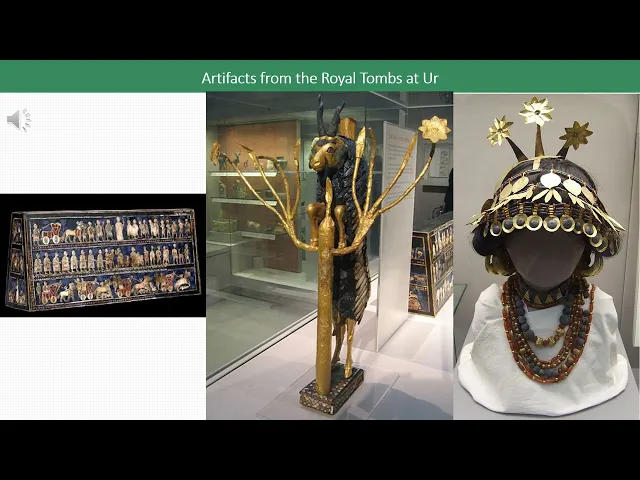
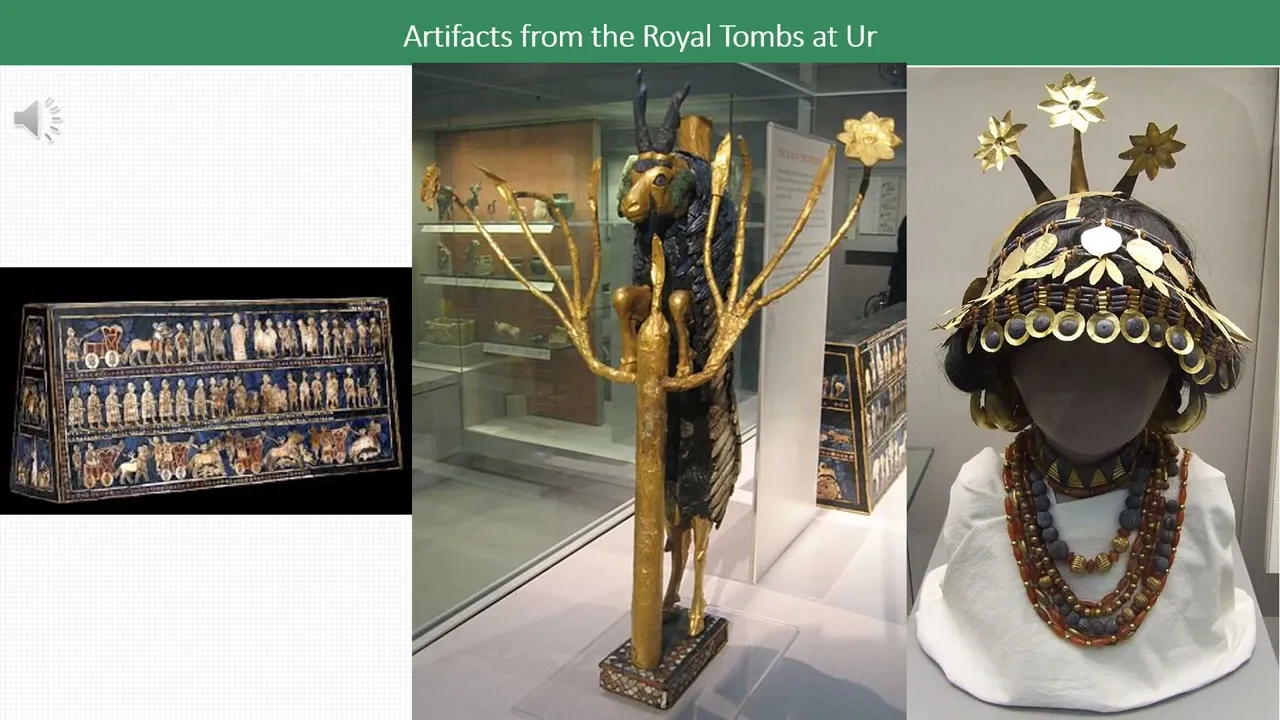
signature to clarify who had sent to the clarity document the Royal grades of myrrh one of the most spectacular archaeological finds from ER which is the Sumerian city was the royal burials the Grays were discovered by Sir London Cooley in 1922 the cemetery at Earl includes over 2 000 burials but some of them fanned out because great well these Tunes are thought to belong to the first Royal Family one of the tombs that was well preserved belonged to Queen Bobby we know her name because her cylinder seal was buried alongside her burial included gold slower
and Lapis Loosely jewelry the two of the royalty included the bodies of attendance that the royalty would need in the next life between 6 to 80 bodies human bodies were buried alongside each Royal member there's a great deal of speculation of how these individuals died some archaeologists have argued that these were human sacrifices others have suggested that the individuals voluntarily drink poison so that they could continue serving the king or queen in the afterlife there's evidence for both some of the skeletons have small cups beside them but they may have Contin that may have contained
poison while other skeletons have evidence of blunt trauma many fancy artifacts were recovered from the Royal tombs these are now on display at the British Museum on the left is the standard of Earth which is a wooden box with lapis lazuli shell and red limestone inlays each of the side of the box has three registers with images displaying a feast on one side and War on the other in the middle is the RAM and the thicket this piece of this piece was made of wood covered with gold lapis lazuli and shell and on the right
is the golden headdress of the queen the acadians occupied origin to the north the Canyons use the same alphabet as the Sumerians that had their own language they had a very powerful armies that use bronze weapons in 2350 BC Kings organ LED in the Canadian Army to conquer consumer in doing so they called most of the regional Mesopotamia and are often referred to as the first Empire according to inscription sarvan of a cad founded the Acadian Empire when he ruthlessly conquered the Sumerian city-states between the 24th and 23rd centuries CE here's a bronze bust of
his head the next emperor that will look at is Babylon Babylon is perhaps one of the most famous of these from ancient Mesopotamia and was a major city of the Babylonian Empire Babylon is most widely known because it was mentioned in the biblical story of the Tower of Babel where Babylonians were trying to build a temple so high that it would reach the heavens God responded by creating different languages so that the builders could not communicate with each other Babylon is also the city that the Hebrews were brought to by King Nebuchadnezzar II in the
6th Century BC this is the location of the story of the fiery furnace according to the biblical story Shadrach Meshach and Abednego are thrown into the fire furnace by Nebuchadnezzar because they refused about it to the king according to the biblical story Shadrach Meshach and Bendigo are Untouched by the Flames because they were protected by their God so while we have archaeological evidence that this city exists and that there were in arched temples so something similar to what's described in the Tower of Babel we have no archaeological evidence to suggest that either of these biblical
stories actually took place Babylon was also the home to the Hanging Gardens of Babylon which was one of the wonders of the ancient world according to Legends the gardens were a gift from Nebuchadnezzar to its Persian life who amidst the landscape from her home the gardens were a series of terraces with lots of vegetation and trees and this is an artist's reconstruction of what they may have looked like the cigarette or Temple at Babylon was 300 feet tall in 300 feet wide it had a large platform with seven stories that got smaller the higher up
the temple the platforms were made from baked clay brick made from the clay from the riverbed of the Euphrates the extreme scale and size of this Temple may have been one of the things that led inspiration to stories like the Tower of Babel archaeologists have been able to map out the layout of Babylon with a mix of archeology in reference to the city in ancient texts here you can see how the city is situated along the Euphrates River on the east side of the river is the ziggurus as well as the Temple of Marduk who
is the principal god of the city you can also see where it Mounds from the river would have brought fresh water into the City and how they extended beyond the city walls to water the crops in the field nearby at the north of the city you can see the Ishtar Heat the Ishtar gate was excavated by the Germans and brought back to the program and Museum of Berlin where it's been reconstructed the Ishtar gate was built around 575 by King Nebuchadnezzar II the gate was built of blue glazed bricks with bar Elites of both lions
and Dragons which symbolized Marduk dad and Ishtar the three main Gods of the city this gate was so spectacular that it was once considered one of the Ancient Wonders of the World Hammurabi was the king of Babylon from 1792 BC to 1750 BC during this time he wrote and codified the first set of laws this is called the Code of Hammurabi some of the famous thoughts from this code include an eye for an eye the tooth for tooth meaning that crime should become punished according to the crime many of the laws refer to economic transactions
as well as family and household relationships including divorce and inheritance flaw and the last civilization that we'll look at today is Hysteria most of what we know about ancient Mesopotamia comes from the Assyrians like the acadians the Assyrians had a very powerful Army that used iron weapons by 900 BC they controlled most of ancient Mesopotamia including ancient Egypt Egypt nimrin is one of the most famous Missourian cities it was a Catholic the Syrian Empire for over 150 years beginning in the 13th century BC with Astro bonamall II Pastor Bonham Hall built II built a very
large Palace in the city where he hosted guests and dignitaries according to one inscription he hosts over 69 000 people for a 10-day party when the palace construction was finished talk about housewarming the inscriptions describe the menu which included 2200 Austin 16 000 sheep 10 000 skins of wine and ten thousand barrels of beer beer Nineveh is another largest Syrian city that was mentioned in the Bible the prophet Jonah was sent to Nineveh to save them invites from their sin according to the biblical story the city was so large that it took up to three
days to Traverse it by tanakra moved the capital to Nineveh in the 8th Century BC during this time they built a seven mile long wall to protect the city from indeed Invaders and another large Palace despite the large walls the city found 612 BC after a three months Siege led by the Babylonians after The Siege the Babylonians sacked the city and killed many of the inhabitants there are many inscriptions retelling this event and archaeological evidence to support it as well including piled on top of each other at one of the gates sinach's successor Asher bonaval
built a second large house at Nineveh as we're lined with relief showing scenes from the life of the king including building large Public Works and Legion more the palace also included a large library with over 24 000 uniform droplets the site was excavated by the British and many of the tablets as well as the release were transported back to Britain to be stored and displayed in the British museum