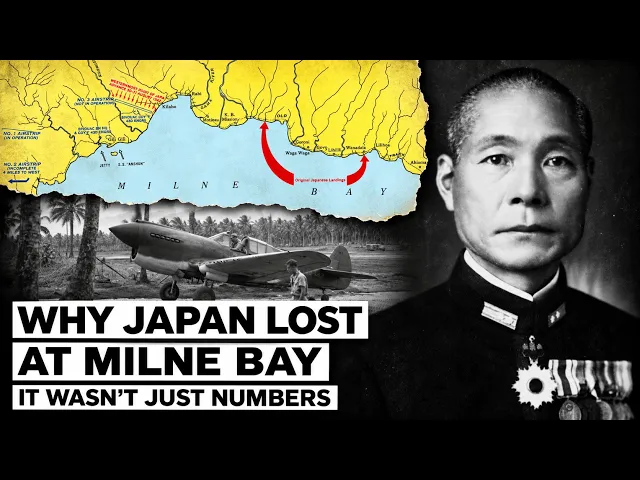
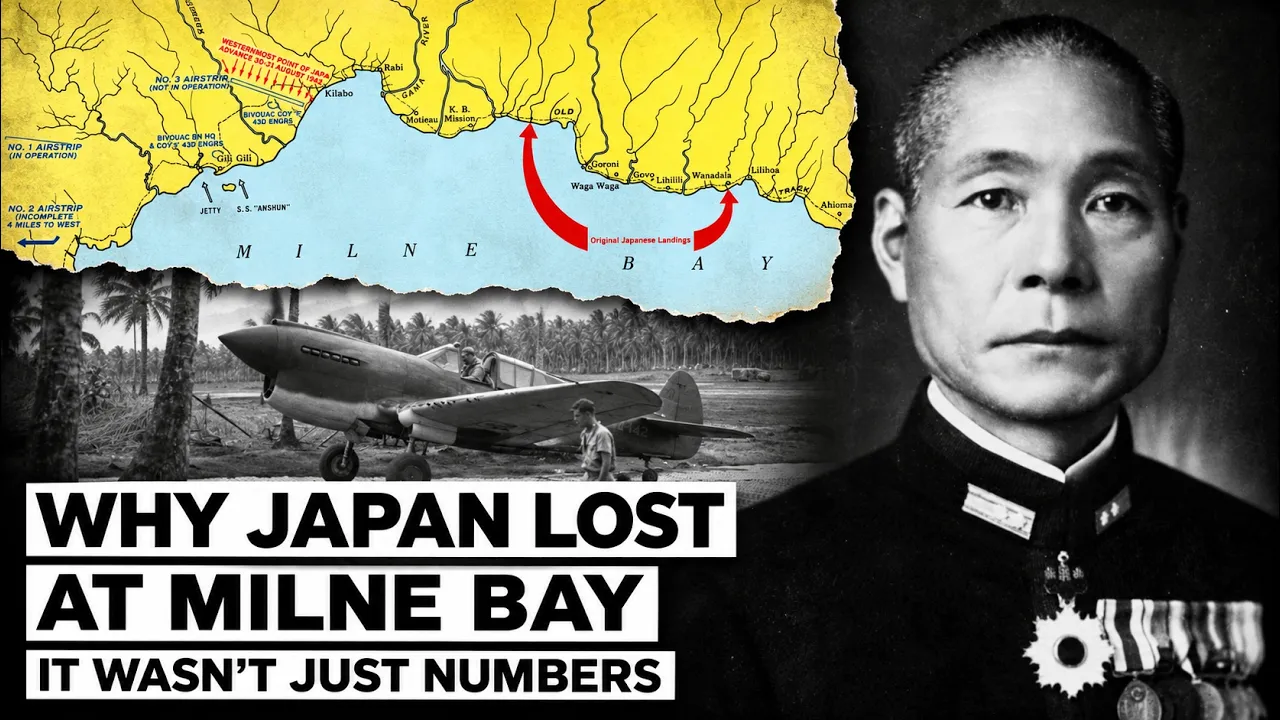
By late August 1942, the Imperial Japanese Navy had not lost a single land battle. Not one. From Pearl Harbor to Singapore, from the Philippines to Java, from Burma to the Dutch East Indies, Japanese soldiers moved like a weather front.
And every force that stood in front of them collapsed, surrendered, or was annihilated. British, Dutch, American, Australian, it didn't matter. For nine straight months, the Empire of the Rising Sun had been undefeated on land.
Then, on a muddy, mosquito-choked strip of coastline on the eastern tip of New Guinea, something happened that the Japanese high command refused to believe was even possible. A small force of elite Japanese marines supported by tanks, naval bombardments, and absolute confidence in their own superiority, walked into a swamp, and never walked out. Within 13 days, they were being pulled off the beach by destroyers in the dead of night, leaving behind more than 600 dead, their equipment, and something far more valuable than any of that.
The myth that they could not be beaten. On the surface, the story is simple. 9,000 Allied troops defeated roughly 2,000 Japanese Marines.
More guns, more men, homefield advantage. Case closed. Except that explanation is wrong.
It doesn't just miss the point, it hides the point. Because the real reason Japan lost at Mil Bay has almost nothing to do with how many Australians were sitting in the jungle waiting for them. [snorts] It has to do with a chain of catastrophic decisions made thousands of kilometers away in a smoke-filled room at Rabbal, a stunning intelligence coup the Japanese never saw coming.
Three weeks of torrential rain, two tanks that bogged in the mud, and a Japanese admiral whose arrogance killed more of his own men than any Allied bullet. This is the real story of what happened at Milb Bay and why it quietly changed the entire direction of the Pacific War. To understand why Milbay mattered, you have to zoom out and look at the map the way the Japanese looked at it in the middle of 1942.
By May of that year, Japan had already achieved almost everything it set out to do in its opening blitz. Its forces controlled a crescent of territory that stretched from Burma in the west across Malaya, Singapore, the Philippines, Dutch East Indies, and down into New Guinea and the Solomon Islands. The next piece of the puzzle was Port Moresby, a strategic port town on the southern coast of Papua, directly across the Coral Sea from the top of Australia.
Whoever controlled Port Moresby controlled the northern air approaches to the Australian continent. If Japan took it, bombers could reach Townsville, Kairens, and the vital shipping lanes between Australia and the United States. If the Allies held it, Port Moresby became the launching pad for everything that would come later.
The entire counteroffensive back up through New Guinea and towards the Philippines. Japan tried to take it the easy way first. In May 1942, a Japanese invasion force sailed from Rabbal with the intention of landing troops directly at Port Moresby.
That attempt was turned back at the Battle of the Coral Sea between the 4th and 8th of May 1942 when American and Australian carrier aircraft fought the Japanese to a bloody draw and forced the invasion fleet to turn around. It was Japan's first real strategic setback of the war. So, the Japanese went back to the drawing board and came up with a new plan, this time overland.
In late July 1942, Japanese troops landed on the northern coast of Papua at Buuna and Gona and started pushing south across the Owen Stanley Mountain Range along a brutal jungle path called the Kakakota track. The idea was to hit Port Moresby from behind through terrain so hostile that nobody thought an army could cross it. But even that wasn't enough.
Japanese commanders at Rabal wanted a second blade on the knife. If they could seize another forward base somewhere to the southeast of Port Moresby, they could squeeze the town in a pinser. One force coming down the COTA track from the north, another sweeping along the coast from the east.
And when they looked at the map, there was really only one place that worked. Milm Bay. It sits at the very eastern tip of the Papuan mainland, a long V-shaped harbor cutting about 30 km into the island, protected on both sides by steep jungleclad mountains.
From Mil Bay, Japanese aircraft could reach shipping lanes between Australia and the United States without having to cross the hellish turbulence and bad weather of the Owen Stanley Range. From Mil Bay, warships could sorty into the Solomon Sea and strike at Guadal Canal, where another battle was already brewing. And from Milbay, troops could sail along the Papuan coast and come at Port Moresby from the sea, where its defenses were weakest.
Here's the problem. The Allies had seen all of this coming. In fact, they had seen it coming so clearly that by the time the Japanese decided to attack Mil Bay, the Americans and Australians were already there building the exact air base the Japanese wanted to capture.
And they had been tipped off by one of the single most important Allied advantages of the entire war. An advantage the Japanese would never fully understand existed until long after the war was over. That advantage had a code name, Ultra.
Ultra was the collective term for intelligence derived from decrypting enemy communications. And by mid1 1942, Allied codereakers in Melbourne, Hawaii, and Washington were starting to crack open Japanese naval traffic with increasing success. Through intercepted messages, Allied planners had learned not only that the Japanese were considering a move against the eastern tip of Papua, but roughly when and roughly how.
In June 1942, before the Japanese had even properly committed to the idea, the first Allied engineers and infantry were already sailing for Mil Bay from Port Moresby. A small advanced party from the Australian 15th Brigade arrived on June 25th. American engineers from the 46th Engineers Battalion arrived shortly after and immediately began the almost impossible task of carving an air base out of a coconut and palm oil plantation sitting in a swamp.
Three air strips were planned. The main one, number one strip, was built close to a village called GillyGilly at the head of the bay. The second and third strips were pushed out along the northern shore.
The engineers paved them with something called Marston matting, pierced steel planking that could be clipped together to form a hard surface over soft ground. Even so, the mud at Mil Bay was so bad that water would seep up through the holes in the matting and turn the surface into a glossy brown slurry. One pilot from number 75 squadron RAAF, pilot [snorts] officer Bruce Buster Brown, later described it as probably the worst airirstrip he had ever operated off in his life or ever expected to.
Men who served there called it, with the sort of flat Australian honesty you don't argue with, a hellhole. Rain fell by the meter, not the centimeter. Trails turned into rivers.
Vehicles bogged within minutes of leaving the matting. Malaria was so endemic that losses to disease would eventually rival losses to the enemy. While the engineers built, the Allies poured in troops.
By late August 1942, the garrison at Milm Bay, collectively known as Milm Force, had grown to something close to 9,000 personnel. According to figures compiled by the Australian War Memorial and the Department of Veterans Affairs, around 7,459 Australian and 1,365 American Army personnel were on the ground, supported by roughly 664 RAAF air crew and ground staff. The Australian Infantry came in two very different flavors.
The first was the 7th Infantry Brigade, three battalions of militia reserveists, the 9th, 25th, and 61st, under Brigadier John Field. These were for the most part inexperienced young men who had been rushed through accelerated training in Australia. The second was the 18th Infantry Brigade under Brigadier George Wooten.
Three battalions of hardened regulars from the second Australian Imperial Force, the 29th, 210th, and 212th, who had already seen combat in North Africa and the Middle East. These were men who had fought Raml. They knew what it was like to be shelled, strafed, and shot at by people who were very, very good at their jobs.
The 18th Brigade only arrived at Mil Bay on August 21st, 1942, slipping in by sea just 4 days before the Japanese attack. Add in American engineers, the 101st Coast Artillery Battalion providing anti-aircraft defense, and two squadrons of Royal Australian Air Force Kittyhawk fighters, numbers 75 and 76 squadrons, and you had a garrison that was large, mixed, and significantly more dangerous than it looked from the air. Which brings us to the Japanese side of the story and the first of several decisions that would unravel the entire operation.
Command of the attack on Nilbeay rested with Vice Admiral Gunichi Mikawa, the officer in charge of the Imperial Japanese Navy's 8th Fleet based at Rabo. Mikawa was a competent and aggressive commander. He had just directed the devastating Japanese victory at the Battle of Tsavo Island on August 9th, 1942, where Japanese cruisers sank four Allied heavy cruisers in a single night.
He was riding high on confidence. And when he turned his attention to Milm Bay, he made a decision that would echo through every single thing that happened next. The original plan called for a full Imperial Japanese Army regiment backed up by elite Marines to be used in the assault.
That force was still assembling. Mikawa decided not to wait. Based on scraps of aerial reconnaissance and his own gut feeling, he believed the garrison at Mil Bay consisted of no more than two or three infantry companies, maybe five or 6 hundred soldiers scattered around a half-built airirstrip.
If that was true, he reasoned, then there was no need for an army regiment. His own naval marines, the kaigunetsi or special naval landing forces would be more than enough. These were in effect the Imperial Japanese Navy's version of Marines trained for amphibious assault and accustomed to winning fast.
He had around 2,300 of them available between the fifth Kuret, third Kuret, fifth Sashibo, and fifth Yokoska SNLF units, plus the 16th Naval Pioneer Unit for construction and support. Mikawa ordered the operation to go ahead. Code name Operation RE.
The Japanese referred to it as the battle of Rabbi after a plantation near the planned landing site. Here is where you can already see the shape of the disaster forming. Mikawa's intelligence was not off by a bit.
It was off by a factor of around 15. The Japanese believed they would be fighting 600 Allied soldiers. In reality, they would be walking into a garrison of nearly 9,000, including a brigade of combat hardened Middle East veterans who had already fought and beaten a European enemy.
His entire operational plan was built on a figure that was catastrophically wrong. And the reason it was wrong is itself part of the real story of why Japan lost at Milm Bay. Brigadier John Field, commanding the seventh militia brigade, had put enormous effort into camouflaging his positions.
The Australian War Memorial's own analysis later singled this out as a decisive factor. Japanese reconnaissance aircraft flew over the bay repeatedly in the weeks before the attack. They photographed the air strips.
They counted barges and tents and they almost completely failed to detect the scale of the ground force waiting for them. The dense coconut and palm oil plantations around Giliggilly combined with fields deliberate camouflage hid thousands of men from the air. The Japanese were literally looking at a trap and not seeing it.
Meanwhile, Allied intelligence, warned through ultra decrypts and supported by MacArthur's intelligence chief, Major General Charles Willoughby, had already identified the Japanese reconnaissance of August 4th as the preliminary move of a coming attack. In response, MacArthur rushed the veteran 18th Brigade to Milm Bay. By the time Operation RE sailed, the balance of forces on the ground was already overwhelmingly against the Japanese.
They just didn't know it. The Japanese attack force departed Rabbal on August 24th, 1942. Hidden under a thick blanket of tropical weather that was so bad it kept Japanese air cover away, but also made it hard for Allied aircraft to find them.
The initial landing force consisted of about 1,170 men. 612 Marines from the fifth Kur SNLF under Commander Shojiro Hayashi, 362 Pioneers from the 16th Naval Pioneer Unit, and 197 from the fifth Sashibo SNLF. They were accompanied by two type 95 Hago light tanks, two 37mm anti-tank guns, and two 70mm howitzers escorted by cruisers and destroyers of the 18th cruiser division and 29th destroyer division.
A separate smaller force of 353 men from the fifth Sashibo SNLF was sent in large motorized landing barges around the north coast of Good Enough Island, intending to swing in behind the Allied positions and attack from the rear. That northern pinser never arrived. On August 25th, Kittyhawks from numbers 75 and 76 squadrons RAAF caught the Japanese barges beached on Good Enough Island where the troops had stopped to eat and rest.
The Australian fighters came in at treetop height and strafed everything in sight. Barges were destroyed. Supplies were set on fire.
The entire fifth Sassibo detachment was stranded. More than 350 elite Japanese Marines spent the rest of the battle sitting on an island watching, taking no part in the fighting at all. In one morning, before a single rifle had been fired on the mainland, the Royal Australian Air Force had removed nearly a fifth of the attacking force from the equation.
The main landing happened late on the night of August 25th, 1942 on the northern shore of Milm Bay. And here, the Japanese made the next in their chain of avoidable disasters. The target of the operation was the airirstrip complex at the head of the bay, roughly at Gilliggilly.
The Japanese plan called for a landing close to that objective so the Marines could push inland quickly before the defenders could react. Instead, in heavy rain and darkness, the landing force came ashore somewhere between the villages of Waga Waga and Wandulla, approximately 11 km east of their intended landing area, by some accounts even further. They had put themselves on the wrong side of a long narrow strip of coastal jungle crossed by swollen rivers with no road worth the name.
And now they had to fight their way west through all of it just to reach the actual target. For a force that had planned on surprise, speed, and overwhelming the garrison before it could organize a defense, this was a catastrophic opening. Every kilometer they would now have to march was a kilometer they would be exposed to Kittyhawk strafing runs during the day, bogged down in mud at night and ambushed by Australian militia who knew the ground.
The two Type 95 tanks, which were the Japanese forc's main shock weapon, and the one piece of equipment the Allies could not match in that first week. Claus had no armor of his own, were loaded off the beach into terrain that was almost completely unsuitable for them. Those tanks are themselves a lesson in why Mil Bay unraveled the way it did.
On paper, the Type 95 Hago was a serious advantage. The Allies had no tanks on the bay and anti-tank weapons in the hands of the militia were thin on the ground. In the first engagements, the appearance of the tanks genuinely shocked and pushed back Australian infantry.
In the fighting around the KB mission on the night of August 27th, the 2/10enth Battalion of the 18th Brigade took heavy casualties from Japanese infantry working behind the tanks, which used their headlights and machine guns to spot and suppress defenders in the darkness. But the tanks could only operate on the narrow coastal road and track between the plantations. Off that strip, in the swamp and the rain, they were almost useless.
And then the rain did what the Australians could not. The ground softened. The track dissolved, the tanks bogged in the mud and could not be recovered.
By the time the Japanese launched their decisive attack on the airirstrip, both of their tanks were out of action, sitting abandoned in the jungle where Australian patrols later found them. Meanwhile, in the air, something was happening that no commander in the Pacific had yet seen. Numbers 75 and 76 squadrons were based right there at Mil Bay itself, flying off the matting at number one strip.
They did not have to transit from distant bases. They did not have to climb over mountains. They lived on the battlefield.
Their Curtis P40E Kittyhawks were not the best fighter in the Pacific. Japanese Zeros could outclimb and outturn them at altitude. But at low level, over mud and jungle, the Kittyhawks were brutal.
They were heavy, they were tough, they carried bombs and machine guns, and they could absorb punishment that would have shredded a zero. From the morning of August 26th onwards, the two squadrons flew almost continuously. They strafed Japanese infantry on the beaches.
They bombed the supply dumps. They destroyed landing barges before they could be used to leapfrog troops forward. One estimate from Japanese records suggests that perhaps 3/4 of all Japanese naval air sorties over Mil Bay failed to find their targets at all because the weather was so poor that pilots could not even see the ground.
Allied Kittyhawk pilots flying off the strip they were defending had no such problem. They took off, climbed over the trees, and started killing Japanese within minutes. Commander of 76 Squadron was squadron leader Keith Blueey Truscott, a former Australian rules footballer who had already made his name flying.
Spitfires over Europe, and he and his pilots threw themselves at the Japanese with a kind of focused aggression that even their own superiors found unsettling. By the time it was over, air power at Mil Bay had done something that would become the template for Allied victory across the rest of the Pacific. It had taken a battle fought on the ground and quietly decided it from above.
On the ground, Major General Sirill Claus was fighting a different and harder battle than you would guess from the headlines. Claus was known in the Australian army as silent Sirill, a quiet, careful, intensely intelligent commander who had taken over Milforce only on August 22nd, 3 days before the Japanese landed. He was flying blind.
His communications with Port Moresby were poor. His intelligence from the forward militia battalions kept reporting Japanese landings at other points around the bay, some real, some phantom. There were rumors of Japanese forces at Topota, at Mullins's Harbor, at Widow, possibly swinging around behind him.
Japanese destroyers kept appearing in the bay at night to shell Australian positions, which looked ominously like preparation for further landings. Claus could never be sure that the force in front of him was the only one he needed to worry about. So he refused to commit the veteran 18th brigade too soon.
He kept them in reserve, used them in pieces, and absorbed the initial Japanese attacks with the militia of the seventh brigade. His superiors in Port Moresby and Brisbane, including General MacArthur, who did not love the Australians, grew impatient. There were cables, there was criticism, there was pressure to counterattack.
Claus ignored almost all of it. He waited until he was sure of what was in front of him. And then he hit it with everything he had.
That everything came together on the night of August 30th to 31st, 1942 at the climactic battle for number three airirstrip. Commander Hayashi had been killed earlier in the fighting. Command had passed to Commander Minoru Yano who had landed on August 29th with reinforcements of around 769 men from the Kur third SNLF and fifth Yokoska SNLF.
Yano decided to throw everything he had at the airirstrip in a single massive night attack. His marines came out of the jungle in waves. The militia of the 25th and 61st battalions of the seventh brigade dug in across the strip, held their fire.
When the Japanese were close enough that Australians could see faces in the muzzle flashes, they opened up. Three separate bonsai charges were turned back during that night. Australian artillery firing over open sights, dropped shells on top of attacking Japanese formations that were trying to form up in the jungle.
The 61st Battalion, those same inexperienced Queensland militia men who had been rushed into uniform only months before, stood on their positions and did not break. By dawn on August 31st, the Japanese attack had failed. The strip was still Australian.
The Marines had suffered heavy losses they could not replace. In the words of one of Klaus's later reports and multiple post-war histories, this was the moment the battle tipped. The moment where the Japanese went from an attack that might still succeed to a force that was now purely trying to survive.
Claus sensed it. At 9 in the morning on August 31st, he ordered the 212th Battalion of the 18th Brigade to counterattack. The veterans of North Africa moved along the Northshore, pushing east, driving the retreating Japanese back towards the landing beaches.
On September 2nd, the 29th Battalion joined the advance. The Japanese fought with the stubborn, suicidal rear guard discipline that was already their trademark in the Pacific. Small groups of Marines holding ridges and streams until they were killed to a man.
But they were being ground down. Yano, now wounded, sent desperate messages to Rabbal, asking either for reinforcement on a scale that could actually change the outcome or for permission to withdraw. His men were starving.
Malaria and dysentery were tearing through the ranks. Supplies were almost gone because every attempt to resupply by barge was being blown apart by Kittyhawks. On the Japanese side of the mountain, there was a brief argument.
Some commanders wanted to double down and feed another regiment into the operation. Yano, the man on the ground, insisted that his force had to come out. He won the argument.
Japanese destroyers crept into Mil Bay over the next several nights and under cover of darkness and torrential rain, they evacuated the survivors. By the morning of September 7th, 1942, the fighting at Mil Bay was over. The numbers tell part of the story.
According to figures compiled by the Department of Veterans Affairs and the Australian War Memorial, Allied losses came to 171 killed and roughly 216 wounded. Of those, around 167 of the dead were Australian and 14 were American. Japanese losses were far higher.
Of the 1,943 troops landed, around 625 were killed in action and about 311 wounded were evacuated. Only 1,318 of the men who had come ashore were taken off at the end. The 353 men stranded on Good Enough Island were still sitting there waiting to be evacuated later.
An additional 21 Japanese air crew were lost supporting the operation. Those raw numbers, however, hide something darker. Of the 36 Australians taken prisoner by the Japanese during the course of the battle, not a single one survived.
Investigators later cataloged acts of extraordinary brutality. Captured and wounded Australian soldiers who had been bayonetted, mutilated, and in several documented cases, tied to trees and used for live bayonet practice. These were events that would become part of the war crimes record and would deeply shape Australian attitudes towards the Japanese for a generation.
For months after the fighting ended, Australian soldiers walking the jungle around the streams north of the bay would find the bodies of Japanese marines still lying where they fell, slowly rotting into the mud of a place that had defeated everyone who tried to live in it. So, let's come back to the question that started all of this. Why did Japan really lose at Mil Bay?
If you listen to the simplest version of the story, you hear they were outnumbered. And that's true, but it's also lazy. The real answer is that Milbay was lost in a long chain of decisions, misjudgments, and systemic weaknesses that reached all the way back to Rabbal, Tokyo, and the entire Japanese way of fighting the war.
Reason one, catastrophic intelligence failure. Admiral Mikawa based his entire plan on an estimate of enemy strength that was wrong by roughly an order of magnitude. He believed he was facing two or three companies.
He was facing almost 9,000 men. No tactical skill in the world can rescue a plan built on that scale of misestimation. Reason two, the inverse of that, the stunning Allied intelligence advantage.
Ultra decrypts, aerial reconnaissance, and good analysis gave MacArthur's staff enough warning to preposition the 7th militia brigade and then rush the elite 18th brigade into Mil Bay 4 days before the Japanese arrived. Combined with Brigadier Fields camouflage, the Allies knew what the Japanese had, and the Japanese had no idea what the Allies had. Reason three, Mikawa's refusal to wait for the Imperial Japanese Army regiment that had originally been earmarked for the operation.
His choice to launch with just the special naval landing forces, essentially a reinforced battalion, reflected the broader Japanese problem of institutional arrogance after a string of easy victories. It would be repeated at Guadal Canal, where Japanese commanders would feed troops into the island in penny packets and watch them die peacemeal. Mil Bay was the first time the pattern played out.
Reason four, the landing itself. By coming ashore roughly 11 km east of their actual target in darkness and rain, the Japanese handed back the one advantage amphibious assault was supposed to give them, which was surprise and speed. From the moment the first boots touched the beach, they were fighting uphill against time, geography, and weather.
Reason five, those two Type 95 tanks, which should have been a decisive weapon, were used in some of the worst tank country on Earth. The combination of torrential rain, soft volcanic soil, dense jungle, and total absence of any serious road network meant that the armor that could have shattered militia positions bogged down in the mud within a few days, and the Japanese infantry no longer had the shock weapon they had been counting on. Reason six, air power.
Numbers 75 and 76 squadrons, RAF, operating off the very ground they were defending, provided a kind of persistent close air support that the Japanese had almost never faced before. They destroyed Japanese barges. They cut Japanese supply lines.
They stranded the fifth Sassibo detachment on Good Enough Island before the battle even really began. They let Claus see what was happening in his own forward areas when ground communications failed. In a very real sense, Milbay was the first battle of the Pacific War where Allied tactical air power was the decisive arm.
Reason seven, command. Claus may not have been glamorous. He was a quiet, cautious artilleryman who was never celebrated the way other commanders were.
But his handling of a confused, fragmented, and frightening tactical situation was close to flawless. He refused to be rushed. He preserved his reserves, and when the moment came, he counterattacked with precision.
His Japanese counterparts, Hayashi and then Yano, were brave and skilled, but were operating inside a plan that was broken before they ever landed. Reason eight, and maybe the deepest one. Milbay was the first battle in which the Japanese war machine ran into a modern combined arms defense.
Infantry, artillery, armor equivalent anti-tank weapons, close air support, logistics, and intelligence, all working together and lost. Every one of those things on its own might have been overcome. All of them together could not be.
The consequences of what happened over those 13 days rippled far beyond the bay itself. Milbay was developed into a major allied base that eventually supported amphibious operations as far away as Lei in September 1943 and later the campaigns in the Philippines by denying the Japanese a southern coastal foothold. The battle protected the eastern flank of the Kakakota campaign which was being fought in brutal conditions on the other side of the Owen Stanley Mountains at exactly the same time.
On September 25th, 1942, just over 2 weeks after the last Japanese destroyer left Milbay, the Australians on the Cakakota track launched the counter offensive that would eventually push the Japanese back over the mountains and down to the north coast at Buna, Gona, and Sananda. Milm Bay made that counteroffensive possible because it meant that the Japanese could never flank the Allied base at Port Moresby from the sea. Strategically, it also ate into Japanese capability at a critical moment.
The naval marines lost at Mil Bay were elite troops trained for amphibious assault, and the shipping and barges destroyed by the RAAF were the kind of specialist assets that Japan would struggle to replace for the rest of the war. More importantly, the battle broke the psychological spell that the Japanese army had cast over Allied forces since Pearl Harbor. Field Marshal William Slim, who later commanded the British 14th Army against the Japanese in Burma, would famously say that it was at Mil Bay that Australian troops inflicted on the Japanese their first undoubted defeat on land.
He went on to argue that this victory, more than any other single event, broke the aura of invincibility around the Japanese soldier. From Burma to the Solomons to New Guinea, Allied troops now had an answer when someone said the Japanese couldn't be beaten. Yes, they can.
We did it at Milm Bay. The men who did it were often not celebrated the way they should have been. Claus, for the sin of being cautious and successful rather than flashy and reckless, received very little credit from his superiors.
His ally in the Australian High Command, General Sydney Raell, was removed from his position in September 1942 after an argument with General Thomas Blamey, which left Claus without a protector in Brisbane. Claus would never again hold a comparable field command. The militia battalions of the Seventh Brigade, those scrappy young Queenslanders whose stand at number three Airstrip arguably saved the whole battle, were remembered mostly inside Australia and mostly by the families of the men who were there.
Mil Bay has always lived in the shadow of Cakakota in Australian memory. In part because Kakakota had a better narrative, a long suffering retreat and a dramatic comeback. While Milbay was a two-week jungle battle that most people outside Papua barely heard about until it was over.
But in strategic terms, Milbay may have mattered just as much, maybe more. It was the first demonstration of the formula that would eventually destroy the Japanese Empire. combined arms, air superiority, signals, intelligence, veteran leadership, logistics, patience.
All of those were on display at Mil Bay in late August 1942. All of them would be refined and scaled up over the next 3 years until they rolled over. Rabal up through the Philippines, across Euima and Okinawa, and ultimately to the gates of Tokyo itself.
So the next time someone tells you Japan lost at Mil Bay simply because the Allies had more men on the ground, you now know that's only a sliver of the real answer. The deeper answer is that an empire built on momentum, intimidation, and the assumption that the enemy would always be unprepared ran into a situation where the enemy was in fact extremely prepared. Warned by codereakers, dug in behind camouflage, supported by relentless air power, and commanded by someone who refused to panic, the Japanese plan collapsed under the weight of its own confidence.
They were defeated by two tanks that bogged in the mud. 350 Marines marooned on an island by Kittyhawks before they could fight. By a landing site chosen in the dark 11 km from where it should have been, by rain that would not stop.
by militia boys from Queensland who did not run and by a quiet Australian general nobody remembers who waited until exactly the right moment to swing the sword. That's the real reason Japan lost at Mil Bay and it changed everything that came after. If you made it all the way to the end of this one, you're the kind of history nerd this channel is made for.
Do me a favor, hit that like button, drop a comment telling me which battle you'd like me to pull apart next, and if you haven't already, subscribe so you don't miss the next one. There's a lot more of these forgotten turning points on the way.