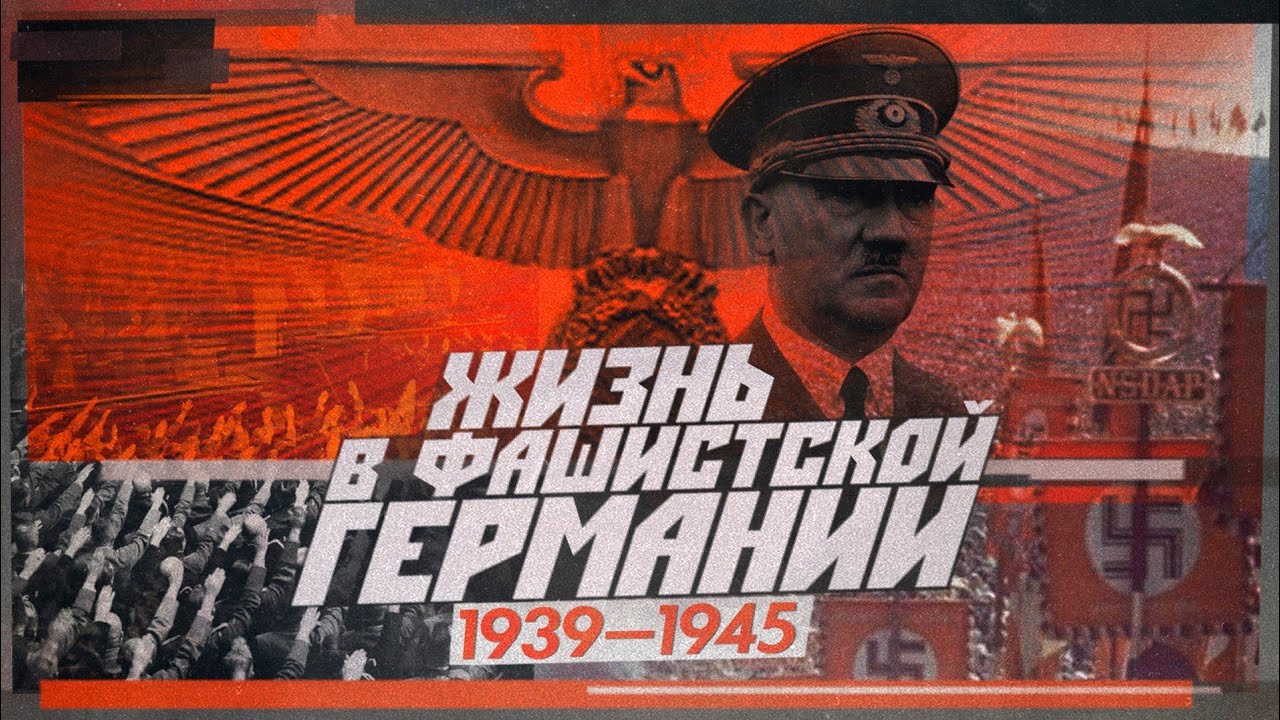
Good day, dear friends. This is "History Lessons with Tamara Eidelman". Today we will talk about Hitler again. Thank you to everyone who helps us. Thanks to our Patrons on Patreon, our sponsors on YouTube, those who managed to subscribe in Russia on the Boosty platform, those who donate to us in cryptocurrency. In general, to all those thanks to whom we can continue working. And, of course, as always, thank you to those who like and share. This will also help us a lot. Today we will talk about that terrible time, when Hitler tried to rebuild, reshape the
world in his own way, turn it into a horrible, ugly hell. Fortunately, he failed. In the terrible pre-war, wartime years, it seemed that evil was prevailing and the world would be arranged as the Führer wanted. But here I am in the eternal city, in Jerusalem, and this is a wonderful proof that, Hitler could not erase the Jewish people from the face of the earth, nor create his abominable world. And it is good to remember here that humanity fought fascism not only with tanks and missiles, but also with words, music, and art. Posters from the war
years, anti-fascist cartoons, drawings, created by people who today we would call graphic designers - this was also a way to resist evil. I am pleased to talk here about a beautiful, peaceful, and useful profession, related to the ability to create something that will stir the minds of millions. I am talking about graphic design, which makes the world more convenient and beautiful. Whatever a graphic designer does, a company logo, a website, an advertising poster, It gives meaning to the environment around us, if, of course, it is a good designer. And you can acquire this profession by
enrolling in the fundamental program "Graphic Designer from Zero to PRO" at the Contented design online school. Here, anyone of any age and any level of preparation can study. Right now, over 7,000 people are mastering new professions at the Contented school. In 20 months of study, students manage to create a solid portfolio for themselves, complete an internship at the creative agency RedKeds, and also take their first orders. Throughout your studies, experienced mentors will be by your side, who will not let you deal with emerging questions alone. And upon completion of the course, you will receive a
standard diploma. Follow the link in the description or scan the QR code on the screen, and with the promo code "History" you will get a 45% discount on your education. Thanks to the online school Contented for helping to master a beautiful and good profession. And thank you for the support of "History Lessons with Tamara Eidelman". On January 30, 1933, President Hindenburg appointed Hitler as Chancellor. This was not yet a dictatorship; he did not have full power yet. In the end, he was under the president, albeit frail and old. There were various parties. By the way,
the Social Democrats were very popular, they had many seats in the Reichstag. But essentially, this was the beginning of Hitler's dictatorship, the dictatorship of the Nazis. This marked the start of those terrible, tragic, horrifying 12 years that would literally change the course of world history, leading to the deaths of millions of people, to horrifying disasters, and it's clear that there are numerous books written about these years, from 1933 to 1945: about economic history, political history, military events, and people's fates. And of course, a huge amount has been written about Hitler, about the man responsible for
all these horrors. We have already discussed in one of my lectures about Hitler, his rise to power, how from nobody, from a failure, a nobody, a person who couldn't get a proper education, who had no profession, who thought he was an artist, an architect, clearly unsuccessful, by the end of the 1920s, he became an idol to thousands, a man whom people literally worshipped. And now this man has come to power. Sebastian Haffner, a German journalist who wrote the book "The Meaning of Hitler," which many are reading in Russia, writes with disdain the following: "Before seizing
power, Hitler had only one glory - the glory of a demagogue." But he immediately qualifies that, perhaps it is necessary to acknowledge in Hitler, besides his unquestionable talents as a demagogue, orator, captivating crowds, one must also acknowledge his talent as an organizer. How he transformed his party, which was initially a completely marginal, small union of a small number of disgruntled individuals, into a mass party in less than 10 years. Nevertheless, these were practically all his talents. The same Hafner immediately quotes Kurt Tucholsky, a German writer, who said: "There is no man Hitler, there is only
the noise he creates." And this, I won't say pleasant, there is little pleasant about anything related to Hitler, but, in any case, somewhat comforting to us. So Hitler is a nobody, Hitler is nothing, a naked king who deceived everyone. And then they said: but the king is naked, and that was it, the charm was gone. Many people later, after the war, will say: we don't understand how this happened. He hypnotized us, he deceived us, he was such a nobody. What is there to say about it? But perhaps it's not all that simple. A person who
managed, well, you could say, to brainwash, or lead millions, obviously, despite the repulsiveness of this person, he deserves study, he deserves analysis. How did this happen? Today, as we constantly think about the situation in Russia and wonder: how can thousands and thousands of people welcome war, admire the tightening of the regime? I'm not comparing Putin and Hitler, in general, comparisons that everyone loves now... I am regularly asked: how would you compare today's situation in Russia? With the Soviet Union of the 1930s, with Germany of the 1930s, all these comparisons fall short, they do not withstand
real scientific analysis. But, of course, to think about how millions of people start going crazy - this is a useful and relevant thing, let's say. So what is happening? It is believed that the Nazi dictatorship began on February 27 after the Reichstag fire. We talked about this in our previous lecture. In fact, during the month between Hitler's appointment as Chancellor and the Reichstag fire, After which everything escalated, the Nazis were already taking action. They were not going to sit idly by. On February 4, the "Law for the Protection of the German People" was enacted. The
very name is quite telling. Every dictator comes as a savior. Hitler consistently builds his image as a savior from enemies, the image of an enemy is crucial for any dictatorship. There are countries, like England, that signed the Treaty of Versailles and want to keep Germany subjugated. There are Jews, a Jewish conspiracy wanting to destroy Germany, there are Bolsheviks. He constantly plays with these images. At any given moment, a certain enemy is appointed as the most dangerous. But they are always present, and it is Hitler who must save. Just a few days after taking office as
Chancellor, he is already protecting the German people. What does that mean? Protecting them in a very interesting way. This law marks the start of dismantling the democratic system, which was carried out at an astonishing speed. So, under this law, the government, with the Chancellor leading it, has the right to take almost any extraordinary measures to protect the people. Because the threat is coming from all sides. After the Reichstag fire, after the semi-mad van der Lubbe was caught at the scene, who most likely did set fire to the Reichstag. The question is whether the SS helped
him or simply allowed him to enter the Reichstag building. But, in any case, from that moment on, firstly, an incredible amount of horror is being stirred up. Here is the evidence of a communist conspiracy. In short, we are all going to perish now. It is very interesting that in the first days after the Reichstag fire, panic spread in Germany. but the panic is not because Hitler will establish a dictatorship, quite the opposite. They are waiting for a coup, people are organizing voluntary militias to guard their homes. Something terrible is about to happen now, there will
be a communist coup. And in this situation, it is certainly very easy to act further. Several more laws with very characteristic names are immediately adopted, such as "On the Protection of the People and the State." By the end of March, the government already has extraordinary powers. At this time, Goebbels writes "Life is delightful again." This atmosphere of escalating horror and the onset of Nazism, of course, is absolute delight for him. The government is granted extraordinary powers. In this atmosphere of panic and military alarm, new elections to the Reichstag were held. The Nazis obtained the majority.
They received almost 300 votes there, but at the same time, the Social Democrats were the second largest faction, they did not lose any votes, but still have 120 votes in the Reichstag. The Communists lost a little, 19 votes less than before, but they are still very numerous. So, a clear victory for the Nazis, but not as powerful as Hitler would have liked. And literally within a few months, by summer, almost all parties are banned, arrests begin. Clearly, compared to what will come next, this is a weak terror. In the words of Hafner, "controlled terror." Everything
is well thought out. So what does controlled mean. In the first month, somewhere around 500-600 people were killed, not so few, and about 50,000 were sent to camps. These were Communists, Social Democrats, just opposition journalists, people clearly actively opposing the regime. At the same time, from the spring-summer of 1933, the formation of a secret police begins, the dark, infamous Gestapo. The Gestapo is usually reasonably associated with the activities of Himmler, although the Gestapo was formed by Hermann Göring. He later vehemently denied these accusations at the Nuremberg Trials, He tried to portray himself solely as a
military man, claiming he did nothing, the Gestapo was Himmler's territory. But in reality, Himmler only took over the Gestapo in 1936, before that, Göring, who was then the Minister of the Interior of Prussia, carefully established these structures of the secret police, which would later play a crucial role in carrying out terror. The calculated use of terror, as wild as it sounds, worked in Hitler's favor, so to speak. It may seem horrifying: half a thousand people killed, 50 thousand in camps, this should evoke horror, this should evoke fear. Naturally, for some, it does evoke horror, for
potential victims. But at the same time, there is a feeling that we are being protected. What terrible dangers threatened us, and now all enemies, well, it seems that all enemies have been vanquished. So, we will live peacefully from now on. There is a sense that yes, there was an attempt to attack, we repelled it, everything will be fine from now on. As we understand it, everything is just beginning. Another important point that also ensured such calmness in society overall is that the old elites did not disappear. When the Bolsheviks came to power, they either destroyed
or simply sidelined all segments of the population, who had some political, economic, or spiritual influence in Tsarist Russia. The nobility, entrepreneurs, clergy, they were deprived of their property, stripped of their political rights. There was the concept of "disenfranchised" in the 1918 constitution. But Hitler acted differently. Firstly, as strange and perhaps even cynical as it sounds, he initially acted within the conditions presented to him. He came to power through elections. We can say they were maybe falsified, voters were intimidated in some places. But he won democratically. He enacted laws passed by the Reichstag. A few months
later, he turns the Reichstag into such a completely decorative body. But this body still functions. There is one party, this party will be closely merged with the state. The idea will be promoted: one party, one people... One country, one people, one Führer. So this vertical power structure will be built very firmly. But at the same time, the law on extraordinary powers, adopted in March 1933, for some reason, will need to be extended several times. So there will be this strange, completely empty shell of democracy from the inside, while a one-party system has already been established.
Well, you could say that just like Stalin accepted the constitution of 1936, where different wonderful and remarkable words will also be written. At the same time, the army top leadership will not disappear anywhere. It is clear that for Germany, especially for Prussia, this is a super elite: aristocrats, entrepreneurs, Despite the name "national socialism" and many events, which we will talk about later, close to socialism, but private property remains, large entrepreneurs remain. They will be under state control, a four-year plan will even be created, but private property remains. So people living in Germany in 1933-34 do
not feel like their whole old world has collapsed. There is a feeling of transformation. Well, of course, a new life has begun. It's just such a wonderful development and a road to a wonderful life. Before Hitler starts acting in various spheres, of course, first and foremost, he needs to strengthen his own power, and what is happening, this almost instant practical dismantling of the democratic system and the creation of a new system - this is very important for him. But he needs to be sure that the new system he is creating will work, undoubtedly, for him,
it will be tailored to him. Well, where to next? He is the Führer. All of his party, the stormtroopers, the SS units that had grown since the 1920s, all work for him. No, not enough. On June 30, 1934, the Night of the Long Knives will come, when the stormtroopers led by Röhm will be eliminated. I don't know if you can say that Hitler had friends, but in any case, this was a close person to Hitler, a person he was on familiar terms with, a rare case. The stormtroopers, who greatly helped the Nazis intimidate all opponents
and secure their rise to power, that's why they are now hindering Hitler. One could talk at length about the personal conflict between Hitler and Röhm. The conflict actually started in the 1920s, and Röhm went to Latin America for a while, then returned to his mountain. When Hitler came to power, Röhm clearly wanted faster, more radical changes, he was annoyed that Hitler did not remove the top generals who were completely alien to him. He believes that the party should rely primarily on his stormtrooper units, not on the army. Hitler has completely different plans, and perhaps it
is these differences that are the issue, but certainly not only them. The fact that there are armed units in the country, trained and prepared for several years, to which the Führer is, in a way, indebted - is absolutely unacceptable. They may become too independent, and Röhm will somewhat contribute to this. He wants more and more autonomy for his units. And then Hitler starts to distance himself from him, criticize him. Rumors started circulating that the stormtroopers were preparing a revolt, although this was clearly not the case. But interestingly, a few days before the massacre in Munich,
the stormtroopers, and the Munich stormtroopers were one of Hitler's key pillars in the 1920s, received some anonymous messages calling them to take to the streets, and many did. Then they realized something was wrong, left, and returned to their barracks. But here he is already an example, they are about to rise up. Röhm, until the last moment, strangely enough, was confident in his good relationship with Hitler. Just shortly before June 30, they were talking, everything seemed fine. One of the leaders of the stormtroopers was planning a honeymoon trip on June 30. He was literally grabbed there,
somewhere on a yacht, where he was about to sail away. And he was sure that it was just a continuation of the bachelor party, that it was rough jokes from his friends. He joked, laughed, teased with those who were already dragging him to his execution, could not understand what was happening. Hitler sanctioned the killing of Röhm, the killing of many other prominent stormtroopers. The list of those killed included, of course, many people who had no connection to the stormtroopers, but simply displeased Himmler or Göring. On July 2, Göring burned all materials related to what happened
on the Night of the Long Knives. And on July 3, Hitler issued a decree stating that everything done on June 30 was considered lawful, So that no charges could be brought retroactively. And shortly after that, the SS troops, by that time... These SS units started with eight people as Hitler's personal bodyguards, and by that time they had become powerful units. They were taken out of the control of the SA, stormtroopers, and became completely separate entities. And the stormtroopers lost so much of their significance from that moment on that they couldn't even declare these SA units
a criminal organization at the Nuremberg Trials simply because they no longer meant anything, did nothing. Thus, Hitler got rid of those who largely helped him come to power, but who could theoretically threaten his power and influence in the future. This is such a typical, of course, dictatorial move. Of course, one terror was not enough. There needed to be ideological justification, propaganda was needed. As we know, Hitler's propaganda, correctly called Goebbels' propaganda. Joseph Goebbels heads the newly created Ministry of Public Enlightenment and Propaganda, Which, of course, works incredibly effectively, overseeing various areas of mass media. There
is a propaganda department that receives a lot of attention, and there are divisions dedicated to cinema, radio, and theater. So here it is. The principles of Goebbels' propaganda, well, which are widely known, and much has been said and written about it. These terrible ideas that propaganda should be based on hatred, first of all, propaganda should be primitive, extremely simple. You have to repeat the same simple things many times. And these ideas turn out to be incredibly effective, incredibly powerful. It all boils down not only to just babbling, there, long live the Führer, everything is thought
out absolutely ingeniously. On May 10, 1933, the famous horrific book burning in Berlin takes place, when huge bonfires are lit, significantly, in front of the law faculty of the University of Berlin, and students - law students, but not only them Solemnly throw political writings, novels, works there, written by Jewish writers, written by leftist writers. Today on this square there is an absolutely stunning monument, well, in Berlin in general, of course, the culture of historical memory today is fantastic and works beautifully on working through this memory, on overcoming old trauma. You don't notice it right away,
then you see that under the pavement there is a huge empty space, you can look through the glass. There are empty shelves where those thousands of books could have stood, which were burned here. And I also really like the fact that a mobile library regularly operates on this square. They bring wagons with books here, people can take books, exchange them, if it is a confrontation to what happened here. But again, propaganda is based not only on destroying the books of opponents, on arresting those who wrote things deemed wrong from the Nazis' point of view. The
most important task of propaganda is to glorify Hitler. Although, it would seem, where else? By 1933, he is already adored. It turns out, there is more. Now, on an incredible scale, much larger than in the 1920s, demonstrations, torchlight processions, Nazi rallies in Nuremberg are organized. All of this is carefully planned, Speer, Hitler's personal architect, is working on it, he certainly applied his immense talents to creating these mass events. And here I don't even know which word is more important, mass or event. It's not just political gatherings, where they gather, decide, resolve, and vote, it's an
actual event. In these events, individuality begins to disappear, merging with the masses. And this is what they strive for. Here is a description of such actions from Hitler's biography, written by Joachim Fest: "Torches, bonfires, fiery wheels were always burning, Which, according to totalitarian masters of creating the right mood, supposedly celebrated life, but in reality, with their pathos, proved that human life is worth little against the apocalyptic images trembling before the universal fire, to which they gave some elevated meaning, and images of destruction, including their own." As we know, Hitler revered Wagner. Every year he would
come to Bayreuth for Wagnerian opera performances and enthusiastically listen to the music, the powerful music of Wagner, and revel in these images of global catastrophe, hero's demise, and world fire. This is what was originally in his mind, what brought him delight. And similar images are imposed on the German people. What's so pleasant about being told that you might have to burn in the fire of a world conflagration, struggle, war. But these are images that transform the small individual into a part of an incredible, vast unity, and this is a great temptation and enormous allure for
many. Fest describes the rally in Nuremberg in 1937. "It all begins at 8 pm - Hitler always liked to appear in the dark. Like meteors, the beams of 150 giant spotlights pierced the sky covered in black-gray clouds. At cloud level, the light beams merged into a shining quadrangle. A stunning scene unfolded before the spectators, a gentle wind unfurling the flags around the field tribunes. Dazzling light highlights the main grandstand, crowned with a shining golden swastika in an oak wreath. On the left and right pillars, huge bowls of fire blaze". These images of fire, blazing amidst
darkness, black uniforms, oak wreaths - all of this, well, on one hand, creates such a grand style, again elevating all participants. Any person marching in a torchlight procession or participating in this party congress, whoever they may be - the smallest party member or some inconspicuous person, suddenly feels part of something grand. And it made a huge impression. This horrifying cult of death, which undoubtedly existed in Hitler's Germany, devalues individuality. How wonderful to die for the Third Reich, for the Führer. And this is completely irrational. A normal person with a normal psyche does not seek death,
they resist it, their mind resists it. But when the mind is weakened, weakened by the effects of light and darkness, weakened by the sight of torches, black color, drumming of drums, marching crowds, completely different tendencies arise, supported, supported by continuous speeches, continuous calls, also irrational. These calls appeal to the unconscious. From the unconscious, adoration for the leader is revived, the desire to die for him. This whole story shows how delicate the shell of civilization covers some ancient, primitive instincts in all of us. How we must value this thin strip of civilization, how we must strive
to strengthen it, affirm how fragile it is. In the 1930s, Hitler said that those who perceive National Socialism as a political doctrine understand nothing in it, that it is the creation of a new person, that is, the transformation of a person's entire life. And this will be very important for him. And part of this transformation will precisely be, well, instilling in people or, perhaps better to say, bringing to the surface some ancient instincts and the release of the destructive urge for death, which was incredibly strong in Hitler himself and will ultimately lead him to his
suicide. But he never wanted to go alone. Already in the early 1930s, long before the war began and even further from the catastrophe, that Germany will suffer in this war, Hitler was already saying terrible things at that time. "Nature is cruel, so we must be the same. If I send the flower of the German nation into the steel storm of the impending war, without even the slightest regret for the precious German blood being shed, then do I not have the right to eliminate millions of representatives of the inferior, insect-like reproducing race". In this case, it
refers to the impending destruction of Jews. But what's interesting is that he is also willing to send the "priceless Aryan race" to death. And this is wonderful, and this is good, noble - to die, it's a pleasure, such a death. Hitler constantly had a sense of impending catastrophe. By the way, he easily fell into despair, and then emerged from it with some new strength. As Joachim Fest rightly notes: "He gained strength when he was pushed against the wall". It seemed like everything was lost, like, for example, during the Beer Hall Putsch. And now we will
break free from here, and if we don't, then we will die, and that's fine. In the same 1930s, he said: "If we do not win, then, dying ourselves, we will drag half the world into this destruction". Of course, it will be wonderful to win, to create a thousand-year Third Reich, to subjugate all inferior races. And in his mind are grandiose images of this failed architect, who envisions completely new cities, where the Aryan race lives, and settlements for those who serve them, and how all of this will be arranged. He paints some incredible, terrifying, frightening pictures.
But if it doesn't work out, then nothing is needed, then let everyone perish. And this suicidal tendency, we will now see how it will manifest during the war even at times when it seems like the German troops are still winning. And at the same time, parallel to all this powerful propaganda, with these terrifying images, Hitler's image is completely changing. He continues to deliver his speeches, drawing a lot of energy from the masses he speaks to. He could step onto the platform looking tired, listless, in despair, and then he would get fired up himself, He attracts
crowds, and from them he gains more and more energy. That was his thing. But at the same time, by the 1930s, he was increasingly losing his human qualities. Well, you could say that, of course, he was losing them, his human face simply due to his vile, despicable politics. But that's not the point now. He is turning himself into a monument, he increasingly stands motionless in front of the crowds. He gazes somewhere above them. In Nuremberg during Nazi rallies, he can stand for hours with his hand raised in the Nazi salute, while enthusiastic crowds pass by,
looking at him. He doesn't even wave to them, he just stands, he just rises up. But just as he wants to crush their individualities, turn them into some unified mass, he also, to some extent, overcomes his own personality. As Nietzsche said, the overman is the overcoming of man. He tries to overcome man within himself and become some kind of giant statue in the manner of those erected for him. And this, of course, is all terribly eerie. Alongside this, completely different things are happening, which later allowed many to say, well, maybe even today some say it,
well, actually he did a lot of good things. Like the autobahns he built. Everyone loves to remember these beautiful German autobahns, really well-built. And here, of course, the question arises: is this Hitler's merit or the merit of the economists who served him? But now we're not even talking about that, but about a very well-thought-out, cunning socio-economic policy being implemented. Firstly, there is a sharp increase in state intervention in the economy, which was not Hitler's invention. This was a global trend of the 1930s, when economists and politicians around the world realized, that an unrestricted market economy
is a very dangerous thing, it is fraught with crises. And, for example, after the great crisis of 1929, how will Roosevelt lead the American economy out of depression? Through state regulation. At the same time, such a radical variant of state regulation - Stalinist, with five-year plans, industrialization, collectivization. But the Stalinist variant turned out to be ineffective precisely because, private property was completely eliminated and there were no economic incentives left, no market economy. This led to a horrifying state of the Soviet economy. And Hitler had very strong state intervention, which perfectly matched his views on the
role of the state, but at the same time, the preservation of private property, the preservation of the market, and simultaneously - huge public works. Labor duty, initially voluntary, then compulsory, huge militarization of the economy, the military industry expands with tremendous force, creating a huge number of jobs. A few years after Hitler came to power in Germany, where unemployment reached a terrible level at the turn of the 1920s and 1930s, by the mid-1930s it was practically non-existent. Naturally, people were very satisfied. The next thing is also a very cunning social policy. On one hand, the policy
is absolutely dictatorial. Trade unions, which were strong in Germany with huge labor movement traditions, Independent trade unions were dissolved, they no longer exist. Instead, the German Labor Front is created, led by Robert Ley. Robert Ley will not live to see the start of the Nuremberg trials, he will end his life in a cell. And I think if he had lived to see the trial, he would have talked about how much good he had done, how he cared for the workers, and the workers, it must be said, largely perceived it that way. A large, extensive, diverse
social policy is implemented. Ley implemented the famous "Strength Through Joy" program, which had several directions. The most popular was cheap cruises, where workers on paid vacations, What was an incredible feat for Europe at that time, they could buy vacation packages very cheaply, go on a sea cruise there, stay in hotels, in good, clean, cheap hotels, travel, which was completely inaccessible to them before. This cruise program is powerful and developed. At the same time, there are many sports clubs, musical activities, self-expression, Of course, folk culture, with dances, songs - all very good things, all very great.
It is clear that this serves political purposes, of course. The German Labor Front absorbed all trade unions, and this, of course, was copied from Mussolini, but carried out with even greater consistency. So, there is no longer any confrontation between workers and entrepreneurs, because both workers and entrepreneurs are part of this labor front, and their problems are resolved by the state. The state provides cheap housing, benefits, and all these entertainments, entertainments, of course, are A lot is said again about Jews as enemies, as those who harm Germans. Why? Because of powerful Jewish capital. And everyone understands
that. One of the first anti-Semitic measures in 1933 was the boycott of Jewish shops. Well, some found it strange. Well, indeed, maybe Jews behave badly. Some were delighted with this. And then gradually, not immediately, although Hitler absolutely... his hatred towards Jews was completely, well, also irrational, and given the chance, Jews would have been destroyed on the first day of his rule. But everything happens gradually. Gradual, small, pinpoint restrictions begin. I attended a seminar held by representatives of the educational center at the Anne Frank Museum in Amsterdam. It must be said that everything the Anne Frank
Museum does is absolutely stunning from an educational point of view. It exists in the apartment in Amsterdam where the Frank family hid, where Anne Frank wrote her diary. But it's long been not just a story about Anne Frank, about those who were in this hiding place, about their fate, it's a powerful center fighting, again, not only against anti-Semitism, but against intolerance in general, against xenophobia. And they have absolutely amazing programs. And they had a program about a Jewish boy who lived in Berlin and kept a diary. And he recorded in this diary all the new
restrictions imposed against Jews. And they had such an amazing lesson on how to work with children using these materials. It started simply by showing one restriction after another, and then offering students to, first of all, sort them into some groups. Well, there could be different principles of sorting, concerning children, concerning adults, concerning private life, public life. I gave this to my students several times, and they classified everything differently. And there are some completely, absolutely illogical things. Everyone knows about the yellow star, but there were plenty of other things there. For example, Jewish women were forbidden
to wear jewelry, At some point, Jewish families were forbidden to own domestic animals. There were restrictions on joint education of Jewish and German children, including a ban on swimming. And very often students ask: why? What's the point? Why can't we own domestic animals? It's clear that the point is humiliation, segregation, isolation, cutting Jews out of common life. German Jews were mostly well integrated into German life, and now they are artificially singled out from there. And this gradual, slow, unhurried separation of people from society, led to Germans gradually getting used to the fact that Jews don't
live like them. And Jews gradually got used to it and thought each time: well, this too, in the end, is necessary, nothing terrible. We'll live without diamonds. It's clear that it didn't apply to everyone, we'll live without domestic animals. You can skip the pool, you can not use bicycles. And so, one concession after another, people moved towards their own destruction, not suspecting it yet. The Nuremberg racial laws will be adopted, which will legalize the idea that Jews are a lower race, they will prohibit any sexual contacts, let alone marriages between Jews and non-Jews. And it
must be said that this image of Jews, preying on Aryan girls... But this is a favorite propaganda image, not only of the Nazi regime, that they prey on our women and children - it's a favorite propaganda move, borrowed by many other regimes from Goebbels. And this is also, in general, an appeal to the unconscious, an appeal to emotions, an appeal to the ancient desire to protect one's family, one's women, one's children. This is where the game is played. A famous example of this propaganda is the film "The Jew Süss", made to the great delight of
Goebbels, who considered it the perfect anti-Semitic film. It's the story of the famous 18th-century financier, the Jew Süss, who served one of the German dukes. And then accused of corruption, which, perhaps, may have been true, but the most important accusation was that he had affairs with Christian women, which also seemed to be true. But the story of the Jew Zeus became a very important moment both in the consciousness of German Jews and in anti-Semitic propaganda. Even before the film was made, Feichtwager wrote his novel "The Jew Zeus." This novel, well, is basically about the rise
of fascism, although it takes place in the 18th century, of course. And in the film, a vile, disgusting, dirty Zeus is shown. Zeus was a completely assimilated Jew, but suddenly his Jewish feeling awakened in prison. He refused to eat non-kosher food, he read Jewish prayers when he was taken to execution. But that's later. And here he is initially a stranger, not the same. He also surrounds himself with vile, dirty Jews, he blackmails the father of a beautiful, wonderful German girl, who, of course, does not want to give her to this despicable scoundrel And quickly gives
her to a wonderful, also, handsome young man. And then there is a borrowed scene from the opera "Tosca," of course, when Zeus says he will torture the young girl's fiancé if she doesn't give herself to him. All of this works on the most base, disgusting instincts. And gradually it escalates more and more. Next, there will be a very interesting break. 1936 - the Olympics, which, you know, never ceases to amaze me, the thought that in 1936 everyone arrived in Berlin so nicely, just like in our time when they went to China and to Sochi after
the annexation of Crimea, everyone arrived in Berlin. Next to the Olympic flame, swastikas were displayed and teams passing by during the opening of the Olympic Games, some of them raised their hands in the Nazi salute, including the French team. They later said: we thought it was an Olympic greeting, what's wrong with that? Well, just before the Olympics, anti-Semitic slogans were removed for a few months. Signs saying that Jews are not welcome here were removed, all of them, so the pressure on Jews kind of disappeared. It was necessary to attract international attention, to show a completely
different image of Germany. As usual, both inside and outside Germany, there were people saying: well, now reason prevails. What was before has passed, and now everything will be fine, so the belief that everything will be fine obviously does not fade away and leads to the death of many people. After the Olympics, things started to escalate more and more. And finally, all these hopes were definitively buried, when in the autumn of 1938, the Jewish boy Herschel Grynszpan killed the German diplomat Ernst vom Rath in Paris, from this, once again, it was naturally concluded that the Jews
were attacking the Aryan race. And on the night of November 9-10, 1938, something happened that is not very accurately called the Kristallnacht, The Kristallnacht sounds too beautiful. And what happened that night? Pogroms, synagogue burnings... It was called Kristallnacht because they smashed the windows of Jewish shops, horrifying mistreatment of Jews. All these events do not at all associate with a beautiful crystal. And this was a very important turning point. After the events of November 1938, the situation of Jews sharply deteriorated, it was practically impossible to leave the country, yes, it was possible before, by selling property
at a low price, but departure was allowed. After that, it was a direct path to deportations, to exterminations. But the decision to what would be delicately called the "Final Solution to the Jewish Question", meaning the course towards complete annihilation, would only be made in 1942 at the Wannsee Conference. But the movement in this direction was already happening before the war. Meanwhile, the war is approaching. And of course, a very important thing in German history and for understanding Hitler is foreign policy. One of the factors that he constantly exploited in his speeches, It's the vile injustice
of the Treaty of Versailles that ended the First World War. And it must be said that the Treaty of Versailles was indeed not very fair. Germany was declared the sole culprit of the war, although today, it is generally understood that almost all major powers involved in the First World War, had their reasons for wanting the war. But Germany was declared the main culprit. And that's why all the main points of the Treaty of Versailles, which supposedly was created to prevent a new war, but in reality, they were aimed at weakening Germany. Well, the logic is
clear: Germany started the world war, so we must not allow it to start another one. Therefore, Germany is deprived of parts of strategically and economically important territories, the German army is sharply limited, reduced to 100 thousand without heavy armaments, well, practically to nothing, the German military industry is sharply restricted, So Germany is put on its knees. Hitler will endlessly return to this issue. But he is a man who lived through the First World War, witnessing all the horrors of the front. And it's interesting that the First World War gave rise to pacifism, to literature of
the lost generation, yes, Hemingway, Remarque, such powerful anti-war literature. And it also gave rise to huge militarism. And Hitler keeps coming back not so much to the war, but to the traitors of 1918, to those who led the revolution, those who went to negotiations when they should have fought to the end, to those who signed the armistice. And not by chance, many politicians of the Weimar Republic in the first months of Hitler's rule will be sent to concentration camps, they are traitors, he dreamed of dealing with them. And he dreamed and promised all the time,
which also pleased those who listened to him, He promised revenge, he promised to restore Germany's greatness. And here's another amazing thing, he practically told people: I will come to power and we will go to war. Of course, it's not that simple. He also, as Joachim Fest very clearly formulated, had a concept of sudden violent actions by Hitler in the 1930s. He was constantly using force in opposition to all international agreements, disguised by peaceful talk within the country. In general, he also... Well, of course, there was more peaceful talk outwardly, directed towards diplomats of other countries,
but within the country, he also said he would ensure prosperity, he would ensure peace. But for this, one might have to sacrifice oneself, move forward. But somehow, mostly people heard about prosperity, and what needed to be sacrificed was initially unclear. It is very clear how Hitler's actions from the beginning, from 1933 practically, well, you could say, even until 1941, Fit into this system. He managed everything so well. And this caused enormous enthusiasm. Already in 1933, shortly after Hitler came to power, Germany withdrew from the League of Nations. The League of Nations - an international organization
created just after the end of the war. The Treaty of Versailles was included in the League of Nations Charter - we don't need that. So he immediately showed that he would not deal with the international community, while they continued to deal with him. They were outraged each time by what he did, and offered him negotiations, or he offered, as if luring a little bit. And immediately English and French diplomats went to these negotiations. This policy, later called appeasement policy towards the aggressor, of course, from today's perspective looks incredibly short-sighted, ill-considered. But, of course, it must
be understood that this was the 1930s, not long after the end of the First World War. All these policies, Chamberlain in England, Daladier in France, and others, If they told their voters they would fight Hitler, they would be immediately swept away. No one wants war, everyone remembers what war was like, so they had to talk to him. Hitler was repugnant to them, Chamberlain at one point said to his circle, he's just a cheap hoodlum. He is still negotiating with him. This is how peace should be ensured. Here are a few things that are probably important
for understanding international relations in the 1930s. Here are a few quotes I have. Firstly, a very sad but reasonable remark by Joachim Fest: "In the 1930s, Europe had almost as many weaknesses that Hitler exploited as Germany did." So what does that mean? In Europe, to varying degrees in different countries, there is also a cult of strength, there is nationalism, there is anti-Semitism, there is fear of the communist threat, in other words, everything that attracted Hitler's supporters, and in other countries, I won't even mention the fairly authoritarian regimes that existed, well, let's say, In Hungary, in
Romania, who with great interest and sometimes even admiration watch what Hitler is doing, in England, in democratic England, there are many crazy Hitler fans. Well, of course, there are not as many as in Germany, but they exist. And he appears as a strong, energetic politician, yes, a nationalist, well, yes, that happens. Yes, an anti-Semite, where is there no anti-Semitism? But he is against the Bolsheviks. And Hitler plays very well on this fear. The great Thomas Mann will write later, of course, after the war: "The agonizingly slow, almost completely denied realization of the fact that the
Europe, to which we, Germans, both internal and external migrants, declared our allegiance and which we considered our moral support, was not actually behind us." This can be interpreted in different ways. Both in Europe's closeness to Hitler and in the fact that it was not going to fight Hitler. This made Hitler's actions easier. And right after coming to power, a very rapid development of the military economy begins. This militarization of the economy will create an incredible number of jobs, help combat unemployment - this violates the conditions of the Versailles Treaty. And with all that has been
said, it is impossible not to think about and not to repeat that in the years 1934-35 There were so many opportunities to use force against Hitler and stop him. But that's not diplomatic, that's not democratic. I don't want to say this ironically, I understand this logic, although it horrifies me. In 1934, a British diplomat writes a report, stating that Hitler is constantly violating the Treaty of Versailles, strengthening the army, developing the military industry, and he writes: "If we are to bury (referring to the Treaty of Versailles), it's better to do it now, while Hitler is
willing to pay the undertaker's fees." What does this mean? And Hitler all the time, he's building more factories and offering the British to discuss a naval agreement that would limit the German fleet. He will progress, but he will be limited. He's introducing something new there, tanks, he's very focused on tanks. Tanks will later become a very important force in the German army. And he offers some more concessions, so he's constantly balancing, he's constantly outsmarting seasoned diplomats, not like some simple naive voters, and they keep going along with him. In 1935, a plebiscite is held in
the Saar region. The Saar region - a small piece of Germany on the border with France, but it's invaluable because it has a very rich coal basin. And the conditions of the Treaty of Versailles deprived Germany of those territories where there was a lot of coal, Necessary for heavy industry. And according to the treaty, the Saar coal basin was to be under the control of the League of Nations for 15 years. In reality, this was under French control. Naturally, this was not liked in Germany. And so, 15 years pass after 1919 when the Treaty of
Versailles was signed, and in 1935 a plebiscite is held - a national vote in the Saar. An overwhelming majority votes to exit from the control of the League of Nations and return back under German control. Some tiny minority, like the Communists, mostly voted against, while all the others are rejoicing. Germany receives coal. But everything went quite democratically, all fair. 1936 is a challenging year in pre-war history. It's a time when, largely due to the threat of fascism, left-wing forces are strengthening. The Popular Front wins in France, the left-wing government, which even signs a pact with
the Soviet Union for mutual assistance. In 1936, the Popular Front comes to power in Spain, the leftists, and the Spanish Civil War begins. Hitler and Mussolini will openly support the Francoists, supporting those who rose against the legitimate government's left-wing forces. At the same time, Mussolini captures Ethiopia. So there's tension from all sides, and Hitler, on one hand, continues his policy of rearmament, militarization of the economy, while also signing a series of agreements, including the 1936 pact between Germany and Italy. In the same year, a pact is signed with Japan, which gets the remarkable name "Anti-Comintern
Pact." What is Comintern? It's an alliance of communist parties across Europe, with its center in Moscow. The Anti-Comintern Pact sounds nice, Japan joins the alliance of Germany and Italy. Thus, the Rome-Berlin-Tokyo Axis is formed, a kind of axis piercing the globe. And he emphasizes all the time this, his anti-communist direction, His anti-communist actions. And this, of course, finds a favorable response in the West among ordinary people and politicians. Simultaneously, in 1936, another important point of the Versailles Treaty is violated, the Rhineland. It's important to understand that the Rhine River formed the border between Germany and
France. And next to the border, there was a so-called demilitarized zone, meaning several tens of kilometers from the border, it was a territory where Germany couldn't have troops. And Hitler sends troops into the demilitarized Rhineland, into the Rhineland region. And again, this is 1936. Of course, the German army is already developed, already strong, but at that moment, these troops could have been stopped. He understood this, he was terribly nervous, and he was waiting for it. He tests the limits of what is allowed, pushing them further and further. Later, looking back on what happened, Hitler said:
"If the French had entered the Rhineland region at that time, We would have had to retreat in shame and disgrace, because we did not even have enough military forces for moderate resistance." But they did not enter, no one did. And Hitler exclaims, when it becomes clear: "How glad I am, Lord, how glad I am that things went so smoothly. Yes, the bold own the world, with God's help." And once again he is convinced that, of course, God helps him, that he is chosen, that he can do anything. And this belief of his grows with each
passing year. It is reinforced by his growing cult within the country and his huge successes in foreign policy. So, until 1936, he acted, well, within Germany. The Saar coal basin - that's Germany, yes, of course, you see, they agreed in Versailles. Well, they returned it, people voted for it even more so. The Rhineland demilitarized zone, well, there was an agreement, but that was long ago, now everything has changed. The Treaty of Versailles, of course, was not very fair. Well, this concerns, after all, Germany. He helps the Francoists in Spain, the rebels, but they are fighting
against the communists. Yes, not good, well, as we know, Western powers, the republican government in Spain, everyone heard about how the Soviet Union was helping the Republicans in Spain. But originally, the Republicans in Spain were not so keen on turning to the Soviet Union. They appealed to Western powers for a long time, but they hesitated. They created a committee for non-intervention in Spanish affairs, which did not resolve anything. And in the end, they turned to Stalin because there was simply no one else to turn to. And Hitler clearly follows his line. Beyond 1938, a campaign
to unite, reunite, as it was said, with Austria begins. And here is also such a complex, difficult matter. In Austria, there were people who did not want to unite with the Third Reich, and there were those who dreamed of it. Let's not forget that less than a hundred years before these events, in the mid-19th century, there was no unified Germany. There were different German states. The two main German states were considered Prussia and Austria, which fought each other for who would become the center of unification. Prussia defeated Austria in the Battle of Sadowa, and Prussia
became the center of German unification, excluding the Austrian Empire from this unification. Now Hitler wants, well, let's say, to correct this historical injustice. He talks a lot about how Austria is also Germany, and therefore the people of Austria should reunite with their homeland. After World War II, Austria did a lot to distance itself from the legacy of fascism. And today they talk about Austrian literature, Austrian culture, which is quite reasonable. They even sometimes talk about the Austrian language, although, of course, Well, here it's a bit complicated to say that it's a separate language, although, of
course, the Austrian dialect is different from others. But at that time, the movement in Austria for unification with the Reich, Hitler suppresses, attempts, very weak attempts to resist this, in general, lead to nothing. In March 1938, a referendum was announced in Austria to discuss the issue of German unification, but Hitler does not even want to wait for this referendum. He is also hesitant, he does not really understand what to do. He just enters Austria, he arrives in the city of Linz, where his youth passed, and he is greeted there with such enthusiasm that he no
longer has any doubts about it. What happened was called the Anschluss. Not conquest, of course, not seizure, not annexation, but the inclusion of Austria in the Third Reich. And then it's enough to look at the map to understand that after the annexation of Austria, The next target was supposed to be Czechoslovakia, which now seemed to be encroaching on German territories. Additionally, Austria also has large coal deposits necessary for industry. Once again, Hitler starts playing on ideas that divide other countries. He doesn't say he wants to capture Czechoslovakia, he says the Sudetenland is part of Czechoslovakia
where the majority is German, and that the Sudetenland also wants to reunite with Germany. When propaganda starts talking about the rights violations of Sudeten Germans in Czechoslovakia, and the need for them to reunite with their homeland, they constantly appeal to the right of a nation to self-determination, a right shared by other countries. This idea is very close to all of European life. Every nation has the right to self-determination. Why are the Sudeten Germans deprived of this right? By autumn 1938, a very complex situation arises, because Hitler is actually not averse to starting a war at
this time. He also has such terrible statements in 1938-39, where he simply says, "I am not young anymore, I need the war to happen in my lifetime." He wants this war. He actually expects to encounter resistance. And another amazing thing is that at this time, especially among German military, there is a growing reluctance to follow Hitler's policies. There are people in high positions who understand that Germany is completely incapable of war. The question that concerns them more is: is this an aggressive war or a war that will ruin Germany? But in any case, they do
not want this war. Colonel Hans Oster, who finds himself at the center of these, well, anti-Hitler forces, Begins secret negotiations with various senior military officials, practically forming a conspiracy. And here's the amazing thing, because these military men establish relations with British diplomacy. And in fact, they are ready to stand against Hitler in the autumn of 1938 if the English support them. The English do not believe and do not do this. There is information that the chief of the Hitlerian General Staff at that time, Ludwig Beck, said: "Bring me evidence that England will start a war
in case of our invasion of Czechoslovakia, and I will end this regime." But England does not want to start a war. One of the high-ranking German statesmen, who will later be accused of conspiracy and executed, said regarding September 1938: "This would be the end of Hitler. Fearing a small risk, Mr. Chamberlain (British Prime Minister) made war inevitable. The English and French peoples will have to defend their freedom with weapons in hand, if they do not prefer a slave existence." So these conspirators were ready to act. They assumed that there would be an invasion of Czechoslovakia
soon, and if England and France reacted with military force, they would act within the country. There were already different options. Some said that Hitler should be killed, they were already negotiating with a psychiatrist who was supposed to declare Hitler insane, mentally incompetent. Well, it's unclear how it would have all played out, but they were ready to act. But the invasion of Czechoslovakia was not needed because a meeting was taking place in Munich between representatives of Germany, Italy, Great Britain, and France - Hitler, Mussolini, Chamberlain, and Daladier. What is left to do in Czechoslovakia, which is
devoid of any support? It's amazing that Chamberlain, upon arriving in Great Britain, joyfully told journalists: "Now peace is assured." And I have no doubt that he really believed in it. Only a few months pass, and in March, German troops invade Czechoslovakia and occupy it completely. It becomes clear here that the policy of appeasement of the aggressor has failed. But in reality, this is clear today, because for a year and a half, attempts will still be made to negotiate with Hitler about something. Although it was completely, of course, senseless. But, in any case, in the spring
of 1939, Chamberlain guarantees Poland, because it was clear that Poland would be the next victim, German propaganda was already focused on Poland. There was already talk of the need to return Danzig, Gdansk, to Germany, which was declared a free city by the Treaty of Versailles. About the outrageous situation where eastern Prussia, the cradle of Germany's greatness, is detached from the main territory of Germany, with Poland somehow wedged between them, this situation needs to be corrected. It is clear that Poland will be next. This is the situation in the spring of 1939, when England and France
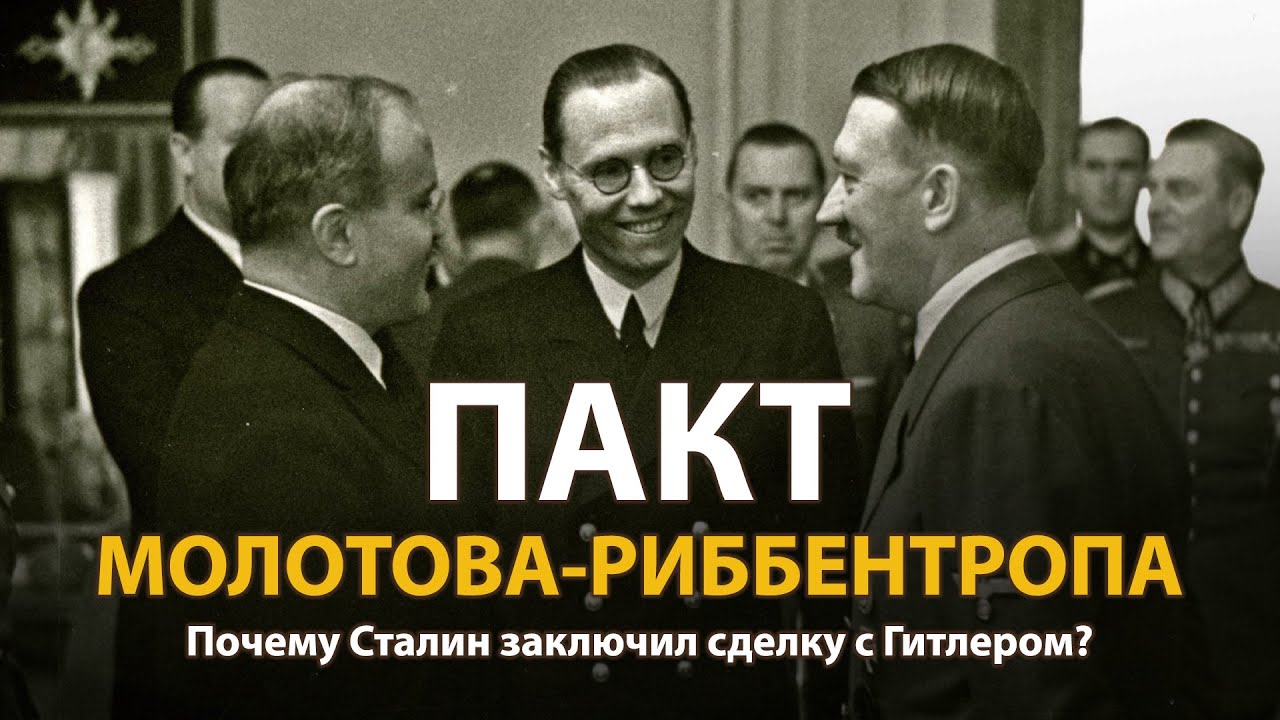
make feeble attempts to negotiate with the Soviet Union, This was already mentioned in one of the lectures about Stalin, so we won't dwell on it in detail now. But it is clear that there was no particular enthusiasm shown in these Anglo-Franco-Soviet negotiations, it is clear that the British and the French viewed Stalin with great suspicion, and Stalin viewed them in the same way. But at this point, diplomats, German and Soviet, are already feeling out the possibility of an agreement. On August 20, Hitler sends a telegram to Stalin requesting Ribbentrop's reception in Moscow. And on August
23, 1939, the world learns the stunning news that Hitler and Stalin, Germany and the Soviet Union have signed a non-aggression pact. There is always a lot of talk about how all left-wing forces in Europe were shocked, because the Soviet Union was seen as the main anti-fascist country. And suddenly, a pact with Hitler. In fact, no less shocked were the anti-communist forces in Europe, because for many years, Hitler had shown himself to be an enemy of the communists. Now he is making deals with them. So, of course, today, if you look at it, it's clear that
two totalitarian rulers, two tyrants, have reached an agreement. It's amazing that they didn't agree earlier, but at that moment it was a shock, basically, for everyone, for the left, for the right, for anyone. Then on September 1, the allegedly falsified attack of the Poles on Germany, and under this pretext, Germany invades Poland, starting the Second World War. We will not, of course, discuss the history of the Second World War in detail now. What interests us is how Hitler behaves. On September 1, when the war begins, he, on the one hand, can be sure that there
will be no attack from the east. He made a deal with Stalin. They had already agreed on the division of Poland, but what will England and France do? The events of previous years gave him reason to hope, that maybe they would limit themselves to outraged words again and nothing more. For Germany, with its position in the center of Europe, there was always a terrible danger, And this was clearly seen during the First World War, always a terrible danger - a war on two fronts. And now, if England and France strike from the west, Germany will
be in a difficult position. And at first, on September 1-2, it seemed that he was lucky again, that nothing would happen again. But this time it turned out differently. There are memories of Paul Schmidt, a translator for the German Foreign Ministry, who had to translate a message for Hitler on September 3 that Britain had declared war on Germany: "When I entered, Hitler and Ribbentrop gave me a tense look. Stopping at a certain distance in front of Hitler's desk, I slowly translated the ultimatum from the British government to him. When I finished, complete silence fell. Hitler
sat as if petrified, staring into space in front of him. He did not lose his composure, as claimed later, he did not rage, as others remembered. He sat in his place completely quietly and motionless. After some time that seemed like an eternity to me, he turned to Ribbentrop, who remained standing by the window as if petrified. "So, what do we do now?" Hitler asked his Foreign Minister with anger in his eyes, as if wanting to express that Ribbentrop had misinformed him about the English reaction. Ribbentrop replied in a quiet voice, "I assume that the French
will present us with a similar ultimatum in the next hour." Indeed, an ultimatum was presented, and the Germans did not withdraw from Poland. Consequently, England and France declared war on Germany. Again, if an attack had been launched on Germany at that moment, there would have been casualties in both the English and French armies. But it is clear that the Second World War would have ended much sooner. This did not happen. A period known as the Phoney War begins, where war is declared but little fighting takes place. This allows Hitler, by the end of 1939 and
into the early months of 1940, to take advantage of the passivity of England and France, Essentially continuing to appease the aggressor, yes, in a new form, yes, they declared war, yes, they support Poland, yes, they support Norway, which Hitler will also invade, but in these few months, firstly, there is further militarization, and secondly, there are new conquests. Because during this time, Hitler manages to capture Scandinavia: Denmark, Norway, and prepares for further war. On May 10, 1940, violating the neutrality of Belgium and the Netherlands, Hitler invades France. The Phoney War ends, but surprisingly, in May 1940,
Chamberlain's government collapses, of course, thankfully, Churchill becomes the Prime Minister of Great Britain, ready to fight to the end. Throughout May, pressure mounts on Churchill, and his position remains precarious. He has not yet become the beloved national leader; his own party could easily remove him. Pressure is mounting on him to start negotiations. They offer him intermediaries who are ready to contact Mussolini in the hope that Mussolini will contact Hitler. Negotiations must be pursued. And of course, Churchill plays a huge role at this time, declaring that he will fight to the end. By the summer of
1940, Hitler's absolute confidence that he is acting correctly, that he is chosen by destiny, that he must perform miracles, is being confirmed one after another. He made a deal with Stalin, deceived Western powers, invaded Poland. Yes, he was declared war on, but beyond that, there is no more war, he continues to capture more and more territories. He invades France, the first real military campaign. The Poles fought heroically, but the superiority of the German troops was immense. The war with France, here there are already more casualties, but also within a month and a half, from May
10 to the 20s of June, German troops advanced very far from the border. They occupied a large part of France, and eventually France surrendered. Marshal Petain, a hero of the First World War "Lion of Verdun," turns to Hitler to negotiate. Upon learning of the readiness to surrender, Hitler, who was in a country house, opened the shutters, turned off the lights, and looked out the window. Clearly, he was experiencing a sense of his own greatness. Then he flies to Paris, where he had never been before, he takes a tour of the opera house. He is an
artist, an architect, he understands all of this. Then he is driven around Paris for three hours, he looks at all these places he has heard and read so much about but had never been to. Then he visits the places of the First World War, reveling in his victory. He revels in his triumph, convinced that everything will continue this way. And it must be said that up to this point, once again, German public opinion, excluding anti-fascists, those who were persecuted, is on his side. He promised victories, and victories there are. A well-known story about people who
have started to resist Hitler in one way or another, when the first funerals, the first coffins started coming back from France. But they are still in the minority for now. Triumph after triumph, and not so far from complete domination of the world. But where to go next? And here arises the question, because Hitler always had a very contradictory attitude towards England. On one hand, there are a million quotes from his speeches where he talks about English capitalism, Jewish capital, colonies, English - these are all Germany's main enemies. That England must be defeated, a lot of
things. At the same time, he repeatedly dreamed of an alliance with England. And then he would say: if it weren't for that drunkard Churchill, maybe we could have come to an agreement with England. There are a lot of unclear and strange things here. One of the greatest, most amazing events in the history of World War II is what is called the Miracle of Dunkirk. When at the end of May, British and French troops were cornered at the port of Dunkirk, and it was clear that the advancing Germans would crush them. And the French troops were
already suffering defeat, while a large part of the best, elite British troops were concentrated here. And if they were destroyed, well, Britain would simply have no strength left to defend itself further. But at the end of May, something amazing happens, because the German troops heading towards Dunkirk receive orders to stop. Oh, since then there have been so many debates and attempts to solve the question of who gave this order. There are different generals who claim to have made this decision. Who ordered Guderian to stop? There is an opinion that Guderian himself, Hitler's great general, made
this decision. Although, on the other hand, it is known that he was absolutely furious, he was just a little away from completing it and that's it, England and France would be defeated. There is a version, though not confirmed by any real facts, that maybe, Hitler himself secretly gave this order, supporters of this version believe that he did not want to completely destroy England. This is a complex issue, it's a weakly supported version. But the fact that Hitler was really wavering, unable to fully determine his attitude towards England, that is definitely true. Thanks to the fact
that the German troops stopped, further this amazing miracle happening in Great Britain, but I refer everyone to the brilliant, in my opinion, movie "Darkest Hour," where this month in Churchill's life is depicted, a lot is fictionalized, but the main historical facts are shown, of course, amazingly. And the British managed to evacuate a large part of their troops from France, not only by the British fleet, but also by fire ships, yachtsmen, anyone who could evacuate their people, And a large part of the British army will be saved, and Britain will be able to continue fighting. The
Blitz begins, bombings of Great Britain begin, again, here too, Hitler is confident that victory is imminent. In this case, he was largely misled by Göring, who commanded the Luftwaffe, and claimed that, well, we will crush the British aviation instantly. The idea was to crush British aviation, then invade the British Isles. But they failed to crush British aviation, and the terrible bombings would continue throughout the war. But Britain stood firm, and there are also questions on which historians do not agree. At what point did Hitler decide to violate his pact with Stalin and attack the Soviet
Union? Opinions vary greatly on this matter as well. Operation Barbarossa was developed, a plan to attack the USSR, but at what point did Hitler decide to actually carry it out? Did he want to do this as early as 1940? Did he decide to attack the Soviet Union when he saw how poorly the Soviet troops fought against Finland in the winter of 1939-40? Did he think about it earlier? It's unclear. And perhaps he thought about it from the beginning, when negotiating with Stalin. Opinions differ here. And here is another mysterious moment, when in May 1941 one
of Hitler's closest aides, Rudolf Hess, a man who had been imprisoned with him after the Beer Hall Putsch, who transcribed "Mein Kampf" for him as dictated by Hitler, one of the key architects of the entire Nazi regime Rudolf Hess boards a small plane and flies to Britain. Materials related to Hess's case remain classified to this day. They were supposed to be declassified at some point but the secrecy was extended. Hess himself claimed he flew to warn the British about Hitler's plans to attack the Soviet Union. In the Soviet Union, there was great concern in May
1941 upon learning about this flight, as there were suspicions, not only in the Soviet Union, that perhaps Hitler sent Hess himself, although Hess claimed he had become disillusioned with Hitler's policies and flew to the British. The British held him as a prisoner of war, and Hess would be tried at the Nuremberg Trials, receiving a life sentence and becoming the last prisoner of Spandau Prison, where everyone else would either die or serve their sentence and be released, while he would remain alone. At the time of the restructuring, when he had a chance to be released, because
England, France, America were ready to release this sick old man. Only the Soviet Union did not allow it. And when it became clear that Gorbachev might allow Hess's release, at that moment he took his own life, taking his secrets to the grave. But this also led to various journalistic speculations that he did not take his own life, that he was killed. But all of this is already in the realm of fantasy. However, the version that perhaps Hitler deliberately sent Hess under the guise of a defector, to negotiate with England, existed and still exists. On the
other hand, there is a completely different version, because the German troops stationed in Poland, They distributed maps of England specifically to create the impression in early 1941 that they would be sent against the English. That is, to confuse the Soviet Union. Who was deceiving whom, who was provoking whom? This is a very, very complex question. Well, as we know, on June 22, 1941, German troops attacked the Soviet Union. This is such a well-known date to all of us, clear, understandable, well, we know that Hitler attacked the Soviet Union. Well, it seems like he couldn't not
attack. Meanwhile, many historians also wonder why he did it? Or, rather, probably, we should say why he did it, without finishing the war with England? Starting from August 1940, so almost a year, England was being bombed, yes, English pilots defended themselves, the English resisted. But it is clear that an invasion of the British Isles can only happen in the summer. It is impossible to cross the English Channel for military purposes in autumn-winter. So, August 1940, September 1940 - terrible bombings of England. The English resisted, it didn't work out, but autumn passed, winter passed, summer comes
again. Why not try again? So Hitler himself creates a situation where he has a war on two fronts. Of course, this is a different war, because France is conquered, he doesn't have to fear an attack from the mainland. But still, he has one military campaign against England. And not finishing it, he starts another one. In 1945, when Soviet troops were already approaching Berlin, Hitler, of course, agonizingly tries to understand, when, what went wrong. And in particular, he returns to this moment, which historians will always consider his mistake. Why did he attack the Soviet Union? And
he says the following: "In order to force the English to surrender, it was necessary to take away their hope of opposing us on the continent with an enemy of our caliber, that is, the Red Army." So he attacked the Soviet Union to make the English surrender, but that doesn't convince me at all. I don't understand why in early 1941 the British should have relied on the Red Army, if the Soviet Union signed a pact with Hitler, it's some strange reasoning. "The second reason - the colossal danger that Russia posed to us simply by the fact
of its existence (but it is more reasonable), it would have been our downfall if it ever decided to attack us. Our only chance to defeat Russia was to preempt it. In the last weeks (before the attack on the USSR) I was troubled by the thought that Stalin might outmaneuver me." This is certainly an interesting point. To some extent, it probably supports Viktor Suvorov's concept, who argues that Stalin was indeed planning to attack, but Hitler preempted him. Anyway, Hitler makes this, in general, miscalculation. One of the reasons for this miscalculation was that, by this point, he
certainly believed in his invincibility. And in general, he had something to believe in, up to that point he had not suffered any defeats anywhere. And that's why he is convinced that this campaign against the Soviet Union will also be brilliant and very fast. A lot is said and written about the reasons for the Soviet army's defeats in the first months of the war. Well, I refer everyone interested to my lecture on Stalin and the war. But there is another thing. In the first months, the German army moves very quickly, Soviet troops are surrounded, hundreds of
thousands of troops. It seems like everything again supports Hitler's concept. And he is so convinced of his rightness that he ordered not to provide winter uniforms to German soldiers, Not to prepare tanks for winter cold, and well, this too, on one hand, may simply indicate his complete military incompetence, well, prepare plan "B", consider different options. But that's Hitler, to not consider plan "B", he always puts everything on the line, it's all or nothing. And of course there must be victory, and of course there must be blitzkrieg, and of course we will conquer everything. Although there
were many generals who told him that it wouldn't work. And not only that, during the discussion of the attack plan, as we know, the German troops advanced in three powerful directions. There was a massive strike on Moscow, a huge strike in the north, towards Leningrad and the Baltics, and in the south - towards Kyiv, with the aim to move further towards the Caucasus. The generals said it was impossible to disperse forces like that. And it's terrifying to think what would have happened if all those powerful German troops had marched on Moscow. Hitler said: my generals
don't understand the economic aspects of war. Well, he understood everything. Of course, he needed Caucasian oil, Ukrainian metals, bread, it's clear. But he dispersed his troops, believing in his inevitable victory. On December 5, 1941, German troops were stopped in the battle near Moscow and the Soviet counteroffensive began, for the first time he was stopped, and for the first time German troops retreated. Hitler was in incredible rage. In general, he did things similar to what Stalin did in the summer of 1941. Firstly, he ordered his troops not to retreat, to fight to the last, to fight
no matter what. They tried to explain to him: this is impossible. What do you mean, fight to the last? They had to retreat. He had a very sharp conflict with his generals, not for the first time, but perhaps never so acute, Guderian tried to explain to him why it was necessary to show what Hitler called "fanatical resistance" in his order. He ordered them to fight fanatically, but Hitler told Guderian: "Do you think, That Frederick the Great's grenadiers joyfully died? Of course not." And he said: "You are too close to the events, you sympathize too much
with the soldiers, you should keep your distance". No need to sympathize with the soldier. They must die, or win, or die. This is again his victory or death. And at the same time, in December 1941, Hitler takes another action, which caused a great surprise and shock on all sides of the front, and to this day causing great surprise to historians. As we know, in these very first days of the Soviet counteroffensive near Moscow, a turning point occurs in the course of World War II. Japanese ships approach Pearl Harbor in Hawaii, where the US Navy base
is located. By this time, President Roosevelt is eager to support the anti-fascist forces, While Congress is adamantly against starting a war. The only thing Roosevelt had managed to do up to this point was to establish the lend-lease system, through which countries receive aid, whose security is of interest to the United States. The Soviet Union is already included in the lend-lease system, but the war has not started yet. Then, after the start of World War II, Japan seized, let's say, French colonies in Asia, and clearly intended to act further. Roosevelt, firstly, imposed an oil embargo on
Japan, which was a severe blow to them, and froze Japanese accounts in American banks. Negotiations were ongoing in Washington, trying to reach some agreement, but to no avail. Meanwhile, Japanese ships, taking a strange, circuitous route to avoid detection, were heading towards Pearl Harbor. Finally, an attack is launched on this base. Fortunately, most American ships were at sea, so not all were destroyed. But it was still a terrible shock. And naturally, immediately the American Congress, with the votes of all deputies except one female pacifist, decides to declare war on Japan. And overall, this situation is very
advantageous for Hitler. We often underestimate the scale and severity of the war between Americans and Japanese. This war took place over vast expanses of the Pacific Ocean, across huge Asian territories, with an incredible number of casualties, extreme cruelty, draining a lot of strength from the Americans. And this benefits Hitler, let the Americans get bogged down there. And it is absolutely clear that they will not willingly venture into Europe again. And in response, Hitler declares war on the USA. So he himself drags the United States into a war against him. Why? Well, Sebastian Haffner has a
romantic, yet on the other hand, a justified version. He believes that when Hitler realized the blitzkrieg near Moscow had failed, he seemed to understand that the war was lost. He had said many times, if we were to lose the war, let Germany perish, let the German people perish, let everyone perish. So Haffner's theory is that this was a suicidal decision. Well, let it be worse, the worse, the better. I don't know how reasonable this is, but it was indeed a strange miscalculation or a wild move, which greatly damaged Hitler. An anti-Hitler coalition is formed and
strengthened. He significantly interferes in military operations. He declares himself the supreme commander because, of course, he is a man of destiny, a man of fate, he understands better than all these generals. Opposition among the generals grows, and Hitler imposes his vision on them. He was quite successful in some aspects, for example, his attention to tank troops, how he organized his tank troops brought him a lot of success. Attention to airborne troops - yes, definitely. Like Stalin, he constantly sacrifices military considerations for political ones. This was very evident at Stalingrad when German troops almost reached the
Volga, they were just a few hundred meters short, and it was announced that Stalingrad had fallen. When the Soviet counteroffensive began, all the generals convinced Hitler that General Paulus should be told to withdraw his army from Stalingrad, save his troops, regroup. And then maybe act again. And actually, Stalingrad was not that necessary at that moment. German troops are already pushing towards the Caucasus, maybe we should send forces there, but Hitler cannot afford it. It has already been announced that Stalingrad has been taken, and Paulus has been ordered to stay. Again, Göring said that the air
forces would supply this army with provisions and weapons as much as needed. Paulus is sitting in Stalingrad, after which Soviet troops encircle the city. There was also a moment when the encirclement closed at the end of November, he could still break through. Because the troops were not yet fortified. Moreover, Manstein's troops were coming from the south to help Paulus. If Manstein had attacked the Soviet encirclement from one side and Paulus from the other, they could have broken the circle. But Paulus was ordered not to leave Stalingrad under any circumstances. Manstein will be stopped, the encirclement
will be secured. Hundreds of thousands of German troops will be trapped in the Stalingrad cauldron. And then, next, a very characteristic moment, when in January 1943 Paulus was given an ultimatum, he asks Hitler for instructions on what to do? Which drives Hitler into a wild rage, another fit of fury. How dare he ask, does he have doubts? Does he think maybe they should surrender? By this time, they had practically lost all airfields, and they were already starving. And of course, no supplies were being dropped from the air, very few supplies were being dropped. No, they
must fight to the end. And such a remarkable turn of events. Perhaps incomprehensible to us today, but understood by both Hitler and Paulus. In the last days of the existence of the Stalingrad cauldron, Paulus is promoted to the rank of Field Marshal. For what? He lost! He will clearly be captured soon. And that was a sign. No German Field Marshal had ever surrendered. So by making him a Field Marshal, Hitler was essentially telling him to commit suicide. But as we know, Paulus did not commit suicide. He was already in full depression, lying face to the
wall. All his assistants were giving orders. He will be captured, he will be a witness at the Nuremberg trials, and he will end his life in the GDR. Because for him, of course, this was a complete upheaval. How Hitler treated him, what he promised and did not fulfill his promises, did not help, did not provide supplies, and ruined his soldiers. And Hitler was in a complete rage. There are very interesting records of the meetings at Hitler's headquarters, where he talks about why he didn't end his own life? He has this will to death, it grows
stronger every year. He constantly indulges in some strange thoughts, like saying the Soviets fight well in winter and poorly in summer. And indeed, in the summer of 1941 - defeats of the Red Army, in the winter - victories. Summer 1942 - defeats of the Red Army, in the winter - victories. But only in the summer of 1943, in the Battle of Kursk, the Soviet army will win, and the offensive will begin, to which Hitler will not be able to oppose anything, but he still does not believe in it. And it is also evident how in
1943, and especially in 1944, and further in 1945, he becomes more detached from reality. He lives in a completely invented world. By 1944, he hardly ever leaves his headquarters. He first had a headquarters in Vinnitsa, then it was moved to Germany, he had several underground residences, but his main headquarters, he sits there, narrow gloomy rooms, he never goes outside. If he needs to move from one place to another, the windows in his train are covered with curtains. There was a moment when by chance Hitler's train, on which he was traveling, stopped next to a train
carrying wounded from the front. And he immediately ordered everything to be closed, the curtains to be closed, because he does not want to come into contact with this reality. And what is the reality? That his troops are suffering defeat, and he is being informed about it. He is given information that the industry is not coping, that there is retreat here, retreat there. Allies are landing in Africa, Mussolini's regime is falling apart, Soviet troops are advancing, partisans are waging a huge war, and he seems not to hear about it. One general presented him with a very
detailed note in early 1944 that it was impossible to continue the war. So something needs to be done, negotiations need to start, he said: "So that I don't receive such notes at all." And he continues to make plans. Why is there a war in the East? He repeatedly explained to the command back even in 1938-39, the need for living space, so the lower races must be destroyed or conquered. And here he is, how he used to indulge in his meaningless projects in Vienna in his youth, sitting there, unwanted by anyone, like how to rebuild Schönbrunn
Palace, something unnecessary, and most importantly, no one was interested in his opinion. Now he is the master of the world. And still, how will this space be organized? How to organize destruction? Decisions of the Wannsee Conference have already been made, all the trains with deported Jews are heading to concentration camps. And how will the territories of the Soviet Union be organized, where there will be cities where representatives of the lower race will live. There is no need to educate them, let them only know a few words in German and know the name of the capital
of the Reich. And in mathematics, for example, there is no need to teach them. Music should be played cheerful all the time, because it increases productivity. And also, by the way, they should be explained that vaccinations are harmful. Let them die. And at the same time, he always loved to delve into details. Here the city will be built like this, and the cities will be located here, and the new capital will be in Germany. It will look like this, there will be such monuments, such buildings, so he is floating in some of his dark, eerie
fantasies. Meanwhile, the war continues, and Germany is fighting worse with each passing month. And for him, it's as if it doesn't exist. Goebbels convinces him to start a total war, that is, total mobilization, drastically change the economy, so that everyone works massively for the war. And he hesitates somehow. He is in his dreams. In 1943, Goebbels delivers a famous speech at the Berlin Sports Palace, Where he shouted and screamed for over an hour, during the speech Goebbels lost three kilograms, and he shouts, we want total war. Well, of course, the whole hall was huge, filled
with various party officials, yes-yes, and Hitler is hesitating. He thinks they will win anyway, that another miracle will happen now. Later, Goebbels will say that "a bomb was needed under Hitler's butt for him to understand that total war is needed". It refers to the conspiracy of Claus von Stauffenberg on July 20, 1944. There were quite a few attempts on Hitler's life, and unfortunately, he survived each time. Stauffenberg came closest to success because he left a briefcase with explosives, so undoubtedly, everything should have been blown up there. But the briefcase was moved, and a very sturdy
table shielded Hitler. There were casualties, there was a terrible explosion. Hitler, well yes, his legs were injured by splinters, but that's all. And this only convinces him of how right he is. Severe repression is unleashed on the conspirators. Stauffenberg and his closest aides were somewhat lucky, as they were shot immediately after the conspiracy was suppressed. Obviously, the Berlin commandant, who was almost on their side, wanted to hide his involvement because an investigation was starting. Hundreds of people are arrested, including high-ranking military leaders, commanders, and senior party officials. They are interrogated incredibly harshly and brutally executed.
The executions are filmed and then shown to Hitler, who watches with delight. He addresses the nation, saying that his survival is not a coincidence, it's a miracle because he is destined for great things. One would think that this conspiracy should show him the huge number of not just ordinary people or leftists, but those who serve him, turning against him. Field Marshal von Kluge, who commanded on the Eastern Front, is implicated, Rommel, Hitler's favorite. The only action Hitler took against Rommel was to announce that he died in a bombing raid. He was given a solemn funeral.
Think about it. But he has the opposite thing: I am saved, so fate is on my side. And everything continues as it is. At the same time, let's say, Himmler already had, since 1943, well, of course, completely insane, but very characteristic thoughts. Himmler was developing such an idea in his final years, that maybe he could negotiate with the Americans, perhaps hand over some well-known Jewish figures and thus, for example, achieve a separate peace or some concessions. Of course, this is a crazy idea, but at least he is looking for a way out of the situation.
Hitler, no matter what anyone says to him, must continue to destroy the Jews, because for him, it is a mission, a sacred duty, he does not want to, cannot deviate from it. And all these mechanisms of the death camps will continue to operate until the last days, when the army approaches, they will try to evacuate the prisoners. Well, of course, to cover their tracks, but also because they must continue, continue, continue to destroy. In these final years, Hitler is incredibly deteriorating. He is not yet sixty, he has turned into a mere ruin. There are many
horrifying descriptions of how he looked and behaved in his bunker, constantly underground, deprived of communication with the real world, completely detached from it, no longer going to the front, hardly interacting with anyone except his close circle. Such a horrifying description is also from Joachim Fest's book: "Tired, shoulders drooping, dragging one leg, he moves through the rooms of the headquarters, dull eyes gaze from the lifeless bloated face, the left hand trembles. Physically deteriorated, hardened, and, in his own words, tormented by melancholy, sinking deeper into the complexes and hatreds of his youth." At this time, Goebbels says:
"It's tragic how the Führer isolates himself from life. He no longer goes outside, finds no relief, constantly sits in his bunker." Here is another description: "A bent figure with a pale, bloated face... (everyone notices this bloated face of his)" He huddled on the chair with trembling palms, carefully hiding his left hand, which was constantly twitching. Then many discussed whether he had Parkinson's disease. Hitler always took great care of his health, being a vegetarian and mindful of his well-being. At that moment, during that period, it all reached a certain absurdity, he sometimes took up to twenty-eight
medications a day, and they were very diverse. On one hand, he was prescribed pills for any reason, given stimulating injections, and took, well, maybe not narcotics, but certainly stimulating substances. He drew a strange doctor with occult swirls closer to him. Occultism was very important for the Nazis in general. But it's completely unclear what he's doing with his health. Obviously, this treatment only made him worse. At the same time, he had an incredible desire for sweets. When a plate of pastries was brought to him, he devoured it. Literally, as one of the observers said, he turned
into a wreck devouring pastries. He was a physical wreck: his hand trembled, his face bloated, saliva dripping from his mouth. A nightmarish sight. Simultaneously, his thoughts, his wild energy, were still directed towards destruction. The same orders continued, like in 1941 when he gave them, and in 1943, in 1944, for example, during the Soviet advance in Ukraine, Hitler marked on the map the places, which he designated as fortresses. A fortress was a populated area that must not be surrendered under any circumstances. But by this point, the Soviet advantage was so significant that Soviet troops simply bypassed
the city and moved on. Naturally, they eventually surrendered. And he kept insisting, no retreat, no retreat, from here, they, there, even calling up elderly people from 15 years old to join the army. In other words, everyone was being thrown in, and in general, he understood what was happening. But he said that if there is no victory, then let everyone perish, and he continues to say this. "If something happens to me, then Germany will be left without a leader, as I have no successor. The first one went mad (referring to Hess), the second squandered the people's
sympathies (referring to Göring), and the third one is not wanted by the party circles (referring to Himmler)." And then comes the stunning addition about Himmler: "And he is completely devoid of artistic sense." The world is collapsing, war is claiming millions of lives. How can Himmler be his successor? He is completely devoid of artistic sense. And he continues to develop plans to create the world's largest art museum in his beloved city of Linz. And then in his will, he writes that he bequeaths his art collection to Linz, and let everything plummet into the abyss. "Because, as
he says, there is no one to whom to bequeath his house, - he says, - there is nothing else left, but to burn down this house with everything inside. It will make an excellent bonfire." And so he arranges a bonfire, basically of the whole world, and even of his own country and people. On one hand, of course, his entourage is already thinking about how to extricate themselves from this. And they try to hint somehow, whether to try a separate peace, to try to stop. But overall, they see that he does not respond to this. It
must be said that they are still completely under his hypnotic influence. And there are examples of how people come to Hitler at headquarters, military personnel, in complete desperation, coming from the front lines, seeing what is happening there. And an hour later, directly after speaking with him, they come out inspired: yes, we believe in miracles, we will be saved. And it seems that he really gains some hope. At the end of 1944, when Soviet troops are already in Poland, and American troops are in France, moving towards the Ardennes. And at that moment, he also gives the
completely suicidal order to start an offensive in the Ardennes, which also resulted in a huge loss of life. And suddenly this offensive turns out to be successful, and for a while the German troops move forward. The problem was that it was the end of December, beginning of January, the weather was bad and the American aviation simply couldn't take off. So suddenly the German troops move forward, which was completely unexpected. The Americans, the British also thought they would reach Berlin by Christmas. And Hitler immediately orders to drop the allies into the sea, to move forward. He
goes on the radio and says: here it is, this miracle. Some time passes. The weather changes, the clouds disperse, the aviation takes off perfectly, and naturally, this offensive falters. In the last months of his life, he reads the history of Frederick the Great. Frederick the Great, Frederick II, the Prussian king, whom Hitler admired, in the 18th century Frederick suffers defeat during the Seven Years' War, particularly from the Russian troops. At some point, Russian troops even occupy Berlin, then they leave, but in any case, they clearly win. And at this moment Empress Elizabeth Petrovna dies at
the end of 1761, and her successor Peter III, who admired Frederick, immediately makes peace. And here Hitler is counting on the same, he is waiting for a miracle, he has a portrait of Frederick hanging in his headquarters. And on April 12, a call comes in, and Himmler tells him: "The miracle has happened, your worst enemy has died." President Roosevelt has died, and Hitler immediately perks up, here it is, a miracle. Naturally, Roosevelt's death did not change anything, the offensive continues. It's already April, on April 16 the Berlin operation of Soviet troops begins, and he is
still waiting for a miracle. It's already unclear, maybe pretending to wait, it's very difficult to understand what he's really thinking. One of the people from his entourage later recalls how meetings were held at Hitler's headquarters: "These fluids of servility, nervousness, and deceit were almost unbearable not only for the soul, they were felt almost as physical discomfort. Nothing was real there, except fear". Well, Hitler's inner circle is certainly experiencing intense fear, but they have nowhere to run. By the end of April, as Soviet troops advance towards Berlin and Hitler is still making plans, decisions need to
be made. But then the flight begins. We know that some high-ranking members of Hitler's inner circle managed to escape somehow and disappear, while others remain with him. One of them, practically a relative, a man married to Hitler's mistress Eva Braun's sister, who was in charge of Hitler's press secretary, left the headquarters. In the final days, he was literally missing. They went to look for him, found him at home, dead drunk, in civilian clothes. It was clear that he wanted to escape. And Hitler, it was already clear, that's it, Hitler ordered him to be shot. And
Eva Braun somewhat weakly defends him, saying, let's demote him to a private and send him to the front. In any case, it's still death. No, and he was shot, at the last moment, if you try to escape. Actually, what he was talking about, starting from the Beer Hall Putsch, that, you see, every time he said: either I will win, or I will perish. And now the time has come, and probably this "ruin, devouring pastries" at the same time recalled some Wagnerian images. I'm afraid he found pleasure in the thought that the whole world is crumbling
in flames, that he is not leaving alone. He calls Eva Braun to his quarters, and on the last day, April 29, they get married. Well, this can simply be interpreted as a desire to take such a gentlemanly step before death towards his beloved woman. But, perhaps, there could be another explanation. He repeatedly said that as long as he is the Fuhrer of the German people, he cannot marry. He does not belong to himself, he belongs to Germany, he belongs to the Aryan race. That's it, the end. He registers his marriage, after which there is a
solemn farewell, shaking hands with everyone, poison is brought. Also very characteristic is that the poison was first tested on his beloved dog, the shepherd Blondi, to check how quickly it would work. The shepherd died quickly. They decided it could be used on themselves. He and Eva Braun go to their room. Then there was such a terrible, wild farce, because at that moment, when all this farewell was happening... And Hitler's bunker - it was a huge underground structure, with many rooms, halls, and there was what was called the antechamber, such an upper room. In the upper
room, where there were quite a few people still working in the quarters, the dancing begins. They were hardly celebrating Hitler's death, so these were also dances on graves. Just a release of tension. They run up to them, what are you doing, the Fuhrer is dying - they keep dancing. It's just complete madness. There are conflicting reports about what happened, as there is a version that they simply took poison, and another version that he actually shot himself. Hitler and Eva Braun's bodies, on April 30th, were taken upstairs and burned because he didn't want his body to
be desecrated. Strange things will also happen here. When Soviet troops capture the bunker and find these remains, there will immediately be speculation that it is Hitler. They will investigate, call a dentist who will confirm it's Hitler from the dental records. Then for some reason, Stalin at the Potsdam Conference mentioned that Hitler's body was not found. Obviously, he is hiding somewhere, for reasons unknown, although today, there is no doubt that it was Hitler's body. But some completely fantastic stories emerged, that he was in a monastery in Spain, or in Latin America, or fighting on the front
lines. Of course, none of this was true. His life ended in the early hours of April 30th under the artillery bombardment of Berlin amidst ruins and fire. This is the story of this dreadful man... Humanism dictates that even in the most terrible villain, we must find something human. It's hard for me to find anything human in Hitler, I can say he loved animals, was a vegetarian. But it sounds particularly cynical, and it's difficult to find any human traits here. I think, on the contrary, he was... I go back to Kurt Tucholsky's words that there is
no Hitler, only his name. I have a feeling that he was just an empty vessel of evil, bringing out the worst in people, all the most horrible things. It may sound mystical even now, nourished by this dark energy. There was an exchange happening, he was charged by these crowds, and then injected this evil into them, this desire for death, murder, and hatred. Of course, with great satisfaction, they later talked about his despair in the bunker, about his terrible physical condition. Well, I don't know to what extent all of this redeems all the atrocities he committed,
how possible it is to redeem them at all. Perhaps the most important thing we can take from this terrible story is to think about how these mechanisms worked, through which he subjugated people, subjugated the country, subjugated the world, And try to ensure that these mechanisms no longer work. Thank you to everyone who contributed to this lesson, our patrons, our sponsors, all those who enable us to continue working. And of course, I would like to hear your opinion on how realistic it was to stop Hitler? And if it was realistic, then when, at what moment? Looking
forward to your comments. Cheers!