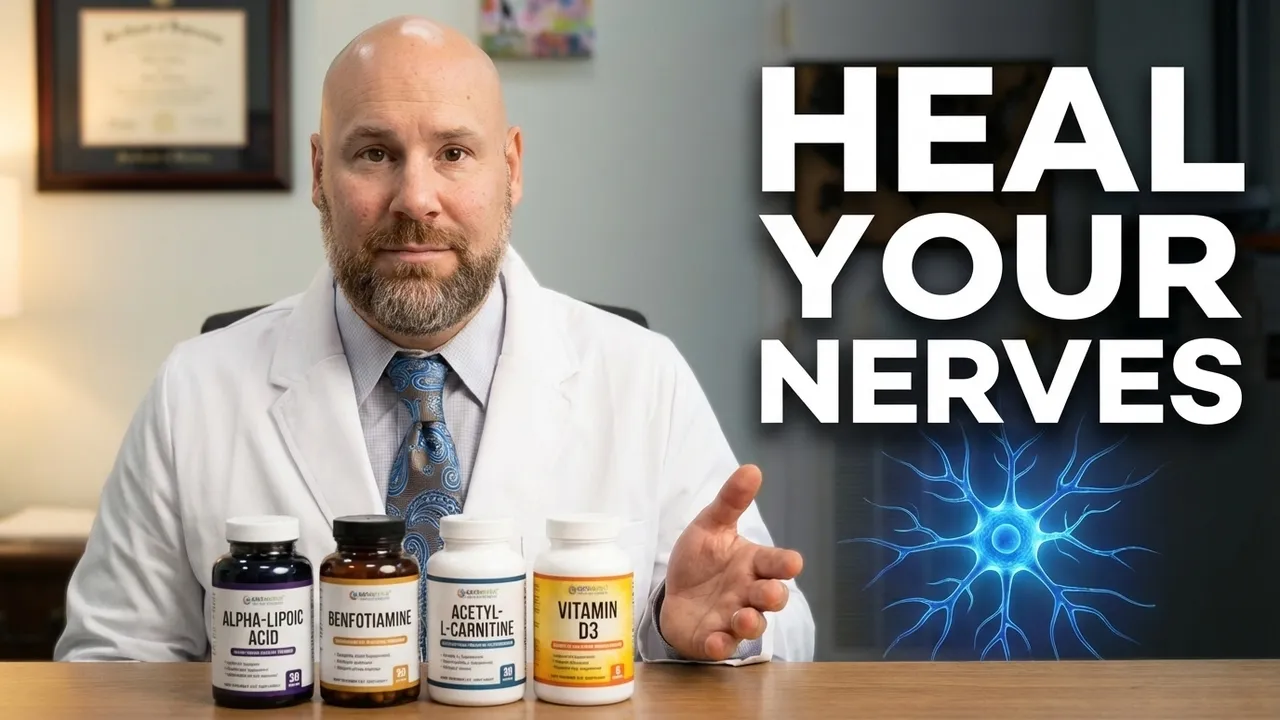
Your peripheral nerves, the one causing your burning and tingling, have a real ability to repair themselves, not just manage symptoms, actually [music] repair. These four supplements support the process directly, and your doctor may not have mentioned any of them. Most people with neuropathy take a generic B complex vitamin and wonder why nothing changes.
I understand the frustration. You're doing everything right, but here's the thing. It's not the supplement, it's the form.
Today, I'm going to walk you through four compounds that have real clinical evidence for nerve repair, not just pain management, repair. And I'll tell you the specific forms that actually make it into your nerve cells. Because the form matters every single time.
Let me show you why. Before we get into the supplements, let me explain something important. Your nerves have a protective coating around them.
Think of it like a plastic covering on an electrical wire. That coating is called the myelin sheath. When the myelin sheath breaks down from blood sugar damage, inflammation, or poor circulation, the nerve can't send clean signals.
That's where the burning, tingling, and numbness come from. The wire is losing its insulation. Now, here's the good news.
Unlike your brain, your peripheral nerves, the ones in your feet, hands, and legs, can actually regrow that coating. It's slow. It takes months, but it's real.
It's documented in research. The four supplements I'm about to show you each support that process in a different way. I want you to think of them as four workers at a construction site.
Each one has a different job. Each one is necessary. Let's meet them.
Worker number one is called benfotamine. [music] Say it with me. Ben foyamine.
You may have heard of B1 vitamins. This is a special form of B1. And the [music] difference matters a lot.
Regular B1 dissolves in water. That sounds fine until you realize that your nerve cells are wrapped in a fatty membrane. Water-based vitamins can't get inside.
Benotamine dissolves in fat. So it can it crosses that fatty wall and gets directly to where the nerves are being damaged. What does it do in there?
It blocks one of the main pathways that blood sugar uses to damage nerves. Remember the caramel coating? Benotamine helps stop that process at the cell level.
Clinical trials in people with diabetic neuropathy showed that real improvements in nerve pain after just 6 weeks. What to look for in the label? Benotamine, not plain B1, not thamine.
Benotamine 150 to 300 milligs per day. The form matters every [music] time. Worker number two is alpha lipoic acid.
You may have seen them in nerve health products. Here's what it does. Your nerves are under constant attack from something called oxidative stress.
Think of oxidative stress like rust forming on a metal pipe. Over time, it [music] breaks down the pipe from the inside. Alpha lipoic acid is one of the most powerful rust removers your body has.
It's an antioxidant, [music] and it's a strong one. Now, here's what makes it special. Most antioxidants can't cross the blood nerve barrier, the protective wall around your nerves.
Alpha lipoic acid can. It gets inside and starts cleaning up the damage at the source. A major clinical study called the Sydney 2 trial showed that 600 mg per day reduced neuropathy symptoms significantly after just 5 weeks.
That's [music] real peer-reviewed evidence, not marketing. What to look for? The R alpha lipoic acid.
The R form, not the S form. The R form is more active in the body. [music] The S form is cheaper to make, so it's in a lot of products.
Read the label. The form matters. Worker number three is a bit of a mouthful.
Acetal LC carnitine or ALC for short. This one does something the other two can't. It helps grow new nerve fibers.
Not just protect them, actually help rebuild them. Here's the simple version. Your nerves are like roads.
When a road is damaged, you need two things. Workers to fix it and trucks to bring in the supplies. Acetal Lcarnine is the truck.
It delivers fuel in the form of fatty acids right to the engine of your nerve cells. That engine is called the mitochondria. When your nerve cells have more fuel, they can repair faster.
A study published in Diabetes Care, one of the top medical journals, showed that 1,000 milligs of ALC per day reduced nerve pain and promoted actual nerve fiber growth after [music] one year. What to look for? Acetal Lcarnitine with the word acetal at the front.
Plain Lcarnitine will not give you the same result. [music] The acetal form crosses the protective nerve barrier. Plain Lcarnitine does not.
The form matters. I'll keep saying it because it [music] keeps being true. Worker number four ties everything together, especially at night.
Magnesium glycinate. Magnesium plays a role in over 300 processes in your body. But for neuropathy, two things matter most.
First, magnesium controls how easily the nerves fire. When you're low in magnesium, your nerves fire too easily. That's when you get sharp electric shooting pain.
Magnesium acts like a dimmer switch on those signals. It turns them down. Second, magnesium helps you sleep deeply.
A deep sleep is when nerve repair actually happens. Now, here's something I want you to know. Most Americans over 55 are low in magnesium.
And many common medications, including metformin, the most common diabetes drug, actively drain your magnesium levels. So, if you're on any blood sugar medication, this one's especially important for you. What to look for?
Magnesium glycinate, not magnesium oxide. Glycinate is the gentlest on your stomach and absorbs the best. 200 to 400 millig.
Take it about 30 minutes before bed. Now, let me give you the full protocol. This is exactly how to take these together.
This is your nerve repair protocol. Write this down. With breakfast, benotamine 150 to 300 mg.
Our alpha lipoic acid 300 to 600 milligrams with lunch or dinner. Acetal Lcarnitine 1,000 milligrams 30 minutes before bed. Magnesium glycinate 200 to 400 millig.
Always talk to your doctor before starting anything new, especially if you're on medication. Some of these can interact with blood thinners and blood sugar meds, but this protocol has peer-reviewed science behind it, and you deserve to know about it. If you want to go deeper on what foods support these supplements and which one actually block absorption, I've got a full video linked right here.
This is your prescription. Four workers, one job. [music] Rebuild your nerves.
I'm Dr Andrew Federman. I'll see you in the next one. And don't forget to like and subscribe.