So let's talk about KPIs or key performance indicators. KPIs measure the performance of your product. They help you to understand how well your product is working or isn't working as well as how changes that you're making to your product move the needle.
There are a couple of different types of KPIs. You can have business KPIs, which measure how you're doing against business goals. You can have product KPIs, which measure how the product is being used and how the product is helping users meet their goals.
You can have quality KPIs, which measure how often users encounter issues or problems with the product. You can have development KPIs, which measure how well the team is executing when it comes to building and delivering the product. So how do you go about picking KPIs?
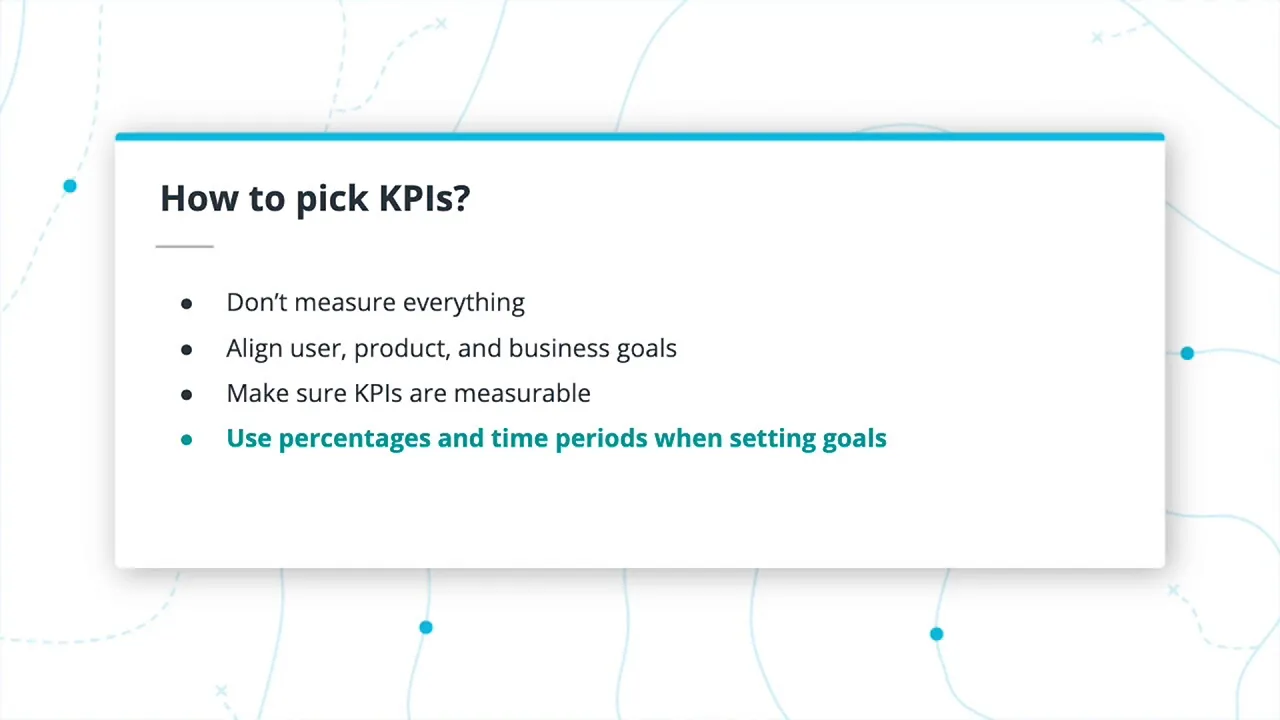
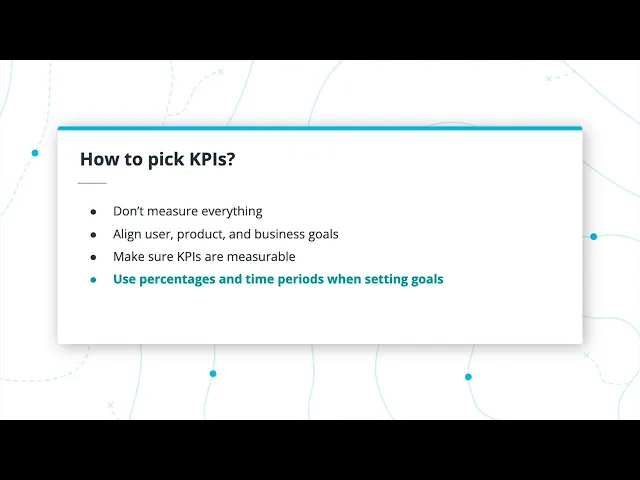
Well, don't measure everything. I know it's really tempting to do because there's lots of data and there's lots of things that you can measure, but you want to be super selective when you're picking KPIs. It's better to have a few actionable KPIs rather than a ton of KPI's that are difficult to understand.
If you have too many KPI's, you'll waste a lot of time trying to understand what they all mean and what's causing them to change over time. So the fewer metrics that you chase, the more focus that you'll have as a team and the more likely that you will be able to move those specific KPIs. The best KPIs capture user, product and business goals.
But it's also okay to have a few KPIs that touch on each of these. If one of your business goals is related to revenue, revenue will likely be one of your KPIs. User goals are related to the problem that your product is trying to solve.
Product goals are generally related to the usage of your product, usually around engagement. You also want to make sure that the KPIs that you identify are measurable and that the team agrees on how those KPIs will be measured. At first, this seems really simple and straightforward, but oftentimes as you start digging into the data, there's a lot more complexity than it might appear at first.
It's also generally more helpful to set goals based on achieving things, based on percentages with a certain time-frame when you're talking about KPIs as well. So let's imagine that we're defining KPIs for Zoom just to make this a little bit more tangible. So assuming that the business goals are related to revenue targets, the things that I think would be important to measure are average revenue per user, or ARPU, the conversion rate moving from a free account to a paid account, and the churn rate in terms of how often do users stop using the product.
In terms of product KPIs, this is really about how the product is being used. The things that I think would be interesting to consider understanding the weekly active users. So how many users rely on using Zoom at least once a week in order to get their work done and collaborate with their team.
Also, how many calls does the average user participate in per week? Another thing that I think it would be important to understand is how long after an account is created does it take for a user to set up their first call with someone else? In terms of quality, this is about understanding how well the product is actually working.
There's a couple of things that come to mind. One of the biggest value props of Zoom is that it's high-quality video conferencing delivered in a very simple way. So I would want to make sure that we're monitoring and tracking the percentage of calls that are delivered in HD.
Since this is one of the key value props. We also ask users to rate each call after it ends. So that would be another helpful metric and KPI to track here, because this reflects the user's perspective on how the product is working.
Another good one to have is the support contact rate. So out of a 100 calls, how many users end up needing to contact support for help? Lastly, for development KPIs, this is about understanding how well the team is executing.
I think that it would be helpful to understand what percentage of futures are delivered on time and if there is any slips, what's the average deviation from the original estimate? I also think that it would be helpful to measure how many outages occur per month and on average, how long do those outages last? It's super important to identify KPIs because it gives you a view into how your product is doing at a glance.
It's something that your team has also agreed and acknowledged as being important things to track and understand.



![Звуковые иллюзии, которые работают на всех (почти) [Veritasium]](https://img.youtube.com/vi/8pCuUfbdheE/maxresdefault.jpg)