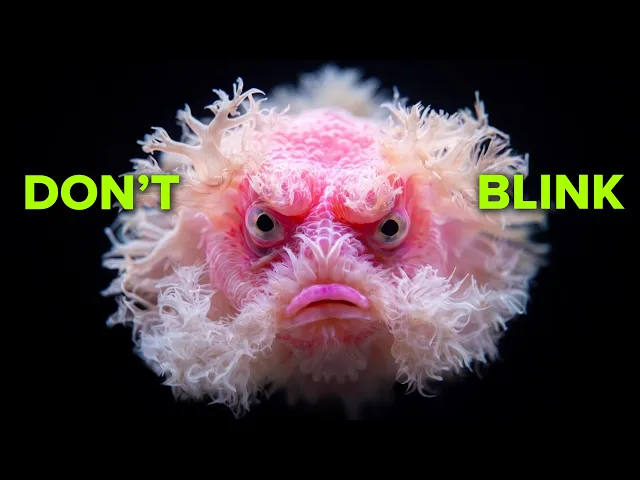
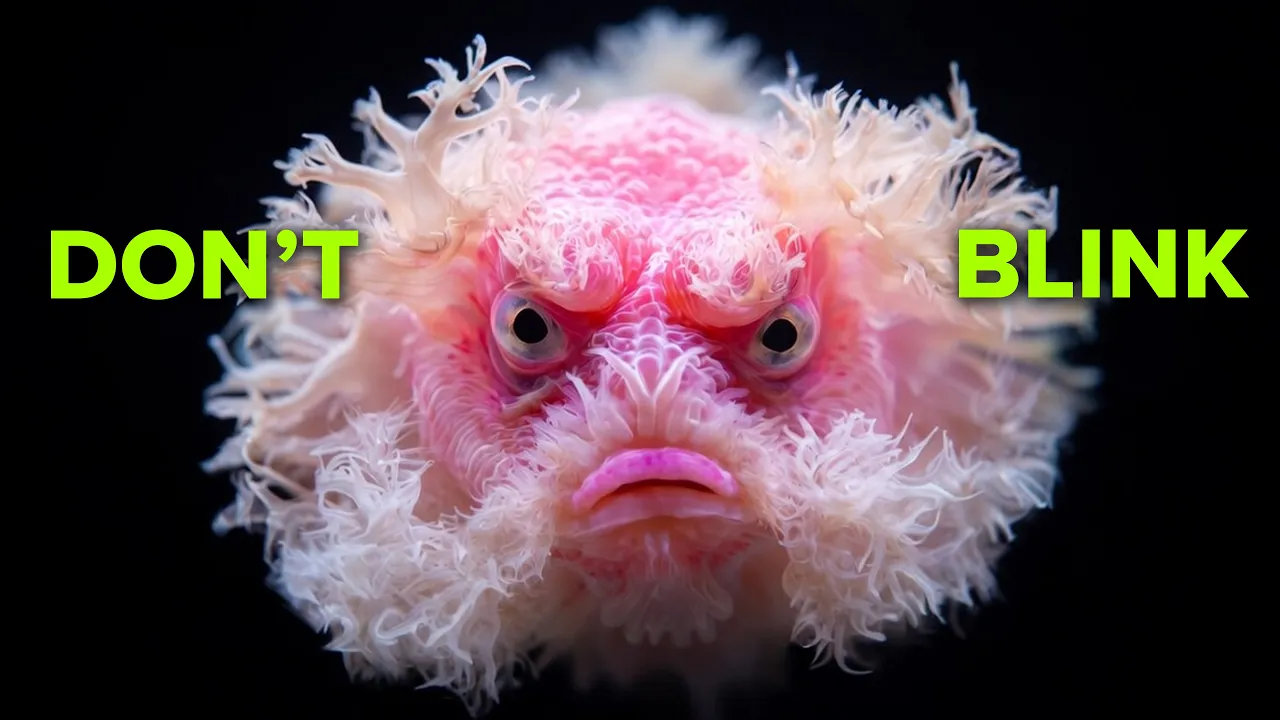
Take a close look at this clump of dead algae clinging to the reef. It is completely motionless without a single wasted breath. [music] In reality, this is a hairy frogfish setting a trap.
Instead of wasting energy chasing down prey, it opts for a more ruthless tactic. Waiting. It uses a modified dorsal fin as a biological fishing rod.
Twitching it continuously just above its mouth to mimic struggling prey. A school of curious small fish approaches. The moment a victim swims into the trap.
The frogfish's lower jaw joint suddenly unhinge and snap downward. Almost simultaneously, its entire mouth cavity balloons, expanding to 12 times its original size. Instantly, the prey is sucked into the darkness of its stomach by an inescapable vacuum force.
There is zero time to react. This entire lethal sequence unfolds in exactly 1/6000 of a second. This is officially the fastest strike ever recorded in the animal kingdom.
The question is, how does such a clunky, sluggish creature possess the fastest bite on the planet? Unlike predators that rely on powerful muscles in their tails or dorsal fins to slice through the water, the frogfish concentrates all of its destructive power in the structure of its head. You can see that its head is so large that it looks completely out of proportion with [music] the rest of the body.
It was not built for swimming, but has evolved into a specialized weapon. So, how does such an oversized [music] head help increase its strike speed? The secret lies in an instantaneous drop in pressure.
Imagine this. The moment the prey enters its range, [music] the frogfish's jaw system snaps open like a spring-loaded trap. In just a few milliseconds, [music] its joints swing wide open, causing the mouth cavity to expand rapidly.
This sudden expansion instantly creates a [music] low-pressure zone. In simple terms, a powerful vacuum right in [music] front of the prey. And by the natural behavior fluids, the surrounding water rushes in at high speeds to fill that space.
The result? The entire volume of water, along with the prey, is pulled deep into the frogfish's stomach. Everything happens so fast that the prey has no time [music] to react.
In fact, the frogfish doesn't bite or chew at all. It simply swallows an entire pocket of space [music] containing the prey. On top of that, thanks to its highly flexible mouth and stomach, this ambush predator can [music] easily consume animals nearly as large as itself.
In reality, carrying such a massive [music] head, along with a stomach always ready to expand, has become a burden for the frogfish. As a result, water resistance becomes [music] too high, making normal swimming almost impossible. And this very disadvantage has pushed the frogfish onto a [music] strange evolutionary path.
It has completely abandoned swimming, turning its fins into legs to slow walk along the ocean floor. At first glance, the frogfish looks like a strange mix between a fish and an amphibian. Along with its oversized head, its pectoral and pelvic fins have been completely transformed.
Instead of being thin and flexible for swimming, these fins are short, thick, and have clearly defined joint-like structures. However, this unusual fin structure is not the only reason why the frogfish abandoned swimming. The deeper reason lies in an internal organ that has completely disappeared.
Scientists found out that the frogfish has undergone a harsh trade-off to adapt to its ambush lifestyle. In most fish, the swim bladder is an essential organ. It works like a gas-filled float, allowing fish to stay suspended easily in the water.
But for a hunter that needs perfect stillness and must stay firmly anchored in strong currents, floating becomes a critical weakness. As a result, over millions of years of evolution, the frogfish has completely lost its swim bladder. As a direct result, the frogfish loses its buoyancy and sinks down to the seafloor.
And once it becomes fixed on the ocean bottom, its fins are forced to change function in order to survive. At this point, these thick fins take on the role of legs. Instead of swimming, the frogfish uses its [music] fins to slowly walk across the sandy seabed.
In addition, the flexible joints in its fins allow it to grip rough coral reef surfaces. It moves very carefully, step by step, always keeping its center of gravity as low as possible to avoid being swept away by currents. This type of movement requires very little energy, making it perfect for a low-activity animal.
However, the perfect stability puts the frogfish in a very ironic situation. Its slowness means it cannot chase after prey, so it must find a way to bring the prey directly to its mouth. To make up for its slow movement, the frogfish has evolved into a true master of camouflage.
When it moves to a new coral reef or sponge, its body slowly changes color. This process can take several weeks, but the result is incredibly accurate. Some species, like the hairy frogfish, take this ability even further.
They grow hair-like spines on their skin that extend [music] outward and sway gently with the current, making them look exactly like harmless clumps of algae. Thanks to this perfect disguise, the frogfish can easily fool everything around it. But being invisible is not enough.
To lure prey into the exact range of its vacuum [music] strike, it needs a more active trap. Once it has fully blended into the seafloor, this motionless piece of coral [music] begins to deploy its secret weapon. Through evolution, the first dorsal fin of the frogfish has been transformed into a highly specialized biological fishing rod.
It consists of a long, flexible stalk and a tiny piece of flesh at the tip that acts as bait. By continuously twitching the base of this fin, the frogfish creates movements that look just like a small worm or shrimp wriggling. In addition, scientists suggest that this lure may not only deceive visually, but could also release chemical signals.
These scents spread through the water, drawing in curious small fish. However, waving a tempting bait right in front of other predators is risky. What if a clever fish rushes in and bites off the fishing rod?
If the lure is accidentally bitten off during the trap, the frogfish's body reacts immediately. An autonomic cell regeneration process is immediately triggered at the site of the injury. In a short time, a completely new fishing rod and lure grow back, allowing this hunting machine to continue operating as if nothing had happened.
Clearly, this is a near-perfect ambush strategy, but the ocean is always a harsh food chain. So, when a larger predator sets its sights on it, how can a slow-walking creature like the frogfish defend itself? At this point, the frogfish uses its massive stomach, originally designed to hold prey, for a completely new purpose.
It begins to gulp in large amounts of water from the surrounding environment. Within [music] just a few seconds, its entire body swells up, expanding like a water-filled balloon. This sudden increase in size creates a direct physical barrier against predators.
No matter how wide or sharp a predator's jaw may be, it cannot open wide enough to swallow such a large, rigid, and spiky sphere. However, this strategy does not always work. If the predator continues to attack, this inflated coral is forced to escape immediately.
>> [music] >> But how can such a slow creature escape instantly? The answer lies in a hidden biological jet propulsion system beneath its rough skin. When the situation becomes critically dangerous, the frogfish opens its large mouth to take in as much water as possible.
Right after that, instead of swallowing it, the frogfish tightly compresses the muscles around its mouth cavity. This powerful compression forces the water out through two [music] tiny gill openings hidden just behind the pectoral fins. The high-pressure jet shooting backward creates an equal forward thrust, launching the frogfish's heavy body ahead.
Although this jet-powered burst only lasts for a very short distance and may look clumsy and chaotic. It creates a huge element of surprise. That short [music] leap of just a few tens of centimeters is enough for the frogfish to escape its predator, land on another coral patch, and disappear once again.
It is fair to say that every skill of the frogfish is truly remarkable. However, these [music] same traits that make it a perfect predator also turn finding a mate and reproducing into a real life-or-death gamble. The answer lies in a fast, calculated reproductive dance.
When the time is right, the female, with her swollen body, suddenly bursts open [music] toward the surface. There, she releases a massive ribbon of mucus that can contain [music] up to 180,000 eggs drifting in the ocean. At this moment, the male must stay close behind and fertilize them as quickly as possible.
As soon as he completes his task, the male must not hesitate. He has to escape immediately. Even a single second of delay, and he will become the female's next meal.
This brutal reproductive strategy has allowed frogfish to survive [music] for millions of years. However, today, the greatest threat to their survival does not come from their aggressive [music] mates. The survival of frogfish depends on healthy coral reefs.
But, as climate change [music] warms the oceans, coral reefs are suffering from widespread bleaching. When corals die and [music] turn into pale, lifeless skeletons, the frogfish's vibrant and precise camouflage suddenly becomes useless. Left exposed on a barren seafloor and unable to swim fast to escape, they are placed [music] in a very vulnerable position.
As a result, the frogfish loses [music] its only form of protection and becomes an easy target for other predators. The inevitable consequence of this change is that frogfish populations in many regions [music] are now facing a serious decline. Today, they are mainly found in scattered areas of warm waters [music] in the Indian Ocean and the Coral Triangle in the Western Pacific, where coral reefs and sponges [music] still provide enough shelter for them.
After taking a look at the frogfish's clumsy appearance with its grumpy face that always looks like it just lost something important, many people might think, "Nature is really fair. It gave this creature a fast mouth, but took away >> [music] >> everything else. " But, honestly, if we judge it based only on that confused look, then we have completely fallen into its trap.
[music] Today, I'm going to reveal some top secret facts about this fish, things that very few people actually know. And by the end of this, you might think twice before calling [music] it a stupid fish. First, we need to talk about its background.
The frogfish is not a newcomer to the ocean. Scientists have discovered fossils of the species [music] dating back to 53 million years, all the way back to the Eocene period. Just imagine this.
While the ancestors of modern [music] elephants were only beginning their first evolutionary steps on the land, the frogfish had already mastered the ability to walk along the ocean floor. It is one of the longest surviving [music] creatures in the sea. For tens of millions of years, while many dominant species have gone extinct, >> [music] >> the frogfish has calmly continued to walk and hunt in its own unique way.
When it comes [music] to its bulky shape, biologists describe it as globose, meaning spherical. While most fish evolved sleek, streamlined bodies to move faster through the water, the frogfish chose a completely different path. It is willing to completely give up its ability to swim just to free up as [music] much internal space as possible for its mouth and stomach.
This is an extremely practical trade-off. Moving slowly is fine, not swimming at all is also fine, as long as the mouth is big [music] enough to swallow almost anything. And here comes the shocking part.
Have you ever taken a closer look at its fins? The frogfish's [music] pectoral fins are not just thick structures to support its body. Inside, their bone structure actually [music] has joints very similar to the wrists of a human.
Thanks to these flexible wrists, it doesn't just awkwardly walk along the sand. It can actually [music] grip things. Yes, you heard that right.
It can use its fins to hold tightly onto coral [music] branches, allowing it to stay stable in strong currents without spending any energy [music] on swimming. If you think its 1/6,000 second strike is already terrifying, >> [music] >> then take a look deeper into its throat. The frogfish has a hidden weapon called pharyngeal teeth.
Once the prey enters its mouth, these teeth, located deep in the throat, perform a motion known as racking, repeatedly grabbing and pulling. They work like a spiked [music] conveyor belt, dragging the prey straight into the mouth without any need to chew. Once the prey passes [music] the first point of no return, that massive mouth, there is no way back because these throat teeth will not let anything escape.
And finally, here is a fact that might truly surprise [music] you. The frogfish has a hunting success rate of up to 91%. To give you some perspective, kings of the land like lions or top ocean [music] predators like great white sharks usually only succeed about 20 to 30% of the time.
In other words, a lion may fail seven or eight times out of 10 hunts, but when a frogfish makes its move, the prey almost has no chance of escape. Looking back at the whole story, we can see that coral reefs [music] are not just colorful scenes beneath the ocean. In reality, they are intense arenas of survival.
Here, creatures like the frogfish are willing to sacrifice even their ability to swim just to gain a chance to survive. And of course, this animal is only a very small piece of the vast ocean. Beneath those deep, dark waters, there are surely countless strange life forms that we have yet to discover.
However, there is a harsh reality unfolding. Before we can fully understand the mysteries of the ocean, climate change and human impact are already pushing this environment to the brink of collapse. The disappearance of coral reefs as ocean temperatures rise is the clearest warning.
No matter how perfectly a species [music] has evolved, no matter how well armed it is, it cannot survive if its home is slowly dying. This concludes the biological profile of the frogfish. Thank you for watching and joining us in exploring the fascinating truths of the natural world.
If you found this video helpful, don't forget to subscribe and leave a comment. What creature or mysterious [music] phenomenon would you like us to explore next? And now, if you're still curious about the other strange hunters of the deep ocean, click on the video on your [music] screen.
Goodbye, and see you next time.