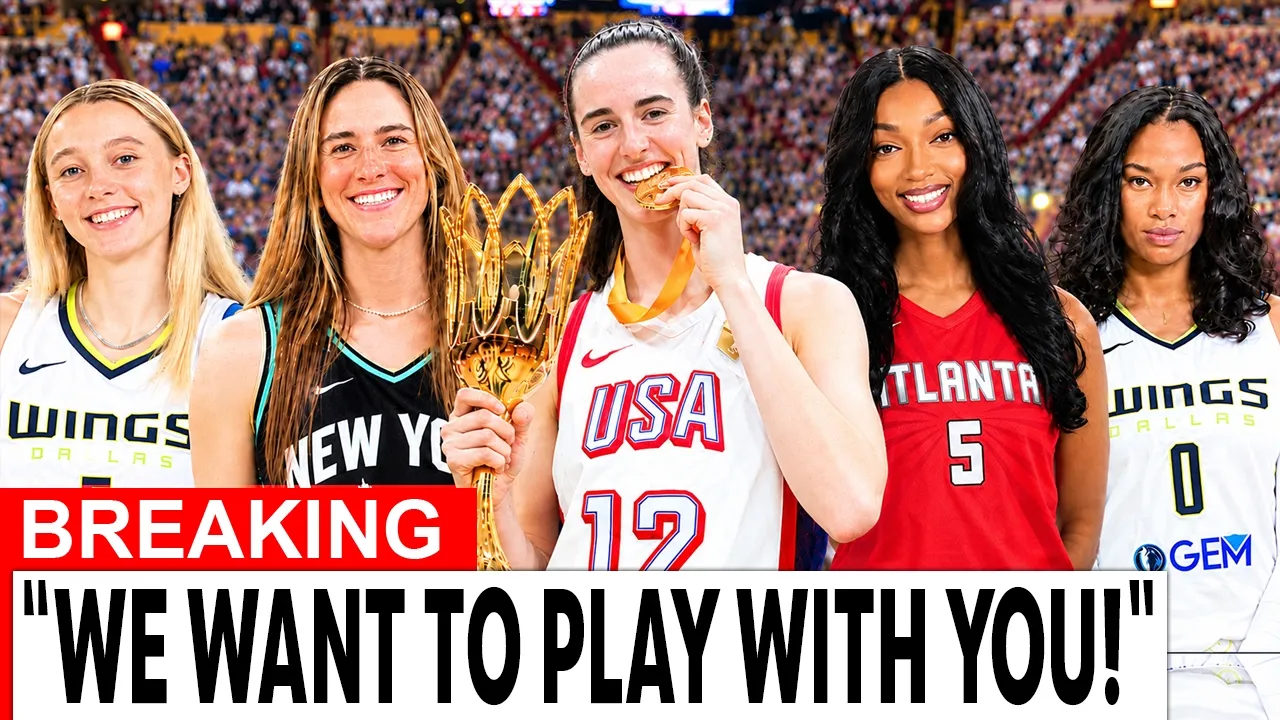
the things. So, we'll start with what Sabrina Inescu had to say, who absolutely had fits with Caitlyn Clark. I mean, she just had a fit dealing with her.
Welcome back to the Clark update. After Team USA's huge FIBA win, 10 WNBA players have now spoken out about Caitlyn Clark, and their comments are getting everyone talking. From praise to surprising reactions, these players had plenty to say about Clark and her impact.
So, what did they really say, and which comments stood out the most? Let's dive into it. 10 legends from 10 different eras.
One rookie who caused them all to pause and pay attention. From Sue Bird, who holds the record for the most assists in a single bay. If you appreciate this content, consider giving this video a like and subscribing to the channel.
Believe it or not, more than 80% of viewers haven't subscribed yet. It's free and only takes a second, but it means the world to us. So, did you subscribe already?
Great. Thank you so much for your support. Now, back to the video.
We are back with basketball hall of famer Sue Bird. Sue is a five-time Olympic gold medalist, [music] fourtime WNBA champion, a 13 time. These are players that seldom agree on anything, especially when it comes to someone new, according to Cynthia Cooper, one of the league's first real superstars.
However, their decisions toward Caitlyn Clark align in a way that no one anticipated. Legends, not madeup drama or hype. On the record, acknowledging that a unique event occurred in front of them.
By the end, some of these responses may actually surprise you. So, let's talk about what each of them truly said. First place goes to Sabrina Ianescu.
Sabrina Ianescu was keeping a careful eye on things long before she won the WNBA twice. In mid-May 2024, she and Caitlyn Clark shared a court for the first time as professionals, but their relationship began much before. Yanescu took Clark and her father to Oregon years ago while she was still a high school recruit and considering her options.
Yay. Anescu's early perception of Clark's ascent was influenced by the bond that developed from that afternoon. I mean, she's just starting her career and and obviously um how she's been able to push the game forward is is amazing and and doing that in college and um breaking so many was not impressed by headlines or hoopla.
It was a range. She cited Clark's ability to shoot from wherever on the floor as the feature that genuinely alters a defense's perspective. Shooting like that does more than merely increase points.
It puts undue strain on a defensive plan, creating openings and assistance that weren't there before. UNESCO expressed excitement about Clark's potential at the professional level, noting it as akin to an expert shooter recognizing herself in someone else's game. Their competitiveness never turned into animosity.
In fact, [music] the opposite occurred. In recent seasons, both players have publicly celebrated each other's great nights, exchanging compliments rather than criticism. Evidence that two individuals pursuing identical records can nonetheless support one another.
Is it possible to be both a real admirer and a true competitor? INescu has always responded yes without hesitation. She stated that she wasn't concerned about what Clark will achieve in the league, just that good character and hard effort usually pay off in the long run.
That isn't meaningless encouragement coming from someone who has already reached the pinnacle of the sport. It's a scouting report written by someone who has experienced every phase that Clark is currently going through. Sue Bird is number two.
Sue Bird is one of the few individuals in basketball history who has earned the authority to assess a point guard. She held the record for career assists in the 1BA when she retired. winningest WNBA player ever, notching 333 regular [music] season victories.
She collected four WNBA championships with the Storm and was named an all-star a record 13 21 seasons and 3,234 dimes, a figure that no active player will be able to reach anytime near. Bird's focus on Clark's rookie season, therefore carried a different type of weight than the typical rookie accolades. She said that she had watched nearly all of Clark's early games because she genuinely wanted to see how the rookie would do on the jump rather than out of obligation.
Her expectations were altered by what she witnessed. The majority of firstear players just lacked the level of anticipation and shot preparation that Bird mentioned because leaving Clark free meant giving up 35 points by the end of the game. Opponents had to respect her range before she even touched the ball.
It often takes years for the floor to develop that kind of gravity. However, Bird was impressed by more than simply the shooting. She identified Clark's capacity to improve her teammates performances as the more uncommon talent that distinguishes a true floor general from a scorer.
How many rookies enter the league and rather than needing to be carried themselves instantly improve the players around them? Few people, including Clark, do according to Bird's response as proof that the influence was genuine and not the result of attention. She cited colleagues who were playing some of the best basketball of their careers alongside Clark.
Bird didn't hedge when she gazed ahead. She stated unequivocally that Clark still had a very high ceiling and that what fans had already seen was just the beginning of what a growing Clark might accomplish with the record books. Nafi Collier is number three.
Before Caitlyn Clark ever dawned a professional jersey, Niisa Collier began reading about her. Collier, [music] the current defensive player of the year for the Wombier, has dedicated her professional life to researching the factors that make an offensive player challenging to stop. She also saw something odd in Clark's college tape against Indiana well before the draft.
It was the range, not the number of shots. Collier clarified that a defense must completely change its structure due to Clark's ability to score from way beyond a conventional shooting distance. Caitlyn should be grateful she makes 60 million off the court because without the platform that the WNBA gives her, she would drawing defenders farther out from the basket than the majority of systems are designed to manage.
Collier didn't discuss Clark's rookie debut season in abstract terms. She discussed the true logistical cost to the league. Venues were relocated in cities where a game had never sold out.
Demand for tickets surged. Collier stated that it was nearly impossible to understand the amount of growth Clark brought to the sport in such a short period of time. She added that the attention and large crowds that Clark attracted convinced her that she should be acknowledged as one of the best players in the world, not just in women's basketball, but in the sport as a whole.
Why would someone who has already earned the league's top defensive award care so much about that distinction? Collier isn't speaking from a fan's perspective. Speaking is someone whose job it is to identify flaws.
She was unable to identify any that were worth discounting. She is more than just a past MVP contender providing distant support. Her admission that Clark's game caused her difficulties carries a weight that most compliments just don't carry because she is the player that opposition coaches base entire defensive game plans around.
She notably mentioned how Clark plays with such passion and how her teammates on the floor can clearly feel that intensity, the genuine contagious intensity that alters a locker room ceiling, not fake intensity. That was a serious compliment coming from the player whose job it is to shut down elite scorers. It was more akin to a warning.
Candace Parker is number four. [music] Few people have witnessed the development of women's basketball from as many perspectives as Candace Parker. As a broadcaster, an MVP, and a player with the words to describe precisely what she's witnessing, Parker is unique in her own right.
She is still the first player in WBA history to earn most valuable player as a rookie. So, she has firsthand experience with the pressure that comes with being in the spotlight. Parker took care to create a larger circle than most observers do when evaluating Clark's contributions to the sport.
She stated that she didn't consider it to be specifically growing women's basketball. She saw it as expanding basketball as a whole without any qualifiers. It wasn't a coincidental framing.
Parker called Clark a true showman who could turn an ordinary week night into an appointment, drawing a clear comparison between her and Steph Curry. She gestured to a particular object. One player's presence causes arenas to sell out.
Booing her was the main focus of student sections. Fans are traveling with the express purpose of witnessing her defeat. That's animosity, isn't it?
In a peculiar sense, evidence of just how important Clark is. Parker seems to agree. According to her, competition and athletics are meant to feel like that kind of intense environment, and Clark delivered it all and more.
Parker went on to say that even when Clark isn't touching the ball, defenses must now take her presence into consideration. [music] In any sport, this title is often reserved for the most serious offensive threats. Parker didn't think Clark was just enjoying a successful season.
According to Parker, she was reimagining what the shot itself could look like. Maya Moore is number five. There was no scouting report at the beginning of Maya Moore and Caitlyn Clark's story.
It began with an embrace and a shirt. Oh my god. Thanks for being here.
Hey, this is special. When she was younger, Clark looked up to Moore so much that in the absence of a phone or any other means of preparation, she would simply go across the court following a game, ask Moore to sign her shirt, receive the autograph, give her a hug, and take off. According to Clark, she still recounts that tale today, describing it as one of her most vivid recollections of her early passion for the game.
Years later, neither of them could have imagined that their roles would be reversed. Moore, one of the league's most decorated champions, took on the role of mentor after witnessing her own heroic moment come back to haunt her. Moore wasn't really impressed by Clark's shooting or her standout plays.
Moore herself had built a whole career on her ability to inspire the athletes around her. She compared the event to her own childhood recollection of running up to embrace a legend from her own generation, describing it as a sort of complete circle. Does a child find inspiration in that chain legend?
A child turns into a legend. When a new child comes to inspire, will it ever truly cease repeating itself? Moore disagrees, viewing herself as merely one link in the chain.
When Moore suddenly showed up at Clark's final regular season game at Iowa, their friendship reached its emotional pinnacle. A move that seemed more like a torch being passed in person than a marketing stunt. Moore described it as extremely cool to watch those tiny seeds, how individuals choose to treat one another, and how appreciation is carried forward rather than ignored, grow into something like this.
And she expressed her pride in a straightforward manner. Moore projected that Clark's impact will go well beyond the court and mold the entire upcoming generation of sportsmen. Cynthia Cooper is number six.
Cynthia Cooper doesn't give compliments lightly. She was one of the first true superstars in the NBA and a two-time MVP. Since her playing days, she has spent years holding up fresh talent to the high standard she set.
Cooper didn't back down when detractors started to doubt Clark's ability to make the transition from college success to professional competition. She stated unequivocally that Clark, a player who helped establish the 1b's own benchmark for greatness throughout her career, was a symbol of basketball's future. That authority is supported by her own resume, a reputation as one of the most formidable rivals the early league ever generated, as well as two consecutive title seasons, the kind of basis that allows her thoughts to be heard instead of just being added to a noisy discussion.
Cooper went on to remark that she wished she had seen some of what Clark went through firsthand in her own time, clearly portraying Clark as the league's future rather than just its current headline. Cooper's endorsement had more weight because of what she chose to emphasize rather than just the words themselves. Cooper focused on Clark's general flexibility and her ability to impact almost all aspect of a game rather than simply the scoring column rather than focusing solely on highlight numbers.
That's what differentiates a scorer from a complete player. And isn't that the more difficult to quantify? Cooper obviously felt the same way.
According to her, Clark's level of constant excellence during his first season put him in the elite echelons of any league, not just the 1B. Watching a rookie have that kind of impact resonated differently for a player who experienced the league's shaky early years when sellout crowds and national attention were far from certain than it could for a more recent retiree. Cooper wasn't merely praising a successful season.
[music] She was acknowledging a moment that she had hoped would come for a significant portion of her own career. Cheryl Miller is number seven. Cheryl Miller existed before there was a womb to set records in.
A name that is still revered by those who study the history of sports. A player whose supremacy in the 1980s contributed to the initial perception that a professional women's league was feasible. Miller focused on nuances that most casual spectators would completely overlook when she applied her analytical eye to Clark's game.
A shooting range like Clark's hadn't actually been seen at this level in a long time. She observed almost incredulously. She was actually taken aback by Clark's ball handling and vision, though.
Miller emphasized that unlike most shooting guards, Clark does not require a screen. Just her handles provide sufficient separation. Miller also highlighted Clark's bounce passing, which he said was practically extinct in the modern game, and that in comparison to the more obvious aspects of Clark's game, didn't receive nearly enough recognition.
How frequently does someone who spent decades researching the role professionally site a passing skill like this? Rarely, and Miller's praise landed differently than generic buzz because of its specificity. Additionally, Miller talked about something that went beyond the box score.
She characterized Clark as both a brand and a player, someone whose presence was actively increasing the league's awareness and drawing in new viewers who had never seen women's basketball before. In a private time away from the cameras, Miller told Clark straight out that she was proud of her and urged her to remain true to herself in spite of criticism from others. Miller's forecast for the future was clear-cut.
If Clark kept going in the same direction, she could completely change the definition of what it meant to be a women's basketball superstar. Rebecca Lobo is number eight. When discussing Caitlyn Clark, Rebecca Lobo offers another perspective.
the perspective of a person who in 1995 won a national championship with an unbeaten team at Yukon and has since developed a second career as one of the league's most reliable commentators. Lobo did not base his assessment of Clark on impressions or highlight reels. Numbers were the foundation of it and the figures she presented were nearly unbelievable for a firstear player.
She cited the fact that Clark averaged nearly 19 points per night, finished the season with the most assists per game in the league, and had one of the best rookie seasons the league has ever seen, according to Lobo. However, Lobo did not end his description of a successful year. She put it in historical perspective, pointing out that Clark's assist was one of the highest ever recorded in a 1B season, regardless of rookie or veteran.
Following in the footsteps of Ticha Panikro, who set the record decades earlier, Clark became just the second rookie in league history to lead the league outright in assists, she continued. How uncommon is it for a rookie to outperform a whole league of season pros in a category where experience is typically the most valuable factor. In response, Lobo said that it hardly ever occurs, which is why she saw the achievement as historically significant rather than just noteworthy for a rookie.
Lobo stated that if Clark kept improving at this rate, it was impossible to predict how high she would eventually rise in the league. Presenting the rookie season as a floor rather than a ceiling. That kind of open-ended prognosis held significant weight for an analyst who established her own name on accuracy rather than hype.
Brianna Stewart is number nine. Brianna Stewart, a three-time winner and two-time most valuable player. We do it all.
That is what makes Curve special. From the Bronx, Staten Island, Manhattan, Queens, and Brooklyn. New York is home.
She's her. She's the first had a professional court with Caitlyn Clark. Most anticipated that the game would turn out to be a well-known veteran lesson.
A seasoned winner demonstrating to a novice the gap that still existed between college supremacy and the professional game. Even Stuart was taken aback by what actually transpired. According to her, Clark is still holding her own and demonstrating her abilities to the league.
Words from a current champion that seem more like sincere appreciation earned in real time than like politeness. Stuart doesn't typically inflate a rookie's resume, so that distinction is important. Her willingness to speak about Clark in that manner has more weight than compliments from a commentator or a fan since she spent her career setting the bar for other players.
It wasn't just raw talent, according to Stuart, that most impressed her. Many rookies have talent when they first start, but many of them are unable to convert it once the professional game speed and physicality overwhelm them. Her obvious dedication to her craft, the kind of preparation that manifests itself once the ball is actually in play, was what set Clark apart.
Stuart notably cited Clark's ability to generate her own shot while maintaining composure under duress, saying it had a genuine palpable impact on how she personally defended her. A noteworthy revelation from a player whose reputation as a defender was based on making it harder for top scorers to create shots. Beyond the technical compliments, Stuart talked about something more difficult to measure.
Clark's capacity to electrify a whole arena, characterizing that kind of crowd energizing presence as truly uncommon in the NBA. Can a rookie alter the mood of a road arena before the other team ever gets a chance to make a play in almost every building Clark visited during that season? Stuart's response consistently implied yes, regardless of whether the home fans came to support or oppose her.
In any case, Stuart claimed she had never seen a firstear player react to the building before the opening tip. Stuart also discussed the stress that Clark experienced throughout her first year. The persistent attention, expectations, and scrutiny that follow a player who treats every game as an event, pointing out that instead of waning under the pressure of it all, Clark continued to show up and got better with every game.
Stuart said that this improvement extended beyond the box score. She talked about how as the season progressed, Clark's decision-making improved, a development that's more difficult to notice in a rookie still getting used to a faster, more physical league. As someone who had been in the league for a long time and had witnessed many promising rookies stall rather than improve, Stuart concluded her assessment with a straightforward statement.
Clark's future looked extremely bright. She found that kind of consistent growth to be genuinely fascinating to watch. Diana Teresy is number 10.
Diana Teresy is the one player in whim history whose skepticism truly has significance. The league's all-time top scorer, a player who has earned the right to cast doubt on anyone until they demonstrate their abilities on the court. Many saw Terrace's remarks early in Clark's rookie transition as an outright challenge.
A rookie is cautioned by an experienced player that the regulations of professional basketball differ from those of collegiate basketball. Throughout the majority of Clark's first season, that scene was repeatedly replayed as either a prophecy or a taunt, depending on who was narrating the tale. But as the year progressed, something changed.
In real time, Terrasi's own viewpoint started to shift. The night Clark's fever confronted Terasi's Mercury directly was the most obvious. Taii and everyone else in the building appeared to realize they were witnessing something strange.
Later, Terasi thought that Clark's accomplishments in such a brief career were impressive, and she particularly pointed out something that went beyond the stat sheet. Clark's enthusiasm for the game was evident, and her hard work was evident on the floor. Is it possible for a player to gain a veteran's respect over the course of a season by just continuing to perform well under extreme pressure?
Teresy appeared to have the exact thought. She called Clark's future bright, pointing out that despite the enormous attention around her during the season, she continued to improve game after game. She also added that having spent so many years in the league herself, witnessing that type of improvement up close remains genuinely enjoyable.
Given how infrequently she received such public recognition from an opponent, after 20 years of playing at the top level, Terrasi's change was more significant than that of nearly anybody else in the league. Terasi's transition from caution to outright admiration wasn't contradictory. She described what happens when a warning proves to be less important than anticipated.
That's it. 10 careers, 10 legends, and one name that they all kept returning to. Early on, she was admired by several.
Some first had doubts about her, but later changed their minds. [music] The same story is told by both responses. This league does not allow anyone to overlook Caitlyn Clark.
Not even the players who created it from scratch. The convincing was done by the games. [music] The remainder was done by the records.
And the most obvious indication that something genuine is taking place is when those who have every reason to remain skeptical ceased to do so. Which voice on this list caught you offguard the most? The converts or the early believers?