Stop. That's an assault. That's assault.
Under arrest for us. Welcome to Raw Audit Reviews, where we shine a light on police misconduct and hold public officials accountable. Today's video is courtesy of Yardley Ski Audits.
You'll find their link down below. So, go show them some support and check out the full clip. In today's episode, an auditor walks into Colondale Police Station to file a simple complaint.
Before he can even sit down, two plain clothes detectives decide he is the real problem. What follows is honestly one of the worst displays I have covered on this channel. He is assaulted, arrested, released without a word, and his camera is seized.
And when he gets that camera back, he finds something in the deleted folder that takes this from bad policing into potential criminal territory. I have never seen anything like this. Let's get straight into it.
Are you recording police cars? I just saw you recording a car leaving the station. Are you recording me right now?
Hello. What are you recording? Sorry.
What's your name? So, what's your name? Just one.
What are you doing here? Just one of them days. What kind of days?
Just one of Okay. them days. What are you doing here, sir?
What are you doing here? Please, sir, what are you doing here? Why are you recording police cars leaving the station?
Are you planning something? Two people in plain clothes begin demanding answers. Who is he?
Why is he recording? Is he planning something? Under the ruling in Rice versus Connelly from 1966, no member of the public is required to answer police questions, and refusing to answer is not grounds for suspicion.
The auditor gives them nothing, which is his absolute legal right, watch what happens next. Because when silence is lawful and the officer cannot accept it, the only tool left is intimidation. And that is exactly the tool they reach for.
I'm going to go leave my bag. Sir, what's your name? Just What's your last name?
Demas. And what are you doing here? Just want to them das.
Can I get anyone to speak to? Do you need to speak with anyone in particular? Are you ask for someone at the police station?
Listen. I'm Who are you? Police officers.
Who are you? Police officers. And who are you?
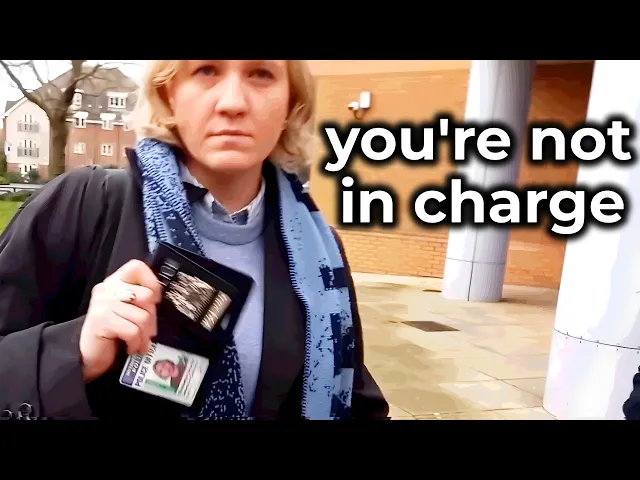
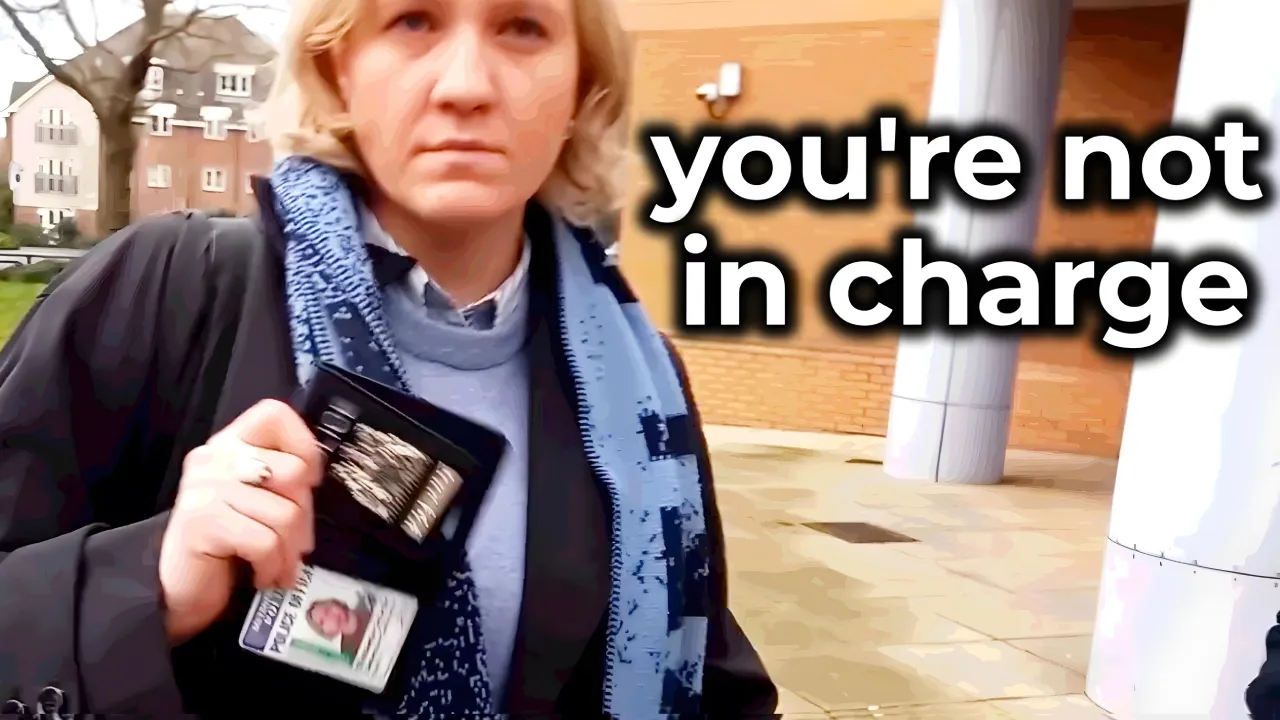
What is that? What's that? It's a badge.
Where's yours? I know it's a badge. What does it say?
Tell me what it says. Tell me. Who are you?
Who are you? Don't come up to me. [clears throat] Don't come up to me because I will defend myself.
Move away from me. Move away from me. Because you're too close.
You're in my space now. Move away. I will tell you one more time.
Move away from me. Sounds like you're being threatened. Move away.
You You section five. That's what you're doing. You are threatening, alarming, and distressing me.
So go away. What are you doing? Do you understand?
Do you understand? stand. Move away.
I don't move away. Yes, you do. You're in my space.
Move away. The officer closes the distance and gets inches from the auditor's face. He's told repeatedly to move away.
He refuses. The auditor even points out that his behavior could amount to an offense under section 5 of the Public Order Act, but the officer keeps going. This is where ego completely replaces procedure.
He's not responding to any genuine threat. He's reacting to the fact that a member of the public refuses to submit to him. And that's not policing.
That's control. Why? Move away.
Move away from me. Sir, move away from me. What are you doing?
Move away from me. Sir, I'm asking you. Move away from me.
Listen, and I'm telling you to move away from me. Police station. Move away from me.
So, what are you doing? Move away. I'm not going to move.
I'm in front of the police station. I'm in public space. Yeah, you're in my space.
No, I'm walked. You walked right up to me. You've walked right asking you.
Yeah. How would you like if I walked right up into your face? You can walk and walk up.
Yeah. There you go. And what?
There you go. What's your name, sir? Go away.
What's your name? Go away. What are you doing here?
Go away. Look at you recording these vehicles. Look at you, sir.
Don't Don't step close to me. Don't step close. Don't step close.
Don't step close to me. Stop pushing me. Listen.
Don't step close to me. I'm not stepping. I'm asking you a question on camera.
I'm asking camera. Stop lying. I'm asking you a question.
Don't step close to me. Who are you? My name is Stephan.
I'm a police officer. Get your warrant card out and show me. I have done that already.
Show me again. I didn't see it. He was too close to me.
Well, I've showed you. No, you didn't move. You didn't.
Yes, I did. I don't care. I'm not going to record that.
Oh, well, go away then. No, you go away. I'm not going anywhere.
Why are you here? Don't ask me questions. Don't ask me questions.
Don't ask me questions. I said go away. You're harassing me now.
I'm not harassing you. Section 5, you're harassing me. You're causing me alarm and distress now.
Go away. I'm sorry to hear that. I'm asking you to You're sorry to hear that.
So you like you like committing offenses, do you? I'm not committing. Yes, you are.
You step right in front of me. You're causing me a section five. What's a section five?
The public order act. What do you mean? Section five of the public order act.
You are causing me alarm, harassment, and distress. Now go away. I don't need to go away.
I'm asking you. I'm asking. Are you detaining me?
Are you detaining me? Not yet. Not yet.
Not at all. Get out of here. You can't.
Get out of here. You touch me and that's an assault. Of course, I can do what I want.
Sir, listen to that answer. Are you detaining me? Not yet.
Not. No. Not yet.
An officer openly telling a member of the public that detention is coming anyway. The auditor then states his position perfectly. He can do what he wants in a public space and touching him would be an assault.
Seconds later, the female officer smacks the camera and twists his arm behind his back. Under section 3 of the Criminal Law Act 1967, force must be necessary, reasonable, and proportionate to prevent crime or make a lawful arrest. No crime had been established.
The auditor stated the law correctly, and the police response was physical force. That is not a mistake. That is the answer.
Don't please go away from me. Stop. I'm asking you to stop.
I don't care if you're asking me lightly and I won't stop recording. No, tell me. Then tell me why you recording.
No, I'm not going to tell you nothing. Why are you recording? That's a problem.
Stop recording. Hey, that's an assault. That's assault.
Under arrest for your hands. Hold on a second. Hold on a second.
I know what she's just assaulted me. assaulted me. What's happened?
It's okay. It's okay. It's okay.
I I don't know what happened just then, but everybody's disappeared. No. Do you know something?
I'm not happy to go. I No, no, no. I I want I want to uh make a claim uh a complaint against these two.
Is that still recording now? Now, I'll start with No, that's cool. I'll I'll It doesn't matter if he's not in uniform.
He's in the public space. But what I'm saying is I'll blur you. You You won't be in my film.
Okay. Call 101. No, no, no.
I'm going to report it in there. I'm reporting in there. I need to know who they are.
No. Firstly, firstly, I need to know who those two are, right? Because that woman's assaulted me and that guy, right, has caused me to be alarmed, harassment, harassed, and distress.
And that's public order 4 a five, whatever it is, he needs to be charged with that. So, this is how it is. This is how it steps.
Okay. You better step out the way if you don't want to be cuz I'm going to come and film this this sergeant. I'll I'll blur it.
Sergeant, your two officers in there assaulted me. One moment. I'll come and listen to this young lady.
You're still filming, I mean, you still got your body worn on. Yeah. Okay.
Yeah. I still need to turn it on just to keep it on the rolling because I I'll I'll ask for it. Yeah.
Hold on. I'm coming. I'm stepping over.
It's all right. It doesn't matter. No, no.
I've got I got um CCTV to back me and I've got this to back me as well. It's fine. I'm cool.
I'm really cool about this. But don't get in the camera and then I'll I'll I'll blur you out. This is on camera.
Who you saying? We just got flagged down by them as we drive in. Back inside.
Thank you. Continue as you were. Hello, sir.
Hello. Right. Um, I don't know what's happened.
Okay. So, my name is Sergeant Robertson. I'm currently the section sergeant responsible for the emergency response team at this current time.
Okay. I know as a way you wish to make a complaint, you've been asked to wait inside the front office until one of the public access officers can speak to you and arrange for whatever you needed to be done dealt with and if you needed to speak to Sergeant for that to be done. Okay.
I understand something since has happened. I don't really know what. I'm trying to ascertain what has happened.
Okay. Okay. But I can see the officers that were initially involved from C are no longer here.
Okay. So I need to find out who they are and what their account is. By the time a sergeant arrives, both CD officers have left the scene of their own use of force.
The College of Policing Standards of Professional Behavior require officers to report, challenge, and account for their actions. Instead, an assault and an arrest evaporated the moment a supervisor appeared. Then it gets worse.
The auditor asks for a reference and is told none will be created. The matter can be managed internally. An assault allegation against two detectives with no incident number handled quietly inside the same building.
Consider what that system produces when there is no camera. If I can ask you to wait in the front office at this moment in time, I will try to find someone to come and promptly deal with your complaint as I believe it is. No, no, no.
That's a separate complaint. Okay. Okay.
I want them to No, I need them to to be charged. So, if you wish for them to be and further complaint to be made that can be done and dealt with, but I need the time to identify who they were and what's happened. Okay.
So, let me literally just come down to find out. So, let me just say this, Sergeant. I've just been stood there.
Yeah. With my hands behind my back. Okay.
Yeah. Technically under arrest. Okay.
Yeah. As in, have you been told you were under arrest? I'm sure that's what the woman said.
Yeah. Which which woman? Sorry.
The one that assaulted me. C. I don't know who she is.
She was in and she was playing clothes, right? I'm sure that's what she said. Otherwise, I wouldn't have been in held by two police officers because if I wasn't under arrest or detained either one of them, then they would have had no right to One second.
One second. Yeah. I would have had no right for them to be holding on to me first and foremost because that would have been an assault because I wouldn't have been detained and I wouldn't have been under arrest.
So therefore, somebody's assaulted me if that's not the case. Right. Firstly.
Secondly, I want to know why everybody's disappeared and nobody's telling me with a bit of paper who these people were. Cuz the guys that was holding me didn't identify themselves. The two that went off, I think the woman identified herself initially in the beginning.
Yeah. I can't remember what her name is. Probably on thing, but the guy didn't.
He said he's not going to identify something like And um so I don't know who they are. So I need some paperwork. So this bit of paper No, no, no.
Don't worry about this bit of paper. This has got nothing to do with with this particular thing. This is my initial complaint.
Yeah. So, I had business to be near first and foremost. Let me just say that they came out and they was asking me what am I doing filming?
I'm in a public place. I can film. I don't need Right.
And I don't need to answer them. I don't need to account for myself being here to them who I don't know who they are in plain closed people. They could be random people.
Right. They could be random people. Back inside the the station.
Yeah. Do you know that woman that took my camera? Right.
Okay. You didn't see, but I'm just saying it. I'm saying it generally.
I'm telling I'm talking to this guy here. I'm saying it generally. But as I am aware, there's a C woman, right?
She took my camera the the camera off of me. She the camera off of you, right? And she deleted the the video clip, right, of me talking to her.
I see. Right. Yeah.
She deleted it and you've got no way of getting that back. Oh, the thing is Yeah. It's gone into my delete box.
There you go. So, it's not gone. Yeah.
But what I'm trying to say to you, and I want this to be recorded, right, is that's what she's done. Now, how criminal, right, can somebody get? She took my phone.
She said she's seizing it for evidence and she deletes the clip that proves everything that I'm saying. Now, the part that separates this from every bad stop you have seen. The auditor checks his gallery.
The clip of the entire confrontation is gone. Then he checks the deleted folder and there it is. The officer who sees that phone claiming it was evidence is the same officer the footage incriminates.
Destroying evidence of a suspected offense is perverting the course of justice, a common law offense carrying a maximum sentence of life imprisonment. It is also misconduct in public office and a direct breach of the duty to retain relevant material under the Criminal Procedure and Investigations Act 1996. Right.
Is has an officer dealt with you? I saw my skipper out there talking to you. They haven't dealt with me yet, but I wanted to make sure that that was said.
Okay. because I am fuming. All right, mate.
Oh, wow. Stop calling people mate. Sorry, mate.
Yeah, don't call people mate. Call them sir or madam or Yeah, I can call you sir if you want. What do you do you want to give me your name?
Do you want to be addressed or something? No, no, no, no. I I'll wait for the the whoever needs to come out.
But mate, doesn't it sounds so crass actually, you know. But I just wanted to say that because this is this that's actually that's corruption. what she's just done is is is corrupt.
Like I say, I haven't witnessed it. I haven't seen anything. So, I can't comment on that, can I?
I just want I just want it done because somehow my camera will be able to tell me Yeah. that at some point that particular file was deleted. Got you.
Yeah. Even though it's not disappeared deleted. Yeah.
It should show that that action was done. Got you. Okay.
terrorist. This started as a man filing a complaint and ended with an assault and abandoned arrest. Two detectives leaving the scene and footage recovered from a deleted folder that should never have been touched.
Every safeguard failed except the camera. And if that clip had stayed deleted, this would be his word against two warrant cards. Check out Yardly Ski auditing in the description and show him your support.
Grab the know your rights guide linked below. And if you found value in this breakdown, consider subscribing. Stay informed and always film.